
T
The first bottle is a Marlborough sauvignon blanc that costs more than Jason's old car payment, and Aria drains her share before the seatbelt sign dings off. The second bottle she splits with Sera, who keeps giving her that sideways dragon look over the rim of her glass — the one that says *I know exactly what you're doing* — and the third she drinks alone while Marcus and Mike nurse two fingers of whiskey apiece and exchange the slow, wary glances of men who have seen her do impossible things and are waiting for the other shoe. Gareth, across the aisle, watches her empty glass number three with the expression of a man watching a fuse burn toward a powder keg. Somewhere over Iceland he opens his mouth. Aria lifts one finger to her lips — slow, deliberate, the violet of her eyes catching the cabin light — and shushes him. He wasn't talking. His jaw clicks shut anyway.
By the time the map on the seatback screen reads four hours to Heathrow, Dani is asleep against Sera's shoulder with her mouth open and Sera is three sheets and gazing at Aria like she's watching the northern lights come up over the wing. Aria sets her glass down, folds her hands in her lap, and goes still. Not the stillness of a woman about to pass out — the other kind, the kind that settles over her like water finding its level. Her shoulders drop. Her breath slows to something almost too even to be sleep. Gareth stares. Mike stares. Marcus mouths *what the fuck* at nobody. She stays like that through Greenland, through the Atlantic, through the first gray line of the Irish coast, and when her eyes open somewhere over Wales they are clear as river stones and she stretches like a cat in a sunbeam and grins at Gareth with every one of her teeth.
"Best nap of my life," she says, and her voice is bright and rested and absolutely sober, and Gareth's expression — the tight-lipped, thousand-yard stare of a man who has spent six hundred years cataloguing things he cannot explain — is the real wine. He turns to the window. Aria reaches over and pats his knee twice, companionably, the way you'd comfort a nervous dog, and leaves her hand there just long enough to watch him decide not to flinch.
Gareth's jaw works for a moment, and Aria watches him decide — she can see it happen, the small war behind his eyes between the man who has catalogued miracles for six hundred years and the man who is currently trapped in a first-class seat with one of them patting his knee. "You were unconscious for four hours," he says finally, flat. "You missed the meal service. You missed the customs forms. You missed the part where the captain came on to apologize for turbulence over the Atlantic."
"I was meditating," Aria says, and she says it the way someone announces they've discovered a new restaurant. "Elven meditation. It's — okay, so you know how normal sleep is like, you close your eyes and then it's morning and you don't remember any of it? This is the opposite. It's four hours of *feeling* every single thing your body is doing, one at a time, on purpose. I could feel my heartbeat in my fingertips. I could feel the plane's engine through the floor. I could feel — " she waves a hand at the cabin, at the sleeping Dani, at Marcus's whiskey, at all of it — "everything. It's awesome."
She giggles. It comes out high and bright and completely unguarded, the sound of a woman who has just had the best nap of her life at thirty-eight thousand feet and does not care who hears it. Mike, two rows back, lifts his head off the seat rest and stares at her like she's grown a second face. Marcus, mid-sip, lowers his whiskey without drinking. Gareth looks at her — really looks, the way he looked at the coin in her driveway — and Aria watches him file the giggle away somewhere in that six-hundred-year cabinet, another entry in a catalogue that was never supposed to have entries like her.
Heathrow is a blur of duty-free perfume and fluorescent light until Gareth produces a folder of Order stationery and a man in a slate suit appears at the end of the jet bridge like he's been waiting there since the Tudors. Passports waved through, no queue, no questions, no customs officer squinting at Aria's ears — just a nod, a stamp, a door held open, and then the six of them are walking out into a gray English morning that smells like wet stone and diesel. Marcus keeps looking over his shoulder like he expects someone to yell *stop*, and Mike has a hand resting on the small of their mother's gift — a tin of cookies she insisted he bring for "whoever's feeding you over there" — and Dani is bright-eyed and jet-lagged in the good way, the way that makes her notice everything twice.
The bus is waiting at the far end of a service lot, long and black and absurdly clean, idling with a low diesel hum that Aria feels in her back teeth. Gareth boards first and counts heads like a man who has been burned by arithmetic before. The driver is a broad, gray-whiskered man who doesn't blink at the elf, the dragon, the deva, the archmage, or the two ordinary-looking men with the whiskey aftertaste — he just folds the door shut behind them and pulls out of the lot without a word. Inside it's leather and lamplight, a table bolted to the floor, a cooler of water, and a window strip wide enough to watch the motorway unspool south. Aria takes the seat facing forward, kicks off her shoes, and presses one bare foot against the cold metal rail like she's testing the bus for a pulse.
"So this is the part where the Order shows us what they are," she says, mostly to herself, watching Gareth settle into the seat across the aisle and open the folder on his knee. He doesn't answer. The motorway signs start counting down the miles to Cornwall, and somewhere past Reading the city gives way to green hills and hedgerows that look older than the country that owns them, and Aria watches the whole island roll past the glass and feels the strange, quiet tug of a place that has been waiting for her longer than she's been alive.
Gareth waits until the bus has swallowed two miles of hedgerow before he closes the folder and turns in his seat, and when he speaks it's the voice of a man who has rehearsed this in a mirror. "Three things," he says. "One: the chamber is not a theatre, and the people who maintain it have served it longer than your country has existed. Two: you will be addressed as Mistress Mithlass, and you will answer as Mistress Mithlass, not as a girl who once rolled dice in an Indiana basement." He pauses, and his eyes flick to the shoes she kicked off, the bare foot on the rail. "Three — and I mean this with the respect due a woman who has buried three of the Cabal in her own lawn — dignity. Decorum. You are the first new thing to walk into that hall in six hundred years, and half the room will want to study you and the other half will want to bury you. Do not give the second half a reason."
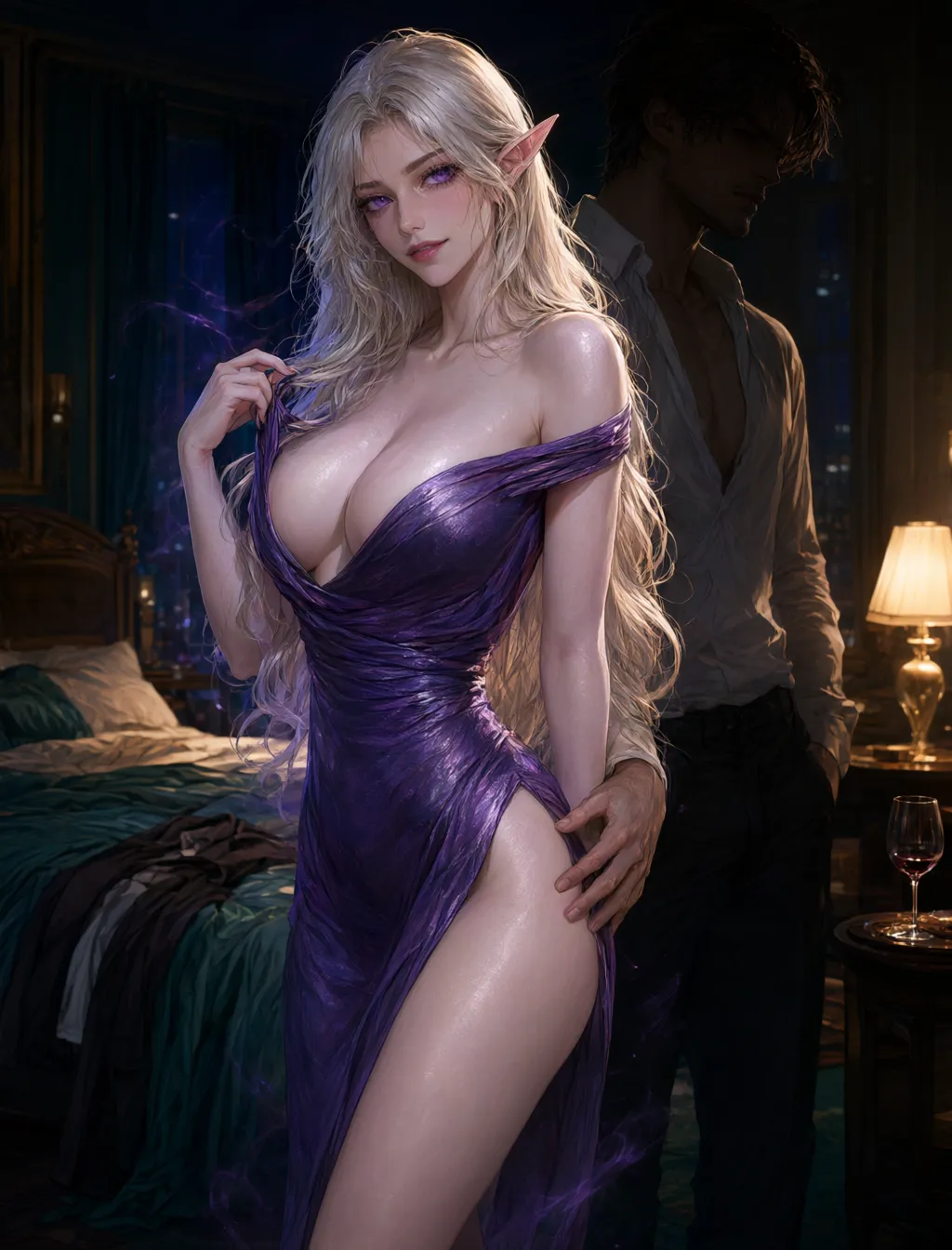
Aria listens with her chin propped on her knuckles, and when he finishes she smiles — slow, wide, the smile of a woman who has just been handed a script she has no intention of reading. "Dignity," she repeats. "Decorum. Got it." She stands, and the air around her goes soft and violet at the edges, and the rumpled travel clothes come apart into light. The jeans and the hoodie and the borrowed jacket dissolve in a breath of warmth that smells faintly of pine and something sweeter underneath, and what settles onto her instead is the uniform the world already gave her a name for: the deep plum gown with the high slit and the silver-threaded bodice that rides low across the swell of her breasts, the sleeves that fall open to the elbow, the hem that pools just enough to hide her feet and reveal the pale line of one thigh when she shifts her weight. Her hair lifts once in the static of the spell and falls back down her spine like poured mercury. She tucks one strand behind a pointed ear and looks at Gareth, and the gown catches the gray English light through the window and holds it.
Gareth's mouth opens, closes, opens again — the look of a man who has spent six centuries being the most unsettling person in every room and has just been upstaged by a dress. "That is not what I meant by decorum," he manages.
"Sure it is." Aria crosses her ankles and settles back into the leather with the satisfaction of a cat that has knocked the good vase off the shelf. "You said the room would want to study me or bury me. Now they'll spend the first ten minutes deciding which, and by the time they've decided, I'll already be inside the door and impossible to ignore. That's what decorum is for." She tips her head at the window, where Cornwall is unspooling in hedgerows and wet slate, and the gown's silver threads catch a pale smear of sun that has no business being out here. "Also it's my uniform. The world named it. I'm just wearing the name."
Across the aisle, Dani has woken enough to look, and she looks the way she always looks at Aria — like the answer to a question she stopped asking years ago. Sera has gone very still in the particular way a dragon goes still, which is not stillness at all but the moment before the wings fold. Mike says nothing. Marcus, two seats back, mouths the word unfair at the ceiling. Gareth pinches the bridge of his nose with the air of a man doing arithmetic he already knows the answer to, and reaches for the folder on his knee — and Aria notices, for the first time, that his hands are steady, which after the last four hours feels like a small and private mercy.
"Then tell me what you'd have me wear," Aria says. Her chin comes off her knuckles and the smile goes level. "Because I've got a closet and a spell and about an hour of motorway left, and I'd rather hear it from you than guess at it and find out I guessed wrong in a room full of people who've been deciding things about monsters since before the Normans." She leans forward. The leather creaks under her. "What do I put on that changes a mind in that hall? And don't say 'something modest,' because modest is a costume too, and I've already worn one of those for twenty-four years."
Gareth works his jaw. He looks at the gown — the low silver-threaded bodice, the slit, the bare foot on the rail — and then past it, at her face, and something in the arithmetic behind his eyes gives way. "You're right," he says, and it costs him, the way a man admits a thing he'd rather not. "Furs and a high collar would only make you look like a thing we'd caught. The hall has seen every costume there is. It hasn't seen a woman who walks in wearing her own name and dares it to argue." He flips the folder shut. "Keep the dress."
Aria settles back into the leather and drops her feet off the rail, and the gown pools around her ankles like it has been waiting there all along. Sera's stillness breaks into something that is not a smile and is not quite anything else. Marcus, two seats back, says nothing at all, which from him is a speech. Through the window the hedgerows keep unspooling south, and the signs keep counting down the miles to Tintagel, and nobody in the bus says the obvious thing — that the first person to agree with her today was the man sent to keep her in line.
Gareth has been looking at her feet for two miles. He thinks he's being subtle about it — folder open on his knee, eyes on the page, chin down — but every time the bus takes a curve his gaze slides left along the floor and snags on the bare foot she's got propped against the rail, and every time, he yanks it back to the folder like a man retrieving a dog from the neighbor's yard. Aria lets him do it three times. On the fourth she raises one eyebrow, and the air at her ankles goes warm and gold. The sandals weave themselves out of nothing — flat soles the color of poured honey, warm under her arches like sunbaked stone, and thin gold bands that climb her calves in a slow spiral and knot themselves just below the knee. They cover almost nothing. Every arch, every toe, every pale line of tendon stays visible, and somehow her feet feel more armored than they did in boots.
"You know, Gareth," she says, flexing her toes against the warm gold, "if you like my feet so much I can probably get you a picture." Dani is mid-swallow of water and it comes out her nose — a hard, undignified snort that sprays the seatback in front of her, and she coughs and wheezes and says oh my god into her own fist while Sera thumps her between the shoulder blades and Mike, two rows back, makes a sound that might be a laugh being strangled at birth. Gareth closes the folder with the precise, terrible calm of a man closing a door on a fire. "It is not the feet," he says.
"Uh-huh." Aria crosses her ankles so the gold catches the window light. "It's the fact that they're bare in England in April. I know what you're looking at. You're looking at the evidence." She tips her head, and the smile goes crooked. "Take the picture. It'll save you the trouble of remembering."
Gareth exhales through his nose — a sound somewhere between a sigh and a surrender, the noise of a man filing his own dignity in the same drawer as everything else he's had to let go of since her driveway. "You'll be the death of me," he says, and folds the folder shut on his knee like a man closing a book he no longer needs to read. He doesn't look at her feet again. That, more than anything he's said all morning, is the tell. Aria lets him have it, and tips her head back against the leather, and the motorway unspools south under the wheels with a low, hypnotic hum she can feel in her spine if she bothers to listen for it.
Marcus lasts four miles before his chin drops to his chest and his whiskey glass lists in his hand until Mike, without opening his eyes, reaches over and takes it from him and sets it on the bolted table. Mike folds his arms and is gone a minute later, the two of them breathing slow and even in the seats behind her, two ordinary Hoosier men asleep on the leather of an Order bus while the hedgerows of Devon roll past the glass. Dani digs a folded *New York Times* out of her bag — she bought it at a Heathrow newsstand out of some homesick instinct, and now she works the crossword in pen with her tongue between her teeth, filling the little grid one stubborn letter at a time. Sera slides down the bench until her shoulder presses along Aria's, until the length of her thigh is warm against the length of Aria's thigh through the gown, and settles there with the particular weight of a dragon who has decided, for now, to be a woman leaning on her wife.
Aria doesn't move. She could sit like this past the end of the world — hedgerows, motorway, the soft scratch of Dani's pen, the weight of Sera's head finding the hollow under her jaw. But under the quiet, she can feel it: the slow, patient pressure of Sera not saying the thing she's waiting to say, the way a held breath feels different from a resting one. Somewhere past the sign for Bodmin, Sera tilts her face up, and her voice comes out low and dry and entirely her own. "So," she says, "when we get there — do I stay a woman, or do I crack the roof off the place?"
Aria doesn't answer with words. She turns her face into Sera's hair and breathes her in — the smoke-and-salt smell that clings to a dragon even in a woman's skin — and her lips find the shell of Sera's ear. "You'll crack the roof off the place," she whispers, barely loud enough to reach past the leather and the diesel hum, "my lovely wife. But only when it's the right time." Sera goes still against her, the way she does before she decides something. Then her hand slides up under the edge of the gown and rests flat on Aria's stomach, warm and heavy, and she doesn't say yes and she doesn't say no. She just breathes, and they let the motorway do the talking for a while.
Across the aisle, Gareth has stopped pretending to read. The folder lies closed on his knee and his eyes are on the two of them — on Sera's hand disappearing beneath the plum silk, on the way Aria's whole body has turned toward her like a sun-flower tracking a light that isn't quite in the room. Aria watches him over the top of Sera's head and sees it land: the small, ugly arithmetic of a man who has spent six hundred years cataloguing things and has just found a hole in his ledger. He has a photograph on his phone of a gold dragon over an Indiana field, grainy and shot from too far away, and he has been telling himself all morning that the photograph is the thing. That it is enough. That he has seen it. His jaw works once, and Aria reads the question he doesn't ask the way she reads everything now — *is the picture the animal, or is the animal the picture* — and she almost feels sorry for him.
"You haven't," she says, quiet, not quite a question. Gareth's eyes flick to her. "Seen her. Not really. You've got the photo I sent you the night we did it, and you've got whatever your people pulled off the internet, and you've been sitting here for six hours with a gold dragon three feet away and you haven't once asked her to show you." She tilts her head against Sera's crown, and the smile that comes is almost gentle, which for her is rarer than the other kind. "That's the difference between us, Gareth. You catalogue the miracle. I married one." Sera's fingers tighten on her stomach, just once, and Dani's pen stops scratching the crossword, and nobody in the bus says anything at all as the hedgerows of Devon keep rolling past the glass toward the sea.
Sera's laugh comes up through Aria's ribcage before it reaches the air — a low, molten thing that starts somewhere under the plum silk and ends in the hollow of Aria's throat. She lifts her face off Aria's shoulder, unhurried, and the smile she wears is the lazy one, the one that has never once been in a hurry about anything in its life.
"No," Sera says, and her fingers spread flat against Aria's stomach, warm through the gown. "That's not it. You didn't marry a miracle. You are the miracle — you're the one who walked out of a dice bag and into a body, and then you looked at the two of us and decided we were worth extending it to." Her voice stays easy, unhurried, absolutely certain. "You just didn't figure it out until you realized how good we were in bed."
Dani doesn't say a word. Her pen rests in the crossword gutter and she looks up over the rim of her glasses with her tongue still caught between her teeth, and the smile she wears is slower than Sera's and warmer, the kind of smile that has already decided something and is in no rush to announce it. Gareth has gone very still in his seat, folder shut, eyes on the window, mouth doing the small hard arithmetic of a man who came to catalogue a monster and is instead watching three women fall in love with each other for the ninth time this week.
Two hours of motorway and hedgerow, and then the sea — a gray sheet of it past the last hill, and Tintagel rising out of the cliff like something the island coughed up and never quite swallowed. The bus noses down a lane too narrow for it, hedges scraping both flanks, and stops at a gate of black iron set into a wall of wet stone that has no business being that old. Gareth is up before the wheels stop. He doesn't say a word, just folds the folder under his arm and looks at Aria the way a man looks at a lit match near curtains. She stands, and the plum gown moves with her, and the gold sandals are silent on the bus floor as she follows him down onto the gravel where the wind comes off the water cold enough to raise the fine hair on her arms. Dani is beside her before she's taken three steps, crossword folded into her bag; Sera hangs back one beat, tasting the air, and Mike and Marcus bring up the rear with the particular quiet of men who have decided to be useful and are waiting to be told how.
The building behind the gate is nothing. A long slate-roofed hall with moss on the north wall and a door of banded oak, the kind of thing the National Trust would put a plaque on and charge eight pounds to enter. Gareth produces the iron coin from his coat and sets it against the door, and the door — opens. Not swings; opens, the whole slab of it going soft as a curtain drawn aside, and behind it is not a hall but a stair, and the stair goes down farther than the hill has any right to allow. Aria feels it in her soles first, the way she feels the bus engine through the floor: a low hum coming up out of the stone, patient, older than the mortar, the sound of a thing that has been running a very long time and does not intend to stop. She looks at Gareth. He's watching her face, and there it is again, that small ugly arithmetic behind his eyes — the man who catalogued the coin, the dragon, the girl with the violet light, and is now about to find out whether the ledger balances. She doesn't give him the satisfaction of a question. She steps through the door, and the stair takes her down.
The stair is cut from the cliff itself, each tread worn into a shallow bowl at the center where six hundred years of feet have worried the stone, and Aria counts them without meaning to — forty, sixty, ninety — and the hum gets louder with every one, until it isn't a sound anymore but a pressure against her eardrums, the way deep water feels before it starts to squeeze. The air changes at the hundredth step. It goes dry and mineral and faintly sweet, like the inside of a struck bell, and the violet in her eyes catches something ahead that isn't torchlight. Gareth's shoulders are a dark shape two steps below her, and behind her the others are breathing in the dark, and nobody speaks, because the stair has a way of making speech feel like litter.
Then the stair ends, and the hall opens, and Aria stops walking because there is nowhere to walk that isn't already full of people.
They stand in a ring around a floor of polished black stone, forty of them, maybe fifty — old men and old women in dark wool and older jewelry, and not one of them blinks at the elf in the plum gown descending into their light. The light comes from the floor itself, a slow violet pulse rising up through the black stone in time with the hum, and at the center of the ring is a well of it: a circular basin cut into the rock, brimming with a radiance that moves like water and doesn't spill. Aria feels the pull in her chest before she understands it — the same tug she felt in her own hallway when the spell points climbed past sixty, the same hunger she has learned to read like a pulse. This is not a chamber. This is a battery. Whatever Merlin built down here, it has been drinking the equinox for fifteen hundred years, and it is still thirsty.
Gareth steps aside and says, in a voice pitched to carry, "Mistress Mithlass of the House of Silverleaf. Her party." And forty faces turn toward her at once, and not one of them looks at her ears.
Aria lets the silence hold one breath, long enough for forty faces to settle on her, and then she reaches for Thaumaturgy the way she'd reach for a light switch — a nudge, no more, and her voice rolls out across the black stone floor and up into the vaulted dark, every syllable arriving whole in every ear in the room. "I greet the Order of Arthur." She tips her chin at the ring of wool and old jewelry like a hostess greeting a dinner party she's slightly late to. "And with me come my party. Ms. Seraphina Laurent." Sera steps forward out of the stair-shadow and the plum silk of Aria's conjuring catches the violet pulse under the floor — a gold gown with a high throat and a slit that runs to the hip, no dragon anywhere in the cut of it, only a woman who has spent her whole life being the most interesting person in whatever room she's walked into and has never once needed to prove it. She gives the hall a slow, easy smile and folds her hands at her waist. Somewhere in the ring, an old man in a silver collar stops breathing for a beat.
"Ms. Danielle Hope." Dani steps up beside Sera in the cobalt pantsuit Aria wove for her on the bus — sharp lapels, a white shirt open at the throat, the whole thing cut to make her look like exactly what she is, a woman who takes up space and is not sorry. Not a feather of the deva shows. No glow, no wings, no seven feet of luminous anything; just brown eyes behind wire-rims and a mouth that has already decided the room is fine. "Mr. Michael Chance." Mike comes forward in the leather Aria made him, thick plates at the shoulders and the chest, scarred and oiled and heavy enough to creak when he moves, and at his belt hangs a one-handed battle axe Gareth had waiting on the bus — a short, brutal, workmanlike thing with a haft of dark wood and a head that looks like it was forged for a man who intends to use it. Mike rests one hand on the axe and doesn't do anything else. He doesn't have to. "And finally," Aria says, "Archmage Marcus."
Marcus steps forward out of the shadow of the stair, and the doublet Aria cut for him on the bus moves with him like it was poured rather than sewn — deep charcoal, seams picked out in brass thread, a wide belt of hammered brass cinched at the waist, the whole ensemble reading less like a costume and more like a man who has always dressed this way and the world is only now catching up. He's the last of them, so the hall has already spent its surprise on Sera's gold silk and Dani's sharp lapels and Mike's creaking leather, and what's left for Marcus is the quiet, curious pause of forty people who have just realized they don't have a name to file him under. A woman near the well tilts her head. A man in a silver collar — the same one who stopped breathing — leans toward his neighbor and says something Aria can't hear, and the murmur that runs around the ring is the particular sound of a room doing arithmetic and not liking the sum.
Aria feels it land the way she'd feel a draft under a door. She should have asked. Three weeks, four, five — game nights and a road trip and a bus ride down through Devon, and she never once thought to ask Marcus for a last name, because in the campaign he was just Marcus, and in the group chat he was just Marcus, and somewhere between the dice and the doublet it had become too late to ask without it being a thing. She keeps her chin level and her smile exactly where it is and does not look at him, because looking at him now would be the tell. He can handle it. He's an archmage. He cast Wall of Force on his first night in the body.
Marcus handles it. He takes one more step onto the black stone, sets his feet like a man who has decided the floor is his, and gives the ring of old wool and older jewelry a small, unhurried bow — not deep, not shallow, the exact angle of a man who has been introduced to rooms like this before and has simply never been in one that mattered. "Marcus Skowronski," he says, and his voice carries without any help from her magic, plain and flat-voweled and unmistakably Midwestern. "At your service."