

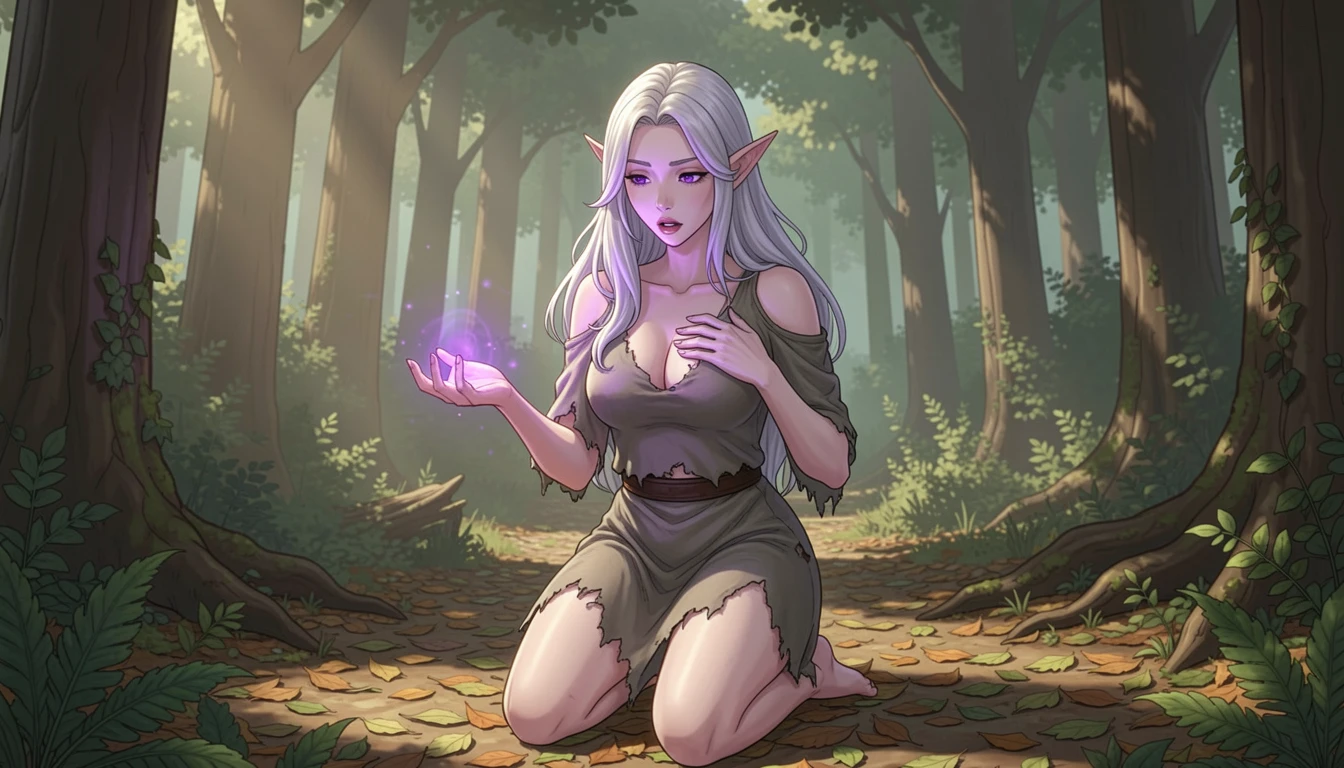
The cold comes first. Not the gentle, blanket-cocoon cold of a sleeping bag, but the raw, seeping cold of the ground itself, pressing up through the thin fabric of her tunic and into her spine. Aria Silverleaf—no, Jason, *Jason*, she thinks, the name arriving like a reflex from a life that suddenly feels very far away—opens her eyes to a canopy of leaves. Gray light filters through them. Dawn, or close to it. Somewhere above, a bird is making a sound she doesn't recognize.
Her hand moves before she tells it to. It rises, trembling, to the side of her head, and her fingers find the long, tapering point of an ear. Not the rounded shell of cartilage she has felt her whole life. This is sharp, delicate, and so sensitive that her own touch sends a shiver down her neck. She traces the curve of it, the way she might trace a scar, hoping the shape will resolve into something familiar. It doesn't.
She whispers the words without thinking. The syllables of the cantrip fall out of her mouth in a language she has never spoken aloud, only typed into a character sheet at two in the morning. *Prestidigitation.* A tiny, harmless trick. The kind of thing Aria used to light candles in taverns or clean mud off her boots.
Violet light blooms on her fingertips. It dances there, a thumb-sized flame of pure color, and it casts a faint glow across the backs of her hands. Her hands. The skin is ivory-pale, nearly luminous in the dim light, and the fingers are long and slender in a way Jason's never were. The light reflects in her eyes, and she can see it. She can see it because she is looking at her own hands, and her own hands are not her own.
"No way," she says.
The voice that comes out is higher, softer, and it carries a musical quality that makes the words feel borrowed. She claps a hand over her mouth, and the gesture is so familiar and so wrong. Jason used to do that. Jason, who was six feet tall and had a beard he only shaved when it started to itch. Jason, who played a sorceress in a tabletop game because it was fun to be someone else for a few hours a week.
She pushes herself up onto her elbows. The movement is awkward, unbalanced, because the weight on her chest is not what she expects. A torn tunic—the same smoky purple fabric she'd described in her character's backstory, the one she'd bought two weeks ago for a cosplay she never finished—hangs loose over a body that curves in ways Jason's never did. The swell of breasts, full and heavy, shifts with every breath. The tunic has a tear along the shoulder, and the cold air finds the bare skin there.
She sits up fully and looks down at herself. The tunic is ruined. Dirt smears the hem, and the neckline has stretched, revealing the pale upper curve of her chest. Her legs are bare beneath it, long and smooth, and when she flexes her toes, they move with a grace she has never felt. She runs a hand down her thigh, feeling the muscle beneath the skin. It's lean, strong, and utterly foreign.
"Okay," she says, and the voice still sounds like someone else. "Okay. Okay. Okay."
The campsite comes into focus around her. The firepit is a circle of blackened stones, and a single charred log lies in the center, cold and dead. The tent has collapsed, its canvas sagging against the poles. Dice are scattered in the dirt—her dice, the purple-and-silver set she'd bought for the campaign—and a few sheets of paper are pinned under a rock. Her character sheet. The one she'd been filling out during the session, the one with Aria's stats and spells and the little sketch Sera had drawn in the corner.
She reaches for it. The paper is damp with morning dew, but the ink hasn't run. She reads the familiar handwriting—her own handwriting, from a life that ended sometime between the last dice roll and this moment—and her eyes catch on a line near the bottom of the page. The homebrew mechanic. The one the DM had added as a joke, the one that had made everyone at the table groan and laugh.
*Succubic Restoration.*
Her face goes hot. She remembers the DM's grin, the way he'd leaned into the camera and said, "Trust me, it'll come up." She remembers Sera's laugh, a little too loud, and the way Mike had rolled his eyes and muttered something about "of course you'd homebrew that." She remembers thinking it was funny. A harmless bit of flavor for a character who was supposed to be fictional.
She drops the sheet like it's on fire.
"No," she says, louder this time. "No, no, no. That's not—that's not a *thing*. That's a joke. That's a—"
She stops. Because the magic is real. The cantrip is real. The ears are real. And if the ears are real, then the rest of the sheet is real too. All of it. Every stat, every spell, every mechanic.
She presses the heels of her hands against her eyes and takes a long, shaky breath. The air smells like damp earth and cold ash and something else, something green and alive. Pine needles. Wet leaves. The world is real, and she is in it, and she is not Jason anymore.
She is Aria.
For a long moment, she just sits there, letting it settle. The fear is there, a tight knot under her ribs, but so is something else. Something that feels suspiciously like wonder. She opens her eyes and looks at her hands again. The violet light has faded, but she can still feel the magic, a warm hum just beneath her skin, waiting.
She flexes her fingers. The cantrip comes easily, the words rising to her lips like she's spoken them a thousand times. *Thaumaturgy.* The ground trembles faintly, a tiny, harmless quake that makes the dice rattle against each other. She laughs—a short, startled sound—and then claps her hand over her mouth again.
"Stop that," she tells herself. "You're going to wake up the whole forest."
But there's no one to wake. The forest stretches in every direction, a wall of green and brown and gray. The campsite is small, a clearing carved out of the underbrush, and she has no memory of how she got here. The last thing she remembers is the video call. Mike's apartment, the glow of his monitor, the sound of dice hitting the table. She'd been Jason then, sitting on the floor with a bag of chips and a character sheet, and then—
Nothing. A gap in her memory, a blank space where the transition should be.
She stands up. The movement is strange, her center of gravity lower than she expects, her hips swaying with a rhythm she doesn't recognize. She steadies herself against a tree and looks around. The campsite is familiar in a way that makes her stomach drop. She's been here before. Not as Aria—as Jason. Years ago, before the divorce, before Mike moved to Blue Castle. Their dad used to take them camping here, a few miles north of town, in the state forest that bordered the old quarry.
If this is the same place, then Mike's apartment is only a couple of miles away. A forty-minute walk, maybe less if she cuts through the quarry road. She can be there before the sun is fully up.
She takes a step, and the tunic shifts against her thighs. The fabric is thin, and the morning air is cold enough to raise goosebumps on her bare legs. She looks down at herself again—at the curves, the pale skin, the pointed ears—and a fresh wave of panic rises in her throat.
Mike is going to lose his mind.
She can picture it. Mike, with his sharp brown eyes and his perpetual five o'clock shadow, opening the door to find a six-foot elven woman on his doorstep. Mike, who fixes things with his hands and his head, who has never believed in anything he couldn't debug. Mike, who is going to slam the door in her face and call the police.
"Okay," she says, and the voice still sounds borrowed. "Okay. Think. You're a sorceress. You have magic. You have—"
She stops. What does she have? She runs through the spell list in her head, the familiar litany of cantrips and spells she'd chosen during character creation. *Mending. Prestidigitation. Shape Water. Mold Earth. Message. Thaumaturgy. Eldritch Blast. Control Fire. Healing Hands. Shape Shift. Fireball. Lightning Bolt. Greater Restoration. True Polymorph. Meteor Storm. Resurrection.*
And then the others. The abilities that aren't spells. *Divine Soul Wings.* She can feel them, a faint pressure between her shoulder blades, like a muscle she's never used. And *Succubic Restoration.*
She groans and covers her face with her hands. Of all the homebrew mechanics the DM could have invented, of all the ridiculous, juvenile, *embarrassing* jokes, it had to be that one. She can still hear his voice, pitched low and dramatic: "Every time you swallow semen or get inseminated, you restore fifteen spell points and heal all wounds. Trust me, it'll come up."
She'd laughed. They'd all laughed. It was a joke, a bit of flavor for a character who was supposed to be a fantasy archetype, not a real person with real needs and real—
She stops. Her cheeks are burning. The knot under her ribs tightens.
"It's not going to come up," she says, firmly. "I'm not going to—I don't even—"
She doesn't finish the sentence. Because she doesn't know what she's going to do. She doesn't know anything anymore.
She gathers the scattered dice and the character sheet, folding the paper carefully and tucking it into the torn pocket of her tunic. The dice go into the other pocket, a small, familiar weight against her hip. She doesn't know why she keeps them. Maybe because they're the only thing that feels real. Maybe because they're a link to the life she used to have, the life where she was Jason Chance, twenty-four years old, unemployed, living in a one-bedroom apartment and playing tabletop games with his brother and his friends.
She starts walking. The forest is quiet, the only sound the crunch of leaves under her bare feet. She doesn't have shoes. She doesn't have anything except a torn tunic and a character sheet and a body that feels like it belongs to someone else.
The path to the quarry road is overgrown, but she remembers it. Jason remembered it. She follows the faint trail through the underbrush, ducking under low branches, stepping over fallen logs. The tunic catches on a bramble and tears further, and she stops to untangle it. The fabric is delicate, the kind of thing Aria would have worn in a tavern, not in a real forest. She makes a mental note to find something more practical. Then she laughs, a short, bitter sound. Practical. As if anything about this is practical.
She reaches the quarry road just as the sun breaks over the trees. The road is gravel, dusty, and it stretches north toward Blue Castle. She can see the town in the distance, a cluster of rooftops and church spires against the pale morning sky. Mike's apartment is on the south side, a converted warehouse with big windows and a view of the old mill. She's been there a hundred times. She knows the way.
She walks faster. The gravel is rough under her feet, and she has to step carefully to avoid the sharpest stones. A car passes her, an old pickup truck, and the driver slows down to stare. She keeps her eyes forward, her cheeks burning, and after a moment the truck speeds up again and disappears around a bend.
She wonders what he saw. A woman in a torn dress, barefoot, walking along a gravel road at dawn. A strange woman, but not an impossible one. Not an elf. Not a sorceress. Just a woman who looks like she's had a very long night.
She wonders if she can pass. If she can hide the ears under her hair, if she can keep her head down and her mouth shut and pretend to be normal. The ears are the problem. They're too long, too pointed, too obviously *not human*. She pulls a strand of silver-blond hair over one of them, but the hair is fine and slippery, and it slides back immediately.
She needs a hat. A scarf. Something.
She reaches the edge of town just as the first shops are opening. A bakery, a hardware store, a coffee shop with a chalkboard sign out front. The smell of fresh bread drifts through the air, and her stomach growls. She hasn't eaten since—she doesn't know when. Before the session, maybe. Before the transition.
She stops at the corner of Main Street and tries to think. She can't walk into Mike's apartment looking like this. She needs a plan. She needs to figure out what she's going to say, how she's going to explain something that can't be explained.
She ducks into an alley between the bakery and the hardware store and leans against the brick wall. Her heart is pounding, and her hands are shaking, and she feels like she's about to cry. She presses her palms against her eyes and takes a deep breath.
"Okay," she whispers. "Okay. You're Aria. You're a sorceress. You have magic. You can figure this out."
She lowers her hands and looks at them. The violet light is gone, but she can still feel the magic, a warm hum beneath her skin. She has power. Real power. The kind of power that could level a building or heal a wound or turn a person into a frog.
She doesn't want to level a building. She just wants to get home.
She takes another breath and steps out of the alley. The coffee shop is open, and through the window she can see a woman behind the counter, a man at a table with a laptop, and a bulletin board covered in flyers. She doesn't have any money. She doesn't have anything.
She starts walking toward Mike's apartment. The streets are quiet, the town still waking up. A few cars pass, but no one stops. She keeps her head down, her hair falling over her ears, and she tries to look like she belongs. It doesn't work. She can feel the eyes on her, the curious glances, the double-takes. A woman in a torn purple dress, barefoot, walking through Blue Castle at dawn. She's a spectacle, a story waiting to be told.
She reaches Mike's building just as the sun clears the rooftops. It's a converted warehouse, all brick and steel and big industrial windows. Mike's apartment is on the third floor, the one with the balcony and the string lights he never takes down. She can see his car in the parking lot, a silver sedan with a dent in the rear bumper. He's home.
She stands at the entrance, her hand on the door, and hesitates. What is she going to say? *Hey, Mike, it's me, your brother. I know I look like an elf sorceress, but trust me, it's a long story.* He's going to think she's crazy. He's going to call the police. He's going to slam the door in her face.
But she has nowhere else to go.
She pushes the door open and climbs the stairs. The stairwell is dim, the concrete walls stained with years of use. Her bare feet slap against the steps, and the sound echoes in the empty space. She reaches the third floor and walks down the hall to Mike's door. Apartment 3B. She's been here a hundred times, but it feels different now. Everything feels different.
She knocks.
For a long moment, nothing happens. Then she hears footsteps, the creak of the floorboards, the rattle of the chain lock. The door opens a crack, and Mike's face appears in the gap. His dark hair is disheveled, his brown eyes bleary with sleep, and he's wearing a faded t-shirt and sweatpants. He looks at her, and his expression shifts from annoyance to confusion to something she can't read.
"Can I help you?" he says.
She opens her mouth, and the words come out before she can stop them. "Mike, it's me. It's Jason."
His face goes blank. He stares at her for a long moment, his eyes traveling from her pointed ears to her violet eyes to the torn purple tunic and the bare feet. He doesn't say anything. He doesn't move. He just stands there, frozen, and she can see the gears turning in his head, the impossible math of what he's seeing.
"I know," she says. "I know it doesn't make sense. I know I look—different. But it's me. It's Jason. Something happened last night, after the session, and I woke up like this, and I don't know how or why, but it's me, Mike. It's really me."
He doesn't respond. He just keeps staring, and she can feel the silence stretching between them, heavy and unbearable. She wants to reach out, to touch his arm, to prove that she's real. But she doesn't know if that would help or make things worse.
Finally, he speaks. His voice is hoarse, barely above a whisper.
"Jason?"
She nods. "Yeah. It's me."
He looks at her again, and this time she sees something else in his eyes. Not confusion. Not disbelief. Something deeper, something that looks almost like fear. He's afraid of her. Afraid of what she's become.
"What happened to you?" he says.
"I don't know," she says. "I woke up in the woods. The campsite, the one Dad used to take us to. I had the character sheet, the dice, everything. And I was—I was Aria. I was her. I am her."
She holds up her hands, and a tiny spark of violet light flickers between her fingers. Mike flinches, and she lets the light die.
"I can do magic," she says. "Real magic. The spells from the game. All of them."
Mike is silent for a long moment. Then he steps back, pulling the door open wider.
"You better come in," he says. "Before someone sees you."
She steps inside, and he closes the door behind her. The apartment is the same as she remembers—messy, comfortable, smelling like coffee and old books. A laptop sits open on the kitchen counter, and a half-empty mug of coffee has gone cold beside it. The morning light streams through the big windows, catching the dust motes in the air.
Mike turns to face her, and his expression is hard to read. He's looking at her like she's a puzzle he can't solve, a bug he can't debug.
"Okay," he says. "Start from the beginning."
She takes a breath. And she tells him everything.
The session. The campaign. The character she'd created, the elf sorceress with the ridiculous backstory and the even more ridiculous homebrew mechanic. The last dice roll, the last joke, the last moment before everything went dark. She tells him about waking up in the woods, about the cantrip, about the ears and the body and the magic. She tells him about the walk to town, the stares, the fear.
When she's done, Mike is quiet for a long time. He walks to the kitchen counter and picks up his cold coffee, takes a sip, makes a face, and sets it down again.
"So," he says. "You're telling me that my brother is now an elf sorceress."
"Yeah," she says. "That's the short version."
"And you can do magic."
"Cantrips, mostly. I haven't tried the bigger spells yet."
"But you could. If you wanted to."
"I think so. Yeah."
Mike nods slowly. He runs a hand through his hair, a gesture she's seen him make a thousand times, and she feels a sudden, sharp pang of something like homesickness. She's standing in her brother's apartment, wearing a torn dress, with pointed ears and violet eyes, and she's never felt more like a stranger.
"What about the—" Mike gestures vaguely at her body. "The rest of it. The, uh, the homebrew thing."
Her face goes hot. "I don't want to talk about that."
"I'm just saying—"
"I know what you're saying. I don't want to talk about it."
Mike holds up his hands. "Fine. Fine. We don't have to talk about it." He pauses. "But you should probably know what you're dealing with. If the character sheet is real, then all of it is real. The stats, the spells, the—"
"I know," she says, cutting him off. "I know."
She sits down on the couch, and the movement is strange, her hips settling into the cushions in a way that feels both familiar and foreign. She tucks her legs under her and pulls the torn tunic around her shoulders. She's cold. She's tired. She's scared. But she's also, somewhere deep down, excited. She has magic. She has power. She has a whole new life ahead of her, and she has no idea what to do with it.
Mike sits down across from her, in the armchair by the window. He's still looking at her like she's a stranger, but there's something else in his eyes now. Something that looks almost like acceptance.
"We need a plan," he says. "You can't go out like this. Someone will notice."
"I know," she says. "I need clothes. A hat. Something to cover my ears."
"I have a hoodie," he says. "And some jeans. They'll be too big, but it's better than nothing."
He gets up and disappears into the bedroom, returning a moment later with a gray hoodie and a pair of dark jeans. She takes them and disappears into the bathroom to change. The bathroom is small, the mirror fogged from Mike's morning shower, and she catches a glimpse of herself as she pulls the tunic over her head. The reflection is startling—the pointed ears, the violet eyes, the silver-blond hair, the curves that belong to someone else. She looks like a character from a fantasy novel, not a person. Not her.
She pulls on the hoodie and the jeans. They're too big, as Mike promised, and she has to roll the waistband to keep them up. The hoodie swallows her, the sleeves hanging past her fingertips, but it's warm and soft and it smells like Mike. She pulls the hood up, covering her ears, and looks at herself in the mirror again.
Better. She looks like a woman in oversized clothes, not an elf sorceress. It's not perfect, but it's a start.
She walks back into the living room, and Mike looks up from his laptop. He's been typing something, his fingers moving fast across the keys, and he closes the screen when he sees her.
"How do you feel?" he asks.
"Like I'm wearing someone else's skin," she says. "But also like myself. Does that make sense?"
"Not really," he says. "But I'm trying."
She sits down on the couch again, and this time the movement feels a little more natural. She's still aware of her body, of the weight on her chest and the curve of her hips, but it's not as overwhelming. She's starting to get used to it. She's starting to feel like it might be hers.
"What do we do now?" she asks.
Mike leans back in his chair. "First, we figure out what you can do. The character sheet—do you still have it?"
She pulls the folded paper from her pocket and hands it to him. He reads it carefully, his eyes moving down the page, and she watches his expression shift as he takes in the details. The stats. The spells. The homebrew mechanic.
"This is—" he starts, then stops. "This is a lot."
"I know."
"You have twenty-five spell points. That's enough for a few big spells, but not many. And the only way to get more is—"
"I know," she says, cutting him off again. "I know."
Mike sets the sheet down on the coffee table. "We're going to have to deal with that eventually."
"Eventually," she agrees. "Not now."
He nods. "Not now."
They sit in silence for a moment, the morning light warming the room. Outside, a car passes, and a dog barks somewhere down the street. The world is going on, normal and ordinary, and she's sitting in her brother's apartment, wearing his clothes, trying to figure out how to be an elf.
"What about Sera?" Mike says.
She looks up. "What about her?"
"She's going to notice something's wrong. You missed the debrief last night. She's probably already texting you."
She reaches for her pocket, then remembers. She doesn't have a phone. She doesn't have anything. Her phone, her wallet, her keys—all of it is gone, left behind in a life she can't go back to.
"I don't have my phone," she says. "I don't have anything."
Mike gets up and walks to the kitchen counter. He picks up his phone and taps the screen, scrolling through something.
"She's been texting you," he says. "Three messages. The last one was an hour ago."
He hands her the phone, and she reads the messages. *Hey, you okay? You dropped off pretty fast last night.* And then: *Everything good? You're usually up early.* And then, the last one: *Jason? You there?*
She stares at the messages, and something tightens in her chest. Sera. Her friend. Her maybe-more-than-friend. The person who designed the game that changed her life, who laughed at the homebrew mechanic, who has been flirting with her for two years without either of them admitting it.
"What do I say?" she asks.
Mike shrugs. "That's up to you. But you can't avoid her forever. She's going to figure it out eventually."
She looks at the phone, at the blinking cursor, and she thinks about Sera. About her wild auburn curls and her sharp green eyes and the way she laughs too loud at her own jokes. About the way she looks at Aria in the game, curious and interested, like she's seeing something she wants.
She types a message. *Hey. Sorry, rough night. I'll call you later.*
She hits send.
It's not enough. She knows it's not enough. But it's something. A thread, a connection, a link to the life she used to have. She hands the phone back to Mike, and he sets it on the counter.
"So," he says. "What now?"
She looks at him, at her brother, the only person in the world who knows what she really is. And she smiles. It's a small smile, tentative, but it's real.
"Now," she says, "I learn how to be a sorceress."
Mike shakes his head. "You're enjoying this."
"A little," she admits. "Is that wrong?"
"I don't know," he says. "But it's definitely weird."
She laughs, and the sound is strange—higher, softer, more musical than Jason's laugh—but it's hers. It's real. And for the first time since she woke up in the woods, she feels like she might be okay.
"I need to practice," she says. "The cantrips, at least. I can use those without spending spell points."
"Not in here," Mike says. "I don't want you setting the apartment on fire."
"I won't set anything on fire."
"You literally have a spell called Fireball."
"I'm not going to use Fireball. I'm just going to practice the basics."
Mike sighs. "Fine. But if you break anything, you're paying for it."
She stands up and walks to the window. The sun is fully up now, and the town is waking up around them. She can see people on the street, cars on the road, the ordinary bustle of everyday life. She's part of it now, in a way she never expected. An elf in a world without elves. A sorceress in a town that doesn't believe in magic.
She holds out her hand and whispers the words. *Prestidigitation.* Violet light blooms on her fingertips, and she watches it dance, a tiny, perfect flame. She can feel the magic flowing through her, warm and alive, and she knows, with a certainty that surprises her, that this is what she's supposed to be.
She is Aria Silverleaf. And she is just getting started.
She hears Mike move behind her, the creak of the armchair as he stands, and then his footsteps crossing to the kitchen. A drawer opens. Closes. She keeps her eyes on the violet flame, lets it gutter and die against her fingertips, and does not turn around.
"Bathroom's down the hall," he says. "There's a clean towel on the rack if you want to—" He stops. Starts again. "You look like you slept in a ditch."
"I did sleep in a ditch."
"Yeah." A pause. "Right."
She turns then, and he's standing by the counter with his arms crossed, his jaw working like he's chewing on something he doesn't want to spit out. The morning light catches the gray at his temples—she never noticed that before, the gray, and it startles her, a small human fact she'd have missed if she weren't looking at him from this height. She's shorter than he is now. Jason was taller. Jason used to rest his elbow on Mike's shoulder just to be annoying, and Mike used to shove him off, and neither of them ever said anything about it because there was nothing to say.
"I'm going to go clean up," she says. "I've got dirt in places I didn't know I had places."
Mike snorts. It's a small sound, barely there, but it's the first thing he's done that sounds like him. "Towels are in the closet. Don't use the good ones, they're for—" He waves a hand. "Never mind. Use whatever."
She walks past him down the hall. The floorboards are cold under her bare feet, and she counts them the way she used to as a kid, a habit she forgot she had. Twelve steps to the bathroom door. The same twelve steps, in a different body, in a life that has no business being hers.
The bathroom is small and bright, the way Mike keeps things—white tile, a single window with frosted glass, a shower curtain printed with cartoon fish that Sera gave him two Christmases ago as a joke. The mirror above the sink is still fogged at the edges from his shower, and her reflection floats in the middle of it, half-clear, half-clouded, like something surfacing.
She closes the door. Locks it. Not because she's afraid of Mike—she isn't, she couldn't be—but because the lock is the only thing in this apartment that answers to her, and she needs one thing to answer to her right now.
She leans against the door and lets out a breath she's been holding since the alley. It comes out shaky. She presses her forehead to the wood and stands there for a moment, and the wood is cool and real against her skin, and her skin is cool and real against the wood, and that's the whole problem, isn't it. She's real. All of her. Every inch.
She straightens up and looks at herself in the mirror. The hood is still up, swallowing her head, and she reaches up and pushes it back.
The ears come out first.
They rise through her hair, long and pale and unmistakably pointed, catching the light from the frosted window like they're lit from inside. She turns her head to the left, to the right, watching them move. They're beautiful. That's the thing she keeps coming back to—they're not grotesque, not alien, not wrong. They're beautiful, and they're hers, and she has no idea how to feel about that.
She pulls the hoodie over her head and drops it on the closed toilet lid. The jeans follow, and she stands in the middle of Mike's bathroom in nothing but the ruined tunic and her own skin.
The tunic is worse than she thought. In the dim light of the apartment she'd only seen the tear at the shoulder and the dirt at the hem. Here, under the bright bathroom light, she can see everything. The seam along the left side has split from the armpit down to the waist, a long ragged mouth that shows the pale curve of her ribs and the side of one breast. The hem is frayed where she caught it on the bramble, a loose fringe of purple threads. There's a stain on the front, something dark and old, and a smaller one near the collar that she doesn't want to think about.
She touches the split seam with her fingertips. The fabric is soft—softer than anything Jason owned, softer than any cosplay she ever bought—and it's warm from her body, and it smells faintly of pine and cold ash and underneath that, something sweet, like the inside of a flower.
She remembers buying it. Two weeks ago, on a Tuesday, from a website that sold "renaissance festival wear" and shipped out of a warehouse in Ohio. She'd paid forty-two dollars for it and told herself it was for the campaign, for the character, for the fun of it. She'd tried it on once in her apartment, in front of the mirror, and laughed at herself, a six-foot man in a purple dress, and then she'd folded it up and put it in a drawer and forgotten about it.
And now it's here. On her. Torn.
She doesn't know how it got here. She doesn't know how any of this happened. But the tunic is real and the tear is real and she's standing in her brother's bathroom with her whole left side exposed to the air, and there's only one thing she can think to do about it.
"Okay," she says to the mirror. "Okay. Let's try."
She holds the split seam closed with one hand, pinching the two edges of fabric together so they meet, and she lifts her other hand and lays her fingers over the tear. The words come easily now—easier than they did in the woods, easier than they should. She doesn't have to think about the syllables. They're just there, sitting at the back of her throat like they've always been there, and she lets them out on a breath.
"*Mending.*"
Nothing happens.
She waits. The word hangs in the air, and the fabric stays split under her fingers, and the bathroom is very quiet, and she feels a hot flush of embarrassment crawl up her neck even though there's no one to see her fail.
"Come on," she mutters. "You did it before. You did *Thaumaturgy* in the woods. You did *Prestidigitation* ten minutes ago."
She closes her eyes. She thinks about the cantrip the way she thought about it at the table, the way she wrote it on the character sheet in her own handwriting—*Mending. Cantrip. Transmutation. Repair a single break or tear in an object you touch, such as a broken chain link, two halves of a broken key, a torn cloak, or a leaking wineskin. As long as the break or tear is no larger than one foot in any dimension, you mend it, leaving no trace of the former damage.*
She thinks about the word *cloak*. She thinks about Aria in a tavern, a hundred imaginary miles away, running her fingers along a torn hem and whispering the same three syllables and watching the threads crawl back together like they missed each other.
She opens her eyes and tries again.
"*Mending.*"
This time she feels it. A tug, low in her chest, like a fishhook catching on something deep. The magic rises up through her—not the warm hum of *Prestidigitation*, but something slower, heavier, with a texture to it, like pulling honey through a straw. It flows down her arm and into her hand, and her fingers go cold, and then the cold spreads into the fabric under her palm.
The threads move.
She watches them. It's the strangest thing she's ever seen—stranger than the ears, stranger than the violet light, stranger than waking up in a body that isn't hers. The split edges of the seam lift, separate, and then begin to reach for each other, thread by thread, like two hands finding each other in the dark. The purple fabric ripples, and the tear narrows, and the loose frayed fibers at the hem pull themselves back into the weave one at a time, each one tucking itself neatly into place like a soldier returning to formation.
She holds her breath. She doesn't want to move, doesn't want to break the spell, doesn't want to do anything that might stop it. Her fingers are still cold against the fabric, and she can feel the magic still flowing, still working, still pulling the broken thing back toward whole.
The seam closes.
It takes maybe twenty seconds—she counts them, one-one-thousand, two-one-thousand, all the way to twenty—and then the fabric is smooth under her hand, seamless, unbroken. She lifts her fingers and looks. There's no scar. No faint line, no puckered edge, no evidence that anything was ever wrong. The purple cloth runs unbroken from her armpit to her waist, and when she runs her thumb along the place where the tear used to be, she can't find it. It's just cloth. Just cloth, whole and clean and perfect.
She laughs. It comes out high and bright and a little unhinged, and she claps her hand over her mouth too late, because Mike is going to hear her through the door and think she's lost it, and maybe she has. Maybe this is what losing it feels like. But she doesn't stop smiling. She can't. The magic is still humming under her skin, and the tunic is whole, and she did that. She *did* that.
"Okay," she whispers. "Okay. That's—that's actually incredible."
She looks at the hem. The frayed fringe is still there, a ragged edge of loose threads that didn't get pulled back in. She hadn't touched it—she'd only been holding the seam—so the cantrip fixed what she touched and left the rest, which means the spell has a range, a limit, a boundary she can actually feel. She files that away. Small tears are easy. Bigger ones take longer. She remembers the character sheet, the notes she'd written in the margin during session zero: *duration scales with size.* Twelve inches is twenty seconds. Twenty-four inches is twenty-five seconds. Thirty-six is thirty-one. She'd done the math at the table just to see if she could, and now the math is real, and the whole thing makes her want to sit down on the floor and laugh until she cries.
She doesn't. She holds the hem instead.
"*Mending.*"
The magic comes easier the second time. She knows the shape of it now, the weight of it, the way it wants to flow. The cold spreads down her arm, and the frayed threads at the hem rise up like grass in a time-lapse, and she watches them weave themselves back into the fabric, one by one, until the hem is clean and straight and the tunic looks like it just came off a rack.
She turns to the side and looks at herself in the mirror.
The tunic is whole. The split seam is gone. The hem is even. The fabric hangs the way it was designed to hang, loose and soft and faintly iridescent in the bathroom light, and it drapes across her body in a way that makes her stomach do something complicated.
She's never seen herself like this. Not this version of herself—not the version with the pointed ears and the violet eyes and the long silver hair that falls past her waist in a curtain of light. The tunic was made for a body like this one. It sits on her shoulders like it was tailored, and the neckline, the swooping neckline that Jason picked out of a catalog because it looked dramatic, dips low across the tops of her breasts in a way that feels deliberate, in a way that feels *intimate*, in a way that makes her want to look away and also not look away at all.
She touches the fabric at her collarbone. The cloth is warm from her skin. It moves with her when she breathes, and she can feel the weight of her own chest against the inside of it, and the whole thing feels less like wearing clothes and more like being held.
She doesn't know what to do with that. She stands there in the middle of Mike's bathroom, in a mended dress that fits her too well, and she has the sudden, vivid, unwelcome thought that she looks beautiful. Not handsome. Not *okay for a guy*. Beautiful. The kind of beautiful that makes people turn their heads on the street, the kind of beautiful she used to see in other people and feel a small, quiet ache about, and now it's hers, and she doesn't know if she's allowed to want it.
Her eyes find the mirror again. Violet. Wide. Watching her back.
She pulls the hoodie on over the tunic. It swallows her—the sleeves hang past her knuckles, the hem reaches her thighs—and it covers everything, the ears under the hood, the neckline, the shape of her. She looks like a woman in borrowed clothes. She looks like someone who slept in a ditch and is trying not to be seen.
She looks like Jason, a little. That's the part that gets her. In the hoodie, from the right angle, with the hood up, she could almost be him. Except she isn't. Except she never will be again.
She picks up the jeans and pulls them on. They're too big at the waist, the way they were in the living room, and she rolls the waistband twice to keep them up. When she looks at herself again, she's a stranger again, a stranger in a gray hoodie and rolled jeans, and that's easier. That's something she can work with.
She gathers the torn tunic—no, the mended tunic, the whole tunic—and folds it carefully. It goes under her arm. She unlocks the door and steps back into the hall.
Mike is standing at the end of it, leaning against the wall with his phone in his hand, and he looks up when she comes out. His eyes go to the hoodie first, then to the folded purple fabric under her arm, then back to her face.
"You were in there a while," he says.
"I was fixing my dress."
He blinks. "Fixing it."
"*Mending.*" She holds up the folded tunic and shakes it out so he can see. "It was torn. Now it's not."
He takes it from her. He turns it over in his hands, looking for the seam, the tear, the evidence. His thumb runs along the place where the split used to be, and she watches his face change—the same way it changed when he saw her at the door, the same way it changes when a bug resolves in his code and he doesn't know why yet.
"It's gone," he says.
"I know."
"There's no line. There's no—" He holds it up to the light. "There's nothing. It's like it was never torn."
"I know."
He hands it back to her. His hands are steady, but his jaw isn't. He looks at her the way he looked at her at the door—like she's a puzzle he can't solve, like she's a bug he can't debug—and she can see him trying to fit this into the world he lives in, the world of logical causes and reproducible effects, and failing.
"Jason," he says, and then stops himself. "Aria. Sorry. Aria."
"You can call me Jason."
"No, I can't." He says it flatly. "You don't look like Jason. You don't sound like Jason. Every time I say it, my brain—" He runs a hand through his hair. "It's like calling a cat a dog. It doesn't fit."
She doesn't answer that. She doesn't have an answer. She folds the tunic over her arm and looks past him, down the hall, toward the living room, where the morning light is falling across the couch and the coffee table and the character sheet still sitting where Mike left it.
"What time is it?" she asks.
Mike checks his phone. "Seven-forty."
"The hardware store opens at eight."
He looks at her. "Why do we care about the hardware store."
"I need a hat. Something with a brim. Something that covers my ears." She touches the hood. "This works for now, but it's Mike's, and it's a hoodie, and eventually I'm going to have to leave this apartment."
Mike nods slowly. He's still looking at her like she's a stranger, but there's something else underneath it now, something that's been building since she walked in the door. Something that looks almost like acceptance.
"Okay," he says. "Hat. Then what."
She looks at the character sheet on the coffee table. She thinks about the twenty-five spell points sitting in her chest like a bank account she's afraid to check. She thinks about the cantrips she can cast for free, the ones she can practice without spending anything, the ones that are already starting to feel like a second language. She thinks about *Shape Shift* and *Healing Hands* and the other spells she hasn't touched yet, the big ones, the ones that cost.
And she thinks about the homebrew mechanic. The one she doesn't want to think about. The one that's sitting on the sheet in her own handwriting, waiting.
"Then I practice," she says. "The cantrips. All of them. Until I know what I can do."
Mike nods again. He picks up his cold coffee and takes a sip and makes the same face he made the first time, and this time it's almost funny, this time she almost laughs.
"Fine," he says. "But we're doing this my way. No fireballs in the apartment. No lightning bolts. No—" He gestures vaguely at the folded tunic. "No weird stuff."
"Define weird."
"You know what I mean."
She does. She tucks the tunic under her arm and walks past him into the living room, and the floorboards are still cold under her bare feet, and her hips still sway with a rhythm she doesn't recognize, and outside the big industrial windows the town of Blue Castle is waking up to a Tuesday morning that has no idea what just walked into it.
She sets the tunic down on the arm of the couch. She looks at the character sheet. She looks at her hands.
And she starts to plan.
"The quarry," she says.
Mike looks up from his phone. He's been scrolling something—she can't see what, and it doesn't matter, because the phone goes face-down on the arm of the couch like he's been caught. "What quarry."
"The one off County Road 400. West of town, past the grain silos." She is already moving toward the window, and the window gives her the street: a row of parked cars, a woman walking a corgi, the gray sky pressing down on all of it. "Nobody's used it since—I don't know. Before we were born. It's just a hole in the ground with a lake at the bottom."
"And you want to go there."
"I want to practice there." She turns back to him. "If I throw a bolt of force at a tree in here, I put a hole through your wall and the neighbor's wall and probably a car. If I do it at the quarry, I put a hole in a rock that nobody's looked at since 1974."
Mike picks up his coffee again, doesn't drink it, sets it down. "That's an hour of driving."
"It's forty minutes."
"It's forty minutes out and forty minutes back and gas I don't have—"
"You have gas."
"I have half a tank and rent on Friday, Jason." The name comes out before he can stop it, and this time he doesn't correct himself. He just lets it sit there between them, a word that used to fit and doesn't anymore. "Aria. Sorry."
"It's fine." It isn't, quite, but she's not going to say that. She picks the character sheet up off the coffee table—the real one, the paper one, the one with her handwriting on it—and holds it against her chest like a shield. "The cantrips are free. I can practice those in the apartment, fine. But I don't know what happens when I actually cast something, Mike. I don't know if it's loud. I don't know if it glows. I don't know if it leaves a mark. I found out this morning that I can mend a torn dress with my hands, and that was in your bathroom with the door locked, and I still spent ten minutes afterward checking the mirror to make sure I hadn't turned green."
"You're already green-adjacent.”
"I'm ivory."
"I know. I'm kidding." He rubs his face with both hands, and when he drops them he looks tired in a way that has nothing to do with sleep. "The quarry."
"The quarry."
He's quiet for a second. She watches him do the math—the same math he does when he's deciding whether a bug is worth chasing or worth ignoring, the math that lives behind his eyes and never quite makes it out of his mouth. The corgi woman passes under the window with her dog and her phone and her Tuesday, oblivious.
"Fine," he says. "But I'm not standing around watching you blow up rocks for three hours. I'm bringing a book."
"You don't read books."
"I'm bringing my phone and I'm sitting in the car and I'm not getting out unless something catches fire."
She feels something loosen in her chest—a knot she didn't know she was holding. "Deal."
He pushes off the wall and heads for the kitchen, and she hears the fridge open, the clink of bottles, the rustle of a plastic bag. He comes back with two bottles of water and a granola bar and drops them into a canvas tote bag that's been hanging by the door since before she woke up in the woods. It's the kind of bag their mom used to carry to the farmers market. Mike has never been to a farmers market in his life. He probably inherited it, the way he inherited the apartment and the coffee maker and the responsibility for everything.
"Shoes," he says.
She looks down at her bare feet. Right. Shoes.
He digs a pair of sneakers out of the closet by the door—his, gray, scuffed at the toes—and sets them on the floor in front of her without comment. She steps into them and they're too big, the way everything is too big, and she laces them tight and hopes she doesn't trip. Her feet are narrower than his. Longer, maybe. It's hard to tell.
"You look like a kid wearing her dad's shoes," Mike says.
"Thanks."
"I'm not—" He stops. "I'm just saying. We need to get you your own stuff at some point."
"At some point." She pulls the hoodie down over her hips, checks the hood, checks that her ears are covered. Her reflection watches her from the dark of the window glass—a shape in gray, hooded, unremarkable. Good. Unremarkable is the goal. "Ready."
Mike grabs his keys off the hook. They're on a carabiner with a bottle opener and a little rubber duck that Sera gave him two Christmases ago as a joke, and the duck swings when he moves, yellow and absurd, and Aria finds herself staring at it as they walk out the door.
The hallway is dim and smells like carpet cleaner. The elevator is out—there's a paper sign taped to it that says OUT OF ORDER in Mike's handwriting—so they take the stairs, and her too-big shoes slap against each concrete step, and by the third flight she's figured out how to walk in them without sounding like a duck herself.
The parking garage is cold. Mike's car is a gray Corolla with a dent in the rear bumper and a stack of fast-food napkins on the passenger seat, and he sweeps the napkins onto the floor with one hand before he opens her door.
"You don't have to do that," she says.
"Do what."
"Open the door for me."
He looks at the door, then at her, then at the door again. "I wasn't—" He stops. "I was clearing the seat."
"Okay."
"I wasn't opening it for you."
"Okay."
She gets in. He shuts the door—gently, like he's not sure how much force is appropriate anymore—and walks around to the driver's side, and she watches him through the windshield as he crosses in front of the car, shoulders hunched against the cold, breath fogging. He's the same Mike. He's always been the same Mike. And she's the one who's different, and it's not fair, and there's nothing she can do about it.
He gets in and starts the engine and the radio comes on too loud—some morning-show host doing a bit about a raccoon in a bank—and he stabs the power button before the host can finish.
"Sorry," he says.
"It's fine."
"I hate that guy."
"Everyone hates that guy."
He pulls out of the garage and into the gray morning, and Blue Castle slides past the windows: the laundromat, the gas station with the cracked sign, the Lutheran church with its doors still shut, the little strip mall where the Chinese place used to be before it became a vape shop and then became nothing. She used to know this town. She used to drive these streets in a different body, with different hands on the wheel, and the weird thing is that it doesn't feel like losing it. It feels like watching a movie she's seen before. Familiar. Distant. Already over.
They pass the high school. There's a kid in a hoodie sitting on the front steps, smoking something, and Aria watches him and thinks about being that kid—about being a person with a face everyone knew, a person whose whole future was a straight line from here to somewhere—and she wonders if Jason is still in there somewhere, folded up small, or if he's gone the way a dream is gone when you wake up.
"You okay?" Mike asks.
"Yeah."
"You got quiet."
"I'm always quiet."
"No, you're not." He keeps his eyes on the road. "You used to talk the whole drive. You'd narrate the whole campaign in the car. 'And then the rogue says—' and I'd be like, dude, I'm trying to merge."
She remembers that. She remembers it from the inside, from the driver's seat of a different car, and the memory is warm and ordinary and it hurts in a way she can't name. "I don't have a campaign anymore."
"Sera's still running it."
"Sera doesn't know."
"No." He says it carefully. "She doesn't."
They drive. The town thins out into fields, brown and frost-bitten, the corn stubble standing in rows like the teeth of something enormous buried under the dirt. The sky is the color of a nickel. A hawk sits on a power line and watches them pass and doesn't move.
"You're going to have to tell her," Mike says.
"I know."
"I'm serious. She's going to call you. She calls you every—" He checks the clock on the dash. "It's Tuesday. She calls you on Tuesdays."
Something cold goes down Aria's spine. "What time."
"I don't know. After work? She's in Chicago, she's on some weird schedule."
"She'll call my phone."
"Your phone is in a ditch in the woods."
"Then she'll text it."
"Then she'll text it and it'll go straight to some voicemail that says 'Hey, this is Jason' in your old voice, and she'll leave a message, and then she'll call again, and then she'll call me."
Aria stares out the window. A barn goes past, sagging, half-collapsed, its roof caved in like a broken spine. "I can't do that to her."
"You can't not do that to her."
"I know."
"She's your best friend."
"I know, Mike."
He doesn't say anything after that. He just drives, and the fields roll by, and the radio stays off, and the little rubber duck swings from the keys in the ignition with every bump in the road.
They turn onto County Road 400 and the pavement gets worse. Cracks, patches, a stretch of gravel where the asphalt gave up years ago. The car rattles. Mike winces at every pothole like it's coming out of his own body. Aria holds the character sheet against her knees and watches the tree line thicken on either side—bare branches, dark trunks, the woods closing in like they've been waiting for her.
She thinks about the campsite. About waking up in the cold with the dice scattered around her and the character sheet under her cheek. About the tent, collapsed, the firepit cold. She thinks about the moment she looked down and saw her own hands and didn't recognize them, and the way her first thought wasn't what happened but oh. Just oh. Like some part of her had been waiting for this her whole life and had finally stopped holding its breath.
The quarry appears all at once, the way things do out here—a gap in the trees, a chain-link fence with a gate hanging open, a gravel road that drops down and away into a bowl of gray rock and black water. There's a NO TRESPASSING sign bolted to the fence, and under it, in spray paint, someone has written SUCK IT, GARY. The gate has been open so long that weeds have grown up through the hinge.
Mike stops the car at the top of the slope and puts it in park. The engine ticks. The quarry lies below them, maybe two hundred yards across, its walls sheer and stepped like the inside of a stadium. The water at the bottom is perfectly still and perfectly black. A heron stands on one of the ledges, and when it sees the car it unfolds itself slowly and flaps away without any apparent urgency.
"Well," Mike says. "There it is."
Aria opens her door. The cold hits her face and her ears—her ears, the pointed ones, the ones that catch sound in a way she still isn't used to, the wind against them like a thumb dragged across skin. She pulls the hood tighter and steps out onto the gravel and looks down into the quarry and feels something in her chest that she doesn't have a word for. Not fear. Not excitement. Something older than either. The feeling of standing at the edge of a pool you know is deeper than it looks.
Mike gets out and leans on the roof of the car. "You sure about this."
"No."
"Great."
She walks to the edge of the slope. The gravel shifts under her borrowed shoes. Below, the water is a black mirror, and the rock walls are streaked with rust and runoff, and the whole place has the quiet of somewhere that hasn't been looked at in a long time. No houses. No roads. No people. Just rock and water and the gray sky and a bird calling somewhere in the trees behind them.
She turns back to Mike. He's still leaning on the car, arms crossed, watching her the way he used to watch her—watch Jason —when they were kids and she was about to do something stupid off the roof of the garage.
"You're going to want to stay back," she says.
"How far back."
"I don't know. Farther than that."
He sighs and gets back in the car and shuts the door, and through the windshield she can see him pull out his phone and start scrolling, the glow of the screen lighting up his face. He's here. He's watching. That's enough.
Aria turns back to the quarry. She rolls her shoulders. She flexes her fingers. The character sheet is folded in the pocket of the hoodie, and she can feel it against her ribs, a paper square of who she used to be.
She lifts her right hand and points it at a boulder on the far side of the pit—a big one, the size of a car—and she thinks about the spell the way the sheet describes it. Force. Pressure. A bolt of nothing that hits like everything.
She reaches for it.
And nothing happens.
She tries again. Nothing. Her hand is just a hand. The boulder is just a boulder. The wind moves across the water and the heron is gone and Mike is scrolling his phone and she is standing at the edge of a quarry with her arm out like an idiot, and for the first time since she woke up in the woods she feels the full weight of how little she actually knows.
She drops her arm. She breathes. She thinks about the dress—the mended dress, the torn fabric that came back together under her fingers. That worked. That was real. She did that in a bathroom with no instruction and no practice, and it worked.
So what's different.
She closes her eyes. She stops trying to do the spell and starts trying to feel it—the way she used to feel a character's voice when she was writing a backstory, the way she used to feel the dice before she rolled them, the small warm certainty in her chest that said this one's going to matter. She reaches for that feeling. She finds it. It's there, buried under the fear and the strangeness and the borrowed shoes, and it's been there the whole time.
She opens her eyes and points her hand at the boulder.
The bolt comes out of her palm like a hard white line—no glow, no thunder, just a flat crack of impact and a puff of rock dust, and a chunk of the boulder the size of a microwave oven shears off and tumbles down into the water with a splash that echoes off the quarry walls. The heron, wherever it went, is definitely gone now.
Behind her, the car door opens.
"What the hell was that," Mike yells.
Aria is staring at her own hand. Her palm is warm. There's a faint smell in the air like the inside of a struck match. She can feel the spell points in her chest, and she can feel that the spell didn't touch them—the cantrips are free, the sheet said so, and the sheet is right.
"That," she says, and she can't keep the grin off her face, "was Eldritch Blast."
Mike is out of the car now, standing at the top of the slope with his phone still in his hand, and he's looking at the boulder and then at her and then at the boulder again. The chunk she took off it is bobbing in the black water, a pale island in the dark.
"You hit it," he says.
"I hit it."
"From here. You hit it from here."
"I can hit anything from here." She looks down at her hand again. The warmth is fading. The smell is going. "Anything I can see."
Mike is quiet for a second. Then he says, "Do it again."
She does. She picks a different rock—smaller, farther, near the top of the far wall—and the bolt takes it clean off its perch and it falls and the splash comes back across the water like an answer. She does it again, and again, and on the fifth one she starts laughing, and she can't stop, and Mike is standing there at the top of the slope with his arms crossed and his face doing something that's trying very hard to be stern and failing, and the sound of her own laugh bounces off the quarry walls and comes back to her changed.
She stops. She lowers her hand. The quarry is quiet again.
"Okay," Mike says. "Okay. That's—okay." He turns and walks back toward the car, and halfway there he stops and looks over his shoulder. "You're not going to do the fireball one, are you."
"Not today."
"Not ever."
"Not today," she says again, and she means it, and she also knows that someday she's going to have to find out, because that's the whole point of being the only elf on the planet—if you don't find out what you can do, you're just a person in a hoodie standing next to a hole in the ground.
Mike opens the driver's door and leans in and comes back out with the canvas bag and the two waters. He walks down the slope toward her, careful on the loose gravel, and when he reaches her he hands her a bottle and cracks his own and they stand there at the edge of the quarry together, looking down at the black water and the rocks she broke.
"You're going to need a hat," he says.
"I know."
"And a phone. And a story." He drinks. "And a way to explain to Sera why Jason's not answering."
"I know, Mike."
"I'm just saying."
"I know."
They stand there a while longer. The sky doesn't clear. The water doesn't move. Somewhere behind them, in the trees, a bird starts up again—the same one, or a different one, and Aria can't tell and doesn't care. She drinks her water and looks at the boulder she broke and thinks about the fact that she did that. Not the character. Not the sheet. Her. The hands are hers. The power is hers. The whole impossible, ridiculous, terrifying thing is hers.
Mike finishes his water and crushes the bottle and stuffs it in the bag. "Hardware store's still open," he says. "If we leave now."
She looks at him. He's already turning back toward the car, and the little rubber duck swings on the keys in his hand, and the morning is getting on toward noon and the town of Blue Castle is out there waiting for her, oblivious, full of people who have no idea that the elf from their Tuesday morning tabletop session is standing in a quarry twenty minutes away with a broken rock and a plan.
"Mike."
He stops. Looks back.
"Thank you," she says. "For not—" She doesn't finish it. There's no way to finish it. For not running. For not calling the police. For not asking her to prove it. For standing at the top of the slope and watching her break rocks and not once telling her she was wrong about who she is.
He nods. Just once. Then he starts up the slope toward the car, and she follows him, and the gravel crunches under both their shoes.
They get maybe ten feet up the slope, gravel sliding under their heels, before Aria stops.
"Wait."
Mike turns. The bag's strap cuts across his chest and the two crushed bottles knock together inside it. "What."
"The sheet." She pulls it out of the hoodie pocket, unfolds it against her thigh. The wind catches a corner and she pins it flat with her palm. "I've been doing the spells. That's all I've been thinking about — the spells, the ears, the—" she gestures at the whole length of herself, "—situation. But there's other stuff on here."
"Other stuff."
"Stats." She reads off the column in her own handwriting, the pencil dark and pressed hard where she'd rolled a good number and gone over it twice. "Strength. Dexterity. Constitution. There's a whole section I wrote out in February and then forgot about, because it was a character sheet. It was numbers." She looks up at him. "They're not numbers anymore."
Mike's face does the thing it does when he's deciding whether to be skeptical or interested, which for him is the same expression, just slower. "What does that mean."
"It means the sheet says I can lift about six hundred pounds." She says it flat, because saying it any other way would sound insane. "And run a mile in under three minutes. And—" she scans down, "—catch things. React to things. Before they happen. Perception, it's called. There's a whole line of it."
Mike is quiet. The bird in the trees has stopped again. "Six hundred pounds."
"That's what it says."
"And you want to find out."
"I want to find out," she says, "before I walk into a hardware store full of people and accidentally rip a door off its hinges because I don't know my own grip."
He considers this for a second. Then he sets the bag down in the gravel and crosses his arms. "Fine. But not the boulder. If you throw your back out I'm not carrying you to the car."
"I don't think I can throw my back out."
"You don't think you can throw your back out." He shakes his head. "Great. Go find a rock."
The quarry slope is littered with them — the whole rim is a scrapyard of broken granite, chunks the size of loaves, chunks the size of coolers, a few the size of a washing machine where the old blasting left the wall in pieces. Aria walks along the edge until she finds one that looks honest: a gray slab about the size of a carry-on suitcase, rough on every face, sitting half-sunk in the dirt. She crouches next to it and puts both hands flat on the top surface, the way she'd brace to slide a heavy box, and she has absolutely no idea what she's doing.
"Okay," she says. "Here goes."
She lifts.
It comes up like it's made of foam. She's braced for the whole weight of it, shoulders set, spine loaded, expecting the drag and the grunt — and instead the rock just rises off the ground and keeps rising and she's holding it at chest height with her elbows barely bent and her hands not even gripping, just resting, and it's still going up, and she has to consciously stop herself from pushing it over her head because that would be showing off and also she doesn't know if she can put it down.
"Jesus," Mike says.
She sets it back in its divot as gently as she can and the ground doesn't so much accept it as thud. The dust puffs out from under it in a ring.
Her arms aren't tired. That's the part that gets her. Her arms aren't tired at all. There's no strain in her shoulders, no heat in her forearms, nothing. She flexes her fingers and they feel like fingers. She looks at her own hands the way she's been looking at them all morning, like they belong to someone she's still being introduced to.
"How heavy was that," Mike says.
"I don't know. A hundred and fifty?" She tilts her head, estimating the way she'd estimate at the table, eyeballing a mini and calling it twenty feet of movement. "Maybe two hundred. It didn't feel like anything."
"Try the big one." He points at a slab twice the size, one that's cracked loose from the wall and lying flat like a dropped door.
She walks over. She gets her fingers under the lip — there's barely a gap, the rock's settled into the dirt, and she has to dig her fingertips in and scrape them along the underside until she finds purchase. Then she lifts, and the big slab comes up too, slower, heavier, but it comes, and she holds it against her chest with her chin tucked and her knees straight and she can feel the weight now, a real weight, a good weight, the kind of weight that would have put Jason on the floor of his apartment, and she is holding it the way you hold a laundry basket.
She takes a step. Then another. The gravel shifts under her sneakers and she doesn't wobble. She carries the rock twenty feet along the rim of the quarry and then she tips it forward and lets it fall and it lands with a crack that comes back off the far wall twice.
Mike hasn't moved. He's still standing with his arms crossed, but his hands are gripping his own biceps now, the way he does when he's keeping his face still on purpose.
"Okay," he says. "Okay. So you're strong."
"I'm strong."
"How strong."
"I don't know. Stronger than that." She looks around the rim. There's a section of the wall where a big rectangular block has sheared off and leaned against the cliff — taller than she is, wider than the car, probably three or four tons of rock sitting at an angle like a propped-open door. "There's—"
"No."
"I didn't say anything."
"You were looking at the big one."
"I was looking at the big one," she admits. "But you're right. If it moves, it might come down on the car."
"Thank you."
"We can do it tomorrow when we come back with a better plan."
Mike's mouth twitches. "You're already planning tomorrow."
"I'm already planning a lot of things." She wipes her hands on her thighs and the dust leaves gray streaks on the borrowed jeans and she doesn't bother to brush them off. "Okay. Strength is fine. Strength is better than fine. But that's the boring one." She walks back toward him, and as she gets closer she notices something she's been noticing all day without letting herself look at it directly: she's not out of breath. The slope, the lifting, the walking — none of it has touched her breathing. Her chest is even. Her heart is slow. It's like her body has a budget she hasn't been able to spend.
"Dexterity," she says.
"What about it."
"It's the other one. The sheet says my dexterity is — " she has to check, "— twenty-two. Which is basically the top of the human range. The sheet says I can run a mile in under three minutes and catch an arrow out of the air."
Mike stares at her. "Catch an arrow."
"That's what it says."
"There are no arrows, Aria."
"There's rocks." She picks up a pebble from the gravel at her feet, thumb-sized, and tosses it up and catches it without looking, and the catch is so easy it's almost embarrassing, her hand just there when the pebble comes down, no adjustment, no thought. She does it again. Then again, faster, and her hand is there every time, and on the fourth toss she flips the pebble over her shoulder, catches it behind her back, brings it around, and holds it up between two fingers for Mike to see.
He's quiet for a second. "Do that again."
"Which part."
"The behind-the-back part."
She does it. It's not even hard. It's so not-hard that she can feel a small, smug curl at the corner of her mouth that she doesn't bother to hide.
Mike runs a hand through his hair, which is already a disaster. "Okay. What else."
"Speed." She looks down the slope at the long flat gravel apron along the waterline — maybe a hundred yards of open ground, no rocks big enough to turn an ankle. "I want to run."
"You want to run."
"I want to see how fast I actually am." She's already moving down the slope, and the gravel gives under her and she doesn't care, and when she reaches the apron she turns around and looks back up at him. "Time me."
"With what, my phone?"
"With your phone."
He pulls it out. "There's no cell service out here, but the stopwatch works. How far are you going?"
She looks at the apron. It runs the length of the quarry on the near side, following the water, and she can see where it ends — a lip of rock where the old road turns back up into the trees. "To the end and back. That's—" she estimates, "—two hundred, two-fifty yards."
Mike thumbs the screen. "On three. One. Two."
Three.
She runs.
She has run before. Jason ran, badly, twice a week, in the flat gray mornings of an Indiana winter, hating every step, lungs burning, feet slapping, the whole thing a chore. This is not that. This is the opposite of that. Her feet find the gravel and the gravel holds and she is moving faster than she has ever moved under her own power, faster than a bicycle, faster than the cars on the county road, and she can feel the wind of her own passage in her hair and the hoodie snapping against her back and the whole long apron of the quarry coming at her and going past her and she is barely working. Her legs pump and her arms drive and her lungs fill and empty and the air tastes like cold stone and she is grinning so wide her cheeks hurt and she is not even close to her limit.
She reaches the end and plants her foot on the rock lip and turns, the turn itself a small miracle, no skid, no stumble, her weight just going where she tells it, and then she's running back and the far wall of the quarry is rushing up at her and Mike is standing on the slope with his phone out and his mouth open and she covers the last fifty yards in what feels like two strides and stops dead in front of him, and the gravel sprays out from under her shoes and she doesn't even have to catch her balance.
She is breathing. That's all. Just breathing. Her heart is up but not pounding. Her legs are warm but not burning. She tucks a strand of silver-blond hair behind one pointed ear and it stays there.
"Time," she says.
Mike looks at the phone. Looks at her. Looks at the phone again.
"Mike."
"Twenty-one seconds," he says.
"For the whole thing?"
"For the whole thing." He turns the phone around so she can see the number, the little digital stopwatch frozen at 00:21.08, and she leans in and looks at it and something in her chest goes quiet and bright at the same time. "That's—" he does the math out loud, the way he always does, "—that's like, what, twenty-four miles an hour? Twenty-five?"
"Over two hundred yards."
"Over two hundred yards." He lowers the phone. "Usain Bolt runs about twenty-seven miles an hour for a hundred meters. You just did a quarter mile at almost that pace and you're not even winded."
She isn't. She's standing in the cold air at the bottom of a flooded quarry in a borrowed hoodie and she isn't winded. She's not even warm. It's like the run happened to somebody else and left her body a note.
"Do you know what this means," she says.
"It means you can outrun a car in a parking lot."
"It means—" She stops. She looks down at her hands, then out at the water, then back at him, and the grin comes back, and this time she lets it stay. "It means I could play."
"Play what."
"Anything. Everything. I could actually—" She gestures at the quarry, at the rocks, at the whole gray morning. "This is a body that can do things. Not a sheet. Not numbers. I can run and I can lift and I can catch and I can hit a boulder from a hundred yards with a spell I made up in my brother's kitchen at two in the morning. Mike. I can do things."
Mike watches her for a second. Then he does something she hasn't seen him do all morning — he laughs. Not the dry half-laugh he uses for armor. A real one, short and surprised, like it got past him before he could stop it.
"Yeah," he says. "You can do things."
She soaks that up. She wants to bottle it. She wants to run the quarry again just to feel the gravel under her feet one more time, and she's about to say so when Mike's phone buzzes in his hand, and his face changes.
"What," she says.
He looks at the screen. The laugh is gone like it was never there. "It's Sera."
Something in Aria's stomach drops a floor. "What does she want."
"She wants to know if I'm coming to game night," Mike says. He's still holding the phone out like it might bite him. "Friday. Her place. She's running a one-shot because the regular campaign's on hiatus and she's got a new dungeon she wants to playtest on us."
"On us."
"On me and Jason." He hears it the second it leaves his mouth and his jaw tightens. "On me and you. She means you. She's been texting you all week."
Aria does the math and doesn't like the answer. "How many times."
"I'm not going to—"
"How many, Mike."
He scrolls. His thumb moves a lot. "She started Tuesday. She's up to eleven." He turns the phone around and there they are, eleven little gray bubbles stacked down the screen, each one from Sera, none of them answered, the last one just a single question mark sitting there by itself like a kid waiting at a window. "You haven't touched your phone since Monday night. Your actual phone. It's still in the glove box where you left it. She's been texting a dead man for four days."
The quarry is very quiet. Somewhere up on the rim a crow lands on the fence post and folds its wings and looks down at them, black and unimpressed, and Aria has the sudden, stupid thought that it's judging her.
"She's going to think I'm ghosting her," she says.
"She's going to think you're dead," Mike says. "Which, technically—"
"Don't."
"I'm just saying there's a version of this where you get to be honest."
"There is no version of this where I get to be honest." She takes the phone out of his hand without asking, and the screen is warm, and she reads the messages in order. hey, you alive? did mike finally kill you over the nat 1 okay seriously jason jason jason jason i'm calling mike mike says you're fine but you're being weird are you being weird if you're being weird i want to be weird with you call me? The question mark is the worst one. The question mark is Sera not knowing whether to be worried or annoyed and landing on both.
Aria reads it twice. Then she hands the phone back like it's hot.
"I can't be Jason," she says. "I can't text her as Jason. That's — that's lying to her, and it's lying to her about the one thing she'd actually want to know, and if I do it long enough it stops being a lie and starts being a whole second life, and I'm already living one life that isn't mine." She looks at her hands, the long pale fingers, the knuckles that don't match any knuckle she ever owned. "I don't have the budget for a second one."
"So what's the version where you're not lying."
"The version where I tell her the truth and she thinks I'm either insane or a stranger who stole Jason's phone."
"Or," Mike says, and stops.
"Or what."
"Or the version where she meets Aria first." He says it carefully, the way you set down something that might be full of liquid. "Not Jason. Aria. You show up Friday as somebody new, somebody Jason introduced, somebody he's — I don't know, somebody he sent. And you let her decide who you are before you make her decide whether to believe you."
Aria opens her mouth to say that's insane and closes it, because it isn't. It's the only thing all morning that's sounded like a plan instead of a confession. She looks down the length of the quarry, at the flat gray water and the long gravel apron and the block of granite she was not allowed to lift, and something in her chest unclenches half an inch.
"Friday," she says.
"Friday."
"That's four days."
"Four days." Mike pockets the phone. "Which is four days to figure out how to walk and talk and not rip a car door off, and also to get you some actual clothes, because you cannot show up to Sera's in my hoodie looking like a runaway." He pauses. "You also can't show up to Sera's with those ears."
Aria's hand goes up to her ear before she can stop it, fingertip tracing the long point of it, and she catches herself doing it and makes herself stop. "I know."
"Do you have a spell for that, or—"
"I have a spell for everything," she says, and it comes out flatter than she meant it, because it's true and it's also the whole problem. "That's the thing. I have a spell for everything and no idea what any of it actually does. The sheet says I can shapeshift. It says I can turn into — I don't know, a bird, or a different person, or a version of me with round ears. It says I can do it for a whole day. But I've never done it. I don't know if it hurts. I don't know if I come back right." She looks at Mike. "I'm not going to find out in front of Sera."
"So find out here."
She looks around the quarry. The crow on the fence post. The cold water. The wall of broken granite. It's as private a place as exists in this county and Mike is the only witness and he's already seen everything. If something goes wrong, there's nobody to see it but her brother and a bird.
"Okay," she says.
She sits down on a flat rock at the edge of the apron and pulls the character sheet out one more time and folds it open on her knee, and she reads the whole thing this time, top to bottom, the way she should have read it the first time instead of just hunting for the spells. Strength. Dexterity. Constitution. There's a line under Constitution that she skipped over before, and she reads it now and it makes her laugh out loud, a short ugly laugh that echoes off the far wall.
"What," Mike says.
"Constitution twenty." She taps the pencil mark. "It says I don't get sick. It says I don't get tired the way people get tired. It says — hold on." She reads it again, slower. "It says I age one year for every ten that pass. That's what elven lifespan means. I wrote that down in February like it was flavor text and now it's a line item on my actual body."
Mike is quiet for a second. "So you're not going to get old."
"Not fast."
"And you're not going to get sick."
"Not that I can tell."
He looks at her for a long moment, and she watches him do the thing he does, the thing where he runs the numbers and then decides not to say the number. "Okay," he says. "So you're going to outlive the car. Let's start with the ears."
She stands up. She folds the sheet and puts it back in the hoodie pocket and she squares up to nothing in particular, facing the water, because there's no mirror out here and she'd rather not have an audience for her own face. She thinks about the spell the way she thinks about all of them now, not as words on a page but as a thing her body already knows how to do, the way she knew how to run. Shape Shift. Five points. Twenty-four hours. A biologically plausible form.
She doesn't have a human face to copy. That's the problem. She can't turn into Mike and she can't turn into Jason, because Jason doesn't exist anymore, and the only face she has to work from is her own — and her own is the one thing she can't make human without inventing it from scratch. So she does the next best thing. She keeps everything. The silver hair, the violet eyes, the height, the build. She just — softens. The ears round off at the tips, the points going blunt like the tip of a thumb, and she can feel the cartilage move under her skin as it happens, a slow warm pressure like the inside of an ear popping on a plane. Her cheekbones drop half an inch. Her jaw squares a little. The faint luminous sheen on her skin dims down to something that could pass for good genetics and a good night's sleep.
It doesn't hurt. That's the strange part. It feels like stretching after a long car ride, if the stretch went all the way down to the bone.
"Well," Mike says.
She turns around. He's looking at her with his arms crossed and his head tilted and an expression she's never seen on him before, which is the expression of a man trying to find the family resemblance in a face that has decided not to have one.
"You look like your own cousin," he says.
"Which cousin."
"The hot one." He says it without thinking and then his face does something complicated and he looks at the quarry instead of her. "Sorry. That was — I'm going to stop talking now."
"No," Aria says, and she's grinning again, and she can feel the grin sitting differently on the new mouth, the teeth a little more even, the smile landing somewhere between Jason's crooked half-smile and something that belongs entirely to her. "No, keep going. The hot one. Which side of the family."
"The side we don't talk about." He picks the bag back up and slings it over his shoulder. "Come on. Four days, remember. We need to hit the store before it gets busy and I need to figure out what size you actually wear, because I'm not guessing in the women's section."
She falls in beside him up the slope, and her feet still find the gravel the way they found it before, sure and light, and the borrowed sneakers are too big and she doesn't care. Halfway up she stops and looks back at the water one more time.
"Mike."
"Yeah."
"The sheet says I can lift six hundred pounds and run a mile in under three minutes and catch an arrow out of the air." She looks at the quarry, at the block of granite she wasn't allowed to touch, at the cold gray water holding the whole sky. "And I still can't answer a text message from my best friend."
Mike doesn't say anything for a second. Then he shifts the bag on his shoulder and starts walking again.
"Friday," he says. "You'll answer her Friday."
She follows him up the slope toward the car, and the crow on the fence post watches them go and then lifts off the post and beats its way up into the trees, and the quarry behind them goes back to being just a hole in the ground with water in it, the way it was before either of them ever climbed down into it.