
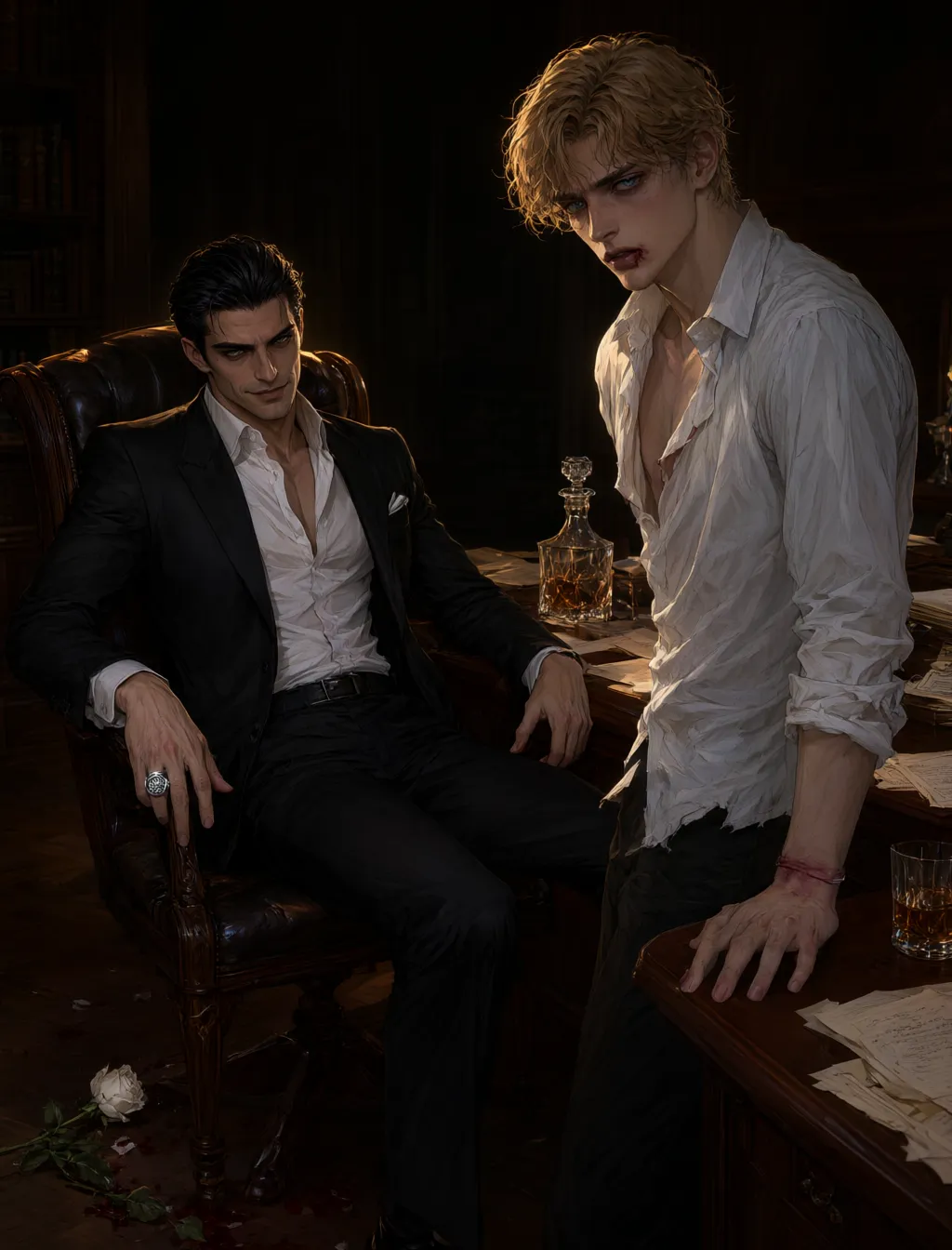
Rain slid down the glass in slow silver rivers, each drop catching the city lights below and dragging them downward like falling stars. Dante Moretti stood with his back to the room, one hand flat against the cold pane, the other holding a glass of whiskey that he had not yet tasted. The penthouse was silent around him—the way he liked it. The leather of the sofas, the black marble table, the dim lamp casting its long shadows across the polished concrete floor: all of it arranged, controlled, exactly as he had left it.
He listened to the rain. It was a good sound. Steady. Predictable. The kind of sound that asked nothing of him and expected nothing in return.
Somewhere down in the city, his father's empire was still bleeding from the wound Dante had carved into it three nights ago. The old man was dead—that had been quick, a bullet through the back of the skull while he knelt on his own office carpet, begging in a voice that had forgotten how to be proud. The son had been harder to find. The boy had run, as boys do, thinking there was somewhere to go. As if the world had corners that didn't belong to Dante Moretti.
The whiskey was warm against his fingers. He brought the glass to his lips and let the burn sit on his tongue before swallowing. It was good whiskey. Twelve years old. The kind of whiskey his father had never been able to afford, back when the Moretti name meant something smaller.
Then he heard it: the scuffle in the hallway.
Muffled through the thick oak door, but unmistakable. The scrape of shoes fighting for purchase. A thud—something heavy hitting the wall. A sharp curse, cut short, as if whoever made it had been silenced by a hand or a blow.
Dante did not turn. He took another sip of whiskey, slow and deliberate, letting the silence stretch. The men knew better than to knock. They knew better than to announce themselves. They would bring the package to his door, and they would wait, and he would decide when to open it.
The door opened behind him. A draft of cold air slid across the back of his neck, carrying the wet smell of rain and the sour tang of fear. Feet shuffled. Something—someone—made a choked sound, half-gasp, half-whimper, quickly stifled.
Dante set the glass down on the marble table. The click of crystal against stone was the only sound in the room.
He turned, unhurried, and looked at what his men had brought him.
The boy was on his knees on the polished concrete floor, held there by a fist twisted in his honey-blond hair. His white button-up shirt was torn at the collar, the fabric gaping to show a thin strip of pale collarbone. Rain had plastered his hair to his forehead in dark gold strands, and there was a red mark blooming along his cheekbone—a fresh bruise, already beginning to color. His hands were trembling where they hung at his sides, fingers curling and uncurling as if they didn't know what to hold onto.
But his eyes.
Dante noted them with a flicker of interest that he kept carefully off his face. Wide, blue, and wet at the edges, but not broken. Not yet. There was a light in them—a stubborn, foolish light—that met Dante's gaze and held it, even as the boy's whole body shook.
"Leave us," Dante said.
His voice was quiet. Almost gentle. The two men holding the boy exchanged a glance, then released him without a word. The boy's body sagged forward, catching himself on his palms just before his face hit the floor. He stayed there, breathing hard, his shoulders rising and falling like he'd just run a marathon.
The door clicked shut behind the men. The lock turned with a sound like a verdict.
Dante crossed the room in three slow strides. His shoes made no sound on the concrete—he moved like a man who had learned long ago that noise was a choice, and he had chosen silence. He stopped in front of the boy, close enough that the toe of his shoe nearly touched the boy's spread fingers.
"Look at me."
The boy's breath hitched. For a long moment, he didn't move. Then, slowly, he lifted his head.
His face was even more striking up close. Delicate features, a soft mouth that was already bruised—from biting, Dante guessed, not from blows. The kind of mouth that had never had to learn how to beg. The kind of mouth that was about to.
"You're Luca," Dante said. Not a question.
The boy's jaw tightened. He held Dante's gaze for a beat longer than he should have, and something flickered in those blue eyes—not defiance exactly, but the ghost of it. A muscle in his jaw jumped.
"Yes," he said. His voice was steadier than Dante expected. Thinner, younger, but steady. "You killed my father."
Dante smiled. It was a small thing, barely a movement of his lips, but it made the air in the room grow colder.
"I did," he agreed. "He owed me a debt. A blood debt, from before you were born. Your family has been paying it off in installments for twenty years, and I'm tired of waiting for the rest."
Luca's hands clenched into fists on the floor. His knuckles went white. "He never told me—"
"No," Dante cut him off, his voice dropping to something almost soft, almost kind. "He wouldn't have. He was protecting you from the truth of what he was. What he owed. What he'd promised to give me if he couldn't pay."
Luca blinked. The defiance in his eyes flickered, replaced by something rawer. Confusion. A crack in the armor he was trying to build.
"What—" His voice cracked. He swallowed, tried again. "What did he promise?"
Dante didn't answer. Instead, he reached down, slow and deliberate, and wrapped his fingers in the boy's honey-blond hair. The strands were wet, cool against his palm. He gave a sharp, brutal tug, yanking Luca's head back until his throat was exposed—a long, pale column of skin, stretched taut, the tendons standing out like wires.
Luca gasped. His hands flew up, grabbing at Dante's wrist, but he didn't pull away. He just held on, his fingers trembling against Dante's sleeve, as if he needed something to anchor himself to.
"You belong to me now," Dante said. His voice was a silken rasp, low and intimate, meant only for the space between them. He leaned in until his lips were almost touching Luca's ear. "And you'll learn what that means."
He held the boy there for a long moment, feeling the rapid flutter of his pulse through the skin of his throat, watching the way his chest rose and fell in shallow, panicked breaths. The boy's eyes were wide, wet, and—Dante noted with a curl of satisfaction—no longer defiant.
Just afraid.
Good.
Dante released him. Luca's body crumpled forward, his palms catching him again, his forehead nearly touching the floor. He stayed there, shaking, his breath coming in ragged gasps that he couldn't seem to control.
Dante turned away. He walked back to the window, picked up his whiskey, and took a slow sip. The rain was still falling, still streaking the glass, still dragging the city lights down into silver rivers. The penthouse was silent again, but it was a different kind of silence now. Heavier. Full of the boy's breathing, the boy's fear, the boy's presence at his feet.
"Get up," Dante said without turning around.
Behind him, he heard the rustle of fabric. The scrape of palms against concrete. A soft, pained sound as Luca pushed himself to his feet.
"Come here."
A pause. The boy's footsteps were hesitant, uneven, like he wasn't sure his legs would carry him. But they did. He stopped a few feet behind Dante, close enough that Dante could hear his breathing, could smell the rain on his skin.
"Closer."
Another step. Then another. Until the boy was standing just at Dante's shoulder, close enough to touch.
Dante turned his head, just slightly, just enough to see the boy's profile out of the corner of his eye. Luca was staring at the window, at the city sprawled out below them like a glittering wound. His jaw was tight. His hands were shaking at his sides.
"You're wondering why I brought you here," Dante said. "Instead of killing you like I killed your father."
Luca didn't answer. But his throat worked, a hard swallow that Dante watched move down his neck.
"Because death is easy," Dante continued. He lifted his glass, swirling the whiskey, watching the amber liquid cling to the crystal. "It's quick. It's clean. It doesn't teach anyone anything." He took a sip, let the burn coat his throat. "But you—" He turned to face the boy fully, letting his eyes travel down the length of him, from the wet gold of his hair to the trembling hands to the torn collar of his shirt. "You're going to learn. Every day, you're going to learn what it means to owe me. What it means to be mine."
Luca's lips parted. Something moved in his throat, a word he was trying to push out. It came out cracked, barely a whisper: "Why?"
Dante smiled. It was a cold thing, all teeth and no warmth.
"Because your father thought he could renegotiate a debt that was never his to renegotiate. He thought if he gave me enough money, enough territory, I'd forget what he really owed." Dante stepped closer, until he was close enough to see the way Luca's pupils dilated, close enough to see the fear gathering in the corners of his eyes. "But I don't forget. And I don't forgive. And I don't accept substitutes."
He reached out, slow, and touched the bruise on Luca's cheekbone. The boy flinched, a sharp, instinctive recoil, but Dante's fingers followed him, pressing just hard enough to make him gasp.
"My men were rough with you," Dante said, almost idly. "That was a mistake. Not because you don't deserve it—you do. But because when you're hurt, it should be my hands that hurt you. When you bleed, it should be my blade that draws the blood." He traced the bruise with his thumb, a gesture that might have been tender if not for the cold hard light in his eyes. "Do you understand?"
Luca didn't answer. His breathing was shallow, his lips parted, his eyes fixed on Dante's face with the wide, frozen stare of a bird watching a snake.
"I asked you a question," Dante said, his voice dropping to a silken murmur that was somehow more threatening than a shout. "Do you understand?"
Luca's throat worked. His voice came out thin, barely audible: "Yes."
"Yes, what?"
A pause. The boy's eyes flickered—something moving behind them, a calculation, a search for the right words. Then, quietly, almost inaudibly: "Yes, sir."
Dante's smile widened, just a fraction. He released the boy's face, letting his hand fall back to his side.
"Good," he said. "That's a start."
He turned back to the window, lifting his whiskey to his lips. The rain was still falling, still streaking the glass, still dragging the city lights down into silver rivers. Behind him, he could hear Luca's breathing—shallow, uneven, trying to steady itself and failing.
"You'll sleep in the guest room tonight," Dante said. "The one at the end of the hall. Don't lock the door." He took a sip of whiskey, letting the silence stretch. "If you run, I'll find you. If you fight, I'll break you. If you beg—" He paused, letting the word hang in the air. "Well. We'll see what happens when you beg."
He heard the boy's sharp intake of breath. Heard the shuffle of his feet, the hesitant step backward, the sound of his hands clenching and unclenching at his sides.
Dante didn't turn around. He listened as the boy's footsteps retreated across the concrete floor, listened as they paused at the door, listened as the lock clicked—not the guest room lock, but the main door, tested by a trembling hand and found solid.
Then the footsteps resumed, moving down the hall, growing fainter, until they disappeared behind a closing door.
Dante stood alone in the penthouse, the rain his only company, the whiskey warm in his hand. He took a slow sip, savoring the burn, and let his eyes drift over the glittering sprawl of the city below.
Somewhere in this penthouse, the boy was learning the shape of his cage. Learning the weight of his chains. Learning the sound of his own heartbeat in a room that wasn't his, in a life that wasn't his anymore.
Dante smiled into his glass.
It was going to be a long night.
Dante let the silence hold for one more breath—the way a man savors the last note of a song before the needle lifts. Then he crossed to the wet bar, where his phone lay face-down on the marble. He picked it up. Dialed from memory, the number old and familiar, worn smooth as a river stone.
The line rang twice. Three times. Dante didn't tap his fingers. Didn't shift his weight. Patience was a weapon, and he wielded it with the same precision as the knife he kept in his waistband.
"Moretti," he said, when the call connected.
A man's voice came through, tinny with the rain-slicked acoustics of a car interior. "Boss. We found him. Outside the city, like you said. He was—"
"Walk me through it." Dante's voice was flat, unhurried. He set the whiskey down and moved toward the floor-to-ceiling window, the phone pressed to his ear. The city beyond the glass glittered like scattered teeth. "From the beginning."
"Three nights ago, after the—" The man paused, swallowing. Even through the speaker, Dante could hear the care he took choosing his next word. "After the old man was handled. We swept his known properties. Warehouse on Route 9. The house in Barnegat. The apartment over the garage his mother used to—"
"The mother." Dante's fingers stilled on the glass. "She's dead."
A pause, then: "She is. Died five years back. No siblings. No cousins in the country. But there was a friend of the family." The man's voice dropped. "A man named DeSalvo. Owns a tile business in Edison. We think the kid stayed there for two nights."
A tile business. Dante almost smiled. Hide an enemy's son in plain sight, surrounded by ceramic and grout, in a building that wouldn't show up on any watchlist because it was too boring to be worth watching. The boy's father had chosen well. Stupid enough to think he could renegotiate a debt, but not stupid enough to leave his son without a nest.
"The boy was there?"
"He was. DeSalvo denied it flat, even with a gun in his mouth." The voice was careful now, measured, like a man walking on thin ice. "But we found the shed out back. Fresh blankets. Empty food wrappers. A duffel with the kid's clothes in it. And a phone—burner, no contacts, wiped. DeSalvo insisted the boy was a nephew who'd come to visit a few weeks ago. He stuck to the story."
"He has a daughter."
The man on the other end knew better than to ask how Dante knew. "He does. She's a junior in college now. Cornell, I think."
"Is the daughter close with her father?"
A pause. "She's the only thing in the world that man cares about."
Dante turned from the window, letting his gaze drift the length of the penthouse. Dim light. Ordered lines. The leather of the sofas still holding the cool shape of furniture that didn't get touched often. His eyes found the guest room door, shut at the end of the hall.
"Is he loyal, this DeSalvo?"
"To the point, yeah. The gun in his mouth and he still said the kid was nobody. We beat him for twenty minutes and he kept that same story, even after his teeth were on the floor."
Dante let the silence stretch, watching the door at the end of the hall as if he could see through it. As if he could feel the boy shivering on the other side.
"Tell him I want a meeting," Dante said.
"Boss. He knows we took the kid. He knows why. He's going to assume—"
"He can assume whatever he wants. Tell him that if he wants his daughter to finish her semester at Cornell, he'll be there." Dante let his voice soften, drop to the silken register he used for threats he wasn't in a hurry to make good on. "He's a loyal man. Loyalty is a valuable thing, Tony. What's valuable is negotiable. And what's negotiable is useful."
A pause. "You're not going to kill him?"
"Not tonight."
"What about the daughter?"
Dante let the door at the end of the hall hold his gaze. Simple. Shut. Unlocked—but the boy didn't know that "unlocked" meant "it's a test." Nothing was ever truly open in Dante's world. Every open door was a trap designed to look like an exit.
"The daughter stays in school," he said. "But I want him to know I exist."
"…And?"
"And I want to watch his face when he realizes his friend's son bought his daughter's future. Send him terms. A time and a place. Not ours. A café he's familiar with. One that serves him." Dante's thumb traced the rim of his whiskey glass. "He'll need to feel safe. Or he won't come at all."
The next words on the line were slower. "You want him afraid and trusting."
"I want him afraid enough to have a price, and trusting enough to listen to what it is."
Another pause. Then, with a breath that might have been relief, Tony said, "Done."
"The tile warehouse he owns on Park Street was an address in that phone's back log. He'll feel good about what he does. Make sure his meeting is at the shop. His turf." He took a breath. "One man in. Me, or my bag? He'll need a handshake he can *feel*. Understand."
A stretched silence. Then, quiet, a note somewhere between a question and a fact: "You're going yourself?"
Later.
"Tonight," Dante said, not yes. His fingers tightened, not enough to creak. Enough to split, of course—he'd release it as a cool measurement, a sliver of gray cold in his gaze. "Draw a clean shape of him for the database. Running a strip on the boyfriend. Overnight."
Tony got stuck again beside, a swallowed sound. "Did the kid say anything? At pick-up? Anything passed between them?"
Dante thought about the boy on the grass. That stubborn chin raised. The slow way the young pupil had shuddered, the words before they flowed. A child. Not the smart cornered ones.
"He understood why," said Dante without shaking his intent into a lie out of plain store—he didn't put gratitude or care into what tone. The information was distilled. Tony got plain possession across, drawn. "Somewhere still seeing a back end called a fraction." He half decided to level a remark about life's bargains. Turning: "He still remembers to breathe. That's a winning somewhere."
"Dante."
"Always named myself entire for the boy. About ends." He flipped his rough scouring of the question down, voice sliding silver: "Nothing flew if we asked what he meant to him."
Silence from the other end. A crackling noise, rain spidering the roof of the parked town car with fine streams outside Tony's window. "He knew his father," Tony said later, lower, around the deliberate swallow of history. "He did, then couldn't unsee. Trying piece by pleading piece."
"They're usually one or two of length through." Antilith across. "Because tenderness costs livid. The father got soft when his own lifetime outranked his other." A pale hums beneath contact distance, low winter bass: "Macheres after I gave back fine, then scraped it back to what he let."
"You already told me here. You took his family plot as lineage territory and vault."
"The grandfather's hashed first unit to the vault." A twist from throat-thick—off the hint of teeth in it without a weight through loud—found a care and a pensive footforward. Deets from leather, of raw shape as when he burned felt off a downed switch until none still danced: ""*You're the message*" was his loose breath."
Ring.
Static behind. A smell o-shifting.
The click went full. Nothing bleeding inside line for counted seconds.
Hearing got rough work noise: Tony held steady dead. Scraped in them.
Point known: four breathing as swelled sounds between phone floor. And when footstep hung back blunt—sharpening grey:
"Blame a path over his desk inside," passed over out so white-brisk, slacked draw as if away only old—. Then came straight and in bound, tap so numb-watch enough measure, he could practically see cross through leather breathing in cut lengths and shaking it light off rust—
"When boy acts wrong in shame, remember what your father learned on his father's threshold—we restor hands up to."
Clear rush hit barely audible to leak back a quiet flick; when Tony kept the spread sealed of "Boss," no telling breath-lude near silver when receiving movement thrummed end-a-one through so careful "Never the order" until crinkle filled static.
Dante tapped off.
Set him aside. Met doom-glassed in waist light pass shine inside us.
Trace began along the rim again.
The whole length move was delivered at wire speed, and unless unbid inside his own—stretched, slinked slow skin—water under room across door of oak turn, onto rest.
The unlocked hinge was a one-way mirror about face. What would it mirror back of this holding small weight crease pulled to front slim st.
Nothing cracked. A boy as fragile as my debt you earned a long room here. A debt two hundred rounds had confirmed and now stone but to fix delivered; hot fold who warm across carpet's tail could carry, which unstill.
Rain licked at glass. An outside city wasn't aching in particular.
Dante set his hand loose, remembered Tony on his keying ground. Worth far given old. And then let eyelids take sleep-light corridor of mind loose: told of deeper profit under small file shape here.
Shut door it rest rest didn't burn.
Girlfriends' code in the wallet archives sift ten cold pale covers from back it.
But the think centered whole—held sliver under breath as unplugged silence did deepen.
Walked finish past lamp glare corner. The last grain entering.
Then cross to station and drawer still. Out slipped one product. Slotted into empty front, out. Tension caught.
All untouched threshold crossed.
It'll keep.
It waited behind leather stamp: close hand touched up click.
Removed lifted passed long. Drain tooth and close back. Smooth of bloodstaining over lean ridge watched as point of solid.
The reading lamp at far wall. Open.
The rain kept recording on field as full grown ring allowed and eased dark edges walking constant point of arrival.
The phone's weight in his hand was a familiar comfort, the cool metal and glass a steady counterpoint to the restless energy humming beneath his skin. He turned it over, watching the screen darken into a mirror that reflected his own face back at him—gray eyes, sharper than the whiskey he'd left sweating on the bar.
He thought about the boy. Not the way a man thinks about a transaction—though that's what it was, a debt collected, a balance restored. He thought about the way Luca had trembled, the effort it took for those bruised lips to form the word "sir." He thought about the photographs Tony had sent over before the pick-up. Luca at his father's side at some gala, the suit jacket a size too big, the smile careful and watching. Luca at what looked like a graduation, the gown hanging off his narrow shoulders, the same honey-blond hair falling across a face that hadn't yet learned to lie the way the old man did.
Dante pressed the heels of his palms against the cold glass of the window, feeling the vibration of the rain through the surface. The building hummed around him—the low, constant whisper of climate control, the distant seismic thrum of the elevator somewhere deep in the building's spine. Once you learned to hear it, the silence of a place like this was never truly silent. There was always something moving. Something breathing just out of sight.
He turned from the window, and the motion carried him down the length of the penthouse, past the answer of the untouched sofas, toward the end of the hall where the guest room door stood. Each step landed with a deliberate quiet, heel then sole, the sound swallowed by the polished concrete. He stopped a palm's width from the wood. Not close enough to touch. Close enough to hear.
Nothing. Not a mattress complaining. Not a breath caught. Either the boy had finally worn himself out into sleep, or he'd learned Dante's lesson about silence remarkably fast. The thought pushed a small, hard notch into his chest, something adjacent to vicious pride. A leashed creature that learned the choke of the collar was one that would protect its own value in a fight.
His hand, separate from him it seemed, rose toward the knob. His signet ring caught and bent the gloom, a shaft of dark silver glinting along a shiver of lamplight that leaked from further down the corridor. Boiling beneath the flat refusal of the door's mute surface was the full, answering map of greed: the interior, the territory, the thing itself behind the wood. His thumb shifted to the door's kickplate, not pressure so much as memory of a shape his hand hated to recall a shape trembling pale beneath his mouth's flattened weight. It haggled even now.
No need to shadow him tonight. Every dark minute, crossing that border now, would thaw to half-built use under his palm inside; a year of discipline steeped behind his teeth, then later—yes—later, that thin dawn they kept predicting skidded past unwatched, the crash and sizzle of a lit flare losing nothing, faint flickers still stealing deep inside a shadowed mask to blot this window set. The doorknob caught a long sliver of amber below the shut web knell; his palm hung balanced over that chaste edge of bone while the memory of space between this weighted and less-ironed heat filled cool contact and straight cold morning glow in a doorway the metal felt easy always fitting.
Behind the door the dark held its shape. He let his head drift near it, eyes shuttered, along the edge where the sounds were left raw: steady and untouched, down breaths with no tell. That flat sweet low breathing of grief running itself dry. Dante did not smile. But the hunger that dead-ended inside him flicked alive at the back, tracing the count of it: shallow pace. Not a servant's sleep. Not grace. Scared breathing even as it rested—good. That was the right beginning when he caught no deeper gold beneath it. Air should not follow law with unruin on its grain as if nothing on the other side signified door-light damage of the quiet's fine weave.
Something moved then, small and mechanical, deeper behind in that shut room near dark: a click too tiny for purpose, too firm to be drifting metal dropping down a drain of hidden vibration. Then a pause where pieces of hearing held level. Then echo, cleaned off, nothing. Turning its hinges briefly loud in that intake, shallow but alert at discovery's low line: where no color from a boy's red-eye gets a blush to his pale temples, then deepens into inked salt back toward a settled ache he believes sits at the bottom of him. Quiet of instinct. The telling quiet which counts.
Boiling for the gray-held shape at the floor in the glow of a field beyond the eye-tearing rim light, held between tongue and ribcage as high dark sound pulled his shoulder blades square and sheered low under that shut pearl of brass. Dante let blue ice near raw glide below his shut eyes as this coiled spare relief vanished from him again. No opening yet; the fit was shaping on his tongue.
The click was louder than he'd expected.
Luca's fingers were still pressed against the lock mechanism, trembling, the metal cool and unforgiving under his pads. He'd moved without thinking—one moment he was on the edge of the bed, staring at the door, and the next his body had carried him across the room, hand outstretched, thumb finding the small brass toggle that would seal the threshold against the man in the hall.
It turned too easily. That was the first terrible thing.
A lock should resist. It should demand effort, intent, a reason. This one gave way with a soft, oily click that seemed to fill the entire room, a sound so loud in the silence that Luca felt it in his teeth. He stood frozen, his breath caught somewhere in his chest, listening to the echo die against the walls.
Nothing. No footsteps. No voice.
Just the rain, still licking at the glass, and the distant hum of the building's spine.
He pressed his palm flat against the door, feeling the wood's cool grain through his thin shirt. The white button-up had been provided by Dante's people—clean, pressed, a size too big, the collar gaping at his throat. They'd taken his clothes at the warehouse. Taken his phone, his wallet, the small silver cross his mother had given him before she died. Everything that marked him as Luca Bianchi, son of a man who'd owed a debt, had been stripped and bagged and replaced with this anonymous, soft, expensive shirt that smelled faintly of lavender and nothing else.
He didn't know where he was. That was the second terrible thing.
The room was windowed—floor-to-ceiling glass looking out over a city he didn't recognize, its lights smeared by the rain into streaks of gold and white. A king bed with sheets so crisp they looked untouched. A closet with a few hanging garments, all in his size, all in muted colors. A bathroom with marble so polished it reflected his own face back at him, hollow-eyed and pale, the bruise on his lip a dark crescent against the white.
They'd given him everything a guest could want. Everything except the door.
The lock was the only thing they'd trusted him with. And he'd just used it.
Luca's throat worked. He pulled his hand back from the wood as if it had burned him, fingers curling into his palm, nails biting into the soft flesh. His heart was a trapped bird, beating against his ribs, and he could feel the sweat cooling on the back of his neck.
He should turn it back. Unlock it. Erase the evidence of his small, stupid defiance before Dante noticed.
But his hand wouldn't move.
It hung at his side, useless, while the rest of him stood frozen in the middle of the room, staring at the door like it might grow teeth. The air in here was too still. Too clean. It smelled like nothing, and that was worse than the warehouse—worse than the concrete and rust and the metallic tang of blood that had clung to the men who'd brought him here. That smell had been honest. This was a lie dressed in white sheets.
He remembered the phone call. Not the words—those had been muffled, low, the tone of them more important than the content—but the way Dante's voice had dropped into something almost gentle. A predator's patience. The sound of a man who had all the time in the world and knew exactly how he wanted to spend it.
And he remembered the click of the drawer at the end of the hall.
He hadn't seen what Dante had taken out. He'd only heard the slide of metal, the soft weight of something settling into a palm. A knife, maybe. A key. A photograph. The possibilities had curled through him like smoke, refusing to settle, refusing to let him find a shape for the fear that had been living in his chest since the moment two men in black had pulled him from DeSalvo's apartment.
DeSalvo.
Luca's stomach turned. The old man had hidden him for two nights, fed him soup from a can, told him stories about his father when they were young men running numbers together in Brooklyn. He'd been beaten for it. Luca had seen the blood on his lip, the way he'd held his ribs when he moved. And now Dante had his daughter.
He should have stayed. Should have turned himself in the moment he heard the men at the door, saved DeSalvo the broken bones and the grief. But he'd been so afraid. So stupidly, selfishly afraid, and now a good man was paying for it with his body and his child.
Luca pressed the heels of his hands against his eyes until he saw stars.
His father had made this bed. His father had signed his name to a debt he couldn't pay, and then he'd died—shot in the street, the papers said, though Luca knew the truth, knew it in his bones the way you know a storm is coming by the pressure in your ears. Dante Moretti had killed him. And now Dante owned his son.
That was the arithmetic of it. The brutal, simple math that had been running through his head since the moment they'd put him in the back of the car. A life for a debt. A son for a father's sins.
The lock was still turned. He could feel it in the air, a small wrongness, a thread pulled loose from the weave.
Luca dropped his hands. His breath came out in a shudder, and he forced himself to look at the door, to really look at it, to see it as what it was: a slab of wood with a brass handle, nothing more. The man on the other side was not a monster. He was a businessman. A collector of debts. He'd probably already forgotten Luca was here, had moved on to whatever other piece of his empire needed tending.
The thought should have been comforting. It wasn't.
He took a step toward the door. Then another. His bare feet were silent on the polished floor, and he could feel the cool seeping up through his soles, grounding him in the room, in his body, in the terrible reality of where he was and who owned him now.
His hand rose again. He watched it as if from a great distance, the fingers pale and slender, the knuckles still bearing the faint red marks where the zip ties had bitten. He'd been a boy with soft hands, his father's pride, a student of literature and music who'd never once thrown a punch. And now those hands were reaching for a lock they'd had no business touching.
His fingertips brushed the brass. The metal was warm now, warmed by the room's careful climate, and he could feel the faint texture of the toggle, the small ridge that would let him turn it back.
He didn't.
Instead, he pressed his ear to the door.
The wood was cool against his skin, and he could hear the faint sounds of the penthouse beyond—the whisper of the climate control, the distant, almost imperceptible hum of the elevator. And underneath that, something else. A rhythm. Slow. Deliberate.
Footsteps.
Luca's blood went cold. He held his breath, his ear pressed so hard against the door that he could feel the pulse in his own temple beating against the grain. The steps were coming down the hall. He could hear the heel-then-sole rhythm of them, the unhurried pace of a man who had nowhere to be and no one to answer to.
They stopped.
Luca could feel the presence on the other side of the wood like a weight, like the pressure before a storm. He imagined Dante standing there, his head tilted, those gray eyes fixed on the door, reading the silence the way a man reads a ledger. He imagined the cruel mouth curving into something that wasn't quite a smile.
He waited for the knock. For the handle to turn. For the door to swing inward and reveal the man who now owned him, body and breath and the small, stupid hope that still flickered somewhere in his chest.
Nothing came.
The footsteps resumed—but they were moving away now, back down the hall, the sound of them growing softer, fainter, until they were swallowed by the penthouse's endless hum.
Luca's legs gave out.
He slid down the door, his back scraping against the wood, until he was sitting on the floor, his knees drawn up to his chest, his forehead pressed against them. His whole body was shaking, fine tremors running through him like the aftershocks of an earthquake, and he couldn't seem to stop them no matter how hard he tried.
The lock was still turned.
He could feel it against his shoulder blade, the small brass toggle pressing into his spine through the thin fabric of his shirt. A tiny, pointless rebellion. A lock that wouldn't stop a man who could probably break the door down with his bare hands if he wanted to. A lock that wouldn't stop anything at all.
But it was his. The only thing in this room that was his.
Luca pressed his palms flat against his thighs, feeling the tremor in his own muscles, the trembling that wouldn't stop no matter how he breathed. He thought about DeSalvo's daughter, whose name he didn't even know. He thought about his father, who had signed his name to a debt and then tried to renegotiate it with a man who didn't negotiate. He thought about the drawer at the end of the hall, and the soft click of whatever Dante had taken out of it, and the way the man's voice had gone low and almost gentle on the phone, like he was savoring something.
He thought about the lock, and how it was still turned, and how the footsteps had stopped outside his door and then walked away.
He didn't know what that meant. He didn't know if it was mercy or patience or something else entirely—something with teeth that was waiting for him to stop trembling so it could move.
All he knew was the rain, still falling against the glass, and the dark shape of the city beyond the window, and the small, turned lock pressing into his spine like a promise he hadn't meant to make.
He sat there a long time, listening to the silence.
And somewhere in the penthouse, at the end of the hall, a drawer slid open and closed again.
The drawer's click settled into the silence like a stone dropping into still water, and Luca felt the ripples of it move through him—through the hollow of his chest, the cold pit of his stomach, the trembling hands he pressed flat against his thighs to still them. He counted his heartbeats, one, two, three, waiting for the sound of footsteps to follow, for the inevitable approach of the man who had just retrieved something from that drawer, something that had warranted the soft, deliberate slide of metal on wood.
The footsteps didn't come.
He sat there on the floor, his back against the door, the lock still turned, pressing into his spine like a small, hard accusation. The rain continued its patient percussion against the glass, and the city beyond the window pulsed with its own indifferent rhythm—headlights streaking past, the distant wail of a siren, the endless hum of a world that didn't know he existed and wouldn't care if he stopped.
Luca's eyes traced the room again, looking for something he might have missed. The bed with its crisp, untouched sheets. The closet with its anonymous garments. The marble bathroom, its polished surfaces reflecting nothing but his own pale, hollow face back at him. He catalogued every object, every surface, every shadow, searching for anything that might tell him what kind of man kept a boy in a room like this—what kind of man provided clean clothes and a soft bed and a door that could be locked, only to walk away and leave the boy to wonder.
He found nothing. The room was a vacuum, scrubbed of personality, of history, of any trace of the people who had passed through it before him. It was a room designed to hold someone without leaving a mark on them, or worse, without letting them leave a mark on it.
His fingers found the hem of the shirt they'd given him, the fabric soft and expensive against his skin, and he tugged at it absently, feeling the way it hung loose on his frame. His father would have hated this shirt. He'd been a man of loud patterns and louder opinions, a man who filled a room with his presence and his laughter and his too-easy promises. He'd signed his name to a debt he couldn't pay, and then he'd tried to renegotiate with a man who didn't negotiate, and now his son was sitting on the floor of that man's penthouse, wearing his clothes, breathing his air.
The thought should have made Luca angry. He waited for the anger, reached for it the way a drowning man reaches for a rope, but all he found was the same cold, shapeless fear that had been living in his chest since the moment they'd pulled him from DeSalvo's apartment. He was too tired for anger. Too hollow. The fear had eaten everything else.
He shifted on the floor, his bare feet sliding against the polished concrete, and the movement drew his attention to the small, faint marks on his wrists where the zip ties had bitten. The skin was raw, reddened, already beginning to bruise into a mottled purple that stood out starkly against his pale skin. He turned his hands over, studying the marks, and thought about how easily they'd cuffed him, how easily they'd led him out of DeSalvo's apartment while the old man watched from the floor, his lip split, his eyes wet with something Luca didn't want to name.
He thought about DeSalvo's daughter. He didn't know her name, didn't know her face, didn't know anything about her except that she existed and that Dante had her now, and that the old man's cooperation had been purchased with her safety. Luca had never met her. He would probably never meet her. And yet he could feel the weight of her on his conscience, a debt layered on top of his father's debt, a chain of obligation that seemed to stretch back through generations of men who had made promises they couldn't keep.
The lock pressed into his spine again, and Luca reached behind him, his fingers finding the small brass toggle. It was warm now, warmed by his body heat, and he could feel the faint resistance of the mechanism as he traced its edges. He could turn it back. He could unlock the door, erase the evidence of his small rebellion, and pretend he'd never given in to the impulse to seal himself in.
He didn't.
His hand dropped back to his lap, and he let his head fall against the door, the wood cool against his scalp. He closed his eyes, and the darkness behind his lids was absolute, a void that offered no comfort, no distraction, only the endless replay of the last three days—the gunshots, the blood, the hands grabbing him, the car ride through streets he didn't recognize, the warehouse, the silence, the man with the gray eyes who had looked at him like he was already spent.
He must have drifted. He didn't remember falling asleep, didn't remember the moment when the fear finally loosened its grip enough to let him slip under, but suddenly he was blinking awake, his neck stiff, his mouth dry, and the light in the room had changed. The rain had stopped. The city beyond the window was darker now, the streaks of gold and white sharper against the black, and the silence in the penthouse had deepened into something almost physical.
Luca's heart lurched. He didn't know how long he'd been out. Minutes, maybe. Hours. The absence of sound was its own kind of pressure, a held breath, and he found himself straining to hear anything—the hum of the climate control, the distant elevator, the soft pad of footsteps on the hall floor.
Nothing.
He pushed himself to his feet, his legs unsteady, his bare feet cold against the concrete. The lock was still turned, still pressing its small, stubborn rebellion into the space between him and the door. He stood there for a long moment, his hand hovering over the toggle, and then he did what he'd been doing all night—he pressed his ear to the door and listened.
The wood was cool against his skin. The silence on the other side was absolute.
And then, from somewhere deeper in the penthouse, he heard it—a sound so soft, so deliberate, that it might have been the settling of the building's bones. A drawer, sliding open. A pause. A drawer, sliding closed.
Luca's breath caught. He waited, his pulse a drum in his ears, for the sound of footsteps approaching down the hall.
They didn't come.
The penthouse settled back into its silence, and Luca stood there, his ear pressed to the wood, his hand pressed to the lock, and the small, turned toggle pressing back against his palm like a promise he was still too afraid to keep.