
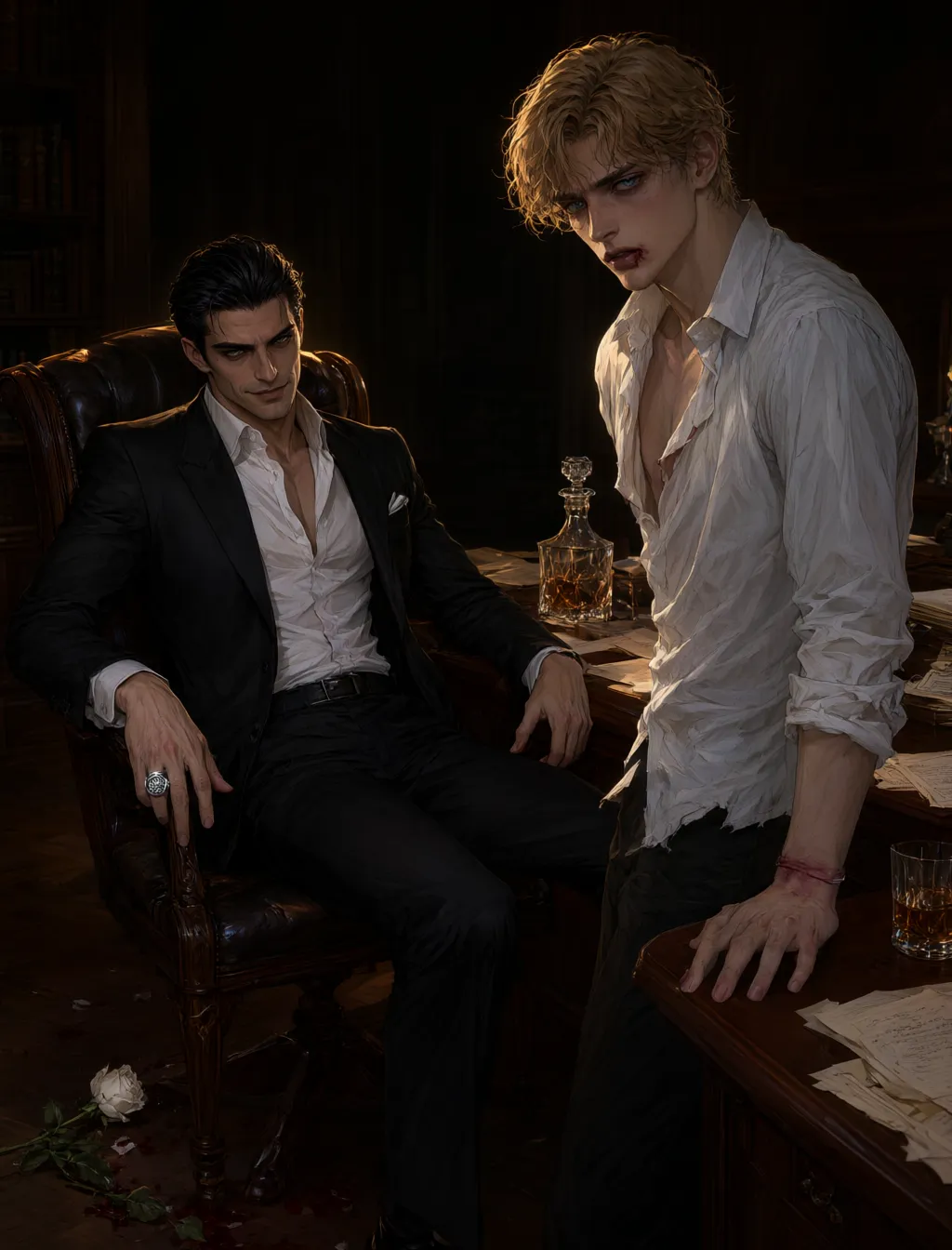
The brass toggle was cold under his thumb. Luca kept it pressed, kept the lock turned, kept his ear against the wood until the silence had a texture—grain and varnish and the faint chemical smell of polish. His own heartbeat filled the space where Dante's footsteps should have been. He counted them. Forty-two before he let himself breathe.
The marble was cold under his bare feet. He'd noticed it when they'd first brought him here, the shock of it traveling up through his arches, but now it was just a fact, a constant, like the ache in his wrists. He lifted one hand, turned it over. The skin was raw, rubbed pink in two neat bands where the zip ties had bitten. He pressed his thumb into the tender flesh and watched the color drain, then flood back.
The room behind him was all expensive silence. A bed he hadn't touched, sheets turned down by someone who'd never meet his eyes. A wardrobe full of clothes that didn't fit his body or his life. A window that looked out on a city he didn't know anymore, rain-slick and glittering with lights that meant nothing to him.
He stayed at the door.
The lock was his. The only thing in this place that was his. He'd turned it the moment the footsteps had retreated, a small defiance, a line drawn in brass and steel. Now it pressed back against his palm, and he held it there, feeling the tiny mechanism hold against nothing, against no one, against the empty hall.
He heard it again—the drawer. Sliding open somewhere deeper in the penthouse. The sound was closer now, or maybe he was just listening harder. A pause, the kind of pause that meant fingers hovering over contents, choosing. Then the slide closed, soft as a breath.
Luca's hand tightened on the toggle. He waited for footsteps. The silence stretched, thin as wire, and then—nothing. No approach. No retreat. Just the absence of sound, the penthouse holding its breath the way he was holding his.
He pressed his forehead to the wood. It was cool, smooth, expensive. Everything in this place was expensive. Even the silence had a price tag.
His wrists throbbed. He'd stopped looking at them, but he could feel them, the way you feel a bruise you keep pressing. He pressed now, thumb working the raw skin, and the pain was a clean thing, a thing he understood. The rest of this—the room, the silence, the waiting—was a language he didn't speak yet.
He thought about his father. That was dangerous. He thought about his father's back, the way it had looked from behind, the way it had looked when it hit the floor. He thought about the bullet, the sound of it, the way the room had smelled afterward—cordite and copper and something else, something he couldn't name.
He thought about his mother's cross.
It had been around his neck when they'd taken him. He'd felt the chain snap, felt the weight leave his chest, and he'd made a sound—a small, stupid sound, the kind of sound you make when something you love is taken and you haven't learned yet not to show it. The man who'd taken it had laughed. The man who'd taken it had been Dante's man, but Dante had been there, watching, and Dante had said nothing.
Now the cross was somewhere in this penthouse. Somewhere in a drawer. Somewhere in a box. Somewhere in the dark, and he couldn't reach it, and he couldn't stop thinking about it.
He turned, pressed his back to the door, and slid down until he was sitting on the marble. It was cold against his bare legs. He'd been given clothes—soft, expensive clothes that smelled faintly of cedar—but his feet were bare, and his ankles were bare, and he felt bare in a way that had nothing to do with fabric.
He pulled his knees up, wrapped his arms around them. The raw skin of his wrists caught on the fabric of his sleeves and he hissed, a small sound, barely a breath, but it was the loudest thing in the room.
He sat like that for a long time. The city hummed beyond the window, a low, distant thrum like a machine running somewhere he couldn't see. The rain had stopped. The sky was a deep, bruised purple, the color of a healing wound. He watched it change, slow as an hour hand, and he thought about nothing, and he thought about everything, and he kept his hand on the lock.
He must have drifted. Not slept—he didn't think he'd slept—but drifted, the way you do when you're too tired to think and too afraid to stop. The room blurred at the edges. The city hummed. His wrists throbbed in time with his heart.
And then he heard it.
Footsteps. Not in the hall. Closer. The hall table, just outside the door—he'd seen it when they'd brought him in, a slim, dark thing with a brass bowl and a stack of mail that no one ever read. The footsteps stopped there. He heard the soft, deliberate slide of a drawer.
Luca's breath caught. He pressed his ear to the wood, and he heard—what? A whisper of fabric. The click of a latch. A pause, long and patient, the kind of pause that meant someone was choosing, arranging, placing.
Then the footsteps retreated. Slow. Measured. Each one a small, deliberate sound, like a period at the end of a sentence.
He waited. He counted his heartbeats. He counted to fifty, to a hundred, to two hundred, and the footsteps didn't come back.
The hall was silent. The penthouse was silent. The city hummed beyond the glass, and the room smelled of dust and old wood and the faint, sharp trace of Dante's cologne, left on the air like a fingerprint.
Luca's hand moved before he knew what he was doing. He pressed his eye to the keyhole.
The hall was dark, but not entirely—a low light burned somewhere, casting a soft, amber glow across the floor. He could see the table, its slim legs, the brass bowl catching the light. He could see the carpet, deep and dark, and the threshold, and the floor beyond it.
And there, on the floor, just out of reach, just beyond the door—
His mother's cross.
It lay on the dark carpet like a coin dropped in the dark. Small, silver, glinting. The chain was coiled beside it, neat as a signature, arranged. He could see the delicate filigree, the worn edges, the spot where the metal had been polished thin by years of fingers, years of worry, years of prayer.
He knew every mark on it. He'd held it in his palm a thousand times. He'd watched it swing from his mother's neck when she leaned over him, when she kissed his forehead, when she whispered things he was too young to understand.
It was there. It was right there. Just beyond the door. Just beyond the threshold. He could reach it if he unlocked the door. He could open it, step out, bend down, pick it up. He could hold it in his hand again, feel the weight of it, the warmth of it, the only thing he had left of her.
He didn't move.
His eye stayed pressed to the keyhole, the brass cold against his brow, and he stared at the cross, and the cross stared back, small and silver and patient, a promise or a trap or both.
The chain was coiled neatly. Not tossed. Not dropped. Arranged, the way you arrange a thing you want someone to find.
The cross glinted. The light caught it, turned it, made it wink at him like an eye.
He thought about Dante's hands. The way they'd looked when he'd taken the cross from his man. The way he'd held it, turned it, examined it, his gray eyes flat and cold. The way he'd said nothing, just pocketed it, and walked away.
He thought about the drawer. The sound of it sliding open. The pause. The choice.
He thought about the footsteps, stopping at the hall table. The deliberate slide. The placement.
The cross lay there, just out of reach, and Luca's hand was already moving toward the door handle—
—when he heard it.
The soft slide of the drawer again. Closer now. The hall table, just outside, its drawer sliding open with a sound like a held breath released.
And then footsteps, returning.
The footsteps were unhurried. That was the worst part—the unhurriedness of them, the way they didn't rush, didn't creep, didn't try to hide. They simply came, one after another, measured and calm, the way a man walks when he knows exactly what he'll find at the end of his path.
Luca's hand froze on the door handle. His fingers were already curled around it, already applying the smallest pressure, and now they locked there, caught between the instinct to turn it and the certain knowledge that turning it was exactly what Dante wanted. The brass was warm now. His palm had been on it long enough to leave a print.
The footsteps stopped.
Not at the door. At the table. The hall table, just outside, where the drawer still hung open. Luca could hear the silence of the man standing there, could almost see him in the dark—tall, black suit, gray eyes taking in the cross on the floor, the coiled chain, the door that was still locked, the boy on the other side of it who had not come out.
He heard a sound. Soft. Almost nothing. It might have been a breath. It might have been a laugh, swallowed before it could form. It might have been nothing at all, just the settling of the building, the shift of wood and glass and stone around him.
Then the drawer slid shut.
The sound was different this time. Not the soft, deliberate close of before, the kind of close that meant *I'll be back*. This was final. A click, a seating of wood against wood, a sound that said *done*.
The footsteps retreated.
Luca waited. He counted his heartbeats again—fifty, a hundred—and the footsteps didn't return. The penthouse settled back into its silence, the expensive, humming silence of a place that had never known fear, never known a boy pressed against a locked door with his eye to a keyhole and his mother's cross lying just beyond his reach.
He looked through the keyhole again.
The cross was still there. Of course it was still there. It hadn't moved, hadn't vanished, hadn't been gathered up and returned to whatever drawer it had come from. It lay on the dark carpet, small and silver and patient, catching the low light, winking at him like an eye that knew something he didn't.
The chain was still coiled beside it. Neat. Precise. A signature. He looked at it now, really looked, and he saw what he'd missed before: the chain wasn't coiled the way you coil a thing you're putting away. It was coiled the way you coil a thing you're offering. The clasp was turned up, facing the door. The cross lay at the center of the coil, perfectly framed, perfectly placed, the way a jeweler places a piece in a window. The way you arrange a thing you want someone to see.
His hand was still on the door handle. He could feel the mechanism under his palm, the tiny resistance of the lock, the way the handle gave slightly when he pressed, the way it would give all the way if he just—
He didn't.
He took his hand away. He made himself do it, made himself watch his own fingers uncurl from the brass, made himself press his palm flat against his thigh, where he could feel the warmth of his own grip fading from his skin.
The cross glinted.
He thought about his mother's hands. The way they'd looked when she'd fastened the chain around his neck for the first time, the way they'd trembled, the way she'd said *this was your grandmother's, and her mother's before that, and it will be yours until you have a child to pass it to*. He'd been nine. He'd barely understood. He'd worn it every day since, through school, through his father's rages, through the night they'd come for him, and now it lay on the floor of his enemy's hall, and he could not reach it.
He thought about Dante's hands. The way they'd looked when he'd taken the cross from his man. The way he'd held it, turned it, examined it, his gray eyes flat and cold. The way he'd said nothing, just pocketed it, and walked away. He thought about the drawer. The sound of it sliding open. The pause. The choice. The placement.
The cross was a test. He knew that. He'd known it the moment he'd seen it, known it in his gut, in the cold pit of his stomach, in the way his breath had caught and his hand had moved before his mind could stop it. Dante had put it there to see what he would do. To see if he would open the door. To see if he would come out.
And he hadn't. He'd stayed. He'd pressed his eye to the keyhole and stared at the one thing he had left of her, and he had not opened the door.
He didn't know if that was courage or cowardice. He didn't know if it was defiance or fear. He only knew that the cross was still there, and he was still here, and the door between them was the only thing keeping him from it.
The city hummed. The sky beyond the window had gone from bruised purple to a deeper, darker blue, the color of a bruise that was still healing. His wrists throbbed. The raw skin was warm under his thumb, and he pressed it, held it, let the pain be a clean thing, a thing he understood.
He stayed at the door. He kept his eye to the keyhole. He kept his hand off the handle.
And the cross lay there, just out of reach, glinting in the dark like a promise he was too afraid to take.
His hand was on the handle before he understood what he was doing. The brass was warm from his earlier grip, the memory of his own palm still pressed into the metal, and he felt the mechanism give the slightest fraction as his fingers curled. The lock was still turned. He'd put it there. He'd held it there all night, a small defiance, a line drawn. Now he stood on the other side of that line, and the line was the only thing between him and the cross.
The cross glinted. The light caught the worn filigree, the thin places where his mother's fingers had worried the metal for years, and he thought about her hands, the way they'd trembled when she'd fastened the chain around his neck, the way she'd said *this was your grandmother's*. He'd been nine. He'd worn it every day since. He'd worn it through school, through his father's rages, through the night they'd come for him, and now it lay on the floor of his enemy's hall, and he could not reach it.
He turned the handle.
The click was small, a sound he felt in his fingertips more than heard, the tiny surrender of the lock he'd turned hours ago. The door swung inward on silent hinges, and the hall air hit him—Dante's cologne, the faint metallic tang of whiskey, the cool breath of a space that had never known fear. He stepped out onto the marble. It was cold under his bare feet, colder than the floor of the guest room, and he felt the shock of it travel up through his arches, the same shock he'd felt when they'd first brought him here, when the world had still been a place he understood.
The cross was closer now. Three steps. Four. He could see the chain, the neat coil, the clasp turned up like a signature, and he could see the way the light caught the silver, the way it winked at him like an eye that knew something he didn't.
He took a step. The marble was cold. The hall was silent. The city hummed beyond the glass walls, a low, distant thrum like a machine running somewhere he couldn't see, and he felt the weight of the silence pressing on him, the expensive silence of a place that had never known a boy creeping through it in bare feet with his heart in his throat.
He took another step. The cross was two steps away now. He could reach down and pick it up. He could feel the weight of it in his palm, the warmth of it, the only thing he had left of her. He could hold it against his chest and feel the chain settle around his neck, the familiar weight, the familiar promise.
He stopped.
The cross lay there, small and silver and patient, and he looked at it, really looked, and he saw what he'd missed before. The chain wasn't coiled the way you coil a thing you're putting away. It was coiled the way you coil a thing you're offering. The clasp was turned up, facing him. The cross lay at the center of the coil, perfectly framed, perfectly placed, the way a jeweler places a piece in a window. The way you arrange a thing you want someone to take.
He thought about Dante's hands. The way they'd looked when he'd taken the cross from his man. The way he'd held it, turned it, examined it, his gray eyes flat and cold. The way he'd said nothing, just pocketed it, and walked away. He thought about the drawer. The sound of it sliding open. The pause. The choice. The placement.
The cross was a test. He'd known it the moment he'd seen it through the keyhole, known it in his gut, in the cold pit of his stomach, in the way his breath had caught and his hand had moved before his mind could stop it. Dante had put it there to see what he would do. To see if he would open the door. To see if he would come out.
And he had. He'd opened the door. He'd stepped out onto the cold marble in his bare feet, and the cross lay at his feet, and he could not reach it, and he could not leave it, and he stood there, caught between the thing he wanted and the thing he feared, and he did not know which way to move.
The hall was silent. The city hummed. The cross glinted.
He heard it then—a sound from deeper in the penthouse. Not footsteps. Not the slide of a drawer. A voice. Low, unhurried, the kind of voice that knows exactly what it will find at the end of its path.
"Come out, little bird."
The words landed in the hall like stones dropped in still water. Luca's breath caught. His hand froze halfway to the cross, fingers hovering over the silver, and he felt the cold of the marble seep up through his bare feet, through his ankles, through the thin fabric of the clothes they'd given him, and he could not move.
The voice came again, closer now, the sound of it curling through the dark like smoke.
"I know you're there. I can hear you breathing."
Luca's breath stopped. He stood in the hall, frozen, the cross at his feet, the door open behind him, the voice ahead of him, and he felt the trap close around him, the neat, patient trap that had been laid hours ago, the trap he had walked into with his own bare feet, his own trembling hand on the handle.
He looked down at the cross. It lay at his feet, small and silver and patient, and he thought about his mother's hands, the way they'd looked when she'd fastened the chain around his neck for the first time, the way she'd said *this was your grandmother's, and her mother's before that, and it will be yours until you have a child to pass it to*. He'd been nine. He'd barely understood. He'd worn it every day since, and now it lay at his feet, and he could not reach it, and he could not leave it, and the voice was coming closer.
He bent down. He didn't think about it. He just did it, the way you do a thing you've been taught to do, the way you reach for a thing you love when it's in reach. His fingers closed around the cross. It was cold, colder than the marble, colder than the air, and he felt the weight of it in his palm, the familiar weight, the familiar promise, and he closed his hand around it and straightened.
The chain dangled from his fist. The cross swung, catching the low light, and he held it against his chest, felt the cold of it through the thin fabric of his shirt, and he did not put it on. He couldn't. He didn't know why. He just held it, his fist closed around the silver, and he stood in the hall with the door open behind him and the voice ahead of him, and he waited.
The footsteps came. Slow. Measured. Each one a small, deliberate sound, like a period at the end of a sentence. They came from the direction of the study, from the dark where the whiskey smell lived, and they stopped at the edge of the hall, at the edge of the light, at the edge of the space where Luca stood with his mother's cross in his fist.
Dante stepped into the light.
He was tall, black suit, black hair slicked back, gray eyes flat and cold. The silver signet ring caught the low light as his hand came to rest on the doorframe, and he stood there, not moving, not speaking, just looking at Luca with those gray eyes, the way you look at a thing you've caught, the way you look at a thing you own.
Luca's hand tightened on the cross. The edges of the filigree bit into his palm, and he felt the pain, a clean thing, a thing he understood, and he held it there, held the cross, held the pain, held the silence.
Dante's mouth curved. It wasn't a smile. It was something else, something smaller, something that lived at the corner of his lips and didn't reach his eyes.
"You came out," he said. The words were soft, almost gentle, and they landed in the hall like stones. "I wondered if you would."
Luca said nothing. He stood in the hall, bare feet on cold marble, mother's cross in his fist, and he looked at Dante, and Dante looked back, and the silence stretched between them, thin as wire.
Dante stepped closer. One step. Two. The marble didn't sound under his shoes the way it sounded under Luca's bare feet. It sounded like a man walking, a man who knew exactly where he was going, the way you walk when you own the floor you're walking on.
He stopped a step away. Close enough that Luca could smell the cologne, the whiskey, the faint metallic tang that lived on his skin. Close enough that Luca could see the gray of his eyes, the flat cold of them, the way they took him in, the way they measured him, the way they found him wanting.
"You kept the lock on," Dante said. "All night. I felt it. Every time I walked past, I felt it."
Luca's jaw tightened. He didn't speak. He couldn't. His voice was somewhere in his chest, somewhere behind the cold pit of his stomach, and he couldn't reach it.
Dante's hand came up. Slow. Deliberate. The silver ring caught the light. His fingers found the cross in Luca's fist, closed around it, and pulled. Luca held on. He held on with everything he had, his fingers white around the silver, the filigree biting into his palm, and Dante pulled again, harder this time, and the cross slipped from Luca's grip, and the chain slid through his fingers like water, and Dante held it up, turned it, examined it, the way he'd examined it before, the way he'd examined it the night they'd taken him.
"This is mine now," Dante said. "Everything you have is mine. Everything you were is mine. You understand?"
Luca's breath caught. He looked at the cross in Dante's hand, his mother's cross, his grandmother's cross, the only thing he had left of her, and he felt something crack open in his chest, something he'd been holding shut all night, something he'd been pressing his thumb against the way he pressed the raw skin of his wrists.
"Please," he said. The word came out before he could stop it, small and stupid, the kind of word you say when you haven't learned yet not to show it. "Please. It's all I have."
Dante looked at him. The gray eyes were flat, cold, the way they'd been when he'd taken the cross from his man, the way they'd been when he'd watched the cross leave Luca's chest. He held the cross up, let the light catch it, let it swing from the chain like a pendulum, like a thing that had never meant anything to anyone.
"You'll learn," Dante said, "to let go of the things you love. You'll learn to let go of everything. And when you have nothing left, when you've let go of all of it, then you'll understand what it means to be mine."
He pocketed the cross. The same pocket. The same gesture. The same flat, cold eyes.
Luca stood in the hall, bare feet on cold marble, hands empty, and he watched his mother's cross disappear into Dante's pocket, and he felt the crack in his chest widen, felt the cold flood in, felt the thing he'd been holding shut all night give way.
Dante turned. The footsteps retreated, slow and measured, each one a period at the end of a sentence. He didn't look back. He didn't need to. He knew Luca was still there, still standing in the hall with his empty hands, still watching the pocket where the cross had gone.
The door to the study closed. The hall was silent. The city hummed beyond the glass, and Luca stood there, bare feet on cold marble, and he did not move.
The cross was gone. The drawer was closed. The door was open.
He looked down at his empty hand. The filigree had left a pattern on his palm, a small, red lattice, a signature. He pressed his thumb into it, felt the pain, a clean thing, a thing he understood, and he held it there, held the pain, held the silence, held the empty hall.
He didn't go back to the room. He couldn't. The room was behind him, and the cross was gone, and the door was open, and he stood in the hall with his empty hand and his bare feet and his cracked-open chest, and he waited.
He didn't know what he was waiting for. He didn't know if it was courage or cowardice, defiance or fear. He only knew that the cross was gone, and he was still here, and the door was open, and somewhere in the dark of the penthouse, Dante was waiting for him to learn what it meant to be his.
The city hummed. The marble was cold. His palm was red where the filigree had bitten, and he pressed his thumb into it, and he did not move.
The door to the study was closed. But it was not locked.
He stood there a long time. Long enough for the cold to move past his feet, up through his ankles, into the bones of his legs. Long enough for the pattern on his palm to fade from red to pink, the lattice of filigree softening into something that could have been a birthmark. The city hummed. The penthouse breathed around him, its expensive silence settling into the corners like dust.
He should go back to the room. He knew that. The room was what he'd been given, the door left open behind him like an afterthought, like a thing that didn't matter enough to close. He could go back, shut the door, turn the lock. He could press his back against the wood and count his heartbeats again. He could pretend the hall didn't exist, that the study door didn't exist, that the pocket where the cross had gone was a dream he'd woken from.
He looked at the open door behind him. The dark of the guest room, the expensive silence of it, the bed he hadn't touched. It waited for him, patient as the cross had been patient, patient as everything in this place was patient.
He didn't go back.
His feet moved before he understood what they were doing, bare on the cold marble, the shock of each step traveling up through his arches like a small, clean pain. Three steps. Four. He stopped in front of the study door.
It was dark wood, darker than the hall, polished until it caught the low light like water. The handle was brass, warm-looking, the kind of handle that had been touched a thousand times by hands that owned this place. He looked at it. He looked at the gap between the door and the frame, a thin line of darkness, a sliver of the room beyond.
He didn't touch it. Not yet. He stood there, bare feet on cold marble, and he listened.
Nothing. The study was silent the way a held breath is silent. He could almost hear the shape of the man inside it, the tall stillness of him, the gray eyes that saw everything and gave nothing back. He could almost hear the way Dante would be sitting, the way he'd be waiting, the way he'd know—of course he'd know—that Luca was standing on the other side of the door, barefoot and empty-handed and cracked open down the middle.
His palm still hurt. The filigree had bitten deep, and the pattern was still there, faint but present, a small red lattice like a signature he hadn't meant to sign. He pressed his thumb into it. The pain was clean. He understood it. He held it there, held the pain, held the silence, held the door.
A sound from inside. Soft. A clink—glass against glass. The pour of something into a glass, the shift of a bottle being set down. He pictured the study: the desk he'd seen when they'd brought him in, the dark wood, the lamp burning low, the whiskey decanter catching the light. He pictured Dante's hand around the glass, the silver ring catching the light, the gray eyes flat and cold and patient.
He thought about the cross, sitting in that pocket. Warm now, probably. Warm from Dante's body, the way it had been warm from his own. He thought about his mother's hands, the way they'd trembled when she'd fastened the chain, and he pressed his palm flat against the door.
The wood was cool. Smooth. Expensive. The same cool smooth expensive as everything else in this place. He felt the grain under his fingers, the tiny imperfections, the places where the polish had worn thin from years of hands. He pressed his ear to the wood.
His breath fogged the grain. He held it, listened, and the silence on the other side of the door was a thing he could feel, a pressure against his skin, a weight in the air.
Then he heard it. A voice, low and unhurried, the same voice that had called him little bird, the same voice that had said *you'll learn to let go of everything*. It came through the wood like smoke through a crack, curling around him, settling in his chest.
"Come."
One word. That was all. It landed in the silence like a stone dropped in still water, and Luca felt the ripples spread through him, through his chest, through his empty hands, through the bare feet that had carried him here against every instinct he had.
He didn't move.
His breath was caught somewhere in his throat, a small, trapped thing. His palm was flat against the door, the wood cool under his skin, the pattern of the filigree still faintly red against his flesh. He could feel the word hanging in the air between them, a single syllable that was an invitation, a command, a test, all of them at once, all of them the same thing.
The city hummed beyond the glass. The marble was cold under his feet. The guest room door stood open behind him, and the cross was gone, and the study door was closed, and the word hung in the silence like a held breath, like a promise, like a trap.
His hand was already on the door.
The brass was warm under his fingers, warmer than the marble at his feet, warmer than anything else in this place had been. He felt the give of the handle before he made the choice, the slight resistance of a latch that had been turned a thousand times, and he understood, with a clarity that cut through the fear like a blade through silk, that he could still let go. He could step back. He could walk the three steps to the guest room, shut the door, turn the lock, and press his back against the wood. He could count his heartbeats. He could pretend.
His hand turned the handle.
The door opened inward, silent as the rest of the penthouse, and the light from the hall spilled across the study floor like a spill of water. He saw the desk first—dark wood, the lamp burning low, the whiskey decanter catching the light. He saw the glass, half full, sitting on the blotter. He saw the chair, empty, turned to face him, and then he saw the man standing at the window, back to the door, one hand in his pocket, the other holding a second glass he hadn't poured for himself.
Dante didn't turn.
The city moved beyond the glass, a slow crawl of lights, and Luca stood in the doorway with his bare feet on the threshold and his hand still on the brass, and he watched the man who owned him stand at the window like the city belonged to him, like everything the light touched belonged to him, like the small, trapped heartbeat in Luca's chest belonged to him too.
"Shut the door," Dante said. Not a request. Not a test. A fact, the way gravity was a fact, the way the cold marble was a fact.
Luca's hand moved before his mind caught up, pushing the door closed behind him, the latch clicking into place with a sound that was final and small and louder than the city. The room contracted. The walls moved closer. The lamp burned low, and the whiskey caught the light, and the man at the window finally turned.
Gray eyes. Flat. Cold. The same eyes that had watched him in the hall, the same eyes that had watched his mother's cross disappear into a pocket. They moved over him now, slow and deliberate, taking in the bare feet, the trembling hands, the white button-up shirt that hung loose on his slender frame. They took in everything, and they gave nothing back.
"You came to the door," Dante said. It wasn't a question.
Luca's throat was dry. He swallowed, felt the click of it, felt the small, trapped thing in his chest beat harder. "You called me."
"I did." Dante set the glass down on the desk, the clink of it sharp in the silence. "And you came." He moved then, slow, unhurried, the way everything about him was unhurried, crossing the room with the predatory patience of a man who had all the time in the world and knew it. He stopped in front of Luca, close enough that Luca could smell the whiskey on his breath, the cologne on his collar, the clean, expensive scent of a man who had never been afraid a day in his life. "That's interesting."
Luca didn't move. He couldn't. The word hung in the air between them, and the man was close, and the room was small, and the door was closed, and the cross was in his pocket, warm from his body, and Luca's hands were empty.
"Most people," Dante said, "when I tell them to come, they run the other way. They lock the door. They press their backs against the wood and count their heartbeats and pray I don't knock." He reached out, and Luca flinched before he could stop himself, a small, sharp movement that made Dante's mouth curve, a cruel, knowing thing. "But you came to the door. You put your hand on the brass. You listened."
His fingers found Luca's chin, tilted it up, the touch light and inevitable, the way a collar was inevitable, the way a leash was inevitable. Gray eyes held him, and Luca felt the heat of the touch travel down his spine, a small, electric thing, a thing he didn't want to feel and couldn't stop.
"You want to know," Dante said, "what's in the drawer. You want to know what I took out. You want to know if it's something you can take back."
Luca's breath was shallow. His palm still hurt, the filigree still faintly red against his flesh, and he could feel the pattern of it, the small, bitten lattice, a signature he hadn't meant to sign. He didn't answer. He couldn't. The words were stuck somewhere in his throat, behind the trapped heartbeat, behind the fear, behind the thing he didn't want to name.
Dante's thumb traced the line of his jaw, slow, deliberate, the way everything about him was deliberate. "That's the thing about cages, little bird. The door's always open. That's what makes it a cage."
The word settled between them, and Luca felt the truth of it in his bones—the door had been open, and he had walked through it, and now the room was smaller than it had been a moment ago, the walls closer, the air thicker. He should have stayed in the guest room. He should have turned the lock. He should have pressed his back against the wood and counted his heartbeats until the city went quiet and the fear went quiet and the man at the window forgot he existed.
But he hadn't. He was here, barefoot on the rug, the cold of the marble still clinging to his arches, and the man's thumb was still on his jaw, light and patient, the way a cat's paw was patient before the claws came out.
"You want to know," Dante said again, quieter this time, "what I took out of the drawer."
Luca's throat worked. He could feel the shape of the words forming, the small, stupid question that would give everything away, and he bit down on them, bit down until the inside of his cheek tasted like copper. The filigree on his palm throbbed. He pressed his thumb into it, the pain clean and familiar, and he held the man's gray eyes with his own blue ones and said nothing.
Dante's mouth curved. A small thing, barely a movement, but Luca saw it, saw the way it didn't reach the eyes, the way it was a calculation, a weighing, a man reading a page he'd already read a hundred times.
"Good," Dante said. "You're learning."
The thumb left his jaw. The absence of it was sudden, a small cold where the heat had been, and Luca hated the way his skin remembered it, hated the way his spine had already leaned toward it without his permission. Dante turned, walked back to the desk, and picked up the second glass—the one he hadn't poured for himself—and held it up to the light.
"Whiskey," Dante said. "Twenty years old. My father kept a bottle in his study, the same way he kept everything else—locked, and close, and only brought out when there was something to celebrate." He set the glass down. "I don't celebrate. I collect."
Luca watched him. The room was warm, warmer than the hall had been, the lamp burning low on the desk, the whiskey decanter catching the light the way it had caught it before, and he thought about the drawer in the hall, the one that had slid open and closed, the one that had made the sound that had brought him here.
"What did you take out?" The words left him before he could stop them, small and rough, and he felt the heat rise in his face, the stupid, telling heat, the thing he couldn't control no matter how hard he tried.
Dante didn't answer. He picked up the glass he'd poured for himself, the one that was half full, and he took a slow drink, the silver ring catching the lamplight, the gray eyes flat and patient over the rim. He set the glass down. He looked at Luca. He looked at him the way a man looked at a thing he owned, a thing he had time for, a thing that would still be there in the morning.
"You have your mother's mouth," Dante said. "The same way of pressing your lips together when you're afraid to speak. The same way of holding your breath." He moved around the desk, slow, unhurried, and Luca felt the air shift as he passed, felt the cologne and the whiskey and the clean, expensive scent of a man who had never been afraid a day in his life. "I saw it the night I killed your father. She stood behind him, white as paper, and she pressed her lips together exactly the way you're pressing yours now."
Luca's chest tightened. The room was too warm, the air too thick, and he could feel the words landing in him one by one, small and sharp, the way the filigree had bitten into his palm.
"She didn't scream," Dante said. "She didn't beg. She stood there and watched me put a bullet in the back of his skull, and she didn't make a sound." He stopped, close again, close enough that Luca could see the faint lines at the corners of his eyes, the way the lamplight caught the gray of them. "That's a particular kind of strength. The kind that doesn't break. The kind that just—bends."
Luca's hands were shaking. He could feel it, the small, fine tremor in his fingers, the way they wanted to curl into fists, the way they wanted to press against the door, the way they wanted to do anything but hang empty at his sides.
"She bent," Dante said, "and then she broke. It took longer than I expected. It usually does, with the strong ones." He reached out, and Luca flinched again, the same small, sharp movement, and Dante's mouth curved again, the same cruel, knowing thing. "But she broke. And you will too."
His fingers found Luca's wrist. Light. Inevitable. The way everything about him was inevitable. He turned Luca's hand over, palm up, and looked at the filigree, the small red lattice, the signature Luca hadn't meant to sign.
"This," Dante said, "is the first thing you've learned. That pain is a language. That it has a grammar, a syntax, a way of speaking that doesn't need words." His thumb pressed into the center of the lattice, and Luca's breath caught, a small, sharp intake that he couldn't stop. "You'll learn the rest. You'll learn what it means to be owned. You'll learn what it means to be seen. You'll learn what it means to let go of everything you love, one thing at a time, until there's nothing left but me."
Luca's eyes were wet. He could feel it, the heat building behind them, the stupid, telling heat, and he blinked, hard, refusing to let it fall, refusing to give the man the satisfaction of watching him cry.
Dante's thumb released the lattice. His hand fell away, and the absence of it was sudden, a small cold where the heat had been, and Luca hated the way his skin remembered it, hated the way his wrist had already leaned toward it without his permission.
"Go back to your room," Dante said. "The door will be open. It will always be open. And you will always know that I'm here, waiting, patient, the way I've always been patient." He picked up the glass again, took another slow drink. "That's the cage, little bird. Not the walls. Not the locks. The knowing."
Luca didn't move. His feet were cold, the marble having found its way back into his bones, and his palm throbbed, the filigree still red, still bitten, still a signature he hadn't meant to sign. He looked at the man behind the desk, the gray eyes, the cruel mouth, the silver ring, the pocket where the cross had gone, and he understood, with a clarity that cut through the fear, that the door behind him was open, that it would always be open, that the cage was not the room at the end of the hall but the man standing in front of him, patient as stone, patient as the city beyond the glass.
He turned. He walked. The marble was cold under his feet, each step a small, clean pain, and the guest room door stood open at the end of the hall, waiting for him, patient as everything else in this place was patient.
He didn't shut it.
He stood in the middle of the room, barefoot on the rug, the door open behind him, the city humming beyond the glass, and he pressed his palm against his chest, against the place where the cross had hung, against the small, empty hollow that the warmth had left behind.
The silence stretched. The penthouse breathed. And somewhere in the study, at the end of the hall, a glass clinked against a decanter, and Luca knew, with the same clarity that had cut through the fear, that the man was waiting, patient, the way he'd always been patient, the way he'd always be patient, the way the cage would always be open.
He counted his heartbeats. He pressed his palm against the hollow. He did not turn the lock.
The word was already in his throat before he understood he was going to speak it. It sat there, small and hot, a stone he'd swallowed hours ago and only now felt the weight of. He pressed his lips together the way Dante had said his mother pressed hers, and he felt the shape of the name behind his teeth, and he opened his mouth.
"Dante."
The sound of it surprised him. It came out rough and small, barely more than a breath, but it carried—he felt it leave him, felt it travel down the hall, through the open door, into the study where the glass had just clinked against the decanter. The clink stopped.
Luca's heart slammed against his ribs. The name hung in the air between the guest room and the study, a word he had no right to speak, a word that belonged to a man who owned everything, a word that had never once crossed his lips since they'd brought him here. He had thought it. He had thought it a hundred times, in the dark, in the cold, in the space behind his eyes where his father's back still hit the floor. But he had never said it. Saying it made it real. Saying it made it his.
The silence from the study was absolute. Not the expensive, humming silence of the penthouse, but a held silence, a silence with a shape, a silence that waited.
Luca's bare feet had carried him halfway down the hall before he knew he'd moved. The marble was cold, the same cold that had been in his bones since they'd brought him here, and he felt each step as a small, clean pain, a thing he understood. The guest room door stood open behind him. The study door stood open ahead of him, a rectangle of low amber light spilling across the hall floor, and he stopped at its threshold, his hand on the frame, his breath caught somewhere in his chest.
Dante was standing at the desk. The glass was in his hand, frozen halfway to his lips, and he was looking at Luca with those gray eyes, flat and cold and unreadable, the way he'd looked at him in the hall, the way he'd looked at him the night they'd taken him. The silver ring caught the lamplight. The whiskey caught the light. The man did not move.
"Say it again."
The words were low, unhurried, the same voice that had called him little bird, the same voice that had said *you'll learn to let go of everything*. They landed in the silence like stones, and Luca felt them settle in his chest, heavy and warm.
His throat worked. The name was still there, behind his teeth, and he could feel it, the shape of it, the weight of it, a thing he'd swallowed and now couldn't spit out. He looked at the man across the room, the gray eyes, the cruel mouth, the pocket where the cross had gone, and he opened his mouth, and he said it again.
"Dante."
Softer this time. Rougher. The word came out like a confession, like a surrender, like a key turning in a lock he hadn't known he was holding.
The glass lowered. Dante set it down on the desk without a sound, the same way he did everything, and he straightened, and he looked at Luca across the room, across the desk, across the distance between them, and his face was unreadable, a page written in a language Luca didn't speak yet.
"You've never said my name," Dante said. Not a question. A fact, the way gravity was a fact, the way the cold marble was a fact. "You've thought it. I can see you thinking it. But you've never said it."
Luca's hand tightened on the doorframe. The wood was cool and smooth under his fingers, the same cool smooth expensive as everything else in this place, and he could feel the grain of it, the tiny imperfections, the places where the polish had worn thin from years of hands. He didn't answer. He couldn't. The name had cost him something, he could feel it, a small thing, a coin dropped in the dark, and he didn't know what he'd bought with it.
Dante moved. Slow, unhurried, the way everything about him was unhurried, and he crossed the room with the predatory patience of a man who had all the time in the world and knew it. He stopped in front of Luca, close enough that Luca could smell the whiskey on his breath, the cologne on his collar, the clean, expensive scent of a man who had never been afraid a day in his life.
"Why?"
The word was soft. Almost gentle. It landed in the space between them, and Luca felt the weight of it, the same weight he'd felt when the name had left his throat, the same weight he'd felt when the cross had slipped through his fingers like water.
Luca's jaw worked. The answer was there, somewhere in his chest, behind the trapped heartbeat, behind the fear, behind the thing he didn't want to name. He could feel it taking shape, the small, stupid truth that would give everything away, and he bit down on it, bit down until the inside of his cheek tasted like copper.
Dante's hand came up. Slow. Deliberate. The silver ring caught the light. His fingers found Luca's chin, tilted it up, the touch light and inevitable, the way a collar was inevitable, the way a leash was inevitable. Gray eyes held him, and Luca felt the heat of the touch travel down his spine, a small, electric thing, a thing he didn't want to feel and couldn't stop.
"Why did you say my name?"
Luca's breath was shallow. The name was still in his throat, a small, hot stone, and he could feel it, the shape of it, the weight of it, a thing he'd given away and couldn't take back. He looked at the man in front of him, the gray eyes, the cruel mouth, the hand on his chin, and he felt the truth rise in him, unbidden, unstoppable, the way water rises in a room that's filling with it.
"Because I wanted you to hear it," he said. The words came out rough and small, the same way the name had come out, and he felt the heat rise in his face, the stupid, telling heat, the thing he couldn't control no matter how hard he tried. "I wanted you to know that I—"
He stopped. The words were there, behind his teeth, and he could feel them, the shape of them, the weight of them, a thing he'd been carrying all night, a thing he'd been pressing his thumb against the way he pressed the raw skin of his wrists.
Dante's thumb traced the line of his jaw. Slow. Deliberate. The way everything about him was deliberate. "That you what?"
Luca's eyes were wet. He could feel it, the heat building behind them, the stupid, telling heat, and he blinked, hard, refusing to let it fall, refusing to give the man the satisfaction of watching him cry. The filigree on his palm throbbed. He pressed his thumb into it, the pain clean and familiar, and he held the man's gray eyes with his own blue ones and said nothing.
Dante's mouth curved. A small thing, barely a movement, but Luca saw it, saw the way it didn't reach the eyes, saw the way it was a calculation, a weighing, a man reading a page he'd already read a hundred times.
"You're afraid," Dante said. "You're afraid of what it means that you said my name. You're afraid of what it means that you came to the door. You're afraid of what it means that you're standing here, in my study, in your bare feet, with your mother's cross still warm in my pocket."
Luca's chest tightened. The words landed in him one by one, small and sharp, the way the filigree had bitten into his palm, and he could feel the truth of them, the cold, clean truth of them, the thing he'd been trying not to know all night.
"You're afraid," Dante said, "because you're starting to understand. That the cage isn't the room. That the cage isn't the locks. That the cage is the knowing, and the knowing is this—" He leaned in, close enough that Luca could feel the heat of him, the whiskey on his breath, the cologne on his collar, the clean, expensive scent of a man who had never been afraid a day in his life. "—that you said my name because you wanted me to hear it. That you came to the door because you wanted to be called. That you're standing here, in my study, because some part of you already knows what it means to be mine."
The words landed and stayed. Luca could feel them the way he felt the cold marble under his bare feet—not as something he could step away from, but as the floor itself, the actual ground of this place he'd been brought to. His hand was still on the doorframe, his knuckles white, and he watched Dante's face for some crack, some tell, some sign that any of this was a game he could learn to play.
There was nothing. The gray eyes held him the way they'd held him that first night, the way they'd held him when his father's body was still warm on the floor somewhere behind them.
"I don't know what that means," Luca said. His voice came out steadier than he expected. "What it means to be yours. I don't—" He stopped, swallowed, started again. "I don't know what that looks like."
Dante's hand left his chin. The absence of the touch was its own thing, a small coldness where the heat had been, and Luca hated the way he noticed it, hated the way his skin remembered the pressure of those fingers.
"You're asking me to show you."
It wasn't a question. Dante said it the way he said everything, like a fact that had already been decided, like a sentence already written in a book Luca hadn't been allowed to read.
"I'm asking you to tell me," Luca said. "What you want from me. What this is. What I'm supposed to—" His voice cracked on the last word, and he bit down on it, tasted copper again. "What I'm supposed to be."
Dante studied him for a long moment. The city hummed beyond the glass walls, a low, distant sound like water moving underground. The whiskey sat on the desk, amber and still, catching the lamplight.
"You want a shape for it," Dante said. "A definition. Something you can hold in your hands and turn over and understand." He took a step closer, not quite closing the distance, and the air between them went tight. "That's not how this works, little bird. You don't get to understand it first. You get to live it, and then, maybe, you start to understand."
Luca's throat worked. The name was still there, a small, hot stone he'd swallowed and couldn't spit out, and he could feel it pressing against the back of his teeth, demanding to be said again.
"And if I don't want to live it?"
The question came out smaller than he wanted. Softer. The way the name had come out, the way everything came out when he was standing this close to the man who owned him.
Dante's mouth curved again. That same small movement, that same calculation, a man weighing a page he'd already read.
"You already said my name," Dante said. "You already came to the door. You're already standing here, in your bare feet, in my study, asking me what I want from you." He reached out, and his fingers found the collar of Luca's white button-up shirt, the one they'd given him, the one that cost more than anything Luca had ever owned. He smoothed the fabric, a slow, deliberate gesture, his knuckles brushing the hollow of Luca's throat. "You've already started living it. You just haven't caught up to yourself yet."
Luca's breath caught. The touch was light, almost gentle, and that was the worst part—the gentleness, the way Dante could touch him like he was something precious and still make him feel like a thing, an object, a possession being examined for flaws.
"My father—" Luca started.
"Your father is dead." Dante's voice was flat. Final. A door closing. "Your father is dead, and he owed me a debt, and you are what he owed. That's the shape of it. That's the definition you wanted. You are the payment. You are what settles the account."
The words hit Luca like a physical thing. He felt them in his chest, in his stomach, in the place behind his eyes where the tears were still waiting, still hot, still threatening to fall.
The tears didn't fall. That was the thing—they hovered there, hot and useless, and Luca held them the way he'd held everything since they'd dragged him out of his father's house: with his jaw locked and his hands still. His thumb found the filigree on his palm, that small raised pattern the men had pressed into his skin the first night, and he pressed back until the pain went white and clean.
"Payment," he repeated. The word tasted like nothing. Like the air in this room, like the whiskey on Dante's breath, like the space between them that kept getting smaller. "That's all I am to you. A debt. A number on a ledger."
Dante's head tilted. A small movement, almost curious, the way a man might look at a tool he was considering buying. "You're asking if there's more."
Luca's throat worked. He wanted to say no, that wasn't what he was asking, that he didn't care what he was to this man, that he just wanted to understand the rules of the cage so he could stop rattling against them. But the words wouldn't come. They sat behind his teeth with the name, the way the name still sat there, demanding to be said again, and he couldn't tell which was heavier.
"I'm asking if there's a version of this where I'm not just—" He stopped. The word was there, the word he'd been circling all night, and he could see it in Dante's eyes, the patience, the waiting, the man reading a page he'd already memorized. "Where I'm not just something you're collecting."
The silence that followed had weight. It pressed down on the room, on the amber light, on the whiskey still sitting on the desk, and Luca felt it in his chest, the way he'd felt the cold marble under his feet, the way he'd felt the name leave his throat. He watched Dante's face for some crack, some tell, some sign that he'd said something that mattered, and he saw nothing but the gray eyes, flat and patient, and the cruel mouth, still and unreadable.
Dante moved. Not forward this time. He turned, walked back to the desk, and picked up the glass he'd set down. He didn't drink. He held it, turning it slowly, watching the amber liquid catch the lamplight, and Luca felt the absence of his attention like a physical thing, a small coldness where the heat had been.
"You want to know if you're more than the debt," Dante said, still looking at the glass. "You want to know if there's something in this for you beyond the room and the clothes and the fear." He set the glass down. Turned. The gray eyes found Luca's and held them. "There is. But you won't believe me if I tell you. You'll have to see it."
Luca's hand tightened on the doorframe. "See what?"
Dante crossed the room again, slower this time, and Luca felt the air between them go tight, the way it had gone tight when Dante had leaned in and told him the cage was the knowing. He stopped close enough that Luca could see the faint lines at the corners of his eyes, the small imperfections in the smooth mask of his face, and he reached out and took Luca's hand—the one with the filigree—and turned it over.
The touch was light. Almost gentle. Luca felt the heat of it travel up his arm, a small, electric thing, and he hated the way he noticed it, hated the way his skin remembered the pressure of those fingers, hated the way the raw skin of his wrists seemed to ache for it.
"This," Dante said, his thumb tracing the filigree, the raised pattern that had bitten into Luca's palm the first night. "This is what they gave you. The men who took you. The men who held you down." He looked up, and the gray eyes were flat and cold. "I'm going to give you something else. Something that will last longer than the marks they left."
Luca's breath caught. The words landed in him, small and sharp, and he could feel the truth of them, the cold, clean truth of them, the thing he'd been trying not to know all night. "What?"
Dante's thumb pressed into the filigree, a small, deliberate pressure, and Luca felt the pain bloom, clean and familiar, the same pain he'd been pressing against all night. "A choice," Dante said. "The only one you'll get. You can keep fighting the cage. You can keep rattling against the bars, pressing your thumb into the marks they left, waiting for a door that isn't going to open. Or you can stop fighting it. You can stop pressing. You can let the marks heal, and learn what it means to be held by something that doesn't hurt."
The words hung in the air between them, heavy and warm, and Luca felt them settle in his chest, the way the name had settled, the way the truth had settled, the way everything had settled since he'd been brought to this place. He looked at the man in front of him, the gray eyes, the cruel mouth, the hand still holding his, and he felt the pull of it, the small, stupid pull, the thing he didn't want to feel and couldn't stop.
"And if I choose wrong?"
Dante's mouth curved. That same small movement, that same calculation. "There's no wrong choice, little bird. There's only the one you make, and the one you live with." He released Luca's hand, and the absence of the touch was its own thing, a small coldness where the heat had been. "You've already made it, anyway. You just haven't caught up to yourself yet."
Luca's throat worked. The name was still there, behind his teeth, demanding to be said again, and he could feel it, the shape of it, the weight of it, a thing he'd given away and couldn't take back. He looked at the man across from him, the man who owned him, the man who had killed his father and taken his mother's cross and filled his chest with a word he couldn't stop saying, and he opened his mouth.
"Dante."
The name came out like a breath. Like the last thing he had. Like the only thing he had left to give.
Dante's eyes changed. A small thing, barely a movement, but Luca saw it—a flicker, a shift, the page turning, the man reading a sentence he hadn't expected. The gray eyes held him, and for a moment, the room was silent, the city hummed, the whiskey caught the lamplight, and Luca felt the weight of the name settle between them, a thing that had been given and received, a thing that couldn't be taken back.
"Say it again," Dante said. His voice was low. Rough. A thing Luca hadn't heard before, a crack in the mask, a small, telling thing.
Luca's heart slammed against his ribs. The name was there, behind his teeth, and he could feel it, the shape of it, the weight of it, a thing he'd given away and couldn't take back. He looked at the man in front of him, the gray eyes, the cruel mouth, the hand that had held his, and he said it again.
"Dante."
The word landed. It hung in the air between them, a small, bright thing, a thing that belonged to both of them now, and Luca felt the heat of it in his chest, the stupid, telling heat, the thing he couldn't control no matter how hard he tried.
Dante reached out. His fingers found Luca's chin, tilted it up, the touch light and inevitable, the way the collar was inevitable, the way the leash was inevitable. Gray eyes held him, and Luca felt the heat of the touch travel down his spine, a small, electric thing, a thing he didn't want to feel and couldn't stop.
"You're learning," Dante said. His voice was soft. Almost gentle. "You're learning what it means to be mine. It doesn't start with the cage. It doesn't start with the locks. It starts with this—" He leaned in, close enough that Luca could feel the heat of him, the whiskey on his breath, the cologne on his collar, the clean, expensive scent of a man who had never been afraid a day in his life. "—with your mouth saying my name like it's the only word you know."
Luca's breath was shallow. The name was still in his throat, a small, hot stone, and he could feel it, the shape of it, the weight of it, a thing he'd given away and couldn't take back. He looked at the man in front of him, the gray eyes, the cruel mouth, the hand on his chin, and he felt the truth rise in him, unbidden, unstoppable, the way water rises in a room that's filling with it.
"It is," he said. The words came out rough and small, the same way the name had come out. "The only word I know. The only word I—" He stopped. The words were there, behind his teeth, and he could feel them, the shape of them, the weight of them, a thing he'd been carrying all night, a thing he'd been pressing his thumb against the way he pressed the raw skin of his wrists.
Dante's thumb traced the line of his jaw. Slow. Deliberate. The way everything about him was deliberate. "The only word you what?"
"You're afraid," Dante said. "You're afraid of what it means that you said my name. You're afraid of what it means that you came to the door. You're afraid of what it means that you're standing here, in my study, in your bare feet, with your mother's cross still warm in my pocket." His thumb traced the line of Luca's jaw again, a slow, deliberate gesture. "You're afraid because you're starting to understand. That the cage isn't the room. That the cage isn't the locks. That the cage is the knowing, and the knowing is this—" He leaned in, close enough that Luca could feel the heat of him, the whiskey on his breath, the cologne on his collar. "—that you said my name because you wanted me to hear it. That you came to the door because you wanted to be called. That you're standing here, in my study, because some part of you already knows what it means to be mine."
Luca's bare feet carried him before his mind caught up. One step back from the desk, then another, the cold marble a shock against his soles that he barely registered. His hand found the doorframe of the study, the wood smooth and warm from the heat of the room, and he stopped there, halfway out, the name still sitting in his throat like a thing he'd swallowed whole.
Dante didn't move. He stood by the desk, the whiskey glass forgotten, his gray eyes tracking Luca's retreat with the patience of a man watching a bird test the limits of its cage. The cross was still in his pocket. Luca could feel it from here, or thought he could—a small warmth against Dante's thigh, a thing that belonged to his mother, a thing that had hung against her chest for as long as Luca could remember.
"Where are you going?" Dante's voice was quiet. Not a command. A question, almost, the kind of question a man asks when he already knows the answer.
Luca's throat worked. His hand tightened on the doorframe, the wood pressing into his palm, and he felt the filigree there, the raised pattern the men had pressed into his skin, the marks Dante had promised to replace with something that lasted longer. "I don't know." The words came out raw. Honest. The same way the name had come out. "I don't know where I'm going. I just—I needed to move."
Dante's head tilted. That small movement, that same calculation. "You needed to get away from me."
Luca flinched. The truth of it landed in his chest, hot and sharp, and he couldn't deny it, couldn't shape his mouth around a lie, couldn't do anything but stand there with his hand on the doorframe and his heart hammering against his ribs. "Yes," he said. The word came out like a breath. Like the last thing he had. "I needed to get away from you."
The silence that followed had weight. It pressed down on the room, on the amber light, on the space between them, and Luca felt it in his chest, the way he'd felt the cold marble under his feet, the way he'd felt the name leave his throat. He watched Dante's face for some crack, some tell, some sign that he'd said something that mattered, and he saw nothing but the gray eyes, flat and patient, and the cruel mouth, still and unreadable.
Then Dante moved. Not toward him. He turned, walked back to the desk, and picked up the glass he'd set down. He didn't drink. He held it, turning it slowly, watching the amber liquid catch the lamplight, and Luca felt the absence of his attention like a physical thing, a small coldness where the heat had been.
"You can go," Dante said. His voice was flat. Easy. The voice of a man who had never been afraid a day in his life. "The door's unlocked. It's been unlocked since the first night. You know that." He set the glass down. Turned. The gray eyes found Luca's and held them. "You can walk out of this penthouse, down the elevator, out the lobby, and into the street. No one will stop you. No one will follow you."
Luca's breath caught. The words landed in him, small and sharp, and he could feel the truth of them, the cold, clean truth of them, the thing he'd been trying not to know all night. "You're lying."
"I don't lie." Dante's voice was quiet. Certain. The voice of a man who had never needed to lie, who had never needed to do anything but state the truth and watch the world bend around it. "I told you the cage is the knowing. I meant it. You can walk out that door, and you'll be free, and you'll spend the rest of your life looking over your shoulder, waiting for me to come for you, knowing that I will, knowing that there's nowhere you can go that I won't find you." He paused. The gray eyes held Luca's, flat and patient. "Or you can stay. And you can learn what it means to be held by something that doesn't hurt."
Luca's hand tightened on the doorframe. The wood pressed into his palm, and he felt the filigree there, the raised pattern, the marks the men had left, and he thought about what Dante had said, the choice, the only one he'd get, the thing he'd already made without catching up to himself. "That's not a choice," he said. "That's a threat with extra steps."
Dante's mouth curved. That same small movement, that same calculation, a man weighing a page he'd already read. "It's the only kind of choice you get in this world, little bird. The one where both doors lead somewhere, and you have to decide which kind of somewhere you can live with."
Luca's throat worked. The name was still there, behind his teeth, demanding to be said again, and he could feel it, the shape of it, the weight of it, a thing he'd given away and couldn't take back. He looked at the man across from him, the man who owned him, the man who had killed his father and taken his mother's cross and filled his chest with a word he couldn't stop saying, and he felt the pull of it, the small, stupid pull, the thing he didn't want to feel and couldn't stop.
"Why do you call me that?" The words came out before he could stop them. "Little bird. Why do you call me that?"
Dante's eyes changed. A small thing, barely a movement, but Luca saw it—a flicker, a shift, the page turning, the man reading a sentence he hadn't expected. He crossed the room again, slower this time, and Luca felt the air between them go tight, the way it had gone tight when Dante had leaned in and told him the cage was the knowing. He stopped close enough that Luca could see the faint lines at the corners of his eyes, the small imperfections in the smooth mask of his face.
Dante studied him for a long moment, the gray eyes moving over Luca's face like a man reading a map of a country he already owned. Then he reached into his pocket and pulled out the cross. He didn't hold it up, didn't offer it back. He simply let it hang from his fingers, the silver catching the lamplight, the chain swaying slightly with the small movement of his hand.
"Because you're small," Dante said. "Because you're bright. Because you're the kind of thing that makes a man want to close his hand around it and see if it stops singing." His thumb brushed the cross, a slow, deliberate stroke, and Luca watched it, the way the silver caught the light, the way the chain moved against Dante's skin. "And because you're the thing I took from a man who thought he could keep it from me."
Luca's breath caught. The words landed in his chest, small and sharp, and he could feel the truth of them, the cold, clean truth of them, the thing he'd been trying not to know all night. He looked at the cross in Dante's hand, the thing that had hung against his mother's chest for as long as he could remember, the thing that had been taken from him in the same breath as his father's life, and he felt the pull of it, the small, stupid pull, the thing he didn't want to feel and couldn't stop.
"What did my father owe you?" The words came out rough, the same way the name had come out, the same way the truth had come out. "What did he promise you that made you take me instead of just killing me?"
Dante's mouth curved. That same small movement, that same calculation, a man weighing a page he'd already read. "Your father was a man who made promises he couldn't keep. He promised your mother he'd protect you. He promised his men he'd lead them. He promised me—" He paused, the cross still hanging from his fingers, the chain still swaying. "He promised me something he never intended to deliver. And I collect what's owed."
Luca's throat worked. The name was still there, behind his teeth, demanding to be said again, and he could feel it, the shape of it, the weight of it, a thing he'd given away and couldn't take back. He looked at the man in front of him, the gray eyes, the cruel mouth, the hand holding his mother's cross, and he felt the truth rise in him, unbidden, unstoppable, the way water rises in a room that's filling with it.
"What did he promise you?"
Dante's head tilted. That small movement, that same calculation. "He promised me you."
The words landed like a blow. Luca felt them in his chest, in his stomach, in the hollow of his throat, and he couldn't breathe, couldn't move, couldn't do anything but stand there with his hand on the doorframe and his heart hammering against his ribs. "That's not true." The words came out small. Broken. The way the name had come out. "He wouldn't—he never—"
"He signed the papers himself. Three years ago, when you were fifteen. A debt of blood, he called it. A promise that if he couldn't pay what he owed, he'd give me the only thing he had left that was worth anything." Dante's voice was flat. Easy. The voice of a man who had never been afraid a day in his life. "You were the collateral, little bird. The thing he put up to buy himself more time. And when the time ran out, he tried to hide you. Sent you to DeSalvo. Thought he could keep you from me."
Luca's knees went weak. The world tilted, the amber light swimming, the marble cold under his bare feet, and he felt the doorframe press into his palm, the wood smooth and warm, the only solid thing in a room that was suddenly made of water. "He wouldn't." The words came out like a breath. Like the last thing he had. "He loved me. He wouldn't—"
"He loved you enough to die for you." Dante's voice was quiet. Almost gentle. "He just didn't love you enough to keep his promises. And that's the thing about men like your father, little bird. They'll give you everything except the one thing they owe. They'll die for you before they'll pay for you."
Luca's hand slid off the doorframe. He didn't mean for it to happen, didn't think about it, didn't decide anything, but his hand slid off the wood and his feet carried him forward, one step, then another, the cold marble a shock against his soles that he barely registered, and he was in the room, in the study, in the amber light, standing in front of the man who owned him, the man who had killed his father and taken his mother's cross and filled his chest with a word he couldn't stop saying.
"Show me." The words came out raw. Honest. The same way the name had come out. "Show me the papers. Show me his signature. Show me that he—" He stopped. The words were there, behind his teeth, and he could feel them, the shape of them, the weight of them, a thing he'd been carrying all night, a thing he'd been pressing his thumb against the way he pressed the raw skin of his wrists.
Dante watched him for a long moment. The gray eyes moved over Luca's face, reading him, weighing him, and Luca felt the weight of the attention like a physical thing, the way he'd felt the cold marble under his feet, the way he'd felt the name leave his throat. Then Dante reached into his jacket and pulled out a folded piece of paper. Old, creased, worn at the edges, the kind of paper that had been carried in a pocket for a long time.
He didn't hand it to Luca. He held it out, the paper between them, and Luca took it with fingers that trembled, the way his hands had trembled when the men had cut the zip ties, the way they'd trembled when he'd stood in the doorway of the study and heard his own voice say the name.
The paper was warm from Dante's body heat. Luca unfolded it, the creases deep and worn, the paper soft from being folded and unfolded many times, and he saw the words there, the legal language, the cold, clean words that made him a thing, a debt, a promise, a payment. And at the bottom, in his father's hand, the familiar slant of the letters, the way his father had signed his name on birthday cards and school forms and the back of photographs, the signature that had never meant anything until now.
Luca's vision blurred. The words swam, the amber light catching the paper, the signature wavering, and he felt the tears there, the stupid, telling tears, the thing he couldn't control no matter how hard he tried. He read it again. The words were the same. The signature was the same. His father's hand, his father's promise, the thing he'd signed three years ago when Luca was fifteen and still believed his father could protect him from anything.
"He sold me." The words came out like a breath. Like the last thing he had. "He actually sold me."
Dante didn't answer. He stood there, watching, the gray eyes flat and patient, and Luca felt the weight of the silence, the weight of the paper in his hands, the weight of his father's signature, the thing that had made him a debt, a promise, a payment. He looked up at the man in front of him, the man who owned him, the man who had killed his father and taken his mother's cross and filled his chest with a word he couldn't stop saying, and he felt the truth settle in him, the cold, clean truth, the thing he'd been trying not to know all night.
"You're not going to let me go." The words came out flat. Dead. The way his father's signature was dead. "You're never going to let me go."
Dante's eyes changed. A small thing, barely a movement, but Luca saw it—a flicker, a shift, the page turning, the man reading a sentence he hadn't expected. "No," he said. "I'm not."
Luca's hands closed around the paper. The edges bit into his palms, the creases sharp against his skin, and he felt the words there, the legal language, his father's signature, the thing that had made him a debt, a promise, a payment. He didn't tear it. He couldn't. It was the only proof he had that his father had loved him enough to die for him, even if he hadn't loved him enough to keep his promises.
"What happens now?" The words came out small. The way the name had come out. The way the truth had come out.
Dante reached out. His fingers found Luca's chin, tilted it up, the touch light and inevitable, the way the collar was inevitable, the way the leash was inevitable. Gray eyes held him, and Luca felt the heat of the touch travel down his spine, a small, electric thing, a thing he didn't want to feel and couldn't stop.
"Now you learn what it means to be held by something that doesn't hurt." Dante's voice was low. Rough. A thing Luca hadn't heard before, a crack in the mask, a small, telling thing. "And you learn it here, in this room, in this penthouse, in the cage you already know is yours. You learn it until the knowing isn't a threat anymore. Until it's a comfort."
Luca's breath was shallow. The paper was still in his hands, his father's signature still under his thumb, and he could feel it, the shape of it, the weight of it, a thing he'd been carrying all night, a thing he'd been pressing his thumb against the way he pressed the raw skin of his wrists. He looked at the man in front of him, the gray eyes, the cruel mouth, the hand on his chin, and he felt the pull of it, the small, stupid pull, the thing he didn't want to feel and couldn't stop.
"Show me," he said. The words came out like a breath. Like the last thing he had. "Show me what that means."
Dante's mouth curved. That same small movement, that same calculation, a man weighing a page he'd already read. But there was something else there, a flicker, a shift, the page turning, the man reading a sentence he hadn't expected. "You're asking me to teach you."
"Yes." The word came out before Luca could stop it. The same way the name had come out. The same way the truth had come out. "I'm asking you to teach me."
The silence that followed had weight. It pressed down on the room, on the amber light, on the space between them, and Luca felt it in his chest, the way he'd felt the cold marble under his feet, the way he'd felt the name leave his throat. He watched Dante's face for some crack, some tell, some sign that he'd said something that mattered, and he saw the gray eyes, flat and patient, and the cruel mouth, still and unreadable.
Then Dante moved. His hand left Luca's chin, traveled down, found the paper in Luca's hands, and took it from him. He folded it, the creases falling into place like they'd been waiting for his fingers, and slid it back into his jacket. The cross was still in his other hand, the silver catching the lamplight, the chain still swaying slightly with the small movement of his fingers.
"Then start by giving me back the name." His voice was quiet. A command, finally, the first one he'd given since Luca had come to the door. "Say it again. Say it like you mean it. Say it like it's the only word you know."
Luca's throat worked. The name was there, behind his teeth, and he could feel it, the shape of it, the weight of it, a thing he'd given away and couldn't take back. He looked at the man in front of him, the man who owned him, the man who had killed his father and taken his mother's cross and filled his chest with a word he couldn't stop saying, and he opened his mouth.
"Dante." The name came out like a breath. Like the last thing he had. Like the only thing he had left to give.
Dante's eyes changed. A small thing, barely a movement, but Luca saw it—a flicker, a shift, the page turning, the man reading a sentence he hadn't expected. The gray eyes held him, and for a moment, the room was silent, the city hummed, the whiskey caught the lamplight, and Luca felt the weight of the name settle between them, a thing that had been given and received, a thing that couldn't be taken back.
"Again," Dante said.
Luca's heart slammed against his ribs. The name was there, behind his teeth, and he could feel it, the shape of it, the weight of it, a thing he'd given away and couldn't take back. He looked at the man in front of him, the gray eyes, the cruel mouth, the hand that had held his chin, and he said it again.
"Dante."
The word landed. It hung in the air between them, a small, bright thing, a thing that belonged to both of them now, and Luca felt the heat of it in his chest, the stupid, telling heat, the thing he couldn't control no matter how hard he tried. The paper was gone, tucked into Dante's jacket, but the signature was still there, under his skin, a thing he'd been carrying all night, a thing he'd been pressing his thumb against the way he pressed the raw skin of his wrists.
Dante reached out again. His fingers found the collar of Luca's shirt, the white button-up the men had dressed him in, and he pulled him forward, gently, a small, inevitable pull, the way the collar was inevitable, the way the leash was inevitable. Luca's bare feet stumbled forward, one step, then another, until he was close enough to feel the heat of Dante's body, the whiskey on his breath, the cologne on his collar, the clean, expensive scent of a man who had never been afraid a day in his life.
"That's the last time you'll say it like that," Dante said. His voice was low. Rough. A thing Luca hadn't heard before, a crack in the mask, a small, telling thing. "The next time you say my name, you'll be on your knees. You'll be looking up at me. You'll be saying it because you want to, not because I told you to." His thumb traced the line of Luca's jaw, slow, deliberate. "That's what it means to be held by something that doesn't hurt. You give me the name because you want to give it. You come to the door because you want to be called. You stay because staying is the only thing you can imagine."
Luca's breath was shallow. The heat of Dante's body was a wall against him, the hand on his collar a small, firm pressure, the thumb on his jaw a slow, deliberate stroke. He could feel the cross still in Dante's other hand, the silver warm from his grip, the chain brushing against Luca's chest, and he thought about his mother, the way she'd worn it, the way it had caught the light when she'd leaned over his bed to kiss his forehead, the way it had hung against her chest for as long as he could remember.
"And if I don't want to?" The words came out small. The way the name had come out. The way the truth had come out.
Dante's thumb stilled. The gray eyes held him, flat and patient, and Luca felt the weight of the silence, the weight of the question, the weight of the thing he'd asked. Then Dante's mouth curved, that same small movement, that same calculation, a man weighing a page he'd already read.
"Then you'll learn what it means to be held by something that does."