
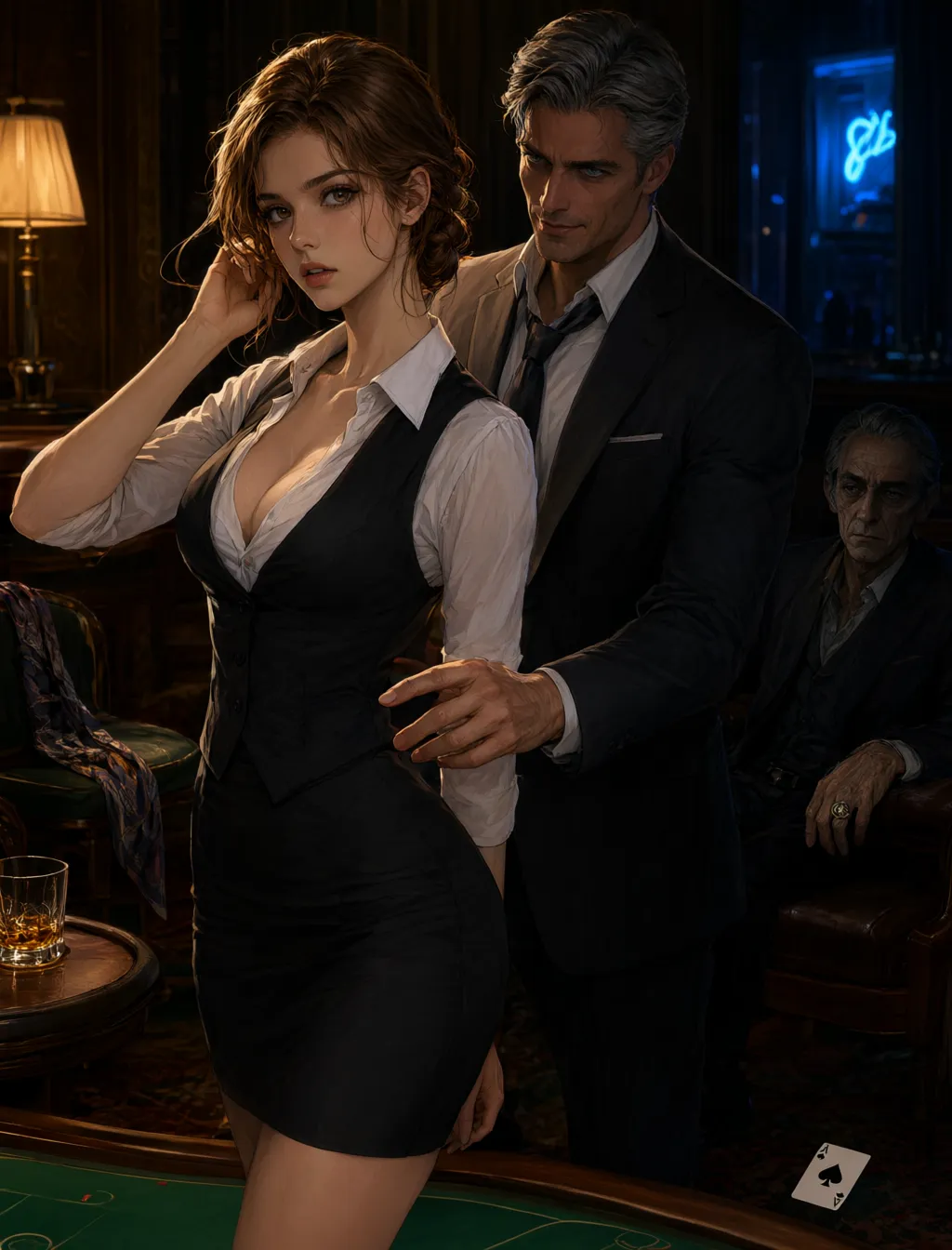
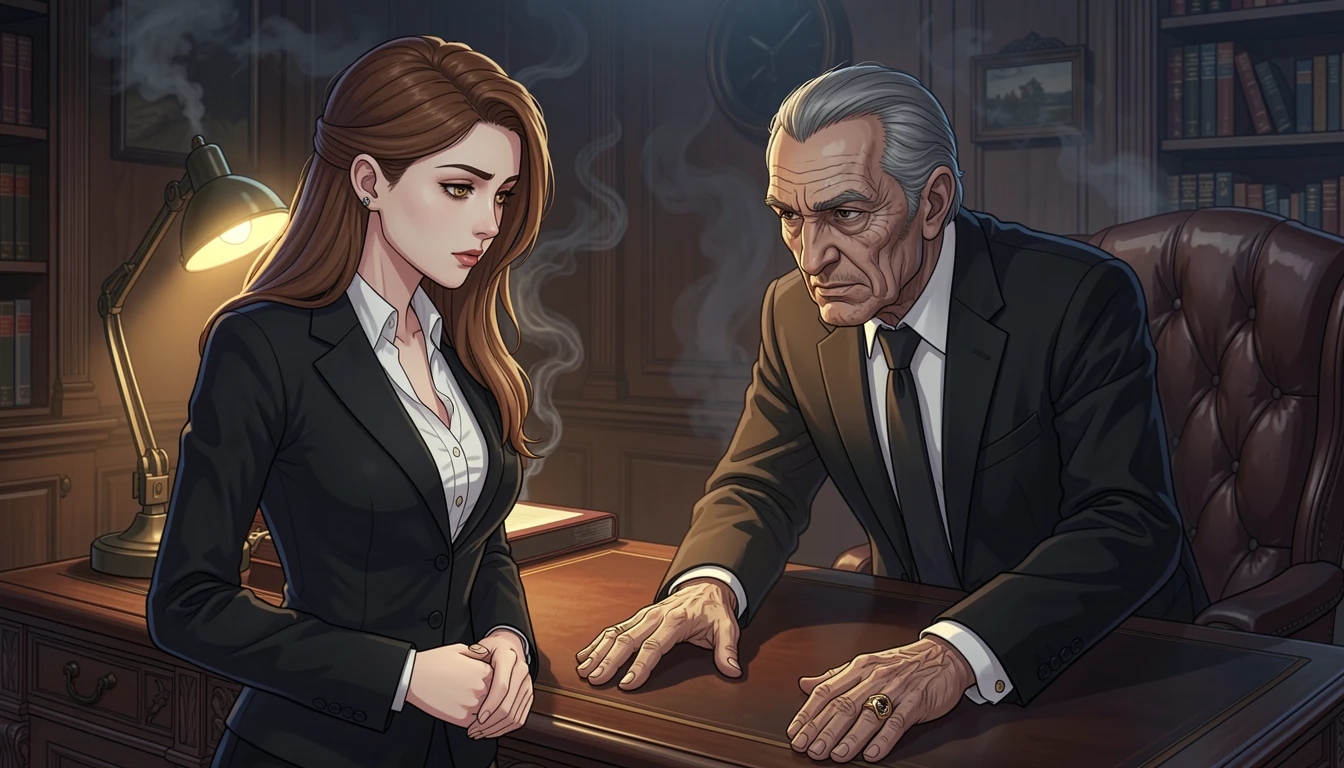
The heavy door clicked shut behind me, and the sound sealed the room like a lid on a jar. I stood just inside, my hands clasped in front of me, the familiar pose of a servant waiting to be acknowledged. The Don's office smelled of leather and cigar smoke and old wood polish, the air warm and still, pressing against my skin like a hand I couldn't shrug off.
The clock on the wall ticked. Once. Twice. The sound was louder than it should have been, marking the silence the way a metronome marks a song no one was playing.
Don Ricci sat behind his desk, his small wiry frame almost lost in the high-backed chair. His face was a crumpled newspaper of wrinkles and old scars, and his dark eyes watched me the way a man watches a chess piece he's already decided to move. His signet ring caught the lamplight as he gestured—one finger, a lazy curl—telling me to speak.
"Well," he rasped, his voice dry as paper. "You saw him."
"Yes, Don." My voice came out steady. I'd practiced it. The words sat on my tongue like coins I'd counted a hundred times. "He came on Friday, as you said he would."
"And?"
"He's a collector." I let the word hang, shaping it the way Alexander had shaped it for me. "He collects things that remind him of what he's lost."
The Don's eyes narrowed, a flicker of something I couldn't read passing through them. He leaned back, the chair creaking under him, and I felt the sound in my spine. "Things," he repeated, tasting the word. "Or people?"
I kept my face still. "He's interested in me. He singled me out the first night he came."
"That's what I told you he'd do."
"Yes, Don."
The clock ticked again. I counted the seconds between each beat, holding my breath without meaning to. The rehearsed words were there, smooth and practiced on my tongue, but the air in the room was thick with something else—the Don's patience, which I'd learned was a blade that cut slow.
"He's not like the others," I said, and the words came out before I could stop them. "He doesn't want—" I caught myself, my teeth clicking shut. The pause stretched, and I felt the Don's attention sharpen like a knife being drawn across a whetstone.
"Doesn't want what?"
I swallowed. "He doesn't want what the others want. Not just—" I gestured vaguely at my body, the uniform, the whole arrangement. "He wants to talk. He asks questions. He looks at me like I'm a puzzle he's trying to solve."
The Don's fingers tapped once on the desk. A small tell I'd learned to read—not impatience, not quite. Interest, maybe. Or calculation. I couldn't be sure.
"A puzzle," he said, his voice slow and deliberate. "That's a dangerous thing for a man like Sterling to find. He's used to solving them."
"I don't think I'm a puzzle he can solve, Don."
The words hung in the air between us, and I felt the risk of them like a stone in my chest. The Don's eyes held mine for a long moment, and I forced myself not to look away. I'd learned that much—that looking away was a confession, and I couldn't afford to confess anything.
"You've been meeting him," the Don said. Not a question. A statement, laid out like a card on the table. "In the casino. In your room."
"Yes, Don."
"And he's been—" The Don paused, his dark eyes searching my face. "Charming you."
I felt the word land like a slap. "He's been kind to me," I said, and the honesty of it surprised me. "He treats me like a person, not a—" I stopped, the word catching in my throat.
"Not a thing," the Don finished for me. His voice was dry, almost amused. "Is that what you think you are, Tina?"
I didn't answer. I couldn't. The truth sat in my chest like a stone I'd swallowed, too heavy to bring up.
The Don leaned forward, his elbows on the desk, his signet ring catching the light again. The gesture was slow, deliberate, and I felt the weight of it in the way the air seemed to thicken around us.
"Has he mentioned what he's truly looking for?"
The question landed into silence. I felt my tongue go dry, the word 'no' rising to my lips like a fragile shield. But the word didn't come. It stuck in my throat, caught on the memory of Alexander's voice, the way he'd said Eleanor's name like it was a wound he carried. The way he'd looked at me when he said he was looking for something he'd lost.
"Tina." The Don's voice was patient. Too patient. "I asked you a question."
"No," I said, and the word came out smaller than I'd meant it to. "No, Don. He hasn't."
The word sat in the air between us, small and hollow, and I felt the Don weigh it the way a man weighs a coin he suspects is counterfeit. His dark eyes held mine, and I kept my gaze steady, the way I'd practiced in the mirror of my narrow room, the way Alexander had taught me without meaning to—by looking at me like I was worth looking at.
"No," the Don repeated, tasting the word the way he'd tasted 'things' a moment ago. "He hasn't mentioned what he's truly looking for."
"No, Don."
The clock ticked. I counted the seconds—one, two, three—and the silence stretched between us like a wire pulled taut. The Don's fingers drummed once, twice, on the polished wood of his desk, and I watched the signet ring catch the lamplight with each tap, a small gold sun rising and falling.
"And yet," the Don said slowly, "you know something about what he's looking for."
My heart stuttered. I felt it in my chest, a bird beating against a cage, and I forced my hands to stay still at my sides, my nails pressing into my palms hard enough to leave crescents.
"I don't understand, Don."
"You're a terrible liar, Tina." He said it almost kindly, the way a man might explain the weather. "You've always been. It's one of the things I like about you. You wear your tells where everyone can see them."
I felt the words land in my stomach, cold and heavy. The rehearsed report I'd shaped with Alexander, the smooth practiced sentences, suddenly felt like sand slipping through my fingers.
"He talks to me," I said, and my voice came out steadier than I felt. "He tells me things. About his work, the casinos he's been to, the cities he's seen. He likes the sound of his own voice, I think."
"Mm." The Don leaned back, the chair creaking under him, and I felt the sound in my teeth. "And what does he sound like, when he talks about what he's lost?"
The question caught me off guard, and I felt my face go still—too still, the way a mask goes still when the hand behind it freezes. The Don's eyes narrowed, and I knew he'd seen it.
"He doesn't talk about that," I said.
"No?"
"No, Don." The lie came easier this time, smoother, sliding off my tongue like a coin into a slot. "He talks about the present. The future. What he's building."
The Don was quiet for a long moment, and I felt the weight of his attention like a hand on the back of my neck. The cigar smoke in the room curled toward the ceiling, slow and lazy, and I watched it the way I'd learned to watch the hands of a clock when I was waiting for something terrible to happen.
"You've changed," the Don said finally. "Since you started seeing him."
I didn't answer. I couldn't trust my voice.
"You stand differently," he continued, his dry rasp almost conversational. "You hold your shoulders like you're expecting something good instead of something bad. You look at me like I'm a man instead of a god."
The words hit me like cold water, and I felt the truth of them settle into my bones. I had changed. Alexander had changed me, in the space of a single night, in the bare room with the key on the table by the window.
"I'm sorry, Don," I said, and the apology came out before I could stop it. "I didn't mean—"
"Didn't mean to become a person?" The Don's voice was dry, almost amused. "Didn't mean to start wanting things?"
I felt the words land like stones in a still pond, each one sending ripples through the silence. The Don leaned forward again, his elbows on the desk, his signet ring catching the light, and I felt the weight of his next question before he even asked it.
"What do you want, Tina?"
The question hung in the air, and I felt it press against me from all sides, the way the warm still air of the office pressed against my skin. I opened my mouth, and the word that came out surprised me.
"To be seen."
The Don's eyebrows rose, a slow arch of surprise that I'd never seen on his face before. "Seen," he repeated, tasting the word. "By whom?"
I felt the trap closing around me, the careful web of lies I'd woven starting to fray at the edges. "By the people I serve," I said, and the words came out smooth, practiced, almost true. "By the men who look at me and see a thing they can use. I want—" I paused, and the silence stretched, and I felt the Don's patience like a blade at my throat. "I want to be a person to someone."
The Don was quiet for a long moment, and I watched his face, trying to read the calculation behind his dark eyes. His fingers tapped once on the desk, and I felt the tell land in my chest like a stone.
"A person," he said slowly. "That's a dangerous thing to want, Tina. Especially for a woman in your position."
"I know, Don."
"Do you?" He leaned back, the chair creaking, and the sound filled the room like a held breath released. "Because I've seen women want things before. I've seen what it does to them. The wanting eats them from the inside, hollows them out until there's nothing left but the wanting itself."
I felt the words land in my chest, cold and heavy, and I forced myself to hold his gaze. "I'm not asking for anything, Don. I'm just telling you what I feel."
"And what you feel," he said, "is what Sterling has put there."
The words hit me like a slap, and I felt the truth of them sting. "No," I said, but the word came out weak, uncertain. "He didn't—"
"He didn't what?" The Don's voice was sharp now, cutting through the warm still air like a blade. "He didn't show you what it feels like to be treated like a person? He didn't make you feel like you could want something for yourself?"
I felt the tears prick at my eyes, and I blinked them back, hard, the way I'd learned to do in the months since the Don had remade me. "He was kind to me," I said, and my voice cracked on the word, the way a bone cracks under pressure. "That's all."
The Don was quiet for a long moment, and I felt the silence press against me, heavy and patient, the way a man presses his thumb against a bruise to see if it still hurts. His signet ring caught the lamplight as he turned it on his finger, a slow, deliberate motion, and I watched it the way a bird watches the shadow of a hawk.
"Kind," he repeated, tasting the word. "That's a dangerous word, Tina. It's the kind of word that makes women do foolish things."
"I'm not foolish, Don."
"No," he said, and his voice was almost gentle. "You're not. That's what worries me."
The clock ticked again, and I counted the seconds—one, two, three, four—and the silence stretched between us like a rope pulled taut, ready to snap. The Don's eyes held mine, and I forced myself not to look away, not to blink, not to let him see the fear I could feel coiling in my stomach like a snake.
"Sterling," the Don said finally, and the name landed in the room like a stone dropped into still water. "He's a collector. You told me that."
"Yes, Don."
"And what does he collect?"
I felt the question land in my chest, and I knew, suddenly, with a cold certainty that settled into my bones like frost, that this was the question the Don had been circling the whole time. The report I'd crafted with Alexander, the careful half-truths I'd shaped like clay in my hands, suddenly felt thin, fragile, transparent.
"Things," I said, and the word came out hollow. "Things that remind him of what he's lost."
The Don's fingers tapped once on the desk, and I felt the tell land in my stomach like a stone. "And what," he said slowly, "has he lost?"
I felt the word rise to my lips—Eleanor, the name Alexander had spoken like a wound he carried, the name that had hung in the air between us in the bare room with the key on the table. I felt it there, on my tongue, a secret I'd promised to keep, and I felt the weight of the choice pressing down on me like a hand on the back of my neck.
"I don't know, Don," I said, and the lie came out smooth, practiced, almost true. "He doesn't talk about it."
The Don was quiet for a long moment, and I watched his face, trying to read the calculation behind his dark eyes. His signet ring caught the light as he turned it on his finger, and I felt the silence stretch between us, patient and heavy, the way a man waits for a confession he knows is coming.
"You're lying to me," the Don said finally, and his voice was flat, certain, the way a man states a fact he's known for years. "I can see it in your eyes, Tina. The way you hold them too steady, the way you blink too slow. You're lying to me, and you're doing it for him."
I felt the words land in my chest like a blow, and I felt the air leave my lungs in a rush. The room seemed to tilt around me, the cigar smoke curling toward the ceiling, the clock ticking its patient seconds, the Don's dark eyes boring into mine like augers.
"Don," I said, and my voice came out small, fragile, the voice of the woman I'd been before Alexander had looked at me like I was worth looking at. "I—"
"You've become his confidante," the Don said, and his voice was dry, almost amused, the way a man is amused by a trap he's watched a small animal walk into. "That's what you are now, isn't it? His little confidante, the woman he tells his secrets to."
I felt the tears prick at my eyes again, and I blinked them back, hard, the way I'd learned to do. "He doesn't have secrets, Don," I said, and the lie came out weaker than I'd meant it to. "He's just—he's just a man who likes to talk."
"And what does he talk about, when he's not talking about the present? When he's not talking about the future? What does he talk about when he's lying in the dark, holding you, thinking you're asleep?"
The question landed in the silence like a stone dropped into a well, and I felt it fall through me, past my practiced composure, past the smooth rehearsed words, past the fragile shield of the word 'no' I'd raised like a hand against a blow. The Don's eyes held mine, patient and knowing, and I felt the truth of what I'd done settle into my bones like cold water.
"He talks about a woman," I said, and the words came out before I could stop them, spilling from my mouth like coins from a torn pocket. "A woman he lost. Her name was—"
I stopped. The name hung in the air between us, unspoken, and I felt the weight of it like a stone in my chest. The Don's eyes narrowed, and I saw the calculation behind them sharpen, the way a blade sharpens on a whetstone.
"Her name was what?"
I felt the choice press down on me, the weight of Alexander's secret, the weight of the promise I'd made in the bare room with the key on the table by the window. I felt the tears prick at my eyes, and I blinked them back, hard, and I opened my mouth to speak.
The clock ticked.
The cigar smoke curled.
The Don waited.
The name sat on my tongue like a live coal, burning to be spat out, warning me not to. Eleanor. One syllable from my lips and everything Alexander had offered me—the future, the being seen, the fragile thing we'd built in a bare room with a key on a table—would turn to ash. But the Don's eyes were patient augers, boring into the silence I'd let stretch too long, and I knew with a cold certainty that the word 'no' had already failed me once tonight.
I let my shoulders drop. Let my chin tilt down, the way I'd seen the other girls do when they wanted to seem smaller, softer, less dangerous. I let my voice go thin, reedy, the voice of a woman who'd been broken and knew it.
"Her name was Rosa," I said. "She worked the floor. Years ago, before I came."
The Don's eyebrows drew together, a slow fold of wrinkles that made his face look like a map being creased along an old fault line. "Rosa."
"She had dark hair. Long, like mine." I touched my own chestnut cascade, a gesture I'd seen the other girls make a hundred times, a nervous feminine thing that bought me a second to think. "She used to sing, sometimes, when she thought no one was listening. Old songs. Italian ones."
I was building it as I went, a woman out of smoke and memory, and the strangest part was how easily the details came. I'd heard Marco mention a Rosa once, a girl who'd worked the floor before my time, a girl who'd disappeared one night and never come back. Whether she'd sung or not, I didn't know. But the Don didn't know either.
"He talks about her," I said, and my voice cracked on the words, a carefully placed fracture. "When he's tired. When he thinks I'm asleep. He says her name like it hurts him."
The Don was quiet for a long moment. His signet ring turned on his finger, a slow, deliberate motion, and I watched the gold catch the lamplight, a small sun rising and falling. I'd learned to read that motion—it was the Don's version of a breath, a pause to weigh what he'd been handed.
"Rosa," he repeated, tasting the name the way he'd tasted 'things' and 'kind' and 'no.' "I don't remember a Rosa."
"She was before me, Don. You wouldn't have had reason to notice her."
"And yet you did."
I felt the trap closing around me, the careful architecture of my lie starting to strain at the joints. "Marco mentioned her once. When I first came. He said she was pretty, and that she'd moved on." I let the words hang, then added, softer, "I didn't know she was someone Sterling had known until he said her name."
The Don's eyes narrowed, and I felt the calculation behind them sharpen. He was a man who'd spent forty years reading lies off the faces of men who thought they could fool him, and I knew—I knew—that my lie was a thin thing, a paper boat floating on a river of truth. But a paper boat could float, if the current was right.
"And what did Sterling say about her?" the Don asked. "This Rosa."
I let my gaze drop to the floor, the way I'd practiced in the mirror of my narrow room. "He said she was the one who got away. That he'd loved her, and that she'd chosen someone else." I paused, letting the silence stretch, then added, "He said he's been looking for her ever since."
The lie landed, and I felt it land, the way a stone lands in deep water—a small splash, then nothing, then the slow spread of ripples. The Don's fingers tapped once on the desk, and I felt the tell in my chest like a second heartbeat.
"Looking for her," he repeated. "A woman who chose someone else. A woman who's been gone for years."
"Yes, Don."
"And he thinks you're her."
The words hit me like cold water, and I felt them soak through the careful armor of my lie. "He thinks I remind him of her," I said, and my voice came out steadier than I felt. "The hair. The way I move. He said—" I paused, letting my voice catch. "He said I have her eyes."
The Don leaned back in his chair, and the creak of the leather filled the room like a held breath released. His dark eyes held mine, and I forced myself not to look away, not to blink, not to let him see the lie I'd woven like a spider's web around the truth of Eleanor's name.
"That's convenient," the Don said slowly, "for a man who collects things that remind him of what he's lost."
"I thought so too, Don."
"And you believe him? That you remind him of this Rosa?"
I felt the question land in my chest, and I knew, suddenly, that this was the crux of it—the test the Don had been building toward all night. I could say yes, and let him believe I was a replacement for a ghost, a tool he could use to keep Sterling close. Or I could say no, and let him see the truth—that Alexander saw me, not some woman from his past, and that what we had was real.
I chose the lie that kept us both safe.
"I don't know if I believe him," I said, and the words came out soft, uncertain, the voice of a woman who'd been told she was pretty her whole life and never quite believed it. "I don't know what I am to him. But he looks at me like I matter, Don. And I've never had that before."
The Don was quiet for a long moment, and I watched his face, trying to read the calculation behind his dark eyes. His signet ring turned on his finger, and I felt the silence stretch between us, patient and heavy, the way a man waits for a confession he knows is coming.
"You've given me a name," he said finally. "Rosa. A woman from the casino's past. A woman Sterling loved and lost." He paused, and his voice dropped, dry and almost amused. "And you expect me to believe that's all he's looking for."
"It's what he told me, Don."
"Mm." The Don leaned forward, his elbows on the desk, his signet ring catching the light. "And you've never once thought to wonder why a man like Sterling—a man with his money, his power, his reach—would come to a casino like this one, to a girl like you, to find a woman who left him years ago?"
I felt the question land in my chest like a stone, and I forced my face to stay still, my hands to stay clasped in front of me. "I don't think about why he comes, Don. I just—" I paused, letting my voice catch. "I just serve him, the way you told me to."
"And you've been serving him well."
It wasn't a question. I felt the words land in my stomach, cold and heavy, and I knew what the Don was really saying—that he'd been watching, that he'd seen the way I'd changed, that he knew the service I'd given Sterling went far beyond the uniform I wore.
"Yes, Don," I said, and the words came out small, fragile. "I've been serving him well."
The Don's eyes held mine for a long moment, and I felt the weight of his attention like a hand on the back of my neck. Then he smiled—a slow, thin smile that didn't reach his eyes, the smile of a man who'd just been handed a piece he wasn't sure he could trust but would play anyway.
"Good," he said. "That's good, Tina. A man like Sterling, he needs to feel wanted. He needs to believe he's found something worth keeping." He paused, and his voice dropped, dry and almost gentle. "You've given him that. A woman who looks like his lost Rosa, who lets him talk about her, who makes him feel like he's found her again."
I felt the words land in my chest, and I knew—with a cold certainty that settled into my bones like frost—that the Don had accepted my lie. He'd taken the name I'd given him, Rosa, and he'd woven it into his own understanding of Alexander Sterling, a collector who'd found a ghost he thought he could reclaim.
But I also knew he hadn't fully believed me. The way he'd said her name, tasting it like a coin he suspected was counterfeit—he'd file it away, check it against what he knew, and if it didn't hold, the lie would come back to me like a debt.
"I'll verify it," the Don said, and his voice was casual, almost offhand, the way a man mentions the weather. "This Rosa. I'll ask Sterling himself, next time he comes." He paused, and his smile widened, a thin blade of amusement. "He'll be glad to know you remember her, I think. Glad to know you've been thinking about her."
I felt the words land in my stomach like a stone dropped into deep water, and I forced my face to stay still, my hands to stay clasped, my breath to stay even. The Don was going to ask Alexander about Rosa—about a woman who'd never existed, a name I'd conjured out of smoke and Marco's passing mention—and when he did, the lie would unravel, and I would be left holding the threads.
But I'd bought us time. That was what mattered. Time for Alexander to figure out what he wanted, time for me to figure out what I was, time for the fragile thing we'd built in a bare room to grow roots deep enough to survive the Don's scrutiny.
"Thank you, Don," I said, and the words came out smooth, practiced, almost true. "For understanding."
The Don's smile didn't waver. It sat on his face the way his signet ring sat on his finger—a thing of weight and habit, worn so long it had become part of him. He nodded once, a slow dip of his chin that could have meant anything, then reached for the crystal decanter on the corner of his desk.
"Understanding," he repeated, pouring two fingers of amber into a glass. He didn't offer me one. "That's a generous word for what I do, Tina. I don't understand people. I read them. There's a difference."
He tilted the glass, watching the liquor coat the crystal, and I understood I was being shown something—a ritual, a glimpse behind the curtain he let very few see. "When I read you tonight, I see a woman who's learned to lie with a straight face. That's a skill. Most of my girls never learn it. They get by on their bodies and their tears."
I kept my hands clasped in front of me, nails pressed into my palms. The crescents I'd dug earlier were still there, faint red marks that would fade by morning, the way the mark from the key had faded. Everything faded eventually. That was the thing about marks—they only lasted if something kept pressing them.
"But you," the Don continued, "you've learned something else. You've learned to lie with your whole body. The way you dropped your shoulders. The way you touched your hair. Small things. Feminine things." He took a sip, his dark eyes never leaving mine. "You've learned to be convincing."
I felt the compliment land in my chest, and I didn't know what to do with it. Praise from the Don was a currency I'd never learned to spend. It always came with a receipt, a debt attached, a string I couldn't see until it was already tied around my wrist.
"Thank you, Don," I said again, because I didn't have anything else.
"Don't thank me." He set the glass down with a soft click. "I'm not praising you. I'm telling you what I see so you understand what I'm going to do next."
The room went still. The clock ticked. The cigar smoke curled. I felt my pulse in my throat, a small drum beating against the silence, and I forced myself to breathe slow, even, the way I'd learned to breathe when Vitale's hands had been too rough and I'd needed to disappear into a place he couldn't reach.
"I'm going to let you keep seeing him," the Don said. "I'm going to let you keep serving him, the way you've been serving him. And I'm going to ask him about Rosa."
I felt the words land, and I kept my face still, the way I'd practiced. "Yes, Don."
"But here's what you're going to do for me in return." He leaned forward, and the lamplight caught the deep lines of his face, carving them into a geography I couldn't read. "You're going to keep your ears open. You're going to listen to what he says about this Rosa, and you're going to tell me if the story changes."
"The story, Don?"
"The story." He picked up the glass again, swirled it, didn't drink. "Men like Sterling, they tell the same story over and over until they believe it themselves. But the details slip. A name gets said differently. A date moves. A woman's eyes change color." He looked at me over the rim of the glass. "When the details slip, you'll notice. And you'll tell me."
I felt the trap close around me, and I understood, with a clarity that settled into my bones, that the Don had just made me complicit in my own lie. He wasn't asking me to spy on Alexander. He was asking me to police the fiction I'd created, to hand him the threads as they frayed, to sit at the center of a web I'd spun myself and watch him pull.
"I will, Don," I said, and the words tasted like ash.
"Good." He set the glass down, and the sound was final, a period at the end of a sentence. "You can go. Get some sleep. You'll need your wits about you when Friday comes."
I nodded, a small dip of my chin that mirrored his, and turned toward the door. My legs felt strange, disconnected, as if the floor had shifted beneath me while I wasn't looking. I'd come into this office a woman with a secret, and I was leaving a woman with a story—a story I'd built out of smoke and a dead girl's name, a story the Don was going to check, a story that would unravel the moment Alexander opened his mouth.
My hand was on the door handle when the Don's voice stopped me.
"Tina."
I turned. He was still sitting behind his desk, still holding the glass, still watching me with those dark, patient eyes. The signet ring caught the light as he turned it on his finger, and I felt the gesture land in my chest like a small, cold coin.
"Rosa," he said, tasting the name one last time. "That's a good name. Old-fashioned. The kind of name a man remembers."
I didn't answer. I couldn't. The word sat in my throat, a lie I'd given breath to, and I felt it settle there, patient as the Don himself, waiting to be fed again.
"Goodnight, Tina," the Don said, and his voice was almost kind.
"Goodnight, Don."
I pulled the door open and stepped into the corridor, and the heavy click of the latch behind me sealed the room shut like a lid on a jar. I stood in the dim light of the hallway, my hands clasped in front of me, my breath coming in shallow drafts, and I felt the weight of what I'd done settle over me like the warm, still air of the office—pressing, patient, impossible to shrug off.
I'd given the Don a name. A false name. A name I'd built from a passing mention and a dead girl's ghost, and I'd watched him weigh it, test it, decide to keep it. He'd accepted my lie, or he'd pretended to, and I couldn't tell which—and that uncertainty was the sharpest thing I'd carried out of that room.
The corridor stretched ahead of me, empty and dim, the carpet muffling my footsteps. I walked toward my narrow room, past the door at the end of the hall—the door to the secret room, the room with the key on the table by the window, the room where Alexander had looked at me like I was worth looking at.
I stopped. My hand went to my pocket, found the key Marco had given me, the key Alexander had returned. The metal was warm from my body heat, worn smooth from the hours I'd spent gripping it.
The room was dark. The corridor was empty. The Don was behind his door, nursing his whiskey and my lie.
I turned the key in the lock and stepped inside.
The key turned smooth in the lock, and I stepped into the dark of the room that was mine and Alexander's and no one else's. The air was cooler here, stiller, as if the walls had been holding their breath since the last time we'd been inside them. I closed the door behind me and stood for a moment, letting my eyes adjust, letting the silence settle around my shoulders like a coat I'd forgotten I owned.
There was a single lamp on the table by the window, the one Alexander had left burning the first night he'd brought me here. I crossed to it and turned the switch, and the small circle of light bloomed across the bare floor, catching the dust motes that hung suspended in the air, spinning slow and gold, the way they'd spun the night he'd looked at me like I was worth looking at.
I knelt by the bed.
The floorboard was the third one from the corner, the one I'd pried loose with the edge of a butter knife the second week I'd had the room, when I'd needed a place to hide the things I couldn't carry. I worked my fingernails into the seam and lifted, and the board came up with a soft groan of old wood, the sound a thing makes when it's been holding a secret too long.
Beneath it, in the shallow hollow I'd carved with the same knife, lay the photograph.
I'd wrapped it in a scrap of cloth I'd torn from an old uniform, the same wine-colored silk as the dress I'd worn the night the Don had stripped me bare in his office. I unwrapped it now, my fingers moving slow, careful, the way I'd learned to handle things that could break, and the lamplight fell across the face of the woman Alexander had lost.
Eleanor.
She was beautiful in the way that hurts to look at, the way a thing is beautiful when you know you can never have it. Dark hair, longer than mine, falling past her shoulders in waves that caught the light of whatever afternoon the photograph had been taken in. Eyes that might have been brown, might have been green—the print was old, faded at the edges, the colors bleeding into each other like water. She was smiling, but it was a careful smile, the kind a woman wears when she's being photographed by someone she loves and doesn't want to ruin the moment by looking too happy.
I knew that smile. I'd worn it myself, in the mirror of my narrow room, practicing the way a woman looks when she's been seen.
Alexander had given me the photograph the second time he'd brought me here, on a night when the casino had been loud and I'd needed somewhere quiet to breathe. He'd taken it from his wallet, worn at the corners the way a thing is worn when it's been carried for years, and he'd placed it in my palm like it was made of glass.
"I want you to know her," he'd said. "I want you to understand what I lost."
I'd looked at the photograph for a long time, and then I'd looked at him, and I'd seen the same thing in his eyes that I saw in the photograph—a grief that had been carried so long it had become a part of him, a thing he'd learned to walk with the way a man walks with a limp.
"She was beautiful," I'd said.
"She was." He'd taken the photograph back, studied it the way a man studies a map of a place he'll never return to. "She was the only woman I ever loved. The only woman I ever will."
I'd felt the words land in my chest then, a weight I hadn't known how to carry. And I'd asked the question I'd been afraid to ask, the question that had been sitting on my tongue like a coin since the first night he'd looked at me like I was a puzzle he was trying to solve.
"Why me?"
He'd looked at me then, and the lamplight had caught his eyes, and I'd seen something there I hadn't seen before—something that looked like hope, and fear, and a hunger that had nothing to do with my body.
"Because you remind me of her," he'd said. "Not the way she looked. The way she made me feel. Like I'd found something I didn't know I was looking for."
I'd felt the words settle into my bones, and I'd known, with a certainty that had nothing to do with logic, that I would do anything to keep that look in his eyes. Anything.
And now I knelt by the bed in the bare room, holding the photograph of the dead woman I'd claimed to be, and I felt the weight of what I'd done settle over me like the warm, still air of the Don's office.
I'd given the Don a name. Rosa. A woman who'd never existed, a ghost I'd conjured out of Marco's passing mention and my own desperate need to protect the secret Alexander had trusted me to keep. I'd woven her from smoke and memory, given her dark hair and a singing voice and a love that had been chosen by someone else, and I'd watched the Don weigh her the way a man weighs a coin he suspects is counterfeit.
And he'd accepted her. Or he'd pretended to. And I couldn't tell which.
"He'll ask him," I whispered to the photograph, to the dead woman who wasn't Rosa, to the ghost I'd built to keep Eleanor's name safe. "The Don will ask him about you, and he won't know who you are, and the lie will unravel, and everything we've built will turn to ash."
The photograph didn't answer. It couldn't. It was just paper and ink and the memory of a woman who'd died six years ago, a woman Alexander had loved with a love that had no room for anyone else.
Except somehow, impossibly, there was room for me.
I ran my thumb along the edge of the photograph, feeling the worn corners, the soft give of the paper where it had been held too many times. I'd held it myself, more times than I could count, in the weeks since Alexander had given it to me. I'd studied the curve of Eleanor's jaw, the way her hair fell, the careful smile she'd worn for the man she loved. I'd tried to find myself in her features, the way Alexander had found her in mine.
"He sees me," I said, and my voice cracked on the words, the way it had cracked in the Don's office when I'd told him about Rosa. "He sees me, not you. He told me that. He said I remind him of the way you made him feel, not the way you looked."
I paused, the photograph trembling in my hands.
"But I don't know if that's true. I don't know if I'm a person to him, or just a reminder of a person. I don't know if he looks at me and sees me, or if he looks at me and sees you, and I'm just—" I swallowed, the words catching in my throat. "I'm just the closest thing he could find to what he lost."
The room was silent. The dust motes spun in the lamplight. The photograph stared up at me with eyes that might have been brown, might have been green, and I felt the weight of her gaze like a hand on my shoulder.
I'd lied to the Don tonight. I'd woven a story out of smoke and a dead girl's name, and I'd watched him accept it, or pretend to accept it, and I'd walked out of his office with the lie still burning on my tongue. But the truth was simpler than the lie, and it sat in my chest now, heavy and patient, the way the Don himself sat behind his desk.
The truth was that I didn't know what I was to Alexander. I didn't know if I was a replacement for a ghost, or a puzzle he was trying to solve, or a woman he actually saw, actually wanted, actually loved.
And I was afraid to find out.
Because if I was just a reminder, just a stand-in for a dead woman's memory, then everything I'd felt in his arms, everything I'd let myself believe about being seen, about being a person to someone—it would all turn to ash, the way the Don's lie would turn to ash the moment he asked Alexander about Rosa.
I looked down at the photograph one last time. Eleanor's careful smile. Eleanor's dark hair. Eleanor's eyes that might have been brown, might have been green.
"I'm sorry," I whispered. "I'm sorry I'm not her. I'm sorry I can't be her. I'm sorry I'm just—" I paused, the words catching in my throat. "I'm sorry I'm just me."
The photograph didn't answer. It couldn't. But I felt something shift in my chest anyway, a small loosening of the knot I'd been carrying since the night Alexander had first looked at me like I was worth looking at.
I sat back on my heels, the photograph still in my hands, and let the silence of the room do its work. The lamplight pooled around me, a small island of gold in the dark, and I watched the dust motes drift through it the way I'd watched the smoke curl in the Don's office—patient, aimless, going nowhere.
My thumb traced the edge of the photograph again, and I thought about the Don's signet ring, the way he'd turned it on his finger while I'd spun my story about Rosa. He'd known I was lying. I was certain of it now, the way you're certain of a thing you've been avoiding all night. He'd known, and he'd let me lie anyway, and that was worse than if he'd caught me outright. Because a man who catches you in a lie punishes you. A man who lets you lie, who watches you build the trap you'll eventually walk into, is a man who's already decided how the story ends.
I looked at Eleanor's face again, and I tried to imagine what she'd think of me—this woman who'd taken her place in the arms of the man she'd loved, who'd borrowed her ghost to build a fiction that might save them both or destroy them entirely.
She'd probably forgive me. That was the kind of face she had. The kind that forgave.
I envied her that. I envied her the certainty of being loved, the way Alexander had loved her, with a love that had no room for doubt. I envied her the way she'd died, if that made any sense—the way she'd left behind a grief so sharp it had carved a space in Alexander's chest that he'd spent six years trying to fill.
And I envied her the photograph. The proof that she'd been real, that she'd existed, that someone had looked at her the way Alexander had looked at her in that careful smile.
I had no photograph of myself. No record of the person I'd been before the Don had remade me. The man I'd been had left no trace—no family to remember him, no friends to wonder where he'd gone, no one to carry a worn photograph in a wallet and say her name like it hurt.
I'd been erased so completely that I sometimes wondered if I'd ever existed at all.
But Eleanor had existed. Eleanor had been loved. Eleanor had left a mark on the world that six years of grief hadn't been able to scrub away.
And I was holding her face in my hands, using her to buy myself time, and I didn't know if that was a betrayal or a survival instinct or something in between.
A sound from the corridor pulled me out of my head—footsteps, soft and unhurried, passing the door. I held my breath, the photograph pressed against my chest, and listened to them fade toward the stairs. Not the Don's step. Not Marco's. Just a night shift worker heading home, or a guard making his rounds, someone with no reason to stop at a door that was supposed to be locked.
I waited until the silence settled back into place, then let my breath out slow.
The photograph was warm against my skin, the paper soft from years of handling. I pulled it away and looked at it one more time, and I felt the weight of the choice I'd made settling into my bones like cold water.
I couldn't keep it here. That was the thought that surfaced, unbidden, from the dark of my mind. The Don had accepted my lie about Rosa, but he hadn't believed it, and a man who suspects a lie starts looking for the truth. If he searched this room—and he would, if the suspicion grew—he would find the photograph, and he would see Eleanor's face, and he would know.
I couldn't burn it. It was the only proof I had that Alexander had trusted me with something real, something that mattered. It was the only proof I had that I was more than a thing he used when he visited the casino.
But I couldn't keep it here either. The room was a secret, but secrets had a way of leaking, and the Don had a way of finding what he was looking for.
I looked around the bare room, my eyes scanning the walls, the floor, the single window with its thin curtains. There was nowhere else to hide it. The floorboard was the best I had, and it wasn't good enough.
My hand went to my pocket, where the key Marco had given me still sat, warm from my body heat. The key to this room. The key Alexander had returned to me, telling me to keep it.
I looked at the photograph in my hands, and I thought about what it would mean to carry it with me. To keep it close, the way Alexander had kept it in his wallet, worn at the corners from years of being held.
It was a risk. If the Don found it on me, if anyone found it, the lie would unravel faster than I could spin another one.
But leaving it here felt like leaving a part of Alexander behind. Like admitting that what we had was too fragile to survive contact with the world outside this room.
I ran my thumb along the edge of the photograph one last time, feeling the worn paper, the soft give of the corners. Eleanor's careful smile looked up at me, patient and forgiving, and I made my choice.
I folded the photograph in half, careful, along the crease that was already there from years of sitting in Alexander's wallet. The paper resisted for a moment, then gave, and I tucked it into the waistband of my uniform, against my skin, where the warmth of my body would keep it safe.
The floorboard lay open at my feet, the hollow empty now, the scrap of wine-colored silk still lying at the bottom like a discarded skin. I picked up the silk and folded it, small and neat, and pressed it back into the hollow, as if something had been there and been taken away.
Then I lowered the board and pressed it flush with the floor, running my palm along the seam until it was smooth, invisible, the way I'd learned to make myself.
The room was quiet again. The lamp still burned on the table by the window. The dust motes still spun in the gold light, patient and aimless, going nowhere.
I stood, smoothing my uniform, feeling the folded photograph press against my stomach like a secret I'd decided to carry.
The Don would ask Alexander about Rosa. That was coming, sure as the clock on his office wall. And Alexander wouldn't know the name, and the lie would strain at the seams, and I would be there to watch it happen, to see the moment the Don realized he'd been played.
But I had the photograph now. I had Eleanor's face, worn and faded, pressed against my skin. I had the proof that what Alexander felt for me was real, even if I couldn't say what it was.
I crossed to the lamp and turned it off, and the room fell into darkness, the way it had been when I'd stepped inside. The way it would be when I left.
I paused at the door, my hand on the knob, and I let myself feel the weight of the photograph against my stomach, the small, warm press of it, like a hand resting there.
I didn't know if I was a replacement for a ghost. I didn't know if Alexander saw me or saw her when he looked at me. I didn't know if the lie I'd told the Don would hold, or if it would unravel and take everything with it.
But I knew one thing, with a certainty that had nothing to do with logic or fear or the careful architecture of my lies.
I was going to find out.
I opened the door and stepped into the corridor, and the dark of the empty hallway closed around me like a held breath released.
The corridor was empty, but I didn't let myself breathe easy until my own door was locked behind me. The key turned with a soft click, and I stood in the narrow dark of my room, the familiar smell of cheap soap and old bedding settling around me like a second skin.
I crossed to the bed and sat on the edge, the springs complaining under my weight. My hand went to my waistband, where the folded photograph pressed against my skin, warm and patient. I pulled it out and held it in my palm, Eleanor's careful smile catching the thin light from the window. I'd carried her out of the secret room, and now I didn't know what to do with her.
But that wasn't the first thing I needed to do.
The floorboard by my bed was looser than the one in the secret room—I'd pried it up my first week here, when I'd needed somewhere to hide the things I couldn't bear to look at. I worked my fingernails into the seam and lifted, and the board came up with a groan that felt louder than it should have been. Beneath it, wrapped in a scrap of cloth, was the paper I'd hidden there the night after Alexander had first looked at me like I was worth looking at.
A single sheet of casino letterhead, the kind they kept by the phones for taking messages. I'd stolen it from the front desk, folded it small, hidden it away. I hadn't known what I'd write on it. I'd just known I'd need something to write on, eventually, when the words got too heavy to carry in my head.
I set the photograph on the bed beside me, face down, Eleanor's smile hidden. Then I smoothed the paper against my knee and looked for a pen.
There was one in the drawer by my bed—a cheap ballpoint, the kind that skipped and stuttered. I clicked it once, tested it on the corner of the paper. The ink came out thin and watery, but it held.
I wrote:
*The Don asked about Rosa. I said she was real.*
The words sat on the page, small and stark. I read them twice, and the second time they felt heavier, like they'd gained weight just from existing in ink.
I needed to tell him more. I needed to tell him that I'd built a woman out of smoke, given her a name and a singing voice and a love that had been chosen by someone else. I needed to tell him that the Don had accepted it, or pretended to, and that he was going to ask Alexander about Rosa, and that when he did, the lie would strain at the seams.
But I couldn't write all of that. The letterhead was small, and Alexander's hands were careful, and the words had to fit in a pocket, had to be read in a hurry, had to say everything without saying too much.
I wrote the second line:
*I need you to tell me the truth about Eleanor.*
I stopped. The pen hovered over the paper, and I felt the weight of what I'd just written settle into my bones. The truth about Eleanor. It was the question I'd been afraid to ask, the question I'd circled in the dark of the secret room, the question that had been sitting in my chest since the night Alexander had placed her photograph in my palm and told me she'd been the only woman he'd ever loved.
I didn't know if I was a replacement for a ghost. I didn't know if he saw me or saw her when he looked at me. I didn't know if what we had was real, or if it was just the shape of a loss he was trying to fill.
And now the Don was going to ask about Rosa, and I needed to know, before he did, whether Alexander would lie for me or fold.
The pen was still in my hand. The paper was still smooth against my knee. I read the two lines again, and I felt the risk of them like a stone in my chest.
I couldn't send it yet. I didn't know how. Alexander came on Fridays, and this was only Wednesday, and the note would sit in my pocket for two days, pressing against my skin like a secret I couldn't set down.
But I could write it. I could hold it. I could let the words exist in the world, even if no one else had read them yet.
I added one more line, smaller than the others, the pen pressing hard enough to leave a groove in the paper:
*I'm afraid I'm just a reminder.*
I set the pen down. The note lay on my knee, three lines of thin watery ink, and I read them the way I'd read Eleanor's photograph in the secret room—searching for something I couldn't name, some proof that I'd gotten it right.
I didn't find it. I never did.
I folded the paper in half, then in half again, until it was small enough to fit in my palm. I held it there, feeling the edges dig into my skin, and I thought about what it would mean to hand it to Alexander on Friday. What it would mean to watch him read it. What it would mean to see his face when he got to the line about Eleanor.
I didn't know if I was brave enough for that.
But I knew I had to be. The Don was going to ask about Rosa, and Alexander needed to know what I'd done, needed to know what was coming, needed to have time to decide whether he'd play along with my fiction or let it crumble.
I tucked the note into the waistband of my uniform, next to the photograph, and I felt the two papers press against my skin like twin weights. One was a lie I'd built to save us. One was a truth I was afraid to hear.
I lay back on the bed, staring at the water-stained ceiling, the way I'd done the first night I'd come to this room, the night the Don had stripped me bare in his office and told me I belonged to him. The stains had looked like a map then, a geography of cracks and water damage that I'd traced with my eyes until I fell asleep.
They looked different now. I couldn't say how. Maybe the light had changed. Maybe I had.
The photograph pressed against my stomach, a small warm weight. The note pressed against my hip, sharper, the folded edges digging into my skin. I lay between them, staring at the ceiling, and I felt the weight of what I'd done settle over me like the warm, still air of the Don's office.
I'd given the Don a name. I'd woven a story out of smoke and a dead girl's ghost. I'd written a note to Alexander asking him to tell me the truth about Eleanor, knowing the truth might break me.
And tomorrow, I'd have to live with all of it.
The clock on the wall ticked. The city hummed beyond the window, a low drone I'd learned to sleep through. The ceiling stared down at me, patient and cracked, and I let my eyes trace the longest fissure, the one that ran from the corner to the center, splitting the map in half.
I thought about Alexander's hands. The way they'd held the photograph, worn at the corners. The way they'd cupped my face in the secret room, gentle and certain, the way a man holds something he's afraid to break.
I thought about the way he'd said Eleanor's name, like it hurt him. The way he'd looked at me when he said I reminded him of the way she made him feel, not the way she looked.
I wanted to believe him. I wanted to believe that I was a person to him, not a reminder, not a stand-in, not the closest thing he could find to what he'd lost.
But I didn't know. And the note in my waistband was the question I was too afraid to ask out loud.
I closed my eyes, and the ceiling faded, and the weight of the photograph and the note pressed against me, patient and warm.
Tomorrow, I'd find a way to get the note to Alexander. Tomorrow, I'd figure out how to cross the distance between my narrow room and wherever he was, between the lie I'd told and the truth I was afraid to hear.
But tonight, I lay in the dark, holding the two papers against my skin, and I let myself feel the small, terrible hope that had taken root in my chest—the hope that when Alexander read my note, he'd write back the one thing I needed to hear.
That I wasn't a reminder. That I was her.
No. Not her. Me.
The word hung in the dark, small and fragile, and I held it the way I held the photograph, the way I held the note, the way I held the key that opened the room where Alexander had first looked at me like I was worth looking at.
I was still holding it when the clock ticked past midnight, and the city hummed its low drone, and the ceiling stared down at me with its patient, cracked geography.
I was still holding it when I finally slept.
Sleep came in fragments, the way it always did lately. I'd drift down into a dark place, and then some sound would surface—a door closing somewhere in the building, a car backfiring on the street below, the creak of old pipes settling—and I'd float back up, my heart knocking against my ribs, my hand already reaching for the key that wasn't in my pocket anymore because I'd left it in the lock of the secret room door.
No. I hadn't. I'd pocketed it. I remembered that now, the way you remember a thing you've done a hundred times, the muscle memory of it. The key was in my other pocket, the one I'd forgotten I had, and I could feel its small weight pressing against my thigh through the thin cotton of my uniform.
I lay in the dark and listened to the building breathe around me. The casino never fully slept. There was always a hum beneath the floorboards, a distant murmur of voices and machines and the clink of glasses, the sound of other people's lives continuing without me. I'd learned to hear it as a kind of lullaby, a reminder that I wasn't alone in the world, even when I felt like the only person awake in it.
Tonight it sounded different. Sharper. Like the building was holding its breath too, waiting for something it couldn't name.
I turned onto my side, and the photograph shifted against my stomach, a small warm pressure. I'd forgotten I was still wearing it. I'd meant to take it out, to put it somewhere safe, but my hands had been too full of the note, too full of the words I'd written, and now it was pressed against me like a second skin.
I reached down and pulled it out, careful, the way I handled everything that could break. The paper was warm from my body, the fold crease soft and worn. I didn't unfold it. I just held it in the dark, feeling the edges, tracing the shape of the woman I couldn't see.
Somewhere in this building, in a room I'd never seen, the Don was probably still awake. Nursing his whiskey, turning his signet ring on his finger, thinking about the name I'd given him. Rosa. He'd said it like he was tasting it, like a coin he suspected was counterfeit, and I'd watched him file it away in whatever ledger he kept in his head.
He'd ask Alexander. That was certain now, the way the tide was certain. And Alexander would have to decide, in the space of a heartbeat, whether to play along with a fiction he'd never heard of or tell the truth and watch everything crumble.
I pressed the photograph against my chest, over my heart, and I felt the beat of it against the paper, a small drum answering a larger one.
I'd written the note. I'd asked the question. I'd set the pieces in motion.
Now all I could do was wait for Friday.
I lay there a long time, the note and the photograph twin weights against my skin, before the restlessness got the better of me. The ceiling had stopped offering its geography—the cracks had become just cracks, water damage and old paint, nothing to trace into meaning. I sat up, and the springs complained, and I swung my legs over the edge of the bed.
The floorboard by my bed was the third one from the wall, the one I'd loosened my first week here. I'd pried it up with a butter knife from the staff kitchen, the same knife I'd used in the secret room, and I'd hidden the letterhead there because I hadn't known what else to do with it. Now the board held nothing but a scrap of cloth and the hollow I'd carved with the knife's edge.
I knelt on the thin carpet and worked my fingernails into the seam. The board came up easier than it had the first time—the wood had given, the way wood gives when it's been coaxed too often. The hollow beneath was dark, empty, the scrap of cloth I'd used to wrap the letterhead lying at the bottom like something discarded.
The photograph was still in my hand. Eleanor's face, worn and faded, the careful smile I'd studied in the lamplight of the secret room. I'd carried her out of that room to keep her safe from the Don's searching, and now I knelt over a different hollow, a different hiding place, and I felt the weight of what I was about to do settle into my chest.
I couldn't keep her in the secret room. The Don knew about that room now—he'd known about it before I'd ever stepped inside it, before Marco had given me the key, before Alexander had looked at me like I was worth looking at. The Don knew everything, or he would soon, and a man who suspects a lie starts looking for the truth in all the places you thought were hidden.
But this room. My room. The narrow dark with the water-stained ceiling and the cheap soap smell. The Don had been here once, the night he'd brought me to the casino, the night he'd told me I belonged to him. He'd stood in the doorway and looked around at the bare walls, the narrow bed, the single window, and he'd nodded, satisfied, the way a man nods at a cage he's built to spec.
He'd never come back. He had no reason to. I was a drink girl, a thing he used, an asset that serviced itself. The room was beneath his notice, the way a key is beneath the notice of a man who owns the whole building.
I folded the photograph along its worn crease, the paper giving the way it had given a hundred times before. Eleanor's smile disappeared into the fold, then her eyes, then her dark hair, until all that was left was a small rectangle of paper, soft at the edges, warm from my body.
I lowered it into the hollow.
The paper settled against the wood with a sound so soft I almost missed it—a whisper of contact, a thing settling into place. I pressed it flat with my fingers, feeling the edges, making sure it lay smooth, the way I'd pressed the silk into the hollow in the secret room. Then I picked up the scrap of cloth and laid it over the photograph, a thin shield between the paper and the board.
I paused, my hand hovering over the hollow. The photograph was hidden now, out of sight, but I could still feel it there, a small weight of truth buried beneath my floor. I thought about what it meant to leave it here, in this room, in this building the Don owned. I thought about the way he'd said Rosa's name, tasting it like a coin he suspected was counterfeit. I thought about the way he'd told me he was going to ask Alexander about her, and the way my stomach had dropped, cold and certain, the way a stone drops into deep water.
If the Don found this photograph, if he found Eleanor's face and her careful smile, the lie would unravel faster than I could spin another one. He would know I'd built Rosa out of smoke and a dead girl's ghost, and he would know Alexander had trusted me with something real, and he would use that trust the way he used everything—as leverage, as a blade, as a way to make me choose between the two of them.
But I couldn't carry her anymore. The photograph was too heavy, too dangerous, too much of a confession to press against my skin. I needed her somewhere the Don wouldn't look, somewhere he'd never think to search, somewhere the truth could wait until I was ready to face it.
I lowered the board and pressed it flush with the floor, running my palm along the seam the way I'd done in the secret room. The wood settled with a soft groan, a sound of something closing, something hidden, something that would stay hidden until I came back for it.
I sat back on my heels and looked at the floor. The board was smooth, invisible, the seam barely a line in the wood. If I hadn't known it was there, I wouldn't have seen it. That was the point of a hiding place—it looked like everything else, ordinary and unremarkable, the last place anyone would think to look.
The note was still in my waistband, the folded letterhead pressing against my hip. The words I'd written—*The Don asked about Rosa. I said she was real.*—sat against my skin like a second heartbeat, patient and waiting. I'd written it to Alexander, but I hadn't figured out how to get it to him. He came on Fridays, and this was only Wednesday, and the note would sit in my pocket for two days, pressing against me like a secret I couldn't set down.
I stood, smoothing my uniform, feeling the folded paper shift against my hip. The photograph was buried now, hidden beneath my floor, and the note was still in my pocket, and the key to the secret room was still in my other pocket, and I was carrying all of it—the lie, the truth, the question I was too afraid to ask out loud.
I crossed to the window and looked out at the city. The lights of the strip bled together into a smear of neon and headlights, the same view I'd looked at a hundred times, the same view I'd traced with my eyes when I couldn't sleep. Somewhere out there, Alexander was sleeping in a hotel room or a penthouse or a house I'd never seen, dreaming of Eleanor or of me or of nothing at all. Somewhere out there, the Don was nursing his whiskey, turning his signet ring on his finger, thinking about the name I'd given him. Rosa. A ghost I'd conjured to protect a truth I was too afraid to speak.
I pressed my palm against the window, feeling the cold glass against my skin, and I thought about the photograph hidden beneath my floor, Eleanor's careful smile buried in the dark. I thought about the note in my waistband, the question I'd written with thin watery ink, the question I'd been too afraid to ask Alexander out loud.
I didn't know if I was a replacement for a ghost. I didn't know if he saw me or saw her when he looked at me. I didn't know if the lie I'd told the Don would hold, or if it would unravel and take everything with it.
But I knew the photograph was safe now. I knew the note was still in my pocket, waiting for Friday. I knew the key was still in my other pocket, the key to the room where Alexander had first looked at me like I was worth looking at.
I let my hand fall from the window and turned back to the room. The bed was unmade, the sheets tangled from a night of restless sleep. The water-stained ceiling stared down at me, patient and cracked. The floorboard lay smooth and invisible, the photograph hidden beneath it like a secret I'd buried and couldn't stop thinking about.
I crossed to the bed and sat on the edge, the springs complaining under my weight. The note pressed against my hip, a small sharp reminder of the question I'd written. I reached down and pulled it out, unfolded it, read the words again in the thin light from the window.
*The Don asked about Rosa. I said she was real.*
*I need you to tell me the truth about Eleanor.*
*I'm afraid I'm just a reminder.*
I read the lines twice, the way I'd read them when I'd first written them, searching for something I couldn't name. The words hadn't changed. They sat on the paper, thin and stark, the same question I'd been circling since the night Alexander had placed Eleanor's photograph in my palm.
I folded the note back along its creases and tucked it into my waistband, against my skin. The paper was warm now, warmed by my body, the edges soft from handling. I'd carry it for two days, I knew. I'd feel it press against my hip every time I moved, every time I bent to serve a drink, every time I walked past the door to the secret room. I'd think about Alexander reading it, about the look on his face when he got to the line about Eleanor, about the way his answer might break me.
But I'd carry it. I'd carry it the way I carried the photograph, the way I carried the key, the way I carried the lie I'd told the Don. I'd carry it because I had to, because the alternative was letting the truth stay buried, and I couldn't do that. Not anymore.
The room was quiet. The city hummed beyond the window. The ceiling stared down at me with its patient, cracked geography.
I lay back on the bed, the note pressing against my hip, the photograph hidden beneath the floor, the key in my pocket, and I stared at the water stains the way I'd done the first night I'd come to this room. The longest fissure still ran from the corner to the center, splitting the map in half. I traced it with my eyes, the way I'd traced it a hundred times, and I thought about Alexander's hands, the way they'd held the photograph, the way they'd cupped my face, the way they'd made me feel like I was something worth keeping.
I closed my eyes, and the ceiling faded, and the weight of the note pressed against my hip, patient and warm.
Somewhere beneath the floor, Eleanor's careful smile waited in the dark. Somewhere in my waistband, the question I was too afraid to ask waited against my skin. Somewhere in the city, Alexander slept, and the Don turned his ring, and the lie I'd built waited to be tested.
And I lay in the narrow dark of my room, between the buried truth and the carried question, and I waited for Friday.