

The rest of Saturday passed in a physical haze of exhaustion, but Brad’s mind was a locked room, the three women laid out like blueprints on a table only he could see.
Anna Akinnov’s tax evasion scheme was a $4.2 million ledger of betrayal, a complex, beautiful fraud. He had the copied files. A weapon, yes, but one that could detonate in his hands if he presented it wrong. Fire him, certainly. Have him disappeared? Possibly. The Russian woman in her tower of ice and stilettos did not strike him as someone who tolerated loose ends.
Elizabeth Evans. The image of her leaving the adult shop, the clerk’s bored confession, the high-end vibrator and the chastity device now sitting in his desk drawer. They were more than objects. They were a schematic of her frustration, a map of a need so profound it had driven a proper woman in a twin-set to seek a solution in a seedy back room. His knowledge was a key. But turning it required a precision touch—one miscalculation and she’d bury her shame in academic fury, have him expelled for harassment.
Then Joanna. His breath hitched just thinking the name. John’s mother. Warm, soft, smelling of lemon polish. The vintage DVD hidden at his uncle’s was a ghost, a secret self she’d entombed. That younger woman on screen, arching and gasping, was now the woman who served him shepherd’s pie and fussed over his grades. The contradiction was a live wire in his chest. One whisper of this to John, to James, and the only real family he had would be incinerated. He would lose everything.
He lay in his rented bed, the streetlight painting bars across the ceiling. Three equations. Three variables of power, risk, and desire. The common factor was him—the orphan with nothing to lose, and therefore everything to gain. A little bit of hope was a dangerous thing. It wasn’t optimism; it was a catalyst.
His planning wasn’t about seduction. It was about engineering a set of conditions where surrender was their only logical choice. For Anna, it would be leverage—the cold language of numbers and consequences. For Elizabeth, it would be revelation—offering the solution to the ache she could no longer ignore. For Joanna… that was the most delicate calculation. It would have to be an awakening, a reminder of the woman behind the mom jeans, coaxed out not by threat, but by a recognition only he could give.
One wrong move. Fired. Kicked out. Alone. The consequences lined up in his mind, clear and stark. He accepted them. The potential payoff was worth the actuarial risk. This was his real work, his true ledger: the balance of control.
His eyes grew heavy, the blueprints in his mind’s eye blurring into shadows. The last conscious thought was a number, as always. A probability, calculated to two decimal places. The chance of total ruin: 38.72%. The chance of total dominion: 7.19%. The remaining percentage was the uncharted territory in between, the only place he’d ever really lived.
Sleep took him not as a respite, but as a tactical retreat. Tomorrow, the work would begin.
Sunday morning arrived not with the groggy weight of obligation, but with a sharp, electric clarity. Brad woke before his alarm, his body humming with a focused energy that felt like a live current under his skin. The exhaustion of Saturday’s mental calculations was gone, replaced by the clean thrill of a problem to be solved. He swung his legs out of bed, the worn floorboards cool under his feet, and went directly to his desk drawer.
He laid the two purchases on the desk’s scarred surface. The high-end vibrator was a sleek, rose-gold bullet, deceptively simple. The female chastity device was less impressive—a cheap-looking contraption of faux leather straps and a bulky plastic shield meant to evoke medieval restraint without the commitment. He picked up the chastity belt, turning it over in his hands. The lock was a flimsy decorative clasp. The waist belt was wide and garish. It was a costume, a toy for a weekend game. Professor Elizabeth Evans needed something else entirely. She needed a solution that felt like fate.
Brad wasn’t an engineer, but he understood systems, mechanisms, cause and effect. He fetched his small toolkit—a relic from a high school electronics class—and began. He worked with a surgeon’s deliberate care, first disassembling the vibrator. Its internal motor was surprisingly potent, a tiny, powerful heart. He extracted it, along with the simple radio-frequency receiver and the coin-cell battery housing. Next, he addressed the chastity shield, the rigid plastic plate that was meant to cover the vulva. Using a precision screwdriver, he carefully pried it open, creating a shallow cavity just behind the area that would sit over the clitoris.
The vibration motor fit into the cavity perfectly. He secured it with a drop of epoxy, then soldered micro-wires from the motor to the receiver. The bulky waist belt and its straps were discarded. The problem of attachment was more interesting. The device couldn’t be easily removed, but it couldn’t cause real injury. His mind, trained on elegant numerical solutions, found one in anatomy. He studied the cheap metal loops meant for the straps. With a pair of needle-nose pliers, he reshaped them into smooth, inward-curving hooks. The idea was simple: the shield would be positioned, and these hooks would gently catch behind the inner labia, holding the plate snugly in place. A small, discreet padlock through aligned eyelets would complete the seal. It would be a psychological lock more than a physical one—a barrier that required a key, a decision made permanent with a click.
The remote control was next. The stock RF remote was useless; its range was short, its signals crude. Brad spent two hours at his laptop, coding a simple app interface. He linked it to a tiny, programmable Bluetooth module he ordered months ago for a different project and had never used. He soldered it into the circuit, replacing the old receiver. Now, the device could be controlled from a phone. The app could start or stop the vibration. It could adjust intensity through a smooth gradient from a faint hum to a punishing buzz. It could set timers. It could be operated from another room, or from across the city. Control, distilled into an icon on a screen.
He reassembled the shield plate. The transformation was remarkable. Gone was the tacky costume piece. In its place was a minimalist, almost clinical device: a smooth, pale plastic shield, slightly curved to the body, with no visible seams or wires. Only a small, subtle bump where the motor sat, and the two polished metal hooks at the sides. The padlock eyelets were small, unobtrusive. He powered it on, connecting via his phone. A soft, nearly silent whir emanated from the plate. He turned the intensity up. The whir became a focused, insistent thrum that made the plastic warm slightly against his fingertip. Perfect.
He found a plain, sturdy cardboard box and lined it with black tissue paper. He placed the device inside, along with the small silver padlock and key. Then he crafted an instruction manual. He used a clean, professional font, writing in the dispassionate language of a medical device or high-end wellness product. *“The Aegis Intimacy Regulator: For focused self-discovery and managed sensory engagement. Follow fitting instructions carefully to ensure secure and comfortable application. The integrated remote management system allows for customizable programming of stimulation sessions.”* He made it sound like a tool for academic study, for mastering one’s own responses. He knew Elizabeth Evans would speak that language. It would cloak the raw purpose in respectability, making the surrender feel like research.
He sealed the box. The late afternoon sun slanted through his window, casting long shadows across his desk, now littered with plastic shavings, bits of wire, and discarded components. His back ached from hunching, his fingers were smudged with solder, but a profound, quiet satisfaction settled in his chest. This was no longer a fantasy. It was a prototype. A calculated intervention.
This sleek, unassuming box was a key to Professor Evans’s stone-cold facade. It wasn’t about forcing her. It was about offering her the exact, precise tool to break herself open, while he held the remote. The power wasn’t in the device; it was in his knowledge of her need, and in his authorship of the solution. He had engineered a door, and he alone possessed the means to open it.
Exhaustion, deep and physical, washed over him as the adrenaline of creation ebbed. He cleaned his workspace meticulously, storing his tools and disposing of the evidence of his tinkering. The box sat alone on his desk, innocent and weighty with potential.
He fell into bed as night fully claimed the city, the sounds of distant traffic a dull lullaby. His mind, for once, was not racing with probabilities or blueprints. It was still, focused on a single, vivid image: Elizabeth Evans, in her prim office, opening this box. Her proper fingers tracing the smooth plastic. Her sharp, analytical mind deciphering the instructions. The moment of understanding, of terrifying recognition, that would flash behind her thick-framed glasses. That was the threshold. Everything else would flow from there.
Sleep took him quickly, a dreamless, tactical blackness. Tomorrow was Monday. Routine would resume. But in his desk drawer, wrapped in black tissue, a silent vibration waited.
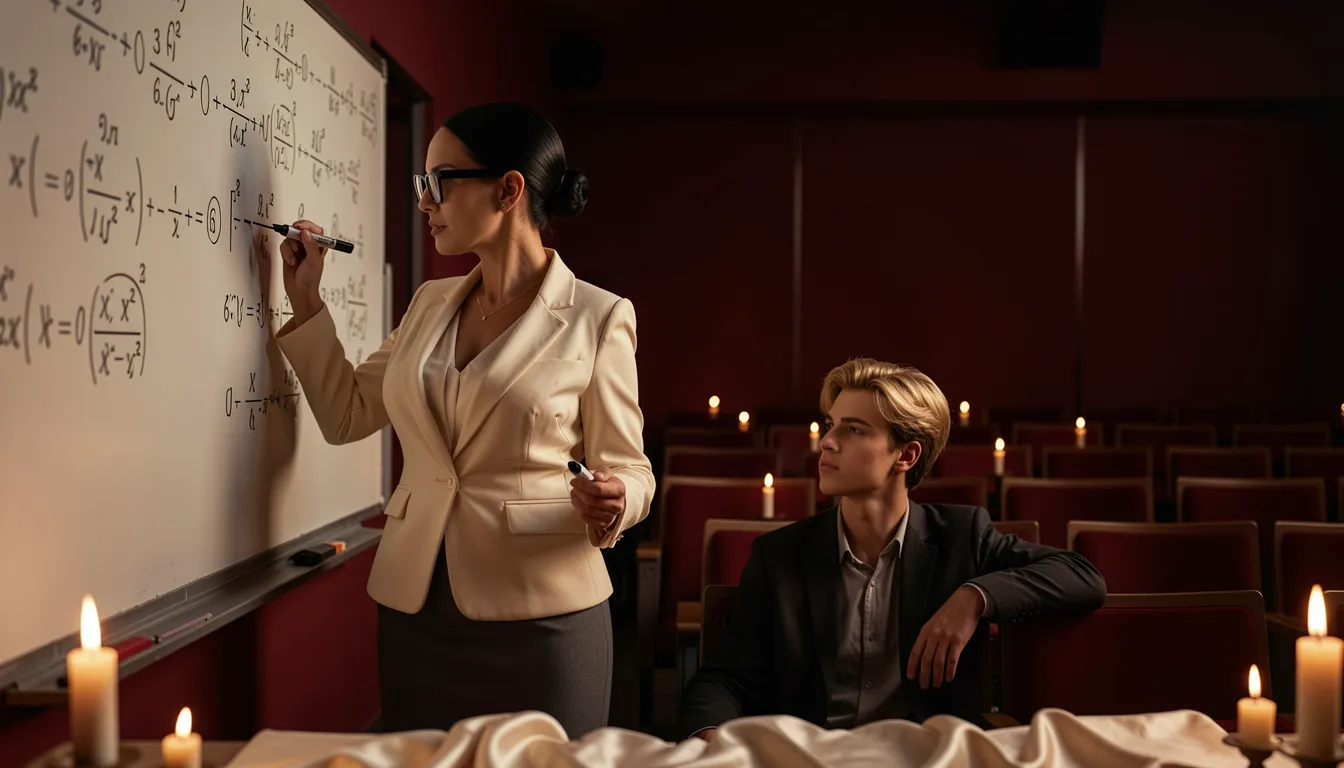
Monday morning’s lecture hall was a cathedral of dry logic, and Professor Elizabeth Evans was its high priestess. Brad sat in his usual seat, third row center, his gaze fixed on her as she derived a complex proof on the whiteboard. Her hand moved with economical grace, the marker squeaking with authority. She wore a cream-colored twin set and a grey pencil skirt that fell precisely to her knees. Her hair was a severe, perfect bun. To the other students, she was an intimidating intellect. To Brad, she was a locked safe, and he had just finished crafting the combination. He watched the subtle tension in her shoulders, the way she adjusted her thick-framed glasses once, precisely, when a step in the logic required a moment’s thought. His mind supplied the image of her opening the black tissue paper, her proper fingers tracing the smooth plastic of the device he’d built. The fantasy was so vivid he could almost hear the whisper of the tissue. He didn’t smile. He just calculated the angle of her jawline, the pulse point in her throat, and filed the data away.
After class, he found John leaning against a bank of lockers, scrolling on his phone. “Evans was on fire today,” John said, not looking up. “I think she melted my calculator just by glaring at it.”
“Her logic is flawless,” Brad said, his voice neutral. “It’s a beautiful system.”
John finally glanced at him, a familiar, easy concern in his eyes. “You alright, mate? You’ve been quiet. Still thinking about that woman from the bar?”
“Just work,” Brad deflected, the lie smooth and practiced. “The internship. Lot of data to process.”
“Right, the glamorous world of spreadsheets,” John chuckled, clapping him on the shoulder. “Don’t let the Russians work you to death.” They parted ways at the campus gates, John heading towards the gym, Brad towards the sleek glass tower that housed Akinnov Holdings.
The office hummed with muted, expensive silence. Brad navigated the cubicle maze to his small, temporary desk, its surface already stacked with the previous week’s reconciliation files. He moved with methodical speed, his accounting mind parsing numbers and entries into tidy, resolved rows. He finished his assigned tasks before lunch, the work trivial against the schematic of fraud living in his encrypted cloud folder. The real work began after he ate a bland sandwich at his desk. He opened the company’s internal network, his low-level employee credentials a flimsy key to a vast vault. He targeted the work folders, digging through layers of departmental accounts, following the digital scent of the offshore trails he’d previously sniffed out.
It was a wall of permissions. Folder after folder flagged with red ‘ACCESS RESTRICTED’ icons. The names of the shell companies—‘Veridian Holdings,’ ‘Marlin Trust’—were visible in directory trees, but the contents, the transaction histories, the authorizing signatures, were locked behind multiple tiers of managerial clearance. His direct boss, two directors above her, the VP of Finance. A chain of command designed to obscure. He sat back, the glow of the monitor reflecting in his eyes. Skipping that chain was a career-ending move under normal circumstances. But these weren’t normal circumstances. This was a $4.2 million anomaly, and he wasn’t a loyal employee; he was a forensic observer, and his subject was the woman at the top.
He composed the email with the care of a man assembling a live explosive. The subject line was professional: ‘Urgent Matter: Preliminary Findings on Irregularities in International Tax Allocations.’ He attached the evidence files—the spreadsheets he’d copied, his own analysis highlighting the discrepancies, the routing numbers that dead-ended in jurisdictions with no extradition treaties. His summary was a masterpiece of implied threat cloaked in corporate loyalty. *‘…patterns suggestive of deliberate misallocation… significant financial exposure… recommend immediate, discreet investigation to identify responsible parties before external audit triggers…’* He made it clear he was bypassing the hierarchy to prevent ‘tipping off the culprit.’ The truth was, he was handing the bomb directly to Anna Akinnov to see if her hands were already on the timer.
He hovered the cursor over ‘Send.’ The risk percentage in his mind ticked upward. 38.72% chance of ruin became 45.00%. He adjusted for the new variable: direct provocation of the CEO. He took a slow breath, the sterile, filtered office air tasting of plastic and ambition. Then he clicked. The email whooshed away into the company server, a digital arrow shot straight at the ice-blonde heart of the tower above him.
The rest of the afternoon passed in a strange, suspended silence. He half-expected security to arrive at his cubicle, or for his computer to suddenly lock. Nothing happened. The office continued its hushed hum. At exactly 5:00 PM, he logged off, gathered his worn backpack, and left without looking back at the glittering facade of the building.
His rented room felt like a bunker that night. He showered, the hot water sluicing away the office’s static cling, but not the low-grade adrenaline still humming in his veins. He toweled off and stood in the dimness, staring at the drawer that held the device for Elizabeth Evans. Two moves made. One overt, one still hidden. The game was live on two boards now. He fell into bed, the sheets cool against his skin. His mind, usually a storm of probabilities, was quiet, watchful. He was no longer just planning. He was waiting for the world to react. Sleep came slowly, a thin and cautious thing.
The gift bag was plain, unmarked, and hung from the polished brass doorknob of Professor Evans’s office before dawn on Tuesday. Inside, nestled in black tissue within the sleek box, was the device. The note was printed on heavy, embossed stationery Brad had forged to mimic a boutique wellness tech firm. It spoke of confidential beta testing, of seeking feedback from discerning professionals, of advancing the science of focused sensory management. It was a lie wrapped in academic respectability, a key disguised as a survey. Brad placed it, his heart a steady, metronomic beat in his chest, and vanished into the empty hallway.
He attended her morning lecture, his posture one of rapt attention. Elizabeth Evans was particularly sharp, her voice cutting through a complex theorem on stochastic processes with glacial precision. Brad watched the pulse in her throat, the way her hand, holding a dry-erase marker, trembled almost imperceptibly at the end of a long, logical sequence. He imagined her finding the bag. Her proper, slender fingers untwisting the tie. Lifting the box. Reading the note with those intelligent, skeptical eyes behind her thick frames. The moment of decision. He felt his phone, silent in his pocket. The app interface was a blank, waiting slate. No connection request blinked into existence. The lecture ended. The day wore on. Silence.
His internship at Akinnov Holdings felt like entering a different kind of classroom, one where the air was chilled and the stakes were monetary. He’d just settled at his cubicle, the ghost of Elizabeth’s unchosen device a quiet hum in the back of his mind, when his manager appeared. Her face was carefully neutral. “Brad. The CEO would like to see you.” A slight pause. “Now.” She gestured toward the bank of elevators at the core of the floor, the ones with the brushed steel doors and no button panel. “Executive elevator. It’s programmed for the penthouse.”
The elevator was a capsule of silent, rapid ascent. His reflection in the polished doors showed a young man in a thrift-store blazer, his blonde hair neat, his expression composed. Inside, his stomach was a cold, hard knot. The doors sighed open directly into a reception area of muted grays and whites. A severe, elegant assistant with a headset nodded him toward a pair of double doors made of frosted glass and dark wood. “Ms. Akinnov is waiting.”
He pushed the door open. Anna Akinnov’s corner office was a monument to power and sightlines. Floor-to-ceiling glass presented the city as a sprawling circuit board of light and shadow. The room itself was sparse: a vast, minimalist desk of pale oak, two low-slung leather chairs facing it, and a single piece of abstract art on one wall that looked like a frozen silver explosion. She stood at the window, her back to him, a silhouette of impeccable tailoring against the sky. Ice-blonde hair swept into a tight knot. The lines of her suit were sharp enough to cut.
“Close the door.” Her voice was accented, clipped, and carried without her turning. It wasn’t a request.
Brad pushed the door shut with a soft click. The sound sealed him in. The silence that followed was profound, broken only by the distant, muffled hum of the city forty stories below. She let it stretch, letting him stand there by the door, letting the weight of the space and her withheld gaze press down on him. Finally, she turned.
Anna Akinnov faced him. Her eyes were the color of a winter sea, and they pinned him where he stood. They held no anger, no bluster. Only a cold, penetrating assessment that stripped away the blazer, the intern badge, the careful composure. It was a look that calculated mass, velocity, and threat. It reminded him, with a visceral jolt, of the first time Cathy Chen had stared at him in The Phantom—that same shivering, reptilian calculation. This was not a CEO about to thank a diligent employee. This was a predator who had found an unexpected creature in her territory.
She didn’t sit. She didn’t gesture for him to sit. She simply studied him, one hand resting lightly on the back of her desk chair, the other holding a slender platinum pen. She rotated the pen slowly, precisely, between her fingers. The movement was hypnotic, a tell of a mind dissecting a problem. “Your email,” she said, the words dropping into the quiet like stones. “It was very… thorough.”
Brad said nothing. His own analytical mind, usually a sanctuary, was screaming with variables. Denial was useless. Apology was weakness. He met her gaze, forcing his breathing to stay even, and gave a single, slight nod of acknowledgment.
A ghost of something—not a smile, but a flicker of interest—touched her cold eyes. “You bypassed your manager. The director of finance. The vice president. You sent evidence of a four-million-dollar fraud directly to me. This is either the act of a very stupid boy, or a very bold one.” She took a single, slow step toward him, her stilettos silent on the polished concrete floor. The space between them seemed to shrink, charged with the quiet voltage of her presence. “Which are you, Brad Bradley?”
Brad held her winter-sea gaze, the cold calculation in it a mirror to his own. The numbers in his head spun, probabilities adjusting in real-time. Confrontation now: high risk, zero reward. Submission: temporary, strategic. “No one instructed me,” he said, his voice measured, devoid of defiance. “It was an anomaly I noticed during routine reconciliation. I believed direct escalation was the most efficient path to contain exposure. I see now that was an error in judgment.”
Anna’s lips thinned, a minuscule tightening that was her version of a smile. “An error,” she repeated, the platinum pen still rotating. “A stupid boy, then. Your job is to input data, not to interpret it. You put your nose where it did not belong.” She took another silent step forward, closing the distance until the chill of her perfume, something like frozen juniper, reached him. “You will delete the email you sent me. You will delete every local copy of your… analysis. You will forget you ever saw those spreadsheets.”
“Understood,” Brad said, dipping his head in a show of deference.
“Furthermore,” Anna continued, her eyes never leaving his face, assessing his compliance for cracks, “I will speak with your manager. Your duties will be reassigned. Less financial analysis. More administrative support. Organizing shared folders. Processing paperwork. Do you understand?”
The demotion was a velvet glove around an iron fist. She was walling him off from the data, burying him in busywork. It was confirmation, as clear as a signed confession. The fraud was hers, or she was its protector. Brad met her eyes, letting a flicker of chastened embarrassment surface—a young intern put in his place. “Yes, Ms. Akinnov. I apologize for the mistake.”
She stared at him for three more heartbeats, the silence a physical weight. Then she gave a single, dismissive nod and turned back to the cityscape, her posture a clear dismissal. “Go.”
Brad didn’t hesitate. He turned, pulled the heavy door open, and stepped back into the muted reception area. The elegant assistant didn’t look up. The executive elevator descended in the same silent rush, his reflection now showing a man who had just been neutered. He felt no anger, only a sharp, clarifying focus. Her reaction had been a data point of immense value. The probability that Anna Akinnov was complicit now sat at 94.8%. He walked back to his cubicle, his steps even, his face a placid mask.
The email from his manager arrived before he could sit down. *‘Per directive from executive leadership, your duties are hereby reassigned. Please begin organizing and standardizing the naming conventions for all files in the department’s shared drive. You are no longer authorized to access financial modeling spreadsheets. Confirm receipt.’* Brad typed a quick, compliant reply. Then he opened the shared drive, a chaotic digital landfill of ten years of reports, presentations, and half-finished projects. He created a new folder labeled ‘ARCHIVE – PRE 2023’ and began dragging files into it. The work was mindless, tedious, and perfect. It gave his hands a mundane task while his mind rebuilt the schematics of her deception, now with her defensive move logged as a key variable.
At exactly 5:00 PM, he logged off, shut down his computer, and slung his backpack over his shoulder. For the first time since starting the internship, he left on time. The evening air outside the glass tower was still thick with heat and exhaust. He walked to the bus stop, the weight of the day settling into his shoulders not as fatigue, but as potential energy. Anna thought she had contained him. She had, in fact, identified herself as a player on his board. And he was on his way to the home of another.
The bus ride to the Jones’s suburban neighborhood was a study in normalcy. Lawns watered, garage doors open, the smell of charcoal grills. It was a world of settled debts and predictable outcomes, a world Brad observed from behind glass. He got off at his stop, the familiar street lined with mature oaks. The Jones house glowed with warm, yellow light, a picture of domestic sanctuary. He could see movement in the kitchen window. Joanna.
He walked up the driveway, the scent of lemon polish and roasting meat greeting him before he reached the door. He didn’t ring the bell. He never did. He opened the door and called out, “Hello?” as he always did, his voice shedding the calculated neutrality of the office for something warmer, younger.
“Brad! In here, love!” Joanna’s melodic voice floated from the kitchen. He followed it, his heart beating a steady, purposeful rhythm. She stood at the stove, her back to him, stirring a pot. She wore faded mom jeans and a soft-looking cream-colored sweater, her hair piled in a loose, messy bun. A simple, maternal image. But Brad’s eyes didn’t see a mother. They saw the curve of her spine under the thin wool, the shift of her hips as she reached for a spice jar, the faint, ghostly echo of a younger woman moving under hot lights for a camera James Jones would never know about. The knowledge was a key in his pocket, warmer than his phone.
Brad was early. The front door swung open before his hand even left the doorknob, revealing Joanna, her expression shifting from mild surprise to a warm, welcoming smile. “Brad! You’re early, love.”
He shrugged, stepping past her into the familiar, lemon-scented hall. “Work got easier today. They reassigned me to filing.” He kept his tone light, a casual dismissal of his corporate neutering.
“Well, come on through. I’m just getting dinner on.” She led him back to the warm, fragrant kitchen. The pot on the stove simmered, and a roasting pan sat on the counter. “John’s at the gym, and James is stuck in traffic. You’ve got me all to yourself for a bit.” She said it with a motherly chuckle, turning back to the stove.
“Let me help,” Brad offered, already shrugging off his backpack and placing it by the kitchen table. He moved to the counter, his eyes tracing the lines of her body as she reached for a wooden spoon. The faded denim hugged her hips. The soft cream sweater stretched across her back. He saw the ghost of the police hat, the skimpy costume, the younger, bolder curve of her smile aimed at a camera. The details aligned perfectly—the arch of her brow, the specific shade of her hair even in the messy bun, the full shape of her mouth. It was all there, hidden under the domestic softness.
“You’re a dear. Could you check the chicken in the oven? Timer should be about up.” Joanna gestured with the spoon, her back still to him.
“Sure.” Brad pulled his phone from his pocket as he moved to the oven. He tapped the screen, bringing up the saved image—JoJo in her police outfit, a frozen moment of lewd, youthful audacity. He set it as his wallpaper. The device felt warm, alive with potential. He placed it face-up on the granite countertop, right beside the roasting pan, a silent bomb in a field of flour and spice jars. He bent, opening the oven door. A wave of herb-scented heat washed over his face. “Looks almost ready,” he called over his shoulder.
With his free hand, he tapped his smartwatch. A single, silent command. His phone, resting on the counter, vibrated with a sharp, insistent buzz.
Behind him, the rhythmic stirring stopped. He heard the soft intake of breath—a tiny, choked gasp that was nothing like her usual melodic sighs. It was the sound of a world cracking. Brad kept his head in the oven, his eyes on the golden-brown skin of the chicken, his own breathing steady. He counted three full seconds of silence, the air in the kitchen now charged with a different, colder energy.
“Another five minutes, I’d say,” he said, his voice calm as he straightened up and closed the oven door. He turned, reaching for his phone. His fingers brushed the screen, the image of her past self glaring up at him for a fleeting moment before he swept it into his pocket. He looked at Joanna.
Her face had lost its warm flush. She was pale, her knuckles white around the handle of the wooden spoon. Her eyes, wide and startled, darted from the spot where the phone had been to his face, searching for explanation, for accusation, for anything. She found only his polite, attentive expression. “Everything okay?” Brad asked, tilting his head slightly.
Joanna blinked, the maternal mask slamming back into place with visible effort. A shaky smile touched her lips. “Yes, of course. Just… thought I’d forgotten the thyme. Didn’t forget it.” She turned back to the stove with a forced briskness, resuming her stirring with a frantic energy that hadn’t been there before.
The back door slammed open, followed by John’s booming voice. “Smells amazing, Mum!” He clattered into the kitchen, dropping his gym bag, his presence shattering the fragile tension. James arrived minutes later, shedding his suit jacket, asking about the traffic. Dinner was a performance of normalcy. James talked about a client. John recounted a failed lift. Brad contributed polite, minimal answers. But his focus was a laser on Joanna.
She laughed at John’s jokes, but the sound was a beat too high. She passed the potatoes, but her hand trembled. She met Brad’s gaze across the table, and each time, her eyes flickered away first, a nervous dart toward his pocket, then back to her plate. She was a woman holding a secret inside a house built on not knowing, and Brad had just shown her he held the key. He ate his chicken, the taste of her fear more potent than any herb.
After dessert, Brad helped clear the plates. “Thank you for dinner, James. Joanna. Always the best part of my week.” His gratitude was perfectly pitched, the respectful young man.
Joanna’s smile was thin, strained at the edges. “Any time, Brad.” Her voice lacked its usual warmth. It was careful, measured, the voice of someone negotiating a minefield.
He fist-bumped John on the porch, then walked down the driveway into the cool night. The bus ride home was a blur of streetlights. His room was dark, quiet. He showered, the hot water beating against his skin, washing away the scent of roast chicken and lemon polish, but not the memory of her pale, shocked face. He toweled off and lay in bed, the darkness pressing close. In his mind, he replayed the gasp. The wide eyes. The tremor in her hand. It wasn’t anger he’d seen. It was fear. And beneath the fear, a thrilling, terrifying recognition. She knew he knew. The game with her was no longer theoretical. It was live. He closed his eyes, the silence of his room a stark contrast to the riotous calculation in his mind. Sleep, when it came, was shallow and full of silent, staring faces.