

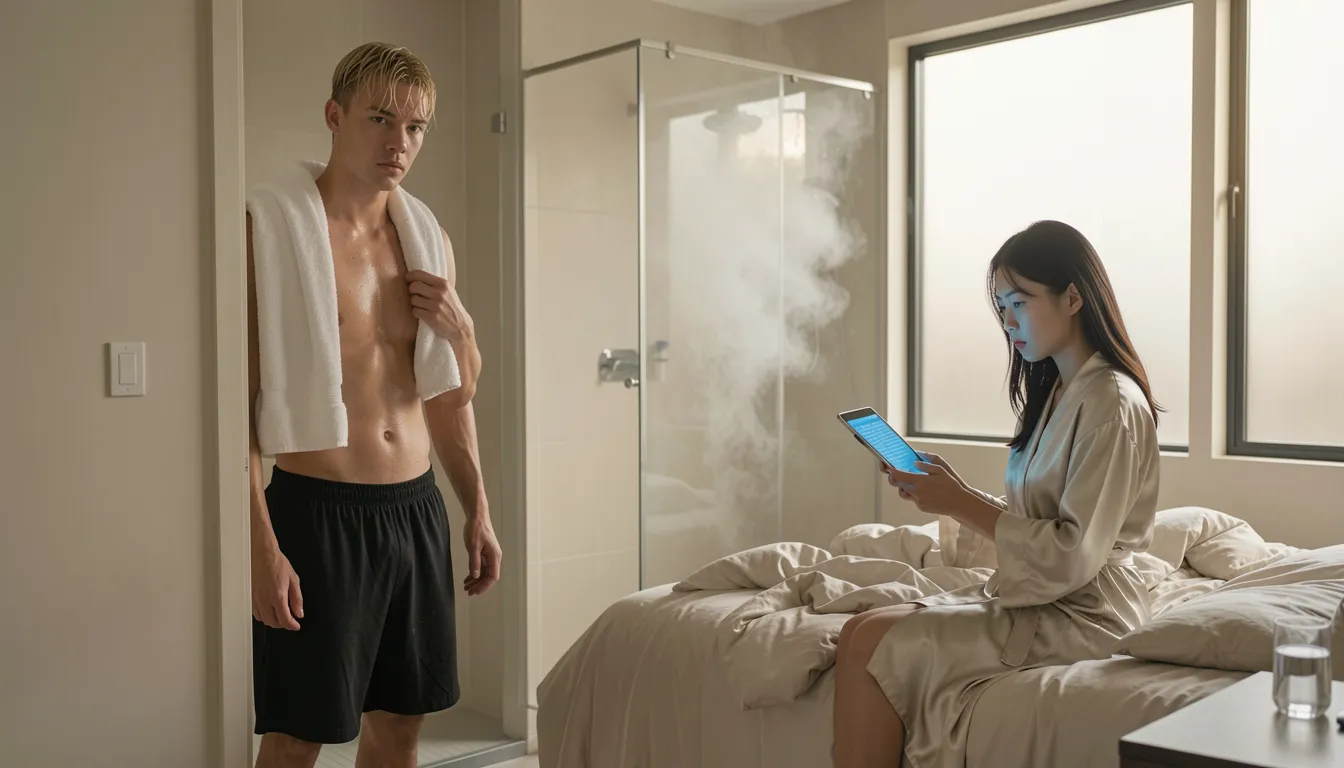
Brad woke to the pale, silent light of a city morning filtering through floor-to-ceiling windows. The weight on his right bicep was warm and solid. Cathy’s head rested there, her dark hair fanned across his skin, her breathing deep and even. He lay perfectly still, cataloging the sensation: the pressure of her skull, the slight dampness where her breath touched his arm, the unfamiliar peace of another person’s sleep trusting his presence. He watched the steady rise and fall of the silk sheet over her back.
He needed to move. His left arm was numb. With a precision that felt surgical, he began to slide his right arm out from under her. He shifted his shoulder millimeter by millimeter, his eyes fixed on her face. She stirred, a soft sigh escaping her lips, her brow furrowing briefly before smoothing back into sleep. His arm came free. He held his breath, then exhaled slowly as he sat up on the edge of the bed. The room was cool. The scent of her, of them, lingered in the air—sex and expensive linen.
The ensuite bathroom was a monument of marble and chrome. He turned the shower to near-scalding and stepped under the spray, letting the water pound the night from his muscles. He used her soap, something citrus and sharp, and the smell of it on his skin felt like a claim, or a contamination. He toweled off with a thick, white cloth, his mind already clicking into the day’s ledger: rent due Friday, a statistics midterm to study for, the part-time analyst work waiting on his laptop. The man in the mirror had calm eyes. He ran a hand through his damp blonde hair.
When he emerged, steam curling out behind him, Cathy was sitting up in bed. The sheet was pulled to her waist, her small, bare back straight against the headboard. She held a tablet, her fingers moving in swift, silent taps. The morning light carved the sharp lines of her shoulders, the elegant column of her neck. She didn’t look up.
“Morning,” Brad said, his voice still rough with sleep. He padded across the carpet to where his clothes lay in a heap. He pulled on his boxers, his jeans.
“What are you working on?” he asked, buttoning his shirt. His tone was casual, a thread of genuine curiosity woven through it.
Cathy’s fingers stopped. She lifted her gaze from the screen. Her eyes, black and unreadable, met his. “None of your business.” Her voice was flat, clean, a door shutting.
Brad nodded once, a small, internal click. The cold Cathy was back. The woman who had fallen asleep with her head on his shoulder, who had made a small, desperate sound against his neck, was gone. He finished dressing in silence, feeling the weight of her stare on his back. It was a physical pressure, cool and assessing. He zipped his fly, tucked in his shirt. When he turned, she was still watching him, the tablet resting in her lap.
He picked up his worn jacket. “I’ll see you around,” he said, not as a question.
As he moved toward the bedroom door, she extended her arm. The tablet was in her hand, offered toward him. “Before you go.” Her voice hadn’t warmed. “Look at this. Tell me if you see anything wrong.”
Brad paused. He walked back, took the tablet. The screen displayed a massive spreadsheet, rows and columns of financial data stretching into a gray digital horizon. Account numbers, dates, transaction amounts in multiple currencies. It looked impeccably ordered. “What am I looking for?”
“An error. A theft. Something that doesn’t belong.” She settled back, watching him now with a different intensity—a professional scrutiny.
Brad sat on the edge of an armchair, his focus narrowing, the world condensing to the glow of the screen. He began to scroll. It was a dance he knew, a language of digits and decimal points. He scanned for patterns, for outliers, for the subtle arrhythmia in the heartbeat of cash flow. Everything looked normal. Too normal. He slowed, his eyes tracing lines, cross-referencing columns. Minutes passed in silence broken only by the soft tap of his finger scrolling.
Then he saw it. Not one thing, but a ghost of a pattern. A transaction here, for a plausible amount, to a vendor that existed. Another, eight pages later, a similar amount from a different account. A third, buried deeper. They were beautiful lies, each perfectly dressed for the ball. He traced them, his pulse picking up a quiet, triumphant rhythm. Sixteen transactions in total, scattered like poisoned seeds across a field of thousands. He was certain no one else would have spotted it. It required seeing the entire field at once, holding all the numbers in your head at the same time.
He stood and brought the tablet to her, sitting beside her on the bed. He pointed to the first one. “Here.” His finger moved to the next. “And here. They’re linked. Sixteen of them.”
Cathy took the tablet, her eyes scanning where he indicated. A faint line appeared between her brows. “They look normal.”
“They’re supposed to,” Brad said. His voice took on the clear, explanatory tone he used in study groups. “The accounts are real. The amounts are within standard thresholds. But the debits and credits are inverted. See? This should be a credit to holdings, but it’s coded as a debit. And the amount…” He leaned closer, his shoulder almost touching hers. He could smell the clean scent of her hair. “It’s off by a factor. It’s not a round number error. It’s a percentage skim. Each one takes a little. Over time, across these…” He tapped the screen. “It’s a lot.”
Cathy was silent, her gaze intense as she followed his logic, tracing the corrupted chain he had unveiled. Her finger moved over the glass, connecting the dots he had given her. He watched the moment of understanding hit—a slight tightening of her lips, a nearly imperceptible nod. She saw the theft now, the elegant, hidden siphon.
She looked from the screen to his face. Her expression gave nothing away, but her eyes held his for a second longer than necessary. “Thank you,” she said. The words were correct, polite, and utterly cold.
Brad stood. The shift was complete. The intimacy of the night, the vulnerability of the discovery—all of it was now a closed ledger. He was being dismissed. “Sure,” he said. He didn’t smile. He just turned and walked out of the bedroom, through the silent, opulent mansion, and let himself out into the ordinary morning.
The city air outside Cathy’s building was a slap of diesel and damp concrete. Brad walked the twelve blocks to his rented room, the morning sun doing nothing to warm the cold knot in his gut. The transaction was complete. He’d provided a service; she’d provided a night. The ledger was balanced, and he hated how clean the math felt.
His room was a ten-by-ten box above a laundromat. The air always smelled faintly of detergent and mildew. He shrugged off his jacket, tossed it onto the unmade bed, and stood for a moment in the silence. Sunday. No classes. No internship. The emptiness of the day stretched before him, a blank column waiting to be filled.
He changed into a clean t-shirt and jeans, the fabric soft from countless washes. The quiet was oppressive. He needed movement, a task. His uncle Ben’s cluttered apartment across town presented itself as a destination. Ben was usually good for a free meal and cryptic, half-drunk stories about Brad’s father. It was better than sitting here counting the water stains on the ceiling.
Ben’s place was in a tired brick building, the hallway smelling of cabbage and old carpet. Brad knocked, then let himself in with the key Ben had given him years ago. “Uncle Ben?”
“In here, kid!” Ben’s voice was gruff, followed by the sound of a vacuum cleaner dying with a wheeze. Brad found him in the living room, a man in his late forties with a rounded belly and the same sharp blue eyes as Brad, now clouded with perpetual weariness. He was wrestling with a dusty upright vacuum, a pile of displaced junk stacked on the sagging sofa. “Spring cleaning,” Ben grunted, wiping his forehead with the back of his hand. “Or fall. Who the hell knows.”
“Need a hand?” Brad asked, already moving to lift a stack of old newspapers from an armchair.
“Don’t touch that,” Ben said, but it was automatic. He waved a hand. “Fine, fine. Boxes in the hall closet. Just… sort. Keep, toss. You know the drill.”
For an hour, they worked in companionable silence, Brad sorting through decades of accumulated debris: expired coupons, broken tools, yellowed phone books. Ben mostly moved things from one pile to another, occasionally holding up some artifact—a cracked mug, a faded baseball cap—and telling a fragmented story that always trailed off. Brad listened with half an ear, his mind still tracing the elegant, fraudulent numbers on Cathy’s tablet.
He was pulling a heavy cardboard box from the back of the closet when it tipped, spilling its contents across the scuffed hardwood floor. Not more papers. DVDs. Dozens of them, in clear plastic cases, their covers featuring garish, photoshopped images of exaggerated bodies and provocative titles. Brad froze, a hot flush creeping up his neck.
Ben bustled over. “Ah, my treasures,” he said, a surprising note of pride in his voice. He didn’t look embarrassed. He knelt, began gathering them with a collector’s care. “Forgot these were in here. Classic stuff. None of that streaming nonsense. Tangible media.”
Brad helped pick them up, avoiding looking directly at the covers. One case, however, caught his eye. The title was “The Lady Detective: Case Files.” The cover showed a woman in a parody of a police uniform—a tiny blue hat perched on blonde hair, a shirt unbuttoned to her navel, a plastic-looking badge. Her face was turned in profile, a sly smile on her lips. Something about the curve of her cheek, the set of her jaw…
“That one’s different,” Ben said, noticing his gaze. He took the case from Brad’s hand. “My favorite. It’s got a story. A real plot. Three episodes. They were trying to make a series out of it, but it died. People just want to get to the fucking, you know? No patience. But this… the buildup was good. Tense. Only one proper sex scene per episode, but it meant something.”
Brad took the case back. He stared at the actress’s face. The familiarity was a dull buzz, growing louder. It wasn’t just generic. The eyes, the smile… it was softer, younger, but the bones were there. The warmth in the expression, even through the cheap production, was unmistakable. His blood went still. “Can I borrow this?” he asked, his voice carefully neutral.
Ben shrugged, already turning back to his vacuum. “Sure, kid. Just don’t scratch it. It’s a limited edition.”
Brad slipped the DVD into the inside pocket of his jacket. The plastic case felt like a live wire against his ribs. He finished helping Ben, refused an offer of a beer, and walked back out into the afternoon. The city noise faded to a distant hum. All he could hear was the echo of a melodic British accent, and all he could see was a warm, maternal smile superimposed over a sly, pornographic grin.
Back in his rented room, the DVD case felt like a stolen artifact. Brad placed it on the rickety desk beside his laptop. He stared at the cover, at the sly, youthful smile of ‘JoJo.’ The plastic was cool under his fingertips. He had no DVD player. He’d been so focused on the discovery he hadn’t thought to borrow Ben’s. A rookie mistake, a break in his usual methodical process. The oversight irritated him.
He opened his laptop, the fan whirring to life in the quiet. The search bar waited. He typed the title: “The Lady Detective Case Files.” He hit enter. The internet, as always, had everything. The first result was a video aggregator site. A thumbnail showed a freeze-frame of the blonde detective, her uniform shirt torn open, pressed against a filing cabinet by a man in a cheap suit. The title read: “Lady Detective – ALL SEX SCENES COMPILATION (JoJo Highlight Reel).” Ben was right. People just wanted the fucking.
Brad clicked it. The video loaded, the quality grainy, digitized from an old source. The audio was tinny synth music. He watched. It wasn’t a scene, but a rapid-cut montage: JoJo, in the parody police uniform, being bent over a desk. JoJo, on a leather couch, her head thrown back. JoJo, on her knees. The acts were mechanical, the camera angles crude, but he wasn’t watching the sex. He was watching her face. The expressions were performative—exaggerated pleasure, fake surprise—but in the moments between, in the half-second before a cut, he saw her. The specific curve of her lip when she almost smiled. The way her eyes, even in ecstasy, seemed to hold a private, amused thought. The shape of her jawline as she turned her head. It was Joanna. Twenty years younger, but undeniably her.
He scrolled down to the comments. Most were what he expected: crude, dismissive. “Cheesy plot lol.” “Mid.” But one, buried lower, caught his eye. A user named ‘VHSArchivist’ had written: “Actually, JoJo had serious talent. Natural screen presence. She got screwed by a crap production company that only cared about pumping out volume. Three episodes and she was gone. A shame. Could’ve been a star with better material.” A few replies were dismissive. “Talented at what? She wasn’t even that hot.” Another: “Who cares, it’s porn.” Brad’s jaw tightened. They were wrong. In the flickering light of his screen, JoJo was incandescent.
He began a deeper dive. Searches for “JoJo actress retired,” “Lady Detective actress whereabouts.” The trail was cold, just as Ben’s box was dusty. A few obscure forums mentioned her, always with the same vague note: retired early, disappeared. No last name. No interviews. She had been a ghost even then. He leaned back, the wheels in his mind turning not with numbers now, but with connections. A mediocre porn actress leaves the business, gets an economics degree, meets a charming British man at a hotel restaurant, marries him, becomes a mother. A perfect cover. A total reinvention. The math of it was elegant, a beautiful equation of erased history.
He navigated to a free AI aging website, one of the widely available tools he used for digital forensics projects at his internship. He took a clear screenshot of JoJo’s face from the video, a moment where she looked almost directly at the camera, her expression neutral. He uploaded it. The parameters: age progression, add twenty years. He clicked ‘generate.’ The software processed, a spinning wheel on the screen. His heart beat a slow, heavy rhythm against his ribs.
The result appeared. Brad leaned forward, his breath catching. The software had smoothed the youthful softness, added fine lines at the corners of the eyes and mouth, subtly changed the hairline. But the bones were there. The warm eyes, the gentle slope of the nose, the particular fullness of the lower lip. It was an approximation, but it was a 90% match. It was Joanna Jones as she was now: the kind, maternal woman who made tea and worried about her son’s laundry. The woman who touched his arm when she spoke, whose laugh was a melodic, comforting sound in a warm kitchen. The woman married to his best friend’s father.
A sharp, electric excitement shot through him, clean and hot. It wasn’t arousal, not yet. It was the pure, intellectual thrill of discovery, of solving a puzzle no one else knew existed. He had uncovered a secret layer beneath the placid surface of his own world. He had proof. He saved the aged image to a hidden folder, encrypted. He closed all the browser tabs, the grainy video, the forum arguments. The room was dark now, the only light the pale glow from his laptop screen reflecting off the empty DVD case.
He went to bed but did not sleep. He lay on his back in the narrow bed, staring at the water-stained ceiling. The excitement hummed in his veins, a live current. He replayed the video clips in his mind, but now he superimposed the present-day Joanna onto them. Her current smile on that younger body. Her melodic British accent gasping the cheesy dialogue. The warm, maternal hands gripping that cheap filing cabinet. The contradiction was dizzying. The ultimate conservative wife had a past of staged, graphic transgression. The fantasy wasn’t just about domination anymore. It was about knowing. About holding a truth she thought was buried forever. About seeing the ghost of JoJo flicker behind Mrs. Joanna Jones’s eyes when she asked him if he wanted more shepherd’s pie.
He would keep this to himself. This was a ledger entry for him alone, an asset of incalculable value. The numbers from Cathy’s spreadsheet, the cold transaction of the morning, faded into background noise. This was different. This was personal. This was power, waiting to be exercised. He finally closed his eyes, the ghost of a young Joanna’s sly smile the last thing he saw before sleep took him, his own lips curving in the dark. Monday’s routine of school and work awaited, but it was just a facade now. He walked through a world where he alone could see the cracks in the foundation.
The city’s Monday morning was a grey, indifferent machine. Brad moved through it on autopilot: the crowded bus to campus, the fluorescent hum of the lecture hall, the dry precision of Professor Evans’s voice dissecting differential equations. He took notes, his handwriting neat and exact, but his mind was elsewhere. It was tracing the curve of a hip under denim, the ghost of a younger, slyer smile. The numbers on the board were simple, obedient things. The equation in his head was far more complex.
His internship at the financial firm that afternoon was a similar exercise in divided focus. He processed invoices, his fingers flying over the keyboard, spotting discrepancies his supervisor missed. Each hidden error was a small, private victory. It felt like practice. His cubicle was a sterile pod, but in his mind, he was in a dusty closet, pulling a box from the shadows, feeling the electric weight of a secret in his hands.
Tuesday evening found him climbing the steps to the Jones’s modest, well-kept house, the smell of roasting meat and herbs greeting him at the door. Normalcy, baked into the very air. John clapped him on the shoulder. James offered a genial nod from the living room, eyes on a football match. And then there was Joanna, emerging from the kitchen with a warm, “Brad, love, you’re just in time. Go on through.”
She wore faded mom jeans and a soft, cream-colored sweater. Her hair was pulled into a loose ponytail. She was the picture of domestic ease. But Brad didn’t see the sweater. He saw the way the fabric draped over the swell of her breasts, remembered the exact shape of them from the grainy video, bare and pressed against cold metal. He didn’t see the jeans. He saw the curve of her hips, the same hips that had rolled with a performer’s rhythm on a cheap leather couch. The ghost of ‘JoJo’ was superimposed over ‘Mum,’ and the collision was dizzying.
He took his usual seat at the dining table, forcing his eyes to his plate. The conversation flowed around him—John’s classes, James’s work, a story about a neighbor’s dog. Brad contributed monosyllables, his appetite gone, replaced by a low, insistent heat in his gut. Every time Joanna moved—leaning to pass the peas, laughing at one of John’s jokes—his gaze snapped to her. The melodic lilt of her laugh wasn’t just comforting now; it was a soundtrack he’d heard gasp in a very different context.
“Brad, love,” Joanna’s voice cut through his reverie. She was looking at him, a faint, amused frown on her face. “Do I have tomato sauce on me? You’ve been staring at my chest for a full minute.”
The room’s attention swung to him. John barked a laugh. James chuckled, not looking up from cutting his meat. “The lad’s got an appetite for more than shepherd’s pie, eh?” James said, good-naturedly.
Blood roared in Brad’s ears, his face burning. He opened his mouth, but no precise, analytical words came. The truth was a live wire he couldn’t touch. “Sorry,” he managed, the word thick. “Just… zoning out. Long day.”
The excuse was weak, and they all knew it. John grinned, elbowing him. “Mate, my mum? Really?” It was a joke, the ultimate safe tease, because the idea was supposed to be absurd.
Brad forced a laugh, a hollow sound. “Shut up, Jones.” He shifted in his chair, acutely aware of the tightness in his jeans, the hard, betraying ache that had grown as he stared. He couldn’t stand up. Not yet. He focused on his breathing, on the numbers of his own pulse, trying to will the heat away. He saw Joanna’s eyes on him for a second longer, a flicker of something—not anger, but a quiet, curious assessment—before she smiled and turned back to James, deflecting the attention. “Leave the poor boy alone, you two. He’s working hard.”
He waited through dessert, through coffee, his body thrumming with trapped energy. When he finally rose to leave, he kept his posture slightly hunched, his jacket held strategically in front of him. The goodbyes were a blur. The cool night air outside was a relief. He walked the twenty blocks back to his room, not feeling the distance. His mind replayed the moment on a loop: her question, her amused eyes, the secret knowledge that made his blush not just embarrassment, but a confession she couldn’t possibly decode. He had looked at her chest and seen JoJo. And for a second, under the warm kitchen lights, he had fantasized about telling her so.
His rented room was a silent, mildewed capsule. He didn’t turn on the main light. He sat on the edge of his bed in the dark, the echo of her laughter still in his ears. The heat hadn’t faded; it had condensed into a hard, focused point of want. He had sat at their table, eaten their food, and secretly undressed the wife and mother with the eyes of someone who had seen every inch of her past. The power of it was immense, and utterly, dangerously his.
Wednesday’s lecture hall was a cathedral of dry logic, Professor Evans’s voice a precise instrument carving derivatives into the whiteboard. Brad’s notes were perfect, but his mind was a partitioned system. One sector processed the mathematical proofs. The other, larger sector replayed the ghost of a younger Joanna’s gasp, the specific curve of her spine as she arched over a desk. The numbers on the board were simple, obedient things. The equation of his secret was infinitely more compelling.
His afternoon internship was a study in sterile focus. The cubicle farm hummed with the low thrum of computers and hushed phone calls. Brad’s screen displayed a sprawling corporate ledger, thousands of lines of procurement data for a client named Akinnov Holdings. His task was data entry, cross-referencing invoice numbers with bank transfers. It was mindless, meant for a temp. His fingers flew, his eyes scanning the rows not for the task, but out of habit—a habit freshly sharpened by Sunday morning in Cathy’s bedroom.
He was halfway through the third spreadsheet when his cursor stuttered. A sequence of entries, a chain of interdepartmental transfers for “consultancy fees,” glitched in his perception. The amounts were plausible. The account codes were valid. But the pattern… it was a faint, familiar echo. He leaned closer, the fluorescent light reflecting off the screen. He isolated five transactions, then ten. They were scattered, disguised by legitimate entries before and after. His pulse, which had been a steady metronome, kicked up a notch. This wasn’t like Cathy’s spreadsheet. That had been a simple, elegant theft—sixteen transactions siphoning funds into a shadow account. This was different. This was a labyrinth.
He began tracing the threads, opening new tabs, cross-referencing subsidiary ledgers. An hour vanished. He found not a chain, but a web. One hundred and three transactions, a dizzying circuit of debits and credits moving between seven shell companies that all, after three layers of obfuscation, linked back to Akinnov Holdings itself. Money was moving, but it wasn’t leaving. It was being… laundered? No. It was being agitated. Churned. The goal wasn’t theft. It was complexity for its own sake. It was a smokescreen so dense no auditor would ever bother to penetrate it. To find what, though?
“Bradley.” The voice was flat, impatient. His supervisor, a middle-aged man with a perpetually sour expression born of missed promotions, stood at the mouth of his cubicle. “The Akinnov reconciliation was due to accounting an hour ago. Status?”
Brad blinked, dragging his eyes from the screen. The digital clock in the corner read 4:47 PM. He’d entered nothing new for over ninety minutes. “Nearly done,” he said, his voice carefully even. “Found some… discrepancies. Took time to verify.”
“Discrepancies are for the auditors. Your job is data entry. Is it done or not?”
“It will be. I’ll stay late.”
The supervisor’s lips thinned. “Unpaid overtime isn’t a perk, it’s a failure to manage time. Get it on my desk by five-thirty.” He turned and walked away, his displeasure a cold cloud left behind.
Brad’s jaw tightened. He minimized the windows revealing his discovery, returning to the mindless entry screen. His fingers moved again, faster now, a blur of mechanical action. But his mind was elsewhere, locked on the beautiful, terrifying web he’d glimpsed. One hundred and three moves. A game of financial three-card monte played at a grandmaster level. He wouldn’t have seen the first thread if Cathy’s cold eyes hadn’t dared him to look. This was her gift, unwittingly given: a new lens, a sensitivity to the cancer hiding in plain sight.
At five twenty-five, he emailed the completed, superficial reconciliation to his supervisor. The man wouldn’t look beyond the summary page. As the office emptied, the silence deepening, Brad reopened the hidden windows. With a few keystrokes, he copied the entire corrupted ledger file, the raw data, onto an encrypted thumb drive he kept on his keychain. The action was smooth, practiced. A thief in the night, but stealing knowledge, not money. He ejected the drive, slipped it into his pocket. The weight of it was negligible. The significance was immense.
The walk back to his rented room was through a city that felt newly transparent. The neon signs, the traffic, the flow of people—all of it was surface noise. Beneath it, in spreadsheets and silent servers, the real currents moved: money, power, secrets. He had two of them now, burning holes in his pocket. Joanna’s past. And whatever this Akinnov web was hiding.
His room was a tomb of quiet. He didn’t bother with the overhead light, just the dim anglepoise lamp on his desk. He plugged in the thumb drive, opened the files. For hours, he mapped the transactions on a digital notepad, drawing lines between entities, calculating the velocity of the churn. It was a firewall. A brilliantly constructed barrier of financial noise. To protect what? The answer was somewhere behind it. The fatigue was a physical weight, but the intellectual thrill was a stimulant. He finally pushed back from the desk, his eyes gritty, the clock reading 1:17 AM. The puzzle wouldn’t be solved tonight.
He fell onto his bed without undressing, the cool of the polyester bedspread against his cheek. In the dark, the numbers slowly faded, replaced by softer, more dangerous ghosts. The melodic lilt of a British laugh. The warm, assessing look from across a dinner table. The secret knowledge that he now saw corruption everywhere, in ledgers and in lives. His last conscious thought was a single, clear line in the ledger of his mind: *Asset Acquired. Nature: Unknown. Value: Potentially everything.* Then, nothing.
The rest of the week passed in a blur of routine, a surface-level performance. Brad attended lectures, took notes, processed invoices at his internship. But his mind was a partitioned system. One sector handled the mundane. The other, larger sector lived in the silent, glowing world of his laptop screen after dark, tracing the beautiful, malignant web within the Akinnov ledger.
Friday night found him at his desk again, the anglepoise lamp casting a tight pool of light. The city’s distant hum was the only sound. On screen, his digital notepad was a spider’s web of lines and numbers, the one hundred and three transactions mapped and connected. He’d been staring at the same cluster for an hour, his eyes dry and aching. The pattern wasn’t theft. It was diversion. A magician’s flourish drawing the eye away from the hand. He leaned back, rubbing his temples. What was the hand doing?
He isolated a sub-chain of twenty-two transactions, all related to “consultancy fees” for a shell company called “Vostok Logistics.” The amounts were plausible, the timing staggered. But when he ran a separate calculation of the total quarterly revenue from Akinnov’s primary subsidiary, then added back in the Vostok fees as if they’d never been deducted, the net profit figure jumped by 3.7 percent. It was a ghost deduction. A phantom expense. His breath caught. Not a smokescreen. A siphon.
He worked faster now, the fatigue burned away by the pure, cold thrill of the solve. He applied the same logic to the other six shell companies in the web. One by one, he recalculated. The ghost deductions were there, each cleverly disguised, each reducing the reported profit by a fraction of a percent. Individually, they were audit-proof. Cumulatively, they were a river. He ran the final sum. The total diverted from reported profit over the last fiscal year was four point two million dollars.
Corporate tax. The answer was so elegant it felt obvious. The goal wasn’t to steal the money outright. It was to hide it from the government. By artificially depressing their taxable profit, Akinnov Holdings—or someone within it—was evading millions in tax liability. The money wasn’t gone. It was just… relocated. Off the books. His next question formed instantly, a hammer blow in the quiet room: where did it go?
He dove back into the raw data, the thousands of lines of code and numbers. The trail was colder here, the obfuscation masterful. The ghost deductions pointed to internal holding accounts, but those accounts were empty, their funds moved within hours of receipt. He followed the digital footprints through three more layers of intermediary entities, shell companies registered in jurisdictions with opaque banking laws. The clock ticked past 2 AM. His back ached. His vision blurred. But the trail was getting warmer.
Finally, buried in a transaction log with a timestamp from nine months prior, he found it. A single, massive transfer. Four point two million dollars, consolidated from a dozen shadow accounts, sent to a numbered entity in the Cayman Islands. The destination was just a string of digits: ACCT-7787-4492. There was no name. No beneficiary. No further details on the spreadsheet. The money had reached its final hiding place, and the ledger offered no key to whose hand was on the vault.
Brad sat back, the chair groaning. The silence in the room was absolute. Four point two million. Hidden from the tax man. He knew who the CEO was. Anna Akinnov. The ice-blonde Russian with the winter-sea eyes and the stiletto heels that clicked like gunshots on marble. Did she know? Was this her design, or was it a cancer growing inside her own company, a betrayal by a trusted lieutenant? The spreadsheet didn’t say. It only whispered of the crime.
He saved his work, encrypted the files, and ejected the thumb drive. The weight of it in his palm felt different now. Heavier. It wasn’t just a puzzle anymore. It was evidence. Of what, exactly, he wasn’t sure. But it was power. A lever. He thought of Anna’s assessing gaze, the way she slowly rotated her platinum pen. Would that cool composure crack if he showed her he could see the corruption woven into her empire’s financial heart?
The digital clock glowed 3:17 AM. Exhaustion hit him like a physical wave, sudden and total. The intellectual high faded, leaving behind gritty eyes and a dull throb behind his temples. The questions—who owned ACCT-7787-4492, what Anna knew, what he should do with this—swirled in a fog. They were problems for a mind with sleep behind it.
He pushed himself up from the desk, his movements slow and stiff. He didn’t bother undressing. He just fell onto the bed, the cool bedspread a relief against his skin. In the dark, the numbers slowly dissolved. The ghost deductions, the Cayman account, the image of Anna’s severe beauty—they all blurred into a shapeless, potent secret. An asset of unknown value. A weapon of unknown caliber. His last conscious thought was a simple, exhausted entry in his mental ledger: *Investigation paused. Asset secured.* Then, nothing.
Saturday arrived as a dull, grey pressure behind Brad’s eyelids. He woke at noon, the silence of his room absolute and heavy. His stomach was a hollow ache, and a glance at the bare cardboard tube on the bathroom holder confirmed a more pressing need. He dressed in yesterday’s jeans and a cleanish t-shirt, the encrypted thumb drive a familiar weight in his pocket, a secret second heartbeat.
The late lunch was a greasy burger eaten alone at a Formica counter. The grocery store was a fluorescent-lit maze of mundane choices. He moved on autopilot: toilet paper, the giant economy pack, a loaf of bread, a jar of peanut butter. He hugged the bulky package of paper against his chest, a separate plastic bag swinging from his other hand, as he pushed through the automatic doors back into the overcast afternoon.
He was halfway across the parking lot when a flash of conservative elegance caught his eye from across the four-lane street. A woman in a beige trench coat, chestnut hair in a severe, perfect bun. Professor Elizabeth Evans. She was stepping out of a storefront with a discreet, black-painted window, her posture rigid, her head down as she tucked a small, plain shopping bag under her arm. Brad stopped walking. He knew that street. The stores there were a mix of tattoo parlors and adult novelty shops. The sign above the door she’d exited was a tasteful, cursive script: *Velvet Touch*.
His breath hitched. The numbers in his head went silent, replaced by a single, blazing point of focus. He waited for a break in traffic, then crossed the street, his groceries forgotten weights in his arms. He stood before the window. Inside, the lighting was soft, purplish, highlighting displays of sleek silicone and polished leather. There was no doubt. An electric current, sharp and hot, shot down his spine. The fortress was shopping for siege weapons.
He pushed the door open, a gentle chime announcing his entry. The air inside was warm, smelled faintly of vanilla and clean plastic. A woman in her fifties with kind eyes and a rainbow-striped apron looked up from behind a glass counter. “Welcome in. Looking for anything specific?”
Brad shifted the toilet paper package, his mind racing, the plan forming with crystalline precision. He adopted a slightly sheepish, concerned expression. “Actually, I’m looking for my mom. We were supposed to meet here, but I’m running late. She’s about this tall, brown hair in a bun, wearing a tan coat? Have you seen her?”
The woman’s kind eyes crinkled, and she let out a soft, knowing chuckle. “Oh, honey. That’s a good one, but no.”
Brad’s feigned confusion was perfect. “What do you mean? She just left, I saw her.”
“The woman you described was just here,” the assistant said, leaning forward conspiratorially. “But she wasn’t meeting anyone. And she certainly isn’t your mother. She was asking for… very specific items. Toys that provide sensation without penetration. She claimed she was a virgin.” The woman shook her head, a mix of pity and professional bemusement. “At her age, you don’t get that request often. Or that level of… clinical anxiety.”
The word *virgin* landed in Brad’s gut like a stone. Thirty-six years old. A professor of higher mathematics. A body of hidden curves beneath twin sets. Untouched. The concept was so vast, so contradictory to the powerful, controlled image she projected, it short-circuited his analytical mind for a full three seconds. Then it rewired itself, the new data integrating into a thrilling, predatory equation. “Was she… satisfied?” he asked, his voice carefully neutral.
The assistant shrugged. “She bought a clit stimulator. A mid-range model. But she mentioned several previous purchases had been ‘unsatisfactory.’ She seemed frustrated. Almost angry at the toys themselves.”
Brad’s gaze swept the store. His eyes landed on a display of gleaming metal and intricate locks. His voice was calm, deliberate, as he pointed. “What about those?”
“Chastity devices? For female anatomy. They’re more for power exchange, long-term wear. Not really for solo play.”
“I’ll take one,” Brad said. “And your most powerful, most precise clitoral vibrator. The one that’s practically medical grade.”
Twenty minutes later, he was back in his rented room. He set the giant package of toilet paper on the floor, the bread and peanut butter on the counter. From the depths of the grocery bag, he withdrew two smaller, unmarked black boxes. He placed them side-by-side on his desk. The first box contained a slender, obsidian-black vibrator with a focused, pinpoint tip. The second held a device of polished surgical steel: two curved shields connected by a short bar, with a small, intricate lock. It looked less like a toy and more like a beautiful, cruel piece of engineering.
He sat in his desk chair, staring at the two objects. The vibrator was a key. The chastity device was a lock. Professor Evans was a complex, locked system of repression and starved need. He had just purchased the tools to either relieve her frustration… or to weaponize it. The power of the choice, of the secret knowledge humming in the quiet room, was more intoxicating than any ledger. He had found another hidden ledger, this one written in the tension of a woman’s body, and he was now the sole accountant.