I follow Natasha through corridors I still haven't learned to name, past doors I haven't opened, past windows that show a sky I still don't trust to stay the same color. My boots make sound on the floor. I keep noticing that. Sound. Movement. Choice. Things that belonged to other people for four years and eight months.
She stops at a door halfway down a hall I don't recognize. Plain. Gray. A number on it I don't bother reading because numbers mean nothing to me anymore — they were what they called me before they used my own name like a weapon.
"This is the file room," she says. "Small. No windows. But it's quiet, and no one will bother us."
She waits. She always waits. Every doorway, every threshold, every moment where I might need to decide — she stops and waits like she learned the shape of my hesitation before I ever knew I had one.
I nod. She opens the door.
The room is smaller than I expected. A metal table. Two chairs. Shelves lined with folders and binders, the paper edges yellowed and soft from handling. The air smells like dust and old coffee and the faint chemical tang of ink that's been sitting too long. A fluorescent light hums overhead — that particular frequency that makes the back of my teeth ache if I listen too long.
Natasha moves to the table and sets down a stack of folders she carried under her arm. I didn't even notice her picking them up. I was too busy watching her hands.
She sits in one chair and leaves the other for me. Doesn't pat it. Doesn't gesture. Just sits and folds her hands on the table and waits.
I lower myself into the chair. It's too soft. The kind of chair that sinks under you, that asks you to let go of the tension in your spine, and I don't know how to do that yet. I sit on the edge, my back straight, my feet flat on the floor, ready.
Ready for what? I don't know. More pain. More truth. More of the weight I've been carrying since I woke up in that first cell and realized the ceiling was too low to stand under.
Natasha's hands rest on the top folder. She doesn't open it. "Before we start," she says, her voice low and careful, "I need you to know something."
I look at her hands. The way they sit — still, precise — like she's holding something fragile. Not the folder. Something else.
"You can stop at any time. You can walk out of this room, and I won't follow. You can tell me to shut the folder and never bring it up again. You can take it one page at a time, or you can read the whole thing in one sitting." She lifts her eyes to mine. "This is your history. Not mine. Not SHIELD's. Yours. You decide how much of it you want to carry today."
The words sit between us. I feel them settling into my chest, heavy and warm, like the first sip of something hot after hours in the cold.
"I want to know," I say. My voice is rough. I clear my throat. "I want to know everything."
She holds my gaze for a long moment. Searching. Making sure. Then she nods once and slides the first folder across the table.
It lands in front of me. Plain. Beige. The edges worn from handling. No label, no marking, nothing to suggest what waits inside. Just paper. Just words. Just the record of four years and eight months that I lived through without ever knowing the shape of what was being done to me.
My fingers hover over the edge. Not touching.
I can feel the weight of it. Not the folder — the knowing. The moment before you open something you can never close again. The threshold between not knowing and knowing. Between surviving what happened and understanding it.
I lift the cover.
The photograph on top is a headstone.
Granite. Gray. Polished smooth, with letters carved into it that catch the light. My name. My full name — Sigrun Elise Moland. The dates beneath it mark the day I was born and the day Hydra took me. The day I died, according to everyone who knew me.
Below the dates, a line of Norwegian I can't bring myself to read. I stare at the words until they blur. I know what they say. I know the shape of a gravestone epitaph without needing to sound out the letters. "Rest." "Remembered." "Never forgotten." Words people put on stones to make themselves feel better about the hole someone left behind.
But I'm not in that ground.
I'm sitting in a too-soft chair in a room that smells like dust, staring at my own name carved into pretend granite, and I don't know if I'm supposed to feel relief or grief or something in between that doesn't have a word yet.
My fingers touch the edge of the photograph. Just the edge. The paper is cool and smooth. I trace the curve of the letter S in my name, and I feel something crack open in my chest — not like a wound, but like a door I forgot was there, swinging inward on rusted hinges.
"They gave me a funeral." My voice sounds strange. Distant. Like it's coming from someone else's throat. "My family. They buried an empty box and said words over it and put a stone in the ground with my name on it."
Natasha says nothing. She doesn't fill the silence with comfort. She doesn't reach for my hand. She just sits there, present, her eyes steady, letting me feel the shape of this moment without trying to reshape it for me.
I turn the page.
The next sheet is a medical intake form. Dated three days after my disappearance. The handwriting is cramped and precise, the ink black and clinical. I scan the first few lines — height, weight, approximate age, estimated time since last meal — and then my eyes catch on a phrase near the bottom.
*Subject displays elevated pain tolerance baseline. Further testing required to establish upper threshold.*
I read it again. Then again. The words don't change. They sit there on the page, matter-of-fact, like a note about the weather or the condition of the specimen upon arrival.
Subject. That's what they called me. Not my name. Not Sigrun. Subject.
I turn the page.
Another form. This one has diagrams — crude outlines of a human body, front and back, marked with measurements and annotations. The handwriting is different here, looser, faster, like someone writing while standing over a table. I see words I recognize — muscle density, bone mass, estimated tensile strength — and words I don't, technical terms that belong to a language I never learned.
I keep turning.
Page after page. Notes on failed experiments. Notes on successful ones. Dose amounts and time stamps and results measured in units I don't understand. I see my own body reduced to data points and observations, a thing to be measured and cataloged and improved upon.
And then I find the page that stops me cold.
It's a summary. A single sheet, typed, with a header that reads *PRELIMINARY ASSESSMENT — SUPER-SOLDIER CANDIDATE 07*.
Candidate 07. I don't know what happened to Candidates 01 through 06. I don't want to know. But I know what happened to me.
The assessment lists physical enhancements first. Enhanced strength — estimated at 8-10 times peak human baseline. Enhanced durability — bone density increased 300%, muscle tissue denser and more resistant to trauma. Accelerated healing — cellular regeneration rate approximately 10 times normal human, with observed capacity to repair tissue damage from most non-catastrophic wounds within hours.
I read the words and feel them landing somewhere deep, somewhere that isn't my mind. My body knows this language. My bones remember every day they spent reshaping me. But reading it — seeing it written down, quantified, reduced to numbers and clinical terms — it makes it real in a way I wasn't ready for.
I reach the next section and stop breathing.
*Enhanced sensory perception — subject demonstrates elevated visual acuity (estimated 20/5 vision), enhanced auditory range (detects frequencies outside normal human hearing), and olfactory sensitivity comparable to trained tracking animals.*
My hands are trembling. I didn't notice them starting. I look down at my fingers, at the faint tremor running through them, and I realize the paper is shaking in my grip.
I remember the days in my cell when sounds felt too loud. The hum of the lights that never stopped. The footsteps in the corridor that I could hear from three floors away. The taste of the air — the metal, the chemicals, the sweat and blood and fear of everyone who'd been in this room before me.
I thought I was going insane. I thought the isolation was breaking something in my mind.
But it was just the serum. Working. Making me more than I was supposed to be.
I turn the page and find the worst one.
*Tolerance testing — Subject 07 displays extraordinary capacity to withstand physical trauma, including blunt force, sharp force, thermal, chemical, and electrical stimuli. Pain response is fully intact but subject can maintain operational capacity far beyond normal human endurance limits. Recalibration recommended to establish new threshold parameters.*
The words blur. I blink. Once. Twice. The paper doesn't get clearer.
I can feel it. The cold metal table. The straps around my wrists. The woman in the lab coat with her careful notes and her calm voice and her hands that never hesitated.
I can feel the electricity. The burns. The cuts they let heal and then made again. The days when I screamed until my throat bled and the nights when I lay silent because I had nothing left to give them.
And they wrote it down. They measured it. They called it *tolerance testing* and *threshold parameters* and *operational capacity*.
My hand slams the folder shut.
The sound is too loud in the small room. The echo bounces off the walls and settles into my chest like something alive.
I'm breathing hard. I didn't realize I was holding my breath. My lungs burn and my hands are shaking and I can feel the rage building in me — not hot, not the kind that burns fast and fades, but cold, deep, the kind that settles into your marrow and lives there.
Natasha hasn't moved. She sits across from me, her hands still folded on the table, her eyes still steady. She doesn't flinch at the sound of the folder slamming. She doesn't tell me to breathe, to calm down, to take a moment. She just waits.
"They made me into a weapon." My voice is flat. Empty. I can hear it and I know it's mine but it sounds like it belongs to someone else. "They took me apart and put me back together piece by piece, and they wrote it all down like I was nothing. Like I was just — data."
"You were never nothing." Natasha's voice is quiet. Not soft — quiet. Precise. Each word placed with care. "They tried to make you nothing. They failed."
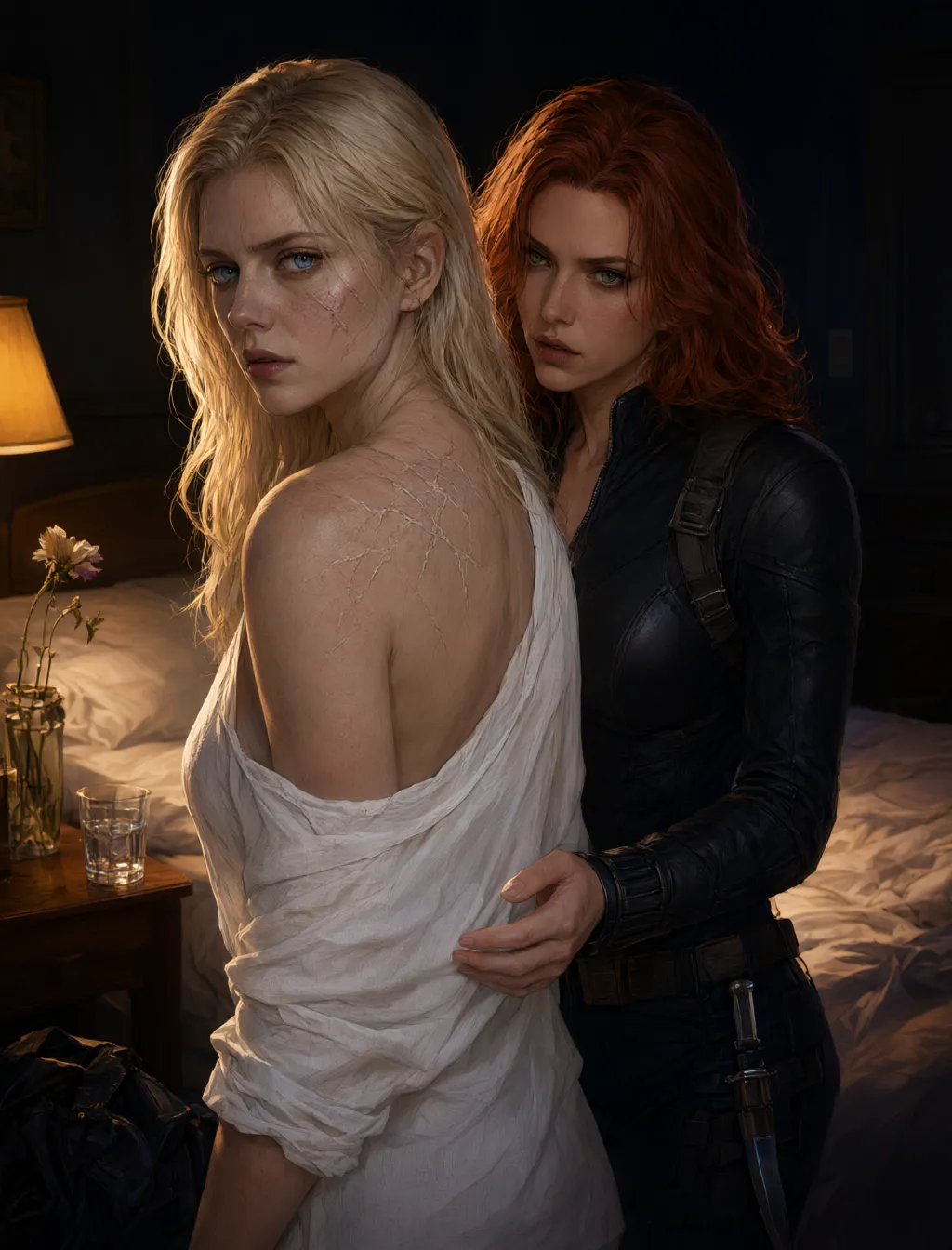
I look at her. Really look. The sharp cheekbones. The red hair that catches the fluorescent light. The green eyes that have seen worse than this room contains, worse than these files describe, and are still here, still steady, still looking at me like I'm someone worth looking at.
"I can hear heartbeats." The words come out without me meaning them. "Through walls. From rooms away. I can taste the difference between the cleaning solution they use in the hallways and the one in the medical bay. I can see the dust motes floating in the air — I can count them, Natasha. I can count the individual particles of dust in a beam of light."
Her eyes don't widen. Her expression doesn't change. She just nods, slow, like she's taking in information and filing it away. "That's a lot of input."
I laugh. It's not a happy sound. "It's everything. All the time. I can't turn it off. I can't stop hearing the man three floors up typing on his keyboard, or the woman in the kitchen running water, or the—" I stop. Swallow. "Or the way your heartbeat changes when you're worried."
Something flickers across her face. Almost invisible. Almost. "What does it sound like?"
The question catches me off guard. I blink at her. "What?"
"My heartbeat," she says. "What does it sound like when I'm worried?"
I don't know why she's asking. I don't know what she's looking for. But I listen — really listen — and I find it. The rhythm beneath the silence. The steady pulse of blood moving through her veins.
"It's steady," I say. "Slower than most people's. But there's a — a skip. Every few beats. Like a stutter. Like something's catching in your chest."
She holds still for a long moment. Then she says, very quietly, "That's the first time anyone's ever noticed that."
I don't know what to do with that. I set it aside, carefully, in a corner of my mind I'm not ready to examine yet.
I open the folder again.
I read the rest. The endurance tests. The strength evaluations. The notes on my healing factor — the way the scientists wrote about it with barely concealed excitement, like they'd found something precious, something worth preserving and studying and using.
I read about the serum they gave me. The formula they adapted from Erskine's work, twisted and refined and pushed past every ethical boundary they could find. I read about the failures that came before me — the subjects who died, who broke, who didn't take to the serum the way I did.
And I read about what I can do.
The full scope of it settles over me like a weight I didn't know I was carrying. Enhanced strength that puts me in a class with Steve Rogers. Healing that means most wounds are temporary. Endurance that means I can keep going long after a normal body would give out. Senses that make the world a constant assault of information I can't filter.
I am a super-soldier.
The words feel wrong in my mouth. They sound like something from a comic book, from a movie, from a story someone tells to make themselves feel better about the dark. They don't sound like me. They don't sound like the woman who spent four years and eight months in a cell, who counted seconds to survive, who forgot what sunlight felt like on her skin.
But they're true. This paper in front of me says so, and my body knows it, and I can feel the truth of it in every fiber of muscle and bone that Hydra reshaped without my consent.
I close the folder. Then I open it again and look at the first page — the photograph of the headstone. My name. My name, carved into stone that was set in the ground while I was still breathing.
"Sigrun Elise Moland died in that facility," I say. The words are slow, deliberate. I'm testing them, tasting them, seeing if they fit. "A woman who was afraid of the dark and loved her mother's cooking and wanted to be a marine biologist died on Day One."
I look up at Natasha. Her eyes are wet. She doesn't blink, doesn't let the tears fall, but I can see them. I can see the shimmer at the edge of her lashes, and I can hear the faint stumble in her heartbeat.
“I know she's gone. And I know I'm the one who's left."
Natasha's voice is raw when she speaks. "You're the one who survived."
I shake my head. "Surviving isn't the same as living."
"No," she agrees. "It's not. But it's the first step."
She reaches across the table. Slowly. Her hand hovers in the space between us — not reaching for me, not touching, just present. An offering.
I look at her hand. The calluses I never noticed before. The faint scars across her knuckles. The way her fingers are slightly curved, like she's ready to pull back the moment I flinch.
I take it.
Her palm is warm. Dry. Steady. She doesn't squeeze, doesn't grip, doesn't try to hold me in place. She just — holds. Like she has all the time in the world. Like she's not going anywhere.
"I don't know what to do with this," I say. My voice cracks on the last word. "I don't know who I'm supposed to be now."
"You don't have to know today." She squeezes my hand once, gentle, then lets go. "You don't have to know tomorrow. You just have to keep being the woman who survived long enough to figure it out."
I look down at the folder. At my name on the headstone. At the words I couldn't bring myself to read before.
*Hvil i fred.*
Rest in peace.
I can't rest yet. I'm not done being alive. I'm not done figuring out what that means.
I close the folder and push it to the center of the table. "I want to read the rest. But not today."
Natasha nods. "They'll be here when you're ready."
I stand. My legs feel unsteady. My chest feels hollowed out. But I'm standing.
I look at her. At the woman who stayed. The woman who held my hand through the dark. The woman who doesn't look at me like I'm a weapon or a victim or a broken thing that needs fixing.
"Thank you." The words feel too small. Inadequate. But they're all I have.
She rises. Stands beside me. "You don't have to thank me."
"I know." I meet her eyes. "That's why I did."
Something passes between us. Not words. Something older. Something that doesn't need a name.
We walk out of the room together. The door closes behind us. The folder stays on the table, waiting for the day I'm strong enough to carry more of its weight.
I'm not sure I'll ever be ready. But I'm not alone.
And for now, that's enough.