
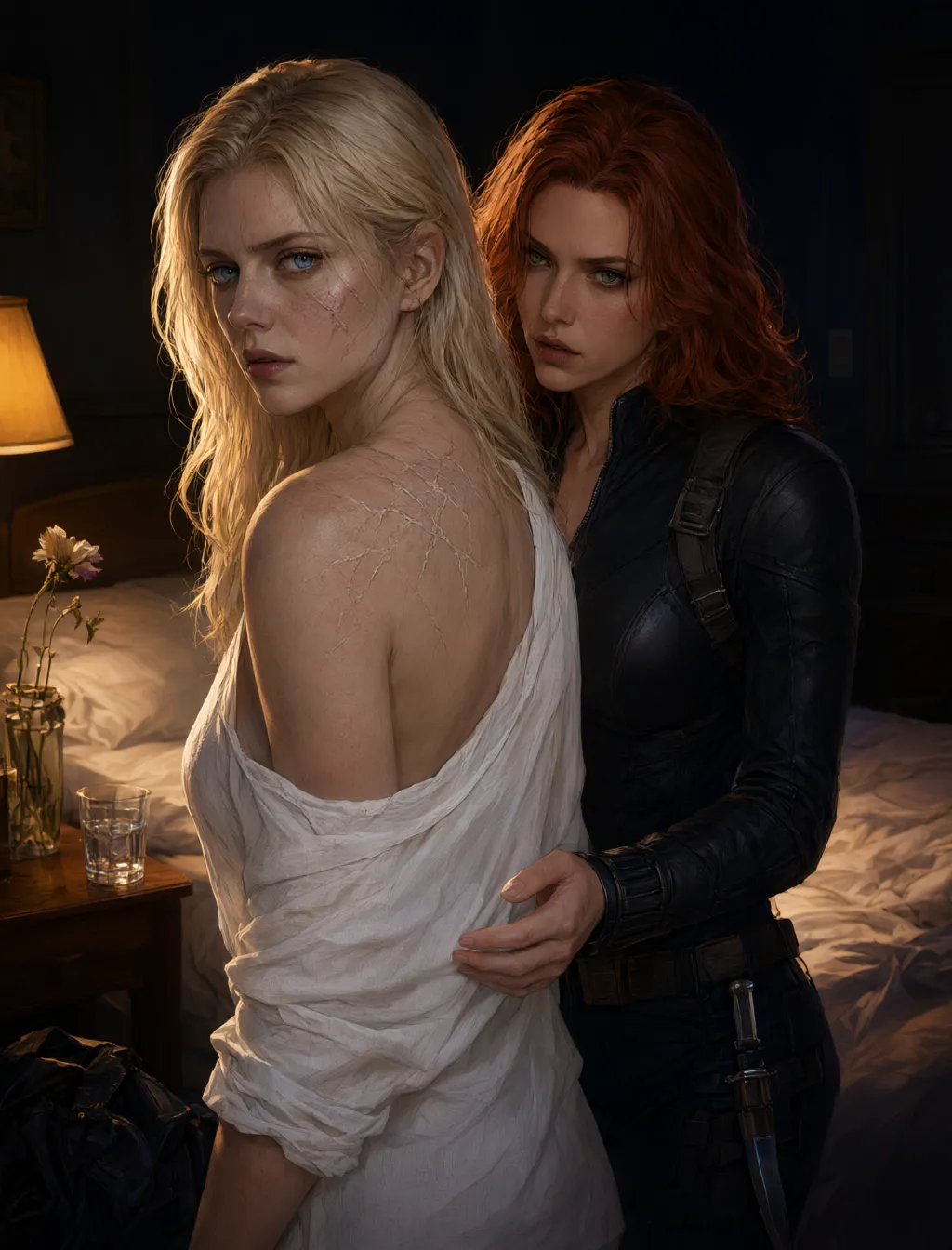
I don't want to let go of her hand.
The thought arrives small and quiet, like a thing I'm not supposed to say out loud. But it's true. Her fingers are still loosely tangled with mine, warm and alive, and the idea of pulling away feels like stepping off a cliff I didn't know I was standing on.
Natasha's breathing has changed. The even rhythm of sleep has shifted into something shallower, and I know she's waking up. I watch her eyes open, slow and unguarded for a fraction of a second before she remembers where she is, who she's with, what she's supposed to be.
"Morning," she says. Her voice is rough with sleep, and there's something in it I haven't heard before. Something raw.
"Morning."
She looks at our hands. Doesn't pull away. "You sleep at all?"
"Some." It's not quite a lie. I closed my eyes. I rested. Sleep came in fragments, but the fragments were enough, because her hand was there every time I opened my eyes.
She sits up slowly, stretching her neck with a wince. The leather of her suit creaks. She slept in it. Slept against a wall. For me.
"I need coffee," she says. "You want breakfast?"
The word lands in my chest and sits there. Breakfast. A normal thing. A thing people do when they wake up in a safe place with someone who stayed.
"Okay."
She nods. Stands. And she doesn't reach for me, doesn't try to help me up, but she waits. Just stands there, hands loose at her sides, watching me find my own way out of bed.
The floor is cold under my bare feet. The borrowed clothes — sweats and a t-shirt someone left folded on the dresser — hang loose on my frame in some places and pull tight across my shoulders in others. I don't recognize myself in the mirror across the room. A tall stranger with pale hair and silver scars and eyes that look like they've seen things I haven't let myself remember.
I look away.
The hallway is quiet. Early. The light is grey and soft, filtering through windows at the end of the corridor, and the air smells like cleaning solution and fabric softener and something faintly metallic that I've learned to associate with buildings full of weapons and secrets.
Natasha walks beside me. Not ahead. Not behind. Beside. She doesn't fill the silence with chatter, doesn't ask how I'm feeling, doesn't try to make this easier with words that would probably just bounce off the walls I've built. She just walks, and the sound of her footsteps matches mine, and somehow that's enough.
The kitchen is warm when we reach it. Someone's already there. A man with blonde hair and broad shoulders and an easy way of moving that speaks to decades of muscle memory. He's standing at the counter, pouring himself a cup of coffee, and he turns when he hears us enter.
Steve Rogers. I've seen his face on screens in the facility, in briefings that the handlers thought I was too far gone to understand. Captain America. The man who fell into ice and woke up in a world that had moved on without him.
He knows what it means to lose time.
"Natasha," he says, and his voice is warm, familiar. Then his eyes find me, and something in them shifts. Careful. Gentle. "You must be Sigrun. I'm Steve."
He doesn't step closer. Doesn't offer his hand. Just stands where he is, coffee mug in his grip, and lets me decide how close I want to get.
"I know who you are." My voice sounds rough, unused to this much talking, this much being around people who aren't holding needles.
"That makes one of us," he says, and there's a hint of a smile there, self-deprecating and easy. "I don't know much about you yet. But I'd like to."
It's an opening. A door left ajar. And I don't know what to do with it, so I say nothing.
Natasha moves past me, heading for the coffee pot. She pours two mugs without asking, slides one across the counter toward me, and I wrap my hands around it before I've decided to. The heat seeps into my palms, grounding me in the present moment, pulling me out of the spiral of what-ifs that's already starting to coil in my chest.
"Bucky around?" Natasha asks, and her tone is light, but I hear the question underneath it. Are we alone, or is this a conversation that needs more people?
"Running," Steve says. "Should be back in twenty."
Natasha nods. Takes a sip of her coffee. Lets the silence settle.
And I realize, standing there with a mug I don't remember taking, that I have a question. A question that's been living in my chest like a second heartbeat for four years and eight months, buried so deep I thought I'd forgotten how to feel it. But it's there. It's always been there. And now, in this kitchen with these two people who keep looking at me like I'm a person instead of a weapon, it's rising to the surface.
"Can I ask you something?"
My voice sounds strange. Too loud in the quiet. Natasha's eyes meet mine, and she nods. Just once. Like she knew this was coming.
"My family." The words scrape against my throat. "In Norway. Do you know—" I stop. Breathe. The coffee mug is hot in my hands, the only solid thing in a world that's suddenly tilting. "Are they alive?"
The question hangs in the air between us.
Steve's fork — he was reaching for something on the counter, I didn't even register what — stops halfway to his mouth. He sets it down. The clatter of metal against ceramic is loud enough to drown out the hum of the refrigerator, the distant thrum of the compound's ventilation system, the sound of my own heartbeat pounding in my ears.
He looks at Natasha. A silent conversation passes between them, quick and practiced, the kind of communication that comes from years of fighting side by side.
Then he turns to me.
"They're alive."
The words don't register at first. They bounce off the walls of my skull, sound without meaning, letters without context. I hear them, but I don't understand them, because I've spent four years and eight months assuming the opposite. Assuming that Hydra killed them the way they killed every loose end, every witness, every person who might have been looking for me.
"SHIELD found them," Steve continues, and his voice is careful, measured, like he's walking through a minefield and knows one wrong step could end everything. "In Norway. They're alive. Your parents. Your brother."
My hands are shaking. The coffee sloshes in the mug, dark and hot, and I watch it move like it belongs to someone else's body.
"They think you died in the kidnapping," Natasha says quietly. "There was a body. Dental records. Hydra covered their tracks."
A body. They put a body in my grave. Someone else's corpse with my name on it, lowered into the earth while my parents stood there and watched and wept, and I was in a windowless room with a drain in the floor, counting seconds between needles.
The relief hits first.
It's a wave, a wall of water that slams into my chest and steals my breath. They're alive. They're alive. My mother's hands, my father's laugh, my brother's stupid grin that he never quite grew out of. They're still in the world, still breathing, still existing somewhere under the same sky I'm standing under.
And then the grief follows.
Because I am alive too. And they don't know. They mourned me. They buried me. They spent four years and eight months learning to live without me, and I am standing in a kitchen in a country I've never been to, drinking coffee I didn't pour, wearing clothes that aren't mine, and I cannot let them see what I have become.
I cannot go back.
The thought is a knife, cold and precise, sliding between my ribs before I have time to brace for it. I cannot go back to Norway, to the fjords and the mountains and the house where I learned to walk. I cannot show up on their doorstep and expect them to recognize the woman who crawled out of Hydra's basement. They will look at me and see a stranger. They will look at me and see scars and muscles and eyes that have seen too much, and they will be kind, because they are good people, but they will never look at me and see the girl who used to fall asleep on the couch watching bad movies with her brother.
That girl died in a cell four years ago.
I am something else now.
The mug slips from my fingers. Or maybe I put it down. I don't know. The next thing I'm aware of is the counter against my hip, hard and solid, and my hands gripping the edge so tight my knuckles go white, and my breath coming in short, sharp gasps that don't seem to be reaching my lungs.
I can't breathe.
I can't breathe, and there's a hand on my back, present but not pressing, and a voice saying my name over and over, low and steady, like a rope thrown to someone drowning.
"Sigrun. Sigrun, I need you to breathe with me. Can you do that?"
Natasha. Her hand is on my back, and I can feel the warmth of it through the thin fabric of the t-shirt, and I want to tell her I'm fine, I want to tell her this is nothing, I've survived worse, I've survived so much worse, but my throat is closed and my chest is caving in and all I can see is my mother's face, older now, lined with grief I put there.
"In through your nose," Natasha says. "Hold it. Out through your mouth."
I try. The air rattles in my throat, thin and useless. But I try again. In. Hold. Out. The rhythm is clumsy, broken, but she stays with me, her hand a steady pressure on my spine, her voice a thread pulling me back to the surface.
I don't know how long it takes. Seconds. Minutes. Time is a stranger to me, something that moved differently in that cell, stretched and compressed by pain and isolation. But eventually the air starts to come easier. The vice around my chest loosens. The world swims back into focus, sharp and too bright, and I realize my cheeks are wet.
I'm crying.
I haven't cried in four years and eight months. Haven't been able to. Something in me broke or burned out or was carved away by the things they did to me, and the tears stopped coming. I thought I'd lost the ability entirely, filed it away with the other pieces of myself that Hydra took and never returned.
But I'm crying now. Silent tears tracking down my face, dropping onto the counter, staining the pale granite with dark spots that spread like bruises.
"I can't go back," I hear myself say. My voice sounds like someone else's, cracked and raw and so small it barely exists. "I can't let them see me like this."
Natasha doesn't say anything. She just stands beside me, her hand still on my back, and lets me fall apart in a kitchen that smells like coffee and cleaning solution and the faint, clean scent of her shampoo.
I don't know how long we stay like that. But eventually the tears stop. My breath evens out. The world settles back into something resembling normal, and I straighten up, wiping my face with the back of my hand, not meeting either of their eyes.
"Sorry." The word is automatic, a reflex I didn't know I still had.
"Don't." Natasha's voice is firm, but not unkind. "Don't apologize for feeling things."
I want to argue. Want to tell her that I'm supposed to be stronger than this, that I survived years of torture without breaking, that falling apart over news I should be grateful for is a weakness I can't afford. But the words don't come. And maybe that's because some part of me knows she's right.
Steve has moved. He's standing by the stove now, and there's a pan in his hand, and the smell of eggs and butter is starting to fill the air. He doesn't look at me with pity. Doesn't look at me like I'm fragile. He just cooks, the way Bucky cooked last night, the way people in this compound seem to express care through food and space and the quiet refusal to make a big deal out of things.
"They're good people," Steve says, not turning around. "Your family. From what I've read in the files.
"She'll want to know," I say. "If she finds out I'm alive, she'll want to see me."
"She will," Natasha says. "But that's your choice. Not Hydra's. Not ours. Yours."
I open my eyes. Look at her. She's watching me with those green eyes that have seen too much, and there's no judgment in them. No pressure. Just the quiet patience of someone who has also had to make impossible choices about who to let back in.
"What if I'm not ready?"
"Then you're not ready." She shrugs, a small, economical movement. "You don't have to be ready today. Or tomorrow. Or next month. You get to decide when, or if, you want to reach out."
I think about that. About the weight of that choice, the terrifying freedom of it. For four years and eight months, every decision was made for me — when to eat, when to sleep, when to bleed, when to scream. And now I'm standing in a kitchen with a cup of coffee I don't remember pouring, being told that I get to choose.
It's the most frightening thing anyone has ever offered me.
Steve slides a plate onto the counter in front of me. Eggs, scrambled, with cheese melted through them. A piece of toast on the side, buttered. It's simple. It's ordinary. It's the kind of meal someone makes when they want to say I see you, and I think you matter without using words.
"Eat," he says. "You're going to need your strength. Not for anything heroic. Just for living."
I stare at the plate. My stomach turns at the thought of food, but my hand reaches for the fork anyway, because some part of me understands that this is an offering. A small one. A quiet one. But an offering nonetheless.
I take a bite. The eggs are warm, salty, familiar in a way that makes my chest ache. I take another bite. And another.
Natasha sits down across from me, her own coffee mug cradled between her palms. She doesn't watch me eat, which I'm grateful for. She looks out the window, at the grey morning light and the trees swaying in the wind, and she gives me the space to exist without being observed.
I finish the eggs. The toast. Drink the rest of the coffee, which has gone lukewarm but still tastes like something real. And when I set the mug down, I meet her eyes.
"I want to know everything," I say. "About what SHIELD found. About what Hydra did to cover it up. About the body they put in my grave." I pause. Swallow. "I want to know who I am now. What they made me into."
Natasha doesn't flinch. She sets her mug down, slow and deliberate, and meets my gaze with that steady, unreadable look that I'm starting to recognize as her version of I'm listening, and I'm not going anywhere.
"That's a lot," she says. "And some of it is going to hurt."
"I know."
"And you still want to know?"
I think about my mother's hands gripping the counter. My father's laugh, the way it used to fill the whole house. My brother's stupid grin. I think about the body in the ground, the grave I never got to see, the years they spent mourning a woman who was still breathing in a cell a thousand miles away.
I think about the scars on my skin, the strength in my bones, the things my body can do now that I haven't even tested yet.
And I think about Natasha's hand in mine through the dark, holding me to the world.
"Yes," I say. "I want to know. All of it."
The kitchen is quiet. The eggs are gone. The coffee is cold. And somewhere outside, footsteps are approaching — Bucky, probably, back from his run, about to walk into a kitchen that smells like breakfast and tears and the beginning of something I don't have a name for yet.
I don't know what comes next. I don't know how long the healing will take, or whether I'll ever really heal, or whether there are pieces of me that Hydra broke so thoroughly they'll never fit back together.
But I know one thing.
I am not alone.
And for the first time in four years and eight months, that feels like enough to start.