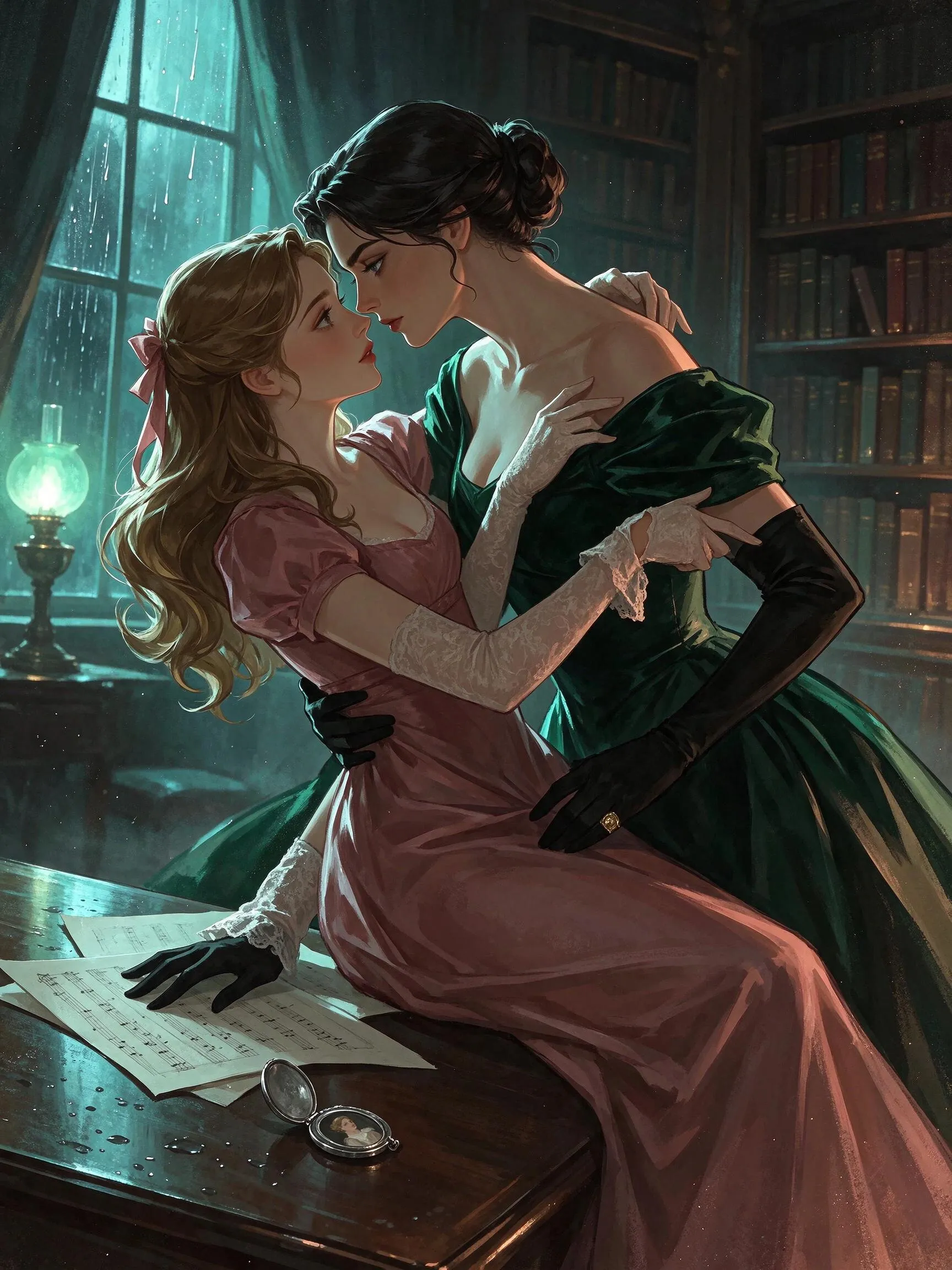

The heat was an animal tonight. Luna could feel it breathing against her skin, thick and damp and patient, curling through the ballroom in waves that carried the sharp musk of spilled wine and the sweetness of crushed rose petals. Someone had already lost a flower to the crush—she could see it flattened against the parquet near the orchestra, a smear of deep crimson petals ground into the grain by dancing slippers.
She did not move. That was the first lesson she had learned at thirteen, standing in this same ballroom while her mother's body lay in state two streets away: when the world is chaos, you become the still point. You do not fidget. You do not glance at the door. You do not let anyone see the calculation behind your eyes.
Fourteen years. Fourteen years of standing exactly here, at the edge of the Ashford dance floor, half-turned from the crush so that the candlelight caught the sharp line of her cheekbones and the dark sweep of her chignon, and no one—no one—had ever seen her waver.
The champagne in her hand was untouched. Condensation beaded along the crystal, a slow crawl of moisture that she could feel against her gloved fingertips, cool and patient. She had been holding it for the better part of an hour. It would be warm by now, or nearly, the bubbles gone flat, and still she did not drink.
"Lady Ashford."
She turned her head a fraction, the barest acknowledgment, and found Lord Pemberton approaching with the particular gait of a man who believed himself charming. He was not. He was the third son of a baron with a gambling debt he thought she did not know about, and he was about to ask her to dance.
"My lord." Her voice was velvet over iron. "I was just thinking how well the chandeliers look this evening. Do you not find them particularly—" she paused, letting the word hang, "—illuminating?"
He blinked, thrown. "I—yes, of course. Very. Very illuminating."
"How fortunate." She smiled, and it did not reach her eyes. "Then you will not miss me when I decline your invitation."
His mouth opened, closed, opened again. She watched him struggle for a response and found she did not care enough to wait for it. Her gaze had already drifted past his shoulder, across the swirling colors of the dance floor, toward the arched doorway at the far end of the room.
And there she was.
Luna's breath caught. It was a small thing, barely a hitch in the rhythm of her chest, and she covered it with a sip of the warm champagne that she did not taste. But her eyes—her eyes did not lie, and they had found Francesca Bridgerton in the doorway like a compass finding north.
She was silhouetted against the corridor's dimmer light, a slim figure in a gown the color of old rose, and the light caught her hair in a spill of honey-brown waves that seemed almost to glow. She was not wearing a tiara. Most of the young women tonight wore them, delicate constellations of paste and crystal that caught the chandeliers and scattered light like falling stars. Francesca wore nothing but a single ribbon threaded through her hair, the same color as her gown, and she looked—
Luna stopped the thought before it could finish. She had spent fourteen years learning to stop thoughts before they finished.
"Lady Ashford?" Pemberton was still there, still floundering. "I hope I have not given offense—"
"You have not." She did not look at him. "You are excused, my lord. I believe Lady Pemberton is looking for you."
It was a lie. His mother was across the room, deep in conversation with Lady Danbury, gesturing with a fan that had seen better decades. But he would not check, and he did not, merely bowing and retreating with visible relief, leaving Luna alone again at the edge of the dance floor with the warm champagne and the sound of her own heartbeat in her ears.
Francesca had stepped fully into the room now. There was a hesitation before she did it, a half-second pause in the doorway that no one else would have noticed, as if she were gathering herself, and Luna watched it with an attention she could not have explained to anyone. The way Francesca's gloves were slightly too long, the fabric pooling a little at her wrists. The way her eyes swept the room once, twice, before settling—
And finding Luna.
The distance between them was the width of the entire ballroom. Sixty feet of polished parquet, of dancing couples and circulating footmen, of the ton at its most glittering and most false. And yet for one suspended moment, it was as if the room had emptied, as if the orchestra had fallen silent, as if the only two people in all of London were the woman at the edge of the dance floor and the girl in the doorway with the honey-brown hair.
Luna did not move. She could feel herself not moving, the way one feels the absence of a limb, and the champagne glass was suddenly heavier in her hand, an anchor holding her to this spot while every instinct she owned pulled her toward the doorway.
Francesca's gaze held hers. There was no smile, no nod, no acknowledgment that the ton would recognize as anything other than two acquaintances meeting across a crowded room. But there was something in the stillness of her posture, the way she did not look away, the way her shoulders settled slightly as if she had found what she was looking for.
Luna had been looked at before. She had been admired, assessed, appraised, desired, feared, resented, and envied. She had been the subject of speculation and the object of ambition. She had been watched by men who wanted her fortune, women who wanted her position, and enemies who wanted her ruin.
No one had ever looked at her like that. Like she was the answer to a question they had not yet learned to ask.
She felt her fingers tighten around the champagne glass, the condensation slick against her glove. Somewhere behind her, a woman laughed too loudly, and a man's voice rose in protest, and the orchestra finished its waltz with a flourish that scattered the dancers into applause. None of it reached her.
She was going to cross the room.
The thought arrived fully formed, as if it had been waiting in the wings of her mind for permission to step onstage. She was going to set down the champagne glass, she was going to walk across the sixty feet of parquet, she was going to stop in front of Francesca Bridgerton and say—
She did not know what she was going to say. That was the terrifying part. Luna Ashford always knew what she was going to say. She had been raised to know, trained from the cradle to measure every word before it left her lips, to weigh the cost of every syllable against the benefit of every silence. She had negotiated treaties with men twice her age and left them wondering how they had been outmaneuvered. She had stared down the Prince Regent himself and made him blink first.
And now she was going to cross a ballroom with no idea what she would say when she arrived.
The thought should have stopped her. It should have been the anchor that held her in place, the voice of fourteen years of careful control whispering you do not move without a plan, you do not speak without a purpose, you do not—
Francesca's head tilted, just slightly, a question in the angle of her chin. The light caught her face, and Luna saw the faint curve of her lips, not quite a smile, not quite anything, and something in her chest—something she had thought long dead, something she had buried beneath the weight of her name and her fortune and her secrets—stirred.
She set down the champagne glass.
It clicked against the marble of a nearby table, a sound so small she was surprised she heard it over the orchestra and the murmur of a hundred conversations. But she heard it, felt it through her fingertips, the finality of the gesture, the commitment of it. The glass was no longer in her hand. She was no longer anchored.
She took a step.
The crowd parted before her. She did not ask it to; it simply did, the way it always did, the way it had done since she was thirteen years old and had learned that the only way to survive was to become someone the world moved around. Bodies shifted, conversations paused, eyes tracked her progress with the particular attention the ton reserved for anything that might become gossip.
She did not see any of them. She saw only the doorway, and the woman in it, and the space between them that was shrinking with every step.
Francesca had not moved. She stood in the arch of the doorway, one hand resting lightly on the frame, her gloves pooling at her wrists, her eyes fixed on Luna with an intensity that should have been unsettling and was instead—
Luna did not let the thought finish. She kept walking.