

Vivi's POV:
The marble bites through the soles of my feet before I've taken three steps. I stop, one hand flat on the banister, and consider going back for the slippers I left in the east sitting room.
No. Let it bite. It's the only thing in this house that's ever told me the truth.
The lilies on the hall table are dying. I noticed it this morning—the way the water's gone cloudy, the way the white petals have started to brown at the edges like something burning inward. I meant to tell Mrs. Hollis. I've meant to tell her for three days. Instead I've walked past the arrangement four times a day, watching it rot in that slow, genteel way expensive things rot in this house, and said nothing.
My father would call that a failure of stewardship.
I'd call it a small, private satisfaction.
I'm halfway down the staircase—the long one, the one that curves past the portrait of my great-grandmother and deposits you directly into the foyer like an announcement—when the front door swings open and the light changes.
Not the light. The air. That's the thing about this house. It's been breathing the same breath for two hundred years, beeswax and old paper and the particular dust of things that have never been moved because moving them would be unthinkable. And then the door opens, and something else walks in. Cigarette smoke and cheap shampoo and the outside, the actual outside, with its grass and its gasoline and its unfiltered sun.
A girl comes through the doorway carrying a cardboard box.
She's got it propped against her hip, one arm hooked under the bottom, the other splayed flat across the top to keep it steady. The box has been used before. I can tell from here—the tape is doubled, the corners are dented inward, someone's written KITCHEN? on the side in blue marker and then crossed it out and written BOOKS underneath.
Her legs are bare.
Cutoffs. Actual cutoffs, the kind you make yourself with kitchen scissors, the kind that fray at the hem and ride up the thigh when you shift the weight of a box. The kind that have no business in this foyer, on this marble, under this ceiling.
I don't look away fast enough.
The late sun is coming through the leaded glass beside the door—that particular four-o'clock light that turns the dust motes gold, that makes the whole foyer look like something out of a painting my father would buy and never hang. And this girl is standing in the middle of it, chestnut hair escaping a ponytail in dark curls at her temples, freckles scattered across her nose like someone flicked a brush at her and missed, and the light catches every one of them.
My hand tightens on the banister. The wood is polished smooth. I know exactly how smooth, because I've been running my palm along this banister since I was six years old, and it has never once felt like anything but smooth.
It feels smooth now. It feels like nothing.
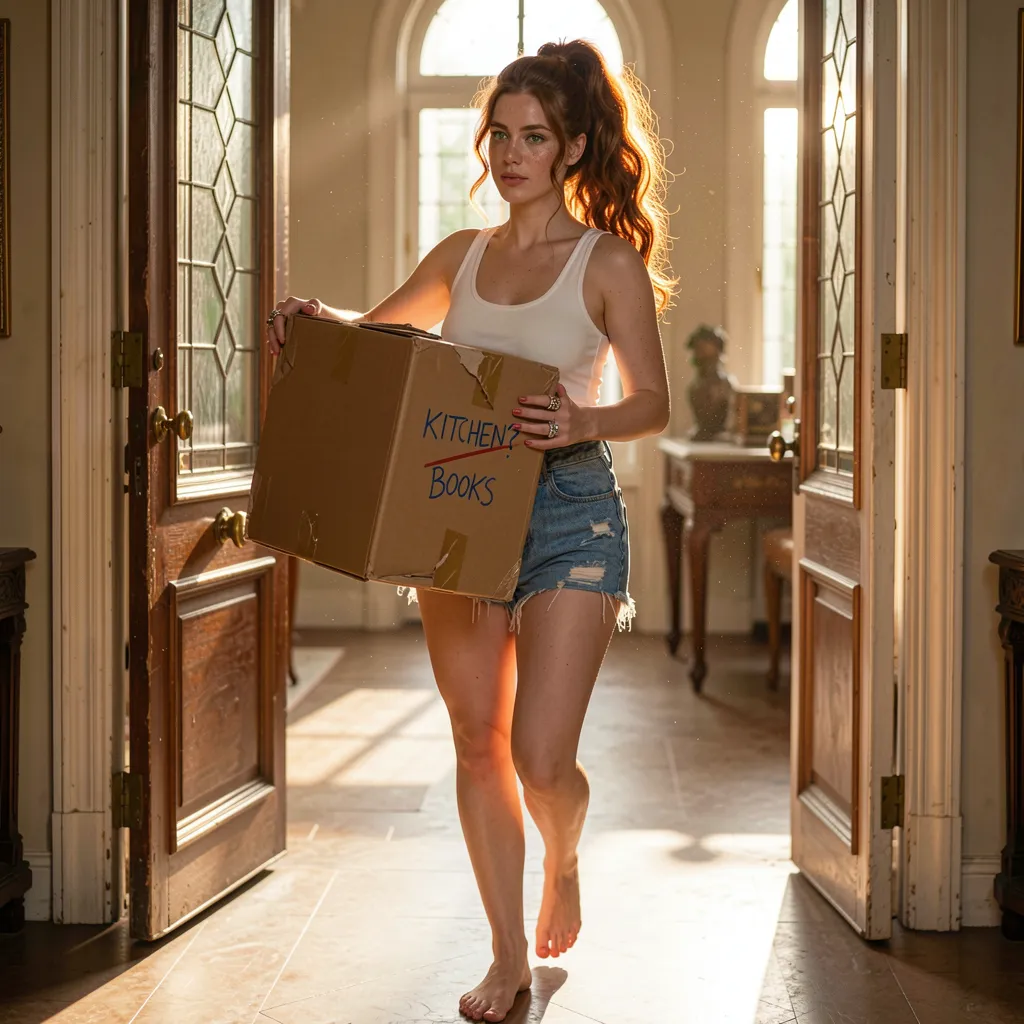
She sets the box down on the console table—my console table, the one with the lilies, the one where I leave my keys and my mail and the invitations I never answer—and the cardboard scrapes across the marble with a sound like something being decided.
Then she looks up.
Green eyes. Vivid, unreasonable green, the kind you'd call fake if you saw them on anyone else. They sweep the foyer once—ceiling, chandelier, the long gallery of portraits my father never mentions—and then they land on me.
They land on me and they stop.
I know the look. I've been looked at my whole life. I know the quick flick of assessment, the recalibration, the way people's faces arrange themselves into something polite once they've decided what I'm worth. I know the look that means that's the Ashford girl and the look that means that's the Ashford girl? and the look that means nothing at all because the person looking has already moved on.
This isn't any of those.
This look starts at my face and travels. Down. Over the black silk of my shirt, the tailored line of my trousers, the bare ankles above my loafers. It travels like it has all the time in the world, like it's not doing anything wrong, like nobody taught it to be careful.
Then it comes back up. And she smirks.
It's not a friendly smirk. It's not a hostile one, either. It's the smirk of someone who has just discovered something she intends to think about later, in private, at length. The corner of her mouth pulls up, crooked, and one of her eyebrows follows, and she opens her mouth like she's about to say something.
My jaw sets. I feel it happen—the small, familiar clench that keeps my face still when I want it to be still—and I cannot stop it.
"Charlie!"
The voice comes from the east hall, bright and warm and entirely too delighted, and I know before I turn that it's Cate. My father's fiancée. My father's latest fiancée, though I've been told—repeatedly, by my father, by Cate herself, by the wedding coordinator who called me sweetheart on the phone—that this one is different.
"Charlie, sweetheart, is that you? Did the movers—oh!"
Cate Whitmore appears in the archway at the far end of the foyer, and the whole room rearranges itself around her. She's wearing a wrap dress the color of champagne and heels that click against the marble in a rhythm I've learned to recognize, and she has the same green eyes as her daughter, the same freckles, softened now by forty-eight years and a fortune's worth of good skincare. She stops when she sees us.
She stops, and her face does something I've seen a dozen times since she moved in, something I've started to recognize as the expression of a woman who has decided, against all evidence, that her life is working out beautifully.
"Look at you two," she says.
She says it to the room. She says it like she's presenting us to an audience I can't see.
"Look at you two, already getting along!"
Charlie's smirk doesn't move. It just gets—better. Sharper. More deliberate. She doesn't look away from me, and I don't look away from her, and somewhere in the middle of that the silence stretches just long enough to become a thing that has happened.
"Mom," Charlie says. Her voice is lower than I expected. Rougher. There's a scratch to it, like she's been yelling or laughing or both, and it curls around the word Mom in a way that's fond and exasperated all at once. "We haven't actually met."
"You haven't—" Cate blinks. Then she laughs, a bright, glassy laugh that bounces off the marble and dies somewhere near the ceiling. "Oh, of course you haven't. I've been so—the movers are still in the back, they've put the boxes in entirely the wrong rooms, and I've been on the phone with the caterer for an hour because apparently the salmon is a problem now—"
She's already crossing the foyer, heels clicking, hands moving. She stops beside the console table and looks at the two of us with the expression of a woman surveying a job well done.
"Vivienne, this is my daughter. Charlotte. Charlie. Charlie, this is Vivienne Ashford. Alex's daughter."
"Vivi," I say.
It comes out flat. It comes out before I've decided to say it, which is unlike me, and I feel Charlie's eyes on me like a hand on the back of my neck.
"Vivi," Charlie repeats. She says it slowly, tasting it. She tilts her head. "Like the candle?"
"Like the name."
"Right." She nods, like she's filing something away. "Nice to meet you, Vivi-like-the-name."
Cate laughs again. "Charlie, don't be—"
"I'm not being anything. I'm being polite. I said nice to meet her."
"You said it like—"
"I said it like a person who just met someone. What do you want me to do, curtsy?"
Cate's mouth opens. Closes. She looks at me, and there's an apology forming in her eyes, and I have the sudden, strange urge to tell her it's fine, that I've heard worse, that her daughter's not the first person to find me amusing in my own house.
I don't say any of that.
"The movers," I say instead. "You said they put the boxes in the wrong rooms."
"Oh—yes." Cate seizes on it gratefully. "They put everything in the blue room, which I specifically said was for the—well, it doesn't matter now, but if you could just tell them—"
"I'll handle it."
"You're an angel. You're an absolute angel." She's already turning, already moving back toward the archway, already halfway to whatever small crisis is pulling at her. She pauses at the threshold and looks back at us—at her daughter, still standing by the console table with the box at her hip, and at me, still halfway down the stairs with my hand on the banister—and her face softens into something that makes my chest do a small, unwelcome thing.
"I'm so glad you're here," she says. To Charlie. To both of us. To the room. "Both of you. I really am."
Then she's gone, heels clicking away down the east hall, her voice rising again as she calls for someone named Marcus.
The foyer is quiet.
Not silent. This house is never silent—there's always something, the tick of the grandfather clock in the library, the hiss of the radiators, the distant hum of the kitchen. But the kind of quiet that happens after a door closes and two people are left in a room together, and neither of them has decided what to do about it.
Charlie looks at the box. Then at me. Then at the box again.
"So," she says. "This is your house."
"It's my father's house."
"Right." She nods slowly. "And my mom's about to be your—what. Stepmom? Is that the word?"
"That's the word."
"Cool." She says it like it isn't. She shifts her weight, and the cutoffs ride up another inch, and I make myself look at the box. "Cool, cool, cool. Great. So we're—what. Sisters now?"
"We're not sisters."
"No?" Her eyebrow lifts. "Because my mom seems pretty committed to the bit. She's been talking about 'the girls' for weeks. 'The girls are going to get along so well.' 'The girls have so much in common.' I didn't know who she meant until—" She gestures at me, at the foyer, at everything. "—this."
"I'm aware."
"Are you?" She tilts her head. The smirk is back, softer now, more curious than sharp. "Because you've been standing on that staircase for a while, and I'm starting to think you're not coming down."
I am, in fact, still on the staircase. My hand is still on the banister. My feet are still on the same step. I've been standing here since the door opened, and I have no memory of deciding to stay.
I take the last four steps. Slowly. Deliberately. My loafers make a sound against the marble that's nothing like her bare feet, and I stop on the floor of the foyer, six feet from her, and I look at her the way I look at everyone who comes into this house.
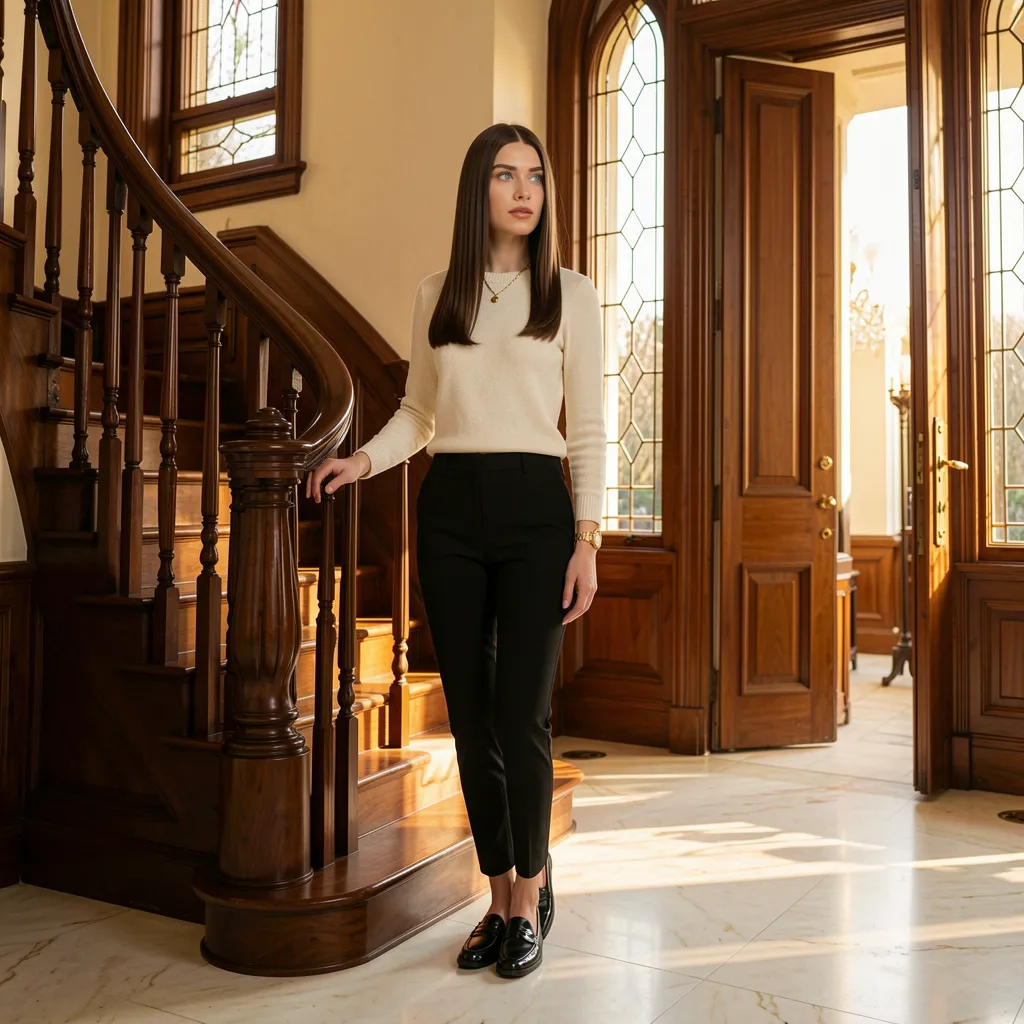
She's shorter than I expected. She's also—messier. There's a smudge of something on her forearm, dust or ink, and her t-shirt has a hole at the collar, and her hair is coming out of the ponytail in a way that suggests it was never really in. She looks like she fell out of a different life and landed here by accident.
She looks at me like she knows exactly where she is.
"Charlotte," I say.
"Charlie."
"Charlie." I let it sit. "The blue room is down the east hall, past the library. Second door on the left. I'll tell the movers to move your things."
"You don't have to—"
"I know."
She studies me for a second. Something moves behind her eyes—quick, unreadable, gone before I can name it—and then she shrugs and picks up the box.
"Okay," she says. "Thanks. I guess."
She turns and walks toward the east hall, and the box scrapes against her hip, and I watch her go because there's nothing else to look at, and because the light is still coming through the leaded glass and catching the dust motes and the back of her neck where her hair has escaped the ponytail, and because—
She stops.
She stops at the archway and looks back over her shoulder, and her eyes find mine across the length of the foyer like they knew exactly where I'd be.
"Hey," she says. "Vivi."
"Yes."
"The lilies are dying."
I look at the arrangement on the console table. The browning petals. The cloudy water. The three days I've been walking past them without saying anything.
"I know," I say.
She nods, once, like that answers a question she hadn't asked, and then she's gone—through the archway, down the east hall, the sound of her bare feet fading into the house.
The foyer is empty. The box is still on the console table, the one she set down and didn't pick up, the one with KITCHEN?crossed out and BOOKS underneath. The tape is doubled. The corner is dented.
I stand there for a long moment, alone in the gold light, with my hand still remembering the smoothness of the banister and the lilies dying quietly behind me.
Then I pick up the box.
The box is heavier than it looks.
I feel it the moment I lift it off the console table—the shift of weight, the way the bottom sags in my grip. Books, then. Real ones, not the decorative kind my father keeps in the library, the ones with uncracked spines and no fingerprints. These have been read. I can tell from the corners of the box, the way the cardboard has gone soft from being carried and set down and carried again.
I tuck it against my hip the way she did. My silk shirt catches on the tape, and I feel the thread pull, and I don't stop to check it.
The east hall is longer than it needs to be. That's the thing about this house—every room is a walk from every other room, as if the architect believed distance was a form of dignity. The library doors stand open on my left, and inside I can see the afternoon light lying across the reading chairs, the ladder still hooked to the shelves where I left it last week. I don't go in. I keep walking, past the portrait of my grandfather in his naval uniform, past the small sitting room where Cate likes to take her calls, past the powder room with its wallpaper of hand-painted peonies that my mother chose and my father never changed.
Second door on the left.
I know the room. I've known it my whole life. It was the guest room, then the sewing room, then the room where my stepmother number two kept her orchids through one winter before the marriage ended and the orchids died. It's been empty for years. Blue walls, tall windows, a fireplace that doesn't draw properly, a bed with a canopy I used to hide under when I was small.
The door is already open.
I stop in the threshold.
The movers have been here. They've stacked boxes in the middle of the floor—not along the wall, not in the closet, just a pile, four high, like they were told blue room and stopped listening. The bed is bare. The curtains are still drawn back from the last time Mrs. Hollis aired the room, and the light comes in grey and flat and shows every mote of dust the boxes kicked up.
But she's been here too.
There's a duffel bag on the window seat, unzipped, one sleeve of a sweater hanging out like a tongue. There's a pair of sneakers kicked off under the window, mismatched, one on its side. There's a phone charger trailing across the floorboards, plugged into a socket that hasn't been used in a decade, and a paperback face-down on the nightstand with its spine cracked open—she reads with the book flat, I can tell, the way you do when you don't care what happens to it.
And there, on the mantel above the fireplace that doesn't draw, three framed photographs have been propped up against the tile. Facing out. Waiting to be hung.
I set the box down.
I set it down beside the others, on the floor, and I straighten, and I stand there in the doorway with the dust settling around me and the smell of her still in the air—cigarette smoke and cheap shampoo, exactly what walked in the front door an hour ago—and I realize I have no reason to be here.
I told her I'd tell the movers to move her things.
I didn't tell her I'd carry the box myself.
I don't know why I did. I don't know why I'm standing in the doorway of a room I haven't entered in years, looking at a stranger's paperback and a stranger's sneakers and three photographs I have no business looking at.
I look at them anyway.
The first is a woman—Cate, younger, maybe twenty years ago, standing on a beach somewhere with her hair blowing across her face and a glass in her hand. She's laughing at whoever took the picture. The second is a dog, a big shaggy thing, tongue out, squinting into the sun. The third is Charlie. She's maybe fifteen, maybe sixteen, sitting on a porch step with her knees drawn up and her chin on her knees, and she's not smiling, and she's not looking at the camera, and she's the only person in any of the three photographs who doesn't seem to know she's being watched.
I put my hand on the doorframe.
The wood is painted, not polished. It's rough under my palm in a way the banister never is, and I notice it—I notice it the way I notice everything, the way I've trained myself to notice, cataloguing the difference between this room and the rest of the house. The blue room has never been restored. The walls are the same blue they were when my mother picked them, and the paint has gone chalky in the corners, and the fireplace still doesn't draw, and nobody has ever bothered to fix it because nobody has ever stayed here long enough to care.
She's going to stay here.
That's the thing I can't make my mind close around. She's not a guest. She's not a stepmother's daughter passing through for a weekend. Her boxes are in the blue room, and her charger is in the wall, and her book is face-down on the nightstand, and she's going to wake up in this room tomorrow and the day after and the day after that.
I should leave.
I should go find Mrs. Hollis and tell her to have the movers bring the rest of the boxes up, and then I should go to my room, or the library, or anywhere that isn't here.
I don't.
I step into the room instead. All the way in. My loafers make no sound on the bare floor, and I cross to the window seat, and I stand there looking down at the duffel bag—at the sweater sleeve hanging out, at the zipper that's been forced past its teeth, at the bottle of lotion tucked in the side pocket with the cap half off—and I don't touch any of it. I just stand there, in her space, in the room that's supposed to be hers now, and I let myself feel how strange it is.
Footsteps in the hall.
Bare feet. I know the sound already—I've heard it exactly once, crossing the foyer, and I know it. That's the part that unsettles me. That I know it.
"You carried it."
Her voice comes from the doorway. Low, roughened, the same scratch I heard downstairs. I turn.
She's leaning against the frame, arms crossed, shoulder pressed to the painted wood. She's still in the cutoffs, still in the t-shirt with the hole at the collar. There's a new smudge on her jaw—dust, probably, from wherever she's been—and her ponytail has given up entirely, the chestnut hair loose around her shoulders now, curling at the ends where it's been crushed against the box.
"I said I'd have the movers bring it up," I say.
"Yeah." She doesn't move. "You said that."
"They're still in the back. It was faster to—"
"To carry it yourself." She tilts her head. The smirk is there, but it's quieter now, like she's not sure yet what to do with it. "Through the whole house. Past the library. Down the hall."
"It's not far."
"It's pretty far." She pushes off the frame and comes into the room, and I move back—half a step, automatic—and she notices, and something flickers across her face, and she doesn't stop. She walks past me to the window seat, drops onto it beside the duffel bag, and pulls her knees up, and now she's the one sitting with her chin on her knees, exactly like the photograph, except she's looking at me this time.
"So," she says. "This is the blue room."
"It is."
"It's very blue."
"It's been blue for thirty years."
"Right." She looks around—at the chalky corners, at the fireplace, at the canopy bed with no bedding on it. "And the movers put everything in here."
"Yes."
"Including the stuff that was supposed to go to the kitchen."
I look at the stack of boxes. The top one has KITCHEN? crossed out on the side, same as the one she carried in. "Apparently."
"Great." She says it flat. "So I've got a box of spatulas somewhere in there and no idea which one."
"I'll have them sorted."
"You keep saying that." She rests her cheek on her knee and studies me. "You going to do it yourself too?"
"No."
"Didn't think so."
I don't answer. The light through the window has shifted—it's later than I thought, the grey gone gold at the edges—and it falls across her face now, across the freckles, across the loose hair at her temple. She's got a small scar on her chin, I notice. Barely there. A pale line, older than the freckles, something that happened a long time ago and healed over.
"You don't have to stay in here," I say.
"I know."
"There are better rooms."
"Are there?"
"The green room faces the garden. The west suite has its own bath."
"And the blue room has a fireplace that doesn't work and a bunch of boxes full of spatulas." She shrugs. "Sounds about right."
"Right for what?"
She doesn't answer. She just looks at me, and the smirk comes back, and I realize I've walked into something—a question I didn't mean to ask, a door I didn't mean to open—and I don't know how to walk back out of it.
"You didn't have to carry it," she says finally. "That's all. You could've just told the movers. You could've gone back upstairs. You could've done literally anything else."
"I was coming this way."
"Were you."
"The library—"
"Is back the way you came." She says it without heat. Just a fact. "I walked past it. Twice. On my way in and on my way out."
I don't have an answer for that. I have a hundred answers, and none of them are true, and she's looking at me like she can hear all of them.
"Okay," she says, and pushes off the window seat. She crosses to the stack of boxes and starts reading the sides—BOOKS, BATHROOM, MOM'S SHOES?, BOOKS, MISC—tilting her head to make out the crossed-out words underneath. "So where do you want me to put all this."
"It's your room."
"Yeah, but it's your house. I don't know where anything goes. I don't know where the closet is, I don't know which way the drawers open, I don't know if there's a—" She pulls open the armoire and stops. "Oh."
Inside, the shelves are lined with old linen. Folded, stacked, lavender sachets gone brown and brittle. Somebody's been keeping this room ready for guests who never came.
"It's fine," she says, softer now. "I'll figure it out."
She closes the armoire. She stands there with her hand on the door, and for a second she's not smirking and she's not sharp and she's just a girl standing in a strange room in a strange house with her whole life in cardboard boxes on the floor.
Then she turns around, and it's gone.
"So," she says. "You want to tell me why you really carried it up here, or are we going to keep pretending it was on your way?"
I look at her. At the box on the floor. At the three photographs on the mantel, facing out, waiting.
"The lilies," I say.
She blinks. "What?"
"You noticed them. Nobody notices them."
"They're dead, Vivi. It's not exactly a magic trick."
"Three days," I say. "Four times a day. I've walked past them for three days and said nothing. You saw them in ten seconds."
"So?"
"So I wanted to know how."
She looks at me for a long moment. The light is going, the gold pulling back toward the window, and in the dim of the room her eyes have gone darker—less green than grey, like water under weather.
"I look at things," she says. "It's not a superpower."
"It's not nothing."
"It's nothing." She picks up the paperback off the nightstand, flips it closed on her finger to hold the page. "It's just—when you grow up somewhere that's about to change, you learn to look at it. Before it does."
She says it lightly. She says it like she doesn't mean it. And then she looks down at the book in her hand, and the room goes quiet around us, and I understand—the way you understand a thing you weren't told—that she's just told me something true.
The grandfather clock in the library chimes. Five. It carries down the hall, muffled and slow, and neither of us moves.
"I should go," I say.
"Yeah."
I don't.
She doesn't either.
The box sits on the floor between us, KITCHEN? crossed out, BOOKS underneath, the tape doubled, the corners soft. She carried it through the front door and set it down in my foyer, and I carried it the rest of the way, and neither of us has said why.
"Vivi," she says.
"Yes."
"Thanks for the box."
I nod. I turn. I walk to the door, and I put my hand on the painted frame—rough, not polished—and I stop there, in the doorway, with my back to her, because there's something I keep almost saying and I don't know what it is.
Behind me, I hear her set the book back down on the nightstand. I hear the small sound of the duffel zipper, half-opened, half-closed. I hear her exhale, and it's not a sigh, exactly—it's the sound of someone alone in a room deciding to be alone in it.
The hall stretches ahead of me, long and dim, the library doors still open, the light still lying across the reading chairs. Down at the far end, somewhere in the back of the house, I can hear Cate's voice rising and falling, and the clatter of the movers, and the ordinary noise of a house being rearranged around two people who didn't ask for it.
I stand in the doorway of the blue room.
I don't leave.
I don't leave. My hand stays on the painted frame, and the rough grain of it presses into my palm, and I stand there in the doorway with my back to her like a woman who has forgotten how doors work.
Behind me, nothing. No zipper. No page. No weight shifting on the window seat. For a second I think she's waiting me out, that she'll let the silence do the work until I either say something or go, and either way it's her who wins.
Then the floorboards creak, and she's moving.
Not toward me. Past me—along the wall, toward the fireplace, and I turn my head just enough to catch her in the corner of my eye. She's got her hands in the back pockets of the cutoffs, elbows out, walking the way you walk when you're not going anywhere in particular and don't want anyone to think you are. She stops in front of the mantel.
"So who took these?" she says.
I turn the rest of the way around. She's standing in front of the three photographs with her head tilted, reading them like they're captions in a language she half-knows. The light off the window has gone thin and orange now, and it catches the edge of the frames, the glass, the dust that's been sitting on those frames since before she was born.
"I don't know," I say.
"You don't know."
"They're yours."
"They're mine." She looks back at me over her shoulder, one eyebrow up. "Right. I put them there. On your mantel. In your blue room."
"You did."
"And you noticed."
I don't answer that. She faces the photographs again, and her weight shifts, and the cutoffs ride up, and I look at the fireplace instead—the black throat of it, the grate that hasn't held a fire in a decade, the tile chipped at the corner where somebody's heel caught it, once, and nobody fixed it.
"This one's my mom," she says. She taps the glass of the first frame with her knuckle. "Obviously. That's—I don't know, probably Cabo. She was with husband number two. He took terrible pictures, so maybe not. Maybe it was a stranger."
"She looks happy."
"She always looks happy." Charlie says it without edge, like a fact she's stopped having feelings about. "That's kind of her whole thing."
She moves to the second frame. The dog—the shaggy one, tongue out, squinting into some blown-out sun.
"That's Deacon," she says. "He was mine. Technically. He was supposed to be a family dog but he picked me when I was nine and that was that." She pauses. "He died two years ago. He was fourteen. It was—" Her jaw moves, a small hitch, and she doesn't finish the sentence, just taps the glass again and moves on.
I should say something. I know I should. I'm sorry, or that's a long life for a dog, or any of the small coin people hand each other at moments like this. But she's already at the third frame, and I've gone still, the way I go still when something is about to happen that I can't stop and can't look away from.
She looks at the third photograph for a long time.
It's the girl on the porch step. Fifteen, maybe sixteen. Knees drawn up, chin on them, hair falling forward. Not smiling. Not looking at the camera. Just sitting there in whatever afternoon that was, in whatever house that was, with her whole face turned three-quarters away from whoever was holding the lens.
"And this one," Charlie says. Her voice has gone quieter. "This one's me."
She says it the way you say a name you used to answer to.
I step into the room. I don't decide to—my feet just do it, one step, two, until I'm standing beside her at the mantel with maybe a foot of air between us, and I can smell the smoke and the shampoo again, closer now, and I look at the photograph the way she's looking at it.
"Where was that taken?" I ask.
"My grandmother's porch. Vermont." She crosses her arms. "Before my mom sold it. She sold everything after the third divorce. The house, the furniture, the—" She gestures vaguely at the frame. "—the whole idea of it, I guess."
"How old were you?"
"Sixteen."
"You look younger."
"I was younger." She glances at me, quick, and something in her face is deciding whether to be annoyed. "That's how photographs work."
"I mean you look—" I stop. I don't know what I mean. I look at the girl in the frame—the set of her shoulders, the way she's holding herself apart from the house behind her even though she's sitting on its step—and I look at the woman standing beside me, who has the same shoulders, the same set, and I don't say any of it.
"Who took it?" I say instead.
"No idea." She shrugs. "Somebody at the party. There was always a party. My mom's whole life is a party you didn't get invited to but somehow you're standing in the kitchen holding a tray."
I laugh. It comes out before I can stop it—a short, low thing, more breath than sound—and Charlie's head turns, and she looks at me like I've just done something interesting.
"Was that a laugh?"
"No."
"That was a laugh."
"It was a cough."
"People don't cough like that."
"I do."
"You don't." She's grinning now, crooked, and it's the first time I've seen her grin instead of smirk, and it changes her whole face—softens it, opens it, makes her look less like she's sizing me up and more like she's just—here. Standing in a blue room. Grinning at me. "Vivi Ashford coughs like a laugh. Noted."
"Don't note it."
"Too late." She taps her temple. "Filed."
I look back at the photograph. The girl on the step. And I want to ask something—I can feel the question sitting in my chest, heavy and badly shaped—and I don't know how to ask it without asking too much.
"You weren't looking at the camera," I say.
"No."
"Why not?"
She's quiet for a second. Then she reaches up and lifts the frame off the mantel—carefully, both hands, the way you'd lift something that might still be warm—and holds it at chest level, angled so we can both see it.
"Because I knew they were leaving," she says. "The party. The house. All of it. It was the last summer before my mom sold it, and I knew. I don't know how I knew. Nobody told me. But I was sixteen and I'd figured out by then that when my mom starts taking longer in the bathroom, something's about to change."
She turns the frame slightly, and the light moves across the glass.
"So I sat on the porch and I looked at the yard instead of the camera," she says. "Because the yard was the thing I was going to lose. And I wanted to—" She stops. She looks at the girl in the photo, at her own sixteen-year-old shoulders, and her mouth does something I can't read. "I wanted to keep it somewhere. The way it actually was. Before."
She says before like it's a place with an address.
"That's what I meant," I say. "Downstairs. When I said you noticed the lilies."
She looks at me.
"You look at things that are about to change," I say. "You said it. I didn't—" I stop. I'm standing in my father's house in a room I haven't entered in years, and I'm about to tell a stranger something, and I can feel the edge of it under my feet like the last step of a staircase in the dark. "I don't do that. I walk past them. Four times a day, for three days, and I say nothing, because—"
Because if I look at the lilies, I have to look at everything else. Because this house is one long hallway of things that have gone quiet and brown and nobody's said a word about any of it. Because my mother picked the blue paint and the peony wallpaper and the orchids that died, and I've been walking past all of it my whole life, keeping my face still, and I've gotten very good at it.
I don't say that. I say nothing, and the nothing goes on long enough that Charlie lowers the frame and sets it back on the mantel—gently, the way she picked it up—and keeps her hand on top of it.
"Vivi," she says.
"Yes."
"You're doing the thing again."
"What thing."
"The thing where you stand very still and don't say anything and look at me like I'm a problem you're trying to solve." She's not smirking. Her voice is low and even, and there's something underneath it that isn't a challenge—something almost careful, like she's testing whether the floor will hold. "You did it on the stairs. You did it when I walked in. You're doing it now."
"I'm not—"
"You are."
I close my mouth. My jaw sets—the small, familiar clench—and she sees it, and her eyes flick down to my mouth and back up, and I feel it land somewhere under my ribs like a dropped key.
"Okay," I say.
"Okay what."
"Okay, I'm doing the thing."
She laughs—a real one, low and rough, the same scratch I heard in the foyer, and it fills the room in a way the room has never been filled. Then she takes her hand off the frame and steps back, and the foot of air between us becomes two, and I breathe again without having noticed I'd stopped.
"So," she says. "We've established you carried my box up here for no reason, you laugh like a cough, and you don't look at dead flowers." She counts them off on her fingers. "Anything else I should know about my new—" She waves a hand at the room, the house, me. "—whatever we are."
"We're not anything."
"We're something." She says it easily. "Our parents are getting married. That makes us something. I don't know what, but it's something."
"Step-something."
"Right." She nods slowly, and the corner of her mouth pulls up, and I watch her decide to say the next thing. "Step-something who's going to be at the same breakfast table every morning. Step-something who's going to see me wander downstairs at two in the morning for water. Step-something who—"
"Who's going to see you leave your shoes everywhere," I say.
She blinks. "What?"
"Your sneakers." I nod at the window seat, at the mismatched pair kicked under it. "One's on its side. There's a whole house and you've been here an hour and your shoes are already in the middle of the floor."
She looks at the sneakers. Then at me. And her face does something complicated—surprise, then amusement, then something warmer underneath that she covers up fast.
"You noticed my shoes," she says.
"They're hard to miss."
"You noticed my shoes." She says it again, slower, like she's tasting it. "In an hour. In a house this size. You noticed my shoes."
"It's not a magic trick."
"No." She's grinning again. "It's not."
She crosses to the window seat and scoops up the sneakers—both of them, one in each hand, laces dangling—and carries them to the armoire, where she opens the door and drops them inside without ceremony. Then she closes the armoire and leans back against it and looks at me across the room.
"There," she says. "Out of the middle of the floor. Happy?"
"Ecstatic."
"You don't sound ecstatic."
"I'm told I don't sound like anything."
"Who told you that?"
I don't answer. She doesn't push. She just stands there against the armoire with her arms crossed, and the last of the light goes out of the room, and the blue walls go grey, and somewhere down the hall the grandfather clock ticks toward something I can't hear yet.
Then she pushes off the armoire and walks back toward the mantel.
She doesn't stop at the photographs this time. She reaches past them—up, to the narrow shelf above the fireplace, where the dust is thickest, and where something's been sitting so long it's grown into the wood. I know what's up there. I've known what's up there since I was six. It's a small brass horse, one of a pair, the other lost decades ago, and nobody's touched it since my mother died.
Charlie's fingers close around it.
She lifts it down—careful, the way she lifted the frame—and turns it over in her palm, and the brass catches what's left of the light and throws it small and warm across her face.
"What's this?" she says.
I look at the horse in her hand. At the empty space it left on the shelf. At the dust ring around it, a perfect outline, proof of how long it's been there.
My hand finds the doorframe behind me. Rough, not polished.
"Put it back," I say.
"No," she says.
Not a refusal. An answer. She turns the horse again, slow, and the brass throws a small warm coin of light across her knuckles, across the dust on the shelf where it sat, across the shape of the empty space it left behind.
"You didn't even look at it," she says. "You looked at the shelf. You looked at the ring."
"There's no ring."
"There's a ring." She points without pointing, the horse still in her palm. "Where it sat. There's a clean circle and everything around it is grey. That's a ring."
I don't say anything. My hand is still on the doorframe behind me, and the wood there is rough where the polish wore off, and I can feel the grain of it against my palm the way you feel a thing you've touched a thousand times without deciding to.
"How long," she says.
"How long what."
"How long has it been sitting up there with nothing touching it."
She's not looking at me when she asks. She's looking at the horse, turning it, and the question comes out casual, the way she asked about the shoes—like it's a game, like she's counting things off on her fingers. But her voice is doing that thing again, the low even thing, the careful thing, and I understand that she already knows the answer is going to be a long time and she's asking anyway.
"A while," I say.
"A while."
"A while."
She lifts her eyes. Blue, and in the grey light they've gone almost navy, and there's no smirk anywhere on her face now.
"You know what I think," she says.
"I don't."
"I think you know exactly how long." She turns the horse over one more time, and the light catches the little carved mane, the little carved tail, and I watch her thumb find the place where the brass has worn smooth—the place where a hand rested, once, for years. "I think you could tell me the month. I think you could tell me the day."
My jaw sets. I feel it do it and I don't stop it.
"You're doing it again," she says.
"I know."
"Good." She says it like praise. Then she crosses the room—four steps, the floor giving a little under the carpet, the same soft complaint it makes under everyone—and she stops in front of me, close enough that the horse is between us, and holds it up.
"So tell me what it means," she says.
I look at the brass horse in her hand. At the smooth place under her thumb. At the small dark seam along its belly where the casting cooled wrong, a hundred years ago, in some workshop where a man was paid to make two of them and only made one that anyone kept.
"It's a horse," I say.
"It's a horse." She nods, slow, mocking me with my own voice. "Great. Thanks. Very helpful."
"It's one of a pair."
That lands. I watch it land—the small pause, the way her thumb stops moving on the brass.
"Where's the other one?"
"Lost."
"Lost."
"Years ago. Before I was born."
She tilts her head. "So it's a pair that isn't a pair anymore."
"It's a horse."
"You keep saying that."
"Because it keeps being true."
She laughs—the low rough one, the cough, and it surprises both of us; I see it surprise her, the way her mouth moves before she can stop it, and she covers it by looking back down at the horse and turning it over again, and I have the strange and unwelcome thought that I would like to hear that laugh in a room where there was more light.
"Okay," she says. "Fine. It's a horse. One of a pair. The other one's lost. It's been on the shelf long enough to grow a ring around itself. And when I picked it up—" she lifts it, small and bright between us, "—you told me to put it back."
"I did."
"You did." She's watching me. "You didn't tell me to be careful. You didn't tell me it was fragile. You told me to put it back."
"It's not fragile."
"No. It's brass." She weighs it in her palm. "It's survived two wars and a house full of people. It's not going to break because I'm holding it."
I don't answer. Somewhere down the hall the grandfather clock takes a step toward the hour—one tick, then the pause, then the next—and the sound comes up the stairs and into the blue room and sits in the corner with us.
"So it's not about the horse," she says.
"It's a horse."
"Vivienne."
My name, flat, dropped between us like a coin on a counter. I don't know why it lands the way it does. She's been calling me things all afternoon—nothing, whatever-we-are, step-something—and she's never once used my name, and now she does and it's the plainest word in the room and it's the one I can't get around.
"It's not about the horse," she says again, quieter. "It's about whatever's under the horse. And you don't have to tell me. I'm not—" She stops. Starts again. "I'm not trying to get in your head. I know what I look like. I know what I sound like when I do this. It's a thing I do, I ask questions, it's not because I—"
She stops again. This time she stops the way you stop at the edge of a step you didn't see.
"It's not because what," I say.
"Nothing."
"Charlie."
Her brows go up—the expressive ones, the ones that do half her talking—and for a second she's off balance, and she covers it by turning the horse over one more time, and I watch her decide something.
"Fine," she says. "It's not because I'm trying to get in your head. It's because I walked into this house an hour ago and you looked at me like I was a mistake someone had already made, and then you carried my box up two flights of stairs, and then you told me to put the horse back." She holds it up. "Those are three different people. I'm trying to figure out which one I'm going to be sharing breakfast with."
I look at the horse. At her hand around it. At the smooth worn place under her thumb that isn't hers and never was.
"The one who carried the box," I say.
"Okay."
"That's the one."
"Okay." She nods, slow, and something in her shoulders comes down, and I hadn't noticed it was up. "Good. That's—okay." She looks at the horse in her hand, then at the shelf above the mantel, then at me. "So do I put it back, or—"
"Put it back."
"Right." She's already moving—back across the room, the carpet complaining, her sneakers gone into the armoire and her bare feet silent on the boards—and she reaches up and sets the horse down exactly where it was, in the middle of its own grey ring, and takes her hand away and stands there looking at it.
It's back. The ring is filled. The shelf looks the way it has looked for as long as I can remember, and I can breathe again, and I hate that I can breathe again.
"There," she says, not turning around. "Exactly where you wanted it."
"Thank you."
"Don't thank me." She turns. "Thanking me makes it weird."
"It was already weird."
"Yeah." She grins, and it's back, the crooked one, and the room feels less like a held breath. "Yeah, it was."
She crosses back toward me—not all the way, just to the middle of the room, where the last of the grey light is, and she stops there and looks around, taking it in, the blue walls, the armoire with her shoes shut inside it, the mantel with its photographs and its horse and its dust.
"This room," she says. "You brought me up here. This house has—what, twenty bedrooms? And you brought me up here."
"The blue room's the only one made up."
"Bullshit."
"There's a guest wing."
"There's a guest wing." She says it like it's a rumor. "And you brought me to the blue room."
"It has the best light."
"It has the best light." She looks at the window—the last of it going, the sky outside gone the color of a bruise—and then back at me. "You know, for someone who doesn't say anything, you say a lot of things."
"That's the first time anyone's said that to me."
"I bet it is." She's still grinning. Then the grin fades, the way a grin does when the thing under it isn't funny, and she looks at the shelf one more time—at the horse sitting in its ring—and then at me, and her voice comes down again, low and even, the careful one.
"One thing," she says.
"What."
"When you tell me to put something back—" she holds my eyes, and she doesn't look away, and I don't either, "—you don't have to tell me why. But don't lie to me about it. That's all. Don't tell me it's a horse."
I don't say anything. My hand is still on the doorframe. The clock takes another step. And Charlie Whitmore stands in the middle of the blue room in her socks with the last of the light on her face, waiting, and I understand that she is not going to fill this silence the way she fills every other one—that she's leaving it for me, that she's already decided to leave it for me—and that whatever I say next is going to be the thing she remembers about today.
"It was my mother's," I say.
The words come out flat. I hear them land, and I don't take them back, and I don't add anything to them, and Charlie doesn't move.
"The pair," I say. "She had the pair. The other one went missing when I was small. She used to say it was in the house somewhere, that it would turn up." I stop. The clock. The dust. The ring on the shelf. "It didn't."
Charlie's hands have gone still at her sides. She's not grinning. She's not counting anything off on her fingers. She's just standing there, looking at me, and her face is doing something I can't read and don't try to.
"Okay," she says. Quiet. No performance anywhere in it.
"Okay."
"Vivienne."
"What."
"Thank you." She says it the way you'd say it about something small—a door held, a light left on—and then she turns and walks to the window seat and sits down on it, and the old cushion gives under her, and she pulls her knees up and looks out at the dark garden, and says nothing else.
I stand in the doorway. The house settles somewhere below us—a beam, a pipe, the ordinary sounds of a place this old telling you it's still here—and the blue room goes darker, and Charlie Whitmore sits in the window with her chin on her knees and her shoes shut in the armoire and doesn't ask me anything else.