
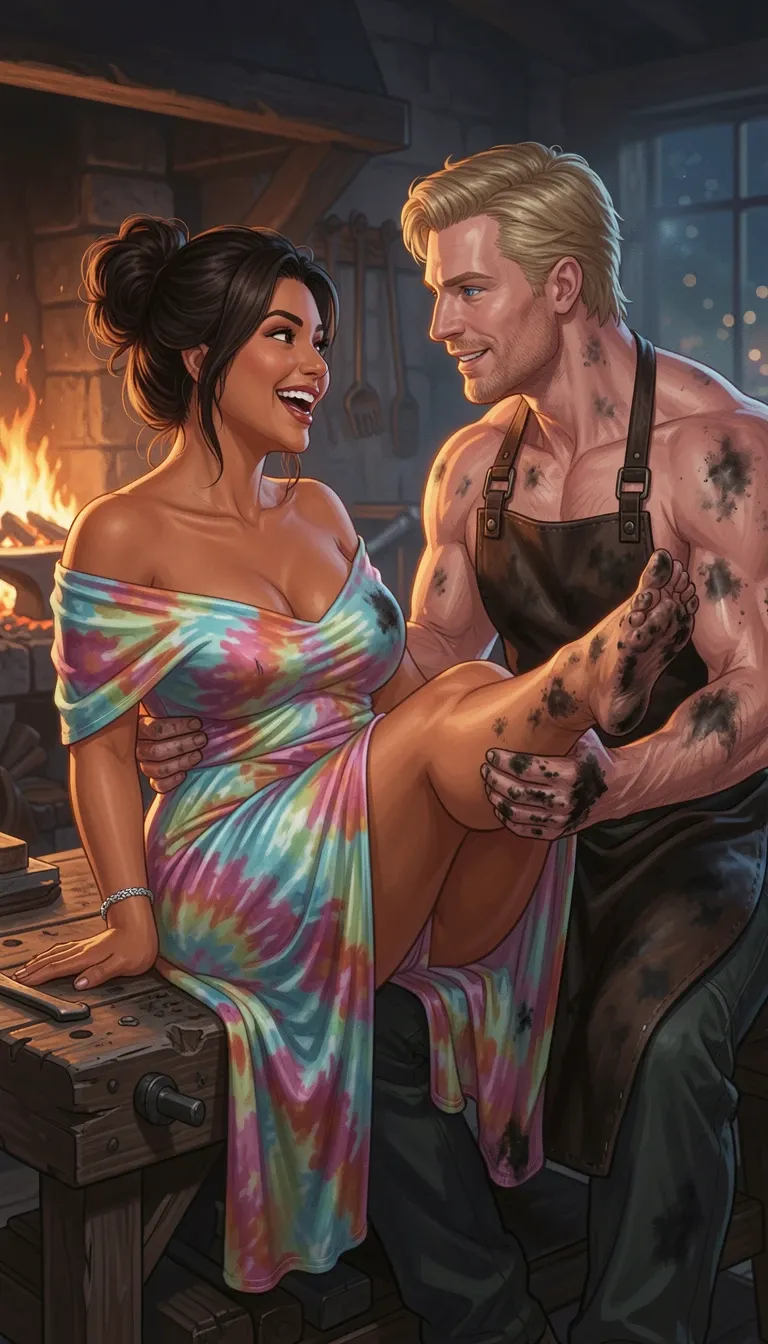
Dusk came to the faire like a curtain dropping. The generators coughed and died one by one, and the lanes went quiet enough that Marisol could hear the gate chain rattle a hundred yards off, the last of the vendors dragging their carts toward the lot. She stood in the mouth of the tickle-stocks booth with a hand on her hip and watched the light go orange, then pink, then nothing, and she did not move to leave.
The booth was hers to close. A plank counter, a cash box with a broken latch, a sign painted in her own hand — TICKLE THE TOES OF A WILLING VICTIM, ONE DOLLAR. Behind the counter the wooden stocks sat bolted to a pair of posts sunk in the dirt: a heavy oak plank with two ankle holes worn smooth as river stones, a hinged upper jaw, a hasp and a steel pin that dropped through with a sound like a coin into a jar. The day's dust hung in the air and settled on everything, on the counter, on the sign, on her own bare feet, which had turned the color of the lane by noon.
She crouched and began stacking the feather dusters into the costume crate. Red. Blue. A peacock one that had shed half its eyes. She tied her ankle bracelet tighter — the silver had gone loose in the heat — and felt the strap-marks her own shoes had left across the tops of her feet, two pale bands above the tan. She'd kicked the shoes off at noon and never put them back on. Nobody paid a dollar to tickle a woman in shoes.
A shadow crossed the counter.
"We're closed," she said without looking up. "Come back Saturday. Bring a dollar and a grudge."
"I've got the dollar."
She knew the voice before she knew anything else about it — low, gravelly, like something dragged over stone. Beau Lindqvist stood at the counter with his leather apron still on and his forearms black to the elbow, soot worked into the creases of his knuckles, and the forge heat still coming off him in a faint shimmer. Thirty-eight years old and he looked at her the way he always looked at her, which was to say he looked at her feet first and then made himself look up.
Marisol straightened. "You're filthy."
"I know it."
"You're going to get soot on my cash box."
"I'll wash first." He didn't move. His blue eyes had that flat, patient stubbornness she'd watched all summer across the lane — the blacksmith who never came to the booth, who stood at his anvil and hammered and glanced over, and glanced over, and never once walked the thirty feet to spend his dollar. "If you're still willing."
She put the peacock feather down very carefully, as if it might break, and her heart did something stupid and juvenile behind her ribs. "Say that again."
"I've watched you laugh for strangers since May." His voice stayed low. "I want my turn."
The quiet of the faire pressed in around them. Somewhere a gate chain rattled and stopped. Marisol wiped her palms on her tie-dye dress and felt the sweat there, and the smile she put on was her booth smile, her theatrical one, wide and easy — and then it wasn't. It slid off her face like water off a leaf. "You know what this is," she said. "What I let people do."
"I know what it is."
"It's not just tickling." She came around the counter, and her bare feet raised little puffs of dust. "Some men get a dollar's worth and think it's a license. So there's a word. One word, and everything stops, no questions, no hard feelings. You say it, I say it, we both stop."
"What's the word?"
"Mercy." She said it flat, no music in it. "Not 'stop,' because people say stop and don't mean it. Mercy. Say it out loud once so I know you've got it in your mouth."
He looked at her for a long moment. Then, quiet: "Mercy."
"Again."
"Mercy."
"Good." She turned and walked to the stocks, and her voice came back light, performing again, but the performance had a crack in it now. "Then take off that apron and wash your hands, blacksmith. I'm not having forge grit on my feet."
He went to the water barrel at the corner of the booth and scrubbed his hands and forearms with the harsh gray soap she kept for the cash box, and she watched him do it — the way he worked the soap into the soot, the way the water ran dark off his wrists — and she sat herself down on the low bench behind the stocks and laid her legs out. The ankle holes were worn smooth and cool. She slid her right foot into the first, then her left, and felt the old wood settle around her ankles like a hand.
"You do the pin," she said. "I'm not locking myself in."
Beau came over with his hands still dripping and knelt by the stocks. He fitted the upper jaw down, and the hinge creaked, and the two holes closed around her ankles, and he looked at her. "This tight enough?"
"Tighter. I don't want to be able to pull out and cheat."
He pushed the plank down until it seated, and dropped the steel pin through the hasp. It rang. She tugged once, twice, and her feet didn't go anywhere. The wood held her at the ankles, and the dust of the lane was still on her soles, and her toes curled against the empty air.
"Wrists now," she said, and held her arms up over her head to the post behind the bench. There was a length of soft cotton rope already knotted there, the same rope she used on volunteers who wanted the full experience, and Beau wound it around her wrists with a blacksmith's care, not tight enough to bite, tight enough to hold. He tied it off and stepped back.
Marisol hung there in the dusk with her arms up and her ankles locked and her bare feet presented to the empty lane like an offering, and she grinned at him, and the grin was real now, and a little wild. "So," she said. "One dollar."
He dug in his pocket and came out with a crumpled bill and laid it on the counter, and then he went to the costume crate and sorted through the feathers with his big soot-stained fingers, and Marisol watched him choose. He passed the red. He passed the blue. He pulled out a long dyed-green ostrich plume, bent at the tip from being crammed in storage, and he straightened it between his fingers and looked at her.
"That one's got a bend in it," she said. "It's not going to tickle right."
"It'll do."
He came back and knelt at her feet, and the forge heat was still in his hands when he laid one palm flat against her sole. Marisol jerked — couldn't help it — and laughed once, a sharp surprised bark. "Cold hands would've been kinder," she said.
"I'm not here to be kind."
He dragged the feather up the length of her right foot, heel to the ball, slow, and she sucked in her breath and her whole leg went rigid in the stocks. Then he did it again, and the bend in the tip made the plume flick and skip over the arch. She made a sound she hadn't meant to make, a high strangled giggle, and yanked at the rope.
"Oh, you—" She couldn't finish. He was drawing the feather between her toes, one by one, and each toe curled and spread and curled again, and she was laughing now, really laughing, the laugh she gave strangers all day but turned up past the point of performance, her head thrown back against the post. "Beau. Beau, that's — I can't—"
He didn't say anything. He worked the feather down her left sole and she shrieked, a full-throated shriek that rang off the empty booths, and then he set the feather aside and used his fingers.
His fingers were worse. Calloused fingertips, still warm, dragging slow circles in the hollow of her arch, and she bucked against the stocks and the wood held her and her laughter came apart into gasping, helpless, hiccuping pieces. "Mercy," she gasped, and he stopped, instantly, hands lifted, and she hung there panting with her chest heaving and her feet tingling and her face wet at the corners of her eyes. "No — not that. I was testing you. God." She laughed again, shaky. "You stopped."
"You said the word."
"I said it to see if you'd honor it." She let her head fall back. "You honored it."
"I'll honor it every time." He picked the feather back up. "Say it again when you mean it."
He tickled her until she couldn't remember her own name. The feather, then his fingers, then the feather again, and she laughed and begged and called him every name she could think of and never once said mercy, and the dusk turned to dark around the booth and the faire went silent and still, and somewhere in the middle of it she stopped fighting the rope and just let it hold her, let the laughter pour out of her, felt her own feet go hot and pink and oversensitive until even the air moving over them made her twitch.
"Enough," she finally gasped. "Enough, enough — I can't breathe. God, you're a menace."
Beau set the feather down. His chest was rising and falling too, and his eyes had gone dark and steady, and he hadn't touched her anywhere but her feet. He picked up her right foot in both hands and held it, and looked at her over the top of it.
"Now I'm going to suck your toes," he said, "unless you say otherwise."
Marisol's laugh died in her throat. She looked at him — the soot still on his forearms, the apron gone, the blacksmith's hands cradling her dusty foot — and she felt the heat go through her like a struck match, and she said, "Go on, then."
He took her big toe into his mouth.
She made a sound that wasn't laughter. His tongue slid around the toe, over the nail, into the webbing between her toes. He sucked it slow and thorough, and her whole body pulled taut against the ropes. He moved to the next toe and did the same, and then the next, and by the fourth toe she had her head tipped back and her hips shifting on the bench and her mouth open on a breath she couldn't finish. His mouth was hot and wet and patient. He sucked each toe until it was clean and slick. Then he licked the length of her sole, heel to ball, tasting the day's dust off her skin, and she shuddered so hard the stocks rattled.
"Beau." Her voice came out wrecked. "Beau, I'm—"
"I know." He kissed the arch of her foot. "I can smell you from here."
He set her foot down and came around the stocks, and he knelt between her thighs.
Marisol was still locked at the ankles and tied at the wrists and she couldn't have moved if she'd wanted to, and she didn't want to. His hands went under her tie-dye dress and pushed it up her thighs, and she lifted her hips as much as the stocks would let her, and he pulled her underwear down her legs and off over her bare feet, and then his mouth was on her.
She cried out — not laughter this time — and her heels came up and her toes curled hard against nothing, and his tongue dragged up through her wet cunt slow and flat and certain. He did it again. Then he found her clit and closed his mouth around it and sucked, and Marisol's hands clenched in the rope above her head and her back bowed off the bench.
"Oh — oh God, right there, don't you dare stop—"
He didn't stop. He worked her with his mouth and his tongue and then his fingers, two of them pushing up into her while his tongue stayed on her clit. She was so wet it was loud in the quiet booth, and her thighs shook on either side of his head. He was a patient man. He'd always been a patient man. He took his time with her the way he took his time with iron, and Marisol hung there in the dark and shook and moaned and said his name and a few other things, and when she finally came it hit her like the forge sparking — her cunt clenching hard around his fingers, her heels drumming the dirt, a long broken cry that went up into the empty night and came back off the shuttered booths.
Beau stayed with her through it. He gentled his mouth and slowed his fingers and didn't pull away until her shaking had gone down to a fine tremor, and then he lifted his head and wiped his mouth on the back of his wrist and looked at her.
Marisol lay back against the bench with her arms still tied above her head, her chest heaving, her feet still locked in the smooth old wood, the dust of the faire ground into her soles and her own wetness still shining on her thighs in the dark.
"Well," she said, when she could. Her voice had gone low and hoarse and she didn't try to fix it. "That's the best dollar this booth has ever made."
Beau reached up and set his hand over hers in the rope, and didn't untie anything yet. "I haven't decided what I want to do with my change," he said.