
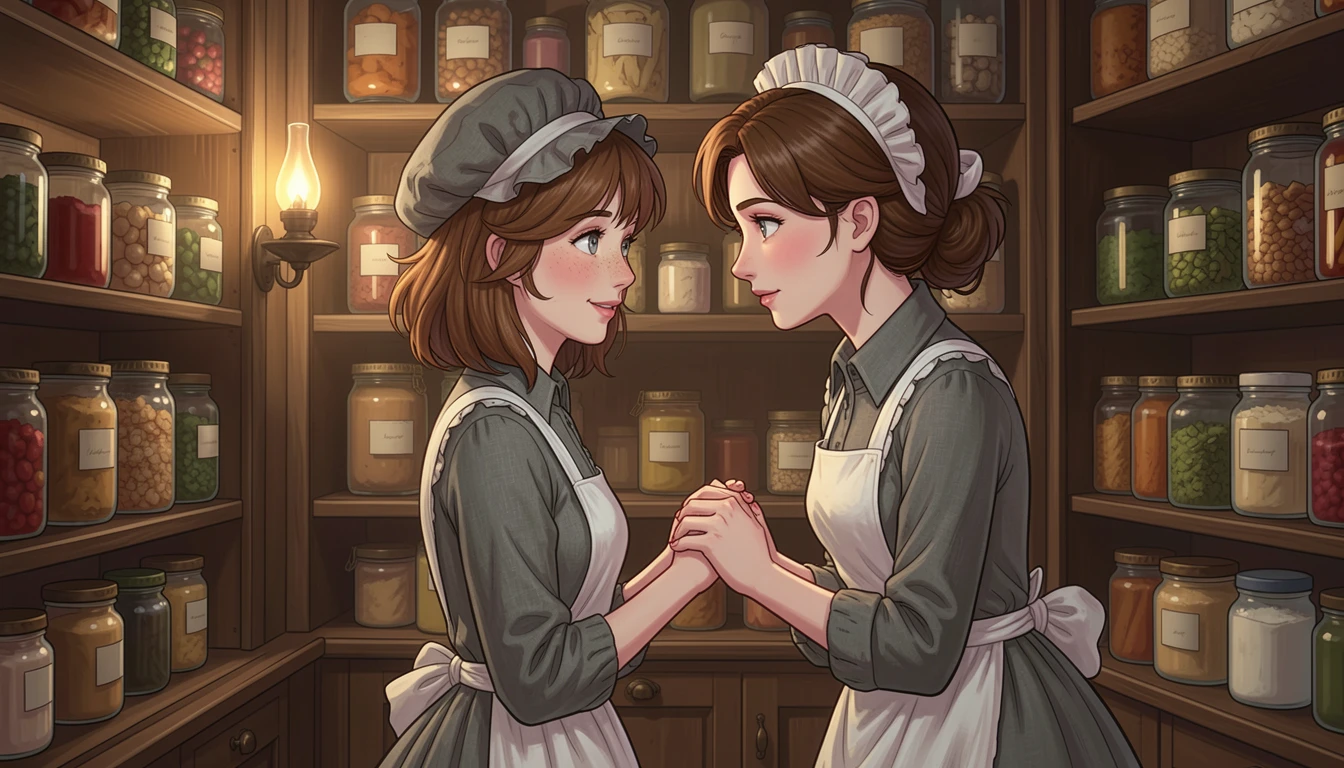
The pantry smelled of flour and last summer's dried thyme, and Bess had been standing in it long enough to know exactly how many jars of quince preserve lined the top shelf — fourteen — and that the third one from the left had a chip in its lid. She had counted them twice. She was counting them a third time when the door clicked shut behind her.
She did not turn around. "If that's you, Nell, I've already told you I don't want your opinion on the—"
"It's not Nell."
Bess's hand stilled on the jar she had been turning. Cecily's voice, and small, smaller than usual, the way it got when she was about to cry or about to lie and hadn't decided which. Bess set the jar down and turned, and there was Cecily Cranston in the narrow space between the shelves and the door, her apron twisted in both hands like she meant to wring water from it.
"I thought you were in the stillroom," Bess said. "Everyone's been saying you're in the stillroom. All afternoon. Scrubbing." She let the word sit there a moment, the way she let most words sit. "The stillroom hasn't been scrubbed since spring."
Cecily's grip on the apron tightened. "I was. I did. I finished."
"Mm." Bess folded her arms and leaned back against the shelf, and the wood creaked a complaint she ignored. She had sharp ears and she knew it, and she had spent the whole week being told to keep them to herself, and she had not, and now here was Cecily standing in the pantry looking like a guilty thing caught in a lantern's beam, which was — Bess thought, with a small mean satisfaction she was not proud of — rather the point.
"Well," Bess said. "You didn't shut the door to tell me about the stillroom."
Cecily opened her mouth. Nothing came out. Her eyes went to the door, then to the floor, then to the jars behind Bess's shoulder as though the quince might offer her something. The afternoon light came thin through the high little window, and in it Bess could see the fine down on Cecily's cheek, the way her throat moved when she swallowed, the blush that had already started somewhere below her collar and was climbing.
Bess waited. She was good at waiting. It was the one thing the house had taught her that she valued.
"I need to tell you something," Cecily said at last, "and you have to promise—" She stopped. Her hands worked at the apron. "No. No, you don't have to promise anything. That's not fair. I'm sorry. I shouldn't have—" She turned toward the door.
"Sit down," Bess said.
"I can't sit down, I'll get flour on—"
"Cecily." Bess pulled the flour sack from the end of the bench and dropped it on the floor, and dust plumed up and settled, and she sat down herself on the bench and looked up at the other girl. "Sit. You're making my neck ache."
Cecily sat. She perched on the very edge of the bench, her back straight as a rule, her knees pressed together so tight the linen of her skirt stretched across them. Bess noticed that. She noticed most things, and the things she noticed she kept, and this — the pressed knees, the twisted apron, the blush — she filed away without yet knowing what it was for.
For a while neither of them spoke. Beyond the door the kitchen went on without them: a pot lid knocking, Nell's voice rising and falling at some poor soul, the scrape of a stool. Bess had always liked the pantry. It was close and it was quiet and it had a door that shut, and in a house where the walls had ears and the ears had Bess's name, a door that shut was worth more than a feather bed.
"The mistress comes home in three days," Cecily said.
"I know it."
"Three days, and then it's—" Cecily's hands stopped their working. She looked at them as though they belonged to someone else. "Then it's back to the way it was. Only it won't be. It can't be. That's what I keep—" She broke off and pressed the heel of her hand against her mouth, hard, and Bess watched her do it and felt the old familiar thing turn over in her chest, the thing that made her sharp when she meant to be kind.
"You've been crying," Bess said. "Not today. Tuesday. In the library. I heard you."
The hand came down from Cecily's mouth. Her eyes were wide and grey-blue and very still, and Bess saw the exact moment she understood that she had been caught out and the exact moment she decided she was past caring.
"That wasn't crying," Cecily said.
Bess frowned. "It was a sound like crying. I know a sound like crying when I hear one, I've heard enough of it in this house."
"It wasn't—" Cecily's voice dropped, and dropped again, until it was hardly more than breath. "It wasn't crying. It was—" Her gaze slid away. "It was the opposite of crying."
The pantry got very quiet. The pot lid knocked once beyond the door and then did not knock again.
Bess sat back against the shelf and felt the wood take her weight. Her mind, which was quick and unkind and had never once in nineteen years learned to slow itself, ran through a great many things at speed — the library, the sound, the opposite of crying, the way Cecily had been all week like a candle burning at both ends, bright and distracted and not quite in the room with the rest of them — and arrived at a place it had not expected to arrive at, and stopped there, staring.
"Oh," Bess said.
Cecily's face crumpled. Not into tears. Into something worse — a tight, mortified little smile, the smile of a person who has been holding a secret so long it has begun to hold them. "You see," she whispered. "You see why I couldn't say it."
"I don't see anything yet," Bess said, though she did, she was beginning to, and she heard her own voice come out flatter than she meant it to. She reached over and picked up the flour sack she had dropped and set it on her knees and folded her hands on top of it, because her hands had started to want to do something and she did not trust them. "Say it plain. I'm not going to guess at it and get it wrong and have you look at me like that."
Cecily took a breath. It shook on the way in. "There's someone," she said. "In the house. It's — we've —" Her eyes came up and held Bess's, and there was something in them now that was not shame at all but a kind of stubborn courage, a small fierce thing that Bess had never seen in her before and would not have believed her capable of. "We've been together. Not once. More than once. Since the mistress left. And it isn't going to stop, Bess. I don't want it to stop. I've never wanted anything the way I want—" She stopped herself. Her jaw worked. "That's it. That's the whole of it. That's what you heard."
She fell silent. The words sat between them in the flour-dusty air, and neither of them moved to take them back.
Bess found, to her surprise, that her first thought was not shock. Her first thought was the stillroom — all afternoon, everyone said, and the stillroom hadn't been scrubbed since spring — and her second thought was the way Cecily's hair had been coming loose from under her cap all week, and her third thought was that she had been telling a ghost story at supper for four nights running and had been so pleased with herself for the telling of it, and all the while the truth had been this plain thing standing in the pantry with flour on her apron.
She turned her head and looked at the fourteen jars of quince, and the chipped lid on the third from the left, and she heard herself say, in a voice that sounded like somebody else's:
"Who is it?"
Cecily did not answer.
Bess looked back at her. "You've told me the rest of it. Don't go shy on the last bit."
"It isn't—" Cecily's hands found each other in her lap and held on. "It isn't only mine to tell."
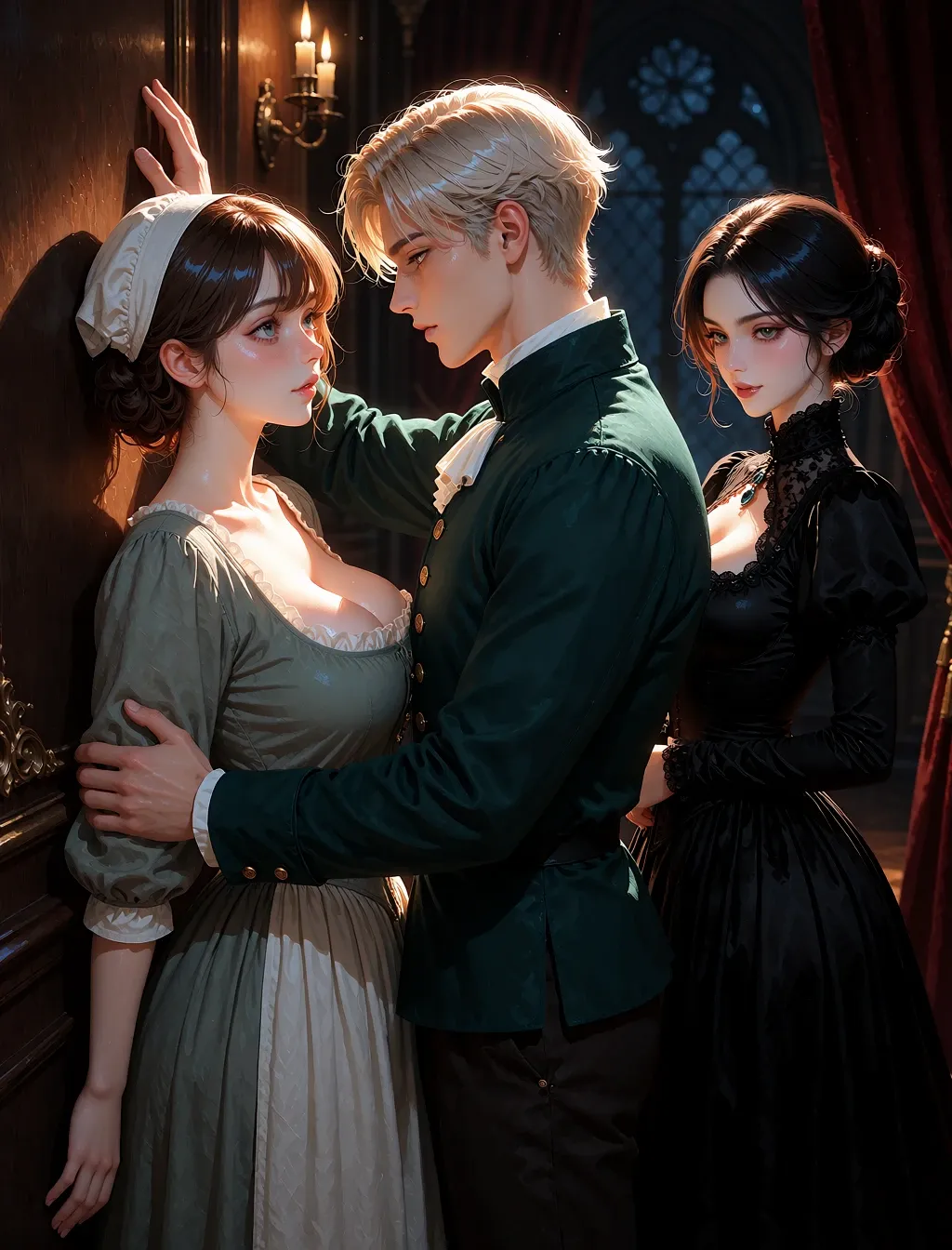
And that, Bess thought, was an answer of its own, and a better one than a name. She turned it over. Somebody in the house who was not only Cecily's to give away. Somebody who had been quiet this week. Somebody who had been — she cast back through the days, the supper table, the corridors, the way the whole house had felt strange and hollow since the mistress's carriage had gone off down the drive — and she thought of Caelum Ellis with his head bowed over his plate and his hands folded in his lap like a shield, and of the way he had not once looked up when Nell had told the ghost story on Wednesday, and of the way his ears had gone red.
She did not say his name. She found she did not need to. She looked at Cecily and Cecily looked back at her, and something passed between them that was not quite confession and not quite silence either, and Bess nodded once, slowly, as though a sum had come out right.
"The both of you," she said. "All week."
Cecily's chin lifted. "All week."
Bess let out a breath she had not known she was holding, and with it went some of the sharpness she had been carrying around like a stone in her pocket. She had been so sure there was something wrong in this house. She had lain awake listening to the shutter knock and told herself it was ghosts, and she had not been wrong that something was happening, she had only been wrong about what.
"The sound I heard," she said. "In the library."
"Yes."
"And Tuesday I sat up half the night with a candle because of it."
"I'm sorry." Cecily's voice was small again. "I didn't know anyone could hear."
"Nobody can hear anything in this house but me," Bess said, "and that's the trouble with me." She looked down at her folded hands on the flour sack. Her thumbs were pressed together, white at the knuckle, and she made herself let go of them one at a time. "You thought I'd tell her."
Cecily did not deny it.
"You thought I'd go running to the mistress the moment she set foot in the door and make a fine story of it."
"I didn't know what you'd do," Cecily said. "I don't know you. Not really. We've shared a kitchen for two years and I don't know the first thing about you except that you hear everything and you don't like anyone and you—" She stopped. Her mouth twisted. "I'm sorry. That was unkind."
"It was true, though," Bess said, and found, to her own surprise, that it did not sting. "I don't like anyone. It saves a great deal of time." She studied Cecily's face, the freckles gone stark against the flush, the grey eyes steady now and waiting. "But I'll tell you a thing about me, since we're telling things. I don't like being made a fool of. Four nights I've sat at that table and told them all there's a ghost in the library, and it was you two the whole time, and I never once guessed it. That's what I mind. Not the rest of it."
Cecily stared at her.
"Don't look at me like that," Bess said. "I'm not finished being cross."
"You're not cross at all," Cecily said slowly. "Are you."
Bess considered it. The pantry was warm and close and smelled of thyme, and beyond the door Nell was still going on about something, and the afternoon light had moved along the shelf and touched the chipped lid of the third jar and made it shine. She thought of the long empty week, and the way the house had felt like a held breath, and the way she had filled the silence with a ghost because she had nothing else to fill it with. She thought of Cecily's pressed knees and twisted apron and the small fierce courage that had come up in her eyes when she said it isn't going to stop.
"No," Bess said. "I'm not cross." She paused. "I'm something. I don't know what yet. Give me a moment to find the word."
Cecily obliged. And then...
"Ah," said Bess. "'Tickled.' Thats the word I was looking for."
And she gave Cecily a crinkled smile.