
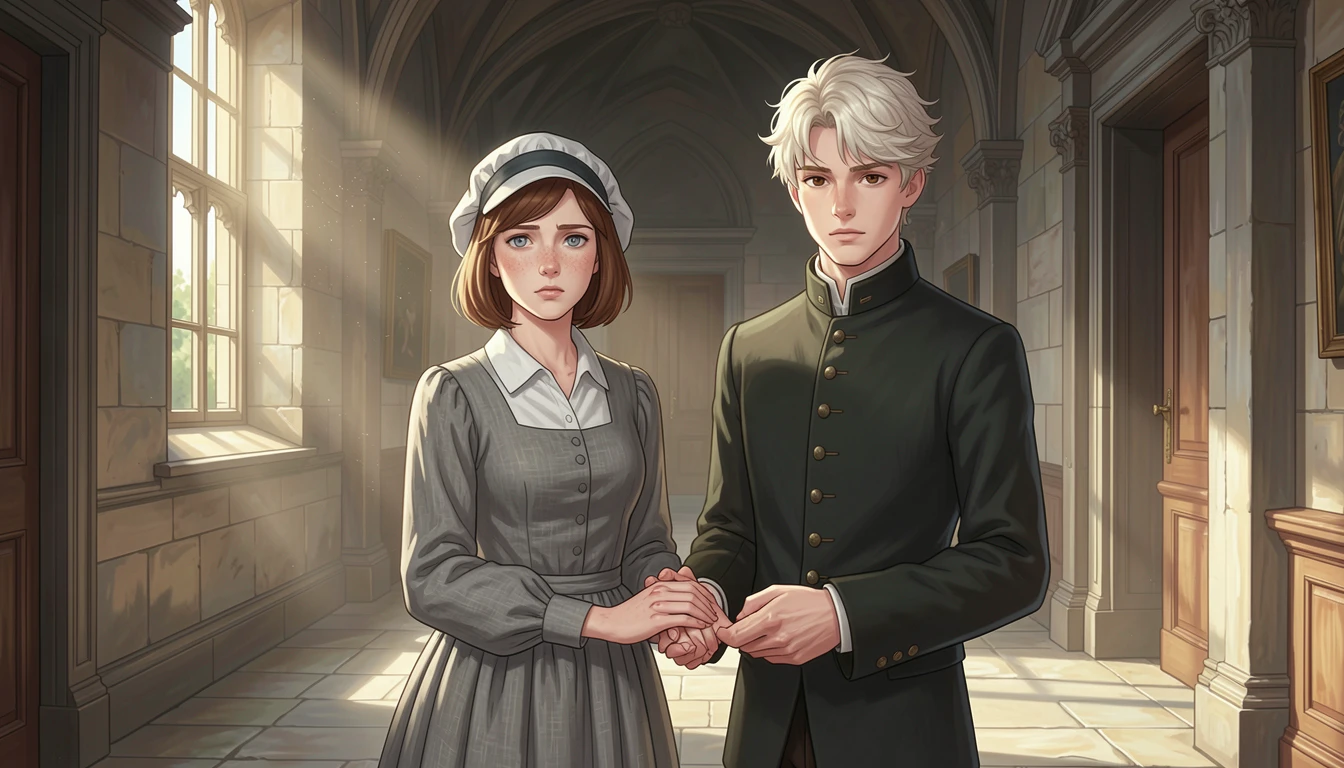

The bell caught her with her hands in the lye.
It came down through the stillroom like a dropped plate — one flat, iron stroke that rattled the copper and set the soap-suds shivering in their pans. Cecily's fingers went still in the water. The batch was half-turned, the fat not yet traced, and she had been thinking — not of the soap, God knew, not of the soap at all — of the way Caelum's sleeve had slipped down his forearm an hour ago and stayed there, and how she had wanted to push it higher, and how she had not.
Caelum's head came up.
He had the paddle in both hands, his knuckles pale on the handle, and his face did the thing she had learned to read across a room — the quick drain of colour, the lips parting on a breath he forgot to finish.
"That's not the first bell," he said.
"It's not." Her own voice came out strange, thin, from somewhere behind her breastbone.
"The first bell rings at six. That's — Cecily, that's the gate bell." The paddle went down on the stone with a clatter he didn't seem to hear. He was already turning, already reaching for her, his wet hand finding her elbow and closing. "She's here. She's here, she's come early, she's —"
"Caelum."
"— she's in the drive, she'll be at the doors in a minute, and we're stood here like —" He looked down at himself, at her, and something in his face broke open. "Look at us."
She looked. She could not help it. His collar hung open at the throat where she had put her mouth to it not twenty minutes since, and there was a smear of something on his jaw — soap, she told herself, soap — and his hair was a wreck of pale gold where her fingers had been. And her own apron was twisted half round her waist, and her cap had slipped, and her wrists were red to the elbow with lye and the water had gone cold on the flagstones in a wide dark ring around them both, and the whole room smelled of tallow and of him.
"Oh," she said. "Oh, no."
Her hand flew up to her mouth. It was a girl's gesture, a foolish one, and she knew it even as she did it — the lye stinging her lip, the taste of it bitter and slick — but her body had gone ahead of her mind and there was no calling it back.
Then the corridor took up the sound. A door somewhere below, thrown wide. Voices — the under-steward's, high and flustered, and a woman's answering, low, unhurried, the words not reaching them but the shape of them carrying all the way up the back stairs like the first cold of autumn coming under a door.
"Move," Caelum said. "Cecily. Move."
What followed was not a plan. It was a flurry of hands and breath and small stupid terrors. He dragged his cuff down over his wrist and it would not stay, the linen gone limp with water, and he swore at it under his breath in a way she had never heard from him and would remember. She wrestled her apron round the right way and the strings knotted, and she pulled, and they knotted tighter, and she made a small furious sound and pulled again.
"Here — let me —" His fingers found the knot. They were shaking. She could feel the tremor of them through the cloth at her waist, and she thought, with a clarity that seemed to belong to somebody else, that she had felt those same fingers steady as stone on the small of her back an hour ago, and that fear unmade him as surely as it unmade her, and that she loved him for it and could not afford to love him for it now.
The knot gave. He tugged her apron straight, one hard tug, and smoothed it flat with the heel of his hand, and there was something so absurdly careful in the gesture — a boy setting a table in a burning house — that she nearly laughed, and the laugh turned to water in her eyes.
"Your cap," he said.
She jammed it back on. Her hair had come loose of it in the front and would not go, and she pushed at it, and pushed at it, and it fell again.
He caught her hands. Both of them, in both of his, and held them still against her own head.
"Leave it," he said. "It's only hair. Cecily — leave it."
Below, a man's voice called for the front doors to be opened, and the great hinges groaned, and the sound of it came up through the floor and into the soles of her feet.
She looked at the stone. The lye water stood in a wide grey puddle across the worktable and had run down the front of it in three crooked streams, and the soap-suds in the pans had gone flat, and the paddle lay where he had dropped it. There was no time to set it right. There was no time to do anything at all.
"The stone," she said.
He looked. "We can't —"
"It doesn't matter." She said it flatly, and found, to her own surprise, that she meant it. "It doesn't matter, Caelum. She'll see the stone. She'll see two servants at the soap and a deal of water on the floor, and none of it will be the thing she sees."
He stared at her.
"Do you understand me?" She had hold of his sleeve now, and she did not remember taking it. "There's no use in hiding this. We said we wouldn't. We said we'd say it plain, and — and now she's here, and we can't —"
Her voice caught, and held, and steadied, and she made it go on.
"— we can't spend the rest of our lives in corners, Caelum. I won't. I've done it a fortnight and it's eaten me hollow. I'd rather be turned out into the road with you than keep one more secret in this house."
He was very still.
Then his hand came up and closed round hers on his sleeve, and he nodded, once, the way he had nodded in the cold of the stillroom when she had told him the speech, and it was the same nod and it was not the same at all, because now the bell had rung and there was no tomorrow left to practise for.
"Say it plain," he said. His voice had gone low and rough, and steady — steadier than hers. "Side by side."
"Side by side," she said. "No begging."
"No cleverness."
"Just the truth."
He drew a breath and let it out slow, and she watched him gather himself the way a man gathers a horse before a jump — the shoulders settling, the chin lifting, the fear put somewhere behind the eyes where it could still be seen but not obeyed.
"Cecily," he said. "Whatever she says. Whatever she — if she turns us out, if she has me put on the road by nightfall —"
"I know."
"— I want you to know that I'd have done it all again. Every hour of it. Every corner and every —" His jaw worked. "I'd have done it all again, and I'd have been glad, and I'd have thanked God for it, and I'll not have you thinking otherwise, whatever happens in that hall."
The words landed in her chest like a hand pressed flat over her heart. She thought she might cry, and she thought she must not, and she did neither — she reached up and put her palm to his cheek, the lye cold on her skin, and held it there a moment, and felt him lean into it.
"Then let's go and be turned out," she said, "and do it handsomely."
The corridor outside the stillroom was full of noise. Somebody had opened the shutters at the end of it and the late light came in long and gold and slanted across the flagstones, and through it came the whole house at once — feet on the stairs, the housekeeper's keys, a girl crying out that the mistress's boxes were still on the cart, a man's voice laughing at something and being hushed. The smell of the drive came in with all of it. Cold air and horse and the wet of the gravel.
Cecily stood in the doorway of the stillroom with her cap crooked and her hands still red, and she did not step back into the dark.
She thought of the library, and the carpet, and the tall shelves that had hidden them. She thought of the linen store and the sticking door and the sheets folded at the bottom of the pile. A fortnight of corners. A fortnight of her own heart beating in her throat every time a stair creaked. She had been so afraid — of Bess, of the cook, of the whole house knowing — and now the whole house would know, and she found that the fear had gone strange and quiet, and that what was left in her was not fear at all but something with an edge to it, almost like gladness.
Caelum came out of the stillroom and stood beside her. Not touching. Close enough that she could feel the warmth of him along her arm, and she did not move away, and neither did he.
"Your cap," he murmured, without looking at her.
"Damn the cap."
His mouth twitched. It was not much of a smile, and it was the best thing she had seen all day.
At the end of the corridor, the front doors stood open, and beyond them the drive was full of the last of the light and the cart with its boxes and two men lifting them down. The housekeeper swept past them both and gave them a look — a quick, sharp look, up and down, taking in the wet apron and the crooked cap and the pair of them standing there like a scandal — and said nothing, and went on.
"She's come early," Caelum said quietly. "She wasn't to come till tomorrow."
"No." Cecily watched the doors. "Why would she come early?"
He had no answer for that, and neither did she, and the not-knowing sat between them as the noise of the arrival swelled and the last of the daylight went from gold to the colour of weak tea.
Then a footstep in the corridor behind them — unhurried, and soft, the step of a woman in good shoes crossing stone she knew to be her own — and Cecily's hand found Caelum's hand, and closed round it hard, and did not let go.
"Side by side," she said, so low that only he could hear it.
"Side by side," he said.
And they turned, together, and went down the corridor toward the light and the noise and the open doors, their fingers laced and their hands cold and their hearts going like a pair of bells — and Lady Seraphina Ashworth came out of the shadows at the far end of the hall, and stopped, and looked at them.
Cecily had built a picture of this moment in the fortnight of waiting, and the picture had been of a great noise — of being called out, of the whole house turning to look. It was not like that at all. Lady Seraphina stood perfectly still at the far end of the hall with the last of the daylight behind her and her travelling cloak still on her shoulders, and she did not speak, and the silence of her was worse than any shouting.
She was taller than Cecily remembered. That was a foolish thing to notice, and she noticed it anyway — the way the woman filled the corridor simply by standing in it, the dark velvet of her travelling dress gone grey with road dust at the hem, the red of her mouth the one bright thing in all that shadow. Her gloves were off and held in one hand. Her hair had come a little loose of its twist on the left side, and that small disorder — that one loose lock — undid Cecily more than the straightness of her spine did.
Caelum's fingers tightened round hers. She felt the bones of them press, felt the cold of his palm go warm against her own, and she did not look at him. She could not. If she looked at him she would lose the speech, and the speech was all she had.
"My lady," she said.
Her voice came out low and clear and did not shake. She heard it from a little distance, as though it belonged to somebody braver, and she was grateful to that somebody and would not let her down.
Lady Seraphina's gaze came round to her — cool green, unhurried, taking her in from the crooked cap to the red of her lye-burned wrists to the hand laced in Caelum's hand — and lingered there, on the joined hands, a moment longer than politeness allowed.
"You are both very wet," she said.
It was so far from anything Cecily had braced for that she nearly answered it plainly — we were at the soap, my lady — and caught herself. No cleverness. No begging.
"We were at the soap," Caelum said, beside her, and his voice was steady too, steadier than it had any right to be, and Cecily's heart turned over to hear it. "In the stillroom. We heard the gate bell and we came out to — to meet you, my lady."
"To meet me." Seraphina's head tilted, the smallest degree, the way a cat tilts its head at a bird that has done something unexpected. "In your aprons. With your hands in one another's." She let the words sit. "That is a strange way to meet your mistress at the door."
Down the corridor, the house was still arriving — a man's boots on the flagstones, a girl's voice shrill about the boxes, the wet slap of the gravel under wheels — and all of it seemed to be happening in another house, a house where none of this was true. Here, in the long grey hall, there was only the three of them and the loose lock of black hair and the joined hands.
Cecily felt the speech go out of her. It had been a good speech, rehearsed in the cold of the stillroom with lye on her hands, and it had been built for a mistress who shouted, and this woman did not shout. This woman waited, and the waiting pulled the words up out of her whether she would or no.
"My lady," she said, "we have something to tell you. We agreed it between us, and we will say it plain, and we will not beg, and — whatever you answer, we will take it." She drew breath. "We have been together. This fortnight past, while you were away. Not as servants. As — as more than that. And we love each other, my lady, and we could not keep it from you, and we would not."
The words were out. They lay on the flagstones between them, and Cecily's ears rang with the sound of her own plainness, and she stood very straight and waited to be turned out.
Lady Seraphina looked at her a long while. Then she looked at Caelum, who had gone the colour of the wall behind him and had not let go of her hand, and who met the mistress's eyes and did not look away.
"And you," she said. "Have you anything to add to that?"
"Only that it is true, my lady," Caelum said. "Every word of it. And that if there is a price for it, I would have it put on me and not on her."
"Caelum —" Cecily began, and he pressed her fingers, hard, and did not let her finish.
Seraphina's mouth did something at the corner. It was not quite a smile. It was the thing that comes before a smile, held back, and it put more fear into Cecily than any frown could have.
"The price," the mistress said, and turned, and began to walk — unhurried, her good shoes soft on the stone — down the corridor toward them, and past them, and on toward the open doors and the noise and the last of the light. "Come. Both of you. Not here, in the draught, with the whole house gawping."
Cecily did not move. Her feet had gone to stone. But Caelum's hand was in hers, and Caelum was moving, and so she moved too — and they went after the dark velvet of her, side by side, into the noise and the cold air of the drive, and Cecily thought she had never in her life been so afraid of anything as she was of the woman's back walking away from her, so calm, so certain of being followed.
The drive was all cart-wheels and cold gravel and the smell of the road still coming off her cloak. A groom touched his cap and took the horses; a footman went past at a jog with a bandbox in either hand. Cecily walked through it like a girl walking through a dream, because not one of them turned to stare, and she had been so certain the whole house would turn and stare.
They went round the east side of the house, where the light came off the windows red and low, and in through a narrow door she had never once used — the private stair, the one that only the mistress and the woman who did her hair ever climbed. Seraphina lifted her skirts and went up without a word. Her shoes made a small, sure sound on each stair, and Cecily's made a different sound, and Caelum's a third, and it seemed to her that the three sounds were the only honest thing in the world just then, because they could not lie about who was following whom.
The chamber at the top was warm. Someone had been up to lay the fire before the cart was even in the drive, and the coals sat red in their bed of ash, and there was a smell of beeswax and dried lavender and, faint under it, the cold clean smell of the road that had come in on her cloak. Seraphina unpinned the cloak at her throat, and it slid off her shoulders in a dark fall, and she laid it over the back of a chair as though it were a thing of no consequence at all.
"Shut the door," she said.
Cecily shut it. Her hand was slow on the latch, and she made herself do it anyway, and the click of it going home was the loudest thing she had ever heard.
"Sit."
There were two chairs before the fire. They sat in them, still holding hands, and Cecily found she could not let go, and that Caelum could not either, and that they had become one trembling knot of fingers and would have to be cut apart.
Seraphina did not sit. She stood with her back to the fire and looked down at them, and the firelight was behind her and the last of the day was at the window, and between the two lights her face was the hardest thing to read that Cecily had ever set eyes on.
Then she smiled.
It began at the corner of her mouth and it went all the way up into her eyes, and it was the smile of a woman who has been holding something in for a very long while and has decided, at last, that she may set it down.
"You have been very foolish," she said. "Both of you. I want that understood before anything else is said in this room."
Cecily's heart dropped. "My lady —"
"I have not finished." The green eyes came round to her, and there was no anger in them, and that was somehow worse, because anger she had braced for, and this she had not. "You have been foolish, and you have been frightened, and you have spent a fortnight creeping about my house like a pair of thieves with a stolen spoon, and I have watched you do it."
The words went through Cecily like cold water. She felt Caelum go still beside her, felt his fingers tighten, and she thought, with a lurch, she knew. She knew the whole time. She was never away at all — she was here, she was watching —
"I was not here," Seraphina said, as though she had heard the thought spoken aloud. "You may put that fear down. I was at my sister's house, and it was the dullest fortnight of my life, and I wrote three letters I did not send and burned them all. But I knew what I would find when I came back. I knew it before I went."
She turned a little, and took up the poker, and stirred the coals, and the fire woke and threw its light up over her throat and her jaw.
"Do you know why I went?"
Cecily shook her head. Her mouth was dry as a stone.
"Because of you." The poker went back on its rest with a small iron knock. "Because I have watched the two of you for a year — a year, and do not look at me as though I had said a year and a day — going round one another like two moths round the same candle, and never once touching, never once saying the plain thing. You, Caelum Ellis, with your eyes on the floor whenever she came into a room. And you, Cecily Cranston, who could not hold a cup steady when he poured it, and thought I never noticed." She let out a breath that was almost a laugh. "I notice everything. It is the one thing I am good for."
Cecily's face was burning. She could feel the heat of it from her chest to her hairline, the old traitor blush, and she could not look at Caelum, and she could not look away from the mistress, and so she looked at the fire and wished the floor would open.
"I gave you a fortnight," Seraphina said. "I gave you an empty house and no eyes on you and every reason in the world to find your way to one another, and still you might have spent it in corners, whispering, and never said a word. I had a notion you would. I had a notion I would come home to two servants still too frightened to say what they wanted." She tilted her head. "I am very glad to have been wrong."
"You —" Caelum's voice came out cracked, and he cleared his throat and tried again. "You left so that we would — my lady, you left so that we would find each other?"
"I left," she said, "because I was tired of the two of you looking at me instead of at each other. You have served me very well, both of you, and I am fond of you, and I will not have it said I keep servants who are too afraid of me to be happy." She turned and looked at them fully, and her mouth curved. "You are not the first pair I have had under this roof, and you will not be the last, and I have never yet turned a soul out for loving where the love was honest. I am not a fool, and I am not a tyrant, and I am not — whatever it is you have been telling each other I am in the dark of that linen store."
Cecily made a small sound. It was not a word. It was the sound a person makes when a thing they have carried too long is taken out of their arms.
"My lady," she whispered. "We thought — we were certain you would — we had the speech all made, we were going to ask for your word, we thought you would call it a sin —"
"A sin." Seraphina said the word the way one might hold up a moth by the wing and find it only a moth. "Child. If I were to begin calling things sins in this house I should have to start with my own, and I have not the leisure for it." She came a step nearer, and her eyes were kind now, and the kindness undid Cecily more than the coldness had. "You have my word. You have my blessing, which is a better thing, and I do not give it lightly. Love him. Let him love you. Do it in a bed and not in a linen store, if it is all the same to you, because I am not made of stone and I do hear the floors creak."
Caelum laughed. It came out of him all at once, startled and wet, half a sob and half a boy's laugh, and he pressed his free hand over his mouth as though he could push it back in.
"I beg your pardon, my lady," he said, muffled.
"You may beg my pardon for the mess." She said it lightly, and then she looked at them both, and her eyes went narrow and bright with something that was very nearly mischief. "Just don't keep leaving messes like you have been doing lately."
Cecily stared at her.
"The library carpet," Seraphina said, and counted it off on one long finger. "The sheets in the attic, which I am told are folded at the bottom of the pile and have not been washed. The stillroom, where I understand there is soap on the floor and lye water on the stone and a great deal of it. And the linen store —" She paused, and her mouth twitched. "The linen store I shall say nothing about, because I am a lady, and because I have a very good notion of what went on in it, and because some things are better left to the imagination."
Cecily's ears rang. She heard herself make a noise — a strangled, mortified little noise — and then, to her own astonishment, she was laughing too, and Caelum was laughing, and the two of them sat in the chairs before the fire with their hands still knotted and laughed like children who have been let out of a dark room.
"We will clean it," Cecily gasped. "All of it. Every — my lady, we will scrub the stillroom to the stone, we will wash the sheets twice, we will —"
"You will do it tomorrow," Seraphina said, "and you will do it in daylight, and you will not do it at midnight with the door bolted, because I have had quite enough of creeping about my own house." She turned to the little table by the window and poured wine into two glasses and then, after a moment's thought, a third. "Tonight you will sit at my table and drink my wine and tell me the truth of it. Not the speech. The truth. How it began. Who spoke first. All of it, and none of your carefulness."
She held out a glass to Cecily, and Cecily took it with a hand that shook so badly the wine swung high in the bowl.
"The apple," Cecily said, before she could think better of it. "It began with an apple, my lady. In the corridor. He gave me an apple, and I have not been able to think straight since."
Seraphina's brows went up, and she looked at Caelum, who had gone red to the tips of his ears and was studying his own wine as though it held the answer to a riddle.
"An apple," she said. "Well. The garden does do very well for apples." She raised her own glass. "To the apple, then. And to the end of a fortnight of foolishness."
They drank.
The wine was dark and warm and it went down into Cecily like a hand at her back, and she sat in the chair before the fire with Caelum's fingers still laced in hers and the glass cold against her palm, and she thought that she had come up those stairs braced to be turned out into the road, and that she was sitting instead in the mistress's own chamber with the mistress's own wine in her hand, and that the world had turned over so completely that she did not know which way was up.
"My lady," Caelum said, after a while, and his voice was quiet and careful again. "May I ask — the house. Does the house know? Bess, and Cook —"
"Bess has known since the pantry," Seraphina said, "and has been enjoying herself enormously. Cook has known since the first morning you came down to the kitchen with your hair wet. They have been keeping your secret between them like a pair of old women with a goose." She set her glass down. "The house knows enough. The house will say what the house will say. What I say is that you are mine, both of you, and I keep what is mine, and any soul in this house who has a word to say against it may say it to me."
She came and stood before the fire between them, and the light went up her dark velvet and turned the red of her mouth to something warmer.
"You will go down to your supper," she said, "and you will go down together, and you will not drop hands at the top of the stairs because a footman might see. You have my blessing, and a blessing is no good at all if it must be kept in a cupboard." She looked from one to the other. "Do you understand me?"
"Yes, my lady," Cecily said.
"Yes, my lady," Caelum said.
"Good." Seraphina turned to the window, and the last of the daylight was gone from it now, and her reflection stood in the dark glass with the fire behind her. "Then go. And Cecily —"
Cecily stopped with her hand on the latch.
"Your cap," the mistress said, without turning. "It is crooked. It has been crooked all evening, and it is crooked now, and I have said nothing about it for a full quarter of an hour, which I consider a great forbearance on my part."
Cecily put up her hand and found it crooked, and straightened it, and caught, in the dark glass, the reflection of the mistress's smile.
They went down the private stair with their hands still laced, and this time Cecily did not let go at the bottom.
The corridor below was full of the house at its evening work — a girl carrying a lit taper that smoked as she walked, a footman hauling a box with his chin up and his breath short, the smell of supper coming up from the kitchens, onions and good beef and bread. Cecily walked through all of it with her fingers knotted in Caelum's and her cap straight, and she felt every eye in the passage slide to their joined hands and then away, and not one of them said a word. The footman with the box nearly dropped it. The girl with the taper stopped dead and her flame guttered. And still nobody spoke, and Cecily understood, with a small hot flare of something between shame and triumph, that the whole house had known before she had ever said a word, and that the saying had only been for her own sake.
"They're looking," Caelum murmured at her shoulder.
"Let them."
"Cecily —"
"You heard her." She turned her head and found him very close, his cheeks still flushed from the fire, his collar still a little open at the throat where she had put her mouth to it an hour ago in the stillroom. "A blessing is no good kept in a cupboard. Her words."
"I know her words. I was standing right there." A corner of his mouth pulled. "I'm only saying that a footman is looking at us as though we've come down the stair with our heads on backwards."
"Then let him look at something worth the looking."
He laughed — a short, surprised thing, half in his throat — and she felt his fingers squeeze hers, and it was that squeeze, that small warm pressure, that decided her. Because supper would come, and the long table, and the whole house watching them eat with their hands in their laps and their faces carefully ordinary, and after supper there would be the clearing and the washing and the last of the night's work, and then — and then the stair, and the attic, and the narrow bed, and the door with no lock on it. And there was a thing she wanted before all of that. One thing. Small and foolish and hers.
She stopped walking.
"What —" Caelum began, and did not get to finish, because she had turned and taken a fistful of his sleeve and was pulling him — not gently, not shyly, with the whole weight of her want behind it — off the main corridor and into the dark of the linen store.
The door stuck, as it always stuck. She put her shoulder to it, and it gave with its old dry complaint, and then they were through and she had shoved it to behind them and the corridor and its taperlight and its staring footman were gone.
Dark. Not quite black — the high window at the far end let in the last of the evening, a blue-grey wash that turned the shelves to shapes and the folded sheets to pale blocks stacked one on another. The smell of it came over her all at once: clean linen and cedar and the cold dust of the high shelves, and under all of it, faint as a ghost, the smell of the two of them from every other night they had come through this door. Her back found the wall beside the doorframe. Her breath came short.
"Cecily," Caelum said, in the dark, very quietly. "What are we doing?"
"One last hidden kiss."
A pause. She could hear him thinking it through — could hear, almost, the shape of the question he wanted to ask and would not.
"It isn't hidden any more," he said at last. "She's blessed us. The whole house —"
"I know." She reached into the dark and found the front of his waistcoat with her fingers, found the warm linen of his shirt beneath it, and pulled him in until she could feel the heat of him along the whole length of her, the wall at her back and him at her front and no room left between. "That's why I want it. One more time. Just this once more, knowing it's the last one we'll ever have to steal."
He made a sound — not a word, something low and yielding — and then his hands came up and found her waist, and his mouth found hers in the dark without fumbling, as though it had known the way all along.
It was not a shy kiss. There had been shy kisses, a fortnight ago, at the beginning — the first one in the library, all breath and trembling and the terrible fear of doing it wrong. This was not that. She took his lower lip between her teeth and pulled, and he gasped into her mouth. She swallowed the gasp and kissed him harder, open-mouthed, her tongue against his, her hands sliding up his chest to grip the collar of his shirt and hold him there. He tasted of the mistress's wine. Dark and warm and faintly of the fire, and under it the salt of his own skin. She wanted to drink him down to the dregs.
"God," he whispered against her mouth, and then, "Cecily — the door —"
"Let it stick."
"If someone comes —"
"Let them come." She kissed the corner of his mouth, the line of his jaw, the soft place under his ear where his pulse went quick and hot against her lips. "Let the whole house come. I don't care. I have spent a fortnight caring, Caelum, and I am done with it, and I want —"
Her voice broke, and she pressed her forehead to his shoulder and breathed him in, and his arms came round her and held her there, and the linen store was dark and quiet and smelled of cedar and of them.
"What do you want?" he said, low. "Tell me. Not the speech. The plain thing."
She lifted her head. In the blue wash from the high window she could just make out his face — the pale of his hair, the shine of his eyes, the parted softness of his mouth, still wet from hers. She took his right hand from her waist and drew it up, slowly, between them, and pressed his palm flat to her breast through the grey linen of her dress.
His breath stopped.
She felt it stop — felt the whole of him go still against her, his hand unmoving on her, the heat of his palm coming through the cloth as though there were no cloth at all. Her nipple drew tight under it. She knew he felt that too, knew it from the way his fingers spread, slowly, of their own accord, and closed again, gentle and sure, cupping the small weight of her as though it were something holy he had been given leave to hold.
"I want you tonight," she said. "Not in a linen store. Not in the dark with a door I have to shove shut and my hand over my own mouth. In a bed. My bed, or yours, I don't care which — in a bed, with the door unlocked, and no one to hide from, and all the night ahead of us and no bell to beat." Her voice had gone rough. "Can you give me that?"
"Cecily." His thumb moved once, a slow stroke across the peak of her, and she arched into it before she could stop herself, her hips lifting off the wall. "You'll have me making a fool of myself in the corridor."
"Then make a fool of yourself." She caught his wrist and held his hand where it was, pressed hard against her, and leaned in until her mouth was at his ear. "But do it tonight. In a bed. With the door unlocked."
He turned his head and kissed her — hard, quick, his hand still full of her — and then, before either of them could say one word more, the corridor outside woke with sound.
Keys. A great iron ring of them, jangling as they swung from a belt, and the brisk, unhurried click of good heels on stone behind them.
They broke apart as though the wall had gone hot. Cecily's back came off the doorframe; Caelum's hand dropped from her breast. He stepped back and his heel caught the bottom shelf and a folded sheet slid and landed with a soft heavy thump at their feet. They both stared at it, and then at each other, breathing as though they had run up all the stairs in the house.
The keys came level with the door and stopped.
"Is there someone in the linen store?" said the housekeeper's voice, flat and dry, from the other side of the sticking door.
Cecily's hand flew to her cap. It was straight. It was the one thing on her that was straight.
"No," she said, in a voice that came out an octave too high, and then, because the sheet was at her feet and her heart was going like a hare's, and because a lie in this house had never once done her any good: "Yes. It's Cecily, Mrs. Pell. And Caelum. We were — fetching a sheet."
A pause on the other side of the door long enough to fit a whole winter in.
"A sheet," said the housekeeper.
"For the attic," Caelum put in, and his voice cracked clean in two on the word, and Cecily bit down hard on the inside of her cheek to keep from laughing or weeping or both.
"Then fetch it," said Mrs. Pell, "and bring it to the linen press where it belongs, and not to the attic, and not —" a jangle of keys, a shift of her weight on the stone, "— not anywhere else it might be wanted. Supper in a quarter hour. Her ladyship's at the head of the table tonight, and she'll want to see the both of you at it." A beat. "Hands washed."
The heels clicked away down the corridor, and the keys went with them, and the sound of them faded and was gone.
Cecily let out her breath all at once and put her forehead against the shelf, and the cedar smell of it came up cool into her face. She was shaking, she found — shaking all over, from her knees to her jaw, and it was not fear. Or it was not only fear. It was the other thing, the thing with an edge to it that had come into her in the corridor above and would not go out of her now.
She bent and picked up the fallen sheet and folded it, crooked, and put it back on the shelf.
"Tonight, then," Caelum said, behind her, and his voice was still half a crack, half a laugh, and all of it his. "In a bed. Door unlocked."
She turned. In the blue wash of the high window he stood with his hair a wreck of pale gold and his collar still open and his mouth still reddened from hers, and he was grinning at her — a real grin, wide and foolish and unafraid — and it was the best thing she had ever seen.
"I'll hold you to that," he said.
She took his hand and shoved the sticking door open, and they went out together into the corridor and the smell of supper and the taperlight, and did not drop hands at the top of the stairs.
The corridor had filled in the minutes they were inside. A scullery boy came past at a trot with a stack of plates held to his chest, and behind him two maids carrying the long white cloth between them like a banner, and the whole of it moved toward the dining room at a pace that said the bell was nearly on them. Cecily pulled Caelum along the wall and behind the turn of the passage, where the taperlight did not reach and the stone was cold through her shoes.
He came willingly, and that was the thing that made her heart turn over — a fortnight ago he would have hung back, stammered about the plates and the cloth and what Cook would say. Now he came, and his hand was warm in hers, and when she stopped he stopped with her, close, his shoulder against the wall and his face half in shadow.
"Your cap's crooked," he said.
"It is not."
"It is. The left side." He reached up and set it straight with two fingers, and it was such a small thing, such a careful thing, that she had to look away down the corridor a moment before she could speak.
"Supper," she said. "We'll be at the table with the whole house and her ladyship at the head of it, and I'll be sitting there with my hands in my lap trying not to look at you."
"Then don't look at me."
"I won't be able to help it." She turned back. "That's what I'm telling you. I've spent a fortnight not looking at you at that table and I don't know how I did it. I don't know that I can do it again for one more night."
Something crossed his face — the old shyness, the duck of the head, and then, underneath it, the grin coming back up like the sun through cloud. "Then look at me," he said. "What's she going to do, turn us out for looking?"
"She might."
"She won't." He said it plainly, without cleverness, the way Bess had told him to say the true thing. "She left us a fortnight to find each other, Cecily. She's not going to break her own work for the want of a glance across a table."
Cecily stood with that a moment. The corridor was emptying now; the last of the maids had gone through the dining-room door and the sound of chairs being drawn came back to her, and the smell of the beef had thickened in the air until it was almost a thing you could put your hand on.
"All right," she said. "Then I'll look at you. And you'll look at me. And we'll see what her ladyship makes of it."
He laughed, low, and took her hand again — his own doing this time, his fingers finding hers without being asked — and they went down the corridor together toward the light and the noise and the long table.
The dining room was alight with candles and full of the small clatter of a house at its supper. The long table ran the length of it, and the servants' places were laid at the far end, below the salt, where they had always been. But her ladyship's chair at the head was empty, and would be until she came down, and the whole room seemed to lean toward that emptiness the way a field leans toward rain.
Cecily took her place beside Caelum and smoothed her dress beneath her and set her hands in her lap, and found she could not stop looking at the door.
"Breathe," Caelum said, under his breath, so low that only she could hear it.
"I am breathing."
"You're holding your breath and calling it breathing." His hand found hers under the cloth and squeezed once, and let go. "There. That's better."
And then the door at the far end opened, and the whole room rose.
Lady Seraphina came in with her dark hair swept up and her velvets whispering, and she walked the length of that table as though the candles had been lit for the purpose of lighting her, and she took her chair and looked down the long board at all of them — footman and scullery maid and cook and housekeeper and the two young servants at the far end with their hands in their laps — and her green eyes passed over Cecily and Caelum and did not stop, and Cecily felt the passing of them like a hand drawn along her spine.
"Sit," her ladyship said. "Eat. We have much to do tomorrow."
The room sat, and the room ate, and Cecily found that her hands were steady after all.
The night had emptied the corridor of its people, and the taper had burned down to a stub in its bracket, and still the two of them sat on the bottom step of the attic stair with their shoulders touching, as though the whole house had not gone to its beds an hour since. Candlelight climbed the wall in slow licks. Somewhere above, a shutter worked at its hinge in the wind and would not settle, and Cecily listened to it the way she used to listen to her own heart — counting, waiting, not quite believing the quiet would hold. She turned her head. Caelum was already looking at her, and had been, she thought, for some while, and there was no flinch in him now, no ducking of the head, no folding of the hands. Just his eyes on hers, warm and steady, and the small crooked smile that had been there since her ladyship's table.
"Say it again," he said, very low, as though the words were a thing he wanted to keep in his mouth a moment longer.
"I love you," she said. It came out whole and unashamed, and the sound of it in the open air of the corridor — no hand over her mouth, no door shoved shut behind it, no fear stuffed down into the floorboards — was so strange and so sweet that she had to laugh, and the laugh broke in the middle. "God. A fortnight I said that to you in the dark with my lips against your ear, and it was true every time, and it was never once like this." She turned on the step to face him properly, and took his face in both her hands, and her thumbs found the soft hollows beneath his cheekbones. "I love you, Caelum Ellis. I'll say it in the hall and the kitchen and the middle of the drive if it suits me. I love you."
He caught her wrists — gently, the way he caught everything — and his eyes had gone glassy, and the smile on him was the wide foolish one, the one he'd worn in the blue wash of the linen store with his collar open. "I love you too," he said. Then, quieter, almost to himself: "I've said it a hundred times and it never had a roof over it before." He drew her hands down and pressed his mouth to one palm, then the other, and the warmth of it went up her arms like wine. "I love you, Cecily Cranston. There's no one to hide it from now. It's just ours, and it's true, and I'll not be careful with it any more."
Cecily giggled. "Lets just be careful enough that we don't keep making those messes our Mistress discovered.
Caelum chuckled sheepishly. "Yes, quite right."
Cecily cupped her lovers cheek, and sighed wistfully. "I love you, Caelum."
Caelum held his lover close to him. "I love you too, Cecily."
THE END~