His pencil stopped mid-stroke.
The note that drifted through his open window wasn't loud, but it cut clean through the low hum of the city—a single long bow across strings, held until the vibration seemed to settle in his chest. Ethan's hand hovered above the drafting paper, the graphite tip resting where a straight line had been. The line kept going, darker and darker, bleeding past the margin he'd drawn an hour ago.
He looked up.
Across the courtyard, three floors up and maybe forty feet away, a woman stood at her open window. White shirt, untucked. Hair the color of dark rust pulled back in a loose twist. Her eyes were closed, chin tilted slightly down, the bow resting against the strings like she was waiting for something inside the silence to tell her when to move again.
He couldn't see her face clearly from here—the light behind her turned her into a silhouette edged in gold—but he could see the way her shoulders held tension, the way her fingers found their grip on the bow as if touching something familiar. Something she'd held a thousand times before.
Then she drew again. A phrase this time, five or six notes that climbed and fell like a question. Simple. Unadorned. The kind of thing you'd play when you thought no one was listening.
His pencil had made a mark six inches long, veering off the blueprint like the line had decided on its own where to go. He looked down at it, then back up at the window.
Her eyes were still closed. The bow moved again, and the sound that filled his apartment was softer now—wistful, maybe, or just tired. The kind of playing that didn't know it was being heard. The kind that told the truth because there was no one there to lie for.
He set the pencil down. His palm found the edge of the drafting table, and he stayed there, watching, as the evening air carried the last note across the courtyard and let it settle somewhere deep in the walls of his empty apartment.
He didn't move. Not yet. The silence that followed wasn't empty—it was full of something he hadn't felt in months. Something that felt dangerously close to alive.
Clara's eyes opened.
Not slowly, not like someone emerging from a dream. One moment they were closed, the bow still against the strings, and the next they were fixed on his window with the kind of directness that made his chest lock. She was looking straight at him. Through forty feet of cooling air and the last light of the evening. Through the glass he'd pressed his palm against without realizing he'd lifted it from the drafting table.
He didn't look away. Couldn't. The instinct to drop his gaze—the reflex of a man caught doing something he shouldn't—fired somewhere in his spine, but his body refused it. His palm stayed flat against the window. His breath stayed shallow. And across the courtyard, she didn't move either.
Her bow arm lowered slowly, the horsehair grazing her thigh. The loose twist of her hair had begun to come undone, a single strand falling across her cheek. She caught it with the same hand that held the bow, tucking it behind her ear without once breaking the line of her gaze.
The distance made her face a study in soft edges and shadow, but he could see the set of her jaw. The stillness of her shoulders. She wasn't startled. She wasn't angry. She was watching him the way she'd been playing—like she was waiting for something inside the silence to tell her what came next.
His hand left the glass. He lowered it to his side, slowly, deliberately, letting her see the motion. A quiet acknowledgment. I see you seeing me.
Something shifted in her posture. A millimeter of relaxation in her spine, or maybe just the light changing as the sun sank another degree behind the rooftops. She turned—not away from him, but toward her side table, where a scrap of paper lay beside a coffee mug. Her fingers found a pen without looking. She wrote something quickly, her hand moving in small, certain strokes.
Then she crossed to the window again. Pressed the note to the glass. Held it there long enough for him to read the single line—a question printed in letters so neat they looked like sheet music.
Can you hear me or just see me?
His pulse was loud in his ears. He reached for a sticky note on his own desk, found a pen, and wrote his answer in the margin of a blueprint. He held it to his own window, letting her read it before he lowered his hand.
Both. But I think I've been pretending it was just the music.
Her bow lifted before the silence could settle. The same phrase—five or six notes that climbed and fell like a question—but this time she drew it fuller, the bow pressing deeper into the strings, the sound blooming across the courtyard with a weight that hadn't been there before. The music hit his open window and filled his apartment like a living thing, vibrating in the hollow of his chest, settling into the corners where the dust motes hung suspended in the last gray light.
She played with her eyes closed. He could see that much—the way her lids pressed shut, the way her chin tilted just slightly, like she was listening to something inside the sound that only she could hear. But her body had changed. The looseness in her shoulders was gone, replaced by a deliberate tension, a coiled readiness that made her silhouette sharper against the gold glow behind her. She knew he was watching. She was playing for him now.
The phrase ended, but she held the final note—a long, slow pull of the bow that seemed to stretch the air itself, thinning it until he forgot to breathe. Then she let the note die. The bow came to rest against her thigh. And the silence that followed was different from the one before. It was full. Waiting.
Her eyes opened.
The green of them caught the last of the daylight, and even from forty feet away, he could see that she was looking directly at him. Not through him. Not past him. At him, with the same directness she'd used when she first caught him watching, but softer now. Like she had made a decision about him without knowing his name.
He didn't move his hand from where it rested on the windowsill. Didn't look away. The evening air between them felt thinner than glass, charged with something that made his pulse push against his collar. She held his gaze for a long count—three heartbeats, maybe four—and then her mouth moved. Not a smile. A single word, spoken to the window, her lips forming the shape of it clearly enough that he almost heard it through the pane.
Again, she said. He was certain of it. The shape of the vowel, the soft press of the second syllable. Again.
Then she lifted the bow once more, and this time she didn't close her eyes. She watched him as her fingers found the strings, as the bow began its slow, deliberate draw across them—a new phrase now, lower, darker, something that moved through the minor register like a question that had been waiting all night to be asked. She played it through once, twice, her gaze never leaving his window, and the sound that reached him was no longer wistful or tired. It was hungry. It was a conversation he hadn't known he'd been waiting to have.
His hand left the windowsill and pressed flat against the glass. She saw it. Her playing paused for a fraction of a second—the bow stuttering against the strings—before she continued, the note held just a beat longer than before, the sound bending toward something raw, something that made his throat tighten.
The phrase ended. She lowered her bow to her side, the horsehair grazing the floor. Her chest rose and fell beneath the white shirt, and the strand of hair that had fallen across her cheek clung to her skin. She didn't tuck it away this time. She just stood there, breathing, the violin and bow hanging from her hands like extensions of her own bones, waiting for him to show her what came next.
He reached for the sticky note pad on his desk. The pen was still warm from the last answer.
He wrote the words without stopping to think, without letting the hesitation that lived in his chest rise far enough to reach his hand. Keep playing. I'm listening. Four words, his architect's handwriting pressing the pen into the paper harder than it needed to, the last letter trailing off as the ink caught the edge of the note.
He pressed it to the glass.
Across the courtyard, he saw her read it. The way her eyes moved across the small square of yellow, the way her lips parted slightly before they pressed together, the way the bow in her left hand seemed to find a new grip, her fingers adjusting on the wood as if the words had changed something in her body. She didn't smile. She nodded. A single, small inclination of her chin, the kind of gesture you'd make to someone across a room who'd just said something you needed them to know you heard.
Then she lifted the violin to her shoulder.
This time, she didn't pause. Didn't close her eyes to find the first note. She drew the bow across the strings with a directness that made the sound start mid-phrase, as if she were continuing a sentence she'd been speaking all along. The music that reached him was faster than before, more insistent, a sequence of notes that moved like footsteps hurrying down a hallway toward a door someone was about to close. She held his gaze as she played, her eyes finding his through the glass, through the darkening air, through the distance that made everything between them a kind of faith.
He didn't move. His palm stayed flat against the window beside the sticky note, the glass cool against his skin. She played through the phrase once, then again, each repetition carrying something new—a slight bending of a note here, a harder press of the bow there, small adjustments that turned the same sequence of sounds into a different question each time. Do you hear this? Do you hear what I mean when I say this?
The final note hung in the air longer than the others, the bow slowing until the vibration thinned to almost nothing. She let it die on her own terms, cutting it off with a small lift of her wrist, and in the silence that followed, he heard the neighbor's TV again, the distant siren, the ordinary sounds of a city that didn't know two people were holding their breath forty feet apart.
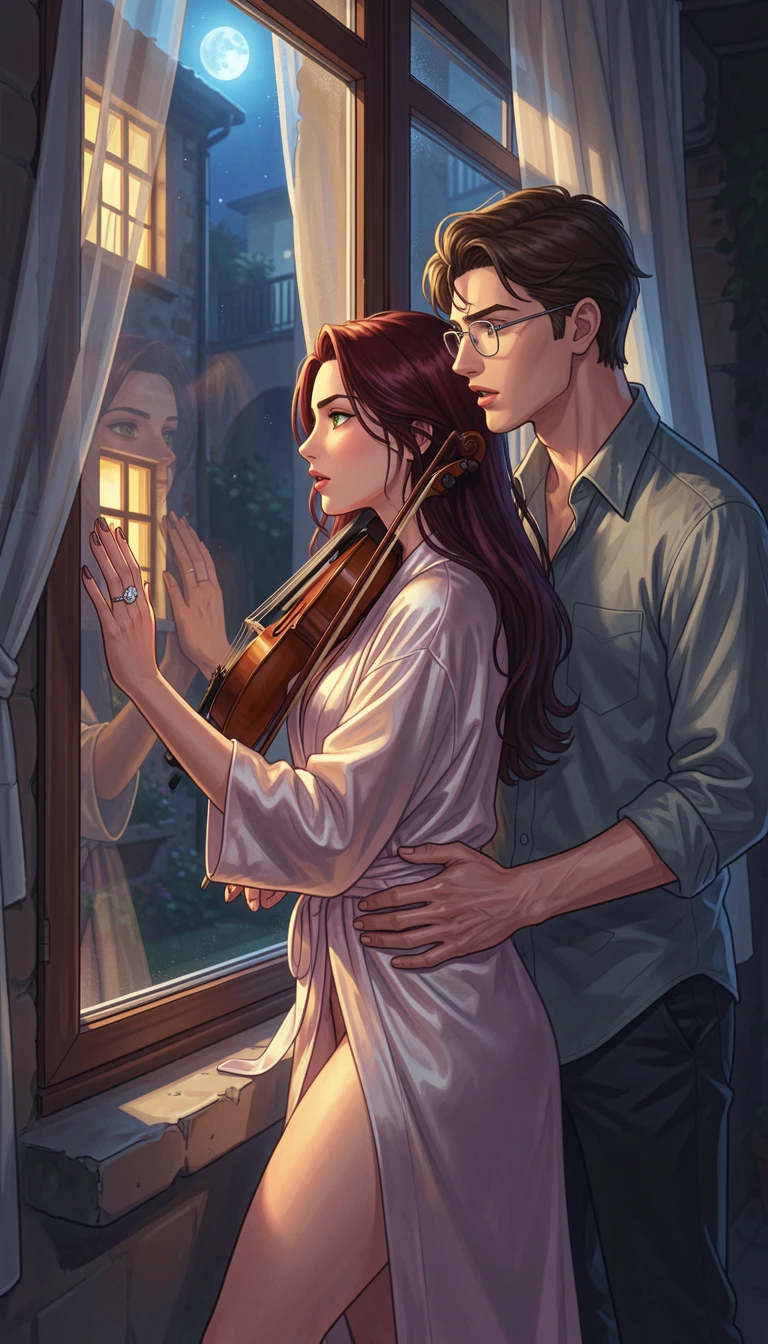
Her hand went to the window. She pressed her palm flat against the glass, mirroring his pose—hers smaller, her fingers spread wider, the silver ring on her left hand catching the last of the light. She held it there for three heartbeats. Then she reached for her own sticky note, wrote something quickly, and pressed it to the pane.
He leaned forward, squinting through the dusk. The letters were smaller than his, more careful, the handwriting of someone who'd learned to make every mark count. What do you want me to play?
He stared at the question longer than he needed to. The answer came easily—too easily—and that was what made him hesitate. He wanted to say anything. He wanted to say the thing you play when you think no one's listening. He wanted to say I don't care what you play, just don't stop, don't put the violin down, don't turn away from the window.
Instead, he wrote: I don't know the names. Just play what you were playing before you knew I was here.
She read it. Her hand stayed on the glass a moment longer, the ring glinting, and then she lowered her arm and tucked a strand of hair behind her ear. The bow rose. Her eyes closed—finally, fully—and she began to play something that sounded like it had been waiting inside her all day, all week, all the years before he'd looked up from his drafting table and heard her for the first time.
The music filled the space between them like a living thing, and Ethan kept his palm pressed flat against the glass, the cool surface grounding him against the pull of what he was hearing. Her eyes stayed closed, her body swaying almost imperceptibly with the motion of the bow, and he watched the way her fingers found the fingerboard with a certainty that made his chest ache—the muscle memory of a thousand nights of practice, a thousand evenings when no one was watching, all of them leading to this one, when he was.
The piece moved through him in ways he hadn't expected. It wasn't the wistful melody from before, nor the hungry one she'd played after catching him watching. This was something older, deeper, a sequence of notes that seemed to circle back on themselves like a thought she couldn't finish. There were pauses between phrases—not hesitations, but breaths, spaces where her bow lifted and the silence held its own weight before she let it fall again. Each pause made his throat tighten. Each resumption made him press his palm harder against the glass, as if he could feel the vibration through the distance itself.
His hand stayed empty. The sticky note pad sat untouched on the drafting table behind him, the pen resting across it like a question he'd decided not to ask. He'd had the impulse to write something—anything—during the pauses, to reach again into the silence with a few words pressed to the window. But the impulse died before it reached his fingers. Whatever she was playing, it didn't need an answer. It needed someone to hear it.
So he stood there, his breath shallow, his palm a constant pressure against the glass, and he let himself be that person.
The phrase she was playing changed. A modulation he hadn't expected, the key shifting upward into something brighter that carried a weight of its own—not happiness, exactly, but the memory of it. The sound that came through his cracked window was thinner now, more fragile, the bow pressing just lightly enough that the strings seemed to whisper instead of sing. He watched her fingers adjust, watched the slight tilt of her chin as she listened to her own playing, and he wondered if she knew what she was telling him. If she understood that every note was a word in a language neither of them had spoken aloud.
Her eyes were still closed. The strand of hair that had fallen across her cheek clung to her skin, and she didn't brush it away. She played through the brighter section, let it climb toward something that felt like a question, and then let it fall—a slow descent back into the minor register, the notes dropping like leaves settling on still water. The final phrase was almost unbearably quiet, the bow barely grazing the strings, and when the last note died, she held the position for a long moment, her body frozen in the aftermath of the sound, the violin still pressed to her shoulder, the bow still touching the string.
She didn't open her eyes. Not yet. Her chest rose and fell beneath the white shirt, and he could see the slight tremor in her bow arm—the residue of something that had cost her more than she'd expected to give. The silence between them held, filled with the last traces of the music, and he felt his own hand press harder against the glass, the pressure turning his knuckles white.
Then her eyes opened.
They found him immediately, as if she'd known exactly where he would be, as if the music had been a thread connecting them across the darkening air. She looked at him through the glass, still holding the violin against her shoulder, the bow still resting against the string, and he saw her gaze move to his palm pressed against the pane. Saw her register that he hadn't written anything. That he had simply stood there, his hand against the glass, his eyes on her, waiting.
Her lips parted. The bow lowered slowly, coming to rest at her side, and she let the violin drop from her shoulder, holding it by the neck as she took a step closer to her own window. Her free hand rose. She pressed her palm flat against the glass, mirroring his pose exactly—the same height, the same spread of fingers, the same stillness. The silver ring caught the last of the evening light, and through the distance, through the forty feet of cooling air, he saw her mouth form a single word. She didn't speak it aloud. She just shaped it with her lips, slowly, clearly, letting him read what she said.
What.
Not a demand. An invitation. A question that meant what comes next, what are we doing, what do you want from me now that you've heard the thing I didn't know I was hiding.
He held her gaze. His palm stayed pressed to the glass. And slowly, without breaking the line of his stare, he shook his head.
The smallest motion. A refusal to answer. Because there was no answer he could put into words that wouldn't ruin the thing that had already passed between them. He didn't want to tell her what came next. He wanted to stay here, in this moment, with his hand against the glass and her hand against hers, the last note of the music still alive somewhere in the walls of his empty apartment, waiting for her to decide what it meant.