
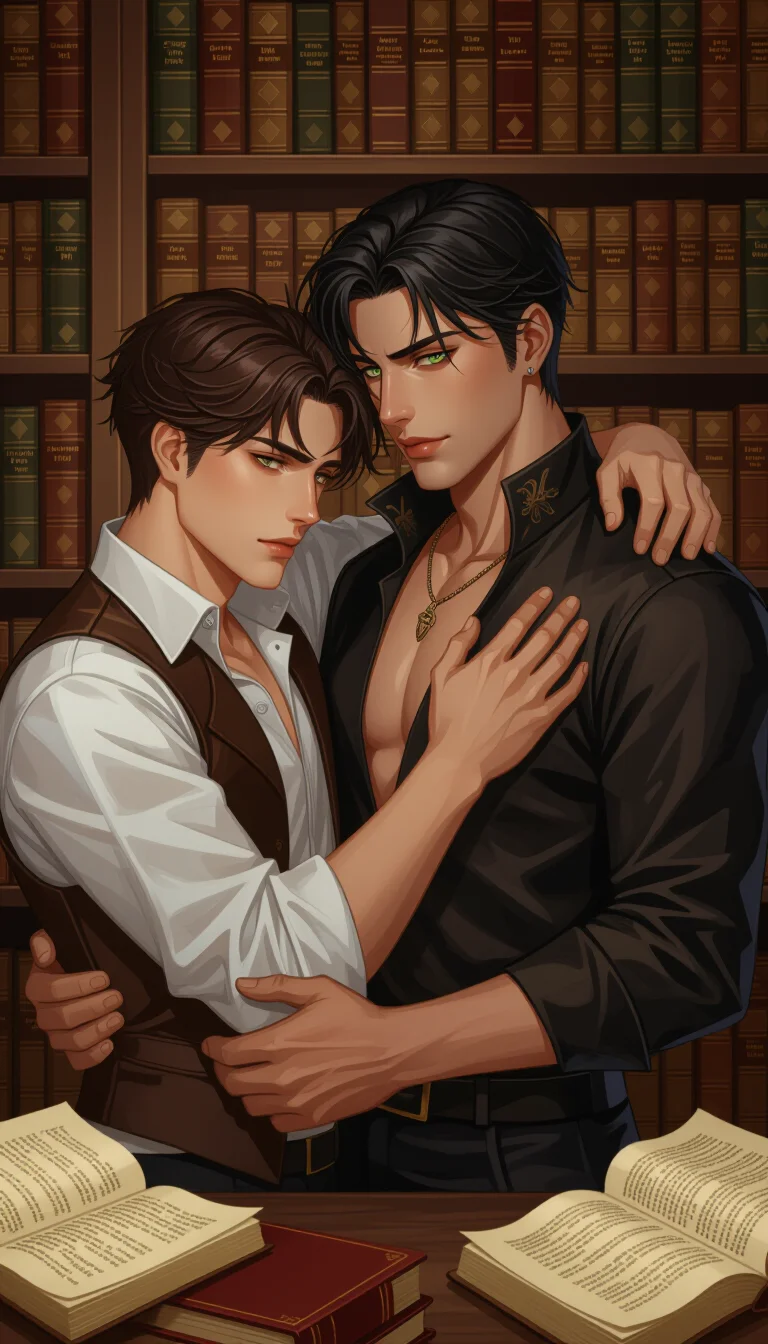
The projector’s beam cut a solid white column through the dark, chalk-dusted air of the lecture hall, illuminating the lone, empty chair placed before the tiered seats. Kieran stood beside it, his notes a cold, crisp weight in his hand. The smell of old varnish and dust was a physical presence, thick in his throat. In the shadows of the front row, Elara Vance sat perfectly still, her hands folded in her lap, playing the accused. Across the open space, Alistair Finch adjusted his cuffs, the prosecutor’s bench a stack of law books on a scarred oak table.
Professor Croft’s voice echoed from the high judge’s dais. “The court is convened. Mr. Finch, you may begin.”
Finch stood. He did not look at Elara. He looked at Kieran. “The charge is a violation of the Public Morals Statute, Section Nine. Consorting with a person of the same sex for the purposes of carnal relations. An offense against the natural order and the foundational morals of the Commonwealth.” His voice was clean, surgical, devoid of malice. That was worse. “The evidence is the testimony of a concerned citizen who witnessed the accused in a compromising embrace with another woman in the gardens of the Lyceum. The law is clear. The morality is clear. We seek a verdict of guilty.”
Croft’s silver letter-opener tapped once against the wood of the dais. “Mr. Belfrey. For the defense.”
Kieran placed his notes on the defense table. He did not look at them. He walked to the center of the illuminated floor, the dust motes swirling around him like agitated spirits. He felt the eyes of the two dozen other graduate students in the dark tiers, watching. He felt Devon’s absence like a fresh bruise. He looked at Elara. She met his gaze, her expression a careful, practiced blank.
“The prosecution rests his case on two pillars,” Kieran began, his voice softer than Finch’s, but it carried in the silent hall. “Testimony. And tradition. Let us examine the testimony. A single witness. An account of an embrace. We are asked to infer ‘carnal purpose’ from a gesture that could signify a hundred other things. Comfort. Grief. Celebration. The law requires intent. Where is the evidence of intent? There is none. It is an assumption. A story built on a glance.”
He turned to face the shadowed tiers. “Now, tradition. The ‘natural order’. A phrase used to justify the subjugation of one class by another for centuries. Used to deny property rights to women. Used to defend the institution of serfdom. Our own legal history is a chronicle of traditions being overturned by a deeper, more fundamental principle: the sovereignty of the private conscience over public dogma.” He paused, letting the words hang in the chalky air. “The law this statute purports to uphold is not about morality. It is about control. It is about the state claiming ownership over the most private landscapes of the human heart. And that, your honor, is a tyranny no free society can tolerate.”
Finch was on his feet. “Sophistry. The law is the bedrock of society. It draws lines. Without it, there is only chaos.”
“The law,” Kieran countered, still facing the darkness, “should protect citizens from harm. Where is the harm here? Who is the victim? The state’s delicate sensibilities?” He finally turned to Croft. “The prosecution offers no injured party. Only an offended ideal. You cannot build a prison out of a feeling.”
The debate unspooled for another twenty minutes. Finch cited precedents, dusty rulings from a century past. Kieran dismantled them, not with passion, but with a cold, relentless logic that felt like it was coming from somewhere outside himself. He quoted philosophical treatises on liberty. He drew analogies to religious freedom statutes. His words were precise, cutting, a scalpel laying bare the rotten core of the law. He was winning. He could feel it in the shifted energy of the room, in the way Finch’s replies grew more clipped, more rigid. In the way Croft’s tapping letter-opener had gone completely still.
“Closing statements,” Croft intoned.
Finch gave his, clean and bitter. “The law is clear. Sentiment cannot cloud judgment.”
Kieran walked back to the center of the light. He looked at Elara, then past her, into the dark where Devon was not. “We are asked to condemn a person for love. For an affection that exists without the sanction of the crowd. If the law can punish that, then the law has lost its purpose. It has become the weapon of the crowd. I ask not for leniency. I ask for justice. And justice, in this case, is a verdict of not guilty.”
Silence. The projector hummed. Croft steepled his fingers, his eyes like chips of flint in the gloom of the dais. He looked from Finch to Kieran to the motionless Elara. The moment stretched, thin and taut.
“The court finds for the defense,” Croft said, his voice dry as the dust. “The charges are insufficient. Case dismissed.”
A low murmur rippled through the tiers. Finch’s jaw tightened, but he gave a sharp, conceding nod. Elara let out a breath she seemed to have been holding for an hour. The other students began gathering their things, the spell of the mock trial breaking into the rustle of paper and the scrape of chairs.
Kieran did not move. He stood in the beam of light, the victory ash in his mouth.
“A compelling performance, Mr. Belfrey.” Croft had descended from the dais and stood at the edge of the light, his black robes merging with the shadows. “Cold logic. Impeccable rhetoric. You eviscerated the statute.” He stepped closer, his voice dropping. “It is a wretched law. A stain. You argued well for its impotence.”
“But it’s still the law,” Kieran said, the words leaving him flat and hollow.
“It is,” Croft affirmed. He tapped the letter-opener against his palm. “Outside this room, in the real world, your client would likely have been convicted. Public opinion, the weight of tradition… it crushes finer arguments. What you won today was a theoretical point. A ghost of justice.” He studied Kieran’s face. “The coldness you feel? That is the distance between the ideal and the real. Remember it. It is the climate in which we all must live.”
The professor turned and melted back into the darkness, leaving Kieran alone in the light.
Elara approached, her steps quiet on the wooden floor. “Thank you, Kieran. That was… astonishing.”
He managed a nod. “It was an exercise.”
“It felt like more.” She hesitated, then leaned in slightly. “For what it’s worth… I know. About you and Somerset. It’s an open secret in some circles.” She didn’t smile. Her eyes were serious, almost sad. “Be careful.”
She was gone before he could respond, her figure disappearing into the hallway’s gloom.
Kieran slowly gathered his notes. The words he had spoken—*sovereignty of the private conscience*—echoed in his head, a cruel joke. He had defended a phantom client against a phantom charge in a phantom court. And he had won a phantom victory. In the real world, he and Devon were a secret. A crime waiting to be discovered. The law he had just dismantled with such clinical efficiency still stood, a wall of stone around his life. The cold wasn’t just a feeling. It was a fact.
He left the lecture hall. The corridor outside was bright, jarring, filled with the ordinary sounds of the university. He walked without seeing, the chill from the hall seeping into his bones. He thought of Devon’s hands on him in the dark. The heat, the certainty of it. He thought of the empty chair in the beam of light. A person reduced to a concept to be argued over. He had never felt more like a ghost.
He found himself at a window overlooking the central quad. Students lounged on the grass, laughing. A couple walked hand-in-hand, openly, without fear. The sun was bright. The world was normal. He pressed his forehead against the cool glass. He had won. He had proven his point. And all he had proven was that he lived in a world where love was a legal argument, and the winning of it felt like loss. The cold reminder was not in Croft’s words. It was in the warmth of the sun on the grass outside, a warmth from which he was permanently separated by an invisible, immutable pane of glass.
Kieran’s feet moved before his mind could form a reason. He pushed away from the window, the sun-warmed glass leaving a temporary print on his forehead, and walked quickly down the corridor. He caught sight of Elara’s dark coat just as she turned a corner toward the History wing. “Elara. Wait.”
She stopped, turning with an expression of mild surprise that didn’t quite reach her eyes. She’d expected him.
“Who knows?” The question came out raw, stripped of the courtroom polish. “You said it’s an open secret. How open?”
Elara glanced down the empty hallway, then gestured to an alcove housing a bust of some forgotten chancellor. The stone face was worn smooth by time, features blurred into anonymity. She leaned against the wall beside it. “Quite a few have inferred. No one has proof. No one needs it.”
“Inferred from what?”
“From the way he looks at you when he thinks no one is watching. From the way you disappear together. From the fact that Devon Somerset, who has never shown a moment’s interest in anyone’s companionship, suddenly has a shadow.” She folded her arms. “It’s a small world, Kieran. The graduate college is an echo chamber. Whispers become facts.”
The cold in his bones intensified. “And these people… what do they do with these facts?”
“Most do nothing. They think the law is garbage—a relic for the public square, not the private room. They look the other way. A smaller number… they’re afraid. Not of you. Of him. Of the House of Somerset. To accuse the Duke’s heir of a morals charge is to declare war on one of the most powerful families in Rathany. The backlash would be… catastrophic. For the accuser.” She met his gaze. “So they stay silent. Not out of kindness. Out of calculus.”
Kieran absorbed this. His safety, their secrecy, was a byproduct of fear and disdain. A fragile shield made of other people’s contempt for the law and their terror of Devon’s name. There was no righteousness in it. No protection. Only a temporary, precarious balance. “You’re not afraid?”
“I’m pragmatic,” she said. “And I’ve seen what happens to people who aren’t. Today was a demonstration. You argued well. You sounded like you believed it. But you walked out of that hall looking like a man who’d just read his own death warrant. That’s the reality. The law is a blade. Whether it cuts you depends on who’s holding the hilt, and who they want to bleed.” She pushed off from the wall. “Be careful doesn’t mean hide better. It means understand the blade.”
She left him in the alcove with the faceless stone chancellor. Kieran stood there for a long time, listening to the distant sounds of the university—a shout of laughter, a door closing, the tread of boots on stone. A world of ordinary noise. He felt hyper-visible and utterly invisible at once.
He didn’t return to his rooms. He walked, directionless, through the older parts of the campus, where the Gothic arches cast long, skeletal shadows even in the afternoon light. His mind was a courtroom without a judge, arguments bouncing off the walls. *Sovereignty of the private conscience*. A beautiful phrase. A phantom. Elara’s words painted a map of his peril: not a secret kept, but a secret tolerated. A thing allowed to exist only so long as it inconvenienced no one with power.
He found himself at the door to Professor Croft’s office. It was a subconscious pull, like iron to lodestone. He knocked before he could reconsider.
A moment passed, then the door opened a crack. Croft’s keen eye assessed him through the gap. “Belfrey. The phantom victor. Come to dissect the carcass of your argument?” He opened the door wider, revealing the familiar chaos of books and artifacts. The air smelled of dust, leather, and the faint, sharp tang of preserving chemicals.
“I want to understand the blade,” Kieran said, stepping inside.
Croft closed the door with a soft click. “A shift in metaphor. Interesting.” He moved behind his desk but did not sit. He picked up the silver letter-opener from a stack of parchment. “Which blade?”
“The law. The real one. Not the theory.”
“Ah.” Croft tapped the point of the opener against his thumb. “You felt the cold, then. Good. Numbness is more dangerous. The law is not a blade, Mr. Belfrey. A blade is clean. It cuts and is done. The law is a climate. As I said. It is the very air a society breathes. It is the temperature that determines what grows and what withers. The Public Morals Statute is not an instrument; it is a weather system. It creates an atmosphere of… permissible condemnation.”
“And how does one live in that climate?” Kieran’s voice was quiet. “If one’s nature is considered a blight?”
Croft’s tapping ceased. He looked at Kieran with an unsettling, depthless focus. “One becomes adept at reading the barometric pressure. One learns to distinguish between a passing squall and a permanent winter. One builds shelters.” He gestured vaguely at the towers of books around them. “Some of us build them out of scholarship. Others out of silence. Others out of power.” He set the letter-opener down. “Your friend, Mr. Somerset. He is a student of power, is he not? In its more… esoteric forms.”
The shift was so subtle Kieran almost missed it. The conversation was no longer about statutes. It was about Devon. About the shadows in his rooms. About the thing that walked the moors. “He is,” Kieran said, guarded.
“Power is its own shelter,” Croft said softly. “A dangerous one. It can keep the cold at bay, certainly. But the source of the heat…” He trailed off, his eyes drifting to a peculiar artifact on a high shelf—a twisted piece of blackened wood, shaped vaguely like a hand. “It matters. Be wary of warmth that comes from a cursed flame, Mr. Belfrey. It may keep you alive, but it will change what you are. You will no longer feel the cold, but you will forget what warmth truly felt like.”
Kieran thought of the heat of Devon’s hands. The desperate, consuming fire that was their intimacy. He thought of the hollow, perfect boy from the festival, lost to a bargain. Was that the change? The forgetting? “And if the alternative is freezing?”
“Then you have chosen,” Croft said, not unkindly. “And you must live inside your choice. Do not cling to the ghost of the other path. It will drive you mad.” He turned his back, effectively dismissing him. “The climate is real. Your victory was phantom. Carry that knowledge. It is the only armor I can give you.”
Kieran left the office. The corridor seemed darker now, the shadows between the wall sconces deeper. He walked, not toward his apartment, but toward the river that cut through Alderfaire. The air grew damp and cool, smelling of wet stone and slow water. He stood on a deserted quay, watching the dark water slide past. The cold reminder was inside him now, a core of ice beneath his ribs. He had chosen his shelter. It was built of whispered secrets, of feared reputations, of a power drawn from a moors-dwelling entity. It was a shelter that demanded a price—his memory, his ordinary life, his very self. He looked at the reflection of the city lights on the black water, shimmering and broken. He had won a phantom victory in a phantom court. And he was building a phantom life, real only in the shadows, warm only by a cursed flame. The cold wasn't coming. It was already here. He was living in it.