
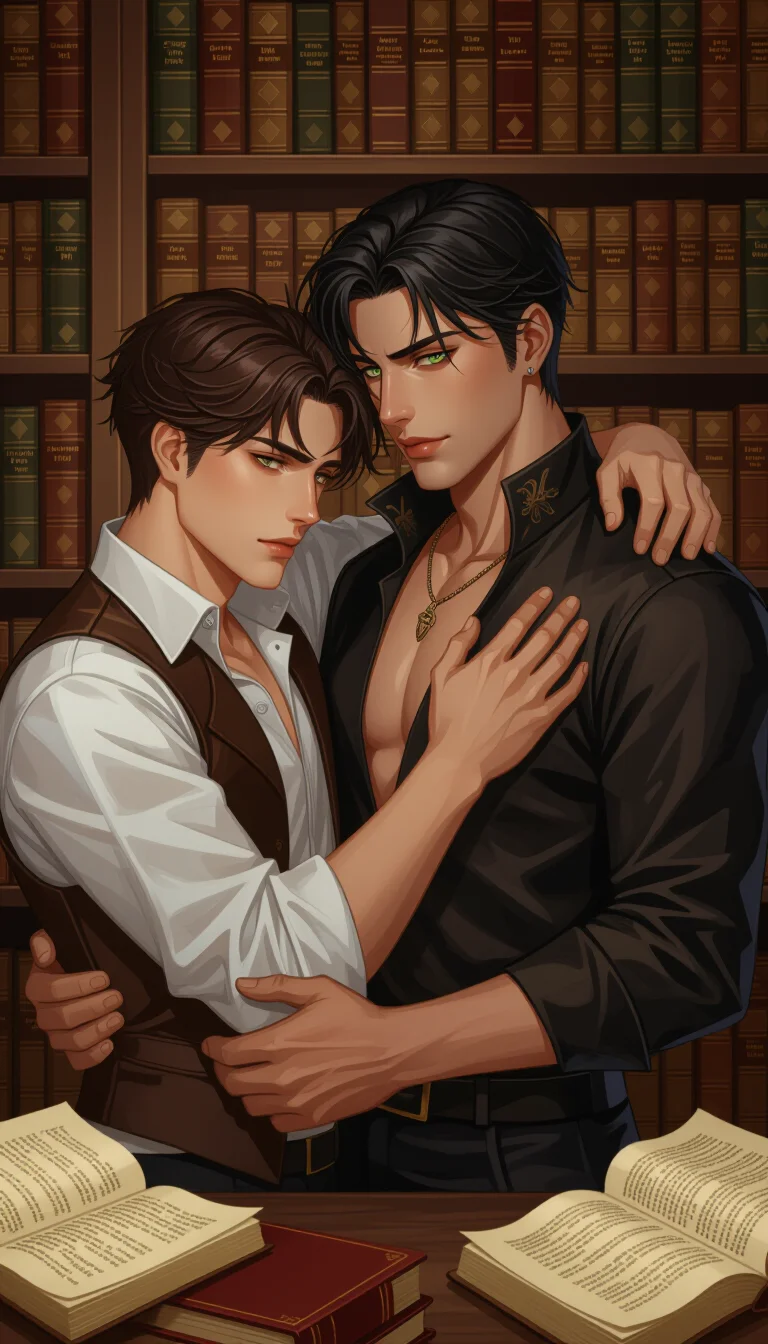
The air in Alderfaire’s central clearing was thick, a soup of pine resin and damp earth that coated the back of Kieran’s throat. He stood beside Devon on the packed, cool ground, the ancient trees around them forming a silent, watching circle. Devon’s hand was a firm pressure on his shoulder, not guiding, but pinning. “Look,” Devon murmured, his voice a low vibration in the dark. “The good doctor takes his evening constitutional.”
Across the clearing, a well-dressed man in his fifties strolled along a gravel path, smoking a pipe. Dr. Stafford Morris. He paused to admire a budding hawthorn, the picture of cultivated tranquility. Kieran’s stomach turned. He knew the dossier Devon had compiled: the vulnerable patients, the subtle coercions, the financial ruin dressed as therapeutic breakthrough. The man cultivated sorrow like a hothouse flower, then sold the seeds back to his patients at a premium.
“He’s a parasite,” Devon said, as if reading the thought. His fingers tightened. “He doesn’t draw blood. He draws despair. It leaves a different stain.”
“How will you…” Kieran began, but the question died. Devon’s profile in the gloom was carved marble, his green eyes reflecting no light.
“Come and witness,” was all Devon said, and the hand on Kieran’s shoulder steered him forward, not toward Morris, but on a parallel route through the trees, a shadow-path to the man’s consulting rooms at the edge of the district.
The office was on the ground floor of a genteel townhouse, its bay window dark. Devon produced a key from his pocket—a simple, brutal twist of iron—and the lock yielded with a sigh. The door opened onto a room that smelled of lemon polish, stale tobacco, and beneath it, something cloying and sweet, like decayed flowers. Devon moved inside with a predator’s silence, Kieran hovering on the threshold.
“Close the door,” Devon said, not looking back. He was already surveying the room: the heavy desk, the leather chaise, the shelves of leather-bound books that were for show, not study. Kieran pushed the door shut. The click of the latch was terribly final.
Devon walked to the desk and opened a drawer. He removed a file, flipping through pages in the faint light from the streetlamp outside. “Ah,” he breathed, a sound of grim satisfaction. “Miss Eleanor Vane. Prescribed weekly consultations for ‘hysterical attachment’ to her deceased father. Billed her estate for two years. She drowned herself in the Rath last autumn.” He dropped the file. It slapped the desktop like a dead thing.
Footsteps on the gravel outside. A key in the lock. Kieran’s heart hammered against his ribs. Devon didn’t move. He stood behind the desk, a silhouette of perfect stillness.
The door opened, and Dr. Morris entered, humming softly. He fumbled for the gas lamp. The sudden flare of light caught Devon first, and Morris jumped, his hand flying to his chest. “Good God! Who are you? How did you get in here?” His indignation was immediate, professional outrage masking a thread of fear.
“I am a concerned party,” Devon said, his voice smooth and cold as a river stone. “Regarding your practice.”
“This is highly irregular. You will leave at once, or I shall call for the constable.” Morris moved to his desk, his eyes darting to a brass bell.
“Call,” Devon invited. He didn’t smile. “Let us discuss your treatments. Let us discuss the tithe you extract from broken spirits.”
Morris’s face hardened. “I am a healer. You understand nothing of the delicate psyche.”
“I understand sorrow,” Devon said. He took a single step forward. “I understand its weight, its taste, its relentless echo. You package it. You sell it back in smaller, perpetual doses. That is not healing. That is usury of the soul.”
“Get out,” Morris spat, but his voice wavered. He looked past Devon, saw Kieran standing frozen by the door. “You, boy! What is the meaning of this?”
Kieran said nothing. His mouth was dust.
Devon raised his hand, not in a gesture, but simply opening his palm toward Morris. The air in the room changed. The sweet, cloying smell intensified, then curdled into something acrid, like burnt hair and salt. Morris’s eyes went wide. “What are you—”
“You have collected so many tears, Doctor,” Devon whispered. “Let us see how well you swim.”
It began as a shudder. A full-body tremor that racked Morris where he stood. Then a gasp, sharp and ragged, as if the air had been ripped from his lungs. His hands flew to his ears. “Stop it,” he whimpered. “The whispering… make it stop.”
Devon’s expression was one of detached, clinical focus. The green of his eyes seemed to deepen, to swallow the lamplight. “That is Miss Vane. She is asking why you told her her grief was a sickness. She is asking why you charged her for the poison you called a cure.”
Morris cried out, a raw, animal sound. He sank to his knees, his face contorted. “No! It’s not… I helped her!”
“And here is Mr. Albright. The despair you cultivated over his lost fortune. You told him his worth was tied to his accounts. He believes you now. He believes he is nothing.”
Morris began to sob, great heaving cries that shook his frame. He clawed at his own face, leaving red welts. “They’re all here… all of them… inside me…”
Kieran watched, paralyzed. He saw the doctor’s mind unraveling in real time, not from without, but from within. The ghosts of a hundred tormented psyches, their harvested anguish, now flooding back into the vessel that had profited from them. It was a psychic avalanche, and Devon was the catalyst, the focused lens concentrating every shard of borrowed pain into a single point.
The room grew cold. The gas lamp flickered, not from a draft, but as if the light itself was being sucked away. Shadows in the corners of the room thickened, pooling like spilled ink. They began to crawl across the floor, up the walls, converging toward the weeping man on the rug.
Morris was babbling now, a stream of apologies, denials, and screams fragmented by different voices—a young woman’s plea, an old man’s lament, a child’s confused terror. His eyes rolled back, showing the whites.
And then Kieran saw Her.
It was not a form, not truly. It was a concentration of the gathering darkness behind Morris, a suggestion of height, of a feminine silhouette woven from the very essence of the shadows and the doctor’s erupting torment. He felt Her presence—a vacuum of warmth, a silent, howling hunger that made the bile rise in his throat. There was no face, only a deeper darkness where a face might be, and a sense of ancient, patient consumption.
She-Who-Walks-The-Moors reached, though no limb moved. A tendril of profound shadow detached from the whole and touched Morris’s heaving back.
The doctor’s babbling ceased. His body went rigid. A single, final tear traced a clean line through the sweat and spit on his cheek. Then, a sigh left him—a long, hollow exhalation that carried with it the last flicker of his conscious mind. The sound was the softest thing Kieran had ever heard, and the most terrible.
The shadow-tendril retracted. The feminine shape in the darkness seemed to turn, just slightly, and Kieran knew, with a certainty that froze his marrow, that the void where a face should be was now regarding him.
He couldn’t breathe. He was a specimen under a glass, his every fear, his devotion, his stolen memory of a laughing boy in Goodbriar, laid bare. The pressure of that attention was immense, a weight that threatened to crack his bones. It was grief given sentience. It was vengeance made atmosphere.
Then, as suddenly as it had focused, the pressure lifted. The silhouette blurred, dissolving back into the ordinary shadows of the room. The cold retreated. The gas lamp steadied, its light seeming garish and false.
Dr. Stafford Morris lay crumpled on the floor, breathing in shallow, mechanical hitches. His eyes were open, vacant, fixed on the ceiling. A thin line of drool connected his lip to the Persian rug.
Devon lowered his hand. He let out a long, slow breath, his shoulders settling. He looked spent, hollowed out, but his eyes when they found Kieran’s were fiercely alive. “The tithe is paid,” he said, his voice rough.
Kieran couldn’t speak. He could only stare at the empty shell of the man on the floor.
Devon crossed the room to him. He didn’t touch the doctor. He came straight to Kieran, his hands coming up to frame Kieran’s face. His palms were ice-cold. “You saw,” Devon stated, searching his eyes.
Kieran managed a nod, a tiny, brittle motion.
“You saw Her.”
Another nod. The cold from Devon’s hands was seeping into his skin.
“Can it be broken?” The words left Kieran’s mouth before he could think, a raw scrape of sound. He was still looking at the hollow man on the rug, but he was asking the cold hands on his face, the green eyes holding his. “The pact. Is there a way out?”
Devon’s thumbs stroked his cheekbones, a gesture that felt like assessment. The fierce light in his eyes didn’t dim. “All things forged can be unmade. She is… still a thing of mercy, in her way. The terms are clear.”
“What terms?”
“A trade. To break the bond, I would have to give Her the full memory of something which brings me joy. Not a shard. The entire thing. The sight, the sound, the feeling. Eradicated.” Devon’s voice was terribly matter-of-fact. “At present, Kieran, that category contains one item. You.”
The cold from Devon’s hands seemed to spear straight into Kieran’s chest. He understood. To be free, Devon would have to forget him completely. The man he was now, the boy in Goodbriar—all of it. A perfect, surgical emptiness where Kieran had been.
Devon watched the understanding dawn, and something like a smile touched his mouth. It was not kind. “So you see. The geometry is fixed. My freedom lies in your annihilation. Within me, at least.” He finally dropped his hands, the absence of his touch leaving Kieran’s skin aching. “Come. We can’t stay here.”
He turned, stepping over Dr. Morris without a glance, and retrieved his overcoat from the chair. He shrugged into it, the movement weary, and opened the office door to the dark hall.
Kieran followed, his legs unsteady. The hallway air was stale, smelling of dust and old wood. It felt obscenely normal. Behind them, the office was just a room with a gas lamp and a man breathing on the floor. The shadow was gone. The weight was gone. But it had been there. It had seen him.
They did not speak in the stairwell. They did not speak on the street. Alderfaire was quiet, the spring night mist gathering in the cobbled lanes, softening the glow of the occasional streetlamp. Devon walked with purpose, his stride eating the distance, and Kieran matched it, his mind a silent, churning static. *The full memory. You.*
They crossed onto the university grounds through a side gate, the iron screeching faintly. The ancient oaks of the central clearing were massive silhouettes against a charcoal sky. The humid, pine-scented air from earlier had cooled, carrying the damp earth smell of the packed bowl. It was here, hours ago, that Devon had pointed out Morris’s consulting rooms. It felt like a lifetime.
Devon didn’t head for their apartment. He led them to a stone bench nestled between two great roots, half-hidden in shadow. He sat, leaning back against the trunk, and finally looked at Kieran, who remained standing.
“Sit. You’re shaking.”
Kieran hadn’t realized he was. He sat, the cold of the seeping through his trousers. The distance between them on the bench was precise, deliberate.
“You asked your question,” Devon said, his gaze fixed on the dark canopy above. “Now I have one. Having seen the transaction… having seen *Her*… do you still choose to be my witness?”
The question wasn’t casual. It was the core of everything. Kieran saw the vacated eyes of the psychologist. He felt the gravitational pull of the shadow-entity, the grief that could unmake a mind. He saw the boy in Goodbriar, laughing, reaching for his hand. He saw Devon’s face in the lamplight, hollowed and fierce. The memory was a warmth in his own chest, a secret he now carried for them both.
“Yes,” Kieran said. The word was quiet, but it didn’t waver.
Devon’s head turned. He studied Kieran’s profile. “Why?”
“Because you need one.”
“That’s not an answer. That’s logistics.”
Kieran looked at him then. “You showed me the cost. You showed me the… the currency. You didn’t hide it. You let me see Her. You told me the price of your freedom.” He drew a slow breath. “You’re giving me the choice. The real one. That’s why.”
A long silence stretched between them, filled with the creak of branches and the distant cry of a night bird. Devon’s expression was unreadable in the gloom.
“I am a warlock,” Devon said, the word flat and heavy in the night air. “My patron is a goddess of collective sorrow. My power is bought with blood and terror. I will do worse than what you saw tonight. There are three more tithes before the year turns. Each will be… tailored. This is the path. It does not lead to a sunny meadow.”
“I know.”
“Do you?” Devon shifted, turning fully toward him. The predatory grace was back, but it was taut, strained. “You think your logic can fence this? Your provincial morality can comprehend it? You can’t witness from a distance, Kieran. You have to stand in the splash zone. You will be stained.”
“I am already stained.” Kieran’s voice gained a hard edge. “I stood there and watched a man’s mind be eaten. I didn’t look away. I didn’t run. I let you hold my face afterwards. Where, precisely, do you imagine my clean line is?”
Devon stared at him. Then, slowly, he reached out. His fingers didn’t go to Kieran’s face this time. They brushed the back of Kieran’s hand where it rested on the cold stone. A touch so slight it was almost not there. “There is no going back after this.”
“I’m not trying to go back.” Kieran turned his hand over, palm up. An invitation. A surrender. “I’m trying to go with you.”
Devon’s hand slid into his, their fingers lacing. His skin was still cold. The grip was firm, almost painful. “Then you are a fool,” he whispered, but he brought their joined hands to his mouth, pressing his lips to Kieran’s knuckles. The gesture was stark, devoid of romance. It was a seal.
They sat like that for a long time, in the dark under the oak, hands locked. The silence was no longer empty. It was charged with the things they had said and the things they had seen. The entity was gone, but her presence lingered in the space between them, a third party to their covenant.
Finally, Devon stood, pulling Kieran up with him. “Come. The equinox is almost over. I’m tired.”
They walked back to their building, shoulders brushing. The foyer was dark, the porter gone for the night. Their footsteps on the stairs were the only sound. Inside their apartment, the air was still and close, smelling of old books and yesterday’s coffee.
Devon went straight to the sideboard and poured two fingers of whiskey from a cut-glass decanter. He didn’t offer Kieran any. He drank it in one swallow, his throat working. He set the glass down with a sharp click. “She looked at you,” he said, his back to the room.
Kieran stood by the door, still wearing his coat. “Yes.”
“She doesn’t usually do that. Not with witnesses. They’re… scenery.” Devon turned. His face was pale in the low light from the single lamp. “She found you interesting.”
A fresh chill traced Kieran’s spine. “Why?”
“Because you carry a piece of what She owns, perhaps. Perhaps you were part of a joyful memory once bequeathed unto Her.” Devon’s gaze was relentless. “She can sense it on you. It’s a paradox. A living vessel for a dead memory.” He took a step closer. “It makes you… luminous to her. And that makes you vulnerable.”
Kieran did not confess that the joy had been Devon’s, once, so long ago. He thought of the pressure of that attention, the feeling of being utterly known. “What does that mean?”
“It means,” Devon said, closing the distance between them, “that you are now part of the transaction. Not just the witness. The collateral.” He brought his hands up, not to Kieran’s face this time, but to the buttons of his overcoat. His fingers were deft, cold. He pushed the heavy wool from Kieran’s shoulders, letting it fall to the floor. “My freedom costs your memory. But your presence… your very soul… is now a flicker in Her peripheral vision. She is curious about what she consumes. And curiosity, in such a being, is not benign.”
He was so close Kieran could see the fatigue etched around his eyes, the faint tremor in his hands that hadn’t been there before the tithe. The power had a cost, and Devon was paying it now. Kieran reached up, covering Devon’s hands with his own, stilling them. “Then we don’t give Her a reason to look closer.”
Devon laughed, a short, hollow sound. “You think we have a choice?”
“I think,” Kieran said, leaning in until their foreheads nearly touched, “that we have tonight. The tithe is paid. She is… fed. For now. That has to mean something.”
Devon’s breath hitched. The mask of control cracked, just for a second, and Kieran saw the raw, spent thing beneath—the boy who had traded his happiness for power, the man who was forever paying the installments. “It means,” Devon whispered, his lips brushing Kieran’s as he spoke, “that I am so very tired of being hollow.”
This kiss was not like the others. It was not a claiming, nor a lesson, nor a negation. It was slow. It was searching. It was Devon pouring the emptiness into Kieran’s mouth, and Kieran drinking it, accepting it, filling it with the warmth of his own breath, the solid truth of his own body pressed close. Devon’s hands came up to cradle his head, fingers tangling in his hair, not with force, but with a kind of desperate anchorage.
They broke apart, breathing ragged. Devon rested his forehead against Kieran’s shoulder, his whole weight leaning into him. Kieran held him up, his arms wrapping around Devon’s back, feeling the tension in the muscles, the ridge of his spine. He held the warlock, the murderer, the lost boy, in the dark quiet of their rented rooms, as the long night of the equinox finally began to wane.