
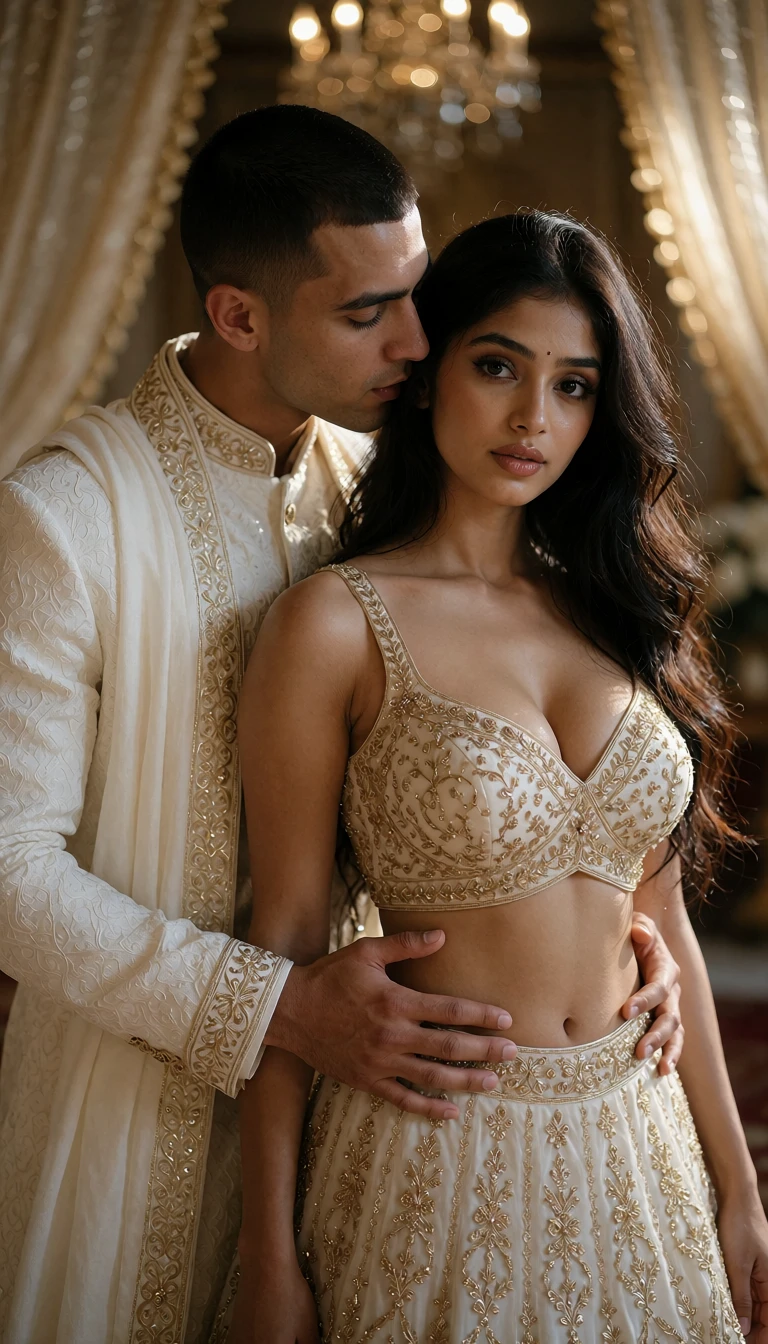
The photographer's smirk sat on his face a beat too long. Sung watched it happen — the wiry man's finger curling over the shutter, his eyes flicking from Loseis's retreating back to Chae Hae In's waist to Sung's shoulders, doing the arithmetic, arriving at the sum he clearly liked. Ink stained the man's thumb. Sweat beaded at his temple. He raised the camera an inch, a small, deliberate lift, the way a man raises a glass.
"Sir," the photographer said, and the word was not for Loseis. "Sir — just there. Behind the madam. One shot. For the album."
The marble was cold through Sung's mojari. Somewhere past the velvet drapes the drums had shifted to a slower rhythm, and the hall's incense had gone sour at the edges, mixed with the smell of too many bodies and hot marigold. He did not answer the man. He stepped in.
His shadow fell across her first. Chae Hae In stood facing the photographer, one hand resting at her hip, the gold embroidery of her lengha pulling at the seam where her waist narrowed before flaring into her hips. The blouse was cut low at the back, a broad band of ivory skin between the gold, and the temple lights laid a thin shine along her spine. Sung set his chest to that shine. He let his breath move her hair.
Then his hand came around her front and splayed flat across her stomach.
She went rigid. Every muscle from her ribs to her thighs locked at once, a body turned to carved wood under his palm. His fingers found the dip of her navel through the silk, pressed in, one knuckle deep, and the fabric there was the thinnest part of her whole outfit — he could feel the small heat of her skin through it, the shape of that little hollow fitted around his fingertip like it had been cast for him.
"Sung." Her voice came out low and flat. Not loud. She was a woman who did not raise it. "Remove your hand."
"The man wants a photograph." He nodded at the photographer, who had gone very still behind his camera. "Smile."
She turned. Her hair came around with her, a black sweep across his forearm, and her face was close enough that he could see the small muscle jumping beneath her eye, the careful paint of her lipstick, the gold at her ears catching the light. Her mouth opened on the protest — he watched the words forming, the clipped precision of her already arranging them into something that would cut — and he took her mouth before they arrived.
Her lips were warm and stiff and tasted faintly of the sweet cardamom tea from the reception. He kissed her deep, one hand fisted in her hair at the base of her skull, holding her steady, and he did not hurry. He let the kiss run long enough that the hall's noise changed pitch around them, the chatter thinning, a woman's startled laugh cutting off. Her hands came up between them — flat against his chest, pushing — and then, as he tilted his head and took her lower lip between his teeth, the push softened. Her fingers curled into the white silk of his sherwani instead of shoving it away.
His other hand dropped.
It went under the lengha's embroidered waistband, past the silk, and found the bare skin of her thigh. Hot. The muscle there jumped under his palm, and he could feel the fine grain of her, the smooth weight of it, the way her leg had already begun to turn inward as though to close against him. He gripped hard enough to hold it open. Pulled her back.
She felt it. He made sure of that — pulled her flush against the front of him, where his dick had gone hard and heavy against his thigh, and let her feel the whole length of it pressed into the small of her back. Nine and a half inches of him, and not a polite fraction of it showing. He heard her breath catch. Not a gasp. Smaller than that. A hitch, a stutter, the sound of a woman's body answering before her mind could file an objection.
Somewhere behind them a cousin whooped. Then another. Somebody clapped, and the clapping spread, and a woman near the front called out, "See, see — the brother does it better than the groom!" and the hall laughed, relieved, delighted, mistaking the whole thing for a joke played by a bold younger brother on his straitlaced new bhabhi. The photographer's shutter went off in a fast stutter, click-click-click, and the man had started to grin in a way that had nothing to do with the wedding.
Chae Hae In's eyes were wide. Her lipstick was smeared at the corner of her mouth. She had not stepped away.
"You're shaking," Sung said, quiet, into her ear.
"I'm not."
"You are. Right here." His thumb moved on her thigh, a slow arc, and he felt the shiver travel up through her hip into his hand. "That's not fear."
She said nothing. Her jaw worked once. He could see her deciding — he had watched her decide things all evening, the way she handled the priest's questions at the mandap, the way she'd cut off an aunt who'd asked about children with a single cool sentence. She was deciding now. He watched her eyes move from his face to the photographer to the crowd and back, and he watched the decision tilt.
"Loseis will be back any moment," she said.
"Then I should hurry."
His hand slid higher.
Up the inside of her thigh, where the skin went softer than anywhere else, and she made a sound — small, bitten off, half a word — and her hand came down to grip his wrist. She did not pull it away. Her nails pressed into his forearm and stayed there, holding on, and he took that for what it was. The lengha's silk slid over the back of his hand as he climbed. He found the edge of her panties, thin and damp at the crotch, and pushed past them.
She was wet. Soaked, actually — slick all along the seam of her, hot against his fingers, and his fingertip slid through it without resistance. He felt her whole body go tight at the contact, a shudder running through her, and her grip on his wrist turned white-knuckled.
"Sung—" His name came out wrong. Too breathy. She heard it herself, he thought, because she cut it off, swallowed, tried again flatter. "There are people—"
"Let them look." He pressed two fingers to her slit, found her clit with the pad of his middle finger, and rubbed — slow, firm, a circle. "You're dripping on my hand, bhabhi."
Her head fell back against his shoulder.
He had not expected that. He had expected her to fight, to twist free, to slap him in front of the whole hall and make a scene that would follow him for years. Instead her head dropped back, her throat bared, the temple-coin necklace at her collarbone sliding sideways, and her hips made a small involuntary roll against his hand — once, then again, catching herself, and the catching was worse than the roll because it told him she wanted it and was trying not to.
The photographer had come closer. Sung saw him over her shoulder, the man's eye pressed to the viewfinder, his whole body leaning in, and the camera was pointed low, at the place where Sung's hand disappeared into the front of her lengha. "Sir," the man breathed, "sir, hold that—" and the shutter ran again, fast, greedy.
"You're photographing my hand up her skirt," Sung said, conversationally.
"For the— for the album, sir, the romantic—"
"Keep it." He turned his wrist, pushed a finger into her, and Chae Hae In's whole body arched against him, her back bowing off his chest, a sound tearing out of her throat that she tried to turn into a cough and failed. "That one. Print that one big."
She was tight and hot inside, clenching around his finger. He added a second, felt her stretch, felt the wet give of her, and she whimpered into her own shoulder. The crowd had gone strange and quiet now — not the laughing quiet, but a different quiet, the kind that comes over a room when the joke has stopped being funny and nobody wants to be the first to say so. Somewhere a woman whispered behind her hand. A man cleared his throat, loudly, twice.
Chae Hae In's hips were moving now. She couldn't stop them. He could feel it building in her, the way her thighs had begun to tremble, the way her cunt gripped his fingers in little pulses. He curled them, found the spot, and pressed, and her hand flew up and grabbed the back of his neck and her nails raked down.
"Don't stop," she said. Then, horrified at herself: "Don't— Sung, the camera—"
"He's getting your face," Sung murmured. "Look at him."
She did. Her eyes opened, glassy, and found the lens, and the photographer made a small broken sound and pressed the shutter down and held it, the camera firing in a long burst, catching whatever her face was doing. Sung felt her go over. It started low, a tightening in her belly against his palm, and then her whole body seized, her back arching hard, her mouth opening on a moan she caught at the last second by biting her own lip — and the orgasm rolled through her, three long waves of it, her cunt clenching and releasing around his fingers, her thighs closing on his hand, her hips grinding down against his palm as she came.
Her juices ran hot over his knuckles. He felt them, wet and thick, sliding down between his fingers and into the embroidery of her lengha, and he kept his hand there, working her through it, slow circles now, until the shuddering stopped and her body sagged back against his chest, boneless, her breath coming in ragged pulls.
Across the hall, a door opened.
Loseis stood in it, his small dark shape outlined against the corridor's brighter light, his gold-rimmed glasses catching a glare. He had the napkin from the reception still crumpled in one hand. He was looking at his wife, and his wife was leaning back against his brother's chest with her head tipped to the ceiling, her lengha bunched and wrong at the waist, and his brother's hand was not visible anywhere it should have been.
The photographer lowered his camera. His grin had gone entirely. "Sir," he said to nobody in particular, "I think I should — the album, I'll just — I'll just delete these—"
Sung slid his hand out from under her lengha. It came away glistening. He did not wipe it. He turned, holding his brother's eyes across the width of the marble floor, and let the wet hand hang at his side where the whole hall could see it.
"Brother," he said. "You're back."
Loseis did not move from the doorway. The napkin in his fist had gone soft and gray with his sweat, and he turned it slowly, once, like a man winding a small clock. Behind his glasses his eyes went from Sung's face to the wet hand to Chae Hae In's ruined waistband, and the order of the looking told Sung everything — he had not come back to find his bride; he had come back to find his brother.
"The caterer wanted a signature," Loseis said. His voice had the flatness of a man reading a menu. "For the extra plates. They always — there's always a form."
"There's always a form," Sung agreed.
The hall had not yet decided what it was. Half the guests were still smiling, their claps dying in their hands one by one, and the other half had gone quiet in the way that costs a family its reputation — the aunts with their mouths pinched, the older men studying the chandeliers as though the fixtures had become fascinating. Somewhere near the buffet a tray of glasses went down too hard and rang.
"Loseis." Chae Hae In had straightened. Sung felt her weight leave his chest, the small cold space opening where her back had been, and she pulled the lengha's waistband straight with both hands, quick and practiced, tucking the silk flat. Her voice had gone back to its clipped self. Only her breathing gave her away. "Your brother was helping with the photographs. The man wanted a couple's pose and you were gone, so—"
"So." Loseis's mouth made a shape that was almost a smile. "So he helped."
"Yes."
"With his hand."
The silence after that had teeth in it. Chae Hae In's chin came up, and Sung watched her decide — again, that same quick tilting of the scale behind her eyes — whether to lie cleanly or to let the lie stand where it was and dare anyone to touch it. She chose the dare. She said nothing at all.
The photographer had begun to edge backward, camera hugged to his chest like a child, and his heel caught the leg of a folding chair. It scraped the marble. Every head in the front rows turned to the sound, grateful for something to look at that wasn't the bride.
"Sir," the man said, to Loseis now, and his voice had climbed an octave. "Sir, I'll take the memory card out, I'll give it to you, I don't want any — this is a wedding, I shoot weddings, I don't want—"
"Keep shooting," Sung said.
The photographer stopped talking.
"There's a whole album still to fill. The couple's portraits. The family on the steps." Sung turned his hand over, looked at the shine drying on his fingers as though it were a smudge of ink from a pen, and then wiped it — deliberately, unhurried — on the white silk at his own hip. The stain bloomed there, a small dark map. "You'll want the wide shots. My mother will want the wide shots."
At the mention of Maria, something moved through the room like a draft under a door. Two of the aunts exchanged a look. A man near the mandap stood up, thought better of it, and sat back down.
Loseis came forward then. He crossed the marble in his soft quick steps, and up close he had to tilt his head back to hold his brother's eyes, and he did it — he tilted, and he held. The crumpled napkin he folded once more and put in his kurta pocket, and the care of that small gesture was somehow worse than shouting.
"The family will talk," he said quietly. "You know they will. By tomorrow it'll be at every dinner table from here to the temple."
"Let it be."
"They'll say things about her."
"They'll say things about you," Sung said, and watched the words land, watched his brother's jaw take them and hold them without flinching. "They already do. Tonight just gives them a new sentence to say it in."
Loseis's eyes went past him, to Chae Hae In, and stayed there a moment too long — the way a man looks at a door he has already been told is locked. Then he turned and walked back toward the corridor, and this time he did not look at anyone, and the guests parted for him the way water parts for a stone going down.
The drummer, somewhere behind the drapes, found the rhythm again. It came back slowly, one hand at a time, and a few of the younger cousins took it as permission and began to dance again, badly, too loud, pretending. The wedding had decided what it was. It would be a story by morning.
Chae Hae In had not moved. Her hand was still at her waist, holding the silk, and she was looking at the stain on Sung's sherwani.
"You did that on purpose," she said. "Wiping it there. Where they'd see."
"I did."
"Why?"
Sung considered the question honestly, which was rare for him. "Because he needed to see it somewhere that wasn't your skin."
She was quiet. The temple-coin necklace at her throat had twisted, and she reached up and set it straight with two fingers, and her hand was not quite steady, and she saw him notice and stopped.
"I'm going to the ladies' room," she said. "I'm going to fix my face, and then I'm going to walk back out there and be a bride, and you are going to stand at the far end of the hall and be a brother-in-law, and we are not going to speak for the rest of the evening."
"All right."
She took one step, and then she stopped, and did not turn around. "The photographs," she said, to the air. "The ones he took. Low. With my face."
"He'll bring them to me."
"And what will you do with them?"
Sung looked at the back of her, the gold band of her blouse, the black fall of her hair, the small fine tremor she could not quite iron out of her shoulders. The stain on his hip had gone tacky in the warm air. Somewhere a child was crying, and the drums had found their old beat, and the marigolds were beginning to brown at the edges in the heat of all those breathing bodies.
"I'll keep them," he said. "For the album."
The car came around the gate at a crawl, gravel popping under the tyres, and the house stood up out of the dark with every window lit — his mother's doing, that. Maria did not wait in the dark for anything.
Sung drove. Loseis had gone ahead in the caterer's van with the ledgers, and Chae Hae In sat in the front beside him because the back seat was stacked with flower baskets and a crate of brass lamps, and because there had been nowhere else to put her. Her lengha was pulled straight again, her face fixed, her hands folded in her lap like a woman at a funeral. She had not spoken since the hall.
Then, at the bend where the drive swung past the old well, she turned on him.
"You knew what you were doing." Her voice came out high and it cracked on the second word. "In front of my — in front of every one of them. The photographer. You knew."
"I knew."
"You put your hand — you put your fingers —" She stopped. Started again, lower. "I am going to tell your mother. Tonight. I'm going to walk in there and tell her everything you did and she will throw you out of that house, and I will watch her do it."
Surya took the last turn one-handed. "All right."
"Don't say all right to me."
"You want me to argue?" He looked over. The dash light sat under her chin, gold on gold. "You'll tell her. Tell her."
Her mouth worked. She had a whole speech in her, he could see it queued up behind her teeth. It would not come out, because her body was still remembering the marble and the camera and his fingers, and a body that has been brought off does not scream with any conviction an hour later. She turned her face to the window instead. Her reflection rode in the glass, smeared, and her jaw was going the way it went when she was trying not to cry.