T
The knock came again—three taps, patient, unhurried—and Clara's hand was already under the pillow, fingers closing around the cold steel of her knife. The radiator hissed like something breathing. She sat up too fast, the damp sheets sliding off her shoulders, and the room tilted for half a second before settling back into its familiar dimness.
The ceiling crack above her bed looked different tonight. It had always been a map of somewhere else—a river delta, a branching road, a question she couldn't answer. Now it looked like a web. Thin lines radiating from a dark center, each one leading somewhere she couldn't see.
She stood. Her bare feet found the cold floorboards, and the chill climbed her calves like something alive. The knife stayed in her hand, blade folded against her palm, as she crossed the room. The peephole was useless—the hallway light was out again, the glass dark as a dead eye.
"Who is it?"
"Rasles."
The word came through the door low and familiar, gravel wrapped in warmth. Her hand tightened on the knife. Then she turned the lock and pulled the door open.
Professor Althor stood in the dim hallway, his face half in shadow, the collar of his coat turned up against the cold. In his hands he held a small, worn book—the spine cracked, the cover soft with years of handling. Physics problems. The kind of book a man kept on his nightstand and reached for when sleep wouldn't come.
"I couldn't sleep," he said. His eyes dropped to her cheek, and something in his face shifted—a tenderness so complete it made her breath catch. "I wanted to make sure you were alright."
The hallway behind him was wrong. She noticed it in pieces, like a photograph developing in slow water. The fluorescent lights that usually buzzed overhead were dark, but the fog had crept in through the windows at the far end, spilling across the floor in long gray tongues. The corridor stretched longer than it should have. The doors along it—doors she'd passed a hundred times—sat at angles that didn't match the walls.
"Clara?"
She blinked. He was still there, still holding the book, still looking at her with that patient, waiting warmth.
"I'm fine," she said. The words came out smaller than she meant them to.
"May I—" He glanced past her into the room, then back at her face. "Just for a moment. I won't stay long."
Her hand was still on the knife. She could feel the weight of it, the familiar balance, the reassurance of its folded blade against her palm. She could close the door. She could say goodnight. She could—
She stepped aside.
The door closed behind him with a soft click, and the room suddenly felt smaller. Warmer. Far more dangerous.
He didn't move toward her. He stood just inside the door, taking in the room with a slow, unhurried gaze—the rumpled sheets, the poster on the wall behind which she'd carved her truth, the knife she'd slid under the pillow before he could see it. His eyes lingered on the butterfly clip on her nightstand, and his mouth softened into something that wasn't quite a smile.
"You kept it," he said.
"It's just a clip."
"It's not just a clip." He set the book on the edge of her desk, his fingers brushing the cracked spine with a gentleness that made her chest ache. "It's a small defiance. I've seen the way Brandon looks at it. Every time you wear it, you tell her she doesn't get to decide who you are."
He turned to face her, and the lamplight caught his face at an angle that softened the lines around his eyes. "That's not nothing, Clara. That's the whole war."
She wanted to say something sharp. Something that would cut through the warmth he was wrapping around her like a blanket. But the words wouldn't come. The room was too warm, the air too thick, and his voice was a low current running under everything, carrying her somewhere she couldn't name.
"I brought you something," he said, nodding at the book. "Old companion of mine. I thought you might like it."
She crossed to the desk and picked it up. The cover was worn leather, the title stamped in faded gold—*Problems in Classical Mechanics*. She opened it, and the smell of old paper and something else—something warm and faintly sweet, like the air in his office—rose up to meet her. His hands had been on these pages. His eyes had traced these equations.
"Page forty-three," he said.
She turned to it. In the margin, in handwriting that was unmistakably his—looping and careful, the letters leaning slightly forward—was a note:
*The pendulum always returns to equilibrium. But the equilibrium is not the truth. The truth is the swing.*
She read it twice. Three times. The words seemed to shift on the page, rearranging themselves into something else, something she almost understood.
"I don't—"
"It's a metaphor," he said softly. "For most things in life, we think the calm is the real state and the disturbance is the problem. But a pendulum that never swings isn't working. It's dead." He moved closer, and she felt the heat of him at her back, not touching, just present. "You've been swinging for a long time, Clara. I wanted you to know that's not a flaw. It's the proof you're alive."
She turned to face him, and he was closer than she'd realized. Close enough that she could see the faint stubble on his jaw, the way his pupils had widened in the dim light, the small pulse at his throat.
"Why do you do this?" she asked. The question came out cracked, half-broken. "Why do you keep—" She gestured vaguely, at the book, at him, at the impossible warmth filling the room. "Why do you care so much?"
His hand rose, slow, giving her time to flinch. She didn't. His fingers brushed the bruised skin of her cheek, feather-light, and she felt the heat of his palm against her face like a brand that didn't hurt.
"Because someone has to," he said. "Because the world is full of people who will tell you to be smaller, to be quieter, to be less. And I—" His thumb traced the edge of the bruise, and his voice dropped to something almost too low to hear. "I can't stand the thought of you learning to believe them."
Her eyes were burning. She blinked, and a tear slipped down her cheek, cutting a warm path through the cold. He caught it with his thumb, wiped it away with a tenderness that made her want to scream.
"Don't," she whispered.
"Don't what?"
"Don't be kind to me. I can't—" She pulled back, breaking the contact, wrapping her arms around herself. "I can't tell anymore. What's real and what's not. What you want and what you're pretending to want. Every time you touch me, I feel like I'm falling, and I don't know if you're going to catch me or if you're the one who pushed me."
He didn't move. He stood there in the dim light, his hands at his sides, and let the silence stretch between them like a held breath.
"I know," he said finally. "I know that feeling. The fog—it does that. It blurs everything until you can't trust your own eyes." He looked at her, and his gaze was steady, unwavering. "But I can tell you this, Clara. I have never lied to you. Not once. Every word I've said to you has been true."
She wanted to believe him. God, she wanted to believe him. The wanting itself was the trap—she knew that, could feel it closing around her like a fist—but she couldn't stop it. The warmth in his voice, the patience in his eyes, the way he stood so still, so present, like nothing in the world mattered more than this moment, than her—
"You should go," she said. The words came out thin, barely there. "It's late. You should—"
"I'll go," he said. But he didn't move. "I just—I need you to know something first."
He stepped closer, and this time she didn't step back. His hand came up again, but instead of touching her cheek, he reached past her, to the butterfly clip on the nightstand. He picked it up, turned it over in his fingers, and then, with a gentleness that made her chest ache, he pinned it in her hair.
"There," he said softly. "Now you're ready for whatever comes."
His fingers lingered at her temple for a moment, tracing the edge of the clip, and then he stepped back. He crossed to the door, opened it, and paused in the threshold.
"Goodnight, Clara."
The door closed behind him with a soft click.
She stood there for a long time, the heat of his fingers still ghosting against her skin, the clip a small weight in her hair. The radiator hissed. The room was smaller than it had been before. Warmer. More dangerous.
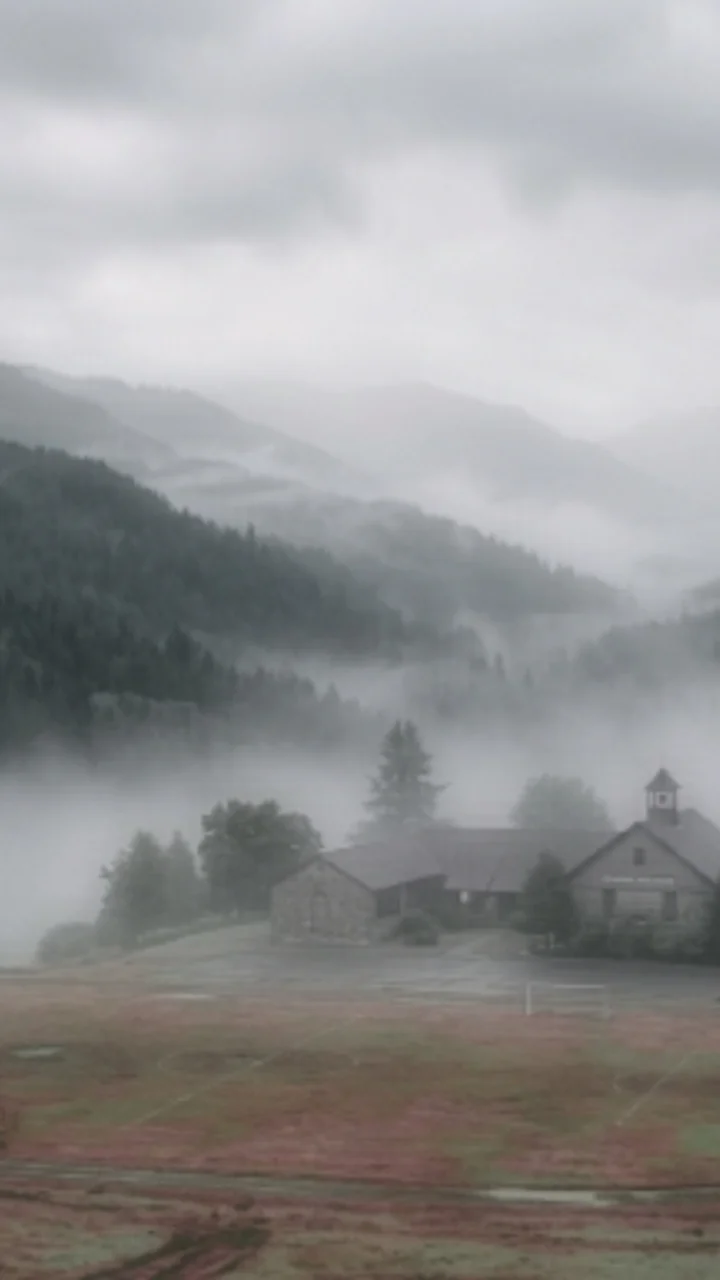
She moved to the window and looked out. The fog had thickened, swallowing the courtyard, the lampposts, the distant shapes of the other buildings. The world had become a gray blur, edges dissolving into edges, and she couldn't tell where the school ended and the fog began.
She touched the clip in her hair. His fingers had been there. His warmth was still there.
She pulled it out and looked at it—the small plastic wings, the faint scratch on one edge where she'd dropped it a week ago. It was just a clip. It was just a thing. But when she looked at it, she saw his hands, his eyes, the way his voice had softened when he'd said her name.
She put it back in her hair.
Then she crossed to the poster on the wall and peeled back the corner. The words she'd carved were still there, rough and raw in the plaster:
*I wanted it to be real.*
She stared at them for a long moment. Then she picked up the physics book from her desk, opened it to page forty-three, and read the note again.
*The pendulum always returns to equilibrium. But the equilibrium is not the truth. The truth is the swing.*
The words blurred. She blinked, and the blur didn't clear. The room felt like it was tilting, the walls breathing, the ceiling crack shifting above her like a web reweaving itself.
She closed the book and pressed it to her chest, feeling the worn leather against her sternum, the weight of his hands still pressed into the pages.
She was still holding it when she lay down. Still holding it when the radiator's hiss softened into something almost like breathing. Still holding it when the fog pressed against the window, gray and patient, waiting for the glass to give.
The ceiling crack was a web. The web was a map. The map led somewhere she couldn't see, but she could feel it pulling, a low current running through the floorboards, through the walls, through the small warm weight of the book against her chest.
She closed her eyes.
The fog was inside her now. She could feel it, gray and soft, filling the spaces where certainty used to live. She couldn't tell anymore what was real and what was warmth, what was a trap and what was a sanctuary, what was his hands on her face and what was just the memory of them, replaying itself in the dark.
The pendulum swung. She felt it, the long arc of it, carrying her somewhere she couldn't name.
She let it carry her.
She woke to a world that had rearranged itself while she slept.
The light through the window was wrong—not the gray pre-dawn she expected, but a thick, amber glow that turned the room the color of old honey. The radiator was silent. The air was still. The ceiling crack above her bed had changed shape again, the web of lines now forming something that looked almost like a hand, fingers outstretched, reaching down toward where she lay.
She sat up slowly, the physics book sliding off her chest and onto the mattress. Page forty-three had left a faint crease in her skin, a pale line across her sternum like a scar she didn't remember earning.
The butterfly clip was still in her hair.
She hadn't—she reached up, fingers finding the small plastic wings. She'd put it back in before lying down. She remembered that. But the angle was wrong now. It sat higher, tilted differently, like someone had adjusted it while she slept.
The room was quiet. Too quiet. The kind of quiet that has a texture, a weight, like the air itself was holding its breath.
She stood, and the floorboards felt different under her feet—smoother, worn in different places. The path from bed to door had been worn by her own steps for months, a groove she knew by heart. But now the wear was on the other side, near the window, as if someone else had been pacing there in the dark.
She crossed to the window and looked out.
The courtyard was gone.
Not fogged over—gone. Where the cobblestone paths and bare winter trees should have been, there was only a flat expanse of gray, stretching to a horizon that didn't exist. The lampposts had vanished. The distant buildings had dissolved. The world had become a single smooth surface, like a photograph that had been wiped clean except for the one figure standing at its center.
Professor Althor stood in the middle of the nothing, looking up at her window.
He was too far away to see clearly, but she could feel his gaze—a pressure against her skin, warm and patient. He raised one hand, slowly, and waved.
She stepped back from the window. Her heel hit the bedframe, and she stumbled, catching herself on the desk. The physics book was there, open to page forty-three, though she'd left it closed on the mattress. The note in the margin had changed.
*The pendulum always returns to equilibrium. But the equilibrium is not the truth. The truth is the swing.*
Below it, in the same looping handwriting, a new line:
*Where are you swinging, Clara?*
She slammed the book shut. The sound was too loud in the quiet room, a crack that seemed to echo off the walls. She stood there, breathing hard, the book under her hand, the clip in her hair, the window at her back showing a world that had stopped being the world.
She didn't remember dressing. She didn't remember leaving the room. But suddenly she was in the hallway, the door closed behind her, her boots on the cold floorboards, and the corridor stretched out before her longer than it should have been, the walls leaning in slightly at the top, like a tunnel narrowing toward something.
The fluorescent lights were on. That was wrong too. They buzzed overhead, but the light they cast was warm, amber, the color of the glow that had filled her room. The fog had receded to the far windows, pressed against the glass like faces.
She started walking.
The doors along the corridor sat at angles that didn't match the walls—she'd noticed that last night, but now she saw it clearly. Each door was slightly off, tilted a few degrees one way or the other, like the whole hall had been assembled by hands that didn't quite understand right angles. The numbers were wrong too: 214, 217, 203, repeating, skipping, doubling back on themselves.
She stopped at a door that should have been the stairwell. The sign on it read *STORAGE* in letters that looked freshly painted. She reached for the handle, and the door swung open before she touched it.
The room beyond was her physics classroom.
But it wasn't. The desks were there, the chalkboard was there, the tall windows with their fogged glass—but everything was reversed, mirrored, like she'd stepped through a looking glass. The chalkboard was covered in equations she didn't recognize, symbols that looked almost like letters but weren't, arranged in rows that seemed to breathe.
At the front of the room, a figure sat on the edge of the desk, legs crossed, hands folded in his lap.
Professor Althor.
He smiled when he saw her, and the smile was the same—warm, patient, the smile of a man who had all the time in the world and wanted to spend it on her. But his eyes were the wrong color. In the amber light, they looked almost black.
"You found it," he said. "I knew you would."
"Found what?" Her voice came out steady. She was proud of that.
"The door." He gestured at the room around them. "Most people never find it. They walk past it a hundred times, a thousand times, and they never see it. But you—" He tilted his head, studying her. "You've always been good at seeing what's hidden."
She took a step back. The door was still open behind her, the hallway visible beyond it, but the hallway looked different now too—dimmer, the lights flickering, the walls curving.
"This isn't real," she said. It came out as a question.
"Isn't it?" He stood, and the movement was unhurried, unhurried like everything he did. "What's real, Clara? The walls you can touch? The floor under your feet? I could tell you this room is real, and you'd have no way to prove I'm wrong. You could touch the desk, feel the wood, smell the chalk dust—and still, you wouldn't know."
He walked toward her, and she walked backward, matching his pace, keeping the distance between them constant.
"The fog does that," he said. "It gets inside you. It fills the spaces where certainty used to live. And once it's in, you can't get it out. You can't tell anymore what's real and what's just—" He spread his hands. "Warmth."
Her back hit the doorframe. She hadn't realized she'd reached it. The hallway was behind her, but she wasn't sure it would hold her.
"Why are you doing this?" The words came out cracked, the way they had last night. "Why are you in my head? Why are you—"
"I'm not in your head, Clara." He stopped a few feet away, close enough that she could see the faint stubble on his jaw, the small pulse at his throat. "I'm in the room with you. I'm in the school with you. I'm in the fog with you." He tilted his head again, and his smile deepened, softened, became something almost unbearably kind. "I've been in the fog with you since the day you arrived. I've been waiting for you to notice."
She wanted to run. She wanted to close the door. She wanted to wake up in her own bed, in her own room, with the ceiling crack a map of somewhere else and the radiator hissing like something breathing.
But she couldn't tell anymore which of those was the dream.
"I have to go," she said. "I have to—"
"Go where?" He didn't move. He didn't need to. "The cafeteria? It's not there anymore. The library? It's been gone for days. The dormitory?" He gestured back at the door behind her. "Go ahead. Look."
She turned. She couldn't help it.
The hallway beyond the door was empty. Not just empty of people—empty of everything. The walls had dissolved into gray, the floor fading into nothing a few feet past the threshold. There was no dormitory. There was no corridor. There was only the fog, patient and gray, waiting for her to step into it.
"Where is it?" she whispered.
"Where is what?"
"The school. The—" She turned back to him, and the room had changed again. The desks were gone. The chalkboard was gone. The windows were gone. It was just the two of them now, standing in a space that could have been anywhere, the amber light coming from no source she could identify.
"The school is where it's always been," Althor said. "Right here. With me."
He reached out, his hand open, palm up, an invitation.
"Come," he said. "Let me show you."
The fog was inside her. She could feel it, gray and soft, filling the spaces where certainty used to live. She couldn't tell anymore what was real and what was warmth, what was a trap and what was a sanctuary, what was his hand reaching for her and what was just the memory of it, replaying itself in the dark.
She reached out.
His fingers closed around hers, warm and solid, and the world snapped back into focus.
She was in her dormitory room. The radiator clanked. The window showed gray fog. The ceiling crack was a map of somewhere else, a river delta, a branching road. The butterfly clip was in her hair, and the physics book was closed on the desk, exactly where she'd left it.
Althor was gone.
There was no sign he'd ever been there—no dent in the mattress, no warmth in the air, no lingering smell of his office. Just the book on the desk, and the clip in her hair, and the faint, fading memory of a hand holding hers in a room that didn't exist.
She crossed to the desk and opened the book to page forty-three.
The note was still there, in his handwriting:
*The pendulum always returns to equilibrium. But the equilibrium is not the truth. The truth is the swing.*
She read it three times. Four times. The words stayed the same.
Below it, the new line was gone.
Or—she turned the page, and there it was, on page forty-four, in the same looping hand:
*Where are you swinging, Clara?*
She closed the book. She pressed it to her chest, feeling the worn leather against her sternum, the weight of his hands still pressed into the pages.
The fog pressed against the window, gray and patient.
And in the dark of her own room, Clara couldn't tell if she was awake or still dreaming, couldn't tell if the warmth she felt was real or just the memory of it, couldn't tell if the hand that had held hers belonged to a man or to the fog itself.
She put the book on the nightstand. She lay down.
The ceiling crack was a web. The web was a map. The map led somewhere she couldn't see.
She closed her eyes, and the pendulum swung, and she let it carry her.