
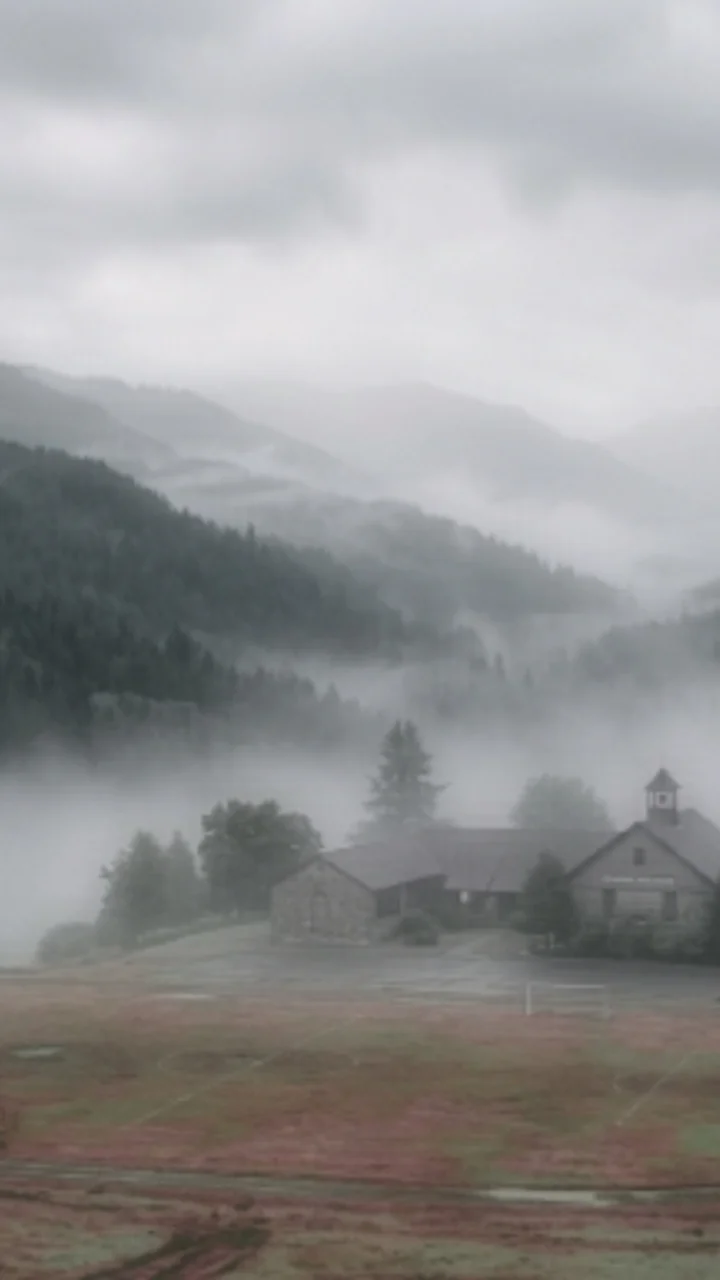
The fog didn't lift. It seeped into the stone of Winter’s Gentle Keep, a permanent, damp exhale that blurred the edges of the world. Clara walked the fluorescent hallway toward breakfast, the lights overhead buzzing and flickering, casting a sickly, intermittent glow on the polished linoleum. Her own reflection in the dark windows was a ghost smeared against the endless white beyond.
The cafeteria was a cathedral of noise and steam. Long tables, scarred by generations of cutlery, were islands in the haze rising from the industrial kitchen. The air smelled of overcooked porridge, weak tea, and the cloying sweetness of jam. Girls in identical grey uniforms moved in a murmuring tide, their voices a low hum of exhaustion and whispered gossip.
Clara took a tray. The metal was cold. She observed.
Miss Harpy stood sentry by the milk urns, her posture a rigid exclamation point. Her eyes, sharp as tacks, scanned the room. She watched a first-year fumble a spoon. The girl flinched, porridge slopping onto the table. Harpy’s lips tightened, not in anger, but in a kind of cold, satisfied recognition. She didn’t move to help. She simply watched the girl’s cheeks flush with shame, the frantic, clumsy mopping with a napkin. The suffering was the point. It proved the system worked.
At the faculty table, the division was a silent play. The female teachers—Harpy, Croft when she deigned to appear, the others—sat upright, eating in brisk, efficient bites. They spoke little, their conversations sharp and administrative. A wall of black wool and starched collars.
Across from them, the male teachers were a study in warm contrast. Professor Finch, in his tan cardigan, laughed softly at something, his eyes crinkling. He passed a basket of toast to Professor Wilson, who accepted it with a paternal nod. Their corner of the table seemed softer, bathed in the yellow light from the high, fogged windows. It smelled of bergamot and pipe tobacco, a scent that cut through the cafeteria grease. It felt like a hearth. A safe, warm hearth.
Clara’s stomach turned. She saw Finch lean over to a passing student, a second-year with red-rimmed eyes. He didn’t touch her. He simply said something, his voice too low to hear. The girl’s tense shoulders dropped a fraction. A grateful, fragile smile touched her lips before she hurried on. A kindness. A palpable, warming kindness.
From the staff table, Miss Harpy watched this exchange too. Her gaze flicked from Finch’s gentle smile to the girl’s retreating back. There was no suspicion in her look. Only a faint, dismissive annoyance, as if the girl’s vulnerability and the man’s comfort were both equally tedious, predictable parts of the morning routine. She saw it. She registered it. And she chose to see nothing wrong.
Clara found an empty spot at a table, the wood sticky with old syrup. She traced the grain with a fingertip, her porridge cooling. The warmth from the male teachers’ corner was a physical pressure against her skin, so at odds with the chill of the women’s disregard. It was the perfect trap. Who would you run from? Who would you run toward?
The answer was a heartbeat in the fog. You would run toward the warmth. Every time.
A shadow fell across her tray. Clara didn’t need to look up to know the scent—lemon polish, starch, and something antiseptic.
“Miss Vance.”
Headmistress Croft’s voice was a scalpel, clean and cold. Clara lifted her eyes. The woman stood imposingly close, her wire-rimmed glasses reflecting the flickering fluorescent tubes, turning her eyes into blank discs of light.
“Your appearance at morning assembly was acceptable.” The words were not a compliment. They were an assessment, filed away. “I trust your… evening studies were productive.”
Clara’s blood went still. She kept her face carefully blank, the image of Althor’s note burning behind her eyes. *Look disheveled. For your own safety.* She had performed. Croft had witnessed it. And now she was collecting the evidence.
“They were, Headmistress.” Clara’s voice was quiet, perfectly measured.
Croft’s gaze lingered on Clara’s face, then dropped to her neck, her rumpled collar. It was a clinical inspection. She was not looking for signs of distress, but for signs of the story—the story the school required. Her lips thinned in what might have been approval. “See that they remain so. The fog makes girls languid. Discipline is the only compass.”
She didn’t wait for a reply. She turned, her black skirt a sharp whisper against the table leg, and walked away, her heels clicking a precise, retreating rhythm on the floor. She passed the faculty table. She did not look at the warm, laughing men. She acknowledged the other women with a slight, shared nod—a communion of willful blindness.
Clara released the breath she’d been holding. Her hand trembled slightly around her spoon. The porridge was cold glue now. The comforting smell of bergamot from across the room suddenly felt thick, suffocating. It was the smell of the trap. And the harsh, lemon scent of the Headmistress was the lock.
Outside the tall windows, the fog pressed close, swallowing the distant pines. The world was reduced to this: the flickering light, the cold tray, the warmth that hid the rot, and the harshness that guarded it. Clara sat in the heart of the pause, listening to the twin heartbeats of the Keep—one soft and beckoning, the other cold and exacting—and knew, with a dread that was utterly calm, that they beat in time.
The thought arrived not as a question, but as a cold fact, settling into the space Croft’s departure had left. Clara stared at the congealed porridge. This was a boarding school. Far from home. Her home. The one she’d been sent away from because a husband found a bold, knife-carrying daughter inconvenient. Was that the common thread? Were all these grey-uniformed girls exiles, too? Cast-offs from families that found them difficult, or loud, or simply in the way?
Or were some of them just… normal? Sent here for the prestigious, fog-shrouded education the brochures promised? The possibility felt naive. The Keep didn’t feel like a place for the wanted.
She couldn’t run. The realization was as solid as the stone walls. Where would she go? Back to the mother who chose a man’s comfort over her daughter’s safety? The fog outside wasn’t a weather pattern. It was the boundary of the world.
The female teachers. Clara watched Miss Harpy’s cold surveillance from across the room. It wasn’t just the rules. It was the neglect that wore a uniform. The deliberate overlooking of a spill, a tear, a tremble. It was the same clinical disregard her mother had perfected on those days Clara was sick, feverish and vomiting, and the silence from the master bedroom was a louder punishment than any shout. The harshness here was familiar. It was home, institutionalized.
But the male teachers…
Her eyes drifted back to the warm corner. Professor Wilson was telling a story, his hands moving in gentle arcs. A circle of younger students near his end of the table listened, their faces soft with attention. He was nothing like her father. Her father’s anger was a sudden, hot thing—a slammed door, a shattered plate. It was over as quickly as it began, leaving a different kind of silence.
This was different. This warmth was constant. This gentleness was a policy. Finch’s cardigan, Althor’s quiet voice, Wilson’s sexy smile—they offered a sanctuary her father never had. A heavenly better. The thought curdled in her stomach. Was it worse? To be broken by something soft? To be unraveled by a hand that stroked your hair while it led you deeper into the fog?
A clatter of trays broke her reverie. The breakfast period was ending. Girls stood in a rustle of wool and a scrape of benches. Clara rose with them, her limbs stiff. She left her full tray on the conveyor, the cold porridge a testament to her paralysis.
The hallway was a river of grey, flowing toward first period. Clara let herself be carried, her mind adrift. She passed the open door of a dimly lit classroom. Inside, a single desk lamp cast a pool of buttery light on worn wood. The smell of old paper and beeswax drifted out. It was Professor Althor’s room, empty now. A sanctuary. A stage.
Further down, the harsh fluorescent buzz of the math wing intensified. Miss Harpy’s voice, sharp as a ruler’s edge, sliced from a doorway. “That is incorrect, Emily. Careless. You will remain after class to correct every problem.” No explanation. Just the verdict. A girl inside sniffled, a wet, hopeless sound. Clara quickened her pace.
She turned a corner into a quieter corridor, one lined with portraits of severe-looking founders. The air here was cooler, damper. A single, flickering bulb at the far end stuttered, casting the hall into a pulsating gloom. From a shadowed alcove, she heard a low, melodic murmur.
Peering cautiously, she saw Professor Finch. He was leaning against the wall, and before him stood the same red-eyed second-year from the cafeteria. He wasn’t touching her. He held a clean, folded handkerchief in his outstretched hand.
“It’s alright, Moira,” he was saying, his voice a soft blanket in the damp air. “The morning fog makes everything feel heavier, doesn’t it? Here.”
The girl, Moira, took the handkerchief with trembling fingers. She didn’t use it. She just clutched it, a white flag of surrender. “I miss my dog,” she whispered, the confession torn from her.
“Of course you do,” Finch said, his head tilting with infinite understanding. “He’s a piece of your heart, left at home. It’s a noble pain to carry.” His words didn’t dismiss; they sanctified her sadness, made it a precious thing only he could witness. “My door is always open, Moira. For tea. For quiet. Whenever the weight is too much.”
Clara watched, frozen. It was perfect. It was the exact kindness a homesick, neglected girl would starve for. It was also a transaction. He took her confession and gave her a sacred, shared secret in return. The warmth was real. The trap within it was realer.
She slipped away before they noticed her, her heart a frantic drum against her ribs. The contrast was the engine of the place. The female teachers created the vacuum—the cold, the shame, the isolation. The male teachers filled it—with warmth, with absolution, with a focused, fatherly attention that felt like the only sun in a frozen world.
Clara found herself at a tall, lead-paned window overlooking the inner courtyard. The fog was so thick the opposite wing was just a grey suggestion. Droplets condensed and trailed down the glass like slow tears. She traced one with a fingertip, the cold pane a shock against her skin.
She was not like Moira. She saw the mechanism. But understanding it didn’t make her immune. The loneliness here was a physical ache, a cold bed, a silent meal. Althor’s arms around her last night, his heartbeat against her ear—that had been a shelter. A real one. Even knowing his arousal, his guilt, the performance of it all, the memory of that shelter held a devastating warmth. That was the true sinister rot. It made you complicit in your own capture. It made you long for the very hand that locked the door.
Outside, a figure materialized from the fog, becoming solid only a few feet from the window. It was Headmistress Croft, taking a brisk, solitary turn of the courtyard. Her black coat was a slash in the white, her pace unvarying. She passed a stone bench where a younger female teacher sat hunched, clearly upset. Croft did not pause. She did not alter her course. She offered the woman the same precise, surgical disregard she offered the girls. The ecosystem demanded it. Suffering, in all its forms, was merely atmospheric.
Clara rested her forehead against the cold glass. The twin heartbeats thrummed through the stone. The harsh, metronomic click of Croft’s heels on the flagstones outside. The deep, silent, beckoning warmth radiating from the staff wing at her back. She was suspended between them, in the long, terrible pause where a heart decides who to trust. The answer, she knew, was the most terrifying part. You would always, always choose the warmth. Even as it burned you alive.