
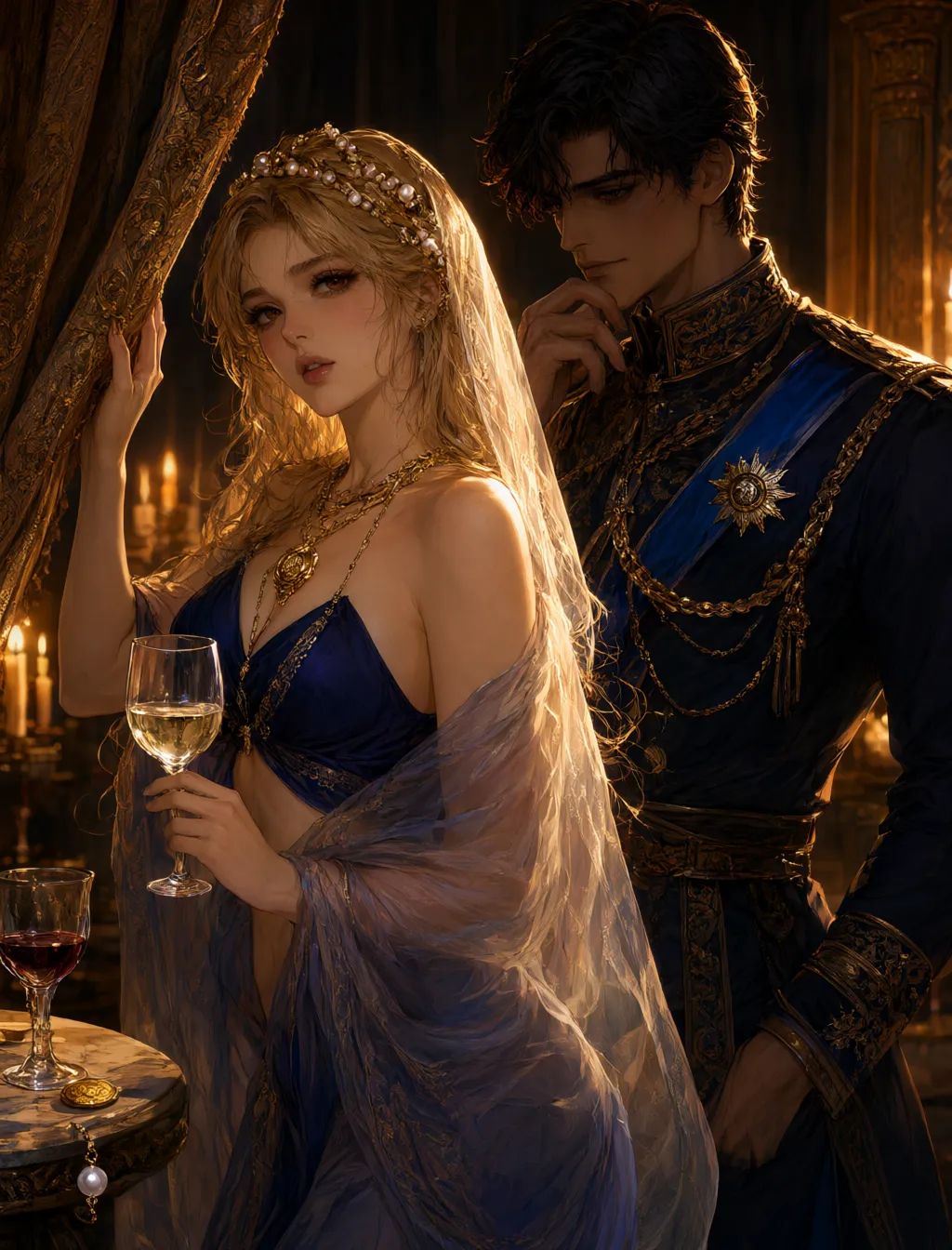
Darius bowed low, his midnight uniform catching the torchlight, the golden filigree on his collar glinting like captured fire. The marble floor beneath his boots was cold—Egyptian marble, always cold, even in the heat of the day. He held the bow long enough to signal respect, then straightened with the measured grace of a man who had performed this ritual a thousand times.
Before him, the Pharaoh sat on his throne—a tired man in a linen robe, his bare arms corded with old muscle, a collar of lapis and gold lying heavy on his chest. His eyes were half-lidded, but Darius had watched him move once, in the training yard. That slowness was a lie.
King Ashur Suren, Darius's father, stood beside him in full ceremonial armor—bronze scaled, lion-pelt-edged, his beard oiled and braided with gold wire. A warrior king who wore his power like a second skin.
Flanking the throne, Egyptian courtiers lounged in their loose shendyts and open linen chest-wraps, their skin oiled and gleaming, scars catching the light like medals. Every one of them had killed. And every one of them was watching him with the flat, measuring gaze of men deciding whether he was worth the trouble.
"Rise, Prince Darius." The Pharaoh's voice was dry, like old papyrus. "You've been on your feet long enough."
Darius rose fully, letting his gaze sweep the hall once before settling on his father. Ashur gave a slight nod—approval, or the absence of disapproval.
To his right stood Lord Xerxis, a broad-shouldered Persian noble with a silver-streaked beard and the heavy jaw of a man who had never lost a debate. To his left, two younger princes—his brothers, Cyaxares and Pharnavaz—and three princesses, including his sister Roxane, who met his eyes with the sharp, knowing smile of someone who saw too much.
They had all traveled for this. To seal the treaty. To see him married.
And to decide how quickly Egypt would fall.
"The barge is ready for the transport," Xerxis said, his voice carrying. "If the arrangements are acceptable to His Radiance, Prince Darius will depart with his bride at first light tomorrow."
Tomorrow.
The word landed in Darius's chest like a stone. He kept his face still, his hands loose at his sides.
The Pharaoh lifted a hand, gestured vaguely. "The princess is fond of her chambers. She may wish to delay."
"We have prepared chambers for her in Persepolis," Roxane said smoothly, stepping forward. Her gown was the color of wine, her dark hair coiled with strings of pearls. "She will find them suitable, I assure you. Gold leaf, silk, enough wine to fill a bath."
Darius's ear burned. He didn't know why—it was a normal statement, a diplomatic courtesy. But the mention of wine. The mention of her. The image of her rising from his lap, honey-gold hair swinging, that dreamy smile—
"Prince Darius." Cyaxares's voice cut through. "You look pale. Has the Egyptian sun tired you?"
Darius met his brother's gaze. Cyaxares was shorter, broader, with a scar through his left eyebrow that made him look perpetually skeptical. He was grinning now.
"I am not tired." Darius's voice came out flat. "I was listening."
"Listening," Pharnavaz repeated, the youngest at twenty, with the same dark hair and the same hooded eyes, but no controlled stillness—he fidgeted, shifted his weight, let his attention wander. "Listening to what? The ventilation?"
"To the arrangement," Darius said.
"The arrangement," Ashur said, stepping forward, "is not yet final." He turned to the Pharaoh. "Your Majesty. My son has been received with great honor. The marriage is consummated in name—"
"—it is not consummated," Darius said, the words out before he could stop them.
Silence.
The Pharaoh's eyes opened a fraction wider. Xerxis coughed. Roxane's grin sharpened.
Ashur turned to him slowly. "Prince Darius?"
Darius's jaw tightened. "The marriage was sealed by ceremony and witness, not by—" He stopped. The word *bed* would not leave his mouth. Not here. Not with his father watching. Not with the memory of her falling asleep in his arms, her breath warm on his collarbone, the weight of her body against his chest.
"It is sealed," he said instead. "The treaty is signed. The alliance stands."
"Then there is no issue," Ashur said, but his eyes lingered a fraction too long.
Pharnavaz was clearly fighting a smile. Cyaxares wasn't fighting at all.
Darius wanted to leave. He wanted to walk out of this hall, find a sparring ring, and hit something until his head stopped feeling like a swarm of bees.
But he stayed.
"A ball," Roxane said, her voice light, rescuing the silence. "Before the princess departs. It would be a courtesy—a celebration of the union. Her Majesty is known for her love of entertainment."
"A ball," Ashur repeated, considering it. "Tonight?"
"If His Radiance permits." Roxane inclined her head toward the Pharaoh.
The old Pharaoh looked between them, his expression unreadable. "The princess will enjoy that. She has been… restless."
Something in the way he said it—restless—made Darius's skin prickle. He stared at the Pharaoh, searching for a second meaning, but the older man had already looked away, his gaze fixed on a spot above the doors.
"A ball is appropriate," Xerxis said. "It will give the court a chance to bid farewell to their princess. And it will give my men a chance to observe the Egyptian nobility at leisure."
Observe. Yes. That was the word of the day.
"Then it is decided," Ashur said, raising a hand. "The ball will be held at sunset. The princess will be prepared."
Darius's ears burned again. He could feel Roxane watching him—could feel her amusement radiating across the marble floor.
"Prince Darius," Roxane murmured, stepping close enough that her voice reached only him. "You have honey on your collar."
His hand went to his neck before he could stop it. She laughed—a low, knowing sound—and stepped away.
Ashur's eyes flicked to him. "Prince Darius. Your attention."
Darius straightened, dropping his hand. "Yes, Father."
"The harbor tariffs. Your morning meeting. Report."
Darius had prepared for this. He had read the documents, memorized the rates, cross-referenced the recent grain shipments. He opened his mouth to begin—and the taste of honey flooded his tongue.
Not real honey. Memory-honey. The sweetness of her fingers pressed to his lips, her laugh like wind through chimes, the way she had tilted her head and said *"Open up, master~."*
He had eaten everything she put in his mouth. Every bite. Because she had held it out to him, and his body had obeyed before his mind could intervene.
The silence stretched.
"Prince Darius." Xerxis's voice carried a warning edge.
Darius blinked, found himself staring at the wall, and forced his shoulders into alignment. "The harbor tariffs have been a source of friction between our kingdoms for the past three seasons. The Egyptian court has been charging—" He paused. "Charging a flat rate on Persian grain vessels, while Egyptian vessels are taxed on cargo weight alone."
"Correct," Ashur said. "And?"
"And the Pharaoh's ministers have offered to equalize the rates in exchange for reduced duties on Egyptian papyrus and linen at Persian ports." Darius's voice steadied as the familiar ground took hold. "It is an acceptable concession. Their papyrus is superior to ours, and the linen market in Persepolis is dominated by Greek imports—Egyptian linen would undercut them."
"The ministers," the Pharaoh said quietly, "have agreed to the equalization pending a trial period of six months."
Darius glanced at him. The old man looked tired. Not just old-tired—bone-tired. The kind of tired that came from years of fighting shadows.
"Three months," Darius said.
The Pharaoh's eyebrows rose a fraction.
"A trial period of three months," Darius repeated. "If both sides are satisfied, the agreement becomes permanent. If not, we renegotiate from a position of demonstrated cooperation rather than suspicion."
Beside him, Xerxis made a sound of approval—a low grunt—and Ashur's lips twitched in what might have been a smile.
"You have your father's head for numbers," Roxane said, not unkindly.
"And his mother's tongue," Pharnavaz added, earning a light smack on the back of his head from Cyaxares.
Darius ignored them. He was thinking about the harbor tariffs, but he was also thinking about her—about Kamilah, who had sat beside him at breakfast and dripped honey on his collar and pretended she didn't know what she was doing.
And he was thinking about the fact that she would leave Egypt tomorrow, and he would have to keep pretending he was merely a husband, and she would have to keep pretending she was merely a wife, and somewhere between the false smiles and the poisoned wine, one of them would break.
He did not know which one he was afraid of.
"The princess," Roxane said, as if reading his thoughts, "will need a wardrobe for the journey. I have taken the liberty of selecting silks from the royal stores—she may choose what pleases her."
"She has her own wardrobe," Darius said.
"She has an Egyptian wardrobe." Roxane's smile was gentle. "Persia is different. The winters are colder. The fabrics heavier."
Darius said nothing. He had not thought about winters. He had not thought about her shivering in his citadel.
The conversation shifted. Xerxis raised the matter of ambassadors, of military escorts, of the exact route the caravan would take. Darius listened, nodded, made the necessary sounds. But his mind was elsewhere.
Honey.
He could still taste it.
He would never admit that she had fed him until his plate was empty—that he, Darius Suren, cold-blooded military prince, had let a woman press bread to his lips like a child and had opened his mouth without thinking.
He would carry that shame to his grave. And he would carry the taste of that honey into every council meeting for the rest of his life.
"—Prince Darius."
Ashur's voice. Firm. Final.
Darius snapped his attention to his father.
"The ball," Ashur said, "will begin at sunset. You will attend. You will dance with your wife. You will smile."
"Yes, Father."
"And you will not allow yourself to be distracted."
Darius held his gaze. "I am not distracted."
Ashur studied him for a long moment. Then he turned back to the Pharaoh and said, "We are agreed, then. The tariffs. The ball. The departure at dawn."
The Pharaoh inclined his head. "It is done."
The courtiers stirred. The conversation broke into smaller fragments—voices overlapping, sandals scuffing on marble, the clink of wine cups being refilled. Darius stood in the center of it, hands clasped behind his back, and let the noise wash over him.
Tomorrow.
She would be his—truly his—in Persia, where the rules were his rules and the walls were his walls. He could watch her then. He could test her. He could catch her in whatever game she was playing.
But tonight, there was a ball.
And he would have to smile, and dance, and hold her hand, and pretend he did not feel the thrum of her pulse under his fingertips.
The honey was still on his lips.
He did not wipe it away.
Xerxis cleared his throat, a sound like grinding stone. "There is also the matter of the princess's attendants."
Darius turned, grateful for the interruption to his own thoughts. "Her attendants?"
"She will wish to bring her handmaidens. Personal servants. Perhaps a guard or two who have attended her since childhood." Xerxis's voice carried the weary patience of a man who had negotiated such details a hundred times. "The Pharaoh's ministers have requested that we allow her to retain her Egyptian household in Persepolis."
"That is not unusual," Roxane said, her tone carefully neutral. "A bride far from home. Familiar faces ease the transition."
Darius heard what she did not say. Familiar faces also carried messages. Reported back. Kept eyes open where Persian eyes would be closed.
"How many?" he asked.
Xerxis consulted a scroll. "The princess has requested twelve attendants, including her chief handmaiden, Nenna. Two guards who have served her family since her childhood. And a cook who knows her dietary restrictions."
Twelve. A small army of Egyptian eyes in his citadel.
"Approved," Ashur said before Darius could speak. "A gesture of goodwill. We are not barbarians who strip a bride of her comforts."
Darius pressed his tongue against his teeth. Of course his father would approve. Twelve attendants meant twelve sources of information. Twelve potential weaknesses. Twelve threads to pull when the time came.
But it also meant twelve pairs of eyes watching his every move, reporting back to the Pharaoh's court.
The game was already being played. He had simply not realized how many pieces were on the board.
"The princess," Pharnavaz said, his voice carrying a note of mischief, "is said to be very attached to her wine collection."
Cyaxares snorted. "Attached?"
"Devoted," Pharnavaz corrected. "I heard she has a dedicated chamber for it. Temperature-controlled. Guarded."
Darius's ear burned. He forced himself not to touch it.
"She is a connoisseur," Roxane said smoothly. "A noblewoman of taste. There is no shame in appreciating the fruits of one's homeland."
"She is a drunkard," one of the Egyptian ministers muttered—loud enough to carry, quiet enough to deny.
The Pharaoh's head turned, slow and deliberate. The minister went pale. The silence that followed was sharp as a blade.
"The princess," the Pharaoh said, his voice soft and utterly deadly, "has never embarrassed this court. She has never failed to represent Egypt with grace. And she has never—" He paused, letting the weight settle. "—been spoken of in such terms in my presence."
The minister bowed so low his forehead nearly touched the marble. "Forgive me, Your Radiance. I spoke without thought."
"See that you think before you speak in the future." The Pharaoh turned back to Ashur, the incident closed. "The princess's wine will travel with her. It is a gift from her mother's vineyard."
Darius filed that away. A vineyard. Her mother's. A detail that might mean nothing—or everything.
The conversation drifted to logistics—the number of camels, the route through the mountain passes, the placement of supply depots. Darius listened with half his attention, the other half still caught in the memory of her fingers pressing bread to his lips.
He had eaten from her hand like a tamed animal.
He had liked it.
The thought made his stomach turn. Not with disgust—with something worse. Something that felt dangerously close to wanting.
"Prince Darius."
He looked up. The Pharaoh was watching him, those half-lidded eyes sharp beneath the weight of age.
"Yes, Your Radiance?"
"You will treat my daughter with respect."
It was not a question. It was not a request.
Darius met his gaze. "I will treat her as my wife, Your Radiance. With all the honor that title demands."
The Pharaoh studied him for a long moment. Then, slowly, he nodded. "See that you do."
The audience was over.
Ashur inclined his head, a gesture of finality. Xerxis rolled his scroll. The courtiers began to disperse, their voices rising as the formal tension broke.
Darius stood in place, watching the Pharaoh rise from his throne with the careful, deliberate movements of a man who did not want to show he was in pain. The old king's hand pressed against the armrest as he stood, his knuckles white for just a moment before he straightened.
He was hiding something. An injury, an illness, a weakness.
Darius filed that away too.
Roxane appeared at his elbow, her wine-colored gown rustling against the marble. "You did well."
"Did I?"
"You didn't mention her once."
Darius looked at her. "Mention who?"
Roxane's smile was infuriating. "Exactly." She patted his arm—a sisterly gesture that carried more mockery than comfort. "The ball is in five hours. You should rest. You look like you've been wrestling a crocodile."
Darius said nothing. He watched her walk away, her steps light and confident, and felt the weight of the day settle onto his shoulders.
Five hours.
Then a ball.
Then a night of dancing with a woman who smiled like she had never had a thought in her life—and who he was beginning to suspect had more thoughts than he could count.
He turned and walked toward the corridor that led to his chambers. The marble was cold under his boots. The torches flickered. And somewhere in the palace, a woman with honey-gold hair was probably laughing at him.
He did not know why that thought made his chest tighten.
He did not want to know.