
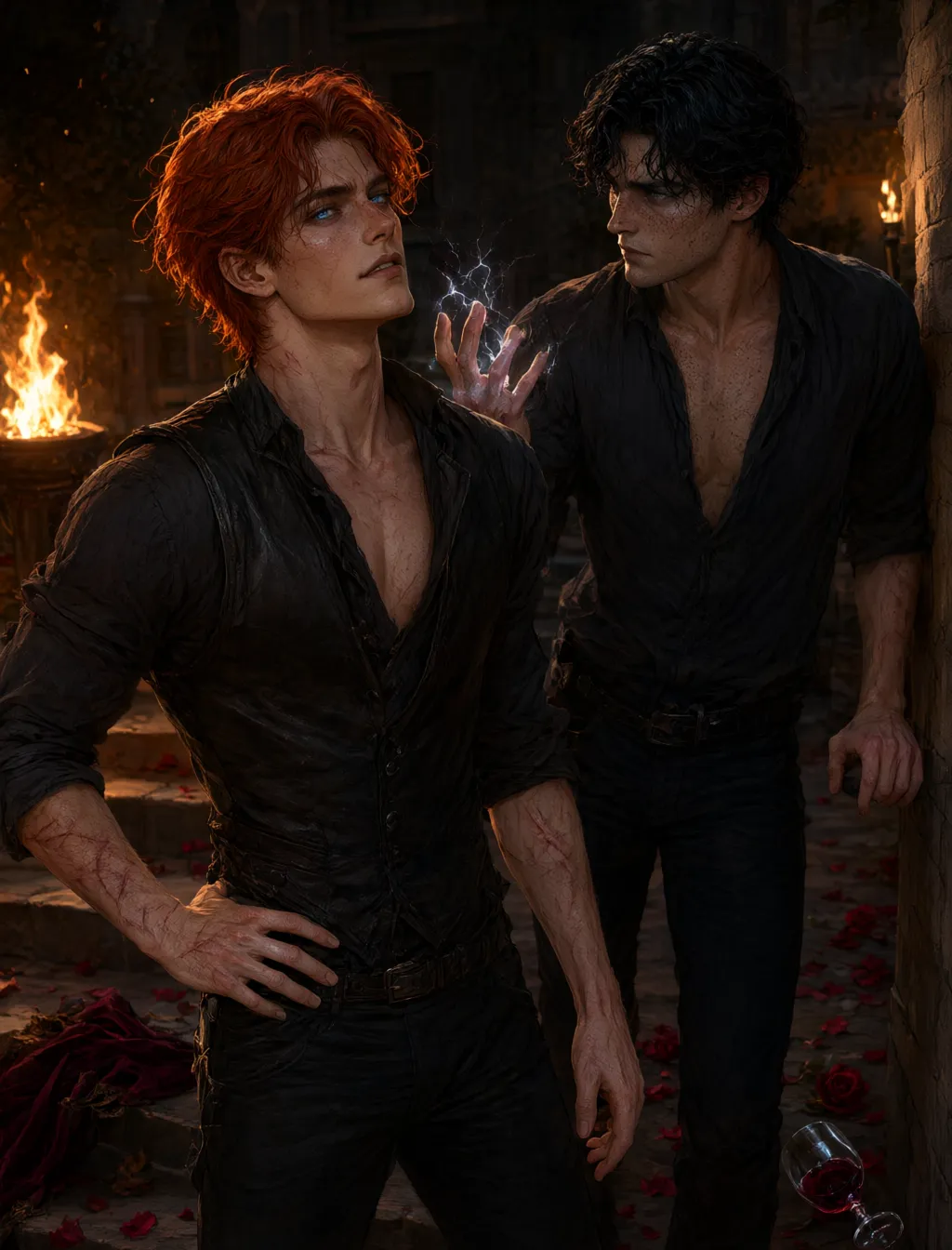
By the time Beck reached the tunnel mouth, the light had already changed. Dawn came up over the arena in a slow amber tide, catching the dust suspended in the passage and turning the air to something you could hold in your hand. The roar of the crowd rolled down the stone corridor like water finding a lower room — twenty thousand voices braided into a single animal sound, and under it the flat percussion of feet on wood, the ring of a judge's staff, the distant clatter of the final wagers being struck.
Beck stood in the shadow of the arch and let it wash over him.
The black tunic sat against his ribs like a second skin. Wool, close-woven, cut for a duelist's shoulders and tapered to the waist — his own from three seasons back, the one he'd worn the night he took the junior circuit at Halveth. The high collar climbed his throat and brushed the underside of his jaw when he moved. Under it, hidden, a single mark had been allowed to live.
He had done it himself, in the small hours, in the steam of the bathhouse. He'd held heat in his palm until the skin above his pulse-point went tender, and then he'd pressed his thumb there — not enough to burn, just enough to bloom. A bruise the color of a plum. He'd watched it darken in the bronze mirror, turning his head one way and then the other, and he had not been able to say out loud why he was doing it.
He knew, though. That was the problem.
His hand came up now, two fingers hooking the collar, easing it down a fraction. He didn't have to look. He knew exactly what was there — a dark crescent tucked beneath his ear, sitting where a lover's mouth would have left it, where Topher's mouth had left it, before Beck had burned the rest away and kept only this one.
He let the collar fall back into place.
The tunnel opened onto the arena floor, and Beck stepped into the light.
It hit him like a physical thing. The sand was pale and dry, raked into careful parallel lines by the groundskeeper at dawn — and there, off to the left, near the western pillar, a single smear of rust-brown still marked the stone at chest height. Nobody had washed it. Beck's eyes found it before his brain could stop them, and his stomach did something small and private.
He looked away.
Topher was already in the ring.
He stood at the far mark with his broadsword grounded point-down in the sand, both hands resting on the pommel, and he was not looking at the crowd. He was looking at the tunnel mouth. He had been looking at it for some time, Beck realized — long enough that the judges had begun exchanging glances, long enough that the crowd had started to notice the storm mage's stillness and had grown quieter for it.
Topher's hair was pulled back today. A leather thong at the nape, the curls escaping anyway at his temples. He wore the grey of the Stormhall, sleeveless, and the freckles across his shoulders stood out sharp against skin that had gone pale in the cold morning. Static lifted the fine hairs along his forearms in a slow, restless crawl. Beck could feel it from thirty feet away, the way you feel a storm before you see it — a pressure behind the eyes.
Topher's grey eyes came up and found him.
And stopped.
Not on his face. Not on the black wool, or the way it fit him, or the two daggers Beck had not yet summoned into his hands. Topher's gaze landed on Beck's throat and stayed there — fixed on the small triangle of skin just below his ear, the place where the collar had slipped, and where, if you knew what you were looking for, you could see the edge of something dark.
Beck held the look.
He didn't move. Didn't touch the collar. Didn't smile. He stood in the mouth of the tunnel with the crowd's noise breaking over him and let Christopher Jacobs stare at the one bruise he'd left that Beck had chosen to keep, and he watched the exact moment Topher understood what he was seeing.
Topher's jaw shifted. His hands tightened on the pommel of the broadsword — knuckles going white, then releasing, one finger at a time, deliberate, as if he were counting.
Beck reached up, slow, and eased the collar back into place.
He watched Topher's throat move.
Then he stepped out onto the sand, and the crowd found its voice again, and the judges' staffs struck the floor three times, and the duel for the title of Grand Archmage began.
Topher came in like weather.
He always did. Four years of sparring had taught Beck the shape of it — the storm mage's opening was never a feint, it was a commitment, a rolling front of pressure that wanted you to move first so it could read you. Beck sidestepped, daggers blooming to life in both hands, and let the broadsword carve the air where his ribs had been. The wind of it pulled at his sleeve. Static snapped across his forearms and made his burn scars prickle.
He answered with fire.
The daggers threw amber light across the sand as Beck spun inside Topher's guard, one blade sweeping high, the other driving low. Topher caught the high strike on the flat of his sword and took the low one on his forearm — a glancing hit that sizzled against the leather bracer and left a smell of scorched hide in the air. He didn't flinch. He never flinched.
"You're showing off," Topher said. Low, raspy, pitched under the crowd. "The judges don't care how pretty you look, Marlow."
"No," Beck said, and pivoted, and let a whip of flame curl off his off-hand dagger and lick past Topher's cheek. "But you do."
Topher's eyes went dark.
He came at Beck hard then — no more reading, no more patience. The broadsword swept in a flat arc and Beck dropped under it, rolled, came up inside the reach, and drove both daggers toward Topher's chest. Topher's boot caught him in the hip and sent him skidding across the sand on one shoulder. He rolled with it, came up on his knees, spat grit, and grinned.
The crowd roared. Somewhere in the upper stands, someone was shouting his name.
They circled.
The sand was already churned. Beck's breath came in controlled pulls — in through the nose, out through the mouth, the way Master Ivers had drilled into him at fourteen. His tunic was dark with sweat at the small of his back. Under the collar, the bruise sat against his skin like a coal, and every time he moved his head he could feel the wool shift against it, a small private friction that had nothing to do with the fight.
Topher was thinking about it. Beck could see it in the way his eyes kept flicking up — not to Beck's face, but to his throat, checking, confirming, the collar still high, the mark still hidden. He was fighting the duel with half his attention. That was a weakness. Beck should have pressed it.
Instead he slowed down.
He let Topher close the distance. Let the broadsword come in and let his own parry be a fraction late, so that the flat of the blade caught his shoulder and spun him, so that he had to throw his head back to keep his balance, so that the collar — just for a heartbeat — rode up off his throat and exposed the whole of the mark beneath his ear to the open air.
Topher saw it.
His next strike went wide. Not by much — a hand's width — but wide enough that Beck read it, and the crowd read it, and one of the judges made a small note on his tablet that Beck would have paid a great deal of money to read.
Beck righted himself. Tugged the collar down with two fingers, unhurried, the way a man adjusts his cuff. Looked at Topher across the sand and let his mouth curve.
Topher's chest was rising too fast. His grip on the broadsword had gone wrong — thumb riding high, the way it did when he was angry. Static crawled up the blade in blue-white threads.
"You did that on purpose," Topher said.
"Did what?"
"You know what."
Beck shrugged, and let the daggers gutter out in his hands — not extinguished, just banked, embers waiting. He walked a slow half-circle. Topher tracked him, blade grounded, and did not attack, and the crowd, sensing something they didn't have language for, went quiet in a slow wave from the front rows back.
"You told me to wear it," Beck said. "So I wore it."
"I told you to wear it so nobody would see —"
"So nobody would see what, Jacobs?"
Topher's mouth closed. His jaw worked once. He looked, for a moment, less like a duelist and more like a man standing in a doorway he hadn't meant to open.
Beck took the opening.
He came in fast and low, daggers flaring, and drove Topher back across the sand in a run of strikes that had the whole arena on its feet — high, low, cross, spin, the blades leaving trails of amber light in the morning air. Topher parried every one. Of course he did. But he was parrying on instinct now, his mind still caught on the bruise, and instinct alone wasn't going to hold against Beck when Beck was fighting the way he fought when he was angry, and he was angry, he realized — angry in the old way, the years-long way, the way that had nothing to do with the duel and everything to do with the fact that Topher had walked away last night and left him standing in the yard.
His last strike knocked the broadsword out of line. He stepped inside, hooked Topher's ankle, and put him on his back in the sand.
The daggers came down. One to the throat. One to the heart. The same position they'd frozen in a hundred times before, in a thousand training yards across four years, and every single one of those times Beck had held it and then stepped back and said something cutting and walked away.
He held it now.
The arena was silent. Twenty thousand people, and Beck could hear Topher breathing.
"Yield," Beck said.
Topher looked up at him. Sand in his hair. A thin line of blood at his temple where the flat of his own blade had caught him on the way down. His grey eyes were not on the daggers. They were on Beck's throat — on the collar, which had ridden up again, and on the small dark edge of the bruise just visible beneath his jaw.
"No," Topher said.
And then he moved.
Beck didn't see the hand. He felt it — Topher's palm flat against his sternum, a hard shove that sent him stumbling back two steps, daggers guttering. In that half-second Topher was up, sand spraying, and the broadsword was in his hand again and the whole arena was on its feet and screaming, and Beck had just enough time to think there he is before the flat of the blade caught him across the ribs and sent him down.
He hit the sand on his back. The daggers winked out. He got one elbow under himself, and then Topher was over him, boot planted beside his hip, blade at his throat, and the crowd was making a sound like the sea.
Topher leaned down. Close. Close enough that Beck could smell the ozone and the sweat and the cold morning air on him, close enough that the static in his hair lifted the fine ends of Beck's own and stood them on end.
"Nice try," Topher said, very quietly, under the noise. "But I saw it. I've been seeing it all morning."
Beck's pulse was in his throat.
"Then you know why I wore the collar," he said.
Topher's eyes dropped — down Beck's face, down his throat, to the place where the black wool sat high against his jaw. He didn't answer. He straightened, stepped back, and let the judges call it.
Beck lay in the sand for one more breath and stared up at the pale morning sky.
He had lost.
He had lost the duel, and the title, and four years of careful arithmetic, and he was not, he found, sorry about any of it.
The judges' verdict took longer than it should have. A disputed final exchange, a consultation at the scorer's table, the crowd's noise rising and falling like surf. Beck stood at his mark with sand in his hair and blood drying on his lip and watched Topher across the ring — watched him receive the ceremonial staff, watched him bow to the high table, watched him accept the title of Grand Archmage with the same flat, contained expression he'd worn through the entire match.
Then Topher turned and walked off the sand toward the champions' tunnel.
He didn't look back.
The crowd was still cheering. Beck's own second was already at his elbow, saying something about the judges, about a protest, about a rematch. Beck waved him off. He walked the other way — not toward the fighters' exit, but toward the narrow service passage that ran along the western wall, the one the groundskeeper used to haul sand and water and which let out behind the champions' tunnel, in the dark, where nobody went.
He wasn't sure why he was going. He told himself it was to rinse the blood off his mouth.
The passage was cool and narrow and smelled of wet stone. Beck made it ten paces before a hand closed around his arm and hauled him sideways into the dark.
His back hit the wall. Topher was on him — no broadsword now, no staff, just the grey tunic and the smell of ozone and the hard line of his forearm across Beck's chest, pinning him. In the low light his eyes were almost black. His breathing was ragged, and not from the duel.
"You wore it," Topher said.
"I wore it."
"You let me see it."
"I let you see it."
Topher's forearm pressed harder. Beck's pulse was going like a bird against his ribs. The passage was so narrow that Topher's knee had already found its way between his thighs, and neither of them had acknowledged it, and both of them knew.
"Why," Topher said. It wasn't a question. It came out of him like something under pressure.
Beck looked up at him. Red hair stuck to his own temple. His lip was split and he could taste copper. The black tunic was wet through at the back, and the collar sat high against his jaw, and under it the bruise was a coal he had carried all morning like a secret he was tired of keeping.
"Because you asked me to burn them off," Beck said, "and I burned all of them but one."
Topher went very still.
"Because I wanted you to know," Beck said, and his voice came out lower than he meant it to, "that I don't do everything you tell me."
Topher's hand came up. Slow. Two fingers hooked the high collar of Beck's tunic and drew it down, baring the throat — the long line of it, the pulse jumping under the skin, and the single dark bruise beneath his ear, plum-colored and unmistakable, sitting exactly where a mouth had put it.
He looked at it for a long moment.
Then he leaned in and put his mouth on it.
Not a kiss. A bite — teeth closing on the bruise, re-breaking it, and Beck's whole body arched off the wall with a sound he couldn't stop. Topher's free hand caught his hip and held him there, palm flat and hot through the wool, and his mouth worked the mark slow and deliberate, tongue flat against the ache, teeth returning, tongue again, until Beck's hands had found the back of Topher's neck and his breath had gone to pieces and the wall behind him was the only thing holding him up.
"There," Topher said against his throat. "Now it's a real mark."
Beck laughed — a wrecked, breathless sound — and dragged Topher's mouth up to his.
The kiss was nothing like the one in the training yard. That one had been a collapse, a dam giving way. This one was a decision. Topher kissed him like he was finishing a sentence he'd started four years ago, and Beck kissed him back like he intended to have the last word, and the service passage echoed with the wet sound of it and the far-off roar of the crowd still celebrating a duel that had stopped being the point somewhere around the second pass.
Topher's hand left Beck's hip and went to his belt.
"Here," Beck said against his mouth. Not a question.
"Here," Topher said. "Unless you'd rather wait for the banquet."
"Fuck the banquet."
"That's the spirit."
The belt came loose. Topher turned him — one hand on his shoulder, firm, unhurried — and Beck let himself be turned, palms flat against the cold stone, forehead down, the black tunic rucked up around his ribs. Behind him Topher's hands worked the laces at his waist with a competence that made Beck's knees feel unreliable, and then the wool was down around his thighs and the cool air of the passage was on his bare skin and he heard Topher's breath change.
"Look at you," Topher said. Quiet. Almost reverent, under the rasp.
Beck's forehead pressed harder into the stone. He could feel the shape of Topher behind him — the broad chest, the heat of him, the hard line of his cock through the grey wool, and the static crawling off him in little invisible waves that lifted every hair on Beck's nape.
Topher's hand slid down his spine. Slow. Fingers spread, mapping him — the ladder of his vertebrae, the dip at the small of his back, the swell of his ass — and then lower, between his thighs, and Beck heard himself make a sound he would deny later.
"You're wet," Topher said.
"I'm a fire mage. I run hot."
"That's not what this is."
His fingers came back slick. He pressed two of them against Beck's entrance, slow, circling, and Beck's whole body flinched toward him and then away, caught between the cold stone and the heat of the hand.
"Say it," Topher said.
"Say what."
"You know what."
Beck turned his head. Just enough to catch Topher's eye over his own shoulder — the wild black curls, the grey eyes gone almost black, the thin cut at his temple still weeping a thread of red. The title staff was somewhere on the other side of the wall. Twenty thousand people were cheering for this man. And he was standing in a service passage with two fingers pressed to Beck's ass, waiting.
"Fuck me," Beck said. "Or I'll find someone who will."
Topher's hand closed on the back of his neck.
Not hard. Just enough to hold him there, face to the stone, while Topher lined himself up and pushed in — slow, relentless, one long inch at a time, and Beck's mouth opened against the wall and no sound came out at all. The stretch burned. His fingers scrabbled at the stone for purchase, found none, curled into fists. Behind him Topher's breath came in a low, ragged rhythm, and his hand on Beck's neck was the only thing anchoring either of them.
"Breathe," Topher said.
"I'm fine —"
"Breathe, Beck."
Beck breathed. And on the exhale Topher sank the rest of the way in, hips flush against him, and the two of them stood there in the narrow dark and shook.
Then Topher moved.
The first thrust drove Beck up onto his toes. The second pulled a sound out of him that he didn't recognize. By the third he had stopped counting and had started meeting it — arching back into the stroke, taking Topher deeper, and the passage filled with the slap of skin and the wet sound of it and the low, broken cadence of Beck's own breathing, which he could not, for the life of him, control.
Topher's hand left his neck. Came around. Found the high collar of the black tunic, which had ridden up around Beck's throat, and hooked it — two fingers under the wool, drawing it down and holding it there, baring the whole side of Beck's throat and the dark, freshly-bitten mark beneath his ear.
"There it is," Topher said. His voice had gone to gravel. "That's what I wanted. All morning. That."
He thrust harder. Beck's cheek scraped the stone and he didn't care.
"Wanted to see it," Topher said, between strokes, "while I was inside you."
"You—" Beck's voice broke. "You could have just said —"
"Shut up, Marlow."
"Make me."
Topher's hand tightened on the collar and hauled Beck back against his chest, changing the angle, and whatever Beck had been about to say next came out as a long, low groan that echoed down the passage and probably, Beck thought distantly, out into the arena, where the crowd was still cheering for the man currently fucking him against a wall.
He didn't care. He was past caring. His cock was untouched, aching, leaking against the cold stone, and every thrust dragged him forward and back in a rhythm he couldn't control, and Topher's mouth was on his shoulder, teeth and tongue, biting down on the freckled skin like he was trying to leave a mark somewhere the collar wouldn't cover.
"Topher—"
"I know."
"I'm going to—"
"I know. Do it."
Beck came with his forehead against the wall and Topher's name in his mouth — a long, shuddering spill against the stone, his whole body locking, his ass clenching hard around Topher's cock. Behind him Topher made a sound like a man being hit and drove in twice more, deep and desperate, and then he was coming too, buried to the hilt, one hand still holding Beck's collar down and the other splayed flat across his hip, fingers digging in hard enough to leave bruises of their own.
For a moment there was no sound but their breathing and the distant crowd.
Then Topher pulled out. Slow. Beck felt it — the drag, the emptiness, the wet trickle down the inside of his thigh — and let his forehead rest against the stone while his legs remembered how to work. Behind him Topher was already fixing his belt, breathing hard, and Beck could hear the small, precise sounds of a man putting himself back together.
Beck straightened. Pulled his tunic up, laced it, smoothed the wool. His hands were not entirely steady. He turned around.
Topher stood two feet away in the dim light, hair in disarray, the cut at his temple still bleeding a thin line down his cheek. The ceremonial staff was propped somewhere out of sight. He looked at Beck for a long moment, and Beck looked back, and neither of them said anything.
Then Topher reached out. Two fingers, again — the same two fingers, hooking the collar of the black tunic, drawing it down one last time. He looked at the mark. The fresh bite on top of the old bruise, dark and unmistakable, sitting exactly where his mouth had put it.
He let the collar go.
"Keep it," he said.
Beck's jaw tightened. "Or what?"
"Or nothing." Topher turned toward the passage mouth, where the noise of the crowd was still spilling down the corridor. He stopped at the turn. Didn't look back. "You won the wager, Marlow. You said if you won, you'd ask me for something."
"I lost the duel."
"You lost the duel," Topher agreed, "but I came in my hand in the training yard last night thinking about your throat, and I came just now inside you, and the title's a piece of wood." He paused. "Ask."
Beck stood in the dark of the service passage with the mark freshly bitten into his neck and the taste of his own blood on his lip and the crowd still roaring somewhere above them, and he did not answer.
Topher waited three heartbeats. Then he shook his head, almost fondly, and walked out into the light.
Beck stayed where he was. He reached up, unhurried, and eased the collar back into place — high, neat, covering everything — and then he bent and picked up the small leather sheath he'd dropped on the sand somewhere in the second pass, and slid his daggers home, and followed.
He made it six paces.
The leather sheath was still warm from his hip when his thumb slid along its lip — a habit, the automatic check a duelist made before sheathing anything sharp. His knuckles brushed the stitching at the seam, and there, tucked flat against the inner curve where the leather had been folded and riveted, was a corner of paper. Not his. He knew every inch of this sheath. He'd bought it off a stall in the lower market when he was sixteen and had never once put anything in it but blades.
Beck stopped walking.
He worked the scrap loose with two fingers. It had been folded small and pushed deep, past the throat of the sheath, into the seam where the leather doubled back on itself — set there with the kind of care that meant it was meant to be found, but not by anyone watching.
The passage light was poor. He turned his shoulder to it and unfolded the paper.
Topher's handwriting. It was cramped and leftward-leaning, the letters pressed hard enough to ridge the paper on the back side — the hand of someone who wrote rarely and resented doing it.
He knew the words before he read them. Four years of watching that hand scratch out equations on slate, four years of the same cramped slant on the margins of shared lecture notes, and his body had learned the shape of it the way it had learned the shape of a sword arc — recognition arriving before thought.
He read it anyway.
I put this here three months ago. You never checked your sheath. You check everything else.
Beck's thumb went still on the fold.
The line sat there in the bad light, small and blunt, and beneath it, pressed harder, the pen having dug in on the final stroke —
If you find this before the Equinox, come find me. If you find it after, don't.
He read it twice. The second time his hand wasn't as steady as the first, and the paper moved against his fingers with a small dry rustle that sounded loud in the empty passage, and he had to press it flat against his palm to make it stop.
Three months. Three months ago they'd been in the archive together, arguing over the Meridian Codex, and Topher had walked him back through the lower corridors and stood too close at the stairwell and said nothing, and Beck had gone up to his room and lain awake cataloguing every reason the closeness meant nothing. Three months ago Topher had already written this. Had already folded it small and slid it into the seam of a sheath Beck wore every day, and then spent ninety days watching to see if he'd ever look.
Beck had not looked. Not once. He checked the blades, the edges, the buckles, the balance — he had never once checked the seam, because who checks the seam, because it was his sheath, because it had only ever held blades.
If you find this after, don't.
After the Equinox. After the duel. After tonight, which was after the Equinox, which meant the note had already expired somewhere between the moment he'd woken this morning and the moment he'd stopped walking six paces past the passage mouth.
He stood there with that.
Somewhere above and behind him the crowd noise was thinning — the ceremony breaking up, the great doors grinding, a few hundred people spilling out into the cloister and the night and their own beds. The service passage ran dark and narrow toward a side exit he'd used a hundred times to avoid exactly this kind of crowd. His daggers sat warm in the sheath against his hip. The mark at his throat sat under the collar, freshly bitten, still tender when he swallowed.
Topher had written come find me and then, when Beck had finally come to the training yard last night with fire in both hands, Topher had met him with a sword and not a word about any of it. Had fought him. Had kissed him. Had fucked him against a pillar and then walked away up the corridor telling him to keep a collar on.
He had the note in his hand and no idea what to do with the fact of it.
Beck folded it back along its creases — small, neat, the way it had come — and for a moment he simply held it, thumb over the ridge of the letters on the back side, feeling the pressure Topher's pen had left. Then he pressed it flat against his chest, over the wool of the black tunic, and stood very still, and let out one slow breath through his nose.
He looked down the passage.
Past the turn, the light was brighter — the corridor mouth opening onto the arena floor, where the torches were still burning and the sand was still churned and somewhere out past all of it Topher had walked into the crowd and become, again, the storm mage who'd lost a duel and won a title and told Beck Marlow to keep a collar on. The distance between here and there was maybe forty paces. Beck could close it in ten seconds.
He didn't move.
Because the note said after, and it was after, and Topher had already been told no — had stood in the dark of the service passage with his hand on Beck's collar and asked him to ask, and Beck had said nothing, three heartbeats, nothing, and Topher had shaken his head and walked out into the light. The door was closed. Beck had watched him close it.
He tucked the note into his collar instead — not the sheath, not a pocket, but up under the high black wool, flat against the skin of his throat, right over the place where the bite was. The paper was cool for a second and then it wasn't. He could feel the corner of it at his pulse.
Then he walked on.
He took the side exit, the one that let out behind the north buttress, and the night air hit him all at once — cold, clean, no ozone in it — and he stood on the flagstones with his hand still half-raised to the door and breathed it in. Above him the sky was clear. No storm gathering. Whatever Topher had brought with him into the arena tonight, he'd taken it back out with him.
Beck's own rooms were across the quad. He crossed the lawn with his daggers warm at his hip and the note a small hard square against his collarbone, and he did not look back at the arena, and he did not look up at the tower windows where the Archmage's new chambers would be lit, and he did not think about any of it in any way that would have survived being said out loud.
His door was unlocked, the way he'd left it. Inside, the fire in the grate had burned down to a low amber bed, and his desk was exactly as he'd left it — the Meridian Codex open to the third theorem, a cold cup of tea at the corner, three quills laid out in a row because he was the kind of man who laid his quills out in a row. Everything in its place. Everything accounted for.
He shut the door behind him and stood in the dark of his own room with his back against it.
Then he reached up and worked the note out of his collar and unfolded it again in the firelight, and read the two lines a third time, and this time his hand was steady, and this time he let himself look at the second line the way he'd been avoiding looking at it since the passage.
If you find this after, don't.
Ninety days. He'd had the answer to a question he'd never let himself ask, sitting in the seam of his own sheath, and he'd walked past it every morning and never once put his thumb along the rivets because he knew every inch of the thing and the seam was not an inch of it that mattered.
Topher had known that. Topher had counted on it. Topher had put the note where Beck would never look and then spent three months waiting to find out whether he ever would, and last night in the training yard he'd held a blade to Beck's throat and said yield, and this afternoon in the ring he'd beaten him in front of the whole academy, and tonight in the passage he'd asked him to ask and Beck had said nothing.
Beck crossed to the desk. He laid the note down flat beside the Codex, crease-side up, and looked at it for a moment, and then he picked up the cold tea and drank it anyway, because it was there and his throat was dry and the alternative was standing in his own room doing nothing at all.
The tea was terrible. He finished it.
Then he sat down in the chair, and pulled the Codex toward him, and did not turn a single page of it — just sat with his hands flat on the open book and his eyes on the note at the corner of the desk, firelight moving across the cramped, leftward-leaning letters, and let the room be quiet around him.
At some point the fire settled, and the note was still there, and Beck was still sitting there, and the hour was very late, and tomorrow the academy would wake up with a new Grand Archmage and a whole day of ordinary lessons, and the note would still say don't, and he would still be the man who had found it after.
He reached out and turned the note over, face down, on the desk.
Then he stood, and banked the fire, and went to bed with his daggers on the chair beside him and the mark at his throat still under his collar, unhealed, exactly where Topher had left it.
The chair creaked when he sat back down. He hadn't meant to sit back down.
His daggers were on the table now, both of them, pulled from the sheath and laid parallel with the points toward the window, which was not where they went. They went on the chair. He'd put them on the chair ten minutes ago and now they were on the table and he didn't remember the interval.
He picked up the sheath instead.
It was a plain thing. Dark leather gone soft at the throat from four years of the same two blades going in and out, a brass rivet at the top where the strap met the belt loop, and the seam — the seam he'd walked past every morning since he was sixteen — running the length of the inner curve in a line of tight, even stitches. He turned it over in the firelight. The leather on the inner face had taken a darker polish than the outside, rubbed smooth by the pressure of his hip against his tunic, and along that polished strip, just above the rivet, the stitches had been worked loose and reworked. Not by a saddler's awl. By something thinner. A pen nib, or a knife point, worrying the thread up and then pressing it back down again.
Beck ran his thumb across it. Twice. The second time he pressed hard enough that the leather dimpled under the nail.
Topher had done this in the archive. Three months ago, in the archive, while Beck had his back turned arguing about the third theorem with the archivist's assistant, and Topher had been — where. Standing behind him. Close enough that Beck had felt the static lift the hair on his forearms and had refused, absolutely refused, to turn around and look at him. He'd stood there with his spine to the man and read the same paragraph four times and heard Topher's breathing change, and then Topher had said something dry about the Codex being mistranslated and walked off down the aisle, and Beck had let him go because letting him go was the whole architecture of the thing.
He'd had Beck's sheath in his hand. Beck's sheath, off Beck's belt, off his hip, in Topher's hand, and Beck had stood there reading the same paragraph four times and never once registered that the weight against his side had gone and come back.
He set the sheath down on the desk, slowly, the way you set down something that could go off.
The fire popped. A coal shifted and the light moved across the room and for a second the note — face down, crease-side up — threw a shadow the length of his hand across the open Codex, and Beck watched the shadow move and did not touch the note.
There was a thing he could have done. It sat in him the way the note had sat in the seam: small, folded, pressed flat where he wouldn't look at it. He could have gone up the passage. He could have crossed the forty paces and come out into the arena light and found Topher in the dispersing crowd, in the middle of the congratulations, with the new title still settling on his shoulders, and he could have taken him by the collar of that grey tunic in front of half the faculty and said the thing. Whatever the thing was. He'd have known it when it got there. He always knew it when it got there, and that was the problem — it arrived late and loud and left scorch marks, and Topher had been standing in the blast radius for four years and had never once flinched.
Instead he sat in his chair with his hands flat on the desk.
This, he thought, was the difference between them. Topher wrote things down. Topher folded a note and worked it into a seam and waited ninety days without once mentioning it, and when the ninety days were up he came to the training yard with a sword and did not bring it up then either. Topher could hold a thing. Beck could only burn it or say it, and he'd burned the marks off his own throat this afternoon in front of the man, which was neither. Which was just a sentence in a language Topher had stopped pretending to read.
He got up. Paced to the window. The quad was dark and the tower windows were dark and there was no light anywhere in the academy except the two braziers at the gate and the small orange square of somebody's study three floors down in the east wing, some other insomniac with a book and a cold cup of something.
He came back to the desk.
He turned the note face up again.
Read it a fourth time. The words hadn't changed — three months ago, you never checked, before, after, don't — but this time he noticed the margin. Down the left edge, in the same cramped hand, smaller, almost overrun by the fold: a single line he hadn't seen because he'd been reading the middle of the page and the middle of the page was where the meaning was.
Which one of us is the coward, Marlow.
Beck laughed. It came out of him wrong — one short, ugly sound in the quiet room, nothing like a laugh, more like something being dropped.
Because it wasn't a question. Topher had never once in four years asked Beck a question he didn't already know the answer to. He'd written it in the seam of a sheath and left it there for ninety days and then come to the training yard and put a blade to Beck's throat and said yield and meant it, and Beck had said never, and then Topher had kissed him, and neither of them had ever answered the margin.
He folded the note along its creases. Small. Neat. The way it had come. His hands were steady now, which was its own kind of information, and he pressed the folded square flat between his thumb and forefinger and held it there while the fire settled again and the room went quiet around him.
He had to put it somewhere. That was the whole problem, laid out small and stupid in front of him: a square of paper the size of his thumb joint, and no place in the room that wasn't either the desk where he'd have to look at it or the fire where it would be gone.
He stood with it pinched between two fingers and turned a slow half-circle on the spot, and the room offered him nothing. The Codex. The quills. The cold cup. The chair with the daggers he'd moved to the table. Every surface in the room was a surface he sat at, worked at, looked at every day — and the note would sit on any one of them and be the first thing his eye went to, every morning, the way the seam had been the first thing his thumb went to for four years without his ever once noticing it was doing it.
He caught himself.
That was the shape of it, wasn't it. The seam. He'd carried the answer in a seam against his own hip for ninety days and the reason he'd never found it was that the seam had never mattered, and the reason the seam had never mattered was that he'd known — some low, animal part of him had known — that if he ever looked, he'd have to do something about what he found.
He'd known. He'd stood in the archive with Topher's breath on the back of his neck and he'd known, and he'd read the same paragraph four times on purpose.
Beck set the note on the desk. Not face down this time. Face up, margin up, the cramped leftward hand catching the last of the firelight, and he looked at it the way he looked at a blade he was thinking about buying — edge, balance, the place where the steel went thin.
Which one of us is the coward, Marlow.
Not a question. He'd decided that already and he stood by it. Topher didn't ask questions he didn't know the answers to. What Topher did was lay the answer down where Beck would trip over it eventually, and then wait with his arms crossed and his grey eyes flat, and let Beck do the arithmetic himself, because Topher had learned a long time ago that Beck didn't take answers from anyone, he only ever took them from the inside of his own skull.
Four years. Four years of the man standing two paces to Beck's left in every lecture hall, of the same dry remark about the same mistranslated theorem, of static lifting the hair on Beck's arms every time Topher walked past his table without stopping. Four years of a careful, brutal architecture, and Beck had helped build it. Had laid every stone himself. Had told anyone who asked — and a few who didn't — that Christopher Jacobs was a talented hack with a good sword arm and no subtlety, and had said it in a voice flat enough that even he believed it most of the time.
He picked the note back up.
There was a shelf above the desk. Third from the left, the one he used for things he didn't need but couldn't throw out — a cracked inkstone from his first year, a pressed leaf from the lower market, a coin from a city he'd visited once and never gone back to. Small things. Dead things. The kind of objects a man kept because getting rid of them would have meant admitting he'd kept them this long.
He put the note on the shelf. Tucked it flat beneath the inkstone, where it would sit and be nothing and be found again the next time he moved the stone, which was never, which was the point.
Then he stood back and looked at the shelf and knew it was a coward's move about four seconds before he finished making it, and made it anyway, and turned away from the desk.
The fire was down to embers. He fed it two logs from the basket and stood watching the bark catch, the small bright line of flame running along the underside of the wood and then flaring, and the room warmed by degrees and the shadows moved back up the walls, and he stood there with his hands loose at his sides and let the heat work into his knuckles.
His throat itched.
He'd been ignoring it for an hour, the way he ignored most things that happened to his own body — a burn, a pulled muscle, the ache in his wrist after a long session with the daggers. But it itched now in a way that had a location, a specific small patch of skin just under the line of his collar, and he knew exactly what it was, and he knew he'd been not-feeling it since the passage.
He reached up and hooked a finger under the collar and pulled it away from his throat.
Cool air on the bite. The skin there was raised and tender, and when he pressed the pad of his thumb to it, it gave under the pressure the way a fresh bruise gave — that low, deep, almost-pleasant ache that came with knowing exactly who'd put it there and exactly when and exactly how hard they'd had to bite to leave it.
He should heal it.
He could. It was nothing — a minute of heat held just under the threshold, the skin knitting itself back smooth, no scar, no trace, the same trick he'd used this afternoon in front of Topher to make a point. He'd done it before, a hundred times, on his own forearms, on the small burns that came with the work. It was the first thing a fire mage learned: how to keep the flame from eating the hand that held it.
He stood in front of the fire with his thumb on the mark and didn't do it.
The logs settled. Sparks went up the flue. Somewhere out in the quad a door closed — a distant, ordinary sound, someone else's night ending, and Beck let his hand drop from his collar and stood there with the heat on his face and the mark still on his throat, unhealed, and the note on the shelf under the inkstone, and the whole room around him exactly as it had been an hour ago.
He picked up the sheath off the desk.
Turned it over. The seam was there, the reworked stitches, the little dimple his own nail had pressed into the leather. He ran his thumb along it again — once, this time, not twice — and then slid the daggers home, one, then the other, the familiar weight settling against his palm, the click of the hilts meeting the throat of the sheath.
He buckled it on. Adjusted the strap. The leather was warm from the fire and it sat against his hip the way it had sat against his hip for six years, and he stood there in the middle of his own room fully dressed with the fire burning and nothing to do and nowhere to be, and he thought, with a clarity that felt like a blade going in clean —
There was no version of tomorrow where he didn't see Topher. The academy was small. The Grand Archmage took the tower chambers and the morning lecture circuit and the same dining hall as everyone else, and Topher would be there at breakfast with the title still new on him and the same flat grey eyes, and Beck would walk past his table, and neither of them would say a word about the note, or the seam, or the margin, or any of it.
That was the thing Topher had understood three months ago when he'd folded the paper small and worked it into the leather. He'd understood that after was a place they were both going to have to live in. He'd written don't and known Beck would find it after, and known that after was going to mean the same dining hall and the same lecture circuit and the same two paces of static between them at every table for the rest of their lives, and he'd written it anyway.
Which one of us is the coward, Marlow.
Beck blew out the lamp.
He didn't go to bed. He sat in the chair by the fire with his boots still on and his daggers still on his hip and his eyes on the low amber light on the ceiling, and he let the hour go by, and the next one, and at some point the fire burned down to nothing and the room went dark and the mark on his throat was still there under his collar, warm and raised and his.