

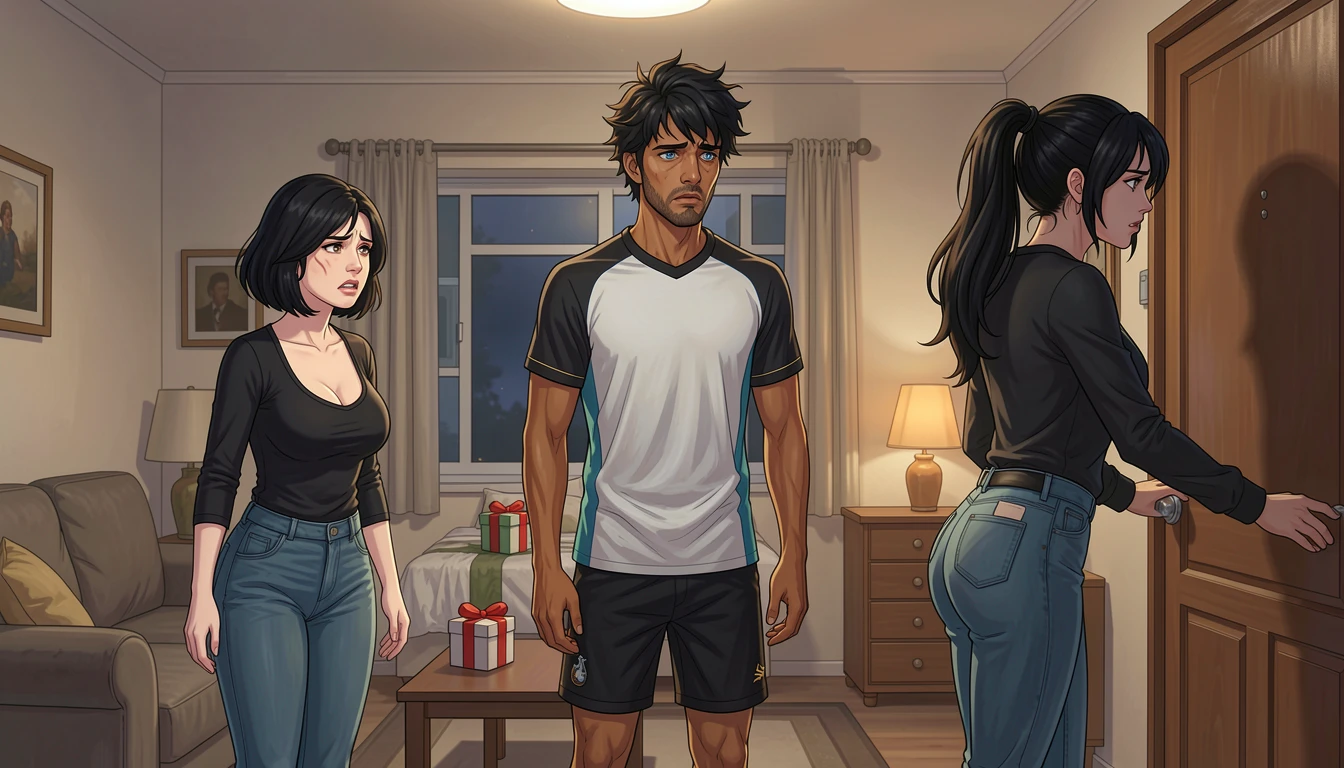
The silence stretched. Arsala's thumb stopped its tracing on his knuckles. Armish lifted her head from his shoulder, her dark eyes finding his in the lamplight.
"Okay." Armish's voice was soft. Careful. "Tell us."
Musab stared at the ceiling. The crack in the plaster he'd meant to fix for months. He could feel both of them watching him, their warmth against his sides, the trust still there, still whole, about to shatter.
"That night," he said. "When I said I was with Sameer."
Arsala went still. Completely still. Her hand stopped on his hip.
"I wasn't."
The radiator clicked. A car passed somewhere below. The lamp buzzed faintly, a sound he'd never noticed before.
"I was with Maryam."
Armish pulled back first. A small movement, her shoulder lifting away from his. Then her whole body, sitting up, the sheet falling to her waist. She stared at him, her face unreadable.
Arsala didn't move. Her hand still rested on his hip, but it felt like a stone now, heavy and cold.
"What do you mean?" Arsala's voice was quiet. Too quiet. "What do you mean you were with Maryam?"
Musab sat up. The sheet bunched at his waist. He didn't look at either of them. He looked at his hands, at the lamp, at the crack in the ceiling — anywhere but their faces.
"I went to her house. We had sex. She was live-streaming it for her OnlyFans." He heard how it sounded. How it would land. "I didn't know about the stream until I got there."
Armish made a sound. A small one. Like something had been knocked out of her chest.
"You fucked Maryam." Arsala's voice climbed. Not loud. But sharp now. A blade being drawn. "The girl you told me not to worry about. The one sitting on your lap in class."
"Yes."
"And you lied to us." Armish's voice cracked on the last word. "You said you were with Sameer."
"I know."
Arsala was out of bed. One moment she was against him, the next she was standing, pulling on her shorts with quick, jerky movements. Her tank top hung loose. Her hands shook as she yanked the fabric down.
"Arsala." He reached for her wrist. She pulled away like his touch burned.
"Don't." Her voice broke. "Don't touch me."
Armish was slower. She sat there, the sheet still pooled around her, her long black hair falling from its ponytail, loose and tangled. She looked at him like she was seeing someone she didn't recognize.
"I love you," she said. "I told you I love you. And you went to another girl."
"It wasn't—" He stopped. What was he going to say? It wasn't like that? It was exactly like that. "I don't have an excuse."
"No." Armish's voice hardened. "You don't."
She stood. Found her shirt on the floor. Pulled it over her head. Her movements were mechanical, precise, like she was running on something other than will.
Arsala was already at the door. Her hand on the knob. She stopped, her back to him, her shoulders shaking.
"I brought you samosas," she said. Her voice was barely a whisper. "My mother made them. And you were fucking Maryam."
"Arsala—"
She opened the door. Walked out. Didn't look back.
The door didn't slam. It clicked shut, soft and final.
Armish was still in the middle of the room, her shirt on but untucked, her hair a mess, her face wet. She hadn't cried yet but she was about to. He could see it in the way her jaw worked, the way her hands hung at her sides, the way her chest rose and fell too fast.
"I'm sorry," he said. The words felt useless. Hollow.
"Sorry." She repeated it like she was testing the taste. "You're sorry."
She walked to the bed. Not toward him. Toward the nightstand. There was a small box there, wrapped in brown paper, that he hadn't noticed before. She picked it up. Held it for a moment, her fingers pressing into the paper.
"I brought you something," she said. "Earlier. Before you told us you needed to talk. I thought... I don't know what I thought."
She set the box back down. Not gently. Not hard. Just... placed it. Like it didn't matter anymore.
"I love you," she said. "I meant it. But I don't know who you are right now."
She walked to the door. Her hand on the frame. She didn't turn around.
"Don't call me," she said. "Don't text. Not tonight. Maybe not ever."
The door opened. She stepped through. It clicked shut behind her.
Musab sat on the edge of the bed. Naked. Cold. The lamp hummed. The radiator clicked. Somewhere in the building, a door closed — not theirs, not his, just someone else's life moving on.
He looked at the box. Brown paper. A small bow on top. He didn't open it. He couldn't. It sat there like evidence, like a wound he hadn't earned the right to touch.
The room smelled like all three of them. Sweat and sex and Armish's shampoo, something floral and clean, and Arsala's skin, that warm salt-and-vanilla scent he'd known for years. He could still feel them in the sheets. In the air. In his skin.
He lay back. Stared at the crack in the ceiling. The city hummed outside the window, distant and indifferent.
He didn't sleep.
───
The week passed like a sentence.
Musab went to practice. He ran drills. He took shots. He did everything on autopilot, his body moving through the motions while his mind sat somewhere else, replaying the sound of the door clicking shut, the look on Armish's face, the tremor in Arsala's shoulders.
He didn't text them. He wanted to. His thumb hovered over their names a hundred times, a thousand times, but every time he thought of what he'd say, and every time he came up empty. I'm sorry. I fucked up. Please talk to me. Words that meant nothing. Words that couldn't undo what he'd done.
They didn't text him either.
He looked for them in the hallways. He saw Armish once, her ponytail swinging as she walked past with the other cheerleaders, her face a mask he couldn't read. She didn't look at him. Didn't slow down. He saw Arsala at lunch, sitting with her friends, laughing at something on her phone, and the laughter looked wrong, looked forced, and she didn't meet his eyes even when he stood ten feet away.
He ignored Maryam. She texted him twice — hey, then u ok? — and he left both on read. He couldn't look at her name without thinking of that night, of the stream, of the comment someone left, of the domino that had started everything falling apart.
Sameer tried to talk to him after practice, clapped him on the shoulder, asked if he was alright. Musab said he was fine. Sameer didn't believe him but didn't push. That was the thing about Sameer — he was a good guy. A decent guy. And Musab had fucked his girlfriend. Had fucked her and told her he loved her and then fucked someone else. He didn't deserve Sameer's concern. He didn't deserve any of it.
He stopped eating. Not on purpose. He just forgot, or didn't care, or both. The fridge was empty anyway. He ordered food once, let it sit on the counter until it went cold, then threw it away.
The box was still on the nightstand. He hadn't opened it. He couldn't. It sat there like a promise he'd broken, a future he'd closed the door on.
───
Saturday. The home game against Royal College. Two-nil win, Musab with the first goal, an assist on the second. He played well. He always played well. The pitch was the only place where his head went quiet, where the only thing that mattered was the ball and the goal and the next move.
The crowd cheered. His teammates lifted him. He smiled for the cameras. He did everything right.
And then, in the tunnel leading to the locker room, someone grabbed his arm.
He turned.
Fizbah stood there, her brown hair falling loose over her shoulders, her busty body wrapped in a sweater that hugged every curve. Her brown eyes were wet. Her jaw was tight. She looked at him like she'd been waiting for this moment all week.
"You've been ignoring me," she said. Her voice was soft, but there was an edge underneath. "You haven't texted. You haven't looked at me. What the hell is going on?"
Musab ran a hand through his hair. His jersey was still wet with sweat. The tunnel was empty except for them, the sound of the crowd muffled through concrete walls.
"Fizbah, I can't—"
"Can't what?" She stepped closer. Her hand still on his arm. "Can't talk to me? Can't tell me what I did wrong?"
"You didn't do anything wrong."
"Then what is it?" Her voice cracked. "You came to my house. We had sex. It was—I thought it was good. I thought you wanted—"
"I did." He cut her off. "I do. It's not about you."
"Then what is it about?"
The question hung between them. The tunnel was cold. His skin was hot. He could smell the grass on his own body, the sweat drying, the ache in his legs from ninety minutes of running.
"I told Arsala and Armish," he said. "About you. About Maryam. Everything."
Fizbah's hand dropped from his arm. Her face changed. The anger faded into something else — worry, maybe. Fear.
"What did they say?"
"They left." His voice was flat. Empty. "They haven't talked to me all week. I don't know if they ever will."
Fizbah was quiet for a long moment. Her brown eyes searched his face. He didn't know what she was looking for. He didn't know what she found.
"I'm sorry," she said. And she meant it. He could hear it.
"It's not your fault."
"I know." She stepped closer again. Not touching this time. Just close. "But I'm still sorry."
She looked at him. The wetness in her eyes had receded. Her jaw was looser now. She was thinking, processing, deciding something he couldn't see.
"Musab." Her voice was different. Lower. "You look like shit. Have you eaten?"
He blinked. "What?"
"Have you eaten? Today? This week?"
He opened his mouth. Closed it. He couldn't remember the last time he'd had a proper meal. The samosas, maybe. The ones Arsala brought. Before everything broke.
"That's what I thought." She grabbed his hand. Her fingers were warm. Soft. "Come on."
"Where?"
"My house. My mom made biryani. You're going to eat something if I have to shove it down your throat."
He should say no. He knew he should say no. He had two girls who weren't talking to him, a third he'd been ignoring, and a fourth standing in front of him offering food and comfort he didn't deserve.
But his feet followed her anyway. Out of the tunnel. Into the parking lot. Toward her car, a small white hatchback with a stuffed tiger hanging from the rearview mirror.
She opened the passenger door for him. He got in. The seat smelled like vanilla air freshener and something floral. The door closed. She walked around the front, slid into the driver's seat, and started the engine.
"Seatbelt," she said.
He clicked it into place. The car pulled out of the lot, past the school gates, onto the main road. The sun was setting, orange and pink bleeding across the sky, and for the first time in a week, Musab felt something other than the weight of the door clicking shut.
The driveway curved past a jacaranda tree dropping purple blossoms onto wet concrete. Fizbah's house was a modest two-story with a rusted gate and a front porch where a pair of faded sneakers sat side by side, laces tangled by rain.
She led him through the kitchen door. The smell hit him first — cumin, turmeric, browned onions, the sharp tang of cardamom rising off a pot on the stove. A woman stood at the counter, her back to them, stirring something in a deep steel pot. She turned when the door clicked shut.
Fizbah's mother was shorter than her daughter, with the same brown eyes and a round face lined with smiling. She took in Musab — his sweat-stained jersey, the hollow under his cheekbones, the way his hands hung at his sides like he didn't know what to do with them — and said nothing. Just nodded once, pulled out a chair, and placed a plate on the table.
The biryani was still steaming. Rice layered with dark meat and caramelized onions, a wedge of lemon on the side. Fizbah sat across from him, her knee brushing his under the table. Her mother poured water into a glass, set it beside his plate, and retreated to the living room without a word. The television murmured — a cooking show, someone's voice describing a recipe in Urdu.
Musab picked up the fork. The first bite sat in his mouth like gravel. He chewed. Swallowed. The second bite was easier. By the third, his body remembered what hunger was, and he ate without tasting, without stopping, the plate clearing in minutes while Fizbah watched him, her own food untouched.
"You were starving," she said. Not a question.
"I didn't realize."
She reached across the table. Her fingers found his. She didn't say anything else. The cooking show host laughed at something. A pot simmered on the stove. The clock on the wall ticked forward, measuring a silence that didn't need to be filled.
"I should go." He pulled his hand back. The words came out rough. "Thanks for the food. Thanks to your mom."
Fizbah's eyes flickered. "You don't have to—"
"I know." He stood. The chair scraped against the tile. "I just can't be anywhere right now. Anywhere with people who are being nice to me."
She was up too, following him to the door, her hand catching his elbow. "Stay. Please. You don't have to talk. You don't have to do anything. Just stay."
He looked at her. At the worry pulling her brow tight. At the way her fingers pressed into his sleeve, like she could anchor him. "I can't." His voice cracked on the second word. "I need to be alone."
He stepped out. The door didn't close behind him. He heard her call his name once, soft, and then the sound of the latch clicking into place as he walked down the driveway, past the jacaranda, toward the empty street.
───
The penthouse was dark when he let himself in. He didn't turn on the lights. He knew the geometry of this place — where the couch sat, where the kitchen island ended, where the bedroom door hung open at the end of the hall. He walked through the dark like a ghost moving through a house that had already forgotten him.
The bedroom smelled stale. Sheets tangled from a week of lying in them. A glass of water on the nightstand, the surface filmed with dust. And the box — brown paper, small bow, still sitting where Armish had left it. He didn't touch it. He didn't even look at it directly. He just felt its presence in the corner of his vision, a wound he couldn't dress.
He lay on the bed fully dressed. His jersey still smelled of grass and sweat. He stared at the crack in the ceiling. The same crack. It hadn't changed. Nothing in this room had changed except the absence of two bodies that had once belonged here.
The first drop of rain hit the window. Then another. Then a dozen, spreading across the glass like the world was finally crying the way he couldn't. The city lights softened, smearing into orange and white blurs through the wet pane. The sound filled the room — a low drumming, steady and patient, washing over the silence he'd been drowning in.
And he remembered.
The first night with Armish. How she'd shown up at his door, tears on her cheeks, her ponytail askew, her voice breaking as she told him about Sameer. How she'd let him hold her. How she'd looked at him with those dark eyes, trust and desperation and something else, something that had made him feel like he could be the person she needed.
I love you, she'd said.
I love you too, he'd said back.
The rain drummed harder. He closed his eyes. The memory played behind his lids — her body in his arms, her breathing slowing, the city lights casting shadows across the room. He hadn't known then. Hadn't known how deep she'd burrow into him, how losing her would feel like losing a part of his own ribs.
His eyes stayed closed. The rain kept falling. The world softened at the edges, blurred, began to dissolve into the dark behind his lids.
A knock.
He was on his feet before his brain caught up, his heart slamming against his ribs, his feet carrying him down the hall before he was fully awake. The knock came again — three sharp raps, impatient, urgent, the kind of knock made by someone who didn't care who heard it.
Armish. He knew it was Armish. Or Arsala. It had to be. No one else would come at this hour, in this rain. He fumbled with the lock. The chain rattled. He pulled the door open —
Fizbah stood in the doorway, soaked to the bone.
Her brown hair hung in wet ropes, plastered to her face and shoulders. Her sweater was dark with water, clinging to every curve, the fabric heavy and dripping. She shivered once, violently, and her eyes found his through the rain running down her lashes.
"Can I come in?" Her voice was raw. "It's raining."
He stepped aside. She walked past him, leaving wet footprints on the floor, a trail of water leading from the door to the middle of the living room. She stood there, dripping onto the hardwood, her arms wrapped around herself, looking at his dark apartment with something like pity.
He closed the door. The lock clicked. She turned to face him.
"Do you know how difficult it was to sneak out in this rain?" A wet laugh escaped her. "My mother thinks I'm in the bathroom. I climbed out the window."
He found a towel in the hall closet. Handed it to her. She took it, pressed it to her face, then rubbed at her hair in rough, quick motions. Water splattered the floor. She didn't seem to care.
"What are you doing here?" His voice was quiet. Strained.
She stopped drying. Lowered the towel. Looked at him with an expression that was half exhaustion and half something he couldn't name — fondness, maybe, or frustration, or both.
"For you, dimwit." She threw the towel onto the couch. "Now if you have something to drink, bring it. I'm freezing."
He walked to the kitchen. The fridge was empty except for a half-empty bottle of water, a jar of pickles expired two months ago, and a takeout container with something green growing inside it. He found a bottle of orange juice in the cabinet — warm, but unopened — and poured two glasses. The ice tray was empty. He brought the glasses to the living room anyway.
She took hers. Drank half of it in one go. Wiped her mouth with the back of her hand. Her clothes were still wet, leaving dark patches on the couch where she sat, but she didn't seem to mind. She patted the cushion beside her.
He sat. The space between them was small. The rain filled the silence.
"You left," she said. "And I couldn't stop thinking about you being here alone."
"I'm fine."
"You're a terrible liar."
He didn't answer. He couldn't. Something in his chest was cracking, a seam he'd been holding shut for a week, and the pressure was building behind it.
She reached over. Her hand found his. Cold fingers, still wet, wrapping around his. "Tell me."
And it broke.
Not a sob — a collapse. His shoulders caved forward. His breath hitched, then tore, then came out in jagged pieces he couldn't control. The tears came hot and fast, tracking down his face, falling onto his jersey, onto his hands, onto the couch between them. He pressed the heels of his palms to his eyes but they wouldn't stop, wouldn't slow, wouldn't give him a moment to breathe.
Fizbah moved without hesitation. She pulled him into her arms, her wet sweater against his cheek, her hands in his hair, her voice a low murmur — "I know, I know, let it out, I've got you" — and he clung to her like she was the only solid thing left in a world that had turned to water.
He cried for Armish's face when she'd said I don't know who you are. He cried for Arsala's shoulders shaking as she walked out the door. He cried for the lie he'd told, the night he'd chosen, the chain of choices that had led to this empty room and this wet girl and this pain he couldn't outrun.
"I want them back," he whispered into her shoulder. The words came out broken, barely audible. "I want them back so bad."
She held him tighter. "I know."
"I fucked everything. I fucked everything and I don't know how to fix it."
"Shh. You don't have to fix it tonight."
He cried until he had nothing left. Until his throat was raw and his eyes were swollen and his body felt hollowed out, scraped clean. And then he just lay there, his head on her chest, listening to her heartbeat under the wet fabric, steady and patient, a rhythm that didn't demand anything from him.
She didn't let go. Her fingers traced slow patterns on his back. Her breath was warm against his hair. The rain continued, softer now, a lullaby falling from the sky.
He fell asleep in her arms.
The first real sleep of the week.
───
Light. Grey and pale, filtering through the rain-streaked windows. The smell of coffee — sharp, fresh, impossibly warm.
Musab opened his eyes. The couch. A blanket draped over him — he didn't remember a blanket. Fizbah's sweater, dry now, hanging over the back of a chair. And the sound of someone moving in the kitchen — soft footsteps, the clink of a cup against the counter.
He sat up. His joints ached. His eyes felt swollen. His mouth tasted like old sleep. But something was different — lighter, like a knot in his chest had loosened a single turn.
Fizbah appeared in the kitchen doorway, holding two mugs of coffee. Her hair was dry now, brushed back from her face. She was wearing one of his old t-shirts — grey, faded, too big for her — and nothing else. The hem hit her mid-thigh. Her legs were bare. She looked tired and soft and impossibly patient.
"Your coffee machine is complicated," she said. "But I figured it out."
She walked over, handed him a mug. Her fingers brushed his. The ceramic was warm.
He took a sip. Black. Slightly too strong. Perfect.
"Thank you." His voice was hoarse. "For last night. For everything."
She sat beside him, her knee touching his. "You don't have to thank me."
"I do." He looked at her. Really looked. At the dark circles under her eyes. At the way she held her mug with both hands, like she needed something warm to anchor her. "You didn't have to come. You didn't have to stay. But you did."
She shrugged. A small smile. "I wanted to."
The silence stretched. Not heavy. Not empty. Just... there. The rain had stopped. The morning light was clean and pale, washing the room in grey-gold. Somewhere outside, a bird called, then went quiet.
He leaned in. Slowly. Giving her time to pull away. She didn't.
His lips found hers. Soft. Brief. A kiss that tasted like coffee and gratitude and something he couldn't name. She kissed him back, just as gently, her free hand finding his jaw, her thumb brushing his cheekbone. When they broke apart, her eyes were wet.
"You have a match today," she said. Her voice was rough. "Drink your coffee. Then get dressed."
He didn't argue. He drank. She drank. They sat in the morning light, two people who had found each other in the wreckage, and for the first time in a week, Musab thought he might be capable of standing up.
───
He was in the bathroom, running a comb through his wet hair, when he heard the knock. His hand stopped mid-motion. His heart slammed against his ribs again, that same reflexive hope, and he set the comb down, walked to the door, and opened it.
Arsala stood in the hallway, her hand raised, mid-motion to knock again. Her dark eyes were wide, her face pale, her short black hair messy like she'd run all the way here. She was wearing an old hoodie — his hoodie, the black one with the faded logo — and her lips were parted like she'd been about to say something.
Then she saw Fizbah.
Fizbah was standing behind him, still in his t-shirt, her brown hair loose, her feet bare on the cold floor. She froze. Her hand tightened on the doorframe.
Arsala's face changed. The hope in her eyes died. Turned to stone. Then to fire.
"So you don't have any guilt." Her voice was low, shaking. "Armish was right. I shouldn't have come."
"Arsala—"
"I was worried about you." The words came faster now, biting. "I was worried. I thought about you all week. And you're here, fucking all the girls you want, like nothing happened."
She turned. Walked. Her footsteps echoed down the corridor.
"Arsala, wait." Musab stepped out, but Fizbah was already past him, barefoot, running down the hall. "Arsala!"
Arsala didn't stop. She was at the stairwell, her hand on the door, when Fizbah caught up. Fizbah grabbed her arm. Arsala spun around, her eyes blazing.
"What?" The word was a slap. "What do you want? To tell me how good he fucked you last night? Or maybe the whole week?"
Fizbah's hand moved fast — a sharp crack against Arsala's cheek that echoed in the narrow corridor. Arsala's head snapped to the side. Her hand flew to her face. She stared at Fizbah, shock replacing anger.
"Just shut up," Fizbah said. Her voice was shaking. "Shut up and listen."
Arsala stood frozen. Her hand still pressed to her cheek.
Musab reached them. He didn't say anything. He stood a few feet away, his back against the wall, his hands in his pockets, his face a mask he couldn't control.
"Yes, I spent the night with him," Fizbah said. Each word was deliberate. Earned. "Because he was alone. He was going down. He was guilty and broken and no one was there for him." She took a breath. "I know what he did was wrong. But to leave your best friend like this — you should be thinking about yourself, Arsala."
Arsala's lip trembled.
"He could have fucked me last night. Or tomorrow. Or every night this week." Fizbah's voice cracked. "But he didn't want to. He doesn't want me. Not the way he wants you." A tear slid down her cheek, catching the light. "I want him. But he wants you guys. And maybe you aren't lucky enough to see that."
Arsala's face crumpled. The anger dissolved into something raw and exposed, a wound mirroring his own. She looked at Musab — really looked — and saw the red-rimmed eyes, the hollow cheeks, the hands shaking at his sides.
She ran to him. Her body hit his. His arms came up automatically, wrapping around her, pulling her close. She sobbed into his chest — ugly, gasping sobs that shook her whole body — and he held her, his own tears falling into her hair, his face pressed to the top of her head.
"I'm sorry," he whispered. "I'm so sorry."
She didn't answer. She just held him tighter.
Fizbah watched them. Her arms were crossed. Her face was wet. She stood at the edge of the scene, her bare feet on the cold floor, and she looked at the two of them holding each other and something in her chest seemed to close, then open, then settle.
She turned. Walked back toward the apartment.
"Fizbah." Arsala's voice stopped her. Hoarse. Broken. "Don't go."
Fizbah didn't turn around. "He's not mine."
"Stay for a while." Arsala's hand found Musab's, squeezed it. "Please."
Fizbah's shoulders lifted. Dropped. She turned, her face unreadable. Musab met her eyes. "Stay," he said. "For me."
The three of them stood in the corridor: Arsala still crying into his chest, Fizbah barefoot in an old t-shirt, Musab between them like a bridge that had just been rebuilt. The morning light fell through the window at the end of the hall, casting long shadows across the floor. Somewhere on another floor, a door opened and closed. A normal sound, in a normal world.
Fizbah walked back. She didn't touch either of them. She just stood close, her presence a third spoke in a wheel that had been missing one. "Fine," she said. "But someone's making me breakfast."
A laugh escaped Arsala — wet, surprised, half a sob. "I'll cook."
"You can't cook," Musab said.
"I can make toast."
"Toast isn't cooking."
"It's close enough."
They walked back into the apartment. The three of them. The sun climbed higher, burning off the last of the clouds, and the room that had been dark for a week began to fill with light.
───
Arsala burned the toast. Slightly. She served it anyway, three plates with butter and jam and a pot of tea that Fizbah made while Musab sat at the kitchen island watching them move around his space like they belonged there. The apartment didn't feel empty anymore. It felt like a room that had been holding its breath, finally allowed to exhale.
They talked. Arsala told him about the week — the crying, the rage, the moment she'd decided to come. She'd walked halfway to his building three times before turning back. She'd deleted his number twice. She'd re-added it in the middle of the night, staring at his name on the screen, her thumb hovering over the call button.
"I hated you," she said. "I tried to hate you."
"I hated me too."
She looked at him. "I can't do that again. I can't be the one who walks out and comes back."
"You won't have to."
She took his hand. Held it. Didn't say anything else.
But something was missing. The three of them sat around the island — three plates, three cups, three bodies — and yet there was a fourth presence that hovered at the edges, a silence that none of them were naming.
"What about Armish?" Musab said.
Arsala's face tightened. "She won't see you. She won't even talk about you. She loved you like crazy, Musab. And she got cheated twice — first by Sameer, then by you."
The words sat on the table like a stone.
Fizbah set down her tea. "Can you bring her to his match today?"
Arsala blinked. "She won't come. Even if she wanted to, she wouldn't."
"Then convince her. Lie. Tell her you need her there. Tell her something." Fizbah's voice was steady. Certain. "Just get her to the stadium."
Musab looked at her. "What difference will that make?"
Fizbah's lips curved. A small smile, almost mischievous, cutting through the heaviness. "Don't worry, dimwit. I have a plan."
The three of them finished their toast. Burned bread and jam and lukewarm tea. The morning stretched ahead of them, uncertain and unfinished, but the room was no longer dark, and the silence no longer hurt the same way.
They left the apartment together, locking the door behind them — Arsala still in his hoodie, Fizbah in borrowed jeans and a t-shirt she'd found in his drawer, Musab between them, stepping into the pale morning light.
The stadium lights blazed against the violet sky, casting long shadows across the pitch. Musab stood at the tunnel mouth, his jersey already damp with warmup sweat, his eyes scanning the stands for the fourth time. The bleachers were full—students, families, a cluster of men in dark blazers holding clipboards, the international scouts he'd been told to impress. But he couldn't see them. He was looking for a ponytail.
The first half crawled. Every pass felt heavy. Every run cost him something he didn't have to give. Royal College's defense held tight, and his shots sailed wide or straight into the keeper's gloves. The scoreboard read 0-0 when the whistle blew, and he walked off the pitch with his head down, his lungs burning, his chest hollow.
He found them in the third row of the east stands. Arsala spotted him first, her dark eyes finding his through the crowd, her face soft with worry. Fizbah sat beside her, brown hair loose, wearing the same borrowed t-shirt from this morning, her hands clasped tight in her lap. And between them, in the middle seat—Armish. Her ponytail was perfect. Her face was stone. She wasn't looking at him. She was looking at the pitch, at the empty goal, at anywhere that wasn't his face. But she was there.
Musab's chest cracked open. He raised a hand, small, tentative—a wave meant for all three of them. Arsala waved back. Fizbah smiled. Armish didn't move. She stared straight ahead, her jaw tight, her hands folded in her lap like she was holding herself together by force of will. She was there. It was enough.
The second half was different. The first goal came in the 52nd minute—a curling shot from outside the box that kissed the post and nestled into the net. He ran to the sideline, his arms wide, his eyes finding the east stands. He pointed at Armish. She didn't react. Her face stayed flat, her eyes fixed on the goal he'd just scored, like she was watching a stranger. He turned back to the pitch, his celebration dying in his throat.
The second goal came eight minutes later. A header from a corner, his neck craned, his body twisted, the ball glancing off his temple and past the keeper. He landed on his knees, grass staining his shins, and looked up at the stands again. Armish was whispering something to Arsala. Fizbah's hand was on Armish's arm. None of them were looking at him. He scored the third in stoppage time—a penalty, cool and clinical, the keeper diving the wrong way. He didn't celebrate. He just watched the ball hit the net, then looked at the east stands one last time. The seat between Arsala and Fizbah was empty.
The final whistle blew. His teammates lifted him, shouting his name, slapping his back. The scoreboard read 3-0. The scouts were making notes. He'd done everything right. He walked off the pitch with no one's face in his mind but hers. In the tunnel, a man in a blazer stopped him. Italian accent, grey hair, a folder tucked under his arm. "Musab Umer. Real Madrid would like to offer you a trial contract. Six months in the youth academy. Full scholarship. Flights covered. If you perform, a senior contract follows." He pressed a glossy document into Musab's hands. Musab looked at it. The crest. The words. The dream he'd whispered into his pillow as a child.
He took the contract. Nodded. "I'll sign it and send it." The scout smiled, shook his hand, and disappeared into the crowd. Musab stood in the tunnel, the contract in one hand, his soul in the other, and he couldn't feel either.
He found Arsala and Fizbah outside the locker room. Their faces told him everything. "She left," Arsala said. Her voice was quiet. "Before the match ended. She said she couldn't—" Fizbah's hand touched Musab's arm. "We tried to stop her. She wouldn't stay." He didn't answer. He pushed past them, into the locker room, into the shower, into the silence. The water was cold. He didn't change it.
He didn't go home that night. He drove. For hours. The contract sat on the passenger seat, getting creased at the edges. He drove past the school, past Fizbah's street, past the spot where Armish's building stood dark against the sky. He slept in the car. When he finally returned to the penthouse, he left the contract on the nightstand—beside the unopened box, beside the crack in the plaster, beside everything he'd broken. He didn't answer the door. He didn't answer his phone. Two days and two nights of silence, of cold takeout he didn't order, of staring at the ceiling until his eyes burned.
On the third morning, Arsala knocked. Then Fizbah. Then both of them, together, their voices weaving through the wood. "Musab. Let us in. Please." He opened the door. They stepped inside and looked at what he'd become. The contract sat on the nightstand, dust settling into the creases. The unopened box beside it. A week's worth of silence pressed into the sheets. Arsala started cleaning without a word—picking up cups, opening windows, letting the afternoon light cut through the dark. Fizbah found rice in the cupboard and started cooking. They moved around him like he was a patient, like he was something fragile that needed tending.
They ate together at the kitchen island. Burned rice and dal that was too salty, but it was hot and it was made for him. Arsala broke the silence first. "She didn't want to come. I spent an hour convincing her. She only agreed because I told her I needed her there, not you." Musab's fork stopped halfway to his mouth. "She was still hurt. She said if she watched you play, if she saw you score, she'd break. So she left before she did." Fizbah set down her glass. "You had the contract. Why didn't you sign it?" He looked at the side table. The papers sat there, untouched. "It doesn't mean anything without her." Arsala's hand found his. Fizbah's hand found his other. The three of them sat there, a circle that was missing a fourth, and the silence was unbearable.
He stood. "I need to drive. Alone." Arsala's grip tightened. "Musab, don't—" "I need to think. I'll be back." He pulled away gently, grabbed his keys, and walked out before either of them could stop him. The door clicked shut behind him. The apartment felt empty again.
The hours passed. The sun set. The rice went cold. Arsala and Fizbah sat on the couch, their phones in their hands, their eyes on the door. At 11:47 PM, Arsala's phone rang. Unknown number. She answered, her voice shaky. "Hello?" A man's voice. Professional. Careful. "Am I speaking with Arsala Khan?" Her throat closed. "Yes." "Are you acquainted with Musab Umer?" She couldn't speak. The word came out a whisper. "Yes." "There's been an accident. He's at Jinnah Hospital. Intensive Care Unit. You should come quickly." The phone slipped from her hand. It hit the floor and the screen cracked, a spiderweb spreading across the glass.
Fizbah picked it up. Her face went pale as she listened. Then she was moving—grabbing her bag, grabbing Arsala's hand, pulling her toward the door. "He's at Jinnah. We're going. Now." Arsala let herself be pulled, her legs moving without her permission, her mind stuck on the word ICU. On the way out, Arsala dialed Armish's number. It rang. It rang. Voicemail. She left a message, her voice breaking on every word. "Armish. Musab. He's in the hospital. ICU. Jinnah. Please. Please come."
The hospital was white and fluorescent and smelled of antiseptic and fear. They ran through the corridors, past gurneys and nurses, until they reached the ICU doors. A doctor in blue scrubs stopped them, his face tired and serious. "You're with Musab Umer?" They nodded, both of them crying, both of them holding each other up. "He's critical. We're doing everything we can. He hit a tree at high speed. The car is destroyed. He's lucky to be alive." Arsala's legs gave out. She slid down the wall, her hands covering her face, her shoulders shaking. Fizbah stood frozen, her hand pressed to her mouth, her eyes fixed on the closed ICU doors.
A police officer approached. Quiet. Sympathetic. "Miss? We need someone to assist with the report. It was a single-vehicle accident. We have some questions." Fizbah wiped her face, straightened her spine, and followed him to a small room down the hall. Inside, a psychiatrist sat behind a desk, her hands folded, her eyes kind. "Please. Sit." Fizbah sat on the edge of the chair, her hands gripping her knees. "Were you close to Musab?" Fizbah nodded. "Did he seem distressed recently? Depressed? Did he express any thoughts of—" Fizbah's voice cut through the room. "Please." "I understand this is difficult. But we need to know. The skid marks suggest he didn't brake. The car went straight into the tree at full speed. We have to consider the possibility that this was intentional." Fizbah stared at her. The word hung in the air like smoke.
She said nothing. She stood. She walked out. In the corridor, she saw a figure running—long black hair flying loose from a ponytail, a cheerleading jacket zipped halfway, tears streaming down her face. Armish. She crashed into the ICU doors, her hands slapping the glass, her voice raw. "Where is he? Where is he? Is he alive? Please—" Fizbah's hand connected with Armish's cheek. The slap echoed down the white corridor, sharp and final. Armish staggered, her hand flying to her face, her eyes wide and wet. "If he dies," Fizbah said, her voice ice and fire, "I am going to kill you. He tried to kill himself because of you." Armish's face crumpled. She couldn't speak. She looked at Fizbah, at the hatred in her eyes, at the truth she couldn't deny.
Arsala pushed herself off the wall. She walked to Armish. Slowly. Her face wet, her arms open. Armish fell into her, sobbing, her body shaking, her words lost in the fabric of Arsala's hoodie. Arsala held her. Fizbah watched them, her own tears falling, her hands shaking at her sides. The three of them stood in the fluorescent light, waiting for news they were terrified to hear. The doctor came through the ICU doors three hours later. His scrubs were wrinkled. His eyes were bloodshot. But he was smiling. "He's strong. He's going to make it. He's asleep now, but you can see him in four hours." Arsala's knees buckled—with relief this time. Armish let out a sound that was half a sob, half a breath she'd been holding for hours. Fizbah leaned against the wall, pressed her palm to her mouth, and let herself cry.
The doctor paused at the door. Her hand rested on the frame. "He asked for someone. Just before we put him under." She looked at the three of them — Arsala on the floor, Armish against the wall, Fizbah by the window. "He said a name."
Armish's breath stopped. Her hand pressed flat against the glass of the ICU door. The fluorescent light caught the tremor in her fingers, the white of her knuckles.
"Armish."
The name hung in the corridor like smoke. Arsala's hands went still on her knees. Fizbah's jaw tightened. The three of them stood in the white light, each one feeling the weight of that single syllable — where it landed, where it didn't.
Armish's face crumpled. A sound escaped her — small, animal, something that had been locked in her chest since the first door closed. Her forehead touched the glass. Her shoulders shook. She didn't cry; she collapsed, her whole body folding against the barrier that separated her from the boy who'd said her name before going under.
Arsala rose slowly. She walked to Armish. Didn't touch her. Just stood close, her shoulder a few inches from Armish's, a presence that didn't demand but didn't leave.
"He said it twice," the doctor added. Her voice was softer now. "The second time, he was already fading. It wasn't loud." She paused. "I thought you should know."
She walked away. Her footsteps faded down the corridor. The automatic doors hissed open, then closed. The three of them were alone again in the white silence.
Fizbah stayed by the window. Her reflection stared back at her — pale, hollow, borrowed t-shirt still loose on her frame. She didn't speak. She didn't need to. The name had drawn a line, invisible but absolute, and she could feel the shape of it around her feet.
Armish's hand lowered from the glass. She turned. Her face was wet, her eyes red, her ponytail loose and tangled. She looked at Arsala first — a long look, wordless, something passing between them that neither could name. Then she looked at Fizbah.
"I'm sorry," Armish said. Her voice was raw. "I'm sorry I left."
Fizbah's lips pressed together. Her arms crossed. She didn't forgive and she didn't attack. She just stood there, a witness to something she couldn't change.
Arsala's hand found Armish's. Squeezed once. Let go.
"Four hours," Arsala said. The words were quiet. Directed at the floor, at the ceiling, at no one. "We wait four hours. Then we see him."
Armish nodded. Her hand stayed where Arsala had left it, hovering in the air like she didn't know what to do with it now.
Fizbah walked to the row of plastic chairs. Sat down. Her hands folded in her lap. She stared at the ICU door, at the small window where Armish's handprint still marked the glass — a ghost of five fingers, waiting to be matched.
The clock on the wall ticked. The fluorescent lights hummed. Three girls sat in a hospital corridor, each carrying the weight of his name, each wondering which version of herself would walk through that door in four hours. The handprint on the glass began to dry. The light didn't change.