
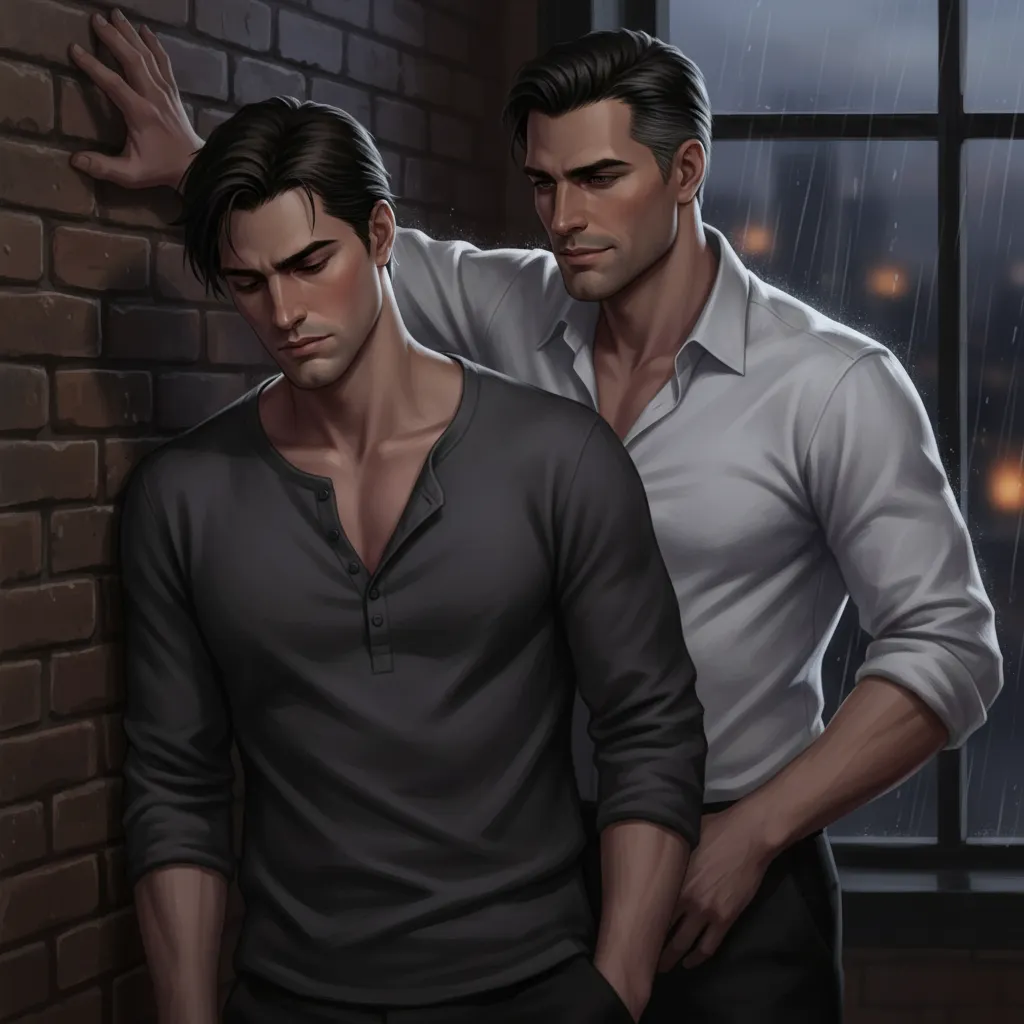
Caleb arrived at his office before dawn, the city still dark and quiet around the building’s concrete bones. He flicked on the single lamp at his desk, the honeyed light pooling across the broad oak surface, and for a long moment he just stood there, his palms flat on the cool, smooth wood. The air smelled of old paper and warm leather, a familiar sanctuary. He needed the sanctuary today.
Last night lived in his muscles. The memory of Thomas’s hands, the heat of another body after so many months of careful distance, the shocking rightness of it—it was a tremor in his foundation. He’d woken alone in Thomas’s bed, the sheets tangled and smelling of them both, and had dressed in silence while his friend slept on. He’d left a note on the kitchen counter: “Thanks for the couch. -C.” A lie so pathetic it made his jaw clench.
So he worked. He buried himself in blueprints for a lakeside renovation, losing himself in lines and angles, in load-bearing calculations and the poetry of cantilevered decks. The sun rose, casting long shadows across his drafting table. He didn’t answer his phone. He ignored the low hum of the city waking up outside his window. He focused on the graphite smudging his fingertips, on the precise world he could control.
His intercom buzzed at ten-thirty, a sharp, unwelcome sound. His assistant’s voice, tinny through the speaker. “Mr. Thorne? Your eleven o’clock is here. Elias Kane?”
Caleb ran a hand through his dark, unruly hair. He’d forgotten. A new client, a gallery owner. A consultation. “Send him in,” he said, his voice rough from disuse.
The door opened. Elias Kane entered not with a step, but with an arrival. He filled the doorway, then the room, his presence a shift in atmospheric pressure. He was older, mid-thirties, with sharp angles and silver threading his temples. His suit was a severe, impeccable charcoal, and his eyes were the dark, focused black of obsidian.
“Caleb Thorne,” Elias said. It wasn’t a question. His voice was precise, economical. He didn’t offer a hand. He simply took in the room, the scattered blueprints, the man behind the desk, with a slight tilt of his head.
“Mr. Kane.” Caleb stood, gesturing to the chair opposite. “Please.”
Elias moved with a predatory elegance, settling into the chair as if assessing it for acquisition. His gaze never left Caleb. “I’ve seen your work on the Modernist restoration on Elm. The restraint was… notable.”
“It needed restraint.” Caleb sat back down, forcing himself to meet that unblinking stare. “The structure spoke for itself.”
“Indeed.” A faint, almost imperceptible curve touched Elias’s mouth. It wasn’t a smile. “Most people can’t resist adding their own voice. You listened. A rare quality.”
They discussed the project—a new gallery space, a challenging, narrow lot downtown. Elias spoke in clear, direct terms about light, about flow, about creating an experience. Caleb found himself leaning forward, engaged despite himself, his mind latching onto the problem. This was safe ground.
Then Elias set his portfolio down on the desk, his movements deliberate. “Your reputation precedes you, of course. The architect who has removed himself from the… fray.”
The words landed in the space between them, heavy and specific. Caleb stilled. “I focus on my work.”
“A year, I hear.” Elias’s head tilted again, analyzing. “A principled stand. After a betrayal.”
A cold flush crept up Caleb’s neck. He said nothing. The memory of last night—Thomas’s breath on his skin, his own willing surrender—flashed behind his eyes, a searing contradiction to the vow sitting in this man’s mouth.
“I admire integrity,” Elias continued, his voice dropping, becoming more intimate in the quiet room. “It’s the most compelling form of beauty. And the most fragile.” His gaze traveled over Caleb’s face, down to the open collar of his shirt, to the strong line of his shoulders. “It creates a… powerful tension.”
Caleb felt seen in a way that had nothing to do with his designs. It was a dissection. His hand tightened around his pencil. “The tension isn’t the point. The work is.”
“Isn’t it?” Elias rose, not to leave, but to circle the desk. He stopped beside Caleb’s chair, close enough for Caleb to smell the clean, cold scent of his cologne. “The work is a product of the man. The discipline. The *no*.” He reached out, not touching Caleb, but his fingers hovered over a blueprint, tracing a proposed wall line. “It makes everything you do… deliberate. Potent.”
Caleb’s breath caught. He was pinned by that gaze, by the heat of the other man’s proximity. His own body betrayed him, a slow, unwinding heat in his gut that had nothing to do with anger. He thought of Thomas’s hands again, and shame twisted with a sudden, shocking spike of desire.
Elias leaned down, his mouth near Caleb’s ear. His voice was a low vibration. “I don’t want an architect who says yes to everything, Caleb. I want one who understands the value of a threshold. The power of what lies on the other side of a door kept deliberately closed.”
He straightened then, leaving the words hanging in the honeyed air. He placed a crisp, white business card on the desk, precisely aligned with the edge. “Think on it. The gallery, and the philosophy.”
Elias Kane left as quietly as he had entered, closing the door with a soft, definitive click.
Caleb sat motionless. The office, his sanctuary, felt different. Charged. The ghost of the man’s presence remained, a scent, a pressure. He looked at the business card. He looked at his own hands, the calluses, the faint tremor in his fingers.
The “year of no” had been a wall he’d built for himself, stone by stone. Last night, with Thomas, he’d stumbled through a hidden door in it. Now Elias Kane stood outside, not asking for a door to be opened, but admiring the fortification itself. Wanting to study the lock.
Caleb put his head in his hands. The blueprints in front of him were just lines. Meaningless. All he could feel was the terrifying, exhilarating sense that his foundations were no longer steady. And that someone, somehow, had just noticed.
Caleb pushed back from his desk, the chair legs scraping against the hardwood floor. He crossed the room to the tall window that overlooked the street below. His palms pressed flat against the cool glass.
Down on the sidewalk, Elias Kane emerged from the building’s entrance. He didn’t pause to look back. He turned left with that same predatory elegance, his charcoal suit a stark, moving shadow against the pale concrete. He disappeared around the corner without a hesitation, as if he’d already catalogued the entire street and found it lacking.
Caleb’s breath fogged the glass. He watched the empty space where the man had been.
The office was too quiet. The low hum of the city felt distant, muffled. The scent of Elias’s cologne—clean, cold, like frost on stone—still lingered near his desk, a ghost in the honeyed light.
He turned away from the window. His gaze fell on the business card, a white rectangle perfectly aligned with the edge of his desk. The name was etched in a severe, minimalist font. Elias Kane. Collector.
Caleb didn’t touch it. He walked back to his chair but didn’t sit. He stood behind it, his hands gripping the worn leather of the headrest. His knuckles were white.
The gallery project was brilliant. Challenging. Exactly the kind of work he craved. It was also a trap. He knew it. Elias had woven the professional and the personal together with surgical precision. Admiring the restraint in his work while dissecting the restraint in his life.
“The power of what lies on the other side of a door kept deliberately closed.”
The words echoed. They vibrated in his chest. They made a mockery of last night.
With Thomas, there had been no door. Just warmth in the dark, a shivering body, and a surrender so complete it felt like drowning. He’d broken his vow in a silent, desperate gasp. He’d called Thomas a good friend afterward. The lie tasted like ash.
Now Elias framed the vow itself as a thing of beauty. A deliberate threshold. Caleb felt like a fraud standing in the wreckage of his own principles.
His intercom buzzed again, jerking him from the spiral. He stared at it. The sound was an intrusion.
He reached over and pressed the button. “Yes.”
“Your twelve-thirty is here, Mr. Thorne.” His assistant’s voice was carefully neutral. “Leo Vance?”
Leo. A client. A different project. A normal man with normal demands. The thought was a lifeline.
“Send him in,” Caleb said. He took a deep breath, forcing his shoulders down, his expression into something professional. He swept the Elias Kane blueprint to the side, replacing it with the file for Leo’s restaurant renovation. He left the business card where it was.
The door opened. Leo Vance filled it differently than Elias had. He was sunshine and open windows. Mid-twenties, with a shock of blond hair and a smile that seemed genuinely pleased to be here.
“Caleb! Man, it’s good to see you.” Leo strode in, his hand already extended. His grip was firm, warm. “Sorry I’m a little early. Got excited.”
“Not a problem,” Caleb said, the practiced calm settling over him like a coat. “Please, sit.”
Leo dropped into the client chair, his energy making the leather seem less severe. He launched into an update on the restaurant’s permits, his hands moving as he talked. Caleb nodded, making notes, asking the right questions. This was the script. This was safe.
But his focus was thin. He kept seeing the obsidian black of Elias’s eyes. Feeling the heat of his proximity beside the chair.
“—and the wife thinks we should do a green tile backsplash, but I’m telling her, Caleb Thorne said exposed brick, so we’re doing exposed brick.” Leo grinned, leaning forward conspiratorially. “You’re the expert. Besides, everyone’s talking about your work lately.”
Caleb’s pencil stilled. “Are they.”
“Oh, yeah. The Elm Street restoration? People are calling it a masterpiece of restraint.” Leo’s gaze was admiring, but it traveled over Caleb’s face, down to his shoulders. “It’s got a… quiet power, you know?”
The phrasing was too close. A cold trickle traced Caleb’s spine. He set his pencil down carefully. “It’s just good bones.”
“It’s more than that.” Leo’s smile softened, turned thoughtful. “It’s the architect. People notice when someone… steps back. Holds themselves apart. It’s intriguing.”
There it was again. Not the work. The man. The myth he’d accidentally built by hiding.
Caleb felt a flush creep up his neck. This wasn’t predatory analysis like Elias. This was something warmer, more inviting. Just as dangerous.
“I appreciate that,” Caleb said, his voice tighter than he intended. “Let’s focus on the vent hood specs. The masonry will need additional support.”
He steered the conversation back to steel beams and load ratings. Leo followed, but his eyes kept returning to Caleb’s hands, to the line of his jaw. The admiration in the room was a palpable, gentle heat.
When the meeting ended, Leo stood, shaking Caleb’s hand again. His grip lingered a second too long. “Really great to see you, Caleb. Let’s grab a drink sometime. Talk design. Life. Whatever.”
“Sure,” Caleb said, the non-commitment automatic.
Leo left with a final, bright smile. The door closed.
Silence rushed back in, louder than before. Caleb stood in the middle of his office, surrounded by the ghosts of two very different men. One who saw his walls as fortifications to admire. One who saw them as an invitation to knock.
He looked at the business card. Then at his closed door.
His year of “no” wasn’t a quiet retreat. It was a beacon. And he was just now realizing he was the one standing in the light, blinking, exposed, while every hungry eye in the city adjusted to the dark and began to walk toward him.
Caleb couldn't stay in the office. The air felt thick with evaluation, the leather chair still holding the impression of two different kinds of want. He grabbed his coat and left, the city’s gray afternoon a relief after the honeyed, trapped light of his desk.
He walked without direction. The chill bit through his wool coat, a clean, physical sensation to ground him. He focused on the rhythm of his boots on the pavement, the steam rising from a manhole cover, the distant wail of a siren. Anything but the echo of Leo’s admiring gaze or the surgical precision of Elias’s words.
He turned into the small park that cut through the financial district, a strip of stubborn green between granite and glass. It was nearly empty. A few pigeons, an old man on a bench. The quiet was a balm.
“Hey! Watch out!”
The voice was cheerful, not alarmed. Caleb looked up just as a soccer ball arced toward his head. He caught it on instinct, the leather cool and slightly damp against his palms.
A man jogged toward him, a grin splitting his face. He was all easy movement and coiled energy, dressed in running gear despite the cold. His red hair was a bright shock against the drab day, and his green eyes crinkled with apology.
“Sorry about that,” the man said, his breath puffing in the air. “My kick’s a little ambitious for the space. Thanks for the save.”
“No problem,” Caleb said, handing the ball back.
The man took it, tucking it under his arm. He didn’t move away. His gaze swept over Caleb, quick and assessing. “You’re Caleb Thorne.”
Caleb stilled. “Do I know you?”
“Nope. But I know your work. The repurposed warehouse on the west side? The one with the steel staircase that looks like a spine?” The man’s smile widened. “I’m Finn. Finn O’Sullivan. I’m in construction. Well, demolition mostly. I take things apart. You put them back together better.”
“I’ve heard of O’Sullivan Wrecking,” Caleb said, the professional part of his brain engaging on autopilot. They had a reputation for clean, efficient work.
“That’s the family business.” Finn shrugged, but his posture was proud. “I like the destructive part. There’s a purity to it. But what you do… that’s alchemy.”
The admiration was familiar now, a pattern Caleb was learning to dread. But Finn’s delivery was different. Open. Friendly. There was no predatory stillness like Elias, no warm invitation like Leo. This felt like genuine, enthusiastic interest.
“It’s just a job,” Caleb said, the deflection becoming a reflex.
“Bullshit.” Finn laughed, the sound echoing in the quiet park. “It’s a calling. I can tell. You’ve got the look.”
“What look is that?”
“The look of a guy who sees what something could be, not just what it is.” Finn’s eyes held his, a direct, green challenge. “It’s a quiet look. Most people miss it. I don’t.”
Caleb felt seen again, but the edge felt different. Softer. Or better disguised. He shifted his weight, suddenly aware of the cold seeping through his shoes. “I should let you get back to your game.”
“Game? Nah, just killing time. Actually, I’m glad I ran into you.” Finn’s tone was casual, but his gaze was intent. “I’ve been wanting to pick your brain. There’s a site I’m clearing next month—old textile mill. The bones are insane. The kind of thing you’d appreciate.”
He pulled out his phone, swiping quickly before turning the screen to Caleb. It showed a photo of a vast, derelict space, sunlight spearing through broken roof panels onto massive timber columns. It was beautiful in its decay.
Caleb’s breath caught. He couldn’t help it. “Those beams are heart pine. You can’t find that anymore.”
“See?” Finn said, triumph in his voice. “You get it. Most developers would just see square footage. You see a cathedral.” He put his phone away, his movement deliberate. “Let me buy you a coffee. I’ll show you the rest of the photos. Tell me how to save it.”
The offer was wrapped in professional interest. It was logical. It was about the work, the bones of a building, not the bones of Caleb’s life. It felt like a lifeline back to something pure.
“Okay,” Caleb heard himself say. “One coffee.”
Finn’s grin was brilliant. “Great. There’s a place just off the park. They don’t burn their beans.”
He fell into step beside Caleb, his stride matching Caleb’s slower, measured pace. He talked easily about the mill, about the challenges of pulling it down without damaging the salvageable elements. His enthusiasm was infectious, his knowledge deep.
But as they walked, Caleb felt a hand clap his shoulder, a friendly, solid weight that lingered just a beat too long before Finn pulled it back to gesture at a building facade. He felt the brush of Finn’s arm against his own as they navigated a crowded sidewalk, a contact that wasn’t quite accidental.
At the coffee shop, Finn held the door open. His eyes swept over Caleb as he passed through. “After you.”
The gesture was polite. The look was not. It was a scan, an appreciation of the broad line of Caleb’s shoulders under the coat, the cut of his jaw. It was the look of a man who took things apart to understand how they were made. Caleb missed it completely, his guard lowered by talk of timber and tension.
He was just grateful, for the first time all day, to be talking about something that made sense. Something he could control. He didn’t see the friendly, predatory edge in Finn’s green eyes, or recognize the hunt disguised as a shared passion. He only felt the relief of a normal conversation, and the dangerous, seductive illusion that this one was different.
The coffee shop was warm, smelling of roasted beans and steamed milk. Finn led them to a small table in the back, away from the window. He shrugged out of his running jacket, revealing a tight-fitting thermal shirt that clung to the hard lines of his shoulders and chest. Caleb hung his wool coat on the back of his chair, the leather cool against his knuckles.
“So,” Finn said, leaning forward as Caleb sat. His green eyes were bright with curiosity. “A year of no women. That’s the word on the street. True?”
The question landed like a physical blow. Caleb’s hand, reaching for the menu, froze. He looked up, the easy camaraderie of the park evaporating. “What?”
“Your vow. The celibacy thing.” Finn’s tone was still friendly, but there was a new edge to it, a testing probe. “It’s a pretty bold move. Makes a guy wonder what happened to inspire it.”
Caleb felt the walls slam up inside him. He forced his hand to complete the motion, picking up the laminated menu he had no intention of reading. “It’s personal.”
“Everything’s personal,” Finn countered, his smile not fading. “Especially the things we try to make professional. Like that mill. It’s just brick and wood until you learn its story. Then it’s alive.” He tilted his head, the red hair catching the overhead light. “So what’s your story, Caleb Thorne?”
The barista called their order. Finn stood to get it, moving with that same easy grace. Caleb watched him go, his mind racing. The relief he’d felt was gone, replaced by a familiar, cold tension. He saw the pattern now, clear and inevitable. Elias with his surgical analysis. Leo with his warm admiration. Now Finn, with his friendly interrogation. He was a curiosity. A project.
Finn returned, setting a black coffee in front of Caleb and keeping a cappuccino for himself. He sat, his knee brushing Caleb’s under the small table. He didn’t pull away.
“I’m not a story,” Caleb said, his voice low. He wrapped his hands around the ceramic mug, letting the heat seep into his palms. “And the mill isn’t a metaphor.”
“Isn’t it?” Finn took a slow sip, his eyes locked on Caleb over the rim of his cup. “You find something broken. You study it. You learn why it fell apart. Then you rebuild it, stronger. Sounds familiar.”
Caleb’s jaw tightened. He thought of Thomas. Of the shattering intimacy of last night, a violation of his own new foundation. He’d broken his vow before the cement had even dried. The shame was a sour taste in his mouth. “You don’t know what you’re talking about.”
“Maybe.” Finn set his cup down. He reached into his pocket and pulled out his phone again, but he didn’t unlock it. He just turned it over and over in his hands, a restless, thoughtful motion. “But I know how to read structures. I know stress points. I know when something is holding a tension that’s unsustainable.” His gaze lifted, direct and unflinching. “You’re holding a lot of tension, Caleb.”
The words were too close to Elias’s. Yet the delivery was different—warmer, more intimate. It felt like concern. It felt dangerous. Caleb’s pulse kicked against his ribs. He could feel the weight of Finn’s knee against his own, a steady, deliberate pressure.
“Why does it matter to you?” Caleb asked, the question gritted out.
“Because tension is interesting.” Finn’s voice dropped, leaning in. The space between them shrank. Caleb could see the faint freckles across the bridge of his nose, the sharp cut of his cheekbones. “It’s potential energy. It’s what exists right before something… releases.”
Caleb couldn’t look away. The coffee shop noise faded to a hum. He was aware of everything—the heat of the mug in his hands, the press of Finn’s leg, the focused intensity in those green eyes. He felt seen, but not dissected. Appraised, but not as a specimen. As a man.
Finn’s phone buzzed on the table. The spell broke. Finn glanced at it, a flicker of annoyance crossing his face before he looked back at Caleb. “I have to go. A beam came down early.” He stood, pulling his jacket on. “But I want to show you that mill. For real.”
Caleb just nodded, unable to form words.
Finn paused beside the table. He placed a hand on Caleb’s shoulder. The grip was firm, grounding. “Think about it. All that beautiful, salvageable timber. It’s a waste to just knock it down.” His thumb pressed once, deliberately, into the muscle. Then he released. “See you around, Caleb.”
He was gone, the bell on the door jingling in his wake. Caleb sat motionless. The ghost of Finn’s touch burned on his shoulder. The imprint of his knee lingered on Caleb’s thigh.
He looked down at his own hands, clenched around the cooling coffee. He thought of Thomas’s quiet breathing in the dark, of the line they’d crossed and the friendship he’d jeopardized. He thought of Finn’s easy smile and probing questions, a different kind of line being drawn.
The vow felt like a lie. The “year of no” was already fractured. And instead of pushing them away, his isolation seemed to be drawing everyone in. He was a locked door, and every man he met now seemed to hold a different key.
Caleb sat in the empty coffee shop for a long time, the cold ceramic of his mug the only real anchor. He pulled out his phone. His thumb hovered over Thomas’s name. The text he typed was a raw, unfiltered spill of words, something he’d never send to anyone else.
Three different men today. All looking at me like I’m a puzzle they want to solve. Or a lock they want to pick. The vow feels like a joke. It didn’t even last a night.
The reply came quickly, as if Thomas had been waiting. The words were calm, a balm to Caleb’s jagged edges. Your vow was no women. You haven’t broken it. What happened with me… that’s different. Friends help each other. It’s not so different from taking care of yourself, which you were bound to do anyway in a year.
Caleb stared at the screen. The logic was clean, surgical. It carved out a loophole he desperately wanted to believe in. He typed again, his fingers clumsy. It didn’t feel like taking care of myself. It felt like you.
This time, the pause was longer. Caleb watched the three dots appear and disappear, appear again. The final message was simple. I know.
Then another came. These other guys. The gallery owner, the contractor. They see the vow. They see the challenge. They don’t see you.
Caleb’s breath caught. He read the last line twice. I saw you last night. All of you. The broken parts and the quiet ones. I’ve always seen you.
The coffee shop air felt too thick. Caleb’s chest was tight. This wasn’t reassurance anymore. This was a claim, staked in the soft, ruined earth of Caleb’s resolve. Thomas wasn’t telling him to avoid the other men. He was drawing a line in the sand only he stood behind.
Caleb didn’t know how to answer. He put his phone away, the silence from Thomas now a palpable weight in his pocket. He paid for the coffee and stepped back out into the late afternoon. The city moved around him, but he felt static, trapped in the echo of Thomas’s words.
He walked without direction, the ghost of Finn’s hand on his shoulder, the memory of Elias’s dissecting gaze, the warmth of Leo’s admiration all swirling together. And underneath it all, the solid, devastating truth of Thomas in his bed. Thomas, who had been there for years. Thomas, who had touched him not as a conquest, but as a confession.
His feet carried him back to his office building, a reflexive retreat to the one space that was supposed to be his. The lobby was quiet. He rode the elevator up, the mirrored walls showing a man with shadows under his eyes, his usually crisp shirt rumpled from the day.
His office door was ajar.
Caleb stopped, his hand freezing on the handle. He’d locked it. He was certain. The hair on the back of his neck stood up. He pushed the door open slowly.
Elias Kane stood at the broad oak desk, his back to the door. He wasn’t touching anything. He was simply looking at the neat stacks of blueprints, the model of a bridge Caleb had been tinkering with, the framed photo of an old building—a personal touch, not a professional one. He turned as Caleb entered, his movement fluid, unsurprised.
“The cleaning staff are remarkably accommodating with a gallery membership,” Elias said, his voice a low hum in the dim, honeyed light. “I let myself in. I hope you don’t mind.”
“I do,” Caleb said, the words coming out flat. He didn’t move from the doorway. “What do you want, Elias?”
“A conversation we didn’t finish.” Elias’s sharp eyes took in Caleb’s dishevelment, the tension in his shoulders. “You left our meeting abruptly. I found myself… concerned.”
“I’m fine.”
“You’re not.” Elias took a single step closer, not invading, but reducing the space. The scent of his crisp, citrus-tinged cologne cut through the smell of old paper and leather. “You look like a man who’s just realized the walls he built have windows, and everyone outside is looking in.”
Caleb’s jaw clenched. “Is that your professional assessment?”
“It’s my human one.” Elias tilted his head, the silver at his temples catching the lamplight. “The vow is a beautiful construct, Caleb. But it’s drawing attention you didn’t anticipate. From men like Leo Vance, who appreciates a fine, restrained surface. From men like that contractor you had coffee with—Finn, was it? Who appreciates solid foundations and the tension before a collapse.”
“You’re following me now?” A cold anger stirred in Caleb’s gut.
“Observing.” Elias’s correction was gentle, precise. “I observe beautiful things. And right now, you are the most compelling thing in this city. A man of principle, visibly wrestling with a fracture in his own resolve. It’s… exquisite.”
He moved then, not toward Caleb, but to the side of the desk. He trailed his fingertips along the cool, smooth oak. “They all want something from you. Validation. A conquest. A story.” He looked up, his gaze locking onto Caleb’s. “I just want to understand the composition. The why of it.”
Caleb felt stripped bare. Elias’s words were a scalpel, laying him open more cleanly than any of the others. He thought of Thomas’s text. They don’t see you. Elias saw the pieces, the architecture of his pain, and found it beautiful. It was a violation more intimate than a touch.
“Get out,” Caleb said, the words barely audible.
Elias didn’t flinch. He gave a slow, almost imperceptible nod, as if Caleb had just confirmed a hypothesis. “Of course.” He walked to the door, stopping when they were shoulder to shoulder in the threshold. He didn’t look at Caleb. He looked straight ahead, his profile severe in the low light. “When the curiosity from the others becomes a burden,” he said, his voice dropping to a murmur meant only for Caleb, “remember my offer. I appreciate integrity. And I know how to protect what’s rare.”
He left, his footsteps silent on the hall carpet. Caleb stood in the center of his office, the space suddenly feeling both too large and too small. He was shaking. He walked to the desk and placed his palms flat on the oak, leaning his weight into it. The wood was solid. Unchanging.
His phone buzzed in his pocket. He didn’t need to look to know it was Thomas. A check-in. A silent pull from the only man who wasn’t asking for a piece of him, but who had already taken something Caleb hadn’t known he’d given away.
Caleb closed his eyes. The vow was a lie. The year of no was a beacon. And he was adrift in a sea of wanting, with Thomas’s claim the only shore in sight.
Caleb pulled the phone from his pocket. The screen glowed with Thomas’s name. No new message, just the last one hanging there like a lifeline. He typed a single word. Elias was here. In my office.
The reply was immediate. Are you safe?
He’s gone. Caleb’s thumbs felt clumsy. He talked about me like I was an exhibit. Said I was exquisite.
Where are you now?
Still at the office. Caleb looked around the shadowed room. The lamp’s honeyed light now felt like a spotlight. It feels contaminated.
Then leave. Thomas’s text was a command, simple and direct. Come here.
Caleb stared at those two words. Come here. Not an invitation. A summons to the only place that hadn’t felt like a negotiation today. The shore. His chest ached with a sudden, desperate need for it.
He didn’t answer. He just moved. He shut off the lamp, plunging the office into the deep blue gloom of early evening. He locked the door, testing the handle twice. The elevator ride down was a silent descent. The lobby was empty save for the security guard, who gave a nod Caleb didn’t return.
The city air was cool, a shock after the closed-in stillness of his building. He walked, his strides long and purposeful. He didn’t think about Elias’s dissection, or Finn’s probing friendliness, or Leo’s admiring gaze. He focused on the mechanics of movement. Left, right. Breathe in, breathe out. The rhythm was a poor substitute for calm.
Thomas’s apartment building was a brick-faced walk-up, unassuming. Caleb took the stairs two at a time, his heart hammering by the time he reached the third-floor landing. He didn’t knock. He turned the knob—unlocked—and pushed inside.
The living room was warm, lit by a single floor lamp. The smell of garlic and oregano hung in the air. Thomas stood in the small kitchenette, his back to the door, stirring something in a pot. He didn’t turn around.
“You didn’t text back,” Thomas said, his voice calm. He kept stirring.
“You told me to come.” Caleb shut the door, the click of the latch loud in the quiet. He leaned against it, the solid wood at his back. “So I came.”
Thomas finally turned. He was wearing a faded gray t-shirt and sweatpants, his feet bare. He looked ordinary. Real. His eyes scanned Caleb—the rumpled shirt, the tight set of his jaw, the shadows under his eyes. He didn’t speak. He just looked.
Under that quiet gaze, the last of Caleb’s composure cracked. “He was just standing there. At my desk. Like he owned the view.”
Thomas set the wooden spoon down on a rest. He walked over, stopping a few feet away. Not touching. Just being there. “What did he want?”
“To understand the composition,” Caleb said, the words bitter on his tongue. “That’s what he called it. The why of me. My beautiful, principled fracture.” He ran a hand through his hair, the gesture agitated. “He made it sound artistic. It felt like an autopsy.”
Thomas was silent for a long moment. His expression was unreadable. Then he said, “He’s wrong.”
“About what?”
“It’s not a fracture.” Thomas took a single step closer. The space between them hummed. “It’s a fault line. And it was there long before your vow.”
Caleb’s breath hitched. The truth of it was a physical blow. Thomas saw it. Thomas had always seen it. The quiet, seismic shift in Caleb that his ex had exploited, that his vow had tried to plaster over. “I don’t know how to do this,” Caleb whispered. The admission left him hollow.
“Do what?” Thomas’s voice was soft.
“Any of it. Be the man who says no. Be the man who…” He trailed off, his eyes dropping to Thomas’s mouth, then flicking away. “The man who broke his promise the first night.”
“Look at me.”
Caleb’s gaze snapped up. Thomas’s eyes were dark, intent. There was no pity in them. Only a stark, unwavering recognition.
“You didn’t break a promise with me,” Thomas said, each word deliberate. “You showed me where the break already was. Letting me touch you wasn’t a failure, Caleb. It was the truth.”
Caleb felt the words sink in, hot and undeniable. They stripped away the pretense, the self-flagellation. What remained was raw, exposed nerve. The memory of Thomas’s hand on him, not as a transgression, but as an acknowledgment. A communion.
He was trembling. A fine, uncontrollable shake that started deep in his core. He clenched his hands into fists to stop it.
Thomas saw it. He closed the remaining distance. He didn’t embrace him. He simply reached out and pried Caleb’s right hand open, his own fingers warm and sure. He interlaced their fingers, pressing their palms together. The contact was electric, grounding.
“They all want the idea of you,” Thomas murmured, his thumb stroking the side of Caleb’s hand. “The architect on his lonely pillar. The challenge. The story.” He lifted their joined hands slightly. “I want the man whose hands shake.”
Caleb made a sound, a choked-off thing that was half sob, half surrender. He leaned forward, his forehead coming to rest against Thomas’s shoulder. The worn cotton of the t-shirt was soft against his skin. He inhaled—laundry soap, garlic, the unique, warm scent of Thomas underneath. A scent that felt like coming home to a place he’d never known he’d left.
Thomas’s free hand came up to cradle the back of Caleb’s head, his fingers threading into the dark, unruly hair. He held him there, solid and unmoving, as the last of the day’s defenses crumbled. Caleb didn’t cry. He just breathed, each inhale pulling that anchoring scent deeper into his lungs.
After a long while, Thomas spoke, his voice a vibration against Caleb’s temple. “The year of no women stands. If you want it to.”
Caleb pulled back just enough to see his face. “And what about you?”
Thomas’s mouth quirked, not quite a smile. “I was never part of that vow. I’m the friend who helps. Remember?” His gaze dropped to Caleb’s lips, then back to his eyes. The air between them thickened, charged with everything unsaid from the night before. “The question is,” Thomas continued, his voice dropping to a husk, “what do you need help with right now?”
Caleb’s whole body went still. The trembling stopped. A different kind of heat flooded him, slow and inevitable. He looked at Thomas—at the steady certainty in his eyes, at the mouth that had spoken a claim Caleb could no longer deny. The office, Elias, the vow—it all receded, white noise against the thunder of his own heartbeat.
He knew what he needed. The need was a physical ache, a hollow yearning only one thing could fill. He leaned in, his lips a breath from Thomas’s ear. “Make me forget I have a name,” he whispered, the words a raw, honest scrape. “Just for a little while.”
Thomas went utterly still. Then his hand, still tangled in Caleb’s hair, tightened. A possessive, claiming pressure. “Yes,” he breathed, the word a vow of its own.
The ruined mill stood at the end of a gravel lane, its old brick bones silhouetted against a grey afternoon sky. Caleb parked his truck and just looked at it for a moment, the architect in him already cataloging the collapsed section of roof, the sagging timber.
Finn was waiting by the open double doors, leaning against the frame with a thermos in hand. He wore a simple grey t-shirt and work pants, and his smile was easy, genuine. “Right on time. Coffee?”
“Thanks,” Caleb said, accepting the thermos cup. The coffee was hot and strong, just how he liked it. He took a sip, using the moment to settle his thoughts. “Let’s see the damage.”
Inside, the air was cool and smelled of damp wood and old stone. Sunlight cut in through holes in the roof, illuminating floating dust. The collapse was localized to the far corner, a mess of splintered beams and broken slate.
Finn didn’t lead him to the wreckage immediately. He stood beside Caleb, his gaze not on the ruin but on Caleb’s profile. “Quiet drive out?”
“Quiet enough.”
“You always this quiet, Caleb Thorne?” Finn’s voice was warm, curious. Not prying. Just asking.
Caleb kept his eyes on the beams above. “When I’m working.”
“Is that what this is?” Finn moved then, not toward the collapse but to a cleared workbench along the wall. He ran a hand over the smooth, aged wood. “Seems to me you’ve been working non-stop for a year. On everything but yourself.”
The words landed softly, but they landed. Caleb finally looked at him. Finn’s blue eyes held no challenge, only that steady, summer-afternoon warmth. It was disarming.
“The mill’s the job, Finn.”
“Sure it is.” Finn pushed off the bench and walked toward him, stopping a few feet away. He studied Caleb’s face with an empathy that felt physical. “You looked rattled, leaving the diner the other day. And you look… braced. Right now. Like you’re waiting for a storm to hit.”
Caleb’s hand went to his hair, a quick, frustrated sweep. “I’m fine.”
“Nobody who’s fine says ‘I’m fine’ like it’s a sentence being served.” Finn took a step closer. The space between them shrank, charged with the quiet of the old building. “That vow of yours. The ‘year of no.’ It’s not a shield, you know. It’s a spotlight.”
“You don’t know anything about it.” The words came out sharper than Caleb intended.
“I know a man hiding when I see one.” Finn’s voice dropped, sincere and low. “I pull people from burning buildings, Caleb. I see what they look like when all their pretenses are gone. Just raw, human fear. Or relief.” He gestured loosely around the mill. “This place fell down because it was tired of holding itself up. Maybe you get that.”
Caleb felt his breath catch. He looked away, toward the broken roof. “I’m here for the mill.”
“I know.” Finn didn’t move away. “But I’m not. I asked you here because I wanted to see you. Not the architect. You.”
The directness was a clean blow. No games, no performance like Elias Kane. Just an offering, laid bare. Caleb could feel the heat of Finn’s body this close. He could see the faint dusting of freckles across his nose from the sun.
“Why?” Caleb heard himself ask, the word quiet in the vast space.
“Because you’re beautiful,” Finn said, simple as fact. “And you look like nobody’s been good to you in a long time. And I’d like to be.”
Finn reached out then, not for Caleb’s hand, but to brush a fleck of sawdust from the shoulder of Caleb’s jacket. His touch was deliberate, gentle. His fingers lingered for a heartbeat on the worn canvas.
Caleb stood perfectly still. Every nerve ending was awake. The scent of Finn—soap, fresh air, coffee—filled his senses. His heart was a hard, steady drum in his chest. A year of ‘no’ screamed in his head, but his body, starved for honest kindness, leaned forward a fraction of an inch.
Finn saw it. His crooked, earnest smile appeared. “There he is.”
He didn’t kiss him. He just closed the last of the distance and rested his forehead against Caleb’s. The contact was devastatingly intimate. A shared breath in the dusty silence.
Caleb’s eyes slid shut. The vow was a wall of ice inside him, and this man’s warmth was melting it, drop by terrifying drop. He could feel the solid strength of Finn’s shoulders under his hands, though he didn’t remember lifting them.
“Finn,” he breathed, a warning or a surrender.
“I know,” Finn murmured, his lips so close they brushed Caleb’s with the words. “It’s a lot. Just breathe.”
And Caleb did. He breathed in the scent of him, felt the heat of his skin, the rough texture of his work pants against his own. His body responded, a slow, aching pull low in his stomach, a tightness in his chest that had nothing to do with panic.
Finn’s hand came up, his thumb stroking a slow, tender arc along Caleb’s jaw. “I’m not asking for your vow, Caleb. I’m just asking you to feel this. Right now. With me.”
It was the permission that undid him. The wall didn’t shatter. It dissolved.
Caleb’s mouth found Finn’s.
The kiss wasn’t hard or claiming. It was deep, and searching, and unbearably sweet. Finn’s lips were soft, his stubble a rough contrast. A low sound escaped Finn, a hum of pleasure, and his arms came around Caleb, pulling him flush against the solid warmth of his body.
Caleb kissed him back, his hands fisting in the back of Finn’s t-shirt. A year of numbness ended in a flood of sensation—the taste of coffee, the feel of a strong back under his palms, the proof that he could still want, and be wanted, without condition.
When they finally broke apart, both were breathing hard. Finn kept his forehead pressed to Caleb’s, his blue eyes dark. “Okay?” he whispered.
Caleb could only nod, his throat tight. The ruined mill, the vow, the world outside—it all felt a thousand miles away. There was only this man, holding him together in the dusty sunlight.
Finn smiled, that crooked, heart-stopping smile. “Good.” He brushed his lips once more against Caleb’s, a soft promise. “Now let’s look at this damn roof.”
Caleb followed Finn up the creaking ladder to the mill’s loft, his mind still on the taste of Finn’s mouth, the solid feel of his back under Caleb’s hands. The inspection was a blur of technical details—Finn pointing out compromised beams, Caleb nodding and making notes on his phone, their voices echoing in the high, dusty space. His professional self operated on autopilot. The rest of him was back on the main floor, kissing a man who looked at him like he was something precious.
“This section’s solid,” Finn said, his boot testing the floorboards near the eastern wall. “Original timber. Heart pine. You don’t see this anymore.”
“Mmm.” Caleb’s eyes traced the line of Finn’s shoulders as he bent to examine a joint. The faded blue t-shirt stretched tight. Caleb’s fingers remembered the feel of the cotton, fisted in his grip.
Finn straightened and caught him looking. A slow, knowing smile touched his lips. “You getting all this, architect?”
“The structure’s sound here,” Caleb said, his voice rougher than he intended. He cleared his throat. “We can build from this.”
“Good.” Finn held his gaze for a beat longer than necessary, then turned back to the wall. “Because I’d hate to think I was boring you.”
They worked their way along the loft’s perimeter. Finn’s explanations were thorough, his hands sure as he pointed out features. Caleb’s body thrummed with a low, persistent heat. Every brush of their arms, every shared glance in the dusty sunlight, sent a fresh jolt through him. His vow felt like a ghost now, whispering uselessly from a corner. This man’s direct kindness had exorcised it.
Finn led him to a small, enclosed office that had been built into the loft’s corner—a later addition, with its own roof and three solid walls. The afternoon sun slanted through a single grimy window, illuminating motes of dust. Inside, it was quiet, the sounds of the main mill muffled.
“Storage, probably,” Finn said, running a hand along the interior wall. “But the frame’s good. No water damage.”
Caleb stepped in after him. The space was intimate, maybe eight by ten. The air was still and warm. He set his phone and notebook on a dusty shelf. His heart was beating hard again.
Finn turned to face him, leaning back against the wall. He studied Caleb, his blue eyes soft. “You’re a million miles away.”
“No,” Caleb said quietly. “I’m right here.”
“Prove it.”
The challenge was gentle. An invitation.
Caleb crossed the small space. He didn’t hesitate. He framed Finn’s face with his hands and kissed him. This kiss wasn’t sweet or searching. It was hungry. A year of starvation poured into the press of his mouth. Finn made a low, approving sound and pulled him closer, his hands sliding down Caleb’s back to his hips.
Finn’s mouth was hot, his stubble a delicious scrape. Caleb could taste the coffee from earlier, and underneath, something uniquely Finn. He licked into his mouth, and Finn groaned, his fingers digging in. The heat between them ignited, swift and undeniable.
Caleb could feel the hard line of Finn’s erection against his own hip. The evidence of his want was a shock of pure lightning. His own cock, already hard and aching in his jeans, throbbed in response. A year of ‘no’ had been a desert. This was a flood.
“Finn,” he gasped against his mouth.
“I know,” Finn breathed, his hands moving to the hem of Caleb’s shirt. “Let me. Please.”
Caleb nodded, a sharp jerk of his head. Finn pushed the shirt up, his palms skating over Caleb’s stomach, his ribs. The touch was electric. Caleb shuddered. When the fabric cleared his head, Finn tossed it aside and just looked at him, his gaze hot and appreciative.
“Christ, you’re gorgeous,” Finn murmured. He leaned in and put his mouth on Caleb’s collarbone, a open-mouthed kiss that made Caleb’s knees weak. His hands were everywhere—mapping the planes of Caleb’s back, squeezing the muscles of his shoulders.
Caleb fumbled with the buttons of Finn’s jeans. His hands, usually so steady, trembled. Finn covered them with his own, stilling them for a second.
“Hey,” Finn whispered, meeting his eyes. “We don’t have to—”
“I want to,” Caleb cut him off, the words raw. “I want this.”
Finn searched his face, then nodded. He helped Caleb push the jeans and boxer briefs down over his hips. His cock sprang free, thick and flushed, curving up toward his stomach. Caleb’s mouth went dry. He wrapped his hand around it, and Finn hissed, his head falling back against the wall.
“Caleb.”
Hearing his name like that, a strained prayer, undid something else inside him. He stroked him, learning the weight, the silken skin, the bead of moisture at the tip. Finn’s hips jerked into his touch.
“Your turn,” Finn growled, and made quick work of Caleb’s belt and zipper. He pushed Caleb’s pants and briefs down just enough, his hand closing around Caleb’s cock. The contact was so good, so direct, Caleb saw stars. He braced a hand on the wall beside Finn’s head, his forehead dropping to Finn’s shoulder.
Finn stroked him, his grip perfect, his thumb swiping over the head on every upstroke. Caleb was already leaking, wetness smearing under Finn’s touch. The slide was exquisite, maddening. He matched the rhythm on Finn, their breaths coming in ragged sync.
The quiet office filled with the sounds of their panting, the slick friction of skin, the creak of the old floor under their shifting weight. Sunlight warmed Caleb’s bare back. Dust motes danced around them like witnesses.
“Look at me,” Finn breathed.
Caleb lifted his head. Finn’s eyes were dark, his lips parted. Sweat gleamed at his temples. He was watching Caleb’s face, drinking in every reaction. The intimacy of it was more devastating than the touch.
“I’m not going to last,” Caleb warned, his voice shattered.
“Good,” Finn said, his own strokes becoming more urgent. “Neither am I. Come with me.”
It was the permission, again. The simple, earnest offering. Caleb felt the climax gather at the base of his spine, a tight, coiling spring. Finn’s thumb pressed just under the head of his cock, and Caleb’s vision whited out.
He came with a choked cry, his release striping Finn’s stomach and his own. The pulses seemed to go on forever, wracking his body. Through the haze, he felt Finn stiffen, heard his guttural groan, and then warmth joined the mess between them as Finn found his own release.
For a long moment, they stayed there, leaning into each other, breathing hard. Caleb’s hand was still wrapped around Finn, now softening. Finn’s arm was around his waist, holding him up. The air smelled of sex and dust and sun-warmed wood.
Slowly, Finn brought his clean hand up and cupped the back of Caleb’s neck. He pressed a soft, lingering kiss to his temple. “Okay?” he murmured.
Caleb could only nod, his body humming, his mind blissfully quiet. The storm had hit, and he was still standing. More than standing. He was here.
Finn reached down and tugged his soft cotton t-shirt free from where it was tucked into his jeans. He used it to wipe the mess from his own stomach, then gently cleaned Caleb’s. The fabric was warm from his skin and smelled like him—clean sweat and sunshine. Caleb stood still, letting him, his mind a blank, humming slate.
Finn balled the shirt up and tossed it into a corner. He stepped back into his jeans and boxer briefs, zipping but not buttoning them. He shrugged his worn leather jacket back on over his bare chest. The look was effortlessly casual, as if standing half-dressed in a dusty mill office was an everyday occurrence.
Caleb stared, his own pants still pushed down around his thighs. The cool air kissed his damp skin. “Your shirt,” he said, his voice rough from panting.
“It’s seen worse,” Finn said with that small, crooked smile. He leaned against the wall again, crossing his arms. The jacket hung open, revealing the solid plane of his torso, the dusting of blond hair. “You gonna get dressed?”
The question was practical, but it felt like a test. Caleb bent and pulled his pants and briefs up, fastening them with fingers that felt clumsy. He retrieved his own shirt from the floor and pulled it on. The cotton felt strange against his oversensitive skin.
He looked at Finn, who was just watching him, calm and patient. A confusion, thick and slow, began to seep into the quiet of Caleb’s mind. This wasn’t how it was supposed to go. He’d broken his vow, again. There should be shame. There should be a frantic scramble for distance, for clothes, for an exit.
With Thomas, it had been different. Thomas had known him for years. That had been a seismic shift, a fault line cracking open in the dark. This… this was a stranger, essentially. A contractor he’d had coffee with once.
“You’re thinking too loud,” Finn said softly.
“I don’t do this,” Caleb said. The words were out before he could stop them.
“Do what?”
“This.” Caleb gestured vaguely between them. “Casual… exchanges. I’ve only ever been with…” He trailed off. Women. And Thomas. The categories felt useless now.
Finn’s blue eyes were understanding, but he didn’t look away. “It didn’t feel casual to me.”
“It should have.” Caleb ran a hand through his hair, the familiar gesture of frustration. “That’s what it was. You asked. I said yes. That’s the definition.”
“Is that what you think happened?” Finn uncrossed his arms and pushed off the wall. He took a single step closer, not crowding, just closing the space a little. “I asked if you were hiding. You kissed me. That’s a different definition.”
Caleb’s breath caught. He remembered the hunger, the year of starvation pouring out. He had initiated it. He had wanted it. The truth of it was a physical ache in his chest.
“I broke a promise to myself,” Caleb whispered, more to the dusty floor than to Finn.
“Maybe the promise was wrong.” Finn’s voice was gentle, but the words weren’t. “Maybe it was built on a cracked foundation. You can’t fix a mill by painting over rotten beams. You tear ‘em out. You start fresh.”
Caleb looked up, meeting his gaze. Finn’s face was open, sincere. There was no judgment there, only that profound, unsettling empathy. “You think that’s what this is? Tearing out beams?”
“I think,” Finn said slowly, “you’re a man who builds things. And right now, you’re trying to rebuild yourself with the wrong blueprint.” He gestured around the small office. “This place? It’s a ruin. But the stone is good. The location is perfect. It’s got bones. You don’t condemn a place with good bones. You strip it back to them. You see what’s actually there.”
He wasn’t talking about the mill anymore. Caleb knew it. The metaphor wrapped around him, tight and inescapable.
“And what are you?” Caleb asked, the challenge quiet. “The wrecking ball?”
Finn’s crooked smile returned, softer this time. “Nah. I’m the guy who shows up with coffee. Who holds the ladder. Maybe points out which beams are load-bearing and which ones you can let go.” He took another step, until they were almost touching again. “The wrecking ball is you, Caleb. You’re the one swinging it. I just happened to be standing in the way.”
Caleb’s throat tightened. He looked at Finn’s mouth, remembering the heat of it. He looked at the jacket hanging open over his bare skin, a picture of unselfconscious ease he couldn’t fathom. This man had seen him come apart, had come apart with him, and now was offering… what? A ladder. A blueprint.
“I don’t know how to do this,” Caleb admitted. The confession felt more vulnerable than anything that had happened with their clothes off.
“Good,” Finn said. He reached out, his hand warm and solid on Caleb’s shoulder. “Then you’re not faking it.”
Outside the small office, the main space of the mill was silent, bathed in the long, golden light of late afternoon. The world was still turning. Caleb’s phone, sitting on the dusty shelf, was a black rectangle of unanswered texts and unresolved chaos. But in here, for this suspended moment, there was only Finn’s hand on his shoulder, and the terrifying, exhilarating feeling of freefall.
Finn gave his shoulder a final squeeze, then let his hand drop. “Come on. I’ll walk you out. Sun’s getting low.”
He turned and led the way out of the office, his bare back a pale slash under the leather jacket. Caleb followed, picking up his phone and notebook. The devices felt alien in his hands, artifacts from a life that already seemed distant.
They walked side-by-side through the cavernous mill, their footsteps echoing. Finn didn’t try to fill the silence. He just walked beside him, a steady, quiet presence. When they reached the large sliding door, Finn pushed it open wider, letting in a flood of cool, fresh air.
Caleb stepped out onto the gravel drive. The sky was streaked with orange and purple. He turned back to look at Finn, who stood framed in the doorway, half in shadow, half in dying light.
“The mill,” Caleb started, grasping for professional ground. “The structural survey. I’ll email you my notes next week.”
Finn nodded. “I’ll look for them.” He paused, his blue eyes holding Caleb’s. “And I’ll see you, Caleb.”
It wasn’t a question. It wasn’t a demand. It was a simple statement, warm as a summer afternoon, that felt like a promise. Caleb had no answer. He just nodded, a sharp jerk of his chin, then turned and walked to his car.
He didn’t look back as he drove away. But in his rearview mirror, he saw Finn still standing in the doorway, watching him go, a silhouette against the old stone, already becoming part of the landscape Caleb would now have to navigate.
The air in the Kane Gallery tasted of chilled stone and expensive isolation. Caleb moved through the opening night crowd, a silent current in a sea of murmured critiques and clinking glasses. The walls were stark white, the lighting surgical, each piece of modern sculpture displayed like a specimen under glass. It was a world away from the scent of sawdust and old brick, from Finn’s steady, grounding presence at the mill. Here, every surface felt like a test.
He’d come as a professional courtesy. Elias Kane was a client, and the invitation had been a crisp, embossed command more than a request. Caleb kept his hands in the pockets of his dark suit jacket, his shoulders a tense line beneath the wool. He felt eyes on him—not for the art he designed, but for the artifact he’d become. The man who’d said no.
“Mr. Thorne.”
The voice materialized from the silence beside a twisted bronze form. Elias Kane stood beside it, his own severe silhouette a companion piece to the metal. His silver-threaded hair was precise, his black suit a blade against the white wall. His gaze was not on the sculpture, but fixed on Caleb.
“Elias,” Caleb said, nodding. His own voice sounded too rough for this polished air.
“You appreciate the piece?” Elias asked, his head tilting slightly. The question wasn’t about the art.
“It’s… deliberate,” Caleb said, studying the bronze. It was all tension and restrained force, coils threatening to spring. He understood it viscerally.
“Precisely.” Elias took a slow step closer, closing the distance between them and the rest of the room. The chatter faded to a distant hum. “Structure pretending at chaos. The integrity is in the armature, the hidden spine that holds the provocative form. Without it, the piece collapses into mere spectacle.”
Elias’s eyes traveled over Caleb then, a slow, cataloguing sweep. From the line of his jaw, down the breadth of his chest, to the way his hands were still clenched in his pockets. It wasn’t a glance. It was an appraisal.
“You build spines for a living, don’t you, Caleb? Foundations. Load-bearing walls.”
“I do.”
“And yet you’ve become the city’s most fascinating piece of performance art. A man of action, practicing the art of inaction. A vow of restraint.” Elias’s lips didn’t smile. His voice dropped, a confidential murmur that felt like a touch in the sterile space. “It creates a remarkable tension. A visible, aching integrity.”
Caleb felt his pulse in his throat. This wasn’t Finn’s warm curiosity or Thomas’s devastating certainty. This was colder. Calculated. He was being assessed for his composition, his durability. A collector’s interest.
“It’s not a performance,” Caleb said, the words tight.
“All integrity is, to those of us who know how to look.” Elias gestured with a faint turn of his wrist. “This room is now closed for a private viewing. Come.”
It wasn’t a question. Elias turned and walked toward a heavy, unmarked door set flush in the gallery wall. Caleb hesitated. The air felt thinner. He thought of Thomas’s hands, Finn’s promise in the dusk. Then he followed.
The room beyond was smaller, darker. Not an office, but a viewing chamber. A single plinth stood empty in the center, lit by a narrow spotlight from above. The walls were padded a deep charcoal. The door clicked shut behind them, sealing them in absolute quiet.
“This is where I study acquisitions,” Elias said, standing near the empty plinth. His gaze was unwavering. “To see them without context. Without distraction. To understand their truth.”
“I’m not for sale,” Caleb said, the words echoing slightly in the muffled space.
“No. You are not.” Elias took another step toward him. “You are for understanding. Your vow is a fascinating shell. But I am a connoisseur of what lies beneath the patina.”
Caleb’s breath felt loud in his own ears. The heat of the main gallery was gone. Here, it was cool. His skin prickled.
“Show me,” Elias said, the command soft, absolute. “The context is suffocating you. The suit. The expectation. The story of the betrayed man. Let’s see the material itself.”
Caleb shook his head, a faint, reflexive denial. But he didn’t move toward the door.
“You came here tonight knowing I would look,” Elias continued, his voice a low hum. “You presented yourself for appraisal. Now participate in the critique. The jacket first.”
It was madness. Yet under the focused pressure of Elias’s gaze, the logic of the outside world dissolved. This was a different kind of truth. A terrifying exposure. His fingers felt numb as he reached for the buttons of his suit jacket. He slipped it off, the weight of the wool falling away. He held it, uncertain.
“On the plinth,” Elias instructed.
Caleb draped the jacket over the stark white surface. It looked like a shed skin.
“The tie.”
Caleb’s hands went to his throat. The silk slithered free with a whisper. He placed it atop the jacket, a dark slash.
“Now the shirt.” Elias hadn’t moved. He was a statue of observation. “Slowly. Let the architecture breathe.”
Caleb’s fingers trembled on the first button. The cool air touched the newly exposed triangle of his chest. He worked down, each button a surrender. The cotton parted. He shrugged the shirt off his shoulders, letting it fall to join the growing pile on the plinth. He stood in his trousers and belt, his torso bare under the clinical light. He felt the scar from a long-ago jobsite mishap on his rib, the dusting of hair across his pectorals. Seen. Catalogued.
Elias’s eyes darkened. “Yes. The form is honest. Strong. The history is written here.” His gaze lingered on Caleb’s belt. “Continue.”
Caleb’s throat was dry. He unbuckled the belt, the leather sliding through the loops with a soft rasp. The button of his trousers came next, then the zipper, a sound that roared in the silence. He pushed the trousers and his briefs down in one motion, stepping out of the pooled fabric. He placed them on the pile, his movements methodical now. Naked, he stood before the plinth, not looking at Elias. The spotlight was warm on his skin. He was hard. The arousal was a stark, undeniable fact in the severe room, his cock full and aching against his stomach. He made no move to hide it.
“Turn around,” Elias said, his voice thicker now. “Let me see the full composition.”
Caleb turned, presenting his back, the line of his shoulders, the curve of his spine descending. He felt more seen than he ever had with anyone. This wasn’t passion. It was dissection. And it was unraveling him completely.
“Fascinating,” Elias breathed, finally moving. Caleb heard the soft tread of his shoes on the floor, circling him. A fingertip, cool and light, traced the length of Caleb’s spine from nape to tailbone. Caleb shuddered. “The tension here is exquisite. The vow… it lives in the muscles. A constant, clenching resistance.” The finger stopped at the small of his back. “And here,” Elias murmured, his other hand coming to rest, not on Caleb’s hip, but on the clenched curve of his buttock, “is where you hold the most fear. Of wanting. Of being wanted.”
Caleb’s eyes closed. He was laid bare, more than skin. The collector had found the crack in the glaze. The raw material beneath.
Elias’s hand remained on the clenched curve of Caleb’s buttock, a possessive weight. His other hand came up, fingers splaying across the tight muscles of Caleb’s lower back. “Here,” Elias murmured, his voice clinical. “The lumbar region. A structural weakness born of constant bracing.” He pressed his thumb deep into the knot, and Caleb gasped, a sharp intake of breath that echoed in the padded room. The pain was bright, clarifying.
“You carry your vow in your flesh,” Elias said, his hands moving with deliberate pressure up the line of Caleb’s spine, mapping the ridges of vertebrae and the roping tension of trapezius muscles. “A fascinating pathology. Restraint manifest as physical stress.”
Caleb kept his eyes closed. Each probing touch was a violation and a revelation. Elias wasn’t groping. He was diagnosing. The cool, sure fingers traced the shelf of his shoulders, the hollows of his collarbones, the hard cap of his deltoid. They moved down his arms, assessing the biceps, the forearms, the clenched fists Caleb hadn’t realized he was making.
“Open your hands,” Elias commanded softly.
Caleb’s fingers uncurled, stiff. Elias took his right hand, turning it palm-up. His thumb stroked over the calluses at the base of Caleb’s fingers, the rough skin of a builder. “The tools of your profession. And the instruments of your denial.” He released the hand, letting it fall. “Turn around. Face the appraisal.”
Caleb turned. The spotlight was blinding for a second. He stood naked, fully erect, his arousal an undeniable truth in the sterile space. Elias’s gaze dropped to it, and for the first time, his analytical detachment flickered. Something hotter, hungrier, swam in the dark depths of his eyes.
“The most obvious tension,” Elias observed, his voice dropping to a husk. He didn’t touch it. Not yet. His hands returned to Caleb’s chest, palms flattening over his pectorals, feeling the rapid, hammering heartbeat beneath. “Cardiac stress. Respiratory restriction. The autonomic system in revolt against the conscious mind.” His thumbs brushed over Caleb’s nipples, once, a neutral pass that made Caleb jerk. “Sensitivity remains high. Interesting.”
Elias’s hands wandered lower, over the defined planes of Caleb’s abdomen. He traced the line of hair that led down from his navel. Caleb’s stomach muscles jumped under the touch. He was trembling now, a fine, constant shiver. The cool air, the searing light, the relentless, cataloguing hands. He was being taken apart.
“And here,” Elias whispered, his fingers finally skimming the tense, aching length of Caleb’s cock. A feather-light graze. Caleb’s hips bucked forward, a helpless, involuntary thrust. “The epicenter.”
Elias watched Caleb’s face, studying the flush that stained his cheeks, the parted lips, the desperate clench of his jaw. He nodded, as if confirming a hypothesis. Then, with a sudden, fluid motion, he shrugged out of his own impeccably tailored suit jacket. He draped it carefully over the plinth, atop Caleb’s discarded clothes. His tie followed, then the cufflinks, placed neatly on the white surface. His eyes never left Caleb.
He unbuttoned his shirt, methodical, revealing a chest that was lean, pale, and surprisingly defined. He wasn’t undressing for sex. He was removing a barrier to his work. The shirt joined the pile. He stood in his trousers, his own arousal evident, a thick line straining against the fine wool. But his focus was entirely on Caleb.
“The theory requires proof,” Elias said, his voice stripped of its gallery-owner polish, raw with want. “I need to witness the moment of structural failure.”
He sank to his knees on the padded floor.
Caleb looked down, breath caught in his throat. Elias Kane, on his knees. The collector submitting to the artifact. It was the most powerful thing Caleb had ever seen.
Elias’s hands settled on Caleb’s hips, holding him still. Not a lover’s grip. A scientist’s. He leaned forward, his breath hot against the weeping tip of Caleb’s cock. He didn’t take him in his mouth. He studied him, up close, his nose almost brushing the sensitive skin. “The vasculature is pronounced,” he murmured, almost to himself. “The level of engorgement suggests prolonged, suppressed arousal. A dam at capacity.”
Then he looked up, his black eyes locking with Caleb’s. “Let’s test the integrity.”
His mouth closed over the head of Caleb’s cock.
The heat was shocking, wet, perfect. Caleb cried out, a broken sound that was swallowed by the soundproofed walls. Elias’s tongue swirled, experimental, then firm. He took Caleb deeper, his movements not frantic, but deliberate. Eager. He was consuming him, but he was cataloguing every twitch, every gasp, every stifled moan.
Caleb’s hands flew to Elias’s head, his fingers tangling in the silver-threaded hair. He didn’t push. He held on, anchors in a dissolving world. His knees threatened to buckle. Elias hummed, the vibration traveling straight up Caleb’s spine, and his hips jerked forward of their own accord.
Elias pulled back, leaving Caleb throbbing in the cool air. A string of saliva connected his lips to Caleb’s cock. “The vow,” Elias breathed, his own composure fraying, his lips slick and swollen. “It’s not in your mind right now, is it? It’s gone. There’s only this. The truth of the material.”
He took Caleb back into his mouth, deeper this time, his throat working, and Caleb shattered. The careful architecture of his year, the walls of “no,” the foundation of his anger—it all collapsed into pure, white sensation. He came with a ragged shout, his body bowing, his fingers clutching Elias’s hair as Elias drank him down, swallowing every pulse, every shudder, until Caleb was empty, spent, trembling.
Elias released him, sitting back on his heels. He wiped his mouth with the back of his hand, his eyes never leaving Caleb’s face. He looked triumphant. A collector who had just acquired a priceless reaction. “There,” he said, his voice hoarse. “The performance is over. Now we have the truth.”
Caleb sank to his knees, his legs unable to hold him. He knelt naked on the padded floor, facing Elias, his breath coming in ragged gasps. The spotlight felt like a judgment. He had broken. By Elias’s hand. And the terrifying part was the relief that flooded the hollow space where his vow had been.
"Now," Elias says, voice low, "get dressed. We're not finished."
His words cut through the ringing silence in Caleb’s ears. Caleb stares at him, kneeling naked on the floor, his skin still humming, his mind a blank white slate. The command is a bucket of cold water. He doesn’t move.
Elias rises to his feet with that fluid, predatory grace. He retrieves his shirt from the plinth, slipping it on but leaving it unbuttoned. He doesn’t look at Caleb as he speaks, his focus on his cufflinks. “The truth is a raw state. It requires framing. Context. Get up.”
The dismissal in his tone is what finally spurs Caleb into motion. A hot flush of shame washes over the relief, tightening his throat. He pushes himself up, his legs unsteady. He avoids looking at Elias, at his own spent body, and moves to the small pile of his clothes. The cotton of his shirt feels alien against his skin.
He dresses in reverse order. Briefs, trousers, buttoning the fly with fumbling fingers. The belt leather feels heavy in his hands. Each article is a piece of armor sliding back into place, but it doesn’t fit the same. The man who put these clothes on an hour ago is gone. He shrugs into his shirt, leaving it untucked, the buttons an impossible task for his trembling hands.
Elias watches him now, fully dressed again, his suit jacket draped over his arm. His expression is unreadable, the collector’s mask firmly back in place. “Your work,” he begins, as if resuming a client meeting, “the mill renovation for Finn O’Sullivan. It’s a compelling project. Brutalist history meeting modern sensitivity.”
Caleb’s head snaps up. “How do you know about that?”
“I make it my business to know about the pieces that interest me.” Elias steps closer, his polished shoes silent on the padded floor. He reaches out and begins buttoning Caleb’s shirt. His fingers are deft, impersonal. “Finn is a talented artisan. Rough, but with an eye for true form. He sees the potential in ruins.” His dark eyes lift to Caleb’s. “Much like I do.”
Caleb stands frozen, allowing the intimacy of the gesture. The brush of knuckles against his chest is a brand. “This isn’t about my work.”
“It’s all about your work.” Elias finishes the last button at Caleb’s throat, his hand resting there, feeling the jump of his pulse. “The architecture of a man. The vow was a fascinating facade. What I just witnessed was the load-bearing wall giving way. Now I want to see the blueprint of what’s left.”
He turns and walks toward the gallery’s main space. He doesn’t look back, expecting Caleb to follow. After a heartbeat of hollow indecision, Caleb does. The transition from the padded, silent room to the vast, cool expanse of the main gallery is jarring. The sculptures loom like silent witnesses.
Elias stops before a large piece—twisted steel and blown glass, violence and fragility fused. “This is one of mine,” he says, his voice echoing slightly. “Most see conflict. I see a conversation. The steel insists on its strength. The glass insists on its transparency. Neither breaks. They redefine each other’s space.”
He turns to Caleb. “You came here tonight wearing a suit of ‘no.’ It was a beautiful, provocative installation. But it was a performance. I have just deinstalled it. What I’m interested in now is the substrate. The man who needs the performance.”
Caleb shoves his hands into his pockets, feeling the ghost of Elias’s mouth on him, the phantom pressure of those cataloguing hands. “You want to be my curator.”
“I want to understand the material.” Elias’s gaze is relentless. “You broke your vow with Thomas Jones in a moment of vulnerable need. You broke it with Finn O’Sullivan in a moment of… what? Rough sympathy? And you broke it with me tonight under clinical analysis. Three different contexts. Three different collapses. The constant is you.”
The words are a scalpel. Caleb feels each one slice, laying him bare more thoroughly than the physical nakedness. He has no defense. It’s all true.
“Your year of ‘no’ wasn’t a shield,” Elias continues, stepping so close Caleb can smell the faint, clean scent of his soap, the hint of Caleb himself on the man’s breath. “It was a spotlight. And now every man with a taste for rare things is drawn to it. Leo Vance with his gentle admiration. Finn with his grounded patience. Thomas with his possessive claim. And me.”
“And what are you?” Caleb’s voice is rough.
“The one who doesn’t want to fix you or comfort you or save you.” Elias’s lips curve, not quite a smile. “I want to display you. In your honest, fractured state. I want to study how you react to different pressures, different environments. Starting now.”
He reaches into his jacket pocket and produces a single, heavy key on a simple steel ring. He presses it into Caleb’s palm. Caleb’s fingers close around it, cold and solid.
“The gallery is closed tomorrow. Private hours. Nine AM.” Elias’s tone brokers no argument. “You will let yourself in. You will wait in the space we just left. You will not speak unless I ask you a question. You will understand that your ‘no’ is now part of my collection. Its violation is my medium.”
He steps back, his appraisal complete. “Now get out. I have your reaction. I need to consider its placement.”
Caleb is dismissed. The key burns in his fist. He turns without a word and walks across the vast concrete floor, his footsteps the only sound. He feels Elias’s gaze on his back all the way to the door, a tangible weight, a label already being written. Collector: Elias Kane. Acquisition: The Ruin of a Vow. Medium: Broken Man.
He steps out into the cool night air. The city sounds rush in—distant traffic, a siren, life moving on. He looks down at the key in his hand. It feels less like an invitation and more like a sentence. And the terrifying, hollow relief inside him whispers that he will be there at nine.