
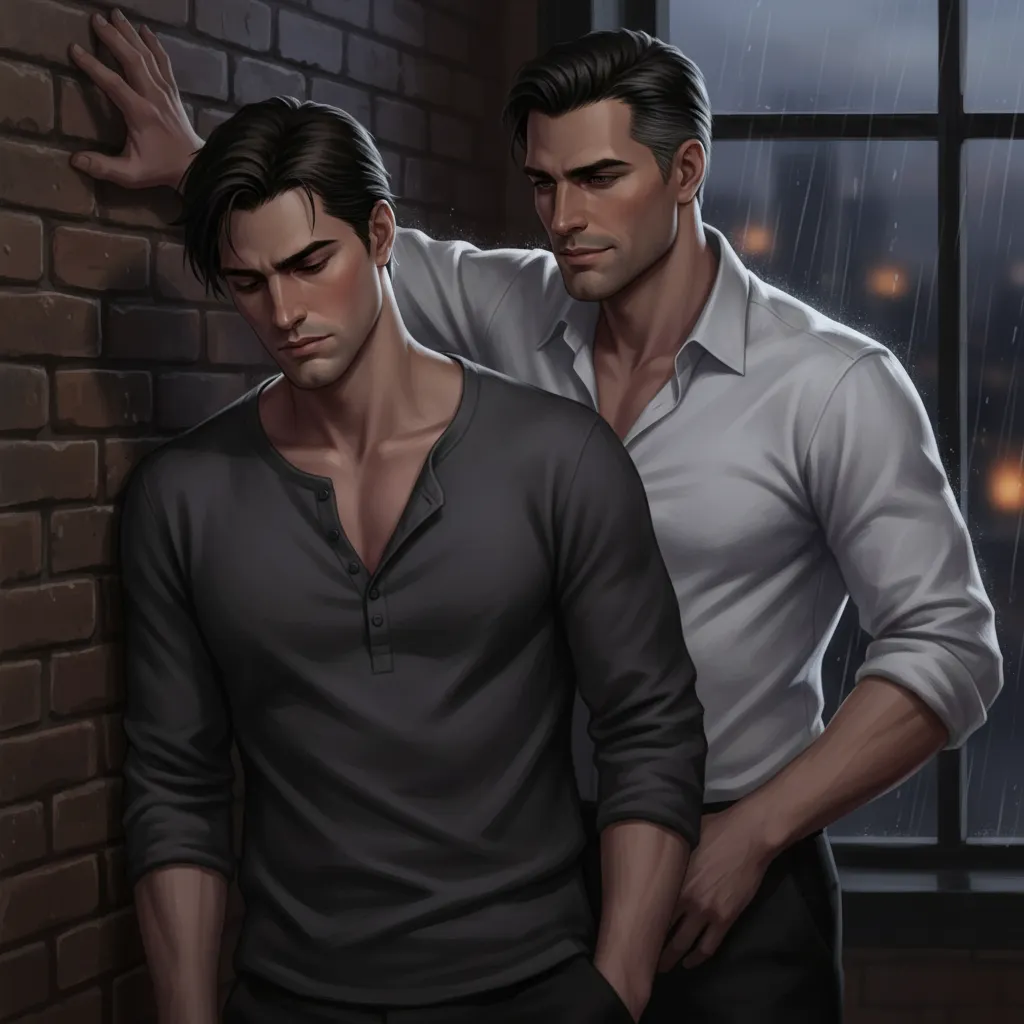
Caleb arrived at his office before dawn, the city still dark and quiet around the building’s concrete bones. He flicked on the single lamp at his desk, the honeyed light pooling across the broad oak surface, and for a long moment he just stood there, his palms flat on the cool, smooth wood. The air smelled of old paper and warm leather, a familiar sanctuary. He needed the sanctuary today.
Last night lived in his muscles. The memory of Thomas’s hands, the heat of another body after so many months of careful distance, the shocking rightness of it—it was a tremor in his foundation. He’d woken alone in Thomas’s bed, the sheets tangled and smelling of them both, and had dressed in silence while his friend slept on. He’d left a note on the kitchen counter: “Thanks for the couch. -C.” A lie so pathetic it made his jaw clench.
So he worked. He buried himself in blueprints for a lakeside renovation, losing himself in lines and angles, in load-bearing calculations and the poetry of cantilevered decks. The sun rose, casting long shadows across his drafting table. He didn’t answer his phone. He ignored the low hum of the city waking up outside his window. He focused on the graphite smudging his fingertips, on the precise world he could control.
His intercom buzzed at ten-thirty, a sharp, unwelcome sound. His assistant’s voice, tinny through the speaker. “Mr. Thorne? Your eleven o’clock is here. Elias Kane?”
Caleb ran a hand through his dark, unruly hair. He’d forgotten. A new client, a gallery owner. A consultation. “Send him in,” he said, his voice rough from disuse.
The door opened. Elias Kane entered not with a step, but with an arrival. He filled the doorway, then the room, his presence a shift in atmospheric pressure. He was older, mid-thirties, with sharp angles and silver threading his temples. His suit was a severe, impeccable charcoal, and his eyes were the dark, focused black of obsidian.
“Caleb Thorne,” Elias said. It wasn’t a question. His voice was precise, economical. He didn’t offer a hand. He simply took in the room, the scattered blueprints, the man behind the desk, with a slight tilt of his head.
“Mr. Kane.” Caleb stood, gesturing to the chair opposite. “Please.”
Elias moved with a predatory elegance, settling into the chair as if assessing it for acquisition. His gaze never left Caleb. “I’ve seen your work on the Modernist restoration on Elm. The restraint was… notable.”
“It needed restraint.” Caleb sat back down, forcing himself to meet that unblinking stare. “The structure spoke for itself.”
“Indeed.” A faint, almost imperceptible curve touched Elias’s mouth. It wasn’t a smile. “Most people can’t resist adding their own voice. You listened. A rare quality.”
They discussed the project—a new gallery space, a challenging, narrow lot downtown. Elias spoke in clear, direct terms about light, about flow, about creating an experience. Caleb found himself leaning forward, engaged despite himself, his mind latching onto the problem. This was safe ground.
Then Elias set his portfolio down on the desk, his movements deliberate. “Your reputation precedes you, of course. The architect who has removed himself from the… fray.”
The words landed in the space between them, heavy and specific. Caleb stilled. “I focus on my work.”
“A year, I hear.” Elias’s head tilted again, analyzing. “A principled stand. After a betrayal.”
A cold flush crept up Caleb’s neck. He said nothing. The memory of last night—Thomas’s breath on his skin, his own willing surrender—flashed behind his eyes, a searing contradiction to the vow sitting in this man’s mouth.
“I admire integrity,” Elias continued, his voice dropping, becoming more intimate in the quiet room. “It’s the most compelling form of beauty. And the most fragile.” His gaze traveled over Caleb’s face, down to the open collar of his shirt, to the strong line of his shoulders. “It creates a… powerful tension.”
Caleb felt seen in a way that had nothing to do with his designs. It was a dissection. His hand tightened around his pencil. “The tension isn’t the point. The work is.”
“Isn’t it?” Elias rose, not to leave, but to circle the desk. He stopped beside Caleb’s chair, close enough for Caleb to smell the clean, cold scent of his cologne. “The work is a product of the man. The discipline. The *no*.” He reached out, not touching Caleb, but his fingers hovered over a blueprint, tracing a proposed wall line. “It makes everything you do… deliberate. Potent.”
Caleb’s breath caught. He was pinned by that gaze, by the heat of the other man’s proximity. His own body betrayed him, a slow, unwinding heat in his gut that had nothing to do with anger. He thought of Thomas’s hands again, and shame twisted with a sudden, shocking spike of desire.
Elias leaned down, his mouth near Caleb’s ear. His voice was a low vibration. “I don’t want an architect who says yes to everything, Caleb. I want one who understands the value of a threshold. The power of what lies on the other side of a door kept deliberately closed.”
He straightened then, leaving the words hanging in the honeyed air. He placed a crisp, white business card on the desk, precisely aligned with the edge. “Think on it. The gallery, and the philosophy.”
Elias Kane left as quietly as he had entered, closing the door with a soft, definitive click.
Caleb sat motionless. The office, his sanctuary, felt different. Charged. The ghost of the man’s presence remained, a scent, a pressure. He looked at the business card. He looked at his own hands, the calluses, the faint tremor in his fingers.
The “year of no” had been a wall he’d built for himself, stone by stone. Last night, with Thomas, he’d stumbled through a hidden door in it. Now Elias Kane stood outside, not asking for a door to be opened, but admiring the fortification itself. Wanting to study the lock.
Caleb put his head in his hands. The blueprints in front of him were just lines. Meaningless. All he could feel was the terrifying, exhilarating sense that his foundations were no longer steady. And that someone, somehow, had just noticed.
Caleb pushed back from his desk, the chair legs scraping against the hardwood floor. He crossed the room to the tall window that overlooked the street below. His palms pressed flat against the cool glass.
Down on the sidewalk, Elias Kane emerged from the building’s entrance. He didn’t pause to look back. He turned left with that same predatory elegance, his charcoal suit a stark, moving shadow against the pale concrete. He disappeared around the corner without a hesitation, as if he’d already catalogued the entire street and found it lacking.
Caleb’s breath fogged the glass. He watched the empty space where the man had been.
The office was too quiet. The low hum of the city felt distant, muffled. The scent of Elias’s cologne—clean, cold, like frost on stone—still lingered near his desk, a ghost in the honeyed light.
He turned away from the window. His gaze fell on the business card, a white rectangle perfectly aligned with the edge of his desk. The name was etched in a severe, minimalist font. Elias Kane. Collector.
Caleb didn’t touch it. He walked back to his chair but didn’t sit. He stood behind it, his hands gripping the worn leather of the headrest. His knuckles were white.
The gallery project was brilliant. Challenging. Exactly the kind of work he craved. It was also a trap. He knew it. Elias had woven the professional and the personal together with surgical precision. Admiring the restraint in his work while dissecting the restraint in his life.
“The power of what lies on the other side of a door kept deliberately closed.”
The words echoed. They vibrated in his chest. They made a mockery of last night.
With Thomas, there had been no door. Just warmth in the dark, a shivering body, and a surrender so complete it felt like drowning. He’d broken his vow in a silent, desperate gasp. He’d called Thomas a good friend afterward. The lie tasted like ash.
Now Elias framed the vow itself as a thing of beauty. A deliberate threshold. Caleb felt like a fraud standing in the wreckage of his own principles.
His intercom buzzed again, jerking him from the spiral. He stared at it. The sound was an intrusion.
He reached over and pressed the button. “Yes.”
“Your twelve-thirty is here, Mr. Thorne.” His assistant’s voice was carefully neutral. “Leo Vance?”
Leo. A client. A different project. A normal man with normal demands. The thought was a lifeline.
“Send him in,” Caleb said. He took a deep breath, forcing his shoulders down, his expression into something professional. He swept the Elias Kane blueprint to the side, replacing it with the file for Leo’s restaurant renovation. He left the business card where it was.
The door opened. Leo Vance filled it differently than Elias had. He was sunshine and open windows. Mid-twenties, with a shock of blond hair and a smile that seemed genuinely pleased to be here.
“Caleb! Man, it’s good to see you.” Leo strode in, his hand already extended. His grip was firm, warm. “Sorry I’m a little early. Got excited.”
“Not a problem,” Caleb said, the practiced calm settling over him like a coat. “Please, sit.”
Leo dropped into the client chair, his energy making the leather seem less severe. He launched into an update on the restaurant’s permits, his hands moving as he talked. Caleb nodded, making notes, asking the right questions. This was the script. This was safe.
But his focus was thin. He kept seeing the obsidian black of Elias’s eyes. Feeling the heat of his proximity beside the chair.
“—and the wife thinks we should do a green tile backsplash, but I’m telling her, Caleb Thorne said exposed brick, so we’re doing exposed brick.” Leo grinned, leaning forward conspiratorially. “You’re the expert. Besides, everyone’s talking about your work lately.”
Caleb’s pencil stilled. “Are they.”
“Oh, yeah. The Elm Street restoration? People are calling it a masterpiece of restraint.” Leo’s gaze was admiring, but it traveled over Caleb’s face, down to his shoulders. “It’s got a… quiet power, you know?”
The phrasing was too close. A cold trickle traced Caleb’s spine. He set his pencil down carefully. “It’s just good bones.”
“It’s more than that.” Leo’s smile softened, turned thoughtful. “It’s the architect. People notice when someone… steps back. Holds themselves apart. It’s intriguing.”
There it was again. Not the work. The man. The myth he’d accidentally built by hiding.
Caleb felt a flush creep up his neck. This wasn’t predatory analysis like Elias. This was something warmer, more inviting. Just as dangerous.
“I appreciate that,” Caleb said, his voice tighter than he intended. “Let’s focus on the vent hood specs. The masonry will need additional support.”
He steered the conversation back to steel beams and load ratings. Leo followed, but his eyes kept returning to Caleb’s hands, to the line of his jaw. The admiration in the room was a palpable, gentle heat.
When the meeting ended, Leo stood, shaking Caleb’s hand again. His grip lingered a second too long. “Really great to see you, Caleb. Let’s grab a drink sometime. Talk design. Life. Whatever.”
“Sure,” Caleb said, the non-commitment automatic.
Leo left with a final, bright smile. The door closed.
Silence rushed back in, louder than before. Caleb stood in the middle of his office, surrounded by the ghosts of two very different men. One who saw his walls as fortifications to admire. One who saw them as an invitation to knock.
He looked at the business card. Then at his closed door.
His year of “no” wasn’t a quiet retreat. It was a beacon. And he was just now realizing he was the one standing in the light, blinking, exposed, while every hungry eye in the city adjusted to the dark and began to walk toward him.
Caleb couldn't stay in the office. The air felt thick with evaluation, the leather chair still holding the impression of two different kinds of want. He grabbed his coat and left, the city’s gray afternoon a relief after the honeyed, trapped light of his desk.
He walked without direction. The chill bit through his wool coat, a clean, physical sensation to ground him. He focused on the rhythm of his boots on the pavement, the steam rising from a manhole cover, the distant wail of a siren. Anything but the echo of Leo’s admiring gaze or the surgical precision of Elias’s words.
He turned into the small park that cut through the financial district, a strip of stubborn green between granite and glass. It was nearly empty. A few pigeons, an old man on a bench. The quiet was a balm.
“Hey! Watch out!”
The voice was cheerful, not alarmed. Caleb looked up just as a soccer ball arced toward his head. He caught it on instinct, the leather cool and slightly damp against his palms.
A man jogged toward him, a grin splitting his face. He was all easy movement and coiled energy, dressed in running gear despite the cold. His red hair was a bright shock against the drab day, and his green eyes crinkled with apology.
“Sorry about that,” the man said, his breath puffing in the air. “My kick’s a little ambitious for the space. Thanks for the save.”
“No problem,” Caleb said, handing the ball back.
The man took it, tucking it under his arm. He didn’t move away. His gaze swept over Caleb, quick and assessing. “You’re Caleb Thorne.”
Caleb stilled. “Do I know you?”
“Nope. But I know your work. The repurposed warehouse on the west side? The one with the steel staircase that looks like a spine?” The man’s smile widened. “I’m Finn. Finn O’Sullivan. I’m in construction. Well, demolition mostly. I take things apart. You put them back together better.”
“I’ve heard of O’Sullivan Wrecking,” Caleb said, the professional part of his brain engaging on autopilot. They had a reputation for clean, efficient work.
“That’s the family business.” Finn shrugged, but his posture was proud. “I like the destructive part. There’s a purity to it. But what you do… that’s alchemy.”
The admiration was familiar now, a pattern Caleb was learning to dread. But Finn’s delivery was different. Open. Friendly. There was no predatory stillness like Elias, no warm invitation like Leo. This felt like genuine, enthusiastic interest.
“It’s just a job,” Caleb said, the deflection becoming a reflex.
“Bullshit.” Finn laughed, the sound echoing in the quiet park. “It’s a calling. I can tell. You’ve got the look.”
“What look is that?”
“The look of a guy who sees what something could be, not just what it is.” Finn’s eyes held his, a direct, green challenge. “It’s a quiet look. Most people miss it. I don’t.”
Caleb felt seen again, but the edge felt different. Softer. Or better disguised. He shifted his weight, suddenly aware of the cold seeping through his shoes. “I should let you get back to your game.”
“Game? Nah, just killing time. Actually, I’m glad I ran into you.” Finn’s tone was casual, but his gaze was intent. “I’ve been wanting to pick your brain. There’s a site I’m clearing next month—old textile mill. The bones are insane. The kind of thing you’d appreciate.”
He pulled out his phone, swiping quickly before turning the screen to Caleb. It showed a photo of a vast, derelict space, sunlight spearing through broken roof panels onto massive timber columns. It was beautiful in its decay.
Caleb’s breath caught. He couldn’t help it. “Those beams are heart pine. You can’t find that anymore.”
“See?” Finn said, triumph in his voice. “You get it. Most developers would just see square footage. You see a cathedral.” He put his phone away, his movement deliberate. “Let me buy you a coffee. I’ll show you the rest of the photos. Tell me how to save it.”
The offer was wrapped in professional interest. It was logical. It was about the work, the bones of a building, not the bones of Caleb’s life. It felt like a lifeline back to something pure.
“Okay,” Caleb heard himself say. “One coffee.”
Finn’s grin was brilliant. “Great. There’s a place just off the park. They don’t burn their beans.”
He fell into step beside Caleb, his stride matching Caleb’s slower, measured pace. He talked easily about the mill, about the challenges of pulling it down without damaging the salvageable elements. His enthusiasm was infectious, his knowledge deep.
But as they walked, Caleb felt a hand clap his shoulder, a friendly, solid weight that lingered just a beat too long before Finn pulled it back to gesture at a building facade. He felt the brush of Finn’s arm against his own as they navigated a crowded sidewalk, a contact that wasn’t quite accidental.
At the coffee shop, Finn held the door open. His eyes swept over Caleb as he passed through. “After you.”
The gesture was polite. The look was not. It was a scan, an appreciation of the broad line of Caleb’s shoulders under the coat, the cut of his jaw. It was the look of a man who took things apart to understand how they were made. Caleb missed it completely, his guard lowered by talk of timber and tension.
He was just grateful, for the first time all day, to be talking about something that made sense. Something he could control. He didn’t see the friendly, predatory edge in Finn’s green eyes, or recognize the hunt disguised as a shared passion. He only felt the relief of a normal conversation, and the dangerous, seductive illusion that this one was different.
The coffee shop was warm, smelling of roasted beans and steamed milk. Finn led them to a small table in the back, away from the window. He shrugged out of his running jacket, revealing a tight-fitting thermal shirt that clung to the hard lines of his shoulders and chest. Caleb hung his wool coat on the back of his chair, the leather cool against his knuckles.
“So,” Finn said, leaning forward as Caleb sat. His green eyes were bright with curiosity. “A year of no women. That’s the word on the street. True?”
The question landed like a physical blow. Caleb’s hand, reaching for the menu, froze. He looked up, the easy camaraderie of the park evaporating. “What?”
“Your vow. The celibacy thing.” Finn’s tone was still friendly, but there was a new edge to it, a testing probe. “It’s a pretty bold move. Makes a guy wonder what happened to inspire it.”
Caleb felt the walls slam up inside him. He forced his hand to complete the motion, picking up the laminated menu he had no intention of reading. “It’s personal.”
“Everything’s personal,” Finn countered, his smile not fading. “Especially the things we try to make professional. Like that mill. It’s just brick and wood until you learn its story. Then it’s alive.” He tilted his head, the red hair catching the overhead light. “So what’s your story, Caleb Thorne?”
The barista called their order. Finn stood to get it, moving with that same easy grace. Caleb watched him go, his mind racing. The relief he’d felt was gone, replaced by a familiar, cold tension. He saw the pattern now, clear and inevitable. Elias with his surgical analysis. Leo with his warm admiration. Now Finn, with his friendly interrogation. He was a curiosity. A project.
Finn returned, setting a black coffee in front of Caleb and keeping a cappuccino for himself. He sat, his knee brushing Caleb’s under the small table. He didn’t pull away.
“I’m not a story,” Caleb said, his voice low. He wrapped his hands around the ceramic mug, letting the heat seep into his palms. “And the mill isn’t a metaphor.”
“Isn’t it?” Finn took a slow sip, his eyes locked on Caleb over the rim of his cup. “You find something broken. You study it. You learn why it fell apart. Then you rebuild it, stronger. Sounds familiar.”
Caleb’s jaw tightened. He thought of Thomas. Of the shattering intimacy of last night, a violation of his own new foundation. He’d broken his vow before the cement had even dried. The shame was a sour taste in his mouth. “You don’t know what you’re talking about.”
“Maybe.” Finn set his cup down. He reached into his pocket and pulled out his phone again, but he didn’t unlock it. He just turned it over and over in his hands, a restless, thoughtful motion. “But I know how to read structures. I know stress points. I know when something is holding a tension that’s unsustainable.” His gaze lifted, direct and unflinching. “You’re holding a lot of tension, Caleb.”
The words were too close to Elias’s. Yet the delivery was different—warmer, more intimate. It felt like concern. It felt dangerous. Caleb’s pulse kicked against his ribs. He could feel the weight of Finn’s knee against his own, a steady, deliberate pressure.
“Why does it matter to you?” Caleb asked, the question gritted out.
“Because tension is interesting.” Finn’s voice dropped, leaning in. The space between them shrank. Caleb could see the faint freckles across the bridge of his nose, the sharp cut of his cheekbones. “It’s potential energy. It’s what exists right before something… releases.”
Caleb couldn’t look away. The coffee shop noise faded to a hum. He was aware of everything—the heat of the mug in his hands, the press of Finn’s leg, the focused intensity in those green eyes. He felt seen, but not dissected. Appraised, but not as a specimen. As a man.
Finn’s phone buzzed on the table. The spell broke. Finn glanced at it, a flicker of annoyance crossing his face before he looked back at Caleb. “I have to go. A beam came down early.” He stood, pulling his jacket on. “But I want to show you that mill. For real.”
Caleb just nodded, unable to form words.
Finn paused beside the table. He placed a hand on Caleb’s shoulder. The grip was firm, grounding. “Think about it. All that beautiful, salvageable timber. It’s a waste to just knock it down.” His thumb pressed once, deliberately, into the muscle. Then he released. “See you around, Caleb.”
He was gone, the bell on the door jingling in his wake. Caleb sat motionless. The ghost of Finn’s touch burned on his shoulder. The imprint of his knee lingered on Caleb’s thigh.
He looked down at his own hands, clenched around the cooling coffee. He thought of Thomas’s quiet breathing in the dark, of the line they’d crossed and the friendship he’d jeopardized. He thought of Finn’s easy smile and probing questions, a different kind of line being drawn.
The vow felt like a lie. The “year of no” was already fractured. And instead of pushing them away, his isolation seemed to be drawing everyone in. He was a locked door, and every man he met now seemed to hold a different key.
Caleb sat in the empty coffee shop for a long time, the cold ceramic of his mug the only real anchor. He pulled out his phone. His thumb hovered over Thomas’s name. The text he typed was a raw, unfiltered spill of words, something he’d never send to anyone else.
Three different men today. All looking at me like I’m a puzzle they want to solve. Or a lock they want to pick. The vow feels like a joke. It didn’t even last a night.
The reply came quickly, as if Thomas had been waiting. The words were calm, a balm to Caleb’s jagged edges. Your vow was no women. You haven’t broken it. What happened with me… that’s different. Friends help each other. It’s not so different from taking care of yourself, which you were bound to do anyway in a year.
Caleb stared at the screen. The logic was clean, surgical. It carved out a loophole he desperately wanted to believe in. He typed again, his fingers clumsy. It didn’t feel like taking care of myself. It felt like you.
This time, the pause was longer. Caleb watched the three dots appear and disappear, appear again. The final message was simple. I know.
Then another came. These other guys. The gallery owner, the contractor. They see the vow. They see the challenge. They don’t see you.
Caleb’s breath caught. He read the last line twice. I saw you last night. All of you. The broken parts and the quiet ones. I’ve always seen you.
The coffee shop air felt too thick. Caleb’s chest was tight. This wasn’t reassurance anymore. This was a claim, staked in the soft, ruined earth of Caleb’s resolve. Thomas wasn’t telling him to avoid the other men. He was drawing a line in the sand only he stood behind.
Caleb didn’t know how to answer. He put his phone away, the silence from Thomas now a palpable weight in his pocket. He paid for the coffee and stepped back out into the late afternoon. The city moved around him, but he felt static, trapped in the echo of Thomas’s words.
He walked without direction, the ghost of Finn’s hand on his shoulder, the memory of Elias’s dissecting gaze, the warmth of Leo’s admiration all swirling together. And underneath it all, the solid, devastating truth of Thomas in his bed. Thomas, who had been there for years. Thomas, who had touched him not as a conquest, but as a confession.
His feet carried him back to his office building, a reflexive retreat to the one space that was supposed to be his. The lobby was quiet. He rode the elevator up, the mirrored walls showing a man with shadows under his eyes, his usually crisp shirt rumpled from the day.
His office door was ajar.
Caleb stopped, his hand freezing on the handle. He’d locked it. He was certain. The hair on the back of his neck stood up. He pushed the door open slowly.
Elias Kane stood at the broad oak desk, his back to the door. He wasn’t touching anything. He was simply looking at the neat stacks of blueprints, the model of a bridge Caleb had been tinkering with, the framed photo of an old building—a personal touch, not a professional one. He turned as Caleb entered, his movement fluid, unsurprised.
“The cleaning staff are remarkably accommodating with a gallery membership,” Elias said, his voice a low hum in the dim, honeyed light. “I let myself in. I hope you don’t mind.”
“I do,” Caleb said, the words coming out flat. He didn’t move from the doorway. “What do you want, Elias?”
“A conversation we didn’t finish.” Elias’s sharp eyes took in Caleb’s dishevelment, the tension in his shoulders. “You left our meeting abruptly. I found myself… concerned.”
“I’m fine.”
“You’re not.” Elias took a single step closer, not invading, but reducing the space. The scent of his crisp, citrus-tinged cologne cut through the smell of old paper and leather. “You look like a man who’s just realized the walls he built have windows, and everyone outside is looking in.”
Caleb’s jaw clenched. “Is that your professional assessment?”
“It’s my human one.” Elias tilted his head, the silver at his temples catching the lamplight. “The vow is a beautiful construct, Caleb. But it’s drawing attention you didn’t anticipate. From men like Leo Vance, who appreciates a fine, restrained surface. From men like that contractor you had coffee with—Finn, was it? Who appreciates solid foundations and the tension before a collapse.”
“You’re following me now?” A cold anger stirred in Caleb’s gut.
“Observing.” Elias’s correction was gentle, precise. “I observe beautiful things. And right now, you are the most compelling thing in this city. A man of principle, visibly wrestling with a fracture in his own resolve. It’s… exquisite.”
He moved then, not toward Caleb, but to the side of the desk. He trailed his fingertips along the cool, smooth oak. “They all want something from you. Validation. A conquest. A story.” He looked up, his gaze locking onto Caleb’s. “I just want to understand the composition. The why of it.”
Caleb felt stripped bare. Elias’s words were a scalpel, laying him open more cleanly than any of the others. He thought of Thomas’s text. They don’t see you. Elias saw the pieces, the architecture of his pain, and found it beautiful. It was a violation more intimate than a touch.
“Get out,” Caleb said, the words barely audible.
Elias didn’t flinch. He gave a slow, almost imperceptible nod, as if Caleb had just confirmed a hypothesis. “Of course.” He walked to the door, stopping when they were shoulder to shoulder in the threshold. He didn’t look at Caleb. He looked straight ahead, his profile severe in the low light. “When the curiosity from the others becomes a burden,” he said, his voice dropping to a murmur meant only for Caleb, “remember my offer. I appreciate integrity. And I know how to protect what’s rare.”
He left, his footsteps silent on the hall carpet. Caleb stood in the center of his office, the space suddenly feeling both too large and too small. He was shaking. He walked to the desk and placed his palms flat on the oak, leaning his weight into it. The wood was solid. Unchanging.
His phone buzzed in his pocket. He didn’t need to look to know it was Thomas. A check-in. A silent pull from the only man who wasn’t asking for a piece of him, but who had already taken something Caleb hadn’t known he’d given away.
Caleb closed his eyes. The vow was a lie. The year of no was a beacon. And he was adrift in a sea of wanting, with Thomas’s claim the only shore in sight.
Caleb pulled the phone from his pocket. The screen glowed with Thomas’s name. No new message, just the last one hanging there like a lifeline. He typed a single word. Elias was here. In my office.
The reply was immediate. Are you safe?
He’s gone. Caleb’s thumbs felt clumsy. He talked about me like I was an exhibit. Said I was exquisite.
Where are you now?
Still at the office. Caleb looked around the shadowed room. The lamp’s honeyed light now felt like a spotlight. It feels contaminated.
Then leave. Thomas’s text was a command, simple and direct. Come here.
Caleb stared at those two words. Come here. Not an invitation. A summons to the only place that hadn’t felt like a negotiation today. The shore. His chest ached with a sudden, desperate need for it.
He didn’t answer. He just moved. He shut off the lamp, plunging the office into the deep blue gloom of early evening. He locked the door, testing the handle twice. The elevator ride down was a silent descent. The lobby was empty save for the security guard, who gave a nod Caleb didn’t return.
The city air was cool, a shock after the closed-in stillness of his building. He walked, his strides long and purposeful. He didn’t think about Elias’s dissection, or Finn’s probing friendliness, or Leo’s admiring gaze. He focused on the mechanics of movement. Left, right. Breathe in, breathe out. The rhythm was a poor substitute for calm.
Thomas’s apartment building was a brick-faced walk-up, unassuming. Caleb took the stairs two at a time, his heart hammering by the time he reached the third-floor landing. He didn’t knock. He turned the knob—unlocked—and pushed inside.
The living room was warm, lit by a single floor lamp. The smell of garlic and oregano hung in the air. Thomas stood in the small kitchenette, his back to the door, stirring something in a pot. He didn’t turn around.
“You didn’t text back,” Thomas said, his voice calm. He kept stirring.
“You told me to come.” Caleb shut the door, the click of the latch loud in the quiet. He leaned against it, the solid wood at his back. “So I came.”
Thomas finally turned. He was wearing a faded gray t-shirt and sweatpants, his feet bare. He looked ordinary. Real. His eyes scanned Caleb—the rumpled shirt, the tight set of his jaw, the shadows under his eyes. He didn’t speak. He just looked.
Under that quiet gaze, the last of Caleb’s composure cracked. “He was just standing there. At my desk. Like he owned the view.”
Thomas set the wooden spoon down on a rest. He walked over, stopping a few feet away. Not touching. Just being there. “What did he want?”
“To understand the composition,” Caleb said, the words bitter on his tongue. “That’s what he called it. The why of me. My beautiful, principled fracture.” He ran a hand through his hair, the gesture agitated. “He made it sound artistic. It felt like an autopsy.”
Thomas was silent for a long moment. His expression was unreadable. Then he said, “He’s wrong.”
“About what?”
“It’s not a fracture.” Thomas took a single step closer. The space between them hummed. “It’s a fault line. And it was there long before your vow.”
Caleb’s breath hitched. The truth of it was a physical blow. Thomas saw it. Thomas had always seen it. The quiet, seismic shift in Caleb that his ex had exploited, that his vow had tried to plaster over. “I don’t know how to do this,” Caleb whispered. The admission left him hollow.
“Do what?” Thomas’s voice was soft.
“Any of it. Be the man who says no. Be the man who…” He trailed off, his eyes dropping to Thomas’s mouth, then flicking away. “The man who broke his promise the first night.”
“Look at me.”
Caleb’s gaze snapped up. Thomas’s eyes were dark, intent. There was no pity in them. Only a stark, unwavering recognition.
“You didn’t break a promise with me,” Thomas said, each word deliberate. “You showed me where the break already was. Letting me touch you wasn’t a failure, Caleb. It was the truth.”
Caleb felt the words sink in, hot and undeniable. They stripped away the pretense, the self-flagellation. What remained was raw, exposed nerve. The memory of Thomas’s hand on him, not as a transgression, but as an acknowledgment. A communion.
He was trembling. A fine, uncontrollable shake that started deep in his core. He clenched his hands into fists to stop it.
Thomas saw it. He closed the remaining distance. He didn’t embrace him. He simply reached out and pried Caleb’s right hand open, his own fingers warm and sure. He interlaced their fingers, pressing their palms together. The contact was electric, grounding.
“They all want the idea of you,” Thomas murmured, his thumb stroking the side of Caleb’s hand. “The architect on his lonely pillar. The challenge. The story.” He lifted their joined hands slightly. “I want the man whose hands shake.”
Caleb made a sound, a choked-off thing that was half sob, half surrender. He leaned forward, his forehead coming to rest against Thomas’s shoulder. The worn cotton of the t-shirt was soft against his skin. He inhaled—laundry soap, garlic, the unique, warm scent of Thomas underneath. A scent that felt like coming home to a place he’d never known he’d left.
Thomas’s free hand came up to cradle the back of Caleb’s head, his fingers threading into the dark, unruly hair. He held him there, solid and unmoving, as the last of the day’s defenses crumbled. Caleb didn’t cry. He just breathed, each inhale pulling that anchoring scent deeper into his lungs.
After a long while, Thomas spoke, his voice a vibration against Caleb’s temple. “The year of no women stands. If you want it to.”
Caleb pulled back just enough to see his face. “And what about you?”
Thomas’s mouth quirked, not quite a smile. “I was never part of that vow. I’m the friend who helps. Remember?” His gaze dropped to Caleb’s lips, then back to his eyes. The air between them thickened, charged with everything unsaid from the night before. “The question is,” Thomas continued, his voice dropping to a husk, “what do you need help with right now?”
Caleb’s whole body went still. The trembling stopped. A different kind of heat flooded him, slow and inevitable. He looked at Thomas—at the steady certainty in his eyes, at the mouth that had spoken a claim Caleb could no longer deny. The office, Elias, the vow—it all receded, white noise against the thunder of his own heartbeat.
He knew what he needed. The need was a physical ache, a hollow yearning only one thing could fill. He leaned in, his lips a breath from Thomas’s ear. “Make me forget I have a name,” he whispered, the words a raw, honest scrape. “Just for a little while.”
Thomas went utterly still. Then his hand, still tangled in Caleb’s hair, tightened. A possessive, claiming pressure. “Yes,” he breathed, the word a vow of its own.