
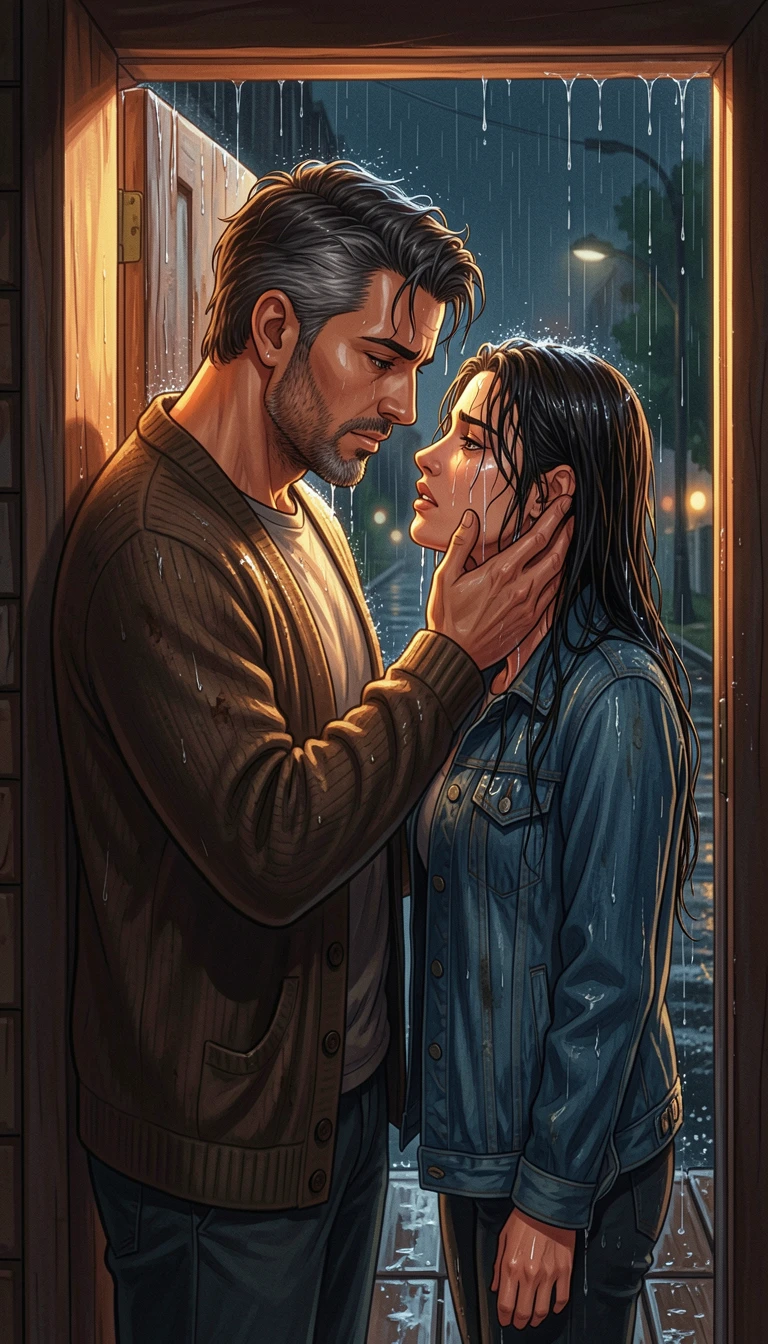
Three sharp knocks—the kind that said someone had been standing in the rain too long, had decided they'd rather be rude than stand there one more second—cut through the low hiss of the television. John muted the documentary he hadn't been watching and glanced at the clock. Quarter past eleven. Rain streaked the front window, distorting the porch light into a blur of sick yellow.
He crossed the thin carpet in four strides, already reaching for the deadbolt. The hallway smelled like floor wax and the chili Estella had made for dinner, the air close and warm. He'd left his reading glasses on the coffee table, and without them the world was soft at the edges—the door a rectangle of dark wood, the brass knob glinting dully.
The chain rattled as he slid it free. When he pulled the door open, the cold hit him first—a wet, mean cold that flattened the warmth from the hallway. Then the wind, carrying rain that misted across his face. Then her.
A woman stood under the porch light, shoulders hunched, arms wrapped around herself. She was soaked through—denim jacket dark and heavy with water, dark hair plastered to her scalp and cheeks. Her lips were pale. She was shaking, a fine tremble that ran through her whole body, and when she looked up at him, he saw large brown eyes that held a familiarity that made something in his chest tighten before his mind caught up.
"John." Her voice cracked on the single syllable. She cleared her throat, tried again. "Hey."
He knew that voice. Knew those cheekbones, that sharpness beneath the waterlogged softness. The years between them fell away like a curtain slipping its rod, and he was twenty-seven again, barefoot in Luna's apartment, watching a younger version of this face push through the front door with a twelve-pack and a smirk.
"Ana." Her name came out rough, surprised. "Jesus—what are you—"
She shook her head, the motion small, almost apologetic. "I know. I know. This is—I didn't know where else to—" She broke off, teeth chattering, and hugged herself tighter. Water dripped from her chin. A puddle was forming on the welcome mat.
John stood aside before he'd finished deciding to. "Get in. Come on—get in."
She hesitated. One heartbeat. Two. Then she stepped over the threshold, and the porch light caught the shape of her through the wet denim—her ribs pressing against the fabric, the hollow of her throat, the sharp line of her collarbone. She was thinner than he remembered. That was the first thing he noticed, after the shock. Thinner, and her eyes held shadows her older sister's had never carried.
The door clicked shut behind her, and the rain went quiet. The hallway felt smaller with her in it. She stood just past the mat, dripping onto the thin carpet, water running in rivulets down her jeans. She was leaving a trail of wet footprints that would darken the beige into a deeper tan, and she seemed to notice it too—she made a small sound, almost a laugh, and looked down at her feet.
"Sorry. I'm getting your floor wet."
"I don't care about the floor." John grabbed a folded towel from the hall closet—the good one, the thick one Estella had bought at the farmer's market—and held it out to her. "Here. You're freezing."
She took it, but didn't use it right away. She just held it, her fingers curling into the fabric, and looked at him. Really looked—the way someone does when they're measuring the distance between who you were and who you've become. Her eyes moved across his face, and he felt the weight of that inventory in his own chest.
"You look good," she said. Quiet. Almost reluctant. "Older. But good."
"You look like you need dry clothes." He kept his voice even, though the familiarity of her—the angle of her jaw, the way she tilted her head when she was thinking—was settling into his ribs like something he'd forgotten he'd been carrying. "I've got a sweatshirt. Maybe some sweatpants. They'll be big on you, but—"
She shook her head. "Don't—I don't need you to—" She stopped, pressed the towel to her face, and when she lowered it, her expression had shifted. The sharpness was back, a thin armor. "How long have you lived here?"
"Three years. Almost four."
"With—" She hesitated. The unspoken name hung between them, a third presence in the narrow hallway. He didn't fill the silence. He'd learned, somewhere in the years since he'd last seen her, that silence was a gift—it gave people room to say what they actually meant.
"With Gloria," he said, when it was clear she wouldn't finish the question. "And Estella."
Ana's eyes flickered—surprise, maybe, or recognition. It was an unusual arrangement, even by the standards of the late-night conversations he'd once had with Luna's younger sister. She'd always asked good questions, Ana had. Paid attention.
"That's good," she said. "I'm glad." She meant it. He could tell. "You deserve that."
Something warm and sharp pushed through his chest. He didn't know what to do with it, so he gestured toward the living room with his chin. "Come on. Let's get you dry before you get hypothermia in my hallway."
She followed him into the living room, and he heard the wet squelch of her sneakers with every step. The television was still on, muted, the documentary showing a slow-motion shot of a glacier calving into the sea. Estella had left a throw blanket draped over the armchair—the one she'd knitted herself, a messy thing of mismatched colors that Gloria pretended to hate but was always the first to grab on cold nights.
Ana stood in the center of the room, dripping onto the hardwood, and looked around. He watched her eyes move across the bookshelves, the framed photographs, the half-empty coffee mug on the end table. She was reading the room the way she'd once read people—quick, thorough, storing details.
"This is nice," she said. "It feels like you." She paused, then added, "I mean—I barely know you anymore. But it feels like you."
"That's a long time." He said it gently, not as a weapon. "Seven years, maybe?"
"Eight." She didn't look at him when she said it. "Luna's in California. Did you know that?"
He hadn't. He shook his head, and Ana's mouth tightened into something that wasn't quite a smile.
"She is. She's doing well. Has a house in Berkeley. A vineyard, if you can believe it." A pause. "She doesn't know I'm here."
The words landed in the quiet room, heavy and specific. John turned them over, let the implications settle. Beside them, the glacier on the television broke apart into the sea.
"Ana." He said her name carefully. "What happened?"
She opened her mouth, but before she could answer, footsteps creaked from the hallway—soft, unhurried, the sound of someone who'd woken from a light sleep and was following the noise. John turned, and Estella appeared in the doorway, her dark curls a mess, her eyes half-lidded, wearing one of his old t-shirts and a pair of shorts. She blinked at the scene: her husband, the shivering woman, the puddle on the floor.
"John?" Her voice was rough with sleep, but alert. "Who's—"
Ana turned, and the two women looked at each other. Estella's hummingbird tattoo caught the lamplight as she reached up to tuck her hair behind her ear—a small, unconscious gesture, but Ana watched it like she was memorizing a room's exits.
"Estella." John stepped between them, not blocking, just bridging. "This is Ana. She's an old friend." The word felt too thin, too simple, but it would have to do. "Her car broke down, I think. She needed somewhere to get warm."
The lie was clumsy and he knew it. Estella's eyes narrowed for half a second before her face softened into something else—something warmer, curious. She stepped forward, barefoot, and extended her hand.
"Hi. Any friend of John's is—well, you're soaking wet. Let me find you something dry." She was already moving, her hand brushing John's arm as she passed. "I've got a sweater that'll fit you. It's in the spare room."
Ana's hand, the one that had been gripping the towel, relaxed slightly. She looked at John, and there was something in her eyes he couldn't name—gratitude, maybe. Or warning.
"I don't want to be a burden," she said, quiet enough that Estella, already halfway up the stairs, couldn't hear. "I know this is—I know I'm showing up out of nowhere. But I didn't know where else to go."
"You're not a burden." He said it firmly, because he needed her to believe it, and because the sight of her—shivering in his living room, carrying shadows he didn't recognize—had opened something in him he'd thought was sealed. "Whatever's going on, you're not a burden. Okay?"
She looked at him for a long moment. Then she nodded, once, and the motion sent a drop of water sliding from her hair down her cheek. She didn't wipe it away.
"Okay." Her voice was barely a whisper. "Okay. Thank you."
Estella came back down the stairs with a folded sweater and a pair of sweatpants, and she pressed them into Ana's hands with a warmth that seemed to come from somewhere deeper than politeness. "The bathroom's down the hall, second door on the left. Towels are in the cabinet. Take your time."
Ana held the clothes against her chest. Her hands were shaking—from cold, from something else. She looked at Estella, then at John, and something in her face cracked, just slightly, before she smoothed it back into place.
"Thank you," she said again. And then, to no one in particular, quieter: "I don't deserve this."
She turned and walked down the hall before either of them could respond. John heard the bathroom door open, then close. The click of the lock.
Estella turned to him, her eyebrows raised. Her voice was low, meant only for him. "Old friend?"
He ran a hand through his hair. The rain was still coming down outside, hard and steady, drumming against the windows like someone asking to be let in.
It was already too late for that.
Estella's arms crossed. The hummingbird on her forearm flexed—wings stretching, a muscle memory of tension she probably didn't know she was telegraphing. She was still wearing his old t-shirt, the collar loose on her shoulder, her bare feet pressed against the hardwood like she was grounding herself for a conversation she hadn't planned to have.
"Old friend." She repeated the words like she was tasting them for something spoiled. "John. It's almost midnight. She's soaking wet. She looked at me like I was a door she wasn't sure she should walk through."
He ran his hand over his jaw. The stubble was rough, three days old. He'd been meaning to shave. "Her car broke down about ten miles out. She didn't have cell service. She remembered I lived around here."
"She remembered." Estella's eyebrows lifted. "How long since you've seen her?"
The question hung in the air, and he let it. The rain drummed against the windows, steady and insistent, and somewhere in the house a pipe creaked. He could hear the bathroom fan humming—Ana had turned it on. The sound was a thin white noise between them.
"A while," he said.
Estella studied him. Her large brown eyes, usually so warm, held something sharper now—not anger, not yet. Assessment. She was an art historian. She'd spent years learning to read what people didn't say. He'd forgotten, sometimes, that she read him the same way.
"A while," she repeated. "You're not going to tell me, are you?"
"There's nothing to tell." He said it gently, because he didn't want to fight her, and because the lie was already sitting wrong in his chest. "She needed help. I helped. That's all."
Estella's mouth tightened. She looked toward the hallway where the bathroom door was closed, the light bleeding under it. "She's pretty."
"She's—" He stopped. The word troubled rose in his throat, but he swallowed it. "She's in a bad place. I can tell."
"I can too." Estella's voice softened. She uncrossed her arms, and the hummingbird settled back into stillness against her skin. "I'm not accusing you of anything, John. But you're a bad liar, and I love you, and I'm going to find out eventually. So if there's something I should know—"
"There isn't." He met her eyes. "She's a friend. An old one. And she showed up on my doorstep in the rain, and I wasn't going to turn her away."
Estella held his gaze for a long moment. Then she nodded, once, and something in her shoulders relaxed. "Okay. I trust you."
She didn't add a but, but he heard it anyway.
The bathroom door clicked open. The sound was softer than he'd expected—the lock turning, the hinge complaining. Estella turned toward it, and John felt his own shoulders tighten as Ana stepped into the hallway.
She'd changed into the clothes Estella had brought her. The sweater was oversized—cream-colored, soft wool that hung to her thighs—and the sweatpants were cinched tight at her waist, the cuffs pooling around her ankles. Her wet hair had been towel-dried, pulled back from her face, and without the water plastering it to her skin she looked younger. Vulnerable. The sharp cheekbones were still there, the hollows beneath them, but the shivering had stopped, and color was returning to her lips.
She held her wet clothes bundled in one arm, pressed against her chest like a shield. Her eyes moved from John to Estella and back, taking inventory, measuring the distance between them.
"I hung my jacket over the shower rod," she said. "I hope that's okay. It's still dripping."
"It's fine." Estella's voice had shifted—warmer now, the hostess reflex kicking in. "Do you want something hot to drink? Tea? Coffee?"
Ana hesitated. She looked at John, and he saw the question in her eyes—how long am I staying—but she didn't ask it. "Tea would be good. Thank you."
"I'll put the kettle on." Estella moved past John, her hand brushing his lower back as she went—a small touch, possessive or reassuring, he couldn't tell. She disappeared into the kitchen, and the sound of water running filled the space she left.
Ana stood in the hallway, barefoot now—she must have left her wet sneakers by the bathroom door. Her toes were pale against the dark wood. She was still holding her wet clothes, and she looked small in the oversized sweater, smaller than he remembered, smaller than she'd looked even on the porch, dripping and shaking.
"She's nice." Ana's voice was quiet. "Your wife."
"She is."
"She's suspicious."
John didn't deny it. "She's smart."
Ana's mouth twitched—almost a smile, almost not. "You always did like smart women."
It was the first thing she'd said that sounded like the Ana he remembered. The dry humor, the quiet observation. He felt something loosen in his chest.
"Come on," he said, gesturing toward the living room. "Sit down. You look like you're about to fall over."
She followed him, her bare feet silent on the hardwood. She sat on the edge of the armchair—the one with Estella's knitted throw—and set her wet clothes on the floor beside her. Her hands found the hem of the borrowed sweater and held it, fingers curling into the wool like she was grounding herself in the fabric.
John sat on the couch across from her. The muted television still showed the glacier documentary, the ice blue and slow, calving into water that looked black. Neither of them spoke. The rain filled the silence, and from the kitchen came the sound of the kettle beginning to heat, a low rumble that built toward a whistle.
"You don't have to tell me," John said, after the quiet had stretched long enough to feel intentional. "Not tonight. But you should know—whatever it is, you're safe here. For as long as you need."
Ana looked at him. Her brown eyes held the shadows he'd noticed on the porch, but beneath them, something else flickered—gratitude, maybe, or disbelief. She didn't answer. She just held his gaze, and the kettle began to whistle.
Estella brought the tea in three mismatched mugs. She handed one to Ana first—the one with the chipped rim, the one Gloria always complained about—and then one to John, and then she sat on the arm of the couch, close enough that her knee pressed against his shoulder. She cradled her own mug in both hands, steam rising around her face, and watched Ana take her first sip.
"It's not fancy," Estella said. "Just chamomile. I figured you didn't need caffeine this late."
"It's perfect." Ana's voice was rough. She looked down into the mug, and for a moment, John thought she might cry. But she didn't. She blinked, twice, and when she looked up, her expression was calm again. "Thank you. Both of you. I know this is—I know it's strange."
"Life is strange," Estella said. She said it simply, without irony, and John felt her hand settle on his shoulder—a small pressure, a bridge. "I learned that when I married this one. It comes with the territory."
Ana's mouth curved—a real smile, brief but real. "He always did collect strange."
Estella's eyebrows went up. "You knew him before?"
The question was casual, but John felt the weight of it. He saw Ana feel it too—the pause before she answered, the careful way she set her mug down on her knee.
"A long time ago," Ana said. "We ran in the same circles."
"What circles?"
John opened his mouth, but Ana answered first. "He used to date my sister."
The words landed clean and quiet. Estella's hand stilled on his shoulder. He could feel her processing it, the math clicking into place—the familiarity, the history, the way Ana had looked at him on the porch like she was reading a page she'd already turned.
"Your sister." Estella's voice was even. "So you're—"
"Luna's little sister. Yeah." Ana's fingers tightened on the mug. "I know it's complicated. I know showing up here, like this—" She shook her head. "I didn't have anywhere else to go."
The rain hammered against the glass. John watched Estella's face, watched her work through it. He should have told her. He knew that. But he hadn't known how to say it—my ex-girlfriend's sister showed up at our door and I lied about why—and now the truth was sitting in their living room, shivering in Estella's sweater, and all he could do was wait.
"How long?" Estella asked.
Ana looked at her. "How long what?"
"How long do you need to stay?"
The question was practical, but it carried weight. Ana held Estella's gaze, and John saw something pass between them—an assessment, a negotiation happening without words.
"I don't know." Ana's voice was barely audible. "A few days, maybe. A week. I just—I need to figure some things out."
Estella was quiet for a long moment. Then she nodded, and her hand moved from John's shoulder to rest on her own knee. "Okay. We've got a spare room. It's not much—just a bed and a dresser—but it's dry, and the lock works."
Ana's breath caught. Just barely—a hitch, a sharp inhale that she tried to disguise as a sip of tea. "Thank you."
"Don't thank me yet." Estella's tone was light, but her eyes were steady. "I haven't shown you where the towels are."
It broke the tension. Ana let out something that was almost a laugh—a short exhale, her shoulders dropping—and John felt his own chest ease.
"We should let her sleep," he said. "She's been driving all night, probably."
Ana didn't correct him. She just set her mug down, stood, and picked up her wet clothes from the floor. "If you could just point me toward the room—"
"I'll show you." Estella stood, took her half-finished mug to the kitchen sink, and gestured for Ana to follow. "It's at the end of the hall. The bed's comfortable, but the blanket's thin—I'll grab you another one."
John watched them go. Estella's hand on Ana's shoulder, guiding her. Ana's bare feet on the hardwood, following without hesitation. The two of them disappearing down the hall, into the spill of light from the spare room.
He stayed on the couch. The tea was cooling in his hands. The rain was still falling, harder now, drumming against the roof like something trying to get in.
Estella came back a few minutes later. She stood in the doorway of the living room, her arms crossed again, but her face was softer now. "She's asleep already. Or pretending to be."
"Probably both."
Estella walked over and sat beside him on the couch. She leaned into him, her head finding his shoulder, her hand settling on his chest. He wrapped his arm around her and felt her breathe.
"You're going to tell me the rest," she said quietly. "Eventually."
"I know."
"Okay." She pressed a kiss to his jaw. "I love you anyway."
They sat like that for a long time, listening to the rain. The television had gone to static, the blue light flickering across the dark room. John's tea went cold in his hands.
From down the hall, through the thin walls and the closed door, he thought he heard something—a shift of weight, a breath drawn too sharp. He couldn't be sure. The rain was too loud, and the house was settling, and he was tired enough that his ears might be playing tricks.
But he didn't move. He stayed there, Estella warm against his side, and listened.
The knock had come. He'd opened the door. And now Ana was in the spare room, wearing Estella's sweater, and the rain was still falling, and the house was not the same as it had been an hour ago.
It was already too late for that.