
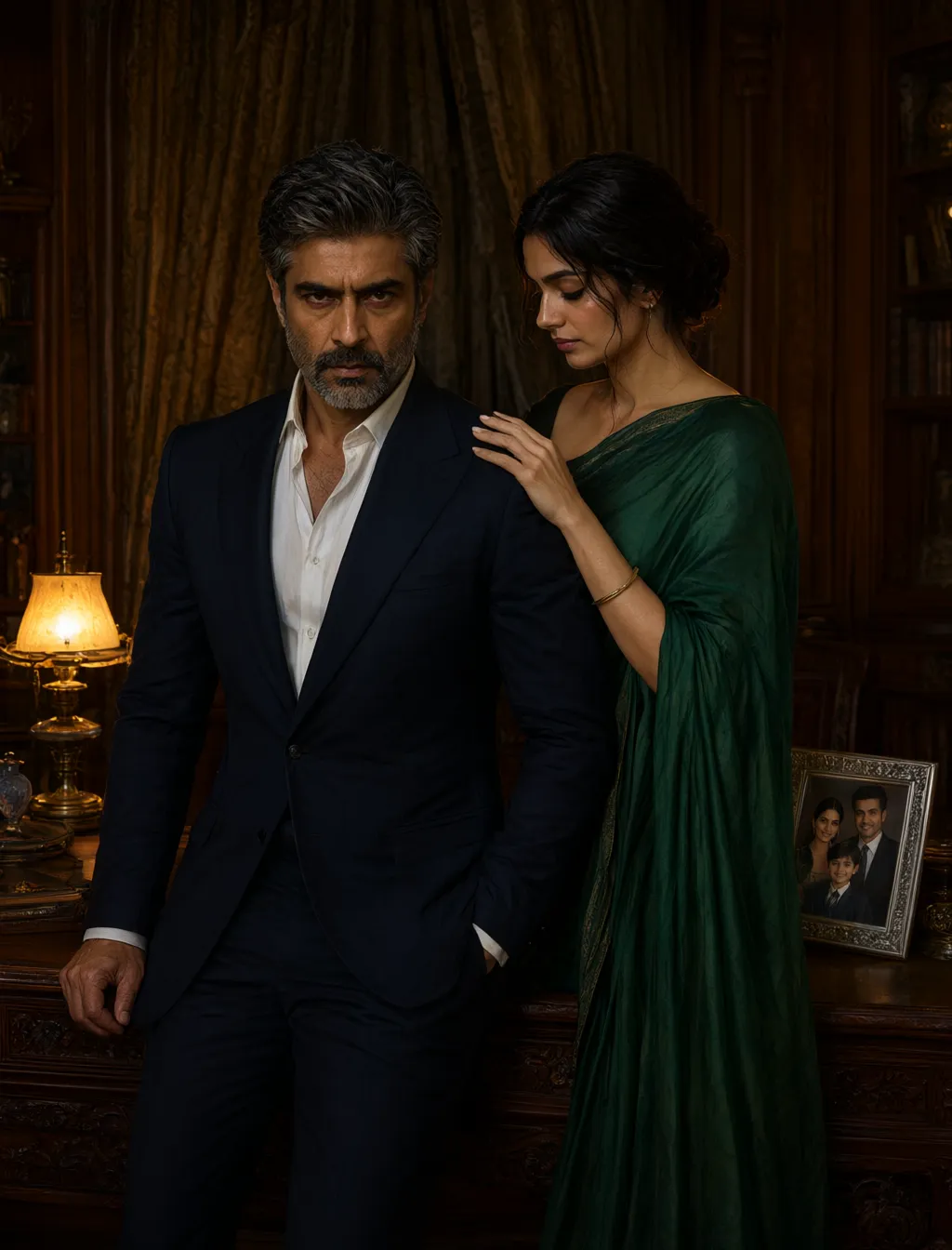
Meghna's office smelled of jasmine and stale coffee. The air conditioner hummed its tired afternoon song, and somewhere beyond her glass walls, the newsroom's muted chaos filtered through like rain on a distant roof. She sat at her desk, the annual report open before her, numbers blurring into meaningless shapes.
Three days since Delhi. Three days since his hands had found the knot at her waist, since she'd told him to take everything, since she'd stopped being the one who held it all together. And now she sat in her cabin, in her silk saree, in her carefully constructed life, pretending the past seventy-two hours hadn't rewired every nerve in her body.
Her phone buzzed. A message from the office group chat—Shauryaraj's shoot had been rescheduled for Thursday. She typed a swift acknowledgment, her fingers moving on muscle memory, and set the phone down. The jasmine on her desk was wilting. She'd forgotten to change the water.
The intercom crackled. "Ma'am, Mr. Kulkarni is here for the four o'clock."
Meghna straightened her spine, smoothed the pallu of her saree, and pressed the button. "Send him in."
Mr. Kulkarni entered with the practiced deference of a man who had spent twenty years managing other people's expectations. He carried a leather folder—scuffed at the corners, the kind of folder that had survived three CEOs—and his smile was the careful, neutral thing he wore like a uniform. Meghna rose, extended her hand, and felt the familiar rhythm of her own performance settle over her like a second saree.
"The Q3 numbers," he said, settling into the chair across from her desk. "I wanted to walk you through the advertising shortfall before the board meeting."
She nodded, her fingers finding the edge of the annual report. The jasmine on her desk had dropped two petals onto the polished wood—small white crescents, like the marks her nails had left in Vikram's shoulders. She blinked, and the petals were just petals again.
"The print division is down eight percent year-on-year," Kulkarni was saying. "Digital is holding, but the regional advertisers are pulling back ahead of the election cycle. They don't want to commit until they know which way the wind blows."
"The wind," Meghna repeated, and heard how hollow her own voice sounded. She cleared her throat. "The wind is always blowing somewhere, Mr. Kulkarni. The question is whether we've positioned ourselves to catch it."
He smiled—the genuine version, the one he reserved for when she said something worth agreeing with. "That's precisely what I told the finance committee. But they want projections, and projections require certainty."
"Then we give them certainty." She opened the annual report to the page she'd been staring at for three hours. "We reallocate the regional print budget into the digital youth vertical. Shauryaraj's campaign is already performing well there—we can leverage that momentum."
Kulkarni's eyebrows rose a fraction. "The Mahadik account."
"The Mahadik account," she agreed, and the name sat in her mouth like a stone she'd swallowed years ago and learned to carry. "He's the face of the next generation. If we position the company as the platform that launched him, the advertisers will follow."
It was true. It was also useful. It was also the only way she knew to touch Vikram's life without touching him—through his son's smile on a billboard, through the careful architecture of a public image she had built with her own hands.
Kulkarni made a note. "I'll have the revised projections on your desk by tomorrow morning."
"Thank you." She stood, and he took the cue, gathering his folder with the same practiced economy. At the door, he paused.
"Ma'am—you look tired. Forgive me for saying so."
Meghna's hand went to her hair, checking the pin that held her bun in place. "The conference in Chandigarh took more out of me than I expected."
"Of course." He nodded, and the door clicked shut behind him.
The silence in her cabin was immediate and total. The air conditioner hummed its tired song. The jasmine dropped another petal. Meghna sat down—slowly, the way you sit when you're afraid your knees might not hold—and pressed her palms flat against the cool surface of her desk.
Three days since Delhi. Three days since she'd undone the first button of his shirt and told him to take everything. He had. God, he had. She could still feel the ghost of his hands on her waist, the weight of his body settling over hers, the way he'd said her name like it was the only word he remembered in any language.
Her phone buzzed. She reached for it automatically, expecting the office group chat, and found a message from a number she didn't recognize.
*The keys to the flat. There are only two. One is in my pocket. The other is yours if you want it.*
Her breath caught. She read it twice, then a third time, her thumb hovering over the screen. The question she'd asked in Delhi—who else has keys—answered in seven lines of text. Not Rani. Not a housekeeper. Just him. And now, potentially, her.
She set the phone down. Picked it up. Set it down again.
The intercom crackled. "Ma'am, your four-thirty is here. Ms. Iyer from legal."
Meghna pressed the button. "Give me five minutes."
She turned her chair toward the window. The Nagpur skyline stretched before her—low buildings, dusty trees, the distant spire of a temple she'd visited once, years ago, before any of this. She thought about the key. A small brass thing, probably. Cold in her palm. The weight of it would be nothing. The meaning of it would be everything.
She thought about Urmila, asleep in her bed last night, her dark braid fanned across the pillow. She thought about the princess story she'd promised, the one she still hadn't figured out how to tell without lying. She thought about the way Vikram had looked at her in Delhi—not like a king looking at his mistress, but like a man looking at the only honest thing in his life.
Her phone buzzed again. The same number.
*No pressure. The offer stands.*
She typed back before she could stop herself: *And if I say yes?*
The reply came in seconds. *Then I'll have the spare cut for you by Friday.*
Meghna stared at the words until they blurred. A key to his flat. His government flat, his private space, the one place in his life that belonged to no one but him. He was offering her access. Not to his marriage—that door was locked forever, and they both knew it. But to something smaller, something real. A room of his own, shared with her.
She thought about the plastic-covered furniture. The fresh paint smell. The way the bed had creaked when he'd lowered her onto it, the sound swallowed by the empty rooms around them.
She typed: *Friday. I'll be there.*
No reply came. She hadn't expected one.
Ms. Iyer from legal arrived with a stack of contracts and a smile that didn't reach her eyes. Meghna walked her through the merger documents, her voice steady and professional, her hands moving through the familiar choreography of clauses and signatures. She initialed three pages, stamped one, and initialed again. The work was a kind of meditation—the precise, unthinking rhythm of it—and for forty minutes, she didn't think about keys or flats or the weight of a man's hands on her waist.
When Ms. Iyer left, the cabin settled back into its familiar hush. Meghna reached for the jasmine, carried it to the small sink in the corner of her office, and filled the vase with fresh water. The petals she'd let fall she pressed between the pages of the annual report, a small white ghost she would find weeks from now and not remember leaving.
Her phone buzzed a third time. She expected another message from Vikram—something dry and possessive, the verbal equivalent of his hand on her neck. Instead, she found a message from her daughter's school.
*Reminder: Parent-teacher conference, Thursday 4 PM. Urmila's art teacher would like to discuss her portfolio.*
Thursday. She'd just scheduled Shauryaraj's shoot for Thursday. And Friday, she was supposed to be in Delhi, picking up a key from a married man who loved her.
Meghna set the phone down. The jasmine's scent filled her office, sweet and heavy. Outside, the newsroom hummed its endless, indifferent song. She thought about the princess who outsmarted the king, the story she'd promised to tell her daughter. She thought about what it meant to choose your own ending when every choice was already made for you.
She picked up the phone again. She typed a message to the office group chat—*Thursday's shoot moved to Saturday. Family commitment.*—and sent it before she could second-guess herself.
Then she typed a second message, this one to a number she knew by heart. A number that belonged to a man who was probably in a meeting right now, or on a call with a minister, or standing in his wife's drawing room with a glass of whiskey in his hand.
*Thursday is taken. I'll see you Friday.*
The reply came after a pause long enough to suggest he'd read it twice. *I'll be waiting.*
Meghna turned her chair back toward the window. The sun was low now, painting the sky in shades of amber and dust. She thought about the key that would be cut by Friday, the small brass weight of it. She thought about the flat, empty and fresh-smelling, waiting for her. She thought about Vikram's hands, his voice, the way he said her name like it was the only word he remembered.
The jasmine on her desk had perked up, the petals drinking in the fresh water. She'd forgotten to change it for three days. Now it was done.
Her phone buzzed one last time. A message from Urmila, sent from her grandmother's phone: *Maa, don't forget the princess story. You promised.*
Meghna smiled—a small, tired, real thing—and typed back: *I haven't forgotten. Friday night, after dinner. I'll tell you the whole story.*
The reply came with a string of emojis. Meghna set the phone down and looked at the sky, at the amber and dust, at the city she'd built her life in. Somewhere in Delhi, a key was being cut. Somewhere in Nagpur, her daughter was waiting for a story. And somewhere between the two, she was still standing, still breathing, still choosing—every day, every hour—the life she'd made out of secrets and silk and love that couldn't be named.
She reached for the annual report, opened it to the page where she'd pressed the jasmine petals, and closed it again. The petals were safe there. Hidden. Like everything else she carried.
The intercom crackled. "Ma'am, your five o'clock is here."
Meghna straightened her spine, smoothed the pallu of her saree, and pressed the button. "Send him in."
The five o'clock was a young man from the digital team, carrying a tablet and a nervous energy that filled the cabin like static. He walked her through the engagement metrics for Shauryaraj's youth campaign—clicks, shares, the demographic breakdown of the eighteen-to-twenty-five bracket—and Meghna listened with half her mind, the other half still turning the key over and over in her imagination. She approved the new creative direction, signed off on the boosted ad spend, and sent him on his way with a smile that felt painted on.
The door clicked shut. The silence returned. And with it, the weight of the day settled back onto her shoulders like a familiar shawl.
She reached for her phone, thumb scrolling to the message from Vikram. *I'll be waiting.* Three words. She'd read them so many times they'd lost their shape, become just marks on a screen, and yet they still managed to find the soft place beneath her ribs. She typed a reply—*I know*—and sent it before she could think better of it. Some things didn't need elaboration.
The phone buzzed almost immediately. Not with words this time, but with a photograph. A brass key, small and unremarkable, lying against the dark wood of what she recognized as his desk in Nagpur. The spare, already cut. Already his. Already, in some small way, hers.
Meghna's breath caught. She zoomed in on the image, as if the pixels might reveal something more—the weight of it, the temperature of the metal, the way it would feel to slide it into the lock of a door that led to him. She set the phone face-down on her desk and pressed her palms flat against the cool wood, grounding herself in the ordinary. The annual report. The wilting jasmine she'd just revived. The stack of contracts Ms. Iyer had left behind.
None of it felt real. None of it felt like hers.
She stood, walked to the window, and looked out at the Nagpur skyline. The temple spire caught the dying light, gilded and distant. She'd visited it once, years ago, before the divorce, before Vikram, before she'd learned to carry secrets the way other women carried handbags. She'd lit a lamp and prayed for something—she couldn't remember what. A peaceful marriage, maybe. A child who would sleep through the night. The kind of ordinary happiness she'd assumed was her due.
The temple had answered her prayers in its own way. Just not the way she'd expected.
Her phone buzzed again. This time it was the office group chat—a flurry of messages about Thursday's rescheduled shoot, confirmations and logistics that moved with the smooth efficiency of a machine she'd built herself. She typed a single acknowledgment and let the conversation carry on without her.
The intercom crackled. "Ma'am, your five-thirty is here."
Meghna turned from the window, smoothed her saree, and pressed the button. "Send him in."
The evening stretched on in a blur of meetings and signatures and careful, professional smiles. She reviewed the revised projections Kulkarni had sent over, initialed three more documents, and took a call from the finance committee that required every ounce of her composure. By the time the clock crept past seven, her voice was hoarse and her eyes burned with the particular fatigue of a day spent being two people at once.
She gathered her things—the annual report with its hidden petals, her phone, the silk pouch that held her reading glasses—and stepped out of her cabin. The newsroom was quieter now, the desks emptying in the slow trickle of evening. A few heads lifted as she passed; she nodded at the ones she knew, smiled at the ones she didn't, and kept walking toward the elevator with the practiced grace of a woman who had learned to move through the world without leaving footprints.
The elevator doors slid shut. The hum of the building faded. And in the brief, suspended silence between floors, Meghna let herself feel the shape of the day—the key in her pocket, the promise on her tongue, the daughter waiting at home with a question her mother still didn't know how to answer.
The doors opened. The lobby was cool and marble-smooth, the security guard offering his usual nod. She returned it, stepped out into the Nagpur evening, and let the warm air settle around her like a second skin.
Her car was waiting. The driver held the door, and she slid into the back seat, the leather cool against her bare arms. She pulled out her phone and typed a message to Urmila: *On my way home. Have you eaten?*
The reply came in seconds. *Yes, Aaji made poha. When will you be home?*
Meghna smiled. *Soon. Save me some.*
The car pulled into traffic. The city slid past the windows—shops closing, streetlights flickering on, the first stars appearing in the dusty sky. She leaned her head against the seat and closed her eyes, and for a moment, she let herself imagine Friday. The key in her palm. The door swinging open. Vikram's hands finding her waist in the fresh-paint silence of a room that belonged to no one but them.
She didn't know what the story would be. She didn't know how she'd tell it without lying, or how she'd keep the key hidden from the daughter who noticed everything. But she knew one thing, with the same certainty that had carried her through ten years of secrets and silk: she would be there. Friday. Waiting. Choosing.
The car turned onto her street, and the lights of home glowed warm through the windows. Meghna opened her eyes, smoothed her saree, and prepared to become the mother her daughter knew—the one who told princess stories, who smelled of jasmine, who had never once in her life been afraid of the dark.
The car idled at the mouth of her street, indicator blinking a soft rhythm against the dark. Meghna had her phone in her lap, her thumb already moving toward Urmila's message — *Save me some* — when the screen lit up with a different name. Not a number. A name. His name, rendered in the quiet font she'd set years ago so it wouldn't scream at her from across a crowded room.
She answered on the second ring, her voice already lowered. "Vikram."
"Where are you?" No greeting. No warmth. Just the question, direct as a hand on her wrist.
"Almost home. Urmila's waiting." She said it as a shield, and they both knew it.
A pause. She heard the scratch of a pen, the faint rustle of paper — the sound of him doing something else while he held her on the line, measuring her answer against a schedule she couldn't see.
"I'm at your office," he said. "I've been here for an hour."
The words landed wrong, then right. Her office. Her cabin. The building she'd left twenty minutes ago, its lights already dimming in her rearview mirror.
"Why?" The question came out smaller than she meant it to.
"Because I wanted to see you." Another pause, longer this time. She heard the pen set down. "And because I'm tired of waiting until Friday."
The indicator blinked. The driver sat motionless ahead, his gaze fixed on the road, a man trained to hear nothing.
"I'm supposed to be home," she said. "Urmila—"
"I know what you're supposed to be." His voice dropped, losing its public register, finding the register that lived only in the space between them. "I know exactly what you're supposed to be, Meghna. I also know you're three minutes from your street and you haven't told the driver to turn around."
She closed her eyes. The handbag against her hip seemed heavier than it had a moment ago, the key inside it a small, cold accusation. She'd put it there this morning, wrapped in a tissue, hidden in the silk pouch that held her reading glasses. She'd told herself it was safer there than in her jewelry box, where Urmila's curious fingers might find it. She hadn't told herself the rest — that she wanted it close, that she'd touched it three times today, that the weight of it had become a kind of compass.
"Vikram." His name was a warning, or a plea. She wasn't sure which.
"Turn around," he said. "Come back. I'll wait in your cabin."
"The security guard—"
"I told him I was reviewing files. He believes me. Everyone believes me." A beat. "Everyone except you."
She heard the smile in his voice, the dry, private humor that belonged to her alone. It undid something in her chest, the way it always did — the knowledge that this man, who moved through the world with the weight of a kingdom on his shoulders, kept this particular lightness only for her.
"I have poha waiting at home," she said weakly.
"I'll buy you dinner."
"Urmila will ask where I went."
"Tell her work called you back. She's twelve. She'll believe you." He paused. "You're very good at it, remember? I taught you."
The words landed like a hand on her spine. She'd said them to him in Delhi, three days ago, and he'd carried them all the way back to Nagpur, sharpened them, and handed them to her now like a returned weapon.
She looked out the window. Her street was visible now — the familiar curve, the warm glow of her mother-in-law's house where Urmila was eating poha and waiting for her. She could be inside in four minutes. She could kiss her daughter's forehead, listen to her talk about school, tell her the story she'd promised. She could be the mother her daughter knew, the one who smelled of jasmine, the one who had never once been afraid of the dark.
She could.
"Give me twenty minutes," she said.
The silence on the other end was thick enough to touch. Then: "I'll be here."
The line went dead.
Meghna lowered the phone. The driver's eyes flickered in the rearview mirror — a question, unspoken, professional. She met his gaze and gave him the only answer she could.
"Change of plans," she said, her voice steady, her hands steady, the rest of her a lie she'd told so many times it fit like a second skin. "I forgot something at the office. Take me back."
The driver nodded. The indicator stopped blinking. The car swung away from her street, away from the warm lights and the waiting daughter, and turned back toward the city.
Meghna leaned her head against the seat and watched her home recede in the side mirror — smaller, smaller, gone. She typed a message to Urmila: *Work called me back. I'll be late. Don't wait up. I love you.* The reply came as the car picked up speed: a string of emojis, a heart, a sleepy face. She smiled at it, and the smile hurt.
The evening traffic had thinned. The car moved through the streets with an ease that felt almost indecent, as if the city itself were conspiring to deliver her. Shops were closing, shutters rattling down, the last light of the day bleeding out of the sky. She watched it all through the window, her handbag pressed against her hip, the key inside it warm from her body heat.
She thought about the first time she'd seen him. Not the man — the MP, the presence, the name that preceded him into every room. She'd been twenty-seven, newly divorced, newly hired, standing in the back of a conference hall while he spoke about the future of Vidarbha. She'd thought he was handsome in the way monuments are handsome — impressive, distant, not meant to be touched. She hadn't known then that monuments could have hands, that they could hold a woman's waist like it was the only thing keeping them tethered to the earth.
The car turned onto the road that led to the office. The building rose ahead of her, dark glass and steel, the lights of the newsroom mostly off now. One window glowed on the fourth floor. Her floor. Her cabin.
The driver pulled into the empty lot and stopped at the entrance. Meghna gathered her things — the annual report, her phone, the silk pouch with its hidden key — and stepped out into the warm evening air.
"I won't be long," she said. It was a lie. She knew it was a lie. The driver nodded anyway, the way he always did, and pulled away to wait at the curb.
The lobby was cool and marble-smooth, the security guard at his post. He looked up as she approached, and she gave him the smile she'd perfected — the one that said *everything is ordinary, nothing is happening, I am simply a CEO who forgot something important.*
"Forgot some files," she said.
He nodded, already returning to his newspaper. She signed the register with a steady hand and walked to the elevator.
The doors slid open. She stepped inside. The hum of the building filled the small space as the doors closed, sealing her in. She pressed the button for the fourth floor and watched the numbers climb — 1, 2, 3 — each floor a small surrender, each lit number a step closer to the man waiting in her chair.
The elevator mirrored her from every angle. She looked at herself — the silk saree, the pinned hair, the gold earrings that had belonged to her grandmother. She looked composed. She looked like a woman who had never once in her life been afraid of the dark.
The doors opened.
The fourth floor was quiet, the newsroom desks empty, the screens dark. Her cabin was at the end of the hall, its glass walls glowing faintly from the light inside. She walked toward it, her heels clicking against the floor, the sound too loud in the silence.
She reached the door. It was closed.
She should knock. She was the CEO; this was her office; the man inside was her visitor. She should knock, and he would say *come in*, and she would enter with professional composure and ask him what he was doing here.
She didn't knock.
She turned the handle. The door swung open.
He was standing at her window, his back to her, his hands clasped behind him. He'd taken off his jacket — it hung over the back of her chair, a dark shape against the leather — and his shirtsleeves were rolled to his elbows, exposing the forearms she'd traced with her fingers in Delhi. The light from the newsroom fell across him in stripes, and he looked, for a moment, like a man who belonged in the dark.
He turned when the door clicked shut behind her.
His eyes found hers, and something in them shifted — the public mask falling away, the private man rising to the surface. He crossed the room in three strides, and his hands caught her hip, her spine, pulling her against him before she could draw breath.
"You came," he said, and his voice was rough, like he'd been holding the words in his chest for an hour.
"You knew I would."
He looked at her for a long moment, his thumb tracing the curve of her hip through the silk. Then he lowered his head, and his mouth found the hollow beneath her ear, and the world narrowed to the heat of him, the scent of him, the weight of his hands on her body.
His mouth moved against her skin, and she felt the words he didn't say in the pressure of his lips, the scrape of his stubble against the tender place where her pulse beat close to the surface. Her hands found his chest, splaying over the fine cotton of his shirt, feeling the heat of him through it, the steady thrum of a heart that belonged to no one but still beat for her.
"You took your time," he murmured against her neck, and his hands tightened on her hip, her spine, drawing her closer still, until there was no space left between them, until she could feel every line of him through the silk of her saree.
"I had a daughter to lie to." The words came out breathless, and she felt him smile against her skin.
"And you did it beautifully." He pulled back just enough to look at her, his dark eyes moving over her face like he was memorizing it, like she was a text he'd been trying to parse for a decade and still hadn't finished. "You always do."
His thumb traced the curve of her jaw, tilting her face up to his. The office was silent around them — the hum of the AC, the distant murmur of the city beyond the glass, the soft tick of the clock on her desk that she never noticed during the day. She noticed everything now. The way the light from the newsroom cut across his face, leaving half of it in shadow. The way his collar was loose, the top button of his shirt undone, as if he'd been waiting in her chair and had grown tired of his own formality.
"I've been thinking about you all day," he said, and his voice was low, rough, the register he kept only for her. "Since the moment I woke up. Since before that."
"Vikram—"
"I know." He silenced her with a look, not a touch, his eyes holding hers with an intensity that made her breath catch. "I know you have a life. I know you have a daughter. I know you have a hundred things that matter more than this." His hand moved from her jaw to her nape, his fingers threading into the hair at the base of her skull, tilting her head back gently. "But tonight, I need you to let me be the only thing that matters."
The words hung between them, heavy with a truth she couldn't name. She could feel the weight of the day pressing on her shoulders — the lies, the guilt, the careful architecture of her double life. She could feel the exhaustion in her bones, the ache of a woman who had been holding herself together for so long she'd forgotten what it felt like to fall apart.
"I don't know how to do that," she whispered.
"I'll teach you." His mouth found hers, and the kiss was not gentle. It was a claiming, a reclamation, a reminder of every night she'd spent alone in her bed, every morning she'd woken up reaching for a warmth that wasn't there. His hands moved over her body with a purpose that made her knees weak — one palm flat against her spine, pressing her into him, the other sliding up her ribcage, his thumb brushing the underside of her breast through the silk of her blouse.
She gasped against his mouth, and he swallowed the sound, deepening the kiss until she forgot where she ended and he began. His tongue swept against hers, and she tasted the coffee he'd been drinking, the faint bitterness of it, the heat of him. Her hands fisted in his shirt, pulling him closer, and he made a sound low in his throat — a growl, almost, a vibration she felt through her whole body.
He broke the kiss and pressed his forehead to hers, his breath ragged. "I'm going to tell you what tonight is," he said, and his voice was dark, measured, the voice of a man who was used to being obeyed. "And I need you to listen."
She nodded, her eyes still closed, her body trembling against his.
"Tonight is not about Friday. It's not about the dinner I promised you, or the hours we'll steal when the city is asleep. Tonight is not about Urmila, or my wife, or any of the careful lies we tell to keep the world from seeing us." His hand tightened on her nape. "Tonight is about you and me, in this room, with the building empty and the world locked out. Tonight, I'm going to take you apart, piece by piece, until you forget every name except mine."
Her breath caught. "Vikram—"
"And you're going to let me." His thumb traced the line of her jaw, tilting her face up to his. "You're going to let me use you. Take you. Waste you quietly on my schedule, not yours." His eyes held hers, dark and unreadable. "Do you understand?"
The words should have been cold. They should have made her feel small, used, a thing to be set aside when he was done. But there was a tenderness beneath them, a vulnerability he never showed anyone else — the need of a man who had spent his whole life being strong, being watched, being the one everyone leaned on. He needed her to be the one place he could put down his weight. He needed her to let him.
"Yes," she whispered.
"Say it." His hand moved from her nape to her throat, his palm resting against the hollow where her pulse beat wild. "Tell me you understand."
"I understand." Her voice was steady, even as her heart raced. "I understand what tonight is. And I'm yours."
Something flickered in his eyes — relief, maybe, or gratitude, or a tenderness so deep it looked like pain. He lowered his head and kissed her again, softer this time, a kiss that tasted like an apology and a promise all at once. His hands moved over her body with a reverence that made her chest ache — tracing the curve of her waist, the dip of her spine, the place where her saree was pinned at her shoulder.
"I've been waiting for this," he said against her mouth. "All day. All week. All month." His lips traced down her jaw, her throat, finding the pulse point at the base of her neck. "Every time I see you across a room, every time I hear your voice on the phone, every time I have to pretend you're just my CEO and not the woman who—"
He stopped. The words hung unfinished between them, and she felt the weight of them, the shape of what he hadn't said.
"Who what?" she asked, her voice barely a breath.
He looked at her for a long moment, his eyes searching hers. Then he shook his head, a small, almost rueful smile tugging at the corner of his mouth. "Not tonight," he said. "Tonight, I don't want to talk about what we are. I want to show you."
His hands found the pin at her shoulder, and he pulled it free with a practiced ease that made her breath catch. The pallu of her saree slipped, sliding down her arm in a whisper of silk, and she felt the cool air of the office against her bare shoulder. He watched the fabric fall, his eyes darkening, and then his mouth was on her skin, tracing the line of her collarbone, the curve of her shoulder, the sensitive place where her neck met her ear.
"You smell like jasmine," he murmured against her skin. "You always smell like jasmine. Even when I'm a hundred miles away, I can close my eyes and—" He broke off, his breath hot against her throat. "I keep a bottle of your perfume in my bag. In my car. Just so I can—"
She made a sound — a small, broken thing that she didn't recognize — and his hands tightened on her body, pulling her closer, his mouth finding hers again in a kiss that was all hunger and heat and years of wanting. She felt his hands move over her back, finding the hooks of her blouse, and she arched into him, her fingers fumbling with the buttons of his shirt.
He pulled back just enough to look at her, his chest heaving, his eyes wild. "Not yet," he said, and his voice was rough, strained. "I want to—" He swallowed hard. "I've been thinking about this all day. The way you look when I—" He shook his head. "I want to take my time with you."
His hand found the edge of her blouse, his fingers sliding beneath the fabric to rest against the bare skin of her waist. She felt the heat of his palm like a brand, and her whole body trembled at the contact. His eyes held hers, dark and intent, as his hand moved higher, tracing the line of her ribs, the underside of her breast, the delicate lace of her bra.
"Is this okay?" he asked, and his voice was low, careful, the voice of a man who knew exactly what he was asking.
"Yes." The word came out breathless, barely a whisper.
His hand moved over the cup of her bra, his thumb finding the peak of her breast through the lace, and she gasped, her hips pressing into his. He made a sound low in his throat, his mouth finding hers again, swallowing her gasp, his hand moving over her with a slowness that was almost unbearable. She felt the fabric of her blouse slip lower, felt the cool air against her skin, and then his hand was inside her blouse, over the cup of her bra, and she felt the weight of his palm against her breast, the heat of him through the thin lace, and she was lost.