
The flat smelled of fresh paint and emptiness. Meghna stood at the window with her arms crossed, watching Delhi's evening traffic coagulate into a red smear below, and tried to remember the last time she'd had three months without his voice in her ear. Chandigarh had been a conference about nothing — three days of hotel air and name badges and men who looked at her the way her ex-husband used to look at waitresses. She'd escaped after breakfast, as planned, because he'd asked her to. Not ordered. Asked. The distinction mattered to her the way a surgeon's tremor matters — small, but you notice it.
Fifteen years ago she'd walked into a marriage with flowers in her hands and walked out of it with a daughter and a hollow where her certainty used to live. The legally made rapes — that was how she thought of them now, clinical, distant, as if they'd happened to someone else — the betrayals she'd found in his phone every month of her pregnancy, the way he'd smiled at her across the courtroom like she was the one who'd failed. Then the job at the media firm. Then him. Ten years of loving Vikramditya Mahadik and she still couldn't name the exact moment it had started, only that it had, the way moss finds a wall, the way a crack finds a foundation.
She knew what she was. A mistress. A kept woman with a CEO title and a competent reputation, both real, both built on his will. She'd stopped pretending otherwise years ago. What she hadn't stopped doing was loving him — fiercely, stupidly, with the full force of a woman who'd been told she was unlovable and had decided, privately, to disagree. He was married. He had a son. He could be dark when the alcohol loosened something in him. But he protected her daughter without ever saying so, and he looked at her like she was the only honest thing in his life, and that was enough. It had to be enough.
The flat was his — an MP's allocated residence, fresh from the government's paintbrush, the furniture still wearing its plastic covers in the bedroom. He'd sent her the address three days ago, buried in a text about Shauryaraj's branding calendar, and she'd understood. Three months was too long. The conference had given them cover. She'd booked her own flight, her own cab, her own name in the visitor log at the gate. Discretion was a language they both spoke fluently.
The key turned in the lock at 7:42. She didn't move from the window. Footsteps crossed the empty living room — deliberate, heavy, the tread of a man who'd spent decades learning to fill rooms — and stopped just behind her shoulder. She felt the heat of him before she felt his hands, and then his palms settled on her hips, thumbs pressing into the silk of her saree's pleats, and his mouth found the curve of her neck.
"You left Chandigarh early," he said. Not a question. His voice was rough, the way it got when he'd been holding something back for too long.
"I was done."
"Three days of conference." His breath warmed her skin. "You could have stayed."
"You told me to come." She didn't turn. "So I came."
His hands tightened on her hips, just shy of pain. "I told you to come because I couldn't wait another day."
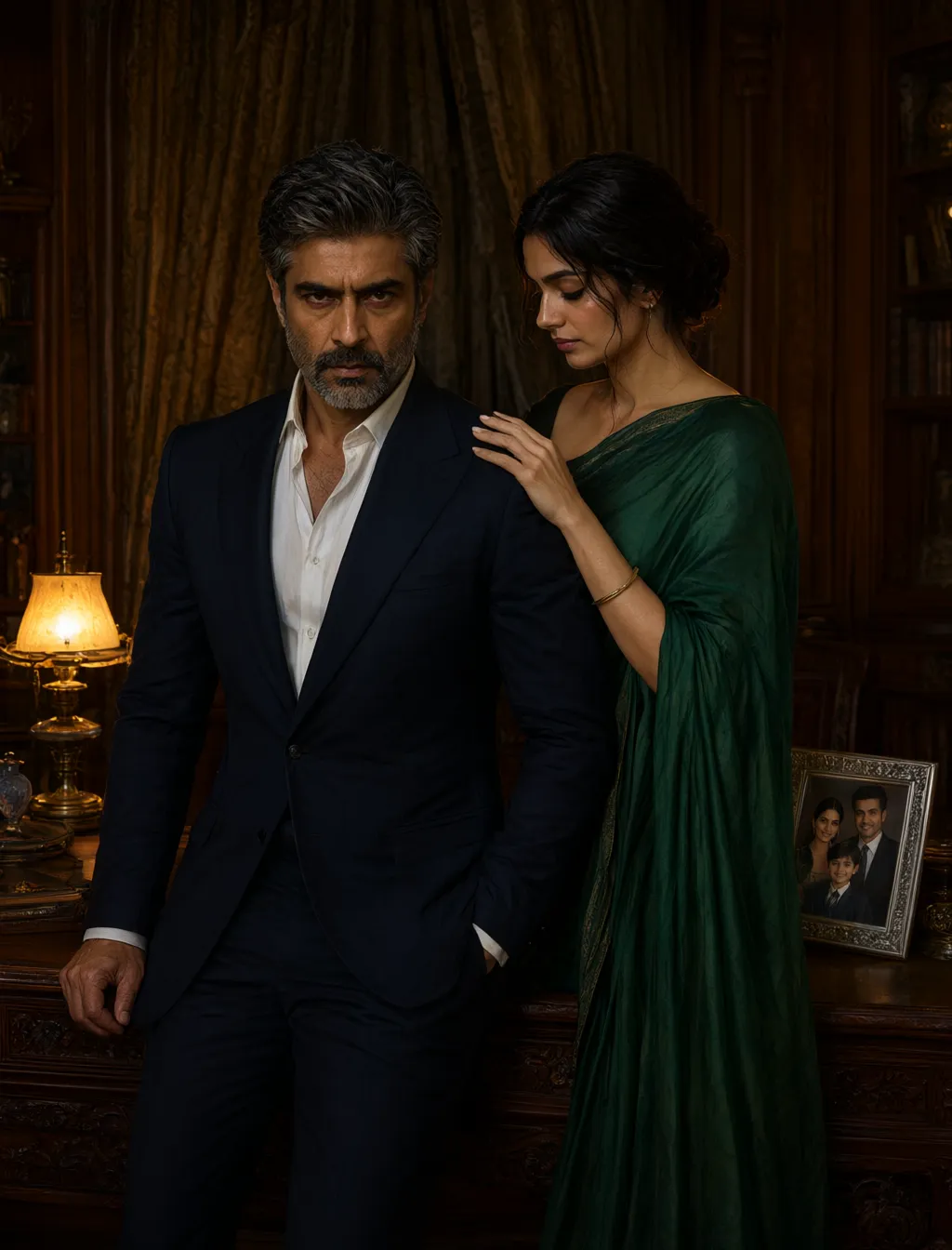
Meghna finally turned, and there he was — salt-and-pepper hair cropped short, the close-cropped beard dusting a jaw that could have been carved from basalt, dark eyes holding that private intensity that no camera ever caught. He was still in his navy suit, tie loosened, the top button of his shirt undone. He looked like a man who'd been holding his breath for three months. She reached up and touched his face, and something in him cracked open.
"Three months," she said softly. "That's a long time."
"Too long." He pulled her against him, and she felt the tremor that ran through his broad frame — not weakness, but want, banked too long. "I didn't realize how long until I walked in and saw you standing at my window."
"Your window." She smiled against his chest. "The government's window. The taxpayer's window."
"Mine," he said, and his hand slid to the back of her neck, fingers curling into the pinned coil of her hair, tugging gently until her head tipped back. "You're in Delhi because I asked. Because I needed you here. Don't pretend you don't know what that means."
His thumb traced the line of her jaw, a slow, deliberate pressure that made her breath catch. "I know what you're doing," he said, his voice low, almost a murmur against her skin. "Making it light. Making it something we can walk away from in the morning." His dark eyes held hers, unblinking. "But you're not walking away tonight."
She should have said something clever. Should have reminded him that she had a daughter waiting for a video call at nine, a board meeting Thursday, a life that didn't revolve around the hours he could steal. Instead she stood there, her head tipped back in his grip, and let herself feel the truth of it — that she had booked this flight the moment his text arrived, that she had packed the blue silk saree she knew he loved, that she had sat through three days of conference panels counting the hours until she could be here, in this empty flat that smelled of paint and him.
"I know what it means," she said finally, her voice steady even as her pulse hammered against his thumb. "I've always known." She reached up and closed her hand around his wrist, not to pull away but to hold him there. "That's the part you keep forgetting. I'm not here because I have nowhere else to go. I'm here because I choose you. Every time. Even when I shouldn't."
Something shifted in his face — a crack in the marble, there and gone. His grip on her neck loosened, and for a moment she thought he might pull back, retreat into the careful distance he wore like armor. Instead his hand slid down to her shoulder, fingers finding the edge of her saree's pallu where it lay draped across her collarbone. He tugged it aside, slowly, exposing the skin beneath, and she felt the cool air of the air conditioner raise goosebumps along her arm.
"Then don't," he said, and his voice was rough in a way that had nothing to do with politics or power. "Don't remind me of everything I can't give you. Not tonight." His palm flattened against her bare shoulder, warm and heavy. "Tonight I need you to just be here. Mine. Not the CEO. Not the mother. Not the woman who has to be careful for both of us." He paused, and when he spoke again, it was quieter, almost fragile. "Just Meghna."
His hands found her shoulders, turning her with a gentleness that belied the hunger in his grip. She faced the darkening glass, Delhi's lights beginning to prick the dusk like scattered seeds, and felt the whole length of him press against her back — chest to spine, thighs to the silk draped over her hips. His mouth found the shell of her ear, and his voice came low, rough, a vibration that traveled straight down her spine.
"Look down there," he said. His palm flattened against her stomach, drawing her closer into the solid heat of him. "See the street? The guards at the gate? The cars waiting at the light?" His lips brushed the curve of her neck. "Any one of them could look up. Could see a silhouette at an MP's window. A woman in a blue saree." His teeth grazed her earlobe, a sharp, fleeting pressure. "They'd never know your name. But they'd know someone is here."
Meghna's breath fogged the glass. Her reflection stared back at her — a ghost in silk, pinned against the broad dark shape of him — and she watched his hand travel from her stomach to the edge of her saree's pallu where it lay crossed over her breast. He didn't pull it aside. He just held the fabric between his fingers, a promise waiting to be kept. "You like that," she said, and her voice came out steadier than she felt. "The thought of them watching and never knowing."
"I like that you're here," he said, and the honesty in it cracked something in her chest. "That I can stand at this window with you and for once not have to count the minutes until you leave." His fingers traced the column of her throat, a slow, deliberate path that made her shiver. "The exposure doesn't scare me. It's the leaving that does."
She turned in his arms, her hands finding the lapels of his navy suit, and looked up at him — at the salt-and-pepper stubble, the dark eyes that held her like a secret he'd never tire of keeping. "Who else has keys to this flat?" she asked, and the question landed between them like a stone in still water. His hands stilled on her waist. The silence stretched, taut as a wire, and somewhere below a car horn blared and faded into the hum of the city that would never know her name.
She didn't let go of his lapels. She rose on her toes and kissed him — not the careful, measured kiss she gave him in hotel corridors and car backseats, but something slower, hungrier, a full-bodied answer that bypassed every careful sentence she could have offered. Her mouth found his and stayed, and she felt his hands tighten on her waist, felt the low sound that rumbled up from his chest, felt the three months of distance collapse into the space between their bodies. She kissed him the way she'd wanted to kiss him in Chandigarh, in the conference hall when some minister's aide had touched her arm and she'd imagined his hand there instead. She kissed him until her toes ached and her saree's pallu slipped from her shoulder, and only then did she pull back, breath coming fast, her fingers still twisted in the wool of his lapels.
"That's not an answer," he said, and his voice was rough, almost accusatory, even as his hands tightened on her waist and pulled her back against him.
"It's the only answer I have." She looked up at him, her thumb finding the knot of his tie, working it loose with a practiced slowness. "You asked me who else has keys to this flat. The answer is — I don't care. I didn't fly to Delhi to count your keys." She tugged the tie free and let it fall to the floor between them. "I flew here because you asked. Because I wanted to. Because for three days I sat in a conference room and watched the clock and thought about the way you look at me when you think I'm not watching."
His jaw tightened. "Meghna."
"No." She pressed her palm flat against his chest, feeling the steady thud of his heart beneath the starched white shirt. "You wanted me to be just Meghna tonight. So let me be her. She doesn't ask about keys. She doesn't count the minutes until you have to leave. She doesn't think about the wife or the son or the party or the risk." Her fingers found the top button of his shirt and undid it, then the next. "She just wants you to stop talking and kiss her again."
He caught her wrist, stilling her hand on the third button. His dark eyes held hers, and for a long moment he just looked at her — at the woman who had flown across the country because he'd asked, who had stood at his window and let him press her against the glass, who was now undoing his shirt in a government flat that smelled of fresh paint and nothing else. "You're dangerous when you're honest," he said finally, but there was no accusation in it. Only wonder.
"You're the one who asked for honesty." She didn't pull her wrist free. She let him hold it, let him feel her pulse jumping beneath his thumb. "So here it is. I don't care who has keys to this flat. I care that you're here. That I'm here. That for one night, we're not counting the cost." She lifted her free hand and touched his face, her fingers tracing the salt-and-pepper stubble along his jaw. "Stop asking questions, Vikram. Just have me."
His hands were already moving before she finished the sentence — a grip on her shoulders, a firm turn that spun her back toward the window. Her palms met the cold glass with a flat slap, the chill of it racing up her arms, and she felt the whole solid length of him press against her from behind. The city sprawled below, a scatter of headlights and neon, and somewhere down there a guard paced the gate in a khaki uniform, a man paid to notice things and trained to forget them.
His mouth found the curve of her neck, hot against the goosebumps his breath had raised. "Look at them," he murmured, and his hand traced the pleats of her saree where they lay against her hip, following the fall of the fabric with a patience that made her breath catch. "They can see a silhouette at the window now. A woman in blue. They don't know your name. They'll never know your name." His fingers found the edge of the silk where it tucked at her waist, and she felt the deliberate tug as he began to work the pleats loose. "But they know someone is here. Someone I wanted badly enough to bring to a flat that still smells of paint."
She pressed her forehead to the glass, the cool surface grounding her as his other hand slid up her spine, finding the hook of her blouse at the back of her neck. "You're showing me off to strangers," she said, and her voice came out thinner than she intended, a thread of breath against the pane. "To guards who can't see past the glare."
"I'm showing you to myself." His thumb traced the edge of the blouse's fabric where it met her skin, a slow, deliberate pressure. "I've spent three months in rooms full of people who wanted things from me. My time. My vote. My name on their cause." His lips brushed the shell of her ear. "You're the only one who ever just stood at my window and let me look at her." The pleats gave way beneath his fingers, the silk loosening its hold on her hips, and she felt the cool air of the flat find the newly exposed skin of her waist.
Her breath fogged the glass in a slow, spreading bloom, and she watched his reflection behind her — a broad dark shape, the salt-and-pepper beard, the intensity in his eyes that the window's glass couldn't soften. "Vikram," she said, and the word came out not as a question but as a landing, a place she'd been flying toward all day. His hand stilled on her hip, and she felt the weight of his gaze on the back of her neck, on the curve of her shoulder where the pallu had slipped.
"Mine," he said against her neck, and the word settled into her skin like a brand that didn't burn — a claim that felt less like ownership and more like being finally, fully seen.
His hand slid from her hip to her wrist, and the shift was so seamless she almost missed it—the way he could turn possession into an invitation without a single word. He tugged, gently, and she let the window go, let the cold glass leave her palms as he drew her across the empty living room toward the hallway. The flat was so new it had no memory yet, no ghost of other evenings, and she liked that—liked that this place would learn its first secrets tonight, from them.
The bedroom doorway swallowed the light from the living room, and she saw it before she understood it: the bed, still wrapped in its clear plastic covers, gleaming dully under the bare bulb of the ceiling fixture. A bed that had never held anyone. A bed waiting for its first weight. Vikram stopped at the threshold, his hand still closed around her wrist, and she felt the pause run through him like a current finding ground.
She looked at the plastic-covered bed, then at him. His dark eyes held hers, and there was something almost boyish in the hesitation—a man who had spent decades taking rooms by force of will, stopped at the edge of a bed that didn't belong to him yet. "It's new," he said, and the roughness in his voice wasn't command now. It was something rawer. "Everything here is new. No one has slept in that bed. No one has touched those sheets." His thumb traced the inside of her wrist, a slow, deliberate pressure against her pulse. "I wanted it to be you. The first one."
The words landed in her chest like a stone in still water. She had been his mistress for ten years, had learned to read the silences between his sentences, and this—this was not the careful seduction he wore in hotel rooms. This was a man standing at the edge of something he had built for her, waiting for her to step in first. She reached out with her free hand and touched the plastic covering the bed frame. It crinkled under her fingers, cold and smooth, and she felt the weight of what he was offering—not just a night, but a first. A beginning, in a place that had no history but the one they would make tonight.
"Then take the covers off," she said, and her voice came out steady, even as her pulse hammered against his thumb. She turned to face him fully, her saree loose at her waist where his fingers had worked the pleats free, the pallu slipping from her shoulder. "I didn't fly to Delhi to sleep on plastic."
She didn't wait for him to move first. Her fingers found the leather of his belt, the metal of the buckle cool against her knuckles, and she worked it open with the same practiced patience she'd used on his tie. His breath caught — a small, sharp sound in the quiet of the flat — and she felt his hands come up to her waist, not to stop her, but to steady himself. She pulled the belt free of the loops with a whisper of leather and let it drop to the floor beside his tie.
Her palm flattened against his chest, feeling the rapid thud of his heart through the starched white shirt she'd undone to the third button. She pushed, and he went — not easily, but willingly, the way a man goes when he's been waiting for permission he didn't know he needed. His knees hit the edge of the plastic-covered mattress, and the crinkle of it was loud in the empty room, a sound so new and so private it felt like a secret they were already keeping. He sat there, looking up at her, his hands frozen mid-air at her waist, and the bare bulb above them carved shadows into the hollows of his face.
Meghna stood between his knees, the loose silk of her saree pooling at her hips, the pallu long gone from her shoulder. She reached up and unpinned her hair, letting the jet-black coil fall heavy past her shoulders, and she watched his eyes track the movement like a man watching water find its level. "You wanted me to be just Meghna," she said, and her voice was low, steady, the voice she used when she was done being careful. "So here she is. No boardroom. No daughter waiting for a video call. No clock counting down to when you have to leave." She lifted his chin with two fingers, tilting his face up to hers. "Just a woman who flew across the country because you asked. Who's about to fuck you on a bed that's never held anyone."
His hands tightened on her waist, thumbs pressing into the bare skin above her hip where the silk had fallen away. "Meghna," he said, and her name came out rough, almost broken, like he'd been holding it too long. She silenced him with her mouth, a slow, deliberate kiss that she controlled from the first brush of her lips to the moment she pulled back just enough to speak against his mouth. "Don't talk," she breathed. "Not yet. Just feel this." She guided his hands to the fall of her saree at her waist, letting his fingers find the edge of the fabric, the skin beneath. "Three months is a long time to go hungry. Let me feed you."
His hands moved on her body like a man relearning a language — the dip of her waist, the flare of her hip, the silk giving way under his fingers until the saree loosened its hold on her entirely. The city hummed below the window, indifferent and distant, and she stood between his knees on a bed that had never known weight, watching his face crack open with want, and thought: this is what I chose. This is what I keep choosing. She reached for the hook of her blouse at the back of her neck, and his hands covered hers, stilling them.
His hands covered hers at the nape of her neck, stilling her fingers on the blouse's hook, and for a moment she thought he meant to undress her himself. But his grip was gentle, almost reverent, his thumbs tracing the delicate bones of her shoulders before he let his hands fall away. "Not yet," he said, and the words came out rough, as if he'd had to force them past something in his throat. "I want to look at you first. Just for a moment."
Meghna stood still between his knees, the bare bulb casting its stark light across the hollows of his face, and let him look. She had been looked at by men her whole life — appraised, dismissed, desired, judged — but never like this. Never like she was something he'd been saving. His gaze traveled from her unpinned hair to the loose fall of silk at her hips, to the bare skin of her waist where the fabric had surrendered, and she watched his throat work as he swallowed. "Three months," he said, almost to himself. "I forgot what you look like when you're not being careful."
The phone buzzed on the living room table, a low vibration against the wood. Meghna felt it like a cold draft across her skin — the spell fracturing, the world sliding back in through the cracks. She glanced toward the doorway, toward the dark living room where her phone lay face-up on the table, and the weight of the hour settled on her chest. "It's Urmila," she said, and the name alone was enough to change the air between them. Vikram's hands, which had been resting on her waist, withdrew slowly, a careful retreat that she felt in the sudden absence of his warmth.
"Go," he said, and his voice was steady, measured, the voice he used in boardrooms when he was granting a concession he'd already decided to make. But his eyes held hers, dark and unreadable, and she saw the flicker there — the brief, involuntary crack in his composure that he would never let anyone else see. She stepped back, her bare feet finding the cold floor, and the plastic of the bed cover crinkled behind him as he shifted. "She waits for your call. You shouldn't keep her waiting."
Meghna walked out of the bedroom, the loose silk of her saree whispering around her hips, her hair falling heavy past her shoulders. The living room was dark except for the glow of the phone screen on the table, and she picked it up with fingers that trembled slightly — not from cold, but from the strange dislocation of it, the way she could step from his hunger into her daughter's voice in the space of a breath. She answered the video call, and Urmila's face filled the screen — twelve years old, her mother's dark eyes, a school uniform collar visible at the edge of the frame. "Mamma," the girl said, and Meghna smiled, the smile arriving on her face before she had to summon it. "You're in a hotel again?"
"Not a hotel," Meghna said, her voice settling into the warm, unhurried register she kept for her daughter. She angled the phone slightly, letting the camera catch the blank wall behind her rather than the bare bulb or the plastic-covered bed frame visible through the doorway. "A colleague's flat. He's letting me stay while he's out of town for a few days. It's quieter than a hotel — I can actually sleep." Urmila's brow furrowed, the way it did when she was testing the weight of a statement, and Meghna felt the familiar ache of it — the twelve-year-old who had learned to read her mother's silences the way Meghna had learned to read Vikram's.
"You sound different," Urmila said. Not accusatory. Just observant, the way she was about everything. "Your voice is — I don't know. Lower." Meghna laughed, and it came out more genuine than she'd expected. Behind her, she heard the faint crinkle of plastic as Vikram shifted on the bed — a sound she prayed the phone's microphone wouldn't catch. She turned slightly, putting her body between the camera and the hallway, and tucked a strand of loose hair behind her ear. "I'm tired, baby. Three days of conference panels will do that to anyone. Did you eat dinner? Is Grandma feeding you properly?"
Urmila launched into a detailed account of her grandmother's dal — too much salt, she reported gravely, but the rotis had been rescued — and Meghna listened with half her attention, the other half tracking the silence behind her. She could feel him there, a weight in the dark of the bedroom doorway, and she knew he was watching her the way he always watched her with Urmila: from a distance, still, his presence a held breath. She had never let him hear this part of her life. He had seen her in boardrooms and hotel rooms and the backseats of tinted cars, but never like this — never with her daughter's voice filling the space between them, never with the mother sitting on her face like a second skin.
"Mamma, will you tell me a story?" Urmila asked, and the question landed in Meghna's chest with a familiar, tender weight. "The one about the princess who outsmarted the king? You haven't told it in ages." Meghna glanced toward the doorway, at the dark shape of him leaning against the frame, his shirt still open to the third button, his tie and belt lying on the floor of the bedroom like shed skin. She could feel the hunger radiating off him, banked and patient, and she knew he would wait — that he would stand there in the dark and listen to her tell a fairy tale to her daughter, because that was the shape of his love: waiting, silent, asking for nothing.
"Not tonight, baby," she said softly, and she watched Urmila's face fall in the small glow of the screen. "I'm too tired for princesses. But I'll call you tomorrow, okay? And I'll tell you the whole story then. Every word." She smiled, and it was real, because it had to be. "Now go to sleep. I love you." Urmila's face softened, the disappointment giving way to something quieter. "I love you too, Mamma," she said, and the call ended with a soft click. Meghna lowered the phone and stood in the dark living room for a long moment, the silence of the flat pressing in around her. Then she turned, and Vikram was there — not in the doorway anymore, but crossed the room, close enough to touch. His hand came up and brushed the loose hair from her shoulder, his thumb grazing the bare skin where the pallu had slipped away hours ago. "You're good at that," he said quietly. "Lying to her." Meghna looked up at him, her daughter's name still warm in her chest. "I'm good at lying to everyone," she said. "You taught me that."