
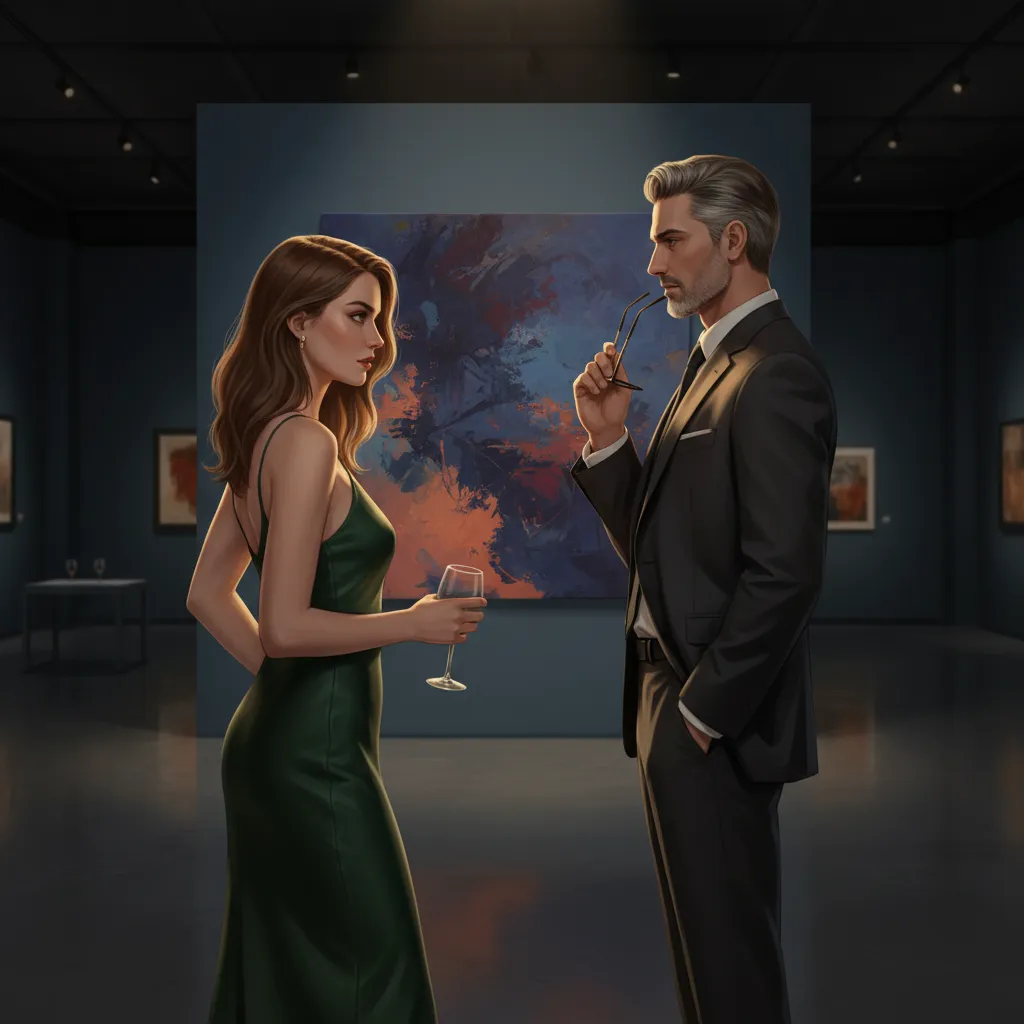
The Keller Gallery asked them to leave politely at 9:40 PM, which was twenty minutes after it had officially closed, because the staff member who came to tell them had walked past twice already and both times found them still standing in front of number seven, talking in low voices, and had felt, obscurely, that it would be unkind to interrupt.
The third time, she interrupted gently.
They came out onto the street still mid-sentence — something about whether abstraction was a form of honesty or a form of avoidance, which neither of them had resolved — and then stopped, because the street required a different kind of attention. The old city at this hour: amber-lit, quiet, the specific beauty of stone at night.
Sofia had her coat and her bag. Luka had his jacket, his folded glasses in his pocket. They stood on the pavement outside the Keller Gallery and the sentence finished itself and then there was a pause.
"There's a place around the corner," Luka said. "If you want to keep—" he gestured vaguely at the space between them, which encompassed the argument and the paintings and the forty-three minutes and everything that had accumulated since.
"Yes," she said.
They didn't move immediately.
The street was quiet. Somewhere nearby, water — a fountain, or rain beginning, or both. The light from a high window fell across the pavement in a pale rectangle.
Sofia looked up at him. He was looking back in the way he had been looking at her since number eight — openly, without the analytical remove he brought to paintings. Like she was something he had stopped trying to read structurally and was simply, finally, experiencing.
She reached out and took his glasses from his jacket pocket — the motion easy, unhurried, like she had done it before, like they were already in the habit of each other. She unfolded them and held them up.
"You keep doing this," she said. "Folding and unfolding."
"I know," he said. "It's what I do when I'm thinking."
"What are you thinking about right now?"
He took the glasses from her hand — slowly, his fingers closing over hers around them, not letting go. "I think you know," he said.
"I want to hear it," she said.
"Sofia."
"That's my name, not an answer."
He smiled — the real one, the unhurried one, the one she had been cataloguing since number seven. He set the glasses down carefully in his pocket with his free hand, and her hand was still in his, and he held it lightly, the way you hold something you are glad to be holding.
"I've been in a lot of galleries," he said. "A lot of rooms with a lot of paintings. And I look at them the wrong way — I know I look at them the wrong way, structure first, everything else second. And I've been meaning to fix that for years."
"And?"
"And tonight," he said, "I didn't look at the paintings the wrong way."
She understood this. She understood exactly what it meant and what it was not about. "Which painting changed it?"
"Not a painting," he said.
She stepped closer. He was warm and tall and smelled like the particular coolness of a stone building and underneath it something warmer, something hers now to know. She put her free hand flat against his chest — not dramatically, just to confirm the distance, to close it with intention — and felt his breath change slightly at the contact.
"Luka," she said. Just his name. The same thing he had done to her earlier, she realized — a name as a full sentence. A name as a door held open.
He kissed her.
Soft and slow, the way people kiss when they have been building toward something carefully and want to honor the building. His hand came up to her jaw, her cheek, his thumb at the edge of her face, and she felt herself arrive completely — not into the kiss only, but into the evening, the whole accumulated weight of it, the argument and the paintings and the forty-three minutes and the thing the crossing doesn't reach, which it turned out, tonight, had reached after all.
When they separated the street was still quiet. The pale rectangle of light still lay on the pavement. The fountain or the rain still made its small sound nearby.
She looked at him. He looked at her. The expression on his face was the same one she had felt in front of the last painting — the white one with the single thin line of color insisting on itself quietly at the bottom edge.
Recognized.
"Around the corner," she said.
"Around the corner," he said.
She kept his hand. They walked.
Behind them, on the fourth floor of the old textile factory, painting number seven hung in the dark — the long diagonal running from upper left toward lower right, not quite reaching, never reaching — and was, for the first time all evening, entirely alone with what it knew.