
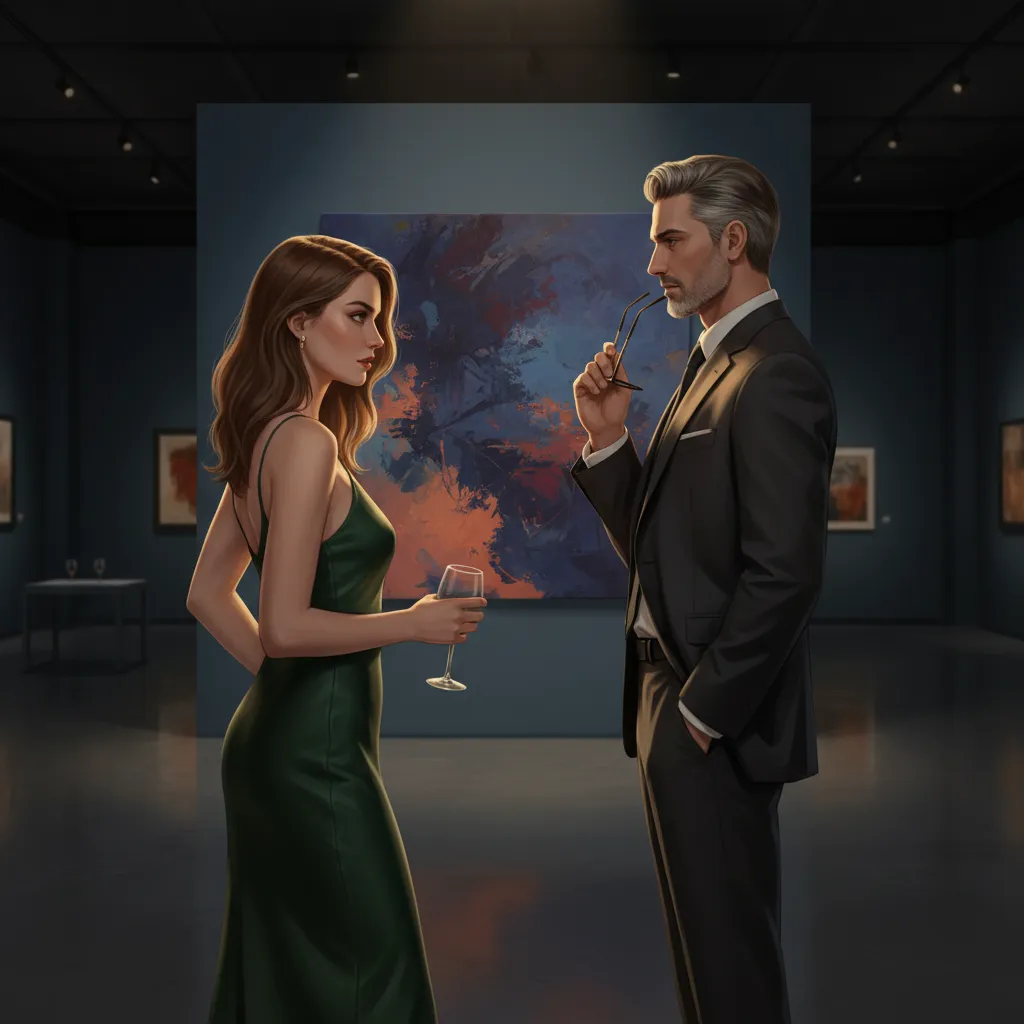
They moved through the gallery together without deciding to.
It happened the way these things happen — they finished with number seven and both drifted toward number eight, which was nearby, and the conversation continued, and after that it seemed strange to separate. By number nine they were walking slowly side by side, wine in hand, speaking in the slightly lowered voices that large quiet rooms require.
He looked at paintings structurally, she noticed. He talked about weight and balance and the way the eye was directed, the architecture of a composition. It was not a wrong way to look. It was a partial way, which was more interesting than wrong.
"You design buildings," she said, at number ten.
"How did you know?"
"You said 'load-bearing' about a painting."
He paused. "Did I."
"Number eight. The red one."
"The red one is structurally incoherent," he said, with a mild defensiveness that made her want to laugh.
"It's emotionally incoherent," she said. "On purpose. That's the work."
"Emotions don't have to be incoherent."
"Sometimes they do," she said. "Sometimes that's the only honest way to represent them."
He was quiet for a moment. They had stopped in front of number ten — smaller than the others, almost square, a deep warm ochre with something dark at its center that could be a figure or a shadow or simply the memory of one.
"What do you do?" he asked.
"I write about this," she said. "Art, culture. What things mean and why that matters."
"Does it? Matter?"
She looked at him. It was a genuine question, not a dismissal — she could hear the difference. "You're asking because you're not sure."
"I'm asking because I want to know what you think."
She considered the painting in front of them. The figure-or-shadow at its center. "I think that people spend most of their lives not saying the true thing. Not because they're dishonest, but because the true thing is difficult to locate. And sometimes a painting locates it. And for a moment, in front of it, you know something about yourself that you didn't know before, or you knew and hadn't admitted." She paused. "I think that matters."
Luka looked at the painting for a long moment.
"Yes," he said quietly. "All right."
"You agree?"
"I'm locating the true thing," he said. "Give me a moment."
She smiled. Genuinely, facing forward so he mostly didn't see it. Mostly.
The gallery was thinning around them. The opening crowd — the loud, social, first-hour crowd — had largely dispersed, leaving only the people who had actually come for the paintings. The lighting felt warmer at this hour. The wine table had been refilled once and was being slowly diminished again.
"Can I ask you something," Luka said, at number eleven. The last painting.
"Yes."
"The gap in number seven. The thing the crossing doesn't reach." He looked at her. "Do you think that's a sad painting?"
She took her time answering. "I think it's an honest painting," she said. "Which is different."
"How?"
"Sad paintings want you to feel sad," she said. "Honest paintings just show you something true and let you feel whatever you feel about it."
"And what do you feel about it?"
She looked at the last painting — this one all white, almost entirely white, with a single thin line of color near the bottom edge, running the full width of the canvas. Present but small. Insisting on itself quietly.
"Recognized," she said. "I feel recognized."
He didn't say anything. She glanced at him and found him watching her with a quiet attention that was different from how he had looked at the paintings — less analytical, more open. Like something had shifted in how he was looking.
She looked back at the painting.
"You?" she said.
A pause. "The same," he said. "Since about number eight, actually."
The room was nearly empty now.