
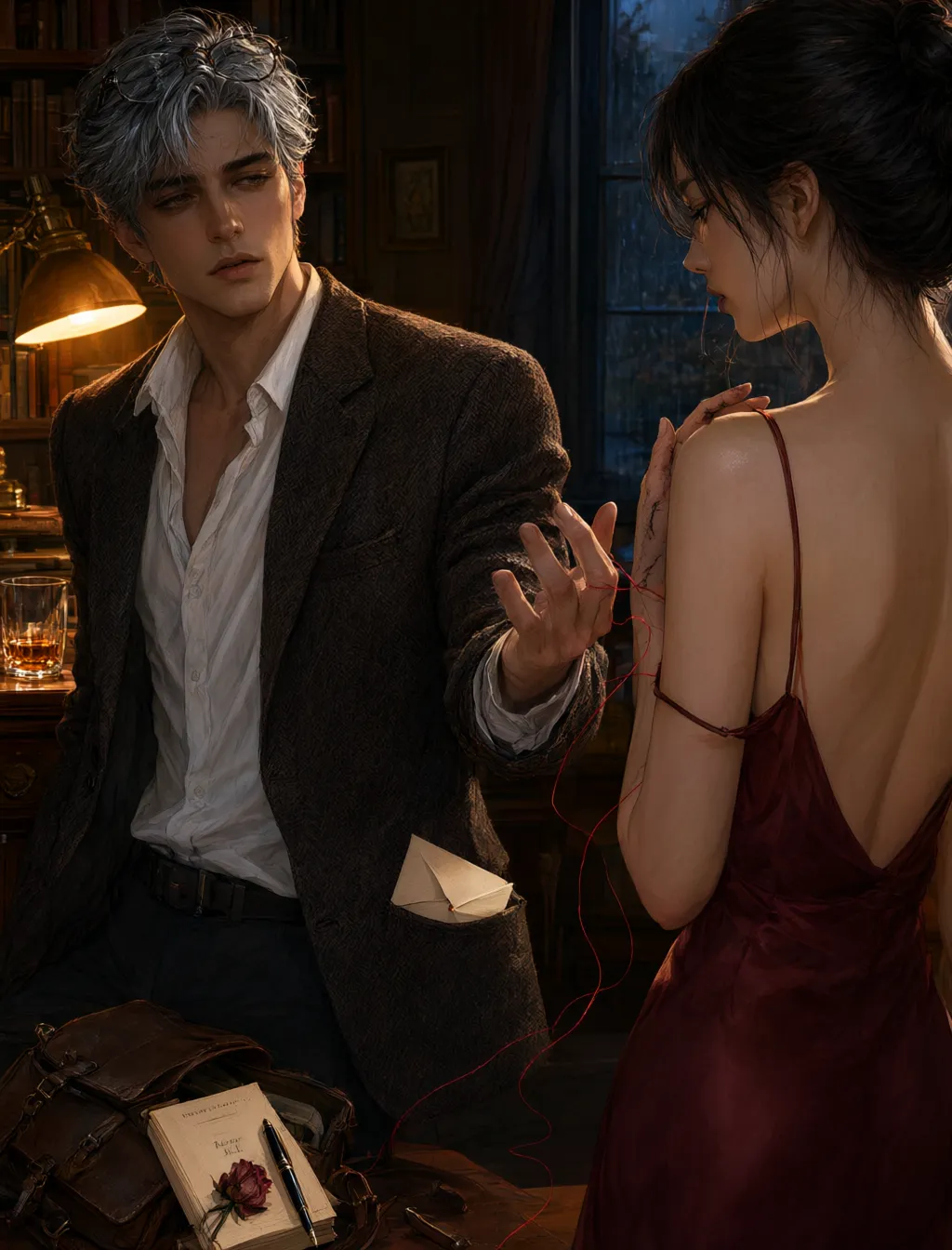
The hallway stretched into darkness ahead of them, old photographs lining the walls like a timeline she couldn't yet read. A sliver of light bled from beneath a door at the far end—the only anchor in the dim. Adrian's hand was still warm around hers, his thumb pressed against her pulse, and she felt the faint tremor running through his fingers.
He stopped at a cluster of frames halfway down. She felt him hesitate before he spoke. "This is the part I don't show anyone." His voice was flat, clinical—a man reporting facts from a safe distance. He lifted his free hand and touched a photograph with his fingertip, not quite making contact with the glass.
She stepped closer. The photograph showed a younger man with the same sharp jaw and the same eyes—but softer, unguarded, the walls she'd come to know not yet built. He stood beside a woman in a blue blouse, red hair loose around her shoulders, both of them leaning toward each other like they shared something unspoken. Sophia recognized the sharp cheekbones, the confident posture. Margaret. Years younger. Before the divorce.
Adrian's finger traced the glass. "That was the year before Catherine left." He said his ex-wife's name like a word he'd nearly forgotten how to pronounce. "I thought I knew what was coming. I was wrong about everything."
Sophia kept her voice quiet. "And the photograph?"
He let out a breath, slow and controlled. "She took it. Margaret. The night I found out Catherine had taken the car, the dog, the furniture. Most of our friends. Margaret showed up with a bottle of whiskey and a camera. Said I'd want to remember what survival looked like." His finger dropped from the glass. "She was right."
The silence between them filled the hallway. Sophia studied the image—the younger version of him, raw and open, standing beside a woman who had witnessed the wreckage. A woman who had stayed. She didn't ask how long Margaret had been that for him. She didn't need to.
"You've been repaying her," Sophia said. Not a question.
Adrian turned to face her. His eyes moved across her face as if memorizing her again, the way he'd done across the restaurant table. "Margaret found me when I was ash," he said, his voice dropping rough. "I've been trying to be what she needs ever since. But I don't think I am. Not anymore."
Sophia looked back at the photograph wall—at the dozens of frames still in shadow, a life assembled in images she hadn't yet seen. She understood, bone-deep, what he was offering her. Not passion that burned clean and left nothing. The slow, terrifying work of becoming someone new together. She felt the weight of every woman who had shaped him settle into her chest.
She didn't say anything. She reached up and touched the frame beside the photograph—the next image still hidden in darkness—and felt the cold glass under her fingertip. She was not stepping into his past. She was deciding whether to build something in its aftermath.
Sophia's finger remained on the cold glass, the next photograph still hidden in darkness. She didn't look away from the wall. "What would Margaret say?" Her voice was quiet, almost clinical—matching his earlier tone. "About this."
Behind her, Adrian's breath stopped. She felt the absence of it like a physical weight, the air between them suddenly thinner. His thumb pressed harder against her pulse, and she realized he was still holding her hand—hadn't let go through the entire confession.
"She'd say I was making a mistake." His voice came rough, scraped. "That I'm too old for you. That this ends badly for everyone." A pause. "She'd be right about some of it."
Sophia turned. He was watching the photographs, not her—his jaw tight, his eyes fixed on the younger version of himself standing beside Margaret. The sliver of light from under the far door caught the silver in his hair, the shadow pooling beneath his cheekbone.
"That's not what I asked." She kept her hand where it was, on the frame, but turned her body toward him. "I asked what she would say. Not whether she'd be right."
Adrian's gaze shifted to her. His eyes moved across her face in that slow, memorizing way, and she felt the weight of it settle into her chest like heat. "She'd say I was being selfish," he said finally. "That I'm chasing something that makes me feel alive instead of something that makes sense." He swallowed. "She'd be right about that too."
Sophia studied him. The man who had shown her his wreckage, his debts, the woman who had witnessed both. She could feel the shape of his guilt in the tremor still running through his fingers, the way he held himself like he was waiting for a blow.
"And what do you say?"
He was quiet for a long moment. The hallway creaked somewhere behind them, the old house settling. A draft brushed her neck, carrying the faint smell of dust and something floral—the ghost of someone else's presence. Margaret's scent, maybe. Lingering.
"I say I don't know how to want something without destroying it first." His voice dropped so low she almost missed it. "Catherine. This. You. I don't know the difference between wanting something and ruining it."
Sophia let her hand fall from the frame. She stepped closer until she could see the flecks of amber in his eyes, the faint redness at the rims. "Then maybe we stop asking what everyone else would say." She held his gaze. "And start figuring out what we want."
He didn't answer. His hand tightened around hers, and she felt the tremor pass through his fingers into her skin, the only truth he could offer. The hallway held them both in its dimness, the photographs silent witnesses, the question still hanging between them like a door neither had opened yet.
The next frame sat lower on the wall, its corner catching the faint light from beneath the far door. Sophia pressed her palm flat against the glass before he could speak, before he could redirect or deflect. The photograph inside was darker than the others—less light, less color, as if the camera had captured something reluctant to be seen.
"This one." Her voice was quiet but didn't tremble. "What hides here, Adrian?"
She felt him go still beside her. His hand, still wrapped around hers, tightened once and then loosened—a reflex he caught and corrected. When he spoke, his voice was rougher than she'd heard it all night. "That's the one I should have taken down."
She didn't look away from the glass. The photograph showed a woman with dark hair and a sharp jaw, standing alone on a porch she recognized as his. Late afternoon light caught the side of her face, half in shadow, half in harsh clarity. The woman wasn't smiling. She was watching someone off-camera with an expression Sophia recognized—the particular resignation of someone who had already made up her mind to leave.
"Catherine," she said. Not a question.
Adrian's breath left him in a slow, controlled exhale. "The week before she told me." His thumb traced the inside of her wrist, an unconscious movement, a man reaching for anchor. "I didn't know that's what I was photographing. I thought I was capturing the light. The way it caught her collarbone. The way she squinted at me like she was trying to remember something." A pause. "I was documenting the end of my marriage and I didn't know it."
Sophia let her palm rest against the glass, feeling the cold seep into her skin. The woman in the photograph looked younger than she'd imagined—younger than Adrian, maybe, or just younger in the way people look before life carves its particular grooves into them. She wondered if Catherine had known, in that moment, that she was already gone. If she'd felt the distance opening between them like a door swinging shut in slow motion.
"Why do you keep it?" Sophia asked. "If it's the one you should have taken down."
Adrian didn't answer immediately. The hallway creaked around them, the old house settling into its bones. She felt his hesitation in the slight tension of his fingers against hers, the way he measured each word before releasing it.
"Because I need to remember what I didn't see." His voice dropped, scraped clean of pretense. "I thought I was a good husband. I thought I was paying attention. And then she was gone, and I realized I'd been living in a story I wrote myself. The photographs on that wall? Most of them are fictions I told myself were true."
Sophia turned. His face was half in shadow, the sliver of light catching the silver in his hair, the hard line of his jaw. He was watching the photograph, not her, and she saw something in the set of his shoulders she hadn't seen before—a weight he carried so long he'd forgotten it was there.
"And the ones you haven't shown me?" Her voice held steady. "Are they fictions too?"
He met her eyes then, and she felt the full weight of his attention land on her like a physical thing. "Some of them," he said. "But I'm trying to learn the difference." He lifted his free hand and touched the edge of the frame she was still pressing against, his fingers brushing hers on the glass. "Catherine was the ending of one story. Margaret was the aftermath of another. But you—" He stopped. His jaw worked. "You're the first thing I've wanted that doesn't feel like a repetition."
Sophia's hand stayed against the glass, his fingers warm against hers. The hallway held them both in its dimness, the photograph of his failed marriage a silent third presence between them. She didn't pull away. She didn't speak. She let the weight of his confession settle into her chest like a stone dropped into still water, the ripples spreading outward, the surface changing shape around them.