
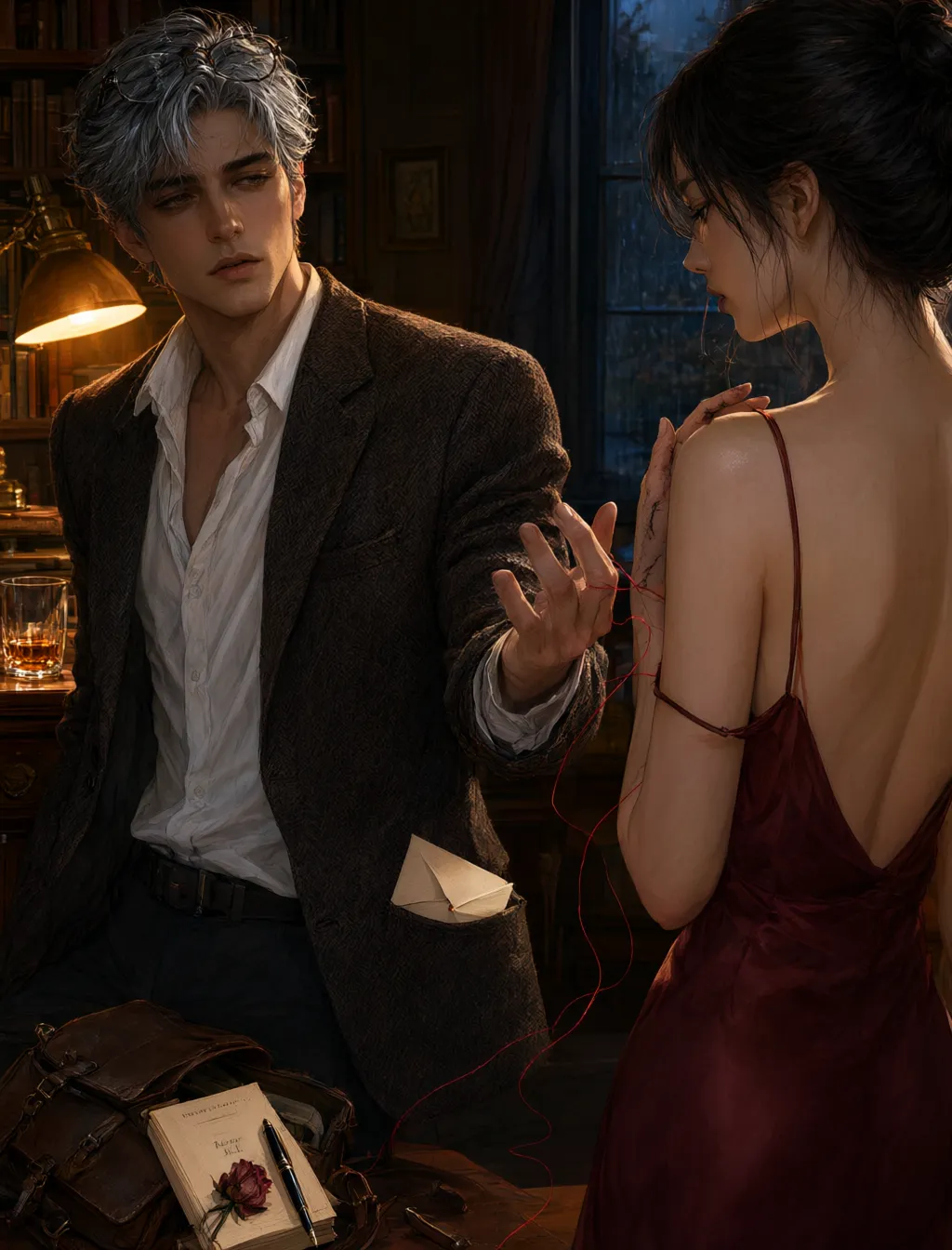
Sophia’s fingers find a strand of her hair, twisting it slow as she settles into the leather chair across from him. The office holds its breath—old paper and sandalwood, the amber glow of the desk lamp catching dust motes that drift like they have nowhere else to go. Adrian Vale pushes his reading glasses up his nose and studies her thesis draft through the haze of lamplight, his voice low and unhurried when he finally speaks.
“Your argument here—the third chapter.” He turns the page, and the sound of paper against his fingers is deliberate, unhurried. “You’re positioning the unreliable narrator as a moral construct rather than a narrative one. That’s a bold claim for a literature thesis.”
She opens her mouth to respond, but he’s already leaning forward, his hand reaching across the desk to point at a passage in her notes. His sleeve brushes against her arm—the faint heat of him through the fabric—and then his fingers touch hers, light, accidental, maybe.
The contact lasts a second. Maybe less. But heat floods her chest, rises to her throat, and she feels her nipples harden against her blouse, pressed tight beneath the silk. She doesn’t pull her hand back. She can’t.
He doesn’t seem to notice. Or if he does, he doesn’t show it. His eyes stay fixed on the page, his finger tracing the line of her argument, and his voice continues steady about narrative distance and reader complicity. But she hears none of it. She’s watching the silver threading his dark hair, the way it catches the lamplight when he tilts his head.
The scent of sandalwood drifts closer, stronger, and she realizes he’s still leaning in. His shoulder almost brushes hers. The leather of his chair creaks as he shifts, and the sound is too loud in the quiet of the room.
She forces herself to breathe. In. Out. Her chest rises against the hard line of her bra, and she hates how aware she is of every inch of her body right now. How her pulse hammers in her throat, how her hand still burns where his touched it, how the hollow below her stomach aches with a certainty she doesn’t want to name.
“Does that track with your reading?” He sits back, taking the weight off the desk, and the space between them widens like a door closing. His eyes meet hers, hazel in the low light, and there’s something there—a flicker, gone before she can catch it.
She nods. “Yes. Yes, it does.” Her voice comes out steadier than she feels. She doesn’t know if that’s a victory or a lie.
But she knows, with a certainty that hollows her stomach, that she is already in dangerous territory. And she has no idea how to get out.
She looks up. His eyes are on her mouth. Not a glance—a linger, a weight she feels like pressure on her skin. The clock on the wall ticks twice before he looks away, and when he does, it's slow, unhurried, like he's saving the image for later.
"The methodology section needs work," he says, and his voice is lower than before. Rougher. He clears his throat and adjusts his glasses, fingers pressing the bridge like he can push the moment back into the frame. "Your sources are solid, but you're relying too heavily on secondary texts. I'd like to see more archival work."
She nods. She can't find words. The space between them feels smaller than it was a minute ago, the desk an insufficient barrier. She watches his hand move across the page—long fingers, elegant, a small tremor at the knuckle—and she wonders if he feels it too, the thread pulled taut between them.
"Next week," she manages. "I can have revisions by Wednesday."
He doesn't answer immediately. He's looking at her again, but this time at her eyes, and there's something in his that makes her breath catch—a crack, a question, a door held open. Then he nods, a single sharp motion, and leans back in his chair.
"Wednesday, then." He closes her thesis and slides it across the desk. The spine faces her. A boundary. "Same time."
She takes it. Her fingers brush the edge of his desk, and she stands. The leather of the chair exhales as she rises, and the sound is loud in the quiet. She reaches the door before she stops, her palm flat against the wood frame.
"Professor Vale."
She doesn't turn. She can feel him behind her, waiting.
"Thank you. For the honesty."
Silence. Then, lower than she's ever heard him: "Sophia."
Her name. Not her last name. Not "Miss Chen." Her name, like he's testing how it feels in his mouth. She waits, breath held, for what comes next. But nothing does.
The door clicks shut behind her. She stands in the empty hallway, her thesis pressed to her chest, and for a long moment she doesn't move. Then she presses her free hand to her blouse, feels her pulse hammering beneath her palm, and lets herself feel the full weight of what she just walked out of.
Her hand hovers over the door handle. She can still feel the shape of his name in the air behind her, the way it hung between them like smoke. Her name. Not Miss Chen. Not a student ID number. Her name, spoken like it mattered.
The hallway is empty. Fluorescent lights hum overhead, flickering at the edges. Somewhere a door opens and closes, footsteps fading in the opposite direction. She should walk away. She should take her thesis and her composure and leave before she does something she can't take back.
Instead she turns.
Her palm presses flat against the wood of his door. The grain is rough under her fingers, the varnish worn from decades of hands just like hers—students, colleagues, lovers. She wonders if Margaret Harlow has stood here. If she's knocked. If she's been let in.
The thought should cool the heat in her chest. It doesn't. If anything, it sharpens it—the knowledge that she's not the first, that there's a territory here she doesn't understand, that she's stepping into something with edges she can't see.
She knocks. Three short raps, knuckle against wood, before she can talk herself out of it.
Silence. Then footsteps. The door opens.
Adrian stands in the gap, his reading glasses pushed up into his hair, his fingers still holding a pen. He doesn't look surprised to see her. He looks like he's been waiting for the knock, like he knew she'd come back before she did.
"I forgot something," she says. Her voice is steadier than she feels. She's gripping her thesis so hard the edges of the paper bite into her palm.
He doesn't ask what. He just steps back, opens the door wider, and lets her in.
She steps inside and closes the door behind her. The lock clicks — a sound too final, too deliberate, and she feels it in her chest like a second heartbeat. The room is smaller now. Every object sharper: the amber glow of the lamp, the dust motes suspended in its beam, the way his shadow stretches across the stacks of books on his desk.
He hasn't moved from where he was standing. The pen is still in his hand. His reading glasses are still pushed up into his hair, catching the light, and he's watching her with an expression she can't read — not surprise, not curiosity, something quieter. Something waiting.
"What did you forget?" His voice is low, unhurried, but there's a weight beneath it she hasn't heard before. He's not asking about the thing she left behind. He's asking why she's still here.
She doesn't answer. She can't. Her mouth is dry, her pulse thrumming in her throat, and the thesis in her hands feels like the only solid thing in the room. She sets it down on the edge of his desk. The spine hits the wood with a soft thud, and the sound fills the space between them.
He doesn't look at it. His eyes stay on her face, tracking something — her breathing, maybe, or the way her fingers curl against her palm. He takes a step closer. Then another. The distance narrows to a desk's width, then less, and she can smell him again — sandalwood and paper and something warmer beneath it, something she doesn't have a name for.
"Sophia." Her name again. Lower this time. Like a question he's afraid to hear answered.
She looks up. His eyes are hazel in the low light, flecked with gold, and there's a crease between his brows she wants to smooth with her thumb. She doesn't. Her hands stay at her sides, pressed flat against her thighs, grounding herself in the texture of her own skirt.
His hand lifts. Hovers. He doesn't reach for her — he reaches past her, for the lamp on the corner of his desk, and turns it off. The room goes dark except for the streetlight filtering through the blinds, casting slats of pale gold across the floor, across his face, across the space between them that feels thinner than air.
The dark makes everything louder: the tick of the clock on the wall, the rasp of her own breathing, the soft creak of the floorboards as he shifts his weight. She can feel the heat of him, inches away, and she doesn't step back. She holds her ground, her heart hammering, her skin alive to every minute sound.
"I should go," she says. But she doesn't move.
He doesn't say anything. He just stands there in the dark, close enough that if she reached out she could touch his chest, close enough that she can hear him breathe. The silence stretches, fills the room, becomes its own presence between them. And she knows — with the same hollow certainty she felt at his desk — that she is not going to leave.