
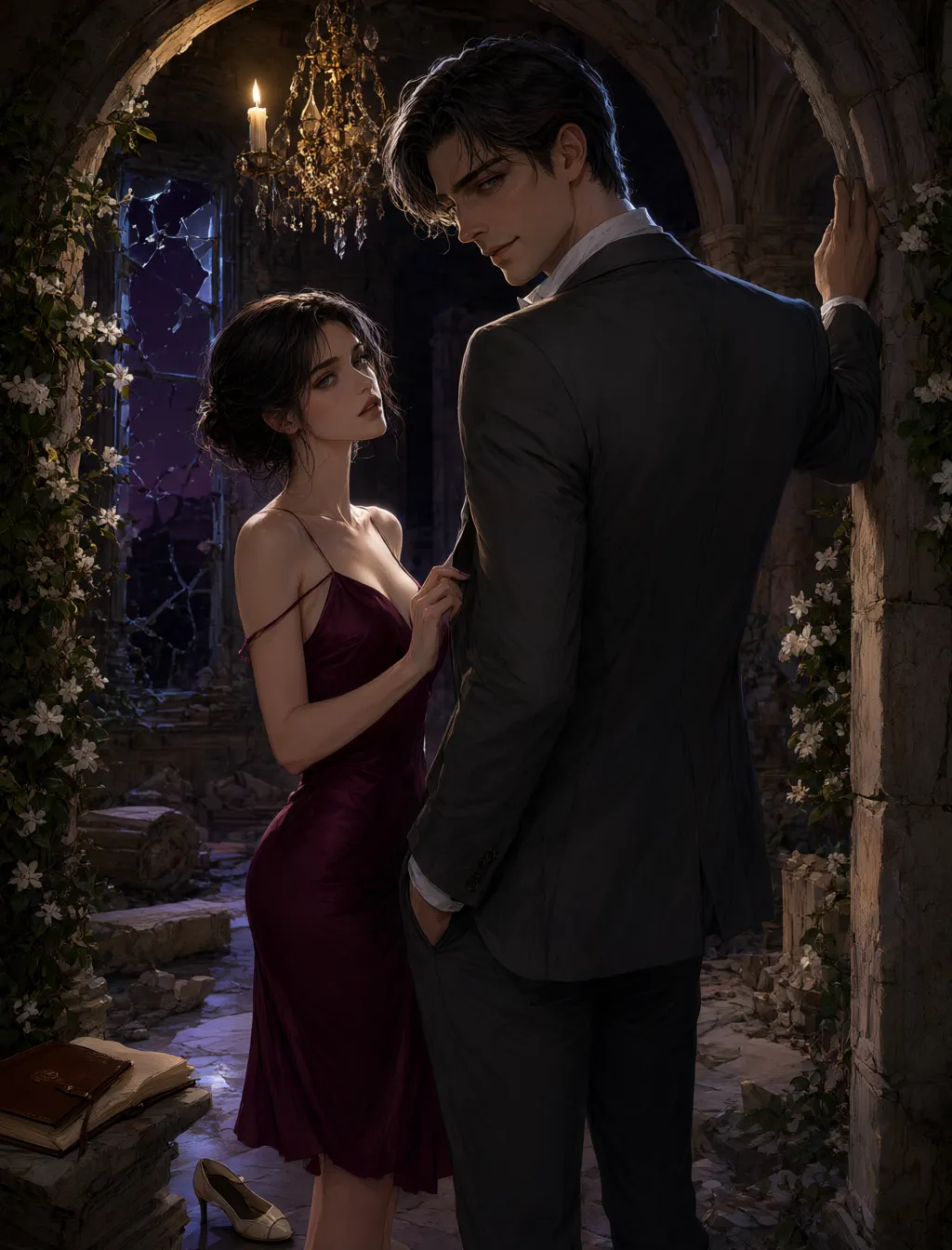
The silence after his question is a living thing. It presses against her ears, thick with the scent of cold stone and their own heated skin, the coppery tang of her blood still on the air. Eliza feels the phantom sting of the blade between her shoulder blades, a cold echo. But beneath it, warmer and more insistent, blooms the memory of his weight on her in a sun-drenched bed, of laughter tangled in linen, of a life she built with him before it was stolen. Her mortal life—the quiet archives, the predictable sunrise, the slow, gentle decay of years—stretches before her like a pale, insubstantial ghost. What he offers is a different kind of ghost: solid, eternal, drenched in night.
His hands are still braced against the wall, caging her. He doesn’t move. His storm-grey eyes hold centuries of waiting, and in them, she doesn’t see the monster from the stories. She sees the man who watched her die and chose not to follow. The cost is a yawning chasm. She knows it. Her mouth waters anyway.
Slowly, his right hand leaves the stone. He turns his wrist upward between them, an offering. The skin there is pale as marble, traced with delicate blue veins. Immortal skin. A feast and a farewell. Eliza stares at the pulse beating steadily beneath that thin veneer. Her own heart thunders, a frantic, mortal drum.
“Elara,” he whispers, and the name is both a caress and a plea.
She doesn’t speak. Her scholar’s mind is silent. Elara’s hunger is not. Eliza brings her trembling fingers to his wrist. The skin is cool. She leans forward, her breath ghosting over it, and presses her lips to the vulnerable blue line. She feels him shudder. Then she opens her mouth. Her teeth find the place where life rivers just beneath the surface. She bites down.
The skin gives way with a shocking ease. Heat floods her mouth—rich, potent, alive. It tastes of dark wine and old magic and Lucien. A groan tears from his throat, part pain, part profound relief. The world narrows to the pull of her mouth, the liquid heat sliding down her own throat, and the slow, terrifying unraveling of everything she is. The choice is made. It tastes like coming home, and like dying.
Eliza drinks, and the world dissolves into sensation. The blood is not just heat—it is a current of raw power, of centuries held in suspension, flooding her veins and rewriting her from the inside. Her mortal frame aches with the influx, bones feeling too thin, skin too permeable. A feverish warmth blossoms in her core, spreading outwards, chasing away the hall’s chill. She hears the wet, desperate sound of her own swallowing, feels Lucien’s wrist tremble against her mouth. His other hand leaves the wall to cradle the back of her head, his fingers tangling in her hair, holding her to him. A ragged sigh escapes him, full of a relief so profound it borders on agony.
“More,” he murmurs, his voice a vibration against her temple. It is not a command, but a granted permission. “Take all you need. Let it burn the mortality away.”
She obeys, sucking deeper, and the memories intensify—not just visions, but lived experience etched into the essence of his blood. She tastes sunlight on a forgotten vineyard, feels the grip of a sword hilt in her palm, smells the lavender in their bedchamber. Her own heartbeat, that frantic mortal drum, begins to slow, its rhythm deepening, syncing with the ancient, steady pulse beneath her lips. The phantom blade in her back vanishes, replaced by a solid, anchoring heat. Her fingers, still wrapped around his forearm, no longer tremble. The strength she feels is not her own, yet it is. It is his, given freely, becoming hers.
Lucien sags against her, his forehead coming to rest on her shoulder. His breath is hot through the torn fabric of her blouse. “Elara,” he breathes again, but the name is different now—a recognition, not a plea. The taste in her mouth shifts, the coppery life giving way to something darker, sweeter, like night-blooming flowers and deep earth. Her thirst, however, does not abate. It transforms. It is no longer about consumption, but completion.
When she finally pulls her mouth away, it is with a gasp that feels like her first. The punctures on his wrist seal over before her eyes, leaving only a smear of crimson on his pale skin and on her lips. Her vision is preternaturally sharp—she can see every fleck of mica in the stone behind him, every thread in the fine wool of his coat. The silence of the hall is no longer oppressive; it is a symphony of tiny sounds—the skitter of a beetle in the rubble, the distant drip of water, the rush of blood in her own, changed veins. She looks up at Lucien. His eyes are pools of storm-grey, wide and unguarded, gleaming with a wetness that does not fall.
“It is done,” he whispers, his thumb stroking her cheek, coming away stained with his own blood. He searches her face, watching the mortal confusion fade, the ancient certainty settle into her features like a mask she was always meant to wear. The choice is not pending. It is etched into her new flesh, thrumming in her quiet heart. She is between worlds—the human life sloughing away like a shed skin, the eternal night not yet fully claimed. But the path is set. Her mouth waters still, not for his blood, but for the forever his kiss promises.
Eliza leans in and kisses him. Her lips meet his, and the taste is copper and dark earth and him—the blood she drank still staining her mouth, his own immortal coolness beneath. It is not a gentle kiss. It is a claiming, a verification written in salt and iron. She feels the exact moment he yields, his mouth opening under hers with a shuddering breath that is half a sob. Their tongues meet, and the taste intensifies, a circuit of shared essence closing between them.
He makes a broken sound against her mouth, his hands coming up to frame her face. His thumbs sweep over her cheekbones, smearing the remnant of his blood into her skin. The kiss deepens, slow and searching, as if he is relearning the topography of a lost country. Eliza’s new senses flare—she can taste the faint ghost of her own jasmine perfume on him, smell the ancient wool of his coat and the clean, cold scent of his immortal flesh. Her fingers find the lapels, clutching fabric, holding him to her as the world tilts on its new, eternal axis.
When they finally part, it is by a breath. Lucien’s forehead rests against hers, his storm-grey eyes wide, lashes damp. “Elara,” he whispers, the name a benediction now, wholly hers.
“Eliza,” she corrects, her voice unfamiliar to her own ears—lower, steadier, the scholar’s measured tone replaced by a quiet certainty that vibrates in her bones. “She is here. I am here. Both.” She watches the understanding dawn in his eyes, the acceptance that she carries the past but is not consumed by it. Her mortality is a shed skin on the stone floor, but the woman who lived it—the historian, the questioner—remains, sharpened by centuries of borrowed memory.
His gaze drops to her mouth, to the blood still gleaming there. “How do you feel?”
Eliza considers. The phantom blade is gone. The quiet heartbeat is a steady, profound drum in her chest, synced to the silent pulse of the castle around them. A new, slow-burning hunger lives in her gut, different from the desperate thirst—a patient, eternal want. “Hungry,” she says, and it is the truth. “But not for that. Not yet.” She looks past his shoulder, through the broken roof to the waning moon. “The sun will be up soon.”
Lucien follows her gaze, a shadow of the old grief passing over his face. “You will not see it again. Not as you did.”
“I know.” She brings a hand to his cheek, her touch deliberate. The coolness of his skin is a comfort, an anchor in the tide of her transformation. “Show me the dark, Lucien. Show me what forever looks like.”
He kisses her.
It is not like the desperate claiming in the Great Hall, or the bloody verification after her transformation. This kiss is slow, deliberate, a sealing. His mouth covers hers with a reverence that feels like a vow spoken directly into her soul. His lips are cool, but the blood they share—his on her tongue, hers in his veins—is a banked fire between them. He breathes into her, and she breathes him back, a circuit of forever closing. When he finally pulls back a fraction, his storm-grey eyes are bottomless. “Forever,” he whispers against her mouth, the word less a description than a sacrament.
Eliza feels the truth of it in her quiet heart. The dawn is a distant, theoretical threat now, a blush of grey at the edge of the broken world above. Her hunger shifts, clarifies. It is not for his blood, but for the depth of the night he promises. She slides her hand from his cheek to the back of his neck, her fingers tangling in the silk of his hair. “Show me,” she repeats, but it is no longer a request. It is a demand from the part of her that is both historian and ancient queen, needing to map her new domain.
Lucien’s smile is a faint, heartbreaking thing, the shadow of grief finally lifting. He takes her hand, his fingers lacing through hers with a possession that feels like belonging. He leads her away from the wall, their steps silent on the dusty flagstones. The ruined hall transforms under her sharpened gaze—every crack in the marble tells a story, every tendril of ivy holds a memory of centuries of moonlight. He does not speak. He shows her. A touch to a particular column, where her name—Elara—is carved in a script forgotten for five hundred years. A gesture toward an archway, through which she remembers the scent of night-blooming jasmine from a garden long since returned to wildness.
The slow-burning hunger in her gut is a compass, pointing always to him. As they walk, she leans into his side, her head fitting against his shoulder as if the notch were worn by time. She can hear the whisper of his coat, the nearly silent rush of immortal blood in his veins, the steady, silent pulse of the castle itself, a heartstone beating in time with her own. This is the dark. Not absence, but a deeper kind of seeing. Not an end, but a landscape.
He stops at the entrance to a spiral staircase, its stone steps worn smooth by ages. “The tower,” he says, his voice a low vibration she feels in her bones. “The world looks different from above when you are no longer afraid of the fall.” He looks at her, waiting. The question is in his eyes: are you ready?
Eliza brings their joined hands to her lips, pressing a kiss to his knuckles. The taste of him—dark earth and eternal night—is on her skin. She meets his gaze, her grey eyes no longer just human, but holding the reflection of centuries. “I’m not afraid,” she says, and for the first time, it is the complete truth. She steps onto the stair first, pulling him into the darkness behind her.
The spiral stairs open into a round, roofless tower, the night sky a vast bowl of indigo above them. Moonlight, clean and cold, pours through the broken vault, illuminating the circular space and the sheer drop beyond the low, crumbling wall. Eliza stops at the edge, the wind pulling at her torn blouse, and turns to him. Without a word, she reaches for his hand, turns it, and her fingers circle his wrist.
His skin is cool marble under her new, sensitive touch. She can feel the twin rivers of his immortal life, the pulse a slow, deep drum against her thumb. This is not the desperate, transformative thirst of before. This is something else—a ritual, a confirmation. Her mouth waters with a clean, sharp hunger. She looks from his wrist to his face. His storm-grey eyes are solemn, waiting, the question from the hall finally answered in her grip.
“A different vow,” she says, her voice the steady sound of the night wind. She brings his wrist to her lips, her eyes holding his. She does not bite. She kisses the pale skin, her tongue tracing the blue highway of a vein. He shudders, a full-body tremor that she feels through their joined hands. “My hunger is yours. Your eternity is mine.”
“Yes,” he breathes, the word ripped from him. His free hand comes up to cradle her jaw, his thumb stroking the corner of her mouth. “Always.”
Then her teeth break the skin. The blood is not a flood this time, but a deliberate, shared sacrament. She drinks slowly, savoring the dark, sweet richness of him, feeling the echo of her own changed blood singing back to his. He sags against her, his forehead dropping to her shoulder, a groan of pure surrender vibrating into her bones. The connection is not one of maker and made, but of two halves of a single, eternal circuit finally closed. She drinks until the hunger is a satisfied, glowing ember in her gut, until she can taste her own power—sharp and clear as starlight—mingled with his in the essence on her tongue.
When she lifts her head, licking the last drop from her lips, the world has shifted again. The approaching dawn is a tangible pressure at the edge of her awareness, a distant furnace she can feel but need not fear. Lucien straightens, his eyes gleaming in the moonlight, the last vestige of grief erased by a quiet, fierce joy. He looks at the twin punctures on his wrist, already sealing, and then at her. “Forever looks like this,” he says, his voice rough with wonder. “It looks like you, here, in the ruin that remembers us.”
Eliza closes the distance and kisses him. Her mouth meets his, and the taste is not just blood or memory—it is the dark, rich soil of their shared eternity. It is the iron of her transformation and the cool, sweet wine of his centuries, all blended on their tongues. She drinks him in, not with the desperate thirst of before, but with the slow, claiming savor of a woman surveying her own country.
Lucien’s hands find her waist through the torn silk of her blouse, his touch both anchor and answer. He kisses her back with a reverence that feels like worship, his mouth moving against hers in a silent litany. She can taste herself in him—the sharp, clear note of her new power, a thread of starlight woven into his darkness. The circuit between them is complete, humming with a voltage that has no mortal name.
When she finally breaks the kiss, it is to press her forehead to his, breathing in the scent of cold stone and immortal skin. The wind coils around them in the roofless tower, tugging at her hair and his coat. “It tastes like us,” she whispers, the words a cloud in the frigid air. “Not just you. Not just me. Something made of both.”
He nods, his storm-grey eyes holding hers. The quiet, fierce joy has not faded; it has settled into the lines of his face, erasing the final shadows of his grief. “It always was,” he murmurs, his thumb tracing her lower lip, smearing the last vestige of their joined taste. “I just had to wait for you to remember the recipe.”
Eliza smiles, a slow, unfamiliar stretching of muscles. It feels ancient on her face. The approaching dawn is a distant pressure against her spine, a warning she no longer needs to heed. Her new hunger is a patient, glowing thing, satisfied for now by the truth on her tongue and the man in her arms. She turns in his embrace, leaning back against his chest to look out at the ruin, at the world slowly bleeding from indigo to grey. “Show me the rest of forever,” she says, not as a question, but as the first command of her new, endless night.
He doesn’t hesitate. Before her last word has fully faded on the wind, his arm is under her knees, the other bracing her back, and he lifts her from the stone floor as if she weighs nothing at all. The world tilts, the ruined tower walls spinning for a heartbeat before settling. Eliza’s gasp is lost against his coat, her arms looping instinctively around his neck. The torn silk of her blouse flutters open, her bare skin meeting the fine wool, cool and real. He holds her against his chest, cradled like something precious reclaimed, and looks down at her. The fierce joy in his storm-grey eyes is brighter than the fading moon.
“Your castle, my queen,” he says, his voice a low vibration she feels where her ear presses to his sternum. “See it as you were meant to.” He turns, carrying her to the broken edge of the tower wall. The drop is sheer, a plunge into shadows and rubble a hundred feet below. The mortal Eliza would have stiffened, dug her fingers into him. The woman in his arms simply tightens her hold, her new, quiet heart steady as she looks out. The ruined expanse of Valerius Keep unfolds below them like a map written in moonlight and memory. She sees the skeletal lines of fallen galleries, the black mouths of empty windows, the great hall where he first kissed her—all of it washed in silver. But she sees more. She sees the ghost of the soaring roofs, the torchlight that once flickered in those windows, the vibrant life that hummed where silence now reigns. Her castle. Her ruin.
Lucien moves, not back toward the stairs, but along the tower’s crumbling perimeter. He walks the edge with a predator’s surefooted grace, the void yawning beside them. The wind is stronger here, plucking at her hair, his coat. It carries the scent of cold stone and damp earth and, faintly, the night-blooming jasmine from the wild garden below. He stops at a place where the wall has fallen away entirely, giving an unobstructed view of the eastern horizon. A thin line of molten gold is beginning to bleed into the indigo. The dawn she will never again greet as a mortal. She feels its approach not as warmth, but as a distant, immense pressure—a furnace banked behind the hills.
“It cannot touch you now,” he murmurs, his lips brushing her temple. His hold on her shifts, one hand splayed possessively over her rib cage, his thumb resting just below the curve of her breast. “The light is for them. The dark is ours. All of it.” He turns his head, his gaze tracing the sharp line of her jaw, the pulse in her throat that now beats in time with his own ancient rhythm. “Do you feel it? The claim of the land? It remembers your footstep. It has waited for your return.”
Eliza does feel it. It is a low, resonant hum in her bones, a pull from the very stones. It is the same pull that drew the historian here, a mystery she could not solve. Now, it is an answer she wears in her blood. She tilts her head back against his arm, looking up at his face. “Show me the rest,” she says, her voice quiet but carrying the weight of command. Not the scholar’s request. The queen’s decree.
He obeys. He carries her down from the tower not by the stairs, but by leaping from ledge to broken archway to fallen buttress, a descent that is a fluid dance of immortal strength. The ground rushes up, then meets his boots with a soft crunch of gravel. He sets her on her feet in what was once the inner bailey, her bare soles touching cool, damp grass. He keeps an arm around her waist, anchoring her to this new reality. Before them, the skeleton of the keep’s main structure looms, a cathedral of loss. But Eliza’s sharpened eyes pick out the details the moonlight reveals: the carving of a hawk, the Valerius crest, above a doorframe; the faint, ghostly pattern of a herringbone brick path under the weeds; the ancient, gnarled trunk of a yew tree, still clinging to life in the center of the courtyard. She walks toward it, drawn, Lucien’s hand a constant pressure at the small of her back.