
The painting seizes her before she can breathe. A woman's face emerging from burnt umber and shadow—one cheekbone caught in light, the curve of a jaw, a dark eye that follows from any angle. The brushwork is hungry, strokes laid so thick they cast their own shadow, paint standing in ridges where the bristles drove deep. And below the face, a hand reaching out of darkness toward the viewer, fingers splayed, nails unpolished, the gesture half-formed and desperate.
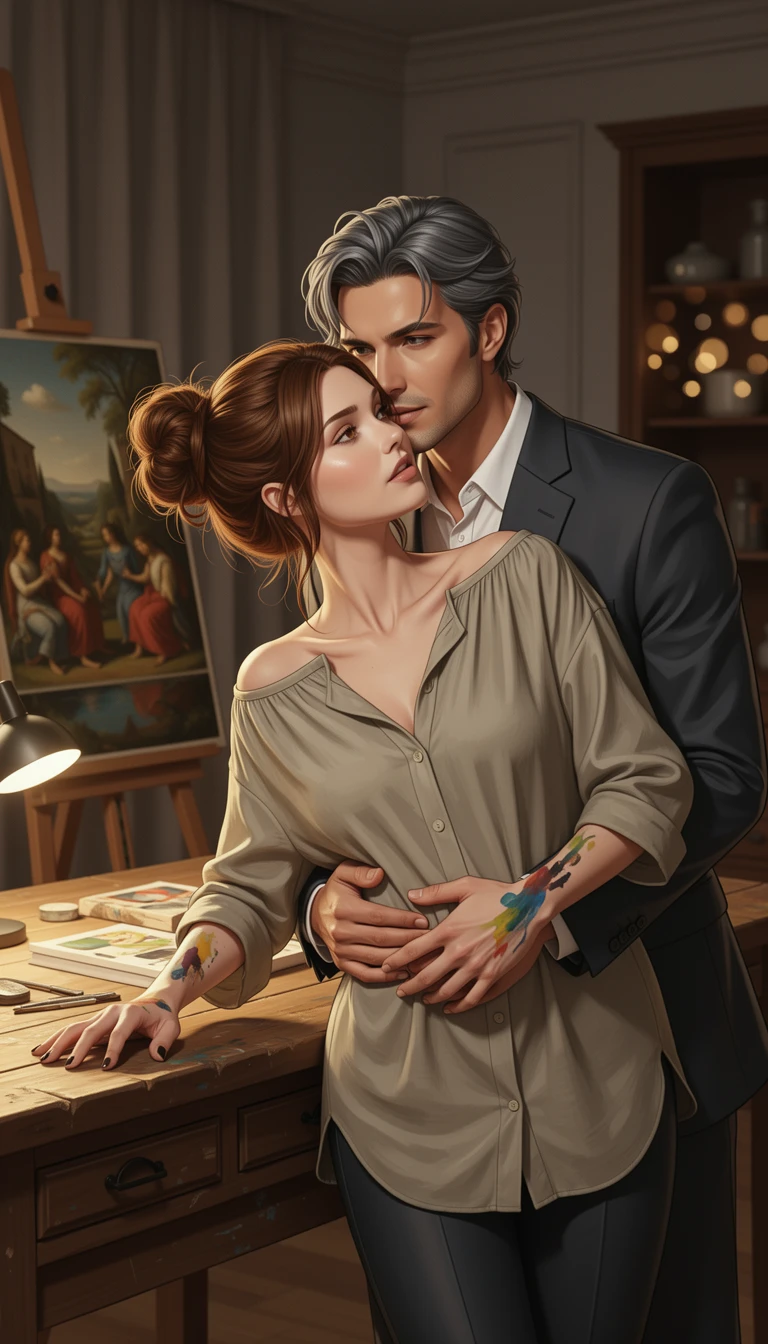
Behind her, Victor's breath stops. Then starts again—ragged, wrong, a sound she feels through her shoulder blades where the air shifts with the change. His chest doesn't touch her back but the warmth of him does, a steady heat pressing at the space between her shoulder blades where her spine knows to arch.
The hand in the painting reaches outward. The fingers are unfinished, sketched in raw umber and white, the thumb a single desperate stroke. It doesn't ask. It grasps. Like someone drowning and reaching for the surface they can't find.
His fingers land on the edge of the frame an inch from hers. She sees them in her periphery—knuckled, pale against the dark wood, close enough that if she spread her thumb they'd touch. He doesn't. She doesn't. The inch between them holds everything.
She studies the face. The eye is dark, almost black, no pupil visible—just a void ringed in ochre that seems to watch from inside the canvas. The mouth is a suggestion, a smear of crimson that could be lips or could be blood, left unfinished as if the painter ran out of time or nerve.
"Elise painted this." Her own voice sounds distant, as if it's coming from the hallway. "Three years ago."
"Yes." His voice breaks on the word, cracks like old varnish. "She painted it in this room. She said it was the last thing she needed to finish before she could leave."
His fingers shift on the frame. Not toward her. The opposite direction—a retreat, an inch he gives back. But the warmth at her spine holds steady, and she knows he hasn't stepped away. Only his hand moved, pulling back from the edge of something he's not ready to touch.
She turns. Not fast—the movement costs her something, a deliberate severing of her gaze from the canvas. The face in the painting keeps watching from her periphery, that dark eye following, but she makes herself look at him instead.
His hand hovers where it retreated, still an inch from the frame, fingers curled as if the wood burned him. He's not looking at the painting anymore. He's looking at the space between them, at the dust motes drifting through the light, at anything that isn't her face.
"What aren't you ready to touch?"
The question lands between them like a stone dropped into still water. She watches the ripples cross his face—the tightening of his jaw, the way his throat works as he swallows. His right hand trembles, a fine vibration she can see even in the dim light, and he doesn't hide it.
"Victor." She says his name the way she pressed her thumb into his palm in the study—deliberate, insistent, a pressure that asks for something in return. "What is it? The painting, or what she left behind?"
His breath comes out in a single exhale, almost a laugh but not quite. "Both." The word is rough, scraped from somewhere deep. "Neither. I don't know how to separate them."
She doesn't reach for him. The instinct is there—her hand wants to close the distance, find his fingers, offer the contact that steadied him before. But she holds still. This isn't the study. This isn't a negotiation. This is a room he's avoided for three years, and whatever he says next can't be pulled from him by touch.
"She painted it the week before she left." His voice is lower now, the accent pulling at the edges of the words. "I didn't know. She told me she was working on something, but she always said that. I was in Geneva. I came back and she was gone, and this was here, covered, waiting for me."
He finally looks at her. His gray eyes are wet at the rims, the pale irises ringed with red, and she sees the thing he's been holding behind every measured word and controlled gesture—a grief so old it's calcified into something harder, something that doesn't know how to break.
"I haven't touched it since the day I found it," he says. "I couldn't. And then I brought you here, and I watched you pull the cloth away, and I thought—" He stops. His hand lifts, not toward her, not toward the frame, but into the empty air between them, as if reaching for a word he can't find. "I thought if you saw it first, maybe I could see it too."