
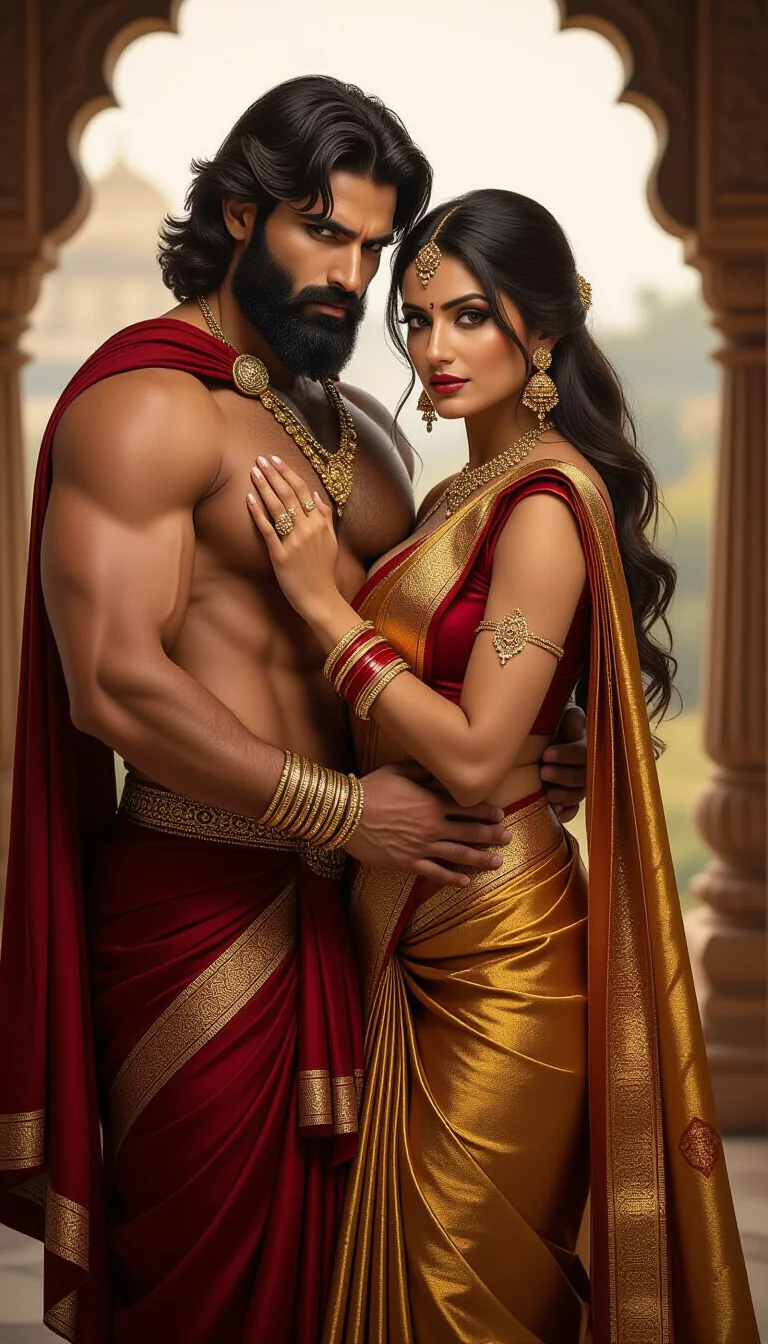
The next morning Dyut was sent to his destination. Nine months got passed. Within this nine months Zeeshan fought and won many Battles. He made many developments that the old king didn't. And after these long nine months queen gave birth to the new prince. The message was sent to Zeeshan, who was still in the war. And queen herself sent the invitation to her son. The dust of the outpost still clung to Dyut’s boots, a fine, red powder that seemed out of place on the polished marble of the palace corridor. He had ridden for two days, his guard of Zeeshan’s men a silent, ominous escort. The invitation, written in his mother’s precise hand on heavy vellum, had been a cold stone in his gut for weeks. He had memorized its five lines, the ink blots where her pen had hesitated. It spoke of a celebration. A prince. A future king. His hands clenched at his sides, the knuckles white.
The palace was not as he remembered. The dark, somber silks of mourning were gone. Brilliant tapestries of crimson and gold draped the walls. Garlands of marigolds and jasmine hung from the archways, their sweet, cloying scent filling the air where once there had been only the smell of old stone and fear. The sound was the worst of it. Laughter. The clink of cups. The low hum of conversation from the great hall. It was a festival, and the memory of his father’s blood on this same floor felt like a scream trapped in his throat.
He recognized faces. Men who had bowed to his father, who had ruffled his hair when he was small. A courtier named Vikram, who had taught him chess, stood by a pillar, holding a golden goblet, his laugh too loud. Their eyes met. Vikram’s smile faltered, his gaze skittering away to find something fascinating in his drink. Dyut felt a hot shame flush through him, as if he were the one who had done something wrong. He was a ghost here, a boy-shaped stain on their new joy.
He did not go to the hall. He turned down the smaller, private passage that led to the queen’s solar. The two guards at her door wore Zeeshan’s lion crest on their tunics. They looked at him, at his travel-stained clothes and his too-thin frame, and after a silent moment, one pushed the door open without a word. Permission, or a dismissal. He stepped inside.
The room was bathed in the soft, late afternoon light that fell through the latticed windows. It was quieter here, the noise from the hall a distant murmur. The air smelled of sandalwood and milk. And there she was.
Sugandha sat on a low divan piled with silk cushions, her back to the door, looking out at the courtyard garden. Her hair, a single thick braid, fell over one shoulder. She wore a simple sari of cream-colored silk, not the brilliant red of a new bride or a celebrant. She was moving, a slow, rhythmic rocking. A tiny, muffled sound filled the space between them—a soft, wet, contented suckling.
Dyut stopped. All the rehearsed words, the anger, the confusion, turned to ash on his tongue. He could only see the curve of her cheek, the line of her neck as she bent her head. The delicate, almost terrifying vulnerability of the nape of her neck, exposed. Her hand, slender and strong, supported a bundle of white muslin wrapped in a gold-threaded shawl cradled against her breast.
He did not know how long he stood there. A servant girl slipped past him with a silent bow, placing a tray with a copper water jug and a single cup on a low table before retreating. The door clicked shut. The sound made Sugandha turn.
Her eyes found his. They were the same dark, intelligent eyes, but the rest of her had changed. A fullness to her face, a tired softness around her eyes. She looked… settled. It was this, more than anything, that carved a hollow in his chest. She did not startle. She did not look guilty. A small, weary smile touched her lips. “Dyut,” she said, her voice the low melody he heard in his dreams. “You came.”
He could not speak. His gaze was dragged from her face to the bundle in her arms. He saw a tiny, star-shaped hand resting against the swell of her breast, the skin a lighter gold than hers. He saw the baby’s head, covered in dark, downy hair. He saw the peaceful, rhythmic pulse of the tiny jaw as it fed.
“Sit,” she said, nodding to the space on the divan across from her.
He moved like a puppet, his legs stiff. He sat on the very edge, his back rod-straight, as far from her as the cushion would allow. He stared at his hands, calloused now from the training yard of the outpost, dirty under the nails. The contrast with the pristine scene before him was obscene.
“You are well?” she asked. A mother’s question. Mundane. Impossible.
“They are celebrating in the hall,” he said. The words sounded ragged.
“I know.”
“They are drinking to the health of the prince.” He forced himself to look at her. “The future king.”
She met his gaze. Her eyes did not waver. “Yes.”
“How can you allow it?” The whisper was torn from him. “How can you sit here and… and feed his son, while they toast with wine over Father’s memory?”
Sugandha did not look away from her son’s shattered expression. She adjusted the baby slightly, her movements slow and deliberate, as if handling something more fragile than glass. The infant made a soft, milky sound and settled deeper against her. “Your father was a good king,” she said, her voice measured. “He was honorable. He built a peaceful realm. But peace is a fortress with its gates unguarded, Dyut. It invites siege.”
“He was murdered,” Dyut spat, the words hot and young in his throat.
“He was defeated,” she corrected, and the calm in her voice was a colder, harder thing. “There is a difference. Zeeshan did not sneak in like a thief. He broke the gate he had studied. He faced your father’s army in the courtyard. He took the throne by the law of conquest, which is the oldest law of kings. And then…” Her eyes flickered, just for an instant, to the window. “He began to build.”
Dyut shook his head, a stubborn, boyish denial. “Build what? A prison?”
“A road,” she said. “From the southern mines to the river port. Your father debated that route for a decade. Zeeshan drafted every able-bodied prisoner from the siege, fed them, and had it done in three months. The treasury, which was dwindling, is now overflowing. Silver from the mines reaches the port in two days instead of ten. Trade has tripled.”
She spoke like a treasurer giving a report. Dyut stared at her face, searching for the woman who had held him as they watched his father’s pyre burn. He found only the calm mask of a queen.
“He crushed the eastern rebellion at Ghoragarh in a fortnight,” she continued. “A campaign your father had postponed for years, fearing the cost. Zeeshan used the new road to move his troops swiftly. He used the rebel lord’s own gold, seized from his vaults, to pay the soldiers. He left a garrison loyal to *this* crown, and now the eastern taxes flow here, on time.”
“He buys loyalty with blood money,” Dyut whispered, but the conviction was bleeding from his voice, replaced by a sickening confusion.
“He buys stability,” Sugandha said. “The merchants in the bazaar do not care whose portrait is on the coin. They care that the coin is sound and that bandits do not roam the trade roads. For nine months, the roads have been safe. The granaries are full. The people in the hall today… they are not celebrating a baby, Dyut. They are celebrating a full belly and a quiet night’s sleep.”
The baby had finished feeding. Sugandha shifted him onto her shoulder, her hand supporting his head with a practiced ease that struck Dyut as a profound betrayal. She patted the tiny back gently. “His methods are a hammer. Your father’s were a chisel. But look at the stone, my son. Look at what stands.”
“And what of me?” The question was small, a child’s question, and he hated it the moment it left his lips.
Her composure fractured then, not with tears, but with a sudden, intense focus. She leaned forward, the baby a soft barrier between them. “You are alive. You are training. You are learning the art of war at an outpost, not languishing in a dungeon. That was the price, Dyut. Your life, for my compliance. This…” she glanced down at the drowsy infant, “…this is the interest on that debt. I pay it so the principal remains untouched.”
Before he could unravel her meaning, a distant sound echoed through the palace corridors—the deep, blaring call of a war horn, answered by a chorus of others from the walls. It was not an alarm. It was a proclamation.
Sugandha’s head lifted sharply, all softness gone. The mask was back, but now Dyut saw the seams. He saw the swift calculation in her eyes, the tightening of her jaw. “He is here,” she said, and it was neither welcome nor dread. It was a statement of fact, like the sun setting.
She stood in one fluid motion, cradling the baby. She walked to a carved sandalwood cradle draped in silk and laid the child down with exquisite care. Her fingers lingered for a second on his cheek. Then she turned, and she was all queen. “Servants,” she called, her voice ringing clear in the chamber. Two women materialized from an alcove, their eyes downcast. “The prince is sleeping. Watch him. Do not leave this room.”
She smoothed the folds of her emerald green sari, adjusted the heavy gold necklace at her throat—a wedding gift from Zeeshan. She approached Dyut, who still sat frozen on the divan. She did not touch him. “You will come with me to welcome the king.”
“I will not,” he choked.
“You will,” she said, and her voice held the iron of the throne room. “You are a prince of this bloodline, however mixed it now may be. You will stand where I tell you to stand. You will show the court a united house. It is not a request. It is your duty to this kingdom, which is still your kingdom, and to me.”
The appeal to duty was his father’s language. She wielded it now like Zeeshan wielded a sword. It left him defenseless. He rose, his limbs heavy.
The corridor stretched before them, a canyon of polished marble veined with gold. Their footsteps echoed, hers a measured tap of sandaled grace, his a reluctant shuffle. The air smelled of beeswax and something colder, the scent of stone that never warmed. Dyut watched the straight line of his mother’s back, the emerald silk of her sari flowing like water, and the words boiled up in him, bitter and childlike.
“Do you accept him?” The question spilled into the silent hall. “As your husband. Do you?”
Sugandha did not break stride. Her gaze remained fixed on the distant archway leading to the main courtyard. “Acceptance is not the point. Survival is. Stability is.”
“That is not an answer.”
“It is the only answer that matters.” She finally glanced at him, her profile sharp against the torchlight. “If his rule brings order, if his strength keeps the borders firm and the granaries full, then he is the king this kingdom needs. My people sleep safely tonight, Dyut. That is the metric. Not my feelings.”
“Your people,” Dyut echoed, the words ash in his mouth.
“Yes. My people. And as their queen, my duty is to the crown that secures their peace. If they have accepted him, then I must stand beside him. If the crown requires an heir, then I must provide one.” Her voice was disturbingly calm, a lesson recited. “A king must secure his lineage. He could, and should, breed me as necessity dictates. It is the function of a royal wife.”
The word—breed—hit Dyut like a kick to the stomach. It was a word for livestock, for horses, not for his mother. He stopped walking. The vulgar, casual cruelty of it stripped her of all majesty, reducing her to a body, a vessel. He saw the flash in her eyes as she said it, a flicker of something—shame, fury, resignation—so fast he almost missed it. Then it was gone, sealed behind the mask of the queen.
She paused, waiting for him to catch up. She did not apologize. She did not explain. She had stated a fact of her new world, and her stillness demanded he accept its geometry.
He followed, numb. The arches gave way to the open courtyard, bathed in the harsh afternoon sun. The scene was a vivid tapestry of power. Zeeshan’s personal guard, men with hard faces and leather armor stained with travel dust, formed a bristling perimeter. In the center, dismounting from a massive black warhorse, was the king.
Zeeshan Khan filled the space. He wore travel-worn battle gear, a layer of fine dust coating his boots and the shoulders of his tunic. He moved with a predator’s economy, handing his reins to a servant without looking. His eyes swept the courtyard, missing nothing—the assembled palace staff, the banners, the queen waiting at the top of the palace steps—and finally, landing on Dyut for a frozen second. A look of mild, dismissive interest. Then his gaze returned to Sugandha.
Sugandha descended the steps. Her movements were a ceremony in themselves, each step deliberate, her head held high, the gold at her throat and wrists catching the sun. She reached the courtyard floor and approached him. She did not kneel. She bowed her head, a precise and respectful incline. “Welcome home, my king. Your son awaits you.”
Zeeshan’s mouth quirked, not quite a smile. He closed the distance between them in two strides. His hand, big and calloused, came up not to her face, but to the back of her neck, his fingers sliding beneath the heavy fall of her hair. It was a possessive gesture, claiming, undeniable. He pulled her gently forward and pressed his lips to her forehead. A king claiming his queen. A man marking his property. Dyut felt his fists clench.
“The ride was long,” Zeeshan said, his voice a low rumble. “But news of a son makes the dust taste sweet.” He released her, his thumb brushing the line of her jaw before dropping away. “Show me.”
“The celebration is prepared inside,” Sugandha said, turning smoothly to guide him. “Your commanders are thirsty, I am told.”
As they turned, Zeeshan’s gaze found Dyut again. He stopped. “The young prince,” he said, as if naming a piece on a board. “You have seen your brother?”
Dyut’s throat locked. He managed a stiff nod.
“A robust child,” Zeeshan stated. “A king’s son. You would do well to learn from him, in time.” A few of his nearby men chuckled, a low, knowing sound. The insult was precise, meant to remind Dyut of his displaced, diluted status. He was a ghost in his own home, a lesson in obsolescence.
Sugandha’s hand, hidden in the folds of her sari, made a slight, calming motion toward Dyut—a flicker of fingers he almost didn’t see. Her face, however, was a placid pool. She offered Zeeshan a small, composed smile. “Let the past wait outside the gates, my king. Today is for the future. Come. Meet him.”
She placed her hand lightly on Zeeshan’s armored forearm, a wifely touch, and led him toward the palace entrance. The courtiers and soldiers flowed after them, a river of noise and color swallowing the silent king and queen.
The great hall thrummed. Music from sitar and dholak wove through the laughter of Zeeshan's commanders and the clatter of golden cups. Servants moved like ghosts through the smoke of roasting meat and heady incense, their faces blank. Dyut stood where the wall met shadow, a pillar of cold marble at his back. He was a statue in his own palace.
He watched his mother. Sugandha moved through the chaos with impossible grace, a flash of emerald silk and gold. She paused by a group of officers, her head tilting as she listened, offering a smile that seemed to make the man before her stand taller. She touched a commander’s arm in brief congratulations. She laughed at a joke, the sound low and melodic, swallowed by the din. She was the perfect hostess. The perfect queen. Dyut’s stomach twisted.
A servant bumped into him, sloshing wine. The man glanced up, muttered an apology, and hurried on without a second look. He hadn’t recognized him. Or he had, and it didn’t matter. Dyut Singh, son of Aranya, was part of the furniture now. Unseen.
His eyes tracked Zeeshan. The king held court from a raised divan, one boot planted on the cushion, a goblet dangling from his fingers. Men clustered around him, recounting battles, their voices booming. Zeeshan’s gaze, however, kept cutting across the room to find Sugandha. Every time it landed on her, his eyes darkened with a quiet, satisfied intensity. A man surveying a prize that had proven fruitful.>
“The young prince should not lurk in corners.”
The voice came from his side. It was one of the older courtiers, a man named Vasu whose loyalty had been bought with Zeeshan’s gold. He offered Dyut a cup of sherbet. “Celebrate. Your brother is the future.”
Dyut took the cup. The sweet, rose-flavored liquid tasted of ash. “My father’s future was a sword,” he said, the words leaving him before he could stop them.
Vasu’s smile tightened. He leaned closer, his breath smelling of spices and fear. “Your father’s future is dust. Drink to the living, boy. It is the only wisdom left to you.” He melted back into the crowd.
Dyut’s hand trembled. He set the cup on a passing tray, his fingers sticky. The noise pressed in on him—the clapping, the music, the roaring approval for the man who had killed his father and now owned his mother. He couldn’t breathe here. He slipped from the hall, the celebration fading to a dull roar behind him.
The palace corridors were cooler, quieter. The familiar scent of beeswax and stone was a ghost of his childhood. He walked without thinking, his feet carrying him toward the old family wing, now Zeeshan’s domain. He shouldn’t go there. He knew it. He went anyway.
The door to the nursery was ajar. A slice of soft lamplight cut across the darkened hallway. From within, he heard a low, humming murmur. His mother’s voice.
He edged to the doorway and peered inside.
Sugandha sat in a low chair by the cradle, her back to him. The cradle itself was a punch to his gut. It was his. The same dark teakwood, the same carvings of elephants along the headboard. He had chewed on that wood as a baby, his mother had told him. Now it held another.
She was not humming a song. She was speaking, her voice a soft, relentless stream. “...and you will be strong,” she whispered to the sleeping child. “You will be clever. You will listen when others shout. You will see what they miss.” Her hand rested on the cradle’s edge, her fingers stroking the wood near the baby’s head. “You will have everything. And you will know the cost of it.”
Dyut felt the jealousy then, not as a hot spark, but as a cold, spreading stain in his chest. The child had his cradle. His palace. His mother’s whispered secrets. Everything was being poured into this new vessel, this son of Zeeshan, while he stood empty in the hallway.
As if sensing him, Sugandha’s words stopped. She did not turn. Her shoulders, usually so straight, slumped for a single, fleeting second. Then she straightened, the queen again. She leaned over the cradle, and Dyut saw the delicate curve of her neck as she bowed her head.
He heard the soft, wet sound. A gentle suckling. The baby had stirred, and she was feeding him.
The sound was intimate. Primitive. It was the sound of his own earliest memory, a warmth and safety so absolute he had forgotten it until this moment, when it was given to another. The jealousy turned molten, furious. This was the final territory. This was the last, sacred thing being claimed. His mother’s milk. Her body’s loyalty. It was being given to the enemy’s son.
The feast roared in the great hall, a storm of drunken laughter and clattering plates that Dyut watched from the edge. Zeeshan held court at the high table, his voice booming over the din, toasting the new prince, the future of his bloodline. And beside him, Sugandha laughed.
Her head was tilted back, the column of her throat exposed as she laughed at something a Zeeshan-loyal general said. A silver cup was in her hand, wine dark as blood. She took a long drink, her eyes bright and unfocused. Dyut watched her lean into Zeeshan’s space, her shoulder brushing his arm, a gesture of casual belonging that made Dyut’s stomach clench.
“A strong son from a strong queen!” a man slurred nearby, raising his cup toward her. Sugandha acknowledged it with a regal, if unsteady, nod. She was participating. She was one of them.
This was not the shattered woman from the wedding night. This was not the grim queen whispering costs to a cradle. This woman was alive in the firelight, her beauty amplified by the wine, her laughter a melody that wove seamlessly into the conquerors’ chorus. Dyut felt invisible. A servant refilled his cup with watered wine, not even meeting his eyes.
He remembered her on the dais months ago, her body rigid as stone, her eyes dead pools as Zeeshan draped a garland around her neck. That had been a violation. This, now—this cheerful complicity—felt like a deeper betrayal. The noise became a physical pressure against his temples. The smell of roasted meat and spilled ale turned cloying. He couldn’t breathe.
He slid from the bench, the movement unnoticed. The cool silence of the corridor was a shock, like plunging into deep water. He walked, his soft boots whispering on polished stone. He wasn’t thinking of a destination. His feet simply carried him away from the proof that his mother had been remade.
He found himself in the old east gallery, where portraits of his ancestors lined the walls. Moonlight fell through high windows, painting pale stripes on the faces of dead kings. His father, Aranya, was not here yet. His portrait would likely never be hung. Dyut stopped before the image of his grandfather, a man with kind eyes and Dyut’s own stubborn jaw. The palace had smelled of jasmine and peace then.
He drifted into the abandoned royal gardens. The siege had trampled the flowers, and no one had bothered to replant them. Weeds grew between the cracked flagstones. Here, by the dry fountain, his father had taught him the names of constellations. Here, his mother had chased him, her silk slippers whispering through dew-wet grass, her laughter real and meant only for him.
He sank onto the fountain’s cold rim. The feast’s distant roar was a mockery. He clutched his arms, the fine linen of his tunic suddenly feeling like a prisoner’s shift. He was a ghost in his own home. The future that had been his birthright—the king he was to become, the kingdom he was to steward—was now promised to a mewling infant. A son of Zeeshan. A filth that had grown inside his mother.
The memories came now, sharp and unbidden. The crack of his father’s neck. The wet, heavy sound as his body hit the throne room floor. The triumphant gleam in Zeeshan’s flint eyes. Then, later, the taunts. “Coward-prince,” the guards muttered when they thought he couldn’t hear. Zeeshan’s own assessment, delivered coolly: “The boy has no fire. He is his mother’s son, all softness.” They had broken his father and called him weak for the breaking.
Hatiefd, hot and sour, filled his mouth. He hated Zeeshan with a purity that was the only clean thing left in him. But Zeeshan was a mountain, untouchable, away at war. The hatred needed a closer target. It flowed, inexorable, toward the nursery. Toward the sleeping cause of all this celebration. The replacement.
He stood. A strange calm settled over him. They called him coward. They thought him broken, harmless, a boy lost in memory. They would be wrong.
The plan formed with chilling simplicity. Everyone of importance was in the hall, drunk on wine and triumph. The nursemaids would have been dismissed to join the festivities. The guards at the family wing would be lax, their attention on the sounds of merriment below. For a window of time, the newborn would be alone. Unguarded.
The nursery door was unguarded, just as he’d guessed. Dyut slipped inside, the scent of milk and talcum powder thick in the dark. A single night-lamp cast a soft glow over the carved cradle. His heart was a frantic drum against his ribs. He approached, each step measured to silence. The baby slept, a tiny fist curled by its cheek, lips making soft sucking motions in a dream. Dyut’s fingers closed around the dagger’s hilt. The metal, warmed by his own sweat, felt like the last piece of his father.
He held the blade over the tiny, pulsing throat. His own breath sawed in and out. He willed his hand to descend, to carve justice into this sleeping usurper. But his arm trembled violently. He was his father’s son. Aranya had faced Zeeshan’s entire army without flinching. Why couldn’t he silence one mewling thing? The coward tag, Zeeshan’s dismissive words, his own men’s sneers—they coiled in his gut, a nest of serpents. Prove it, he commanded himself. Now.
Footsteps. Firm, confident, coming down the corridor. A man’s bootheels. A lighter, familiar tread beside them.
Panic, cold and absolute, flushed through him. He yanked the dagger back from the baby’s skin, the blade catching the lamplight. He dropped to his knees and shoved the weapon under the cradle bed, the metal skittering on stone. His eyes darted. The large wardrobe—the same one—stood against the far wall. He scrambled across the floor, pulled the door open, and folded himself inside among hanging silks that smelled of his mother’s jasmine. He pulled the door shut, leaving a crack the width of a blade.
The nursery door opened. The footsteps entered. The door closed with a soft, final click.
“See? Peaceful,” his mother’s voice said, a low, rich sound. “He just fed.”
“Good.” Zeeshan’s voice was a gravel rumble. “A strong son needs a strong appetite.”
Dyut pressed his eye to the crack. Zeeshan stood with his back to the cradle, looking at Sugandha. He was still in his riding leathers, dust from the road on his shoulders. Sugandha wore a deep maroon sari, her hair loose. She was smiling. Not the hollow smile from the dais, but a real one that touched her eyes. Zeeshan reached out, not to strike or claim, but to tuck a strand of hair behind her ear. His knuckles brushed her cheekbone.
“You look pleased with yourself, my queen,” Zeeshan said, his thumb tracing her lower lip.
“I have given you a prince,” she said, her gaze holding his. “The kingdom is stable. Should I not be pleased?”
Zeeshan’s answering smile was slow, satanic in its satisfaction. He said nothing. Sugandha’s eyes dropped. Without a word, she sank gracefully to her knees before him on the nursery rug. Her hands went to his leather belt. Dyut’s breath froze in his lungs. The memory of the wedding night assaulted him—the violence, the tearing silk, her muffled sobs. This was different. Her movements were deliberate, unhurried.
She loosened the fastenings of his trousers. Zeeshan watched her, his hand coming to rest on the crown of her head, not forcing, just possessing. His length sprang free, thick and full, gleaming in the lamplight. Sugandha did not hesitate. She leaned forward and took him into her mouth, all of him, in one smooth, deep motion. A wet, gulping sound filled the quiet room.
Sugandha took him deep, again and again, her nose buried in the coarse hair at his base. Each time, the thick girth of him stretched her throat, a visible bulge traveling up the pale column of her neck before receding with a wet, gulping retreat. Tears leaked from the corners of her squeezed-shut eyes, tracing shiny paths through the powder on her cheeks, but her rhythm did not falter. It was relentless, a rough, mechanical worship.
From the crack in the wardrobe, Dyut watched, his own throat constricting with a sick, sympathetic pressure. He could not reconcile the woman he knew with this kneeling figure. This was not the forced violation of the wedding night. This was deliberate. Devotional.
She pulled away with a slick pop, her mouth glistening. She spat into her palm, the sound obscenely loud, and used the moisture to slick his length, her hand and tongue moving in tandem. She licked along the prominent vein underneath, traced the flared head, as if memorizing its geography. Claiming it. Her eyes, when they flicked up to Zeeshan’s face, held a challenge amidst the tears.
Dyut felt his stomach turn. His fingers dug into the silks around him, crushing the jasmine scent.
Then she took him back inside, and the vigorous, choking rhythm resumed. Zeeshan’s head had fallen back, his eyes closed, a low groan rumbling in his chest. His hand, which had been resting possessively on her head, now tightened, his fingers threading through her dark hair. He held her still.
“Enough of your games,” he gritted out, his voice thick.
The change was instant. He took control, his hips driving forward, forcing himself deeper into the constriction of her throat. No longer was she setting the pace. He was. Each thrust was a short, brutal impact, a growl tearing from his lips with every forward slam. Her body jolted with the force.
The gulping sounds became sharper, more desperate. The bulge in her throat swelled alarmingly with each invasion. Sugandha’s hands, which had been braced on his leather-clad thighs, began to pat at them frantically. Not a push, but a frantic, staccato tapping, like a bird beating against a window.
Dyut saw it. The helpless, involuntary signal. She was choking.
Zeeshan looked down, his gaze molten with pleasure. He watched her hands patting, fluttering against the solid rock of his thighs, and a dark, exhilarated smile spread beneath his beard. Her helplessness was his dominion. He did not slow. He drove harder, grunting with effort, mesmerized by her struggle.
A high, strangled noise escaped Sugandha’s clamped lips. Her patting grew weaker. Just as Dyut thought he would vomit or scream, Zeeshan stilled, buried to the hilt. A full-body shudder racked him. A raw, animal sound was torn from his throat.
Inside hers, he spilled. Dyut saw the convulsive swallow, the huge, difficult bob of her throat as it worked to take it all. He heard the final, wet gulp. The room fell silent, save for Zeeshan’s ragged breathing and a faint, choked cough from Sugandha.
Zeeshan withdrew, softening, glistening. Sugandha slumped back onto her heels, one hand going to her throat. Her face was flushed a deep red, her eyes streamed, her lips were swollen and slick with spit and seed. She dragged in a shuddering, ragged breath.
And then she laughed.
It was a hoarse, breathless sound, edged with hysteria but unmistakably a laugh. Her watery eyes met Zeeshan’s triumphant gaze. She shook her head, as if in disbelief at herself, at him, at the entire violent transaction. A strange, wild light was in her eyes.
“A game,” she rasped, her voice wrecked. “It is all a savage game, is it not?”
Zeeshan looked down at her, his chest heaving. He did not answer with words. He bent, hooked a finger under her chin, and kissed her. It was not tender. It was a claiming of the mess he’d made, a taste of his own release from her battered mouth. She accepted it, her patting hands now coming to rest, limp, on his boots.
When he straightened, he fastened his trousers with deliberate, casual movements. He looked like a man who had conquered a rebellious citadel and found the treasure within to his exact liking. His eyes shifted to the cradle, where the prince slept on, undisturbed.
“You please your king,” he stated, his voice returning to its normal gravel. It was not praise. It was a verdict.
Sugandha used the edge of her maroon sari to wipe her mouth. The gesture was shockingly mundane. “I know my duty,” she said, the laugh gone, replaced by a flat, exhausted resonance.
“See that you remember it.” Zeeshan’s gaze lingered on her for a moment longer, then swept the room. It passed over the wardrobe. Dyut froze, his heart a hammer against his ribs. But the king’s eyes did not pause. He turned and left, the door closing softly behind him, leaving only the sound of the baby’s quiet snuffles and Sugandha’s uneven breathing.
For a long minute, Sugandha did not move. She knelt on the rug, head bowed, the picture of devastation. Then, with a slow, pained grace, she pushed herself to her feet. She walked to a brass ewer and poured water into a basin, dipping a cloth. She wiped her face meticulously, the cool water perhaps soothing the heat in her skin. She smoothed her hair, adjusted the pallu of her sari. With each motion, she reassembled herself, piece by piece, into the Queen.
Zeeshan returned again, as he always did, his boots silent on the marbled floor. He closed the door, and the lock turned with a soft, final click. “The hall echoes with celebrations for the prince,” he said, his voice a low rumble in the quiet room. “No one will come this way. Some… worship… is still left undone.” He said the word with a dark, possessive weight.
Sugandha just gave a smile. It was a small, knowing curve of her lips that did not reach her eyes. She came close to him, her movements fluid, practiced. Her fingers went to the knot at her waist. With a deliberate pull, the maroon silk of her saree pooled at her feet in a whisper of sound. She stood before him in only her deep red petticoat and a short, tightly-fitted choli that barely contained her breasts. She lifted her arms, crossing her wrists above her head, a pose of offering. The candlelight caught the sheen of sweat in the hollows of her armpits, the damp valley between her breasts, the curve of her exposed waist.
“My king,” she said, her voice a low hum. “I know what you want.”
From the wardrobe, Dyut’s breath stopped. He understood, with a sickening lurch, that this was a ritual. Within these nine months, this had become their habit. They had built a terrible, intimate coordination.
Zeeshan didn’t waste any time. A rough hand encircled her waist and pulled her against him. He buried his face in her cleavage, a growl vibrating against her skin. He did not kiss. He licked, a broad, vigorous stripe from sternum to the swell of a breast. He spat, the wetness shocking and cool before his hot mouth closed over her nipple through the thin fabric, biting just enough to make her gasp. He moved to the other, his tongue mapping her, claiming every curve with a wet, unapologetic hunger.
Sugandha made a sound. A moan, low and genuine. Her head fell back. This time she was not screaming. Not crying. Her eyes were closed, her lips parted. A faint smile touched them when his teeth grazed a particularly sensitive spot. She chuckled, a breathy exhalation, as his stubble brushed the tender skin beneath her breast. “It tickles,” she whispered, and the admission seemed to thrill him more.
Dyut watched, frozen, as Zeeshan’s mouth moved lower, down the plane of her stomach. His king’s hands gripped her hips, holding her still as he knelt before her. He nuzzled the damp skin of her navel, then dipped his tongue inside the shallow, perfect hollow.
Sugandha’s breath hitched. “Ah.”
Zeeshan licked it, a slow, circling exploration. He spat into it, the liquid pooling for a moment before his mouth sealed over it, sucking the skin until it bloomed a faint red. He bit the soft flesh around it, not hard, a testing pressure that made her stomach muscles flutter. A stronger moan escaped her, and her hands, still above her head, flexed against empty air.
Then he rose, his attention returning to her raised arms. He leaned in, his nose grazing the delicate hollow of her left armpit. He inhaled, deeply, a conqueror sampling the scent of his territory. It was clean, musky, utterly her. A groan of pure appetite rumbled from his chest.
His tongue followed. He licked the hollow with precise, thirsty strokes, as if drinking from a sacred spring. He was meticulous, leaving no patch of skin untouched. He switched to the right, his hand coming up to hold her arm steady, his mouth working with the same focused intensity. Sugandha shuddered, her composure melting into a series of soft, helpless sounds. She was smiling, her eyes heavy-lidded, watching the man between her arms as if in a trance.
Zeeshan pulled back, his beard glistening with her sweat. He looked up at her, his flinty eyes black in the low light. “You taste of jasmine and salt,” he said, his voice thick. “You taste of victory.”
She looked down at him, her chest rising and falling rapidly. Her arms trembled from being held aloft. “I am yours,” she said, and the words were not flat, not dutiful. They were warm, infused with the heat of her skin and the reality of his mouth on it. “To worship. To taste.”
Dyut felt the world warp. He saw his mother surrendering, her body arching into Zeeshan’s ministrations, her responses unfeigned. She was not the broken woman from the wardrobe nine months ago. This was someone else. A queen who received a brutal king’s devotion and gave back… pleasure.
Zeeshan surged to his feet, capturing her mouth with his. This kiss was different from the last. It was not a claim of violence, but a sharing of the taste he had just gathered from her skin. It was deep, consuming. Sugandha’s arms finally lowered, her hands coming to rest on his shoulders, then sliding to tangle in the hair at the nape of his neck. She kissed him back.
When they parted, both were breathing hard. Zeeshan’s thumb stroked the bite mark near her navel. “You enjoy your king’s worship,” he stated, watching her face.
“Yes,” she breathed, the word a confession in the quiet room. Her gaze flickered, for the briefest instant, toward the cradle where her newborn son slept. Then it returned to Zeeshan, solid, present. “It reminds me that I am here. That I am alive.”
He studied her, his expression unreadable. The raw hunger had banked, replaced by a simmering possession. “The prince sleeps soundly,” he said, his hand moving from her stomach to cup the back of her head. “Your body has done well. It pleases me.”
“I am glad,” she said, and leaned into his touch, her cheek against his palm. It was a gesture of shocking intimacy. Dyut had never seen his mother lean into anyone but his father. The wrongness of it was a physical ache in his chest.
Zeeshan's hands slid from her head to her waist, his grip firm and certain. He did not ask. He simply lifted her, one arm hooking under her knees, the other cradling her back, and raised her from the chaise as if she weighed nothing. Sugandha gasped, a sound of surprise that melted into a low laugh as he carried her the few steps to the vast bed. He did not lay her down. He threw her. Her body landed with a soft thump on the silk covers, her hair fanning out around her, and she was still smiling, her eyes locked on his.
He stood at the foot of the bed, his chest heaving. With deliberate, rough motions, he unwrapped the damp cloth from his waist and let it fall. He was revealed entirely, gleaming in the candlelight, every muscle defined, every scar a pale silver river on his skin. He was drenched, sweat tracing the hard lines of his abdomen. He did not shy from her gaze; he presented himself as the weapon he was.
Sugandha pushed herself up on her elbows. Without breaking eye contact, her own hands went to the sari pooled around her waist. She untangled it, the movement slow and intentional, and let the final length of silk slide from her body. She lay back, naked, her skin glowing. Her body was softer now, marked by motherhood, her hips fuller, her breasts heavy. The dark triangle of hair at the junction of her thighs was fully visible. She made no move to cover herself.
Dyut’s breath stopped in his throat. This was not the violent exposure of the wardrobe. This was an offering. His mother’s body was not being taken; it was being given. The difference was a canyon he could not cross.
Zeeshan’s nostrils flared. He climbed onto the bed, moving over her on all fours like a great beast. He did not kiss her. He lowered his head between her legs. He inhaled, a long, deep draught, his eyes closing. “By the gods,” he muttered, his voice ragged. “Even your musk is a royal decree.”
Dyut felt a wave of nausea so potent he had to press his forehead against the cool wood of the wardrobe door. Filth. This was filth. Yet his mother did not push him away. Her head tipped back into the pillows, her back arching slightly off the bed.
She reached down, her fingers threading through his dark, sweat-damp hair. Not to pull him away. To guide him. Her voice, when it came, was a throaty, resonant thing Dyut had never heard. “O my king,” she sighed, the words dripping with a dark honey. “Come. Breed Sugandha. Only the bravest and the strongest gets to breed Sugandha. Sugandha will only mate with the alpha king.”
The words struck Dyut like physical blows. They echoed in the silent chamber, obscene and ritualistic. This was not his mother. This was some temple priestess chanting a blasphemous hymn. He dug his nails into his palms, the pain a tiny anchor in a dissolving world.
Zeeshan growled, the sound vibrating against her skin. He reared up, positioning himself over her. Sugandha’s legs fell open wider, a deliberate, welcoming gesture. She guided him with a hand that was not tentative. Her eyes were wide, dark pools reflecting the frantic candle flame.
He buried himself in her with one powerful, unyielding thrust.
Sugandha’s moan was huge, a guttural sound ripped from the core of her. Her eyes bulged, her mouth fell open in a silent ‘O’ of shock and sensation. But she did not resist. Her hands flew to his back, her fingers splaying across the knotted muscle, holding on as he began to move.
Zeeshan set a brutal, punishing rhythm from the start. He was a man digging a trench, a warrior hammering at a gate. Each grunt that punched from his lungs was timed with a drive of his hips. The bed frame creaked in protest. The sound was animal, primal, a raw music of possession.
And Sugandha met it. Her initial moans climbed in pitch and volume, transforming into breathless cries, then into full-throated screams that she made no attempt to stifle. Each scream seemed to fuel Zeeshan further. His pace increased, his thrusts becoming shorter, harder, faster, a relentless campaign to shatter the very silence of the palace.
Their bodies shone, slick with sweat, catching the light so they seemed to be carved from living amber. Dyut watched, trapped, as his mother’s body was rocked by the force of the king. Her breasts shook with each impact. Her expression was one of agonized ecstasy, her teeth bared, her neck corded. This was her worship. This violent coupling was her liturgy.
“My king,” she cried out, the words breaking on a sharp gasp as he drove into her. “Plough this fertile Sugandha! Sow your seeds inside!”
Zeeshan’s control snapped. A final, ragged roar tore from him as he slammed into her, his body locking, shuddering. He spilled himself inside her with a violence that made her whole body convulse beneath him. He collapsed, his weight pressing her into the mattress, his face buried in the sweat-damp hollow of her neck.
For a long moment, there was only the sound of their ragged, heaving breaths, a dissonant duet in the quiet room. Then, with a wet, soft sound, Zeeshan pulled himself out of her and rolled onto his back beside her. Sugandha trembled, a fine, continuous shiver running through her limbs. A thin sheen of their mingled sweat coated her stomach.
They lay side by side, not touching, staring up at the shadowed canopy. The only other sound was the soft, rhythmic breathing of the newborn prince in his cradle, undisturbed by the tempest that had just passed.
Inside the wardrobe, Dyut’s world had ceased to spin. It had simply frozen. The images were burned onto the backs of his eyelids: his mother’s open, screaming mouth, her welcoming body, the words of submission and desire. The filth was not in the act, he realized with a cold, clarity. The filth was in her willingness. The betrayal was not Zeeshan’s conquest; it was her surrender.
After an eternity, Sugandha slowly turned her head on the pillow to look at Zeeshan. Her breathing had begun to steady. She did not speak. She simply looked at him, her face unreadable in the dimness.
Zeeshan turned his head toward her. He reached out a heavy hand and laid it on her stomach, his fingers splayed over the place where his seed now lay. “A king,” he stated, his voice hoarse but sure.