
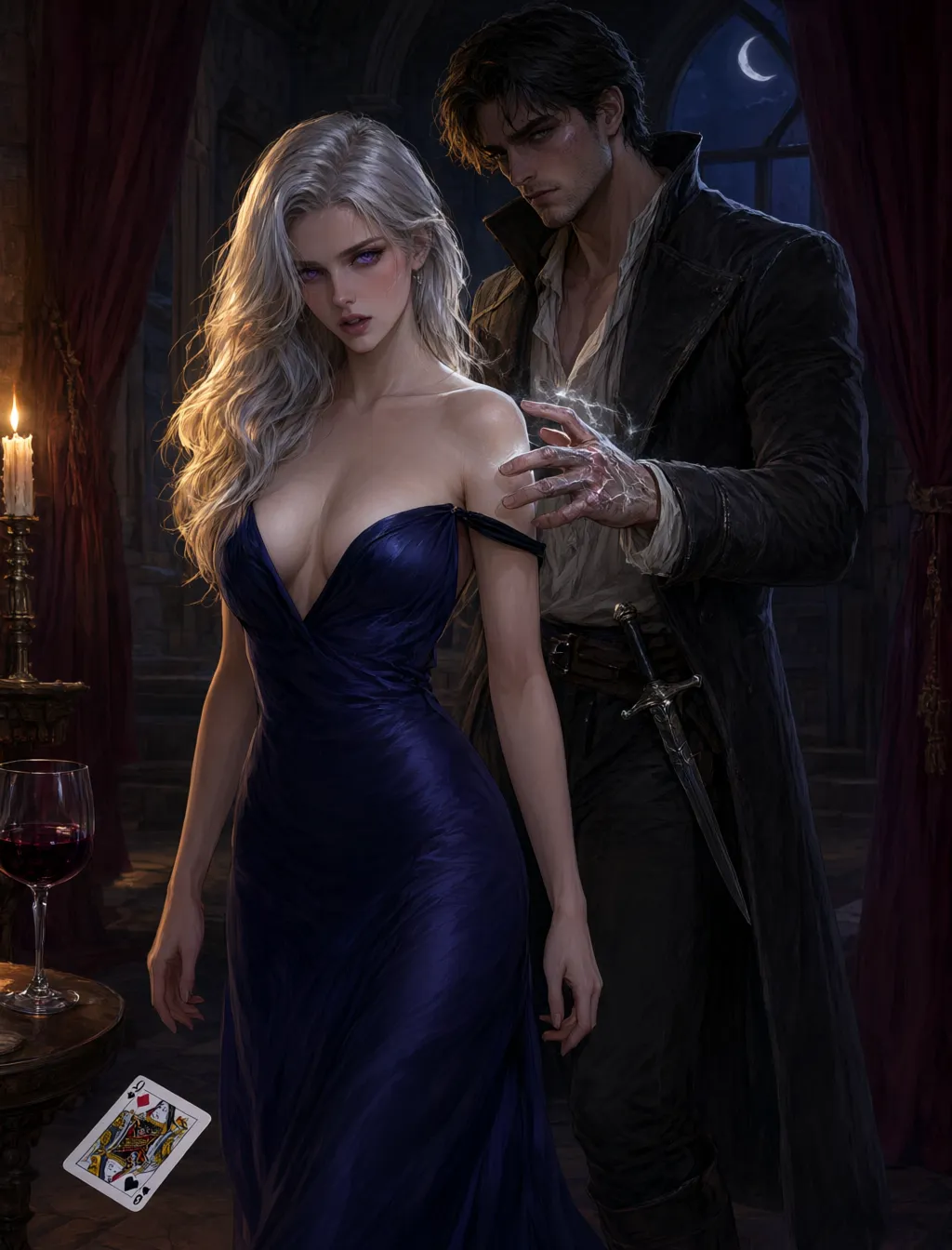
Kael breaks the kiss with a ragged sound that is half-gasp, half-sob. He doesn’t pull back to his feet. He sinks, his body folding down onto the cold cellar floor as if the bones have been removed from his legs. His forehead comes to rest against the stone between her knees, his hands—those scarred, powerful hands—curling into impotent fists on the grimy flagstones.
Aria stares down at the crown of his jet-black hair, her own breath trapped somewhere high in her chest. The desperate heat of a moment ago evaporates, leaving a vacuum filled only by the sight of the King’s Master of Shadows brought low. This isn’t a seduction. It’s a collapse. The raw intensity shatters, and what pours out is hollow, devastating contrition.
“I killed her,” he says, the words muffled against the stone. His voice is stripped, unrecognizable. “I condemned an innocent woman. I gave the order. I stood and watched them lead her away.”
Her historian’s mind, always cataloging cause and effect, goes silent. She knows the facts of Queen Elara’s condemnation, but here is the living consequence of it: a man unraveling at her feet. The true power she holds clicks into place, cold and brilliant. It isn’t her knowledge of the Chancellor’s betrayal. It is this. She is the proof. The walking, breathing evidence of his catastrophic failure.
Slowly, her hand lifts. It doesn’t tremble. It descends through the damp, chilly air and comes to rest on his head. Her fingers slide into the dark strands. The touch is not gentle, not soft. It is a settling. A benediction for his guilt, and a claim upon the man who now owns it.
Aria’s fingers tighten in Kael’s hair. The pressure is deliberate, insistent. She presses his forehead harder against the stone between her knees, accepting the weight of his collapse, anchoring him in his own surrender. The damp chill of the floor seeps through the thin fabric of her gown, a sharp contrast to the heat radiating from his scalp under her palm.
He doesn’t resist. A shudder travels the length of his spine, visible through the dark fabric of his robes. His fists uncurl, fingers splaying flat against the grimy stone as if seeking purchase in a world that has just dissolved. The proud line of his shoulders is gone. All that remains is the rise and fall of his breath, ragged and uneven against her leg.
“Look at me,” she says. Her voice is quiet, but it doesn’t waver. It is a historian’s command, demanding witness.
For a long moment, he doesn’t move. Then, slowly, he turns his head. His cheek grates against the rough stone, coming to rest against her thigh. He looks up. The storm in his eyes has broken, leaving behind a wreckage of stark, unguarded shame. The torchlight catches the tracks of moisture—whether sweat or something else—on his temple. “Proof,” he whispers, the word raw. “You are proof I am not what I believed.”
Aria holds his gaze. Her thumb strokes a slow, firm arc just above his ear, a counterpoint to the severity of her grip. The power here is not magic. It is colder, simpler. It is truth. She feels it humming between them, a live wire. She is the evidence of his failure, and in this shattered moment, that makes her the only thing that is real. “Then believe this,” she says. The scent of dust and old wine and his skin fills her senses. “You don’t get to fall apart. Not while the Chancellor is poisoning your king.”
The words land like a command from a queen. Kael’s eyes, pools of unguarded shame, flinch. Then they harden. The change is physical, a ripple of tension that runs from the crown of his head, still beneath her palm, down the shuddering line of his spine. The ragged breath he draws in doesn’t tremble. It fills him, steel reforging itself in a furnace of self-loathing. He pulls back from her thigh, his cheek leaving the damp impression of her gown on his skin.
He rises. It is not a graceful movement. It is the slow, deliberate uncoiling of something wounded and dangerous. His knees protest against the cold stone, his hands pressing flat for leverage as he pushes himself up. Aria’s fingers slip from his hair, the connection severing. He stands before her, not as the broken man of moments ago, but as the King’s Mage once more. The shame is still there, etched into the tight line of his mouth, the grim set of his jaw, but it has been compressed into a cold, diamond-hard purpose. His storm-cloud eyes find hers, and the devastation in them has been banked into embers of furious intent.
“The Chancellor,” Kael says, his voice low and rough from disuse, but no longer stripped. It is edged, now. A blade being drawn. He looks past her, toward the forgotten vial of wolfsbane lying on the dust. “Three hours, you said. From your warning.” His gaze snaps back to her, calculating. “How much time remains?”
Aria slowly gets to her feet, her muscles stiff from the cold and the kneeling. The shift in him is dizzying. The power dynamic, so firmly hers a breath ago, now teeters on a knife’s edge. He is not pleading. He is planning. “Less than two,” she says, the historian in her tracking the imaginary clock in her mind. “The poison acts quickly once ingested. He’ll use the ceremonial toast. It’s the only moment guaranteed.”
Kael gives a single, sharp nod. He steps over to the vial, crouches, and retrieves it. His long fingers close around the glass, holding it up to the guttering torchlight. The pale liquid within seems to swallow the flame. “Proof of your innocence,” he murmurs, not to her, but to himself. “And of my blindness.” He tucks the vial inside his robes, the movement decisive. When he looks at her again, his expression is a mask of brutal clarity. “You will return to your chambers. You will be seen. You will do nothing.”
“And you?” Aria asks, her own voice quiet in the thick air.
A muscle ticks in his jaw. “I,” he says, the word a promise of violence, “will rectify a mistake.” He closes the distance between them in one stride. He doesn’t touch her, but his presence is a wall. The scent of him—spice, night air, and the faint, metallic tang of magic—wraps around her. His eyes rake over her face, her borrowed silver hair, her too-knowing violet eyes. “If you are lying,” he says, his breath ghosting over her lips, “if this is some elaborate trick, I will not merely execute you. I will unmake you.” The threat is absolute. And beneath it, she hears the desperate plea of a man who cannot bear to be wrong again.