
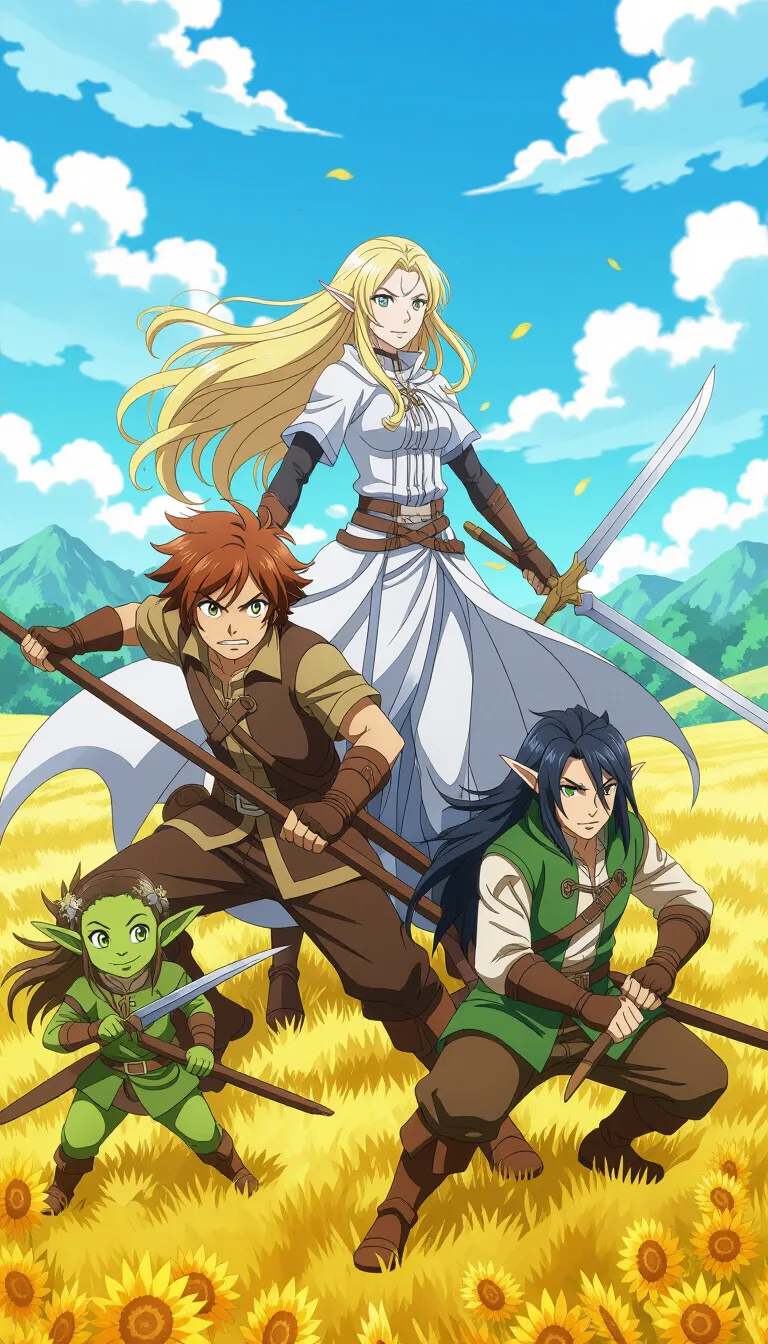
The eastern plains stretched out before them, a sea of wind-whipped grass under a bruised evening sky. They stood at the cave’s mouth, hollowed out by exhaustion and hunger, their clothes stiff with dried blood and cave silt. Richard’s legs trembled from the climb out, a deep, marrow-deep fatigue that the bond echoed back at him from the four women leaning against the rocks. It wasn’t just tired. It was the hollow feeling of having run in a terrible circle.
“We lost it all,” Hilda said, her voice a gravelly rasp. She didn’t look at anyone, just stared at the horizon where the orc caravan should have been. “The coin from that shipment was supposed to set us up for months. Buy passage, gear, silence. Now we’re right back where we started. Worse. We’re hunted, and we smell like a centipede’s ass.” Lys let out a short, humorless laugh, picking at a tear in his fine tunic. “And I’d just broken in these boots for a life of luxury, too. Now I’ll be trading them for moldy bread and information.”
Lillian moved without a word, a silent shift of her slim frame against the stone. She slipped away into the tall grass, her blonde braids the only flash of color before she vanished. The wait was a physical weight. Richard chewed on a stalk of bitter grass, the taste of ash and his own failure in his mouth. When Lillian returned, the last of the sun caught the sharp angles of her face. “A village. Two dozen miles east. Smoke from chimneys. No walls.” It was more than she’d said in three days. The relief was a tangible, shared exhale.
They gathered their pitiful few things—dulled weapons, empty waterskins. As they turned to leave the cursed cave behind, Hilda paused. “One second.” She hefted her warhammer, the runes on its head catching the dim light. She took two steps back, then charged forward with a roar that tore the quiet plains apart. The hammer connected with the limestone arch with a crack that shuddered up through their boots. Stone screamed, fractured, and collapsed in a roaring cascade of dust and rubble, sealing the dark mouth shut forever. For a long moment, there was only the sound of settling rock and their own ragged breathing. Then Zena whooped, a sharp, goblin-like sound of pure triumph, and Lys clapped his hands together once, a bright, clear punctuation. A grim, unified smile passed between them all. It was a small victory. But it was theirs.
They walked for hours with nothing but the distant cries of coyotes and the wind hissing through the dry grass. The plains were a featureless ocean under the moon, and they navigated by the cold pinpricks of stars, a silent, stumbling procession of shadows. Richard’s feet, used to the soft earth of his farm, ached against the hard, uneven ground. The bond hummed with a shared, hollow hunger—a gnawing emptiness that was more than physical. It was the taste of ash, of plans turned to dust, of running with no destination.
Lys broke the silence, his voice a dry rasp. “I’m so hungry I’d consider eating one of those coyotes. Provided someone else skins it. This tunic is silk, darling, not butcher’s leather.” Hilda grunted, not breaking stride. “Your whining is louder than the coyotes. Save your breath for walking.” Zena, walking close behind Richard, reached out and pinched the back of his arm, hard. He flinched. “What was that for?” “You’re thinking too loud,” she muttered. “It’s annoying. Your shoulders are up by your ears.” He hadn’t realized. He forced them down, the movement sending a fresh ache through his back.
Lillian was a ghost ahead of them, her form blending with the swaying grass. She moved without sound, a scout even in exhaustion, her head constantly tilting as she read the night. Richard watched the set of her shoulders, the tense line of her spine. She was listening for more than coyotes. She was listening for the world that wanted them dead. The bond carried a thread of her hyper-vigilance, a sharp, metallic taste of alertness that cut through the general fatigue. It made his own senses prickle, scanning the darkness for a shape that didn’t belong.
The village announced itself first as a smell—woodsmoke and manure and the faint, sweet tang of baking bread carried on a predawn breeze. Then, as the sky lightened to a dirty gray, as shapes emerged from the gloom: a low sprawl of thatched roofs, a rickety fence, a single stone well. It was poor, small, forgotten. Perfect. A collective, unspoken relief washed through them, so potent Richard felt it in his own chest, a loosening of a knot he’d carried since the cave. They slowed, a pack assessing a watering hole.
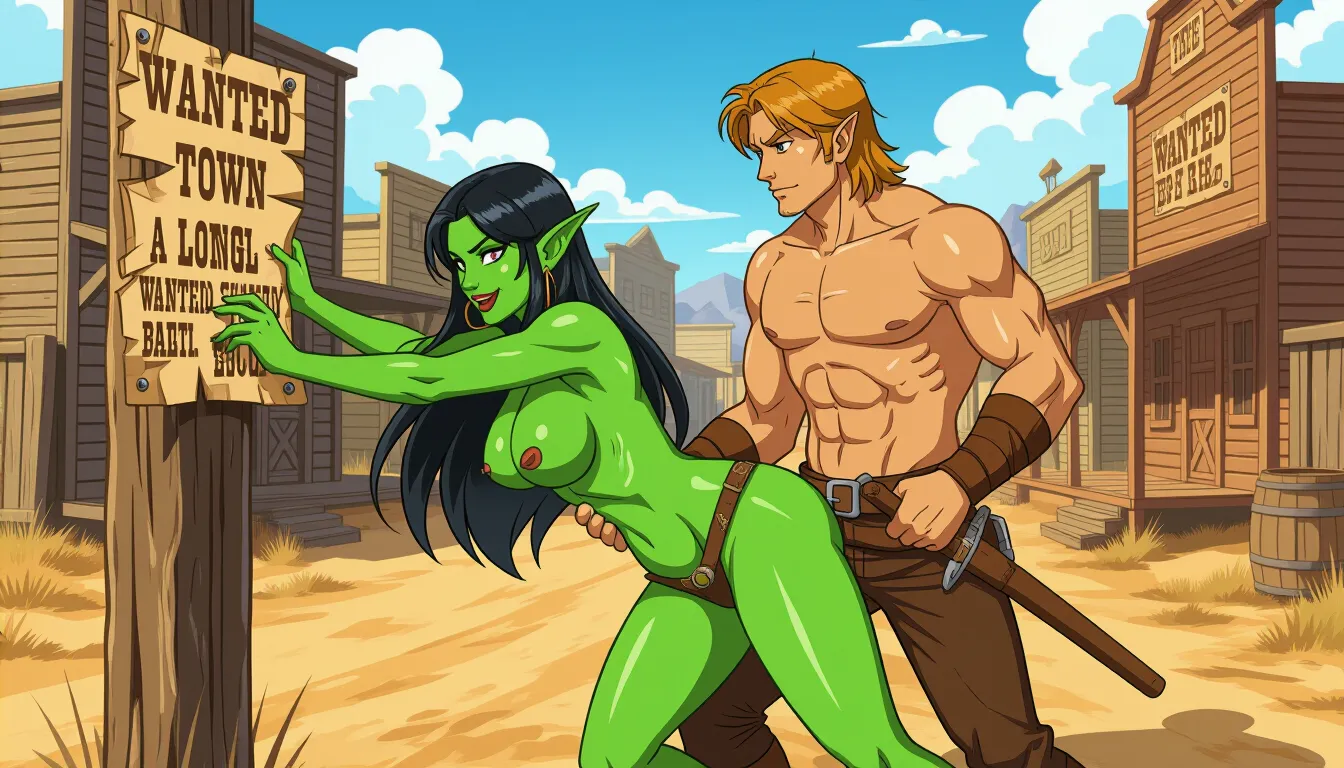
It was Hilda who saw it first. She stopped dead, her hand shooting out to bar Richard’s chest. Her eyes were locked on the side of a weathered barn. Nailed to the splintered wood, curling at the edges, was a sheet of cheap parchment. The dawn light caught the crude, inked sketch of a snarling orc face, one ear blacked in with tar. Above it, block letters promised a staggering sum of gold. WANTED. ALIVE. FOR CRIMES AGAINST THE CROWN AND COMMERCE. The name beneath the picture was Gorrok. But it was the smaller sketches below, renderings of his known lieutenants, that froze the air in their lungs. The likenesses were rough, but unmistakable. The world hadn’t forgotten them. It had just begun to look.
They moved into the village like ghosts at dawn, the wanted poster for Gorrok burning in their peripheral vision. Then they saw another, nailed to a post by the well. This one had five rough sketches. Richard’s own face, angular and serious, stared back at him. The caption read: ‘SEEN THEM? ALE’S ON THE HOUSE AT THE TWO MUGS.’ A few paces down, on the side of a tanner’s shed, another offered a discount on horseshoes for information leading to the “vicious bandits.” The rewards were petty, insultingly small—a free drink, a copper off a loaf—but their faces were everywhere. The Black Ear wasn’t just hunting them with orcs. They’d turned the whole frontier into a snitch.
Lys let out a low, appreciative whistle. “Darling, we’ve made it. We’re cheap tavern gossip. I’ve never been so offended in my life.” He reached out and casually tore the poster from the shed, crumpling it into a tight ball. “The likeness is atrocious. They gave me a weak chin.” Hilda didn’t look at the papers. Her eyes scanned the dusty lane, the shuttered windows, the early-rising farmer already leading a mule toward the fields. “They know we’re in the region. This is a net. Small mesh, but a net all the same.” Her hand rested on the haft of her hammer, not gripping it, just feeling its weight.
Zena moved close to Richard, her shoulder brushing his arm. Her voice was a bare whisper, meant only for him and the bond that hummed between them. “My father’s people use wasps. They sting once, it hurts. But they leave a scent on you. Then the whole nest finds you.” Her dark eyes flicked to a poster where her own caricature, all wild hair and sharp teeth, was pinned. “These are the stings. The scent is on us now.” Richard could feel the truth of it through the link—not just her fear, but a cold, calculating understanding of the hunt. It mixed with his own rising bile, the farm-boy instinct to run now, to leave this death-trap village behind. But his legs were lead, his stomach a hollow pit. They needed food. They needed rest. They were caught.
The bond became a tangled knot of impulses. From Hilda, a simmering, defensive rage, the desire to smash every post and dare the villagers to speak. From Zena, a predatory stillness, the urge to hide in shadows and cut the throat of anyone who looked too long. From Lys, a brittle, performative calm that tasted like cold metal. From Lillian, a focused, surgical alertness that sharpened the world to potential threats. And from Richard, crashing over it all, the raw, animal need for sanctuary. It was too much. He leaned against the rough-hewn wall of the tanner’s shed, closing his eyes, trying to breathe through the onslaught of five separate terrors. The sun, now fully cresting the plains, felt like a searchlight.
The child’s voice cut through the thick tension like a bell. “You’re here!” A boy of maybe seven, all knobby knees and sun-bleached hair, stood gaping from the mouth of an alley. Before anyone could move, he darted forward, pointing a grubby finger. “The heroes! The heroes showed up!” Hilda’s hand flew to her hammer, her body coiling into violence, but Lillian was faster. The elf’s slender hand closed over Hilda’s wrist, not with force, but with a stillness that was absolute. “Wait,” Lillian breathed, her eyes on the boy, reading the lack of fear, the pure, unguarded excitement. Zena moved, a fluid drop into a crouch that put her eye-level with the child. She didn’t smile. Her voice was low, curious. “What do you mean, heroes?”
The boy beamed, oblivious to the lethal tableau around him. “The posters! Everybody knows! You’re the ones messin’ up Gorrok’s wagons, makin’ his orcs run scared!” He puffed out his chest, mimicking a town elder. “Old Man Barrett at the Two Mugs says every copper that bandit loses is a copper he can’t use to burn our fields. Says you’re the only good news this stretch of dirt has seen in a decade.” He leaned closer to Zena, conspiratorial. “My pa says the Black Ear took my uncle for a debt. He never came back. You’re hurtin’ ‘em. That makes you heroes here.” The words hung in the dusty air, a complete inversion of the world. Richard felt the shift through the bond—Hilda’s rage banked into stunned confusion, Zena’s predatory stillness softening into calculation, Lys’s brittle calm giving way to genuine intrigue.
Lys stepped forward, his earlier offense forgotten. He smoothed his tunic, a performer finding his stage. “Well, of course we are, darling. But a hero works up quite an appetite. Where might a band of celebrated… disruptors… find a decent meal and a discreet roof?” The boy’s eyes went wide. “The Two Mugs! I’ll show you!” He scampered off a few paces before turning, beckoning frantically. They followed, a silent, wary procession moving from the open lane into the deeper shadows between buildings. The bond was a cacophony of reassessment. Richard tasted Lillian’s hyper-vigilance shifting targets—from the villagers to the horizons, watching for the real threat that might be drawn to this spark of hope. From Hilda, a grudging, unfamiliar warmth, like stone soaking up sun after a long frost.
The Two Mugs was a low, leaning building of clay and timber. The boy pushed the door open, announcing their arrival with a shout that silenced the murmur within. A dozen faces turned from their morning ale—farmers, a blacksmith, a weary-looking carter. For a heart-stopping second, there was only silence and staring. Then a grizzled man with a barkeep’s apron stood, his eyes moving from their worn weapons to their dirty faces. He didn’t smile. He gave a slow, solemn nod. “Table in the back’s free,” he grunted. “Ale’s on the house. For now.” It wasn’t a welcome to friends. It was a pact with fellow enemies of a common foe. The tension didn’t leave Richard’s shoulders, but it changed, settling into something harder, heavier. Sanctuary, it seemed, was not a place of peace, but a forward camp.
They slid into the shadowed booth, the rough-hewn table a barrier between them and the room. A serving girl brought a pitcher and five tankards without a word, her eyes downcast. As the door swung shut behind the retreating boy, the low conversations resumed, but Richard could feel the weight of glances, the subtle nods. Zena’s knee pressed against his under the table, a point of solid contact. She poured the ale, the dark liquid foaming. “A nest of wasps,” she murmured, not looking at him, her eyes scanning the room. “But this nest… stings the other way.” Hilda took a long, deep drink, then set her tankard down with a solid thunk. She didn’t look at the wanted poster she knew was outside. She looked at Richard. “Eat,” she said, the word a low command. “Then we find out what a hero’s price really is.”
Richard waited until the others were distracted by the food—Hilda tearing into bread, Lys dissecting the quality of the ale—then slid from the booth. He moved past the hearth, through a low archway into a cramped back room stacked with barrels. The barkeep, Barrett, was there, tallying something on a slate. Richard didn’t speak. He drew the short sword from his belt, the metal whispering, and in one fluid motion, he had the man pinned against a barrel, the blade’s edge pressed to the thick vein in his neck. The scent of stale beer and old wood filled the space. “Talk,” Richard said, his voice low and flat, the farm-boy gone, replaced by something hunted and sharp. “How does this village know us? Why are your posters the only ones we’ve seen? This feels like a pretty trap, and I’m done walking into them.”
Barrett didn’t struggle. He let the slate clatter to the dirt floor. His eyes, old and weary, held Richard’s. “The carter,” he rasped, the blade dimpling his skin. “Lysander. Runs the route from the capital to the border outposts. He’s the one who brings the royal bulletins, the official wanted notices. He also brings… other news. Gossip from the guardhouses, tales from the road. He saw what you did at the western ford. Saw the burned wagons, the dead orcs. He put it together.” Barrett’s breath was sour with ale. “We pay him. In ale, in grain. He… delays the official bulletins for this region. The Crown’s notices sit in his cart for a week, sometimes two. Gives us time. The posters you saw outside? We printed those. Not the Crown. Us.”
Richard’s grip on the sword tightened. The logic was a cold trickle down his spine. “You’re painting targets on our backs. Drawing them here.” “No,” Barrett hissed, the first flash of heat in his voice. “We’re drawing a line. For years, we’ve paid Gorrok’s ‘tolls,’ watched our kin disappear into his mines. The official posters offer reward for information. Ours offer a drink for silence. They tell our people: these faces are not the enemy. The enemy is the one with the black ear. You are a symbol, boy. A spark. We are kindling.” He didn’t blink. “If you die, we make new posters. The spark matters, not the stick.”
“You’ve got three breaths,” Richard said, the blade not moving. The farm boy was gone, buried under weeks of running and killing. What remained was a wire-taut animal who’d walked into one too many ambushes. “Explain why I shouldn’t open your throat right now. I don’t want to kill more today, but I won’t lose sleep over you.” It was a lie. The bond screamed with the others’ alarm—Hilda’s readiness to storm the back room, Lillian’s cool assessment of his bluff—but he let the lie sit in the stale air between them, hard and final.
Barrett’s eyes, like worn river stones, didn’t flinch. “The carter’s name is Lysander. He runs the Crown’s mail. He also runs our hope.” He spoke slowly, each word measured against the steel at his neck. “He saw the aftermath at the western ford. Burned Black Ear wagons, dead slavers. He put the pieces together—a young man, an elf, a dwarf, others—and he brought the tale here, not the official bulletins. We pay him in ale and grain to delay the royal notices. The posters on my wall are ours. We print them. The Crown’s posters offer gold for your capture. Ours offer a free drink for your silence.”
Richard’s mind raced, the cold logic of it seeping in. A spark. Kindling. He could feel Zena’s approval through the bond, a dark, sharp thrill at the cunning. He could feel Hilda’s grudging respect for a fight picked, even a passive one. “You’re using us as a banner,” Richard whispered, the pressure on the blade easing a fraction. “You draw Gorrok’s eye here. To your homes.”
“He’s already here!” Barrett’s voice cracked, a sudden, raw heat breaking through his calm. Spittle landed on Richard’s wrist. “He takes our children for his mines. He burns our fields when the ‘tribute’ is late. We are already dying. Your face on that wall tells my people the dying might mean something. That someone is fighting back. So yes. It’s a trap. But not for you. For him. And we are the bait as much as you are.” The old man’s chest heaved. “Now kill me if you’re going to. My daughter knows the press. She’ll make more posters tomorrow.”
Richard lowered the sword. The metal point scratched a line in the dirt floor as he stepped back. The bond flooded with a complex, silent verdict—Lys’s admiration for the theatrical gamble, Lillian’s analytical acceptance of the new variable, Hilda’s simmering outrage at being made a symbol without her consent. Richard sheathed the blade. “We need a place. Out of sight. For a week. Food. Water.”
Barrett rubbed his neck, a red line marking where the steel had been. He nodded toward a narrow stair behind the barrels. “Loft above the stable. It’s dry. We’ll bring what we can. Don’t use the front.” He met Richard’s eyes, the pact sealed in threat and necessity. “Don’t let the spark go out, son.”
Stefan, the boy from the door, slipped into the back room, his eyes wide at the sight of the barkeep rubbing his neck. "He says to come," the boy whispered, jerking his thumb toward the main room. "All of you. Now." Barrett gave a single, grim nod. Richard led the way back through the arch, his hand resting on the pommel of his sword. The tavern had gone quiet again. A grizzled old man with a woodcutter's arms and a missing ear sat at a table by the dead hearth, Stefan hovering behind him. The man didn't stand. He just looked at each of them in turn, his gaze lingering on Hilda's warhammer, on Lillian's braids, on Zena's inhuman eyes. "Loft's secure," he grunted. "But you don't go up yet. You sit. You listen."
They settled around the old man's table, the weight of the village's silent stare pressing in from the shadowed corners of the room. He called himself Griss. He poured a measure of clear, sharp-smelling liquor from a clay jug into a cracked cup, drank it, and began to talk in a low, gravelly monotone. He told them of missing children, taken not by night-raiders but by men in broad daylight who presented scrolls with forged Crown seals. He spoke of granaries burned after "tax disputes," of a local militia that vanished after ambushing a slaver caravan. "Barrett's posters are a prayer," Griss said, his eyes on the empty cup. "But prayers need steel to answer them. You killed Black Ear men. You have their attention. We have a cellar. A network of root cellars and old badger sets that link under the fields east of here. You can disappear there. For a week. For a month. But in return, you listen to our reports. You learn the patterns of the patrols. And when you are strong again… you become the answer."
Zena’s knee found Richard’s again under the table, a steadying pressure. Hilda’s jaw was a hard line, her thick fingers tracing the grain of the wood. "We are not your army," Hilda rumbled, but the protest lacked its usual fire. They were exhausted, hunted, and this village, this nest of wasps, was offering a hive in which to heal. Lys leaned forward, his silver hair catching the dim light. "A network of cellars, you say? How discreet are the entrances? And more importantly," he added, a flicker of his old smirk returning, "how is the ventilation?"
It was decided. Griss’s grandson, a silent youth named Kael, would guide them at dusk. They finished the meal in tense quiet, the ale now tasting of grim alliance. When the sun dipped below the horizon, painting the plains in long, purple shadows, they followed Kael out the tavern’s rear door, through a tangled kitchen garden, and into a sea of whispering grass. He led them to a seemingly barren patch of earth, kicked aside a mat of woven grass to reveal a heavy oak door set flush with the ground. The smell that wafted up was of cool earth, damp stone, and stored turnips. One by one, they descended a rough ladder into the darkness. Richard went last, pausing at the threshold to look back at the vast, darkening plain. Somewhere out there, Gorrok was listening. The thought was no longer a spike of fear, but a cold, settling stone in his gut. He pulled the door shut above him, plunging them into absolute black.
Kael struck a flint, lighting a tallow candle. The cellar was larger than expected, a low-ceilinged space supported by ancient timber beams, with several shadowed tunnels leading off into deeper blackness. Shelves held sacks of grain, clay jars of water, and bundles of dried herbs. It was a burrow. A warren. A tomb. Hilda set her warhammer down with a definitive thud that echoed in the confined space. "Home," she said, the word dripping with bitter irony. Zena immediately began exploring the tunnels, her fingers brushing the walls as if reading them. Lillian took the candle from Kael and began a slow, methodical circuit of the main chamber, her eyes missing nothing. Lys sighed dramatically, dropping his pack. "Well. The ambiance is subterranean chic, but it lacks a certain… vibrancy." Richard stood in the center of the room, the weight of the earth above him feeling both like a prison and a strange, first respite in weeks. The bond hummed with their collective exhaustion, their wariness, and beneath it, a reluctant, simmering acknowledgment. They had been given a hole to hide in. A spark, buried in the dirt to keep it from the wind.
Richard watched Kael, the silent youth, fuss with the wick of a second tallow candle. The boy’s hands were steady, but his eyes kept flicking toward the ladder, the door to the world above. "Your grandfather," Richard started, picking a dried stalk of something from his sleeve and rolling it between his fingers. "He talks about patterns. Patrols. You know those patterns?"
Kael didn’t look up. "I watch the east road. Every third day, after sundown. Two wagons. Four guards each. They don’t stop here. Not anymore." His voice was a soft monotone, rehearsed. "They take the south fork toward the mining camps."
"Why every third day?" Richard pressed, leaning against a rough timber. The earthy smell of the cellar was thick in his lungs.
A shrug. "The ore trains run on a schedule. The guards get bored. They gamble at the waystation ten miles down. They’re loud. Predictable." Kael finally met his gaze, and Richard saw it—not fear, but a cold, meticulous hatred. This boy had counted every pebble in the road, memorized every laugh from those wagons. This was his hope. Not posters. Not prayers. Accounting.
From the tunnel mouth, Zena’s voice slithered out of the dark. "Predictable men are lazy men. Lazy men have routines." She emerged, a shadow given form, her fingers brushing the damp wall. "They stop to piss at the same bend. They check the same wheel. They become ghosts before they’re dead." Her eyes, reflecting the candle flame, held Kael’s. "You’ve marked the spot, haven’t you?"
The boy gave a single, sharp nod. In the main chamber, Hilda’s whetstone sang against her hammer’s edge. The sound was a slow, grinding heartbeat. Lys sighed, unpacking a bedroll with theatrical disdain. "A symphony of vengeance and turnip air. I feel my strength returning already." Lillian stood perfectly still by the supply shelves, her braids a golden cascade in the gloom, her eyes closed as if listening to a song only she could hear—the song of a trap being built, not around them, but for once, with them at its center.
Kael’s eyes stayed on Richard, the candlelight carving hollows in his young face. “The spot is a dry creek bed, a half-mile east of the south fork. The bank is high there, and the wagons slow to cross the stones. The guards… they always send one man ahead to scout the far side. He walks the same path, kicks the same rock. The other three stay with the wagons, backs turned, sharing a flask.” The boy’s voice was a flat recitation of facts, but his hands clenched at his sides. “That’s the moment. When the scout is thirty paces out and the others are drinking.”
Zena drifted closer, the earthy scent of the tunnel clinging to her. “A clean extraction. The scout first, silent. Then the three at the wagon, before the flask is lowered.” Her gaze slid to Hilda, whose whetstone had gone still. “It would require precision. Not rage.”
“Precision I have,” Hilda grunted, setting her hammer down. The iron head gleamed dully. “But a wagon raid with four of us in this state is a suicide run. We need rest. Real rest.” Her eyes found Richard, and the bond throbbed with her unspoken thought—a memory of shared exhaustion, of muscles that still trembled with the ghost of collapse.
Lys unrolled his bedding with a flourish, lying back with his hands behind his head. “Darling Hilda is right, for once. We are a symphony of aches. But consider the morale! Hiding in a hole is dreadfully depressing. Ambushing a slaver patrol, however… that’s a tonic.” He grinned, a flash of white in the gloom. “Think of the supplies. The coin. The fresh clothes. I, for one, am tired of smelling like cave centipede and regret.”
Lillian had not moved from the shelves. Her stuffy 5 fingers now traced the rim of a clay water jar. When she spoke, her voice was so quiet it seemed to come from the walls themselves. “Kael. After the ambush. Where do the wagons go?”
The boy blinked, thrown by the question. “To the mining camp. It’s a fortified stockade. No one gets in or out without Black Ear marks.”
“And before the camp? Is there a checkpoint? A place where they are… vulnerable?” Lillian turned, her braids swaying, her elven eyes catching the candlelight like chips of frost. She wasn’t planning a raid. She was reading a map only she could see, finding the seam in the armor. Kael stared at her, and for the first time, his rehearsed certainty faltered. He shook his head. “I… don’t know.”
Richard chewed on the inside of his cheek, the taste of dust and ale still there. He looked from Kael’s cold hatred to Lillian’s glacial calculation, to Hilda’s pragmatic fatigue, to Zena’s predatory stillness, to Lys’s performative levity. The bond hummed with all of it, a tangled knot of want and need. “We sleep,” he said, the words final. “We eat Griss’s turnips. We heal. And in three days, when those wagons roll…” He met Kael’s gaze. “You show us that creek bed.” The spark in the dirt wasn’t just hiding now. It was starting to breathe, waiting for fuel.
Hilda found Kael by the tunnel’s mouth, sharpening a rusted dagger on a flat stone. The rhythmic scrape stopped as her shadow fell over him. She didn’t speak, just stood, her warhammer resting on her shoulder, until the boy’s shoulders tightened. “The creek bed,” she said, her voice a low rumble. “Describe the stones.”
Kael’s eyes flicked up, wary. “Gray. Flat. Some are loose.”
“The scout’s path. Which foot does he lead with when he kicks the rock?”
“His right.” The answer came too fast. Hilda’s expression didn’t change, but the air grew heavier. She squatted, bringing her face level with his, the scent of oil and iron between them. “You watched this how many times?”
“Enough.”
“Men with routines are lazy. Men who are lazy get sloppy. Did the flask ever change hands? Did the scout ever *not* kick the rock?” Hilda’s gaze was a physical pressure. Kael’s knuckles whitened around the dagger’s hilt. He looked away, toward the dark tunnel. “No. It was always the same.”
Hilda nodded, a slow, deliberate dip of her chin. She believed him. That wasn’t the test. “Why tell us? You could’ve slipped out, taken your chance alone. We’re baggage. Weak.” She let the word hang. The boy’s young face hardened, something old and festering moving behind his eyes. “Alone, I kill one. Maybe two. With you…” He didn’t finish. He didn’t need to. The hatred was his fuel, but it wasn’t his plan. He needed their weight to break the wagon. Hilda saw it. She stood, the joints in her knees popping. “Get some sleep, boy. In three days, you’ll need your legs.” As she turned, she added, almost too quiet to hear, “And your nerve.”
Richard watched from the tunnel’s shadow, the cool stone against his back. Hilda’s interrogation was a low, grinding stone, but his eyes were on Kael. The boy’s hatred was a live wire, but the way his fingers trembled on the dagger—that was the truth. It wasn’t just rage. It was a kind of hunger, thin and desperate, the same hollow ache Richard had felt staring at a failing crop. You don’t plan revenge when you’re just angry. You plan it when you’ve got nothing else to eat.
The common room was dark, the single tallow candle guttering. Lys was already asleep, or pretending to be, curled on his side with a thin blanket pulled over his head. Zena sat against the far wall, methodically cleaning under her nails with the tip of a small knife, her dark eyes reflecting the dying flame. Lillian stood by the crude table, her fingers tracing invisible lines on its scarred surface, her mind clearly leagues away. The bond was a muted thrum of exhaustion, a shared, heavy fatigue that sat in the joints and the back of the throat.
Hilda returned, the weight of her settling onto a bench with a sigh of leather and mail. She looked at Richard, then at the tunnel mouth where Kael had been. “Fuel for the fire,” she grunted, answering the question ishe hadn’t asked. “But fire you don’t control burns your own camp first.”
“We control it,” Richard said, the words feeling like a wish more than a statement. He pushed off the wall, the ache in his muscles a familiar litany. He moved past Hilda, his hand brushing her shoulder—not a caress, but a point of contact, a silent check on the bond’s current. Her fatigue echoed into him, a dull, deep soreness, but beneath it was a solid, unwavering heat. Steady. He needed that. He walked to where Lillian stood. “We lost the ambush pay. We’re back to square one. Just us, the plains, and every orc in twelve lands.”
Lillian’s finger stopped tracing. She didn’t look up. “The boy’s creek bed is square one with a weapon. It is a difference.” Her voice was so quiet it seemed to absorb the candlelight. “But weapons break. We need a forge. A place to heal, properly, for more than a night.” She finally lifted her frost-chip eyes to his. “At first light, I will scout. Find that forge.”
From the shadows, Zena’s knife stilled. “Don’t get seen.” It wasn’t concern. It was a reminder of the scent she’d left in the caves, of the things that might still be hunting. Richard felt the bond prickle with her protective aggression, a sharp contrast to Lillian’s cold calculus. He just nodded, the honey rose stem long gone, nothing left to chew but the gritty reality of their next move.
Zena stood, sheathing her knife. “I’m going with you.” Lillian didn’t turn, her gaze fixed on the dark tunnel. “No.” “Your scent is clean. Mine is blood and centipede bile. I am the better distraction if we are seen. You are the better shadow. We cover each other.” Zena’s logic was bratty, immutable. Across the room, Hilda’s snoring was a rhythmic, grating saw of sound, her head tilted back against the stone wall. Richard, too tired to argue, sank onto a low stool, the wood groaning under his weight.
Lys appeared beside him without a sound, a phantom in the flickering dark. He settled on the floor, leaning his back against Richard’s legs, the contact casual and electric. “You’re thinking too loud, farm boy.” His voice was a velvet murmur, meant for Richard alone. “It’s all worry and grain prices in there. Dull.” Lys’s head tilted back, resting against Richard’s thigh, his silver hair cool through the worn fabric of Richard’s trousers. “You should be thinking about my mouth.”
Richard went very still. The bond, a muted hum of shared exhaustion, suddenly sharpened into a single, piercing note of intent—Lys’s intent. It wasn’t an offer. It was a fact, presented as casually as the time of day. Richard felt the heat of it, a low ember glow in his own gut, an unwelcome and immediate answer to the half-elf’s certainty. He could feel the shape of Lys’s smile without seeing it. “Don’t,” Richard breathed, the word tight.
“Why?” Lys’s hand came up, his fingers tracing the inside of Richard’s knee, a feather-light touch that burned. “Hilda takes the edge off. Zena marks her territory. But they’re both fighting the bond, wrestling with it. I’m not.” He turned his head, his cheek pressing against the growing hardness in Richard’s pants. Richard’s breath hitched. “I understand utility. This,” Lys whispered, his lips moving against the strained linen, “is useful. Let me be useful.”
The snoring stopped. Hilda’s eyes were open, watching them from across the room, her expression unreadable in the gloom. Zena and Lillian were a whispered argument by the tunnel, two shapes merging with the dark. Lys’s mouth was a searing promise against his cock, not moving, just resting there, a claim and a question. The bond flooded with a cocktail of sensation—Lys’s focused hunger, Hilda’s watchful heat, the distant prickle of Zena’s irritation—all of it funneling into the aching tightness in Richard’s groin. He was a instrument, and they were all playing him.
Lys’s tongue pressed a slow, wet circle through the fabric. Richard’s hands fisted on his own thighs. He didn’t push him away. The cave, the exhaustion, the relentless pressure—it all narrowed to this point of contact, to the devastating, simple utility of release. His head fell back against the wall with a soft thud. He was so, so tired of fighting everything.
The message came through the bond not as words, but as a heavy, deliberate weight—a boulder settling into place. It was Hilda’s intent, clear and unmistakable: *I’ll make sure you’re not interrupted.* Across the room, she rolled onto her side, turning her broad back to them, a wall of leather and mail facing the tunnel mouth. Her breathing deepened, a performance of sleep, but her consciousness in the bond was a vigilant, simmering watchfire. Lys smiled against the straining fabric of Richard’s trousers, the curve of his lips a palpable delight. “Told you,” he murmured, the vibration searing. Then he got to work.
His hands were deft, untying the laces with a thief’s grace. The cool cave air hit Richard’s flushed skin, a shock that made him jerk. Then Lys’s mouth was on him, no fabric between them, and the shock became a lightning strike. It wasn’t a tentative taste; it was a claiming. Lys took him deep, his throat working, swallowing him down until Richard felt the soft, impossible press at the back. The heat was absolute, wet and tight, and the bond amplified it, turning the sensation into a feedback loop. Richard’s head cracked against the stone wall, a gasp torn from him. He could feel Lys’s satisfaction, a shimmering, wicked pleasure at his own skill, at the way Richard’s hips twitched upward, seeking more.
Lys pulled back, his tongue tracing the swollen vein on the underside, savoring the salt and the desperate pulse there. He looked up, silver eyes gleaming in the low light, meeting Richard’s stunned gaze. A string of spit connected his lips to the slick, aching head of Richard’s cock. “See?” Lys whispered, his voice hoarse. “Useful.” He dove down again, setting a rhythm that was both relentless and deeply practiced. Slow, deep sucks that hollowed his cheeks, then a flurry of quicker, teasing flicks of his tongue over the most sensitive spot. He used his hand at the base, twisting in time with his mouth, a perfect, coordinated torture. Richard’s hands, which had been fisted on his thighs, now tangled in Lys’s silver hair, not guiding, just holding on, anchors in a sensory flood.
The bond was a chorus. Hilda’s watchful heat was a steady drumbeat, a permission that felt like being pinned. From the tunnel, the faint, sharp prickle of Zena’s distant awareness spiked—annoyance, recognition—before being forcefully shut away. But Lys’s experience dominated. Richard felt the slick slide of his own cock in Lys’s mouth, the flutter of the half-elf’s throat, the pure, uncomplicated enjoyment of the act. It wasn’t about domination or healing or marking. It was about this: the weight on the tongue, the taste of skin, the building tension in the body beneath him. Lys was savoring it, drawing it out, his own quiet moans vibrating through Richard’s core. The slow-burn wasn’t in the lead-up; it was in the execution. Lys was going to make this last, wringing every shudder, every choked breath, until there was nothing left.
Richard’s thighs began to tremble. A low, ragged sound built in his chest. Lys felt it—through the bond, through the flesh in his mouth—and he redoubled his efforts, his free hand sliding up to cradle Richard’s balls, applying a gentle, devastating pressure. The world narrowed to wet heat and the sight of silver hair fanned across his lap. The exhaustion, the fear, the relentless chase, all of it coiled tight in his gut, and Lys’s mouth was the only key. Release wasn’t a choice; it was an inevitability he was racing toward, helpless, every muscle drawn wire-tight. Hilda’s presence in the bond shifted, a wave of fierce, protective focus washing over him, and it was that, the feeling of being guarded so he could break, that finally undid him.
Lys felt the climax building like a tremor in the earth, the pulse against his tongue turning frantic, the taste of salt and skin sharpening. He pulled off with a wet, obscene pop, his breath cool on the slick, throbbing heat. Richard’s hips jerked upward, seeking the lost pressure, a raw, broken sound escaping his throat. Lys held him down with a firm hand on his stomach, his silver eyes glinting with merciless delight. “Not yet,” he whispered, his own lips swollen and glistening. “I’m not done being useful.”
The denial was a physical agony. Richard shuddered, his knuckles white where they gripped Lys’s hair, suspended on a razor’s edge. The bond screamed with frustrated need, a shared ache that echoed from Hilda’s silent vigil and spiked again from Zena’s distant, furious awareness. Lys simply lowered his head again, but this time he avoided the desperate, leaking head. He pressed open-mouthed kisses along the shaft, down to the tight, drawn-up sac, his tongue tracing patterns that made Richard’s entire body tense and shake. He was mapping him, savoring the delay, turning the denial into its own exquisite form of torment.
“Enough.” The word was a graveled command from the tunnel mouth. Zena stood there, her curvy silhouette blocking the faint light, her arms crossed. The bond flooded with her irritation, a hot, prickling static. “We have miles of open plain to cross at first light. He needs his legs, not a fucking coma.”
Lys didn’t lift his head. He swirled his tongue once, slowly, making Richard gasp. “He’s not complaining,” he murmured against the skin.
“I am.” Zena took a step forward. “Lillian’s back. We need to move. Now.” The finality in her voice cut through the humid tension. Across the room, Hilda sat up, the performance of sleep over. She met Richard’s dazed, desperate gaze, and through the bond came a pulse of grim understanding—a soldier’s recognition that the moment for relief was over. The watchfire of her presence banked, shifting to practical readiness. Lys sighed, a theatrical sound of disappointment, and finally released him. The cool air was a brutal shock. Richard slumped against the wall, aching and painfully unfinished, the unresolved tension a live wire under his skin as he fumbled to lace his trousers with trembling hands.
Lys leaned in as Richard stood on unsteady legs, his breath a warm, intimate whisper against the shell of his ear. “Next time,” he promised, his voice a silken thread of sound, “I won’t stop until you’re screaming.” He pulled back, his silver eyes holding Richard’s for a heartbeat, then turned to gather his pack, the casual grace of his movements a stark contrast to the unresolved ache throbbing in Richard’s veins.
Lillian stood just inside the main cavern, her twin scimitars already strapped to her back. Her expression was unreadable, but her gaze swept over them—Richard’s flushed skin, Lys’s smug composure, Hilda’s deliberate avoidance of eye contact, Zena’s simmering irritation—and she gave a single, slow blink. “The plains are exposed,” she said, her voice quiet but cutting through the humid air. “We have twelve hours of daylight. Move now, or bake later.” She tossed a waterskin to Richard. It was full, cool and heavy in his hands.
“Wait,” Richard said, the word scraping out of his dry throat. He shoved the waterskin back at Lillian without drinking. “We just got here. We’re supposed to hide for a week. Where’s the kid? What’s going on?” The questions tumbled out, sharp with the pent-up anxiety of the interrupted release still throbbing low in his gut. He felt exposed, half-dressed in more ways than one, and the sudden shift to movement felt like another trap.
Lillian’s gaze was fixed on the cave entrance, a sliver of dawn light cutting the gloom. “I mapped the eastern approach,” she said, her voice a low, clear note in the stillness. “The village is a dozen miles out, exposed on the plain. We’ve drawn enough danger to them already.” She turned, her braided hair a pale rope over her shoulder. “I sent the boy back. His instructions were clear: tell the town to take down any posters speaking against the Black Ear gang. Remove any pictures naming us as heroes. The orcs are slowed, not stopped. We do not lead that poison to their gates.”
Richard stared at her, the cool logic of it slicing through the fog of his own unresolved need. “So we just… leave them to it? After everything?” The stubborn farm boy in him rebelled, the part that acted first and counted consequences later. Hilda snorted, hefting her warhammer onto her shoulder with a grunt of effort. “You want to paint a target on their backs, pup? Lillian’s right. Mercy isn’t a shield. It’s a liability.” She strode past him toward the tunnel, her boots crunching on gravel. “We move. Now.”
They filed out of the cave’s mouth one by one, blinking against the brutal, rising sun. The eastern plains stretched before them, an endless, tawny sea of dust and brittle grass under a vast, pitiless sky. The air was already hot, smelling of baked earth and dry sage. Richard’s skin, still sensitized from Lys’s ministrations, felt every whisper of the hot wind. The ache between his legs was a dull, persistent throb, a private torment amplified by the bond’s shared, restless energy. Zena moved past him, her curvy body a dark silhouette against the light, and he felt a spike of her irritation—directed at the sun, the distance, at him.
Richard didn’t follow. His boots stayed planted on the packed earth of the root cellar’s threshold, the shadow of the doorway cutting a sharp line across his chest. The others took a few steps into the blinding sun before they noticed, turning back one by one. He crossed his arms, the lean muscle of his forearms corded tight. “I’m not leaving,” he said, the farm-boy stubbornness thick in his voice. “Not until I’m sure we led them off. I didn’t free you all from slavery just to watch this place burn because we showed up.”
Hilda sighed, a sound of grinding stone. She shifted her warhammer’s weight. “Pup, your conscience is gonna get this whole village killed. We’re the scent. We leave, the hounds follow.”
“Then we make a trail they can’t ignore.” Richard’s gaze swept over them, landing on Lillian. “You’re the scout. There’s a way to do it. A false trail. Something loud, something stupid—something orcs would chase instead of stopping to poke through every cellar.” The bond thrummed with their collective exhaustion, a dull ache behind his eyes, but beneath it he felt Zena’s sharp attention and Lys’s amused curiosity. He was vibrating with unfinished tension, every nerve still singing from the root cellar, and it poured into his voice. “I’m not asking. I’m telling you. I’m doing this.”
Lillian studied him, her elven face unreadable in the shade. Her fingers tapped once, twice, against the leather-wrapped hilt of a scimitar. “A diversion requires bait,” she said, her quiet voice slicing through the heat. “It requires the bait to survive the chase. You are exhausted, you are injured, and you are,” she paused, her pale eyes flicking to the damp patch on his trousers, then back to his face, “distracted.”
Zena stepped forward, her curvy body blocking the sun. “He’s not doing it alone.” The words weren’t an offer. They were a claim. She looked at Richard, her dark eyes holding his, and through the bond came a flash of the cave river—the chill water, the struggle, the certainty of not letting go. “We draw them east. Toward the bluffs. Plenty of rock to lose them in, or bury them under.” Hilda grunted, a reluctant approval. Lys’s smile was a slow, wicked thing. “Oh, I’ll make it loud,” he purred. Lillian gave a single, slow nod. “Then we move. Now.”
Richard’s stubborn posture didn’t soften, but his eyes did. He gave a sharp, grateful nod, then turned and spat into the dust of the village path. “Alright,” he said, the word full of grit and promise. “Let’s go be the worst thing those bastards ever chased.”
“How long?” Richard asked, his eyes scanning the flat, shimmering horizon. The question was for Lillian, but his mind was already racing ahead, calculating sun angles and distances on a farmer’s instinct. “How long until they find this place? And which direction would they come from?” He turned, the hot wind plastering his damp shirt to his chest. “We need to know which way to run to make them chase.”
Lillian didn’t look at the plains. She looked at the ground near the cellar entrance, her sharp eyes tracing the scuffs in the dust, the broken stems of grass. “They are methodical,” she said, her voice barely louder than the wind. “They will have tracked us to the canyon collapse. From there, they will fan out in a search grid. The nearest orc-held outpost is north-west.” She pointed a slender finger toward a distant, hazy line of hills. “They will come from there. We have hours, not days. To pull them, we must run east-south-east, toward the bluffs. It is the only terrain that offers us a chance to break pursuit.”
“East-south-east,” Richard repeated, the words a plan solidifying in his mouth. He spat again, the saliva dark on the pale dust. The bond hummed with a new, focused tension—Lillian’s cold calculus, Hilda’s grim readiness, Zena’s predatory alertness, and Lys’s thrilling anticipation. It mixed with the unresolved, aching heat still coiled in his groin, sharpening everything. “Then we make a mess they can’t ignore. Lys. Can you make a sign they’d follow? Something that screams ‘we went this way’?”
Lys’s smile was a flash of silver. “Darling, I can make a sign that screams, faints, and leaves a forwarding address.” He sauntered past Richard, his slender fingers already weaving in the air. A faint, illusory shimmer began to form—the ghostly imprint of a boot, then another, leading away from the village at a careless angle. “I’ll give them a trail a blind drunk could follow. And I’ll make it… fragrant.” With a wink, he added a shimmer of magical scent to the illusion, something musky and human-sweat strong. “Let’s give the pigs something to snort at.”
The idea hit Richard like a physical blow, stopping him mid-stride. He turned to Lys, the bond humming with sudden, frantic possibility. “That’s not enough. Can you make copies of us? Four of them. Something they can kill. Let them believe I’m alone.”
Lys’s silver eyebrows shot up. Then his grin returned, wider and more wicked. “Oh, you clever, cruel boy.” His hands were already moving, weaving light and shadow from the harsh noon sun. Illusions shimmered into being beside each of them—a phantom Hilda hefting a warhammer, a spectral Zena with flowing black hair, a ghostly Lillian with drawn scimitars, and a duplicate Lys who blew a kiss. They were perfect, silent, and moved with an eerie mimicry of their counterparts. “They’ll hold for a mile, maybe two, before they fray. Long enough to make a very convincing, very stupid stand.”
“How long if pushed can you make them last?” Richard asked, his gaze fixed on the shimmering duplicates. The bond thrummed with a cold, tactical curiosity from Lillian, a savage approval from Hilda. “Killing them off slowly. One by one. Make it look like a desperate, running fight.”
Lys’s fingers never stopped moving, fine-tuning the illusions. “Darling, I can make them die screaming. I can make the big one bleed out from a gut wound for an hour of trail. I can make the elf stumble and fall, an arrow in her back. The goblin-princess can take a blow to the leg, crawl, then get dragged off. The pretty one—that’s me—can make a last, glorious stand.” His voice dropped, theatrical yet deadly serious. “It’ll be a tragedy in five acts. They’ll be picking over the corpses for trophies.”
“Good. I have a plan,” Richard said, his voice cutting through the hum of the bond and the shimmer of the illusions. He looked at each of them—the real ones, their faces etched with exhaustion and trust they hadn’t asked for. “But everyone has to trust me.” The words felt strange in his mouth, a farmer’s son asking for faith, not offering a trade.
Hilda spat a glob of phlegm onto one of her phantom’s boots. “Trust is a luxury for people with full bellies and warm beds. We have your back because you have ours. That’s the deal. So what’s the play, farm boy?” She hefted her real warhammer, the iron head gleaming dully in the sun, a counterpoint to the silent, perfect copy beside her.
“Then keep up!” Richard barked at Hilda, the words sharp with a frustration that wasn’t hers. It was the plan’s tension, the bond’s constant hum, the sheer fucking exhaustion of being responsible. He channeled it all into motion, breaking into a loping run across the sun-baked plain, the illusory copies of their party shimmering into step beside and behind him. The tall, dry grass whipped at his legs.
Hilda’s answering grunt was pure gravel. She matched his pace, her real warhammer a solid weight in her grip, a stark contrast to the silent, perfect phantom of herself that ran just to her left. The bond carried her approval—no hurt feelings, just the grim satisfaction of a direction, any direction. They ran as a fractured, mirrored company: the real five, breathing hard, and the magical four, moving in eerie silence. Lys, at the rear, wove his hands in a continuous, subtle dance, his face a mask of concentration as he puppeted the decoys, making them stumble on rocks the real ones avoided, having them glance back with perfect replicas of fear.
“The cleft,” Richard gasped, pointing ahead to where the land split into a shallow, rocky ravine. “We funnel them there. The fakes make their stand. We’ll be above.” He scrambled up the side, his farmer’s hands finding purchase on sun-warmed stone. Below, the illusions gathered, the phantom Hilda turning to face the back trail, her hammer held high in a defiant, silent challenge. The real Hilda crouched beside Richard, her shoulder pressing against his. He felt the heat of her, the quick rise and fall of her ribs. Her smell—sweat, iron, and the lingering scent of cave water—was suddenly the most real thing in the world.
Lys, from his perch, let out a soft, theatrical sigh. “Act one, curtain up.” In the ravine below, the spectral Zena cried out—a soundless scream they all felt in their guts—as an illusory crossbow bolt sprouted from her phantom thigh. She fell, the illusion of her long black hair fanning in the dust. The phantom Lillian rushed to her side, only to be “cut down” by a sweeping axe blow that passed through her shimmering form. It was horrifyingly beautiful. The real Lillian, pressed against the rock next to Zena, didn’t flinch, but her knuckles were white on her scimitar hilts. Zena’s breath hitched; her hand found Richard’s ankle, her grip tight.
The bond flooded with it all: Hilda’s savage joy at the spectacle of violence, even fake; Lys’s focused, artistic pride; Lillian’s cold, analytical tracking of the illusion’s tactical value; Zena’s visceral, empathetic shudder. And beneath it, Richard’s own churning calculation. He watched the phantom Hilda—*his* Hilda’s copy—fight a desperate, swinging retreat, “bleeding” glowing light from a gut wound. The real Hilda’s chest vibrated with a low, approving growl. Her thigh was pressed firmly against his now, a solid line of contact in the dizzying sensory overload. When the final illusion—Lys’s beautiful copy—was “run through” with a spear and dissolved into motes of light, the real Lys collapsed back against the stone, sweat-drenched and panting, a spent and satisfied smile on his face. The ravine below was empty, silent, telling a perfect story of slaughter.
“They’ll spend hours searching for bodies that aren’t there,” Richard said, his voice rough. He didn’t move. Hilda’s heat was a anchor. Zena’s fingers were still locked around his ankle. The bond was a live wire, buzzing with the aftermath of shared deception, shared danger, and the unspoken, aching intimacy of having just watched themselves die.
On a distant hilltop, Tartear Bronzesmith watched the orcs dig. He chewed a thumbnail, his eyes dull and impatient, tracking the labor like a man waiting for a kettle to boil. Then, a deep, percussive *thump* echoed across the plains, rolling from the east. A puff of dust, distinct against the baked sky, bloomed from the canyon’s far side. His lips stretched into a wet, thin smile. He didn’t need to see them. He knew the sound of a dwarf’s warhammer meeting stone. He turned and began walking, a spindly figure moving with a predator’s certainty toward the source of the sound.
Tartear Bronzesmith arrived with the dawn mist, a spindly shadow slipping between the village’s rough-hewn huts. A wide-brimmed hat hid his face, the brim pulled low. He moved with a rodent’s patience, pausing to listen at shuttered windows, his head cocked toward the murmured prayers of families who pinned their hopes on phantoms. It took an hour of silent circling before he saw them—five figures emerging from a hidden root cellar near the treeline, blinking against the morning sun like moles. He crept closer, using a dry irrigation ditch for cover, and lay still in the dirt. Their voices carried on the still air.
“The creek bed is three miles north,” Richard was saying, his voice low. He drew a map in the dirt with a stick. “Griss says the patrol passes at midday, every third day. That’s tomorrow. We hit them there, take their gear, their coin, and vanish before any runners get back to the main column.” Hilda grunted, her thumb testing the edge of her axe. “Simple. I like it. We kill them all?” Richard’s stick paused. “We kill anything that fights. The rest… we let run. They’ll carry the story.” From the ditch, Tartear’s wet, thin smile returned. He didn’t need to hear more. He settled into the dirt, the cool earth against his cheek, and decided to wait. Let them have their planning. Let them feel safe. The attack would be sweeter after hope.

