
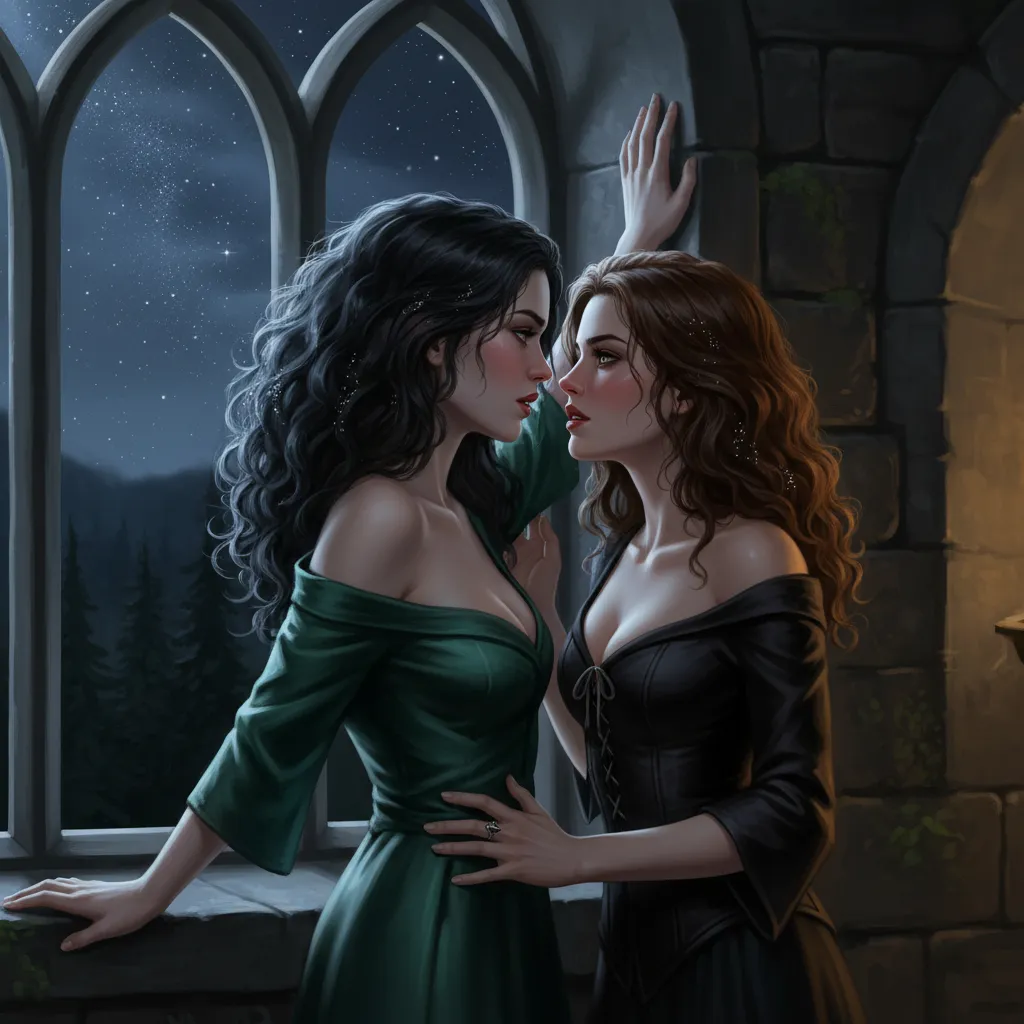
The Black family returned on a Wednesday.
Hermione knew they were coming two days before they arrived because Bellatrix changed. Not dramatically — nothing Bellatrix did was dramatic without intention — but in small, precise ways that Hermione had learned to read over the course of the summer. She sat differently at the breakfast table. Her answers became slightly shorter. She moved through the house with the particular efficiency of someone ensuring everything was exactly where it was supposed to be, including, Hermione understood, herself.
"Your parents," Hermione said on Tuesday evening.
"Tomorrow afternoon." Bellatrix didn't look up from the document she was reviewing. "My mother will want to meet you within the first hour. My father will observe you for approximately two days before saying anything of substance. Narcissa will be polite and watch everything."
"And Andromeda?"
A brief pause. "Andromeda is still at the Rosiers'. She'll be back the day before we leave for Hogwarts."
Hermione filed this away. "What have you told them. About me."
"That I encountered a Peverell heir through correspondence — we share an interest in advanced magical theory. That her circumstances required somewhere to stay while her Beauxbatons transfer was arranged." Bellatrix set down her quill and looked at her directly. "That she is exceptionally capable, impeccably discreet, and that I have vouched for her bloodline personally."
"That's it?"
"That's sufficient." She picked up her quill again. "My mother will fill in the rest herself. She prefers her own conclusions."
"And what conclusions will she draw?"
"That you're a useful connection. That I've been strategically acquiring allies, which she'll approve of." The quill moved across the parchment. "She won't be wrong."
Hermione looked at her profile — the careful neutrality of it, the slight tension she was containing so well that someone who hadn't spent a summer learning her face wouldn't see it at all.
"Bellatrix."
"Mm."
"We'll be fine."
A pause. Then, without looking up: "I know that."
She said it the way people say things they're in the process of convincing themselves of, and Hermione let it stand, because some things were better left as statements than questions.
Druella Black arrived first.
She came through the Floo in the main drawing room at half past two, Narcissa a step behind her, and took in the room with the swift, comprehensive assessment of a woman who had never in her life entered a space without immediately establishing her position within it.
Hermione was standing beside Bellatrix. Not close — a careful, appropriate distance, the distance of a houseguest rather than anything else. She had chosen her clothes with the same precision she'd applied to the Peverell genealogy: conservative, expensive-looking, the kind of thing that communicated old money without announcing it.
Druella's eyes found her immediately.
"Mother," Bellatrix said, with a warmth that was genuine in the way that a precisely calibrated instrument is genuine — present and functional and not a degree more than required. "Good journey?"
"Adequate." Druella crossed the room, kissed her daughter's cheek, and then turned to Hermione with an expression that was perfectly pleasant and entirely evaluating. "Miss Peverell."
"Mrs Black." Hermione inclined her head at exactly the right angle. "Thank you for your hospitality. I hope my presence hasn't been an inconvenience."
"Not at all." Druella looked at her the way a jeweller looks at a stone of uncertain provenance — searching for flaws, not expecting to announce them if found. "Bellatrix speaks very highly of your work in advanced theoretical magic."
"She's generous. Though I'd say the standard of her own work makes generous an understatement."
A fractional shift in Druella's expression — not quite approval, but its precursor. The correct answer had been given. Hermione had praised her daughter without obsequiousness and demonstrated the particular social fluency that mattered most to women like Druella Black: the ability to navigate a compliment like a weapon and a courtesy simultaneously.
"Indeed," Druella said, and moved on, which was its own form of clearance.
Narcissa, who had been standing slightly behind her mother with the stillness of someone who had learned early that observation was its own kind of power, stepped forward.
She was thirteen and looked like a study in deliberate perfection — pale hair, pale eyes, the composed face of someone who had been attending adult social events since she was old enough to be dressed for them. She looked at Hermione with eyes that were, Hermione noticed immediately, considerably sharper than their expression suggested.
"Miss Peverell," she said. Her voice was already learning the particular register of the Black women — low, precise, giving nothing away.
"Miss Black." Hermione met her eyes. "I've heard a great deal about you."
"Have you." Not a question. An assessment of how much and from whom.
"Bellatrix mentioned you have an exceptional aptitude for charms work."
Something shifted in Narcissa's face — not quite pleasure, but its shadow. She had not expected to be seen as a subject of genuine interest rather than a footnote to her sister. She glanced briefly at Bellatrix, who was watching the exchange with the expression of someone observing a game they'd already predicted the outcome of.
"I manage," Narcissa said, which from a thirteen year old Black girl meant something considerably more.
Hermione smiled. "I imagine you do."
Narcissa looked at her for another moment — that sharp, filing gaze that was going to be formidable in ten years and was already unsettling now — and then stepped back with the smooth grace of someone who never fully retreated, just repositioned.
Cygnus Black arrived two hours later, exchanged three sentences with Hermione over dinner, and then spent the rest of the meal watching her with the silent, comprehensive attention of a man who made decisions slowly and didn't announce them until he was certain.
By the end of the evening, Hermione understood what Bellatrix had meant. She'd passed, provisionally, through a family whose approval operated like a series of gates rather than a single door. She had passed the first two. The others would take longer.
Under the table, for just a moment, Bellatrix's hand found hers.
Then it was gone, and they were both looking at separate points in the middle distance, and no one had seen a thing.
Andromeda came back on a Sunday.
She came in through the front door rather than the Floo, which Hermione would later learn was characteristic — Andromeda Black had a slight preference for conventional entrances, which was either coincidence or the first visible sign of the ways she differed from her family.
She was fifteen, not quite as classically striking as her sisters but warm in a way the Black house generally wasn't, with dark eyes that moved through a room differently — not assessing threat, just genuinely curious about the people in it.
She found Hermione in the library twenty minutes after arriving, which may or may not have been deliberate.
"You must be Mia," she said, in a tone that suggested she'd already formed opinions and was verifying them.
"And you're Andromeda." Hermione closed her book. "Bellatrix mentioned you'd be back before term."
"Did she." Andromeda sat down without being invited, which Hermione found immediately likeable. "She mentioned you rather a lot in her letters, actually. For someone who was supposedly just a useful contact."
Hermione kept her expression pleasant. "I hope the letters were favourable."
"They were accurate," Andromeda said. "Which with Bellatrix is more or less the same thing." She looked at Hermione with a directness that was different from her mother's assessment or Narcissa's surveillance. This was just — curiosity. Open and genuine. "She said you were the most intellectually honest person she'd met."
"That's a specific compliment."
"It's the highest one she gives." Andromeda tilted her head slightly. "She doesn't say things she doesn't mean. You probably know that already."
"I do," Hermione said.
A small silence. Then Andromeda said, with the lightness of someone asking a question they already know won't be answered directly: "Are you good for her?"
Hermione looked at her. Fifteen years old and already asking the right questions.
"I intend to be," she said.
Andromeda studied her for a moment longer. Then she smiled — warm, quick, real — and reached across to take one of the books from the pile beside Hermione's chair. "Good," she said simply. "Now tell me what you're reading, because I've been trapped in a house with the Rosiers for two weeks and I need an actual conversation."
They left for London on a Thursday morning, the four of them — Bellatrix, Narcissa, Hermione, and Druella, who accompanied them to King's Cross with the brisk efficiency of a woman fulfilling a scheduled obligation.
The platform was everything Hermione remembered and nothing like she expected.
She had forgotten what it felt like to see it without knowing what was coming. The scarlet engine, the noise, the families arranged in elaborate social configurations along the platform — she could read them now in a way she hadn't been able to at eleven, could see the careful distances between houses, the nods that meant approval and the ones that meant tolerance and the ones that were pure performance.
She could also see, three carriages down, Rodolphus Lestrange.
He was taller than she'd pictured — broad-shouldered, with the particular look of someone whose physical size had always done half their social work for them. He stood with two other boys whose body language identified them immediately as Crabbe and Goyle's fathers, or their equivalents, and he was scanning the platform with the proprietary ease of someone checking on something they owned.
His eyes found Bellatrix.
Then they found Hermione, standing beside her.
The assessment was brief and thorough and ended with the particular expression of a man reclassifying something from irrelevant to potential obstacle. He looked at Hermione the way someone looks at an unexpected piece on a board they thought they understood.
Hermione looked back with the serene composure of someone who knew exactly how the game ended.
Bellatrix touched her elbow — light, quick. Don't.
Hermione moved her gaze smoothly away as though she'd simply been surveying the platform. Rodolphus, she noted from the corner of her eye, watched them both for another moment before returning to his conversation.
Beside her, Narcissa had observed the entire exchange with her particular brand of comprehensive silence. Her expression said nothing. Her eyes said considerably more.
"We should find a compartment," Bellatrix said, with the tone of someone who had also observed everything and had decided that acknowledgment was not the same as reaction.
The Hogwarts Express moved north through countryside that deepened from gold to green, and Hermione sat in a compartment with Bellatrix and two seventh year Slytherins she didn't know and performed the social exercise of being Mia Peverell in company for the first time.
It was, she found, easier than expected and harder than expected in different ways.
Easier because she had Bellatrix's coaching, weeks of it, and the Peverell identity fit her well — she moved like someone who had always known her own value, which wasn't entirely false, just differently sourced.
Harder because being Mia in company meant not being entirely herself, and not being entirely herself in the same small space as Bellatrix, who knew exactly who she was, created a particular kind of low-level pressure that she suspected she'd be managing for the foreseeable future.
The two other Slytherins — Avery and Mulciber, she catalogued, names she knew and didn't associate with anything good — were polite in the careful way of people measuring a new face against the social register in their heads.
"Peverell," Avery said, with the thoughtful air of someone running genealogy. "Old family."
"Very old," Mia agreed pleasantly.
"Beauxbatons transfer?" This from Mulciber, whose tone wasn't unfriendly, just precise. Among purebloods, academic history was social currency.
"Seventh year. I wanted to complete my N.E.W.T.s at Hogwarts." A small pause, then, with calibrated lightness: "Bellatrix's recommendation was persuasive."
Both boys glanced at Bellatrix, who was reading with the serene detachment of someone only partly present in the conversation. She didn't look up. The reading was its own endorsement — she'd brought this person into the compartment, which meant the conversation about whether they belonged there was already over.
Avery accepted this. Mulciber took slightly longer, then accepted it too.
Mia looked out the window and breathed.
Hogwarts appeared through the rain at dusk, exactly as she remembered.
She had expected it to feel smaller, or different, or somehow diminished by knowing what she knew. Instead it felt the same as it always had — enormous and ancient and quietly, enormously itself, the kind of building that operated outside the scale of personal history. It had stood through everything. It would stand through this.
The boats, the Great Hall, the candles — all of it precisely as she remembered and completely new, because she was different and so was everything that had brought her here.
She stood in the entrance hall with the other transfer students — three of them, a boy from Durmstrang who looked uncomfortable and two sisters from somewhere in Ireland who clung to each other's arms — and waited.
Professor Slughorn, who was exactly as she'd expected from every description she'd been given, beamed at them in the manner of a man assessing additions to his collection. His eyes lingered on Mia slightly longer than the others.
"Miss Peverell," he said, in the warm voice of a man who had just recalled something pleasing. "We've heard wonderful things. Wonderful things." He said it twice with the satisfied air of someone for whom once was never quite enough.
Mia smiled. "You're very kind, Professor."
"The Sorting, then," he said, turning to the hall. "Quite straightforward for a transfer student — we still like to do things properly."
The Sorting Hat was placed on her head.
Well, said a voice, dry and interested, somewhere inside her thoughts. You're not what I was expecting.
No, she agreed.
Gryffindor's all through you, it said. Courage, loyalty, the whole thorough business. But you've been doing something rather interesting with it, haven't you. Reshaping it.
Yes.
Hmm. A pause that felt like something turning a page. You know, I sorted you once before. Different name, different year. You argued with me.
I remember.
You're not arguing now.
I know where I need to be.
The Hat was quiet for a moment. Then, with something that felt almost like approval: Better be—
"SLYTHERIN."
The Slytherin table erupted into the particular brand of applause that was more assessment than welcome — sharp and measured, the sound of people deciding what to do with a new piece. Mia walked to the table with her shoulders straight and her expression composed and did not look at Bellatrix, who she could feel watching from the seventh year end without needing to see it.
She sat down between a fifth year girl who introduced herself as Wilkes and a boy who said nothing at all, and picked up her goblet, and looked up at the enchanted ceiling where the storm was moving in from the north.
Hogwarts, she thought. Again.
The second time felt nothing like the first. It felt like the beginning of something entirely new.
The first weeks were a study in calibration.
Academically, she was exactly where she needed to be — seventh year N.E.W.T. coursework presented no surprises to someone who had already sat the exams once, though she was careful never to be so far ahead that it attracted the wrong kind of attention. Being exceptional was necessary. Being inexplicable was dangerous.
Socially, she moved through the Slytherin common room with the careful patience of someone learning a new dialect of a language they already spoke. The hierarchies were familiar from her research — the old families, the alliances, the quiet ongoing negotiation of who deferred to whom and why. She made no mistakes and no enemies and waited.
Bellatrix she saw in classes, in the common room, in the corridors — and treated her with the precise warmth of a close acquaintance. Not cold enough to seem strange given what the rest of the house knew of their connection. Not warm enough to suggest anything else.
It was the most difficult performance she gave, every day, in every small interaction — a glance held a beat too short, a half-step of distance maintained in doorways, the particular work of knowing someone completely and showing only a curated portion of it.
Bellatrix managed it better than she did, because Bellatrix had been managing her face her entire life.
She met Rodolphus properly in the third week of term.
It was in the common room, early evening, the fire lit against the September chill. He crossed the room with the unhurried ease of someone who understood that the space contracted around his preferred path, and sat in the chair adjacent to hers without asking.
"Peverell," he said.
"Lestrange," she said pleasantly.
He looked at her with the same expression he'd worn on the platform — that recalibrating assessment, slower this time, more thorough. He was testing something. She let him test it and showed him nothing useful.
"You came from Beauxbatons," he said.
"Final year, yes."
"Long way to come for N.E.W.T.s."
"I prefer British methodology for advanced practical work." She turned a page of the book in her lap with the calm of someone who had not clocked every exit in the room since he sat down. "Beauxbatons is exceptional for theory. Less so for application."
Something moved in his expression — a slight recalibration of category. She had answered in a way that was socially fluent rather than defensive. He'd been expecting the latter, she thought.
"You're close with Bellatrix," he said. Not a question.
"She's been generous with her time," Mia said, with the warmth of someone describing a valued mentor. "She has a remarkable mind."
"She does," he agreed, in the particular tone of a man referring to something he considered his.
Mia smiled at him with her full social arsenal — pleasant, warm, entirely opaque.
He looked at her for another moment.
Then he stood, nodded once, and left.
Mia looked back at her book and did not release the breath she was holding until he was through the door.
Sirius Black she encountered on the fourth day.
He was exactly what she'd expected, which was somehow worse — fifth year, already wearing his face like it was a decision he'd made and stood by, that particular quality of performed recklessness that she now understood, with the advantage of knowing how it turned out, was neither performance nor recklessness but something more complicated underneath.
He was also, she discovered, constitutionally incapable of ignoring a Slytherin he didn't recognise.
"Oi," he said, falling into step beside her in the corridor with the cheerful presumption of someone who had never once questioned whether he was welcome in a conversation. "You're the transfer. Peverell."
"You're Sirius Black," Mia said. "I've heard about you."
"All good things I hope." Said with the complete confidence of someone who didn't actually care whether the answer was yes.
"Balanced," she said honestly.
He grinned — that quick, bright grin she recognised from photographs in a house that had very few of them. "That's fair. How are you finding the snakes?"
"Functional," she said. "How are you finding Gryffindor?"
"Brilliant. Obviously." He looked at her sidelong. "You know Bella?"
The name, from him, landed differently than it did anywhere else — slightly warmer, slightly more complicated, the sound of a family relationship that had never been simple. "We met over the summer," Mia said.
"She doesn't usually collect people," he said. Not suspicion, just observation, and sharp enough under the casual delivery that she revised her estimate of him upward slightly.
"She doesn't," Mia agreed. "I'll take it as a compliment."
He looked at her for a moment with those grey eyes that were going to break several people's hearts over the next few years and had no idea yet.
"You're alright," he announced, with the finality of someone issuing a verdict they considered binding.
"High praise," she said dryly.
He laughed, clapped her once on the shoulder with the complete social unawareness of someone who had grown up in a house full of cousins, and veered off down a side corridor with the energy of someone who had three other places to be.
Mia watched him go.
Oh Sirius, she thought, with the particular ache of knowing someone's story before they did. You have absolutely no idea.
She turned and walked toward the library, and did not let herself think about it again.
It was Narcissa who found her first.
Not immediately — she had taken her two weeks, which Mia suspected was deliberate. Long enough to observe. Long enough to form a view that wasn't reactive.
She appeared in the library on a Friday evening, selected a chair across from Mia's with the precision of someone choosing a position rather than a seat, and opened a book without preamble.
They read in silence for twenty minutes.
"You're careful," Narcissa said, without looking up.
"I try to be," Mia agreed.
"With my sister specifically." Now she looked up. Those clear, assessing eyes. "You're very careful about how you are with her in front of people."
Mia held her gaze. "She's an important connection. I'd rather not create the wrong impression."
"Mm." Narcissa looked back at her book. "Rodolphus is watching you."
"I know."
"He's not stupid."
"I know that too."
A pause. "Neither am I," Narcissa said, with the even delivery of a statement rather than a threat.
"No," Mia said. "You're really not."
Narcissa turned a page. Something in the set of her shoulders changed fractionally — not relaxing, exactly, but adjusting. The repositioning of someone who had received a piece of information and was incorporating it.
"Bellatrix hasn't been like this before," she said finally, in a quieter voice. The social cadences had dropped slightly, leaving something younger and more genuine underneath. "Whatever this is."
Mia was quiet for a moment.
"I know," she said. "Neither have I."
Narcissa looked at her for a long moment with an expression that was complicated and careful and somewhere underneath both of those, the look of a younger sister deciding whether to trust what she was seeing.
Then she looked back at her book.
"Rodolphus dislikes challenges to what he considers his," she said, with the matter-of-fact tone of someone delivering tactical information. "He'll move before Christmas if he feels threatened."
"I'm counting on it," Mia said.
Narcissa's page turned. The fire settled.
"Good," she said simply.
They read in silence until the library closed, and when they left they walked the same direction without discussing it, and somewhere in the space between the shelves and the corridor a line had been drawn that was neither alliance nor friendship yet but held the shape of both.
October arrived with cold mornings and the particular heightening of tension that descended over the castle whenever N.E.W.T. year began to feel real rather than theoretical.
It was in the second week of October, after a Defence Against the Dark Arts class in which Mia had performed with the careful precision of someone competing against a much younger version of their own knowledge, that Bellatrix fell into step beside her in the corridor.
The other students had dispersed. The corridor was quiet.
"He's decided," Bellatrix said, without preamble or context, because they had been having this conversation in pieces for weeks and neither of them needed the setup.
"Rodolphus."
"He spoke to his father last weekend. His father wrote to mine." Her voice was level. "They want the contract formalised before the end of the year."
There it was. The clock made audible.
"Then we move," Mia said.
"We move," Bellatrix confirmed. She glanced sideways, brief and careful. "I'll write to my grandfather this week. Arrange the meeting."
"And your parents?"
"My father will want to know the parameters before he agrees. My mother—" A slight pause. "My mother will object less than you might expect. She doesn't like Rodolphus. She likes the alliance." She stopped walking.
Mia stopped beside her.
The corridor was empty. The torches burned. Outside, through a high narrow window, the October sky was the pale grey of something preparing for a harder season.
Bellatrix looked at her — fully, without the careful management she wore everywhere else. Just her face, clear and decided.
"Whatever happens after this," she said quietly. "You know what this is."
Not a question. Not a reassurance. Just the thing itself, stated plainly by a person who didn't say things she didn't mean.
Mia looked back at her and felt the full weight of everything — the summer, the library, the years she'd lived and the years she'd come back to change, this girl who had taken her hand in the rain and had not once, in all of it, been anything less than exactly what she was.
"I know," she said.
Bellatrix nodded once. The management came back, smooth and immediate, and she turned and walked toward the staircase with the unhurried grace of someone who had made a decision in a corridor and would not revisit it.
Mia watched her go.
Then she turned toward the library, and pulled out a piece of parchment, and began drafting the letter to Arcturus Black that would start everything.