
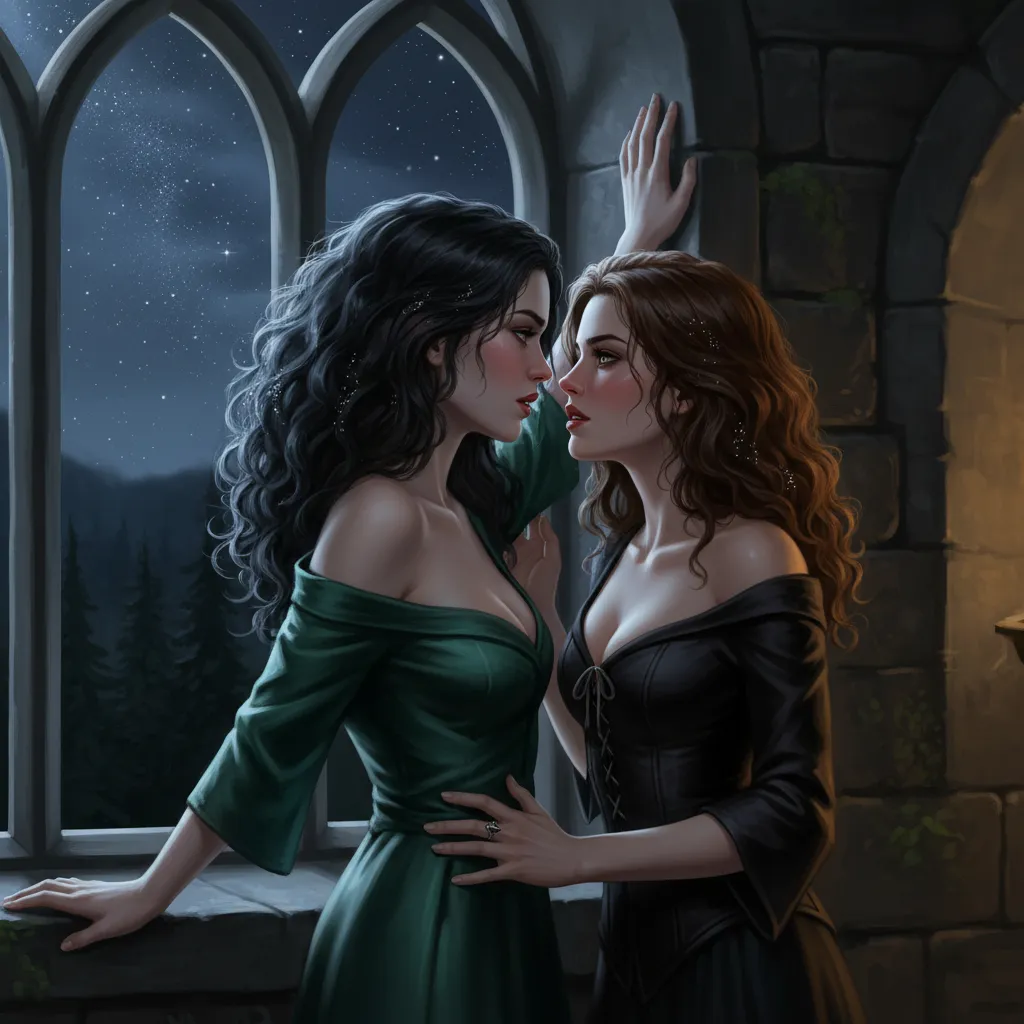
Mia found out by accident.
Which was, she would later think, the only way it could have happened — Andromeda was careful in the specific way of someone who had been living inside a secret for months and had gotten very good at the architecture of it. She didn't slip. She didn't confide. She managed it with the quiet precision of a girl who had grown up watching her family and learned exactly how much could be hidden in plain sight.
What she hadn't accounted for was Mia leaving the library early on a Wednesday evening and taking the long way back through the east corridor and turning a corner at the exact wrong moment.
Or the right moment, depending on how you looked at it.
They were standing in an alcove behind a tapestry — not entirely hidden, just removed enough from the main corridor to have a conversation nobody was supposed to hear. Andromeda and a boy Mia didn't immediately recognise, standing close, talking in low voices. The boy had his hand at Andromeda's elbow. Andromeda was looking at him with an expression Mia had never seen on her face in any social context — completely unguarded, the composed Black family manner entirely gone, just a fifteen year old girl looking at someone she was very clearly in love with.
Mia stopped.
Andromeda looked up.
Their eyes met.
The boy — tall, sandy-haired, with an open face that was currently doing its best to be invisible — stepped back slightly. Andromeda went very still in the way that people go still when they've been caught and are rapidly calculating every possible outcome.
Mia looked at her for a moment.
Then she turned and walked back the way she'd come.
Andromeda found her twenty minutes later in an empty classroom, which was where Mia had gone on the reasonable assumption that Andromeda would come and they should have this conversation somewhere that wasn't a corridor.
She came in and closed the door and stood with her back against it and looked at Mia with an expression that was trying to be composed and not quite managing it.
"His name is Ted Tonks," she said.
Mia kept her face neutral. "Okay."
"He's a Hufflepuff. Sixth year." Andromeda looked at her steadily. "He's Muggle-born."
The word landed in the room and sat there.
"I know what that means," Andromeda said, with the quiet intensity of someone who had been having this argument in their own head for a long time. "I know exactly what it means. I know what my family would do. I know what it looks like." She paused. "I don't care."
Mia looked at her for a moment. Fifteen years old and already past the point of pretending.
"How long," she said.
"Since October." Andromeda's hands were still at her sides, very controlled. "We started talking in the library. He's — he's brilliant. And kind. And he looks at me like I'm a person and not a Black family asset." She stopped. "I know you're going to tell Bellatrix."
"I'm not going to tell Bellatrix."
Andromeda blinked. "You're not."
"Not without talking to you first." Mia pulled out a chair and sat down. "Sit down, Andromeda."
She sat, slowly, the way someone sits when they're still not certain the ground is solid.
"Does anyone else know," Mia said.
"No one."
"Not even the girls in your dormitory."
"Especially not the girls in my dormitory." She paused. "Narcissa suspects something. She hasn't asked."
"That sounds like Narcissa."
Something moved in Andromeda's face — a fractional softening, the particular expression of someone who loves their difficult family regardless. "Yes," she said.
Mia looked at her. At the girl who in her own timeline had walked away from everything she knew for exactly this reason and never gone back, who had lost her family and kept going, who had raised a daughter who became an Auror and lost her in the war and kept going from that too. The particular stubborn, quiet courage of Andromeda Black that nobody ever talked about because it didn't announce itself.
"What do you want to do," Mia said.
Andromeda looked at her. The question seemed to catch her off guard — like she'd been braced for a different conversation entirely. "I want—" She stopped. Started again. "I want to not lose him. I want to not lose my family. I know I can't have both and I'm not—" Her voice was steady but only just. "I'm not ready to choose yet. I know that's not brave."
"It's honest," Mia said. "That's different from not brave."
Andromeda looked at her hands. "Does Bellatrix have to know."
This was the complicated part.
Mia thought about it genuinely, which was the only way she knew how to think about things that mattered. Bellatrix would want to know — not to report it, not to damage Andromeda, but because Bellatrix felt responsible for her sisters in the specific fierce way she felt responsible for everything she loved, and not knowing meant not being able to protect.
But Andromeda knowing that Bellatrix knew would change the shape of the secret. Would add weight to it. Would make it more real in a way Andromeda wasn't ready for yet.
"Not yet," Mia said. "But eventually."
Andromeda looked up. "You'll tell her eventually."
"She'd want to know. And she'd keep it." Mia met her eyes. "You know she would."
A pause. Something complicated moved through Andromeda's expression — the specific difficulty of believing good things about someone you love in a situation where the worst thing seems most likely.
"She won't—" Andromeda stopped. "She's different this year. Since you." She looked at Mia carefully. "She wouldn't have kept this secret last year. She would have thought she was doing the right thing and told my parents and genuinely believed she was helping me."
"I know," Mia said.
"What changed."
Mia thought about this honestly. "She has something she'd lose everything to protect," she said. "That changes how you think about other people's everythings."
Andromeda was quiet for a moment. The classroom was still, dust motes floating in the lamplight.
"I'm scared," she said. Very quiet. The composed manner entirely gone, just the truth of it.
"I know," Mia said. "That's reasonable."
"What do I do."
"Right now? Nothing. Keep being careful. Don't rush." She paused. "You're fifteen. You have time."
"My family won't think I have time. When they find out—"
"When they find out," Mia said, "you won't be fifteen and you'll have had time to be certain." She held Andromeda's gaze. "Be certain first. Everything else is easier when you're certain."
Andromeda looked at her for a long moment. The calculation behind her eyes was visible — weighing, measuring, deciding.
"You're not what I expected," she said finally.
"What did you expect."
"Someone Bellatrix had collected. A useful person she'd decided to keep." She paused. "You're not that."
"No."
"You're the person she thinks about when she thinks everything will be fine." She said it simply, like stating a fact she'd observed and filed away. "I've seen her do it. Something goes wrong and she goes very still for a second and then she's fine again." She paused. "That's you. You're the thing she goes still about."
Mia looked at her.
Andromeda stood up and straightened her robes. The composed manner was coming back, settling over her like a coat she knew how to wear. "Thank you," she said. "For not—"
"Don't thank me yet," Mia said. "Get out of the corridors by ten and stop meeting in the east wing, Filch does that round on Wednesdays."
Andromeda blinked. Then the corner of her mouth moved. "Right," she said. "Thank you."
She left.
Mia sat in the empty classroom for a moment and thought about the particular weight of knowing how things turned out and choosing not to use it — not because it wasn't useful but because some things had to unfold in their own time, at their own pace, chosen by the people they belonged to.
She thought about a girl who would one day walk away from everything and keep walking.
Good for you, she thought. Both times.
She told Bellatrix that night.
Not everything — not Ted's name, not the specifics. But the shape of it: Andromeda was seeing someone. Someone the family wouldn't approve of. She was being careful and she wasn't ready and she needed time.
Bellatrix listened without speaking.
When Mia finished she was quiet for a long moment, sitting on the edge of her desk with her arms folded, looking at the floor.
"How serious," she said.
"Serious enough that she's terrified."
Another silence. Mia watched her work through it — the complicated internal process of Bellatrix caring about something and deciding what to do about it, which was never simple and never fast.
"She's fifteen," Bellatrix said.
"Yes."
"She's too young to be this frightened about something."
"She's a Black," Mia said gently. "She's been this age for this family her whole life."
Bellatrix's jaw tightened. Not at Mia — at the truth of it. "Who is he."
"I'm not telling you that yet."
Bellatrix looked up sharply.
"Because it's not mine to tell," Mia said. "And because you don't need it yet. What you need to know is that your sister is scared and she needs to know you're not going to make it worse."
"I wouldn't make it worse."
"You might try to make it better in ways that feel like making it worse to her." She held her gaze. "You'd want to fix it. Manage it. Make it safe. And she doesn't need it managed. She needs to know that when it stops being a secret — when it can't be anymore — you'll still be her sister."
Bellatrix looked at her for a long moment.
"You knew," she said quietly. "About her. What she'd do."
"I knew," Mia confirmed.
"From your timeline."
"Yes."
"And she—" She stopped. Mia could see her working through the implications. In her own timeline Andromeda had been burned off the family tree. Had lost everything. Had kept going regardless.
"She was happy," Mia said. "I want to be clear about that. However it went. She was happy."
Bellatrix absorbed this. Something moved through her expression — complex and private, the particular grief of someone confronting a loss that hadn't happened yet in this version of things and maybe didn't have to.
"Can we stop it," she said. "The burning off. If my parents find out—"
"I don't know," Mia said honestly. "I think it depends on how much the world changes. On what we manage to shift." She paused. "But Bellatrix — she's going to love him regardless. Whoever he is. That part isn't changing."
Bellatrix was very still.
"Then what matters," she said slowly, "is what happens around it."
"Yes."
"If the war doesn't happen the way it happened. If Voldemort doesn't—" She stopped. "If we succeed. If the world is different. Then maybe there's less reason for my family to—"
"Maybe," Mia said. "That's not a promise. But maybe."
Bellatrix stood up. She moved to the window and stood looking out at the dark grounds and Mia let her have the silence.
"I'm not going to say anything to her," she said finally. "Not yet."
"Okay."
"But I want her to know." She turned. "Not that I know. Just — I want her to feel it. That it's alright."
Mia looked at her. "That's a very Bellatrix solution."
"I'm a very Bellatrix person."
"You are." Mia crossed the room and stood beside her at the window. Outside the grounds were dark and still, the lake reflecting a sliver of moon. "She already knows, actually."
Bellatrix looked at her.
"She said you're the thing she goes still about," Mia said. "She watches you when something goes wrong. She sees you get through it." She paused. "She knows you're different this year."
Something moved in Bellatrix's face. Raw and quick and gone almost immediately.
"She's going to be fine," Mia said. "Whichever way it goes."
Bellatrix looked out the window for another moment. Then she turned and put her arms around Mia without preamble, which she almost never did — she wasn't someone who initiated this kind of thing, the uncomplicated physical comfort of it — and held on for a moment.
Mia held on back.
"Okay," Bellatrix said, into her hair.
"Okay," Mia agreed.
They stood at the window while the castle settled into the quiet of late evening around them, and outside the grounds were cold and still, and inside something had shifted — another piece of the Black family moving, slowly and without announcement, toward a different arrangement.
The following week Andromeda came down to breakfast and found a book on her plate.
No note. Just a book — advanced charms theory, one that Andromeda had mentioned wanting in October and that had been out of stock at Tomes and Scrolls.
She looked down the table at Bellatrix.
Bellatrix was reading her own book and paying attention to no one.
Andromeda looked at the book in her hands. Something moved across her face — complicated and private and entirely its own thing. Then she opened it and started reading and said nothing at all.
Mia, sitting across from Bellatrix, caught her eye.
Bellatrix turned a page of her own book.
Don't, her expression said.
Mia said nothing. She drank her tea and smiled into it and said nothing at all.
The two weeks of Rodolphus's investigation passed.
Not quietly — nothing with Rodolphus was quiet — but in the way that things pass when you've decided to stop bracing against them. He moved in the background, the invisible machinery of his case-building continuing, and they let it continue because the plan was in motion and the plan was better than anything he was building.
Avery confirmed Croaker's access on a Thursday.
Bellatrix spent a weekend dismantling it — not by confronting Croaker directly, which would have created noise, but by ensuring that the specific archive records he'd been accessing had been updated. Not changed — she wasn't so careless as to falsify Ministry records, which was both illegal and traceable. But supplemented. A letter of provenance, written in aged ink on period parchment, filed correctly in the Ministry archive through a contact of Alphard's who asked no questions. A secondary genealogical reference, cross-indexed with the Gringotts vault records, that made the 1847 inconsistencies look like precisely what they were — the normal imperfections of genuine old records.
Not constructed. Clarified.
"He'll know we did something," Mia said, watching her work.
"He'll know something changed," Bellatrix agreed. "He won't be able to prove we changed it. And the changes will hold up to independent scrutiny, which the original records did not, which actually makes our position stronger than it was before he started looking."
Mia looked at her. "You're enjoying this."
"I'm not—" She stopped. A slight pause. "It's a satisfying problem."
"You're enjoying it."
"The intellectual component is—"
"Bellatrix."
She looked up with the expression of someone caught at something. "Fine. Yes. He handed me an opportunity to improve the documentation by making me aware of its weaknesses and I find that satisfying. It doesn't mean I'm enjoying the fact that he—"
"It's okay to enjoy it," Mia said. "He's awful. Outmanoeuvring him is fun."
Bellatrix looked at her for a moment. Then she looked back at her work with the ghost of a satisfied expression that she didn't bother hiding.
"Two days," she said. "And he has nothing."
She was right.
On the Tuesday Rodolphus found her in the corridor again.
This time Bellatrix stopped before he could say anything.
"I've considered your proposal," she said.
He waited.
"No," she said pleasantly. "Was there anything else?"
The look on his face was extraordinary. Not quite anger — he was too controlled for that. But the expression of someone who has built something carefully and arrived to find the ground it was standing on has been quietly removed.
"The documentation—" he started.
"Is verifiable through Ministry records, cross-referenced with a Gringotts vault that predates your family name by three centuries." She tilted her head slightly. "If you'd like to take it to the families formally I'm delighted to do that. Shall I write to my grandfather or would you prefer to write to yours?"
A silence.
Rodolphus looked at her. She looked back. Pleasant, composed, and about as moveable as the castle walls.
"This isn't finished," he said, very quietly.
"No," Bellatrix agreed, and her voice dropped its pleasantness for just a moment — something underneath it, clear and direct. "It isn't. But you should know that every time you build something against us, we're going to be faster and more thorough." She held his gaze. "That's not a threat. It's just accurate."
She walked away.
She found Mia in the library and sat down and didn't say anything for a moment.
"Well?" Mia said.
"He said it's not finished."
"It isn't."
"I know." She picked up her quill. "But he knows where we stand now."
"Good." Mia looked at her. "How do you feel."
Bellatrix considered this with her usual seriousness. "Like we're winning," she said. "And like that's the most dangerous thing to feel."
"Why dangerous."
"Because winning makes people careless." She looked at Mia. "We can't be careless."
"We won't be."
"No," Bellatrix agreed. She opened her notes. "The locket," she said. "Tell me again what you know about its chain of possession."
Mia looked at her — this brilliant, relentless, occasionally maddening woman who had just walked into a corridor confrontation with someone who wanted to take everything from them and come back to the library to do Horcrux research — and felt something so complete it had no edges.
"You know," Mia said, "most people would want to celebrate."
"We can celebrate later."
"When."
"When there are no more Horcruxes."
"That could be years."
"Then we have a lot to look forward to." Bellatrix looked at her with the expression that was warm and dry and entirely hers. "The locket, Mia."
Mia laughed and opened her own notes and told her about the locket.
Outside the library windows the March light was getting longer, the worst of the winter releasing its grip on the grounds, and inside the castle something was shifting too — the year turning toward its end, the next thing waiting just past the edge of what they could currently see.
But that was later.
Right now there was the locket and the notes and the familiar warmth of working next to someone who matched her, and it was enough.
It was, Mia thought, more than enough.