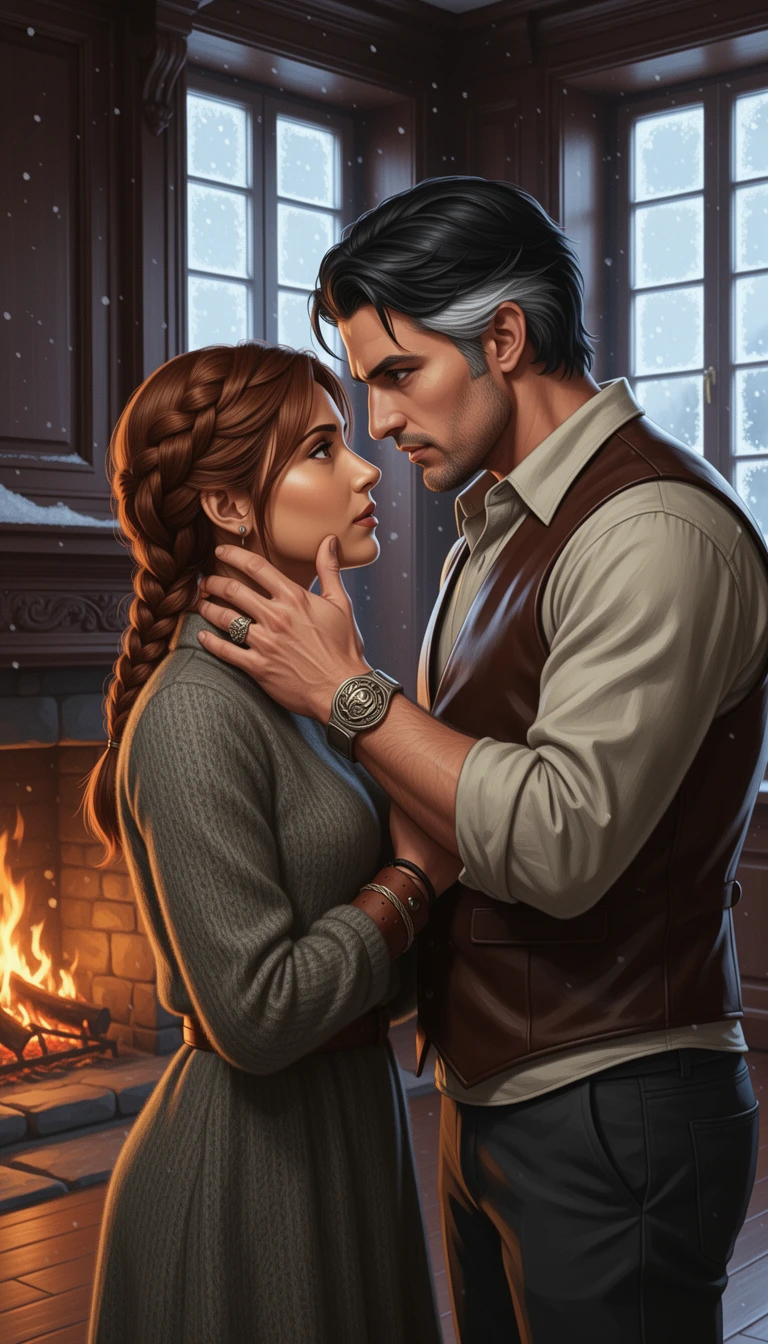
The draft curled around her ankles, colder than it had been in the hallway, colder than the air in her room. It smelled of iron—not the sharp, metallic scent of blood, but something older, deeper, like rust blooming in a locked room for years. The hem of her wool dress fluttered against her calves, tugged once, twice, as if something wanted her to follow.
Her thumb found the ridge of scar beneath the leather bracelet. She pressed. Pain bloomed, clean and familiar, and the world sharpened around it—the cool stone under her bare feet, the darkness that pressed against her eyes like wool, the faint echo of her own breathing in the narrow passage ahead. The east wing. The place he told her not to go.
She took a step. Not toward her room. Not toward the candle she'd left behind. Into the dark, where the air grew colder and the iron scent thickened until she could taste it on her tongue, metallic and ancient, like licking the rust off a locked door.
The walls changed. The smooth plaster of the main hall gave way to rough stone, unplastered, the mortar crumbling between the blocks. Her fingers brushed the surface, felt the grit, the cold seep into her knuckles. The floor slanted downward, a long, shallow decline that pulled her deeper, and she let it, her bare feet finding each step without hesitation.
A sound. Ahead. Not a voice—something softer, a scrape of cloth against stone, or the shift of something heavy being dragged across a floor. She stopped. The darkness was absolute here, no sconces, no light from any window, and she realized the passage had turned, the faint glow from the hallway behind her gone. She was blind now, truly blind, the world reduced to touch and smell and the beating of her own heart.
Her thumb pressed harder against the scar, the pain a bright thread in the dark. She held it, let it anchor her, then let go and stepped forward again. One hand trailed the wall, counting the gaps between stones—three, four, five—until her fingers found wood. A door frame, the wood old and splintered, the grain rough against her palm. The iron scent was strongest here, so thick it felt wet in her lungs.
She stopped. Her hand rested on the frame, the wood gritty with age. She could step back. She could return to her room, light a candle, pretend she hadn't followed the draft, hadn't broken the promise she'd made with her lips while her body already knew it would. The scar throbbed beneath her thumb, a warning or a memory, she couldn't tell which.
She pressed her ear to the door. Silence. Not the empty silence of an unused room—a held silence, the kind that listened back. Someone was on the other side. Or something. The iron scent coiled around her, familiar in a way she couldn't name, as if her body recognized it before her mind did.
Her fingers found the latch. Cold iron, shaped like a hand curling inward, the metal worn smooth by use. She traced the curve of it once, twice, the cool metal warming under her touch. She did not lift it. She held it, her palm pressed flat against the latch, feeling the weight of the door, the silence beyond, the darkness pressing against her back.
The draft stopped. The hem of her dress stilled against her calves, and the air around her grew still, heavy, waiting. She stayed there, hand on the latch, thumb pressed to the scar, the east wing's secret sealed behind an inch of wood and her own hesitation. The house held its breath with her.
Her thumb left the scar. The pain faded, and in its absence, her hand moved—not fast, not slow, but with the inevitability of something that had already been decided. The cold iron of the latch warmed under her palm as she curled her fingers around it, felt the weight of the mechanism through the metal, the resistance of something that had been closed for a long time.
She lifted.
The latch released with a sound like a breath exhaled—soft, almost human, the iron grinding against itself in a low whisper that seemed to travel through the stone rather than the air. The door did not swing open. It waited, unlatched but unopened, the seal broken but the threshold still between her and whatever lay beyond.
The draft returned. Not the gentle curl at her ankles, but a pull—slow, steady, drawing the air past her face into the darkness beyond the door, as if the room was breathing her in. The iron scent flooded her lungs, thick and wet, and she tasted it on her tongue, felt it coat the back of her throat like something she had swallowed once before, a long time ago.
She pushed the door open.
It moved without resistance, swinging inward on hinges that did not creak, did not protest, as if they had been waiting for this moment. The darkness beyond was absolute, heavier than the dark of the passage, a black that pressed against her eyes and seemed to absorb the faint light from behind her before it could reach two feet into the room.
She stepped across the threshold. Her bare foot found stone colder than the passage floor, smooth and worn, and the change in temperature was immediate—the air dropped, settled into her bones, made her breath visible in a thin white plume that she watched dissolve into the dark ahead.
The door swung shut behind her. The latch clicked into place, and the sound was final, a seal closing, the darkness complete. She could not see her own hand in front of her face, could not see the door she had just entered through, could not see anything but the black that pressed against her from all sides.
She did not panic. Her thumb found the scar again, pressed, held. The pain was a point of light in the dark, a thread she could follow back to herself. She let it ground her, then let go.
A voice spoke from the dark. Close. Not Darius's voice—lower, older, a rasp that seemed to come from the stone itself, from the walls that surrounded her. "You smell of the sea," it said. "And of blood."
Her thumb found the scar through the leather. Pressed. Held. The pain was a bright point in the absolute dark, the only thing she could trust—her own body, her own refusal to answer. She did not speak. The silence stretched, the darkness pressing against her eyes, the iron scent coating her tongue, and she felt the weight of the voice's words settle into her chest like stones dropped into still water.
"The sea," she said finally. Her voice was steadier than she expected. "I haven't seen the sea in years."
A sound from the dark. Not quite a laugh—something older, rougher, like stone grinding against stone. "You carry it. In your skin. In the way you breathe." A pause. "The blood is newer."
She felt her hand drop from the scar, felt her fingers find the hem of her wool dress, twist the fabric once, twice. The draft had stopped. The air was still, heavy, waiting. She could not see the speaker, could not judge the distance, could only feel the presence of something that knew more about her than she had given permission to know.
"You're not Darius," she said. Her thumb pressed against the scar again, the pain clean and sharp, and she let it hold her in the present. "Who are you?"
Silence. Then a shift—fabric against stone, the creak of old wood under weight. The voice came from a different place now, closer, as if the speaker had moved without sound and only now let her hear the aftermath of motion. "I am what remains. What the master keeps sealed." Another pause. "What you came to find, even if you did not know it."
Elena's fingers tightened on the hem of her dress. Her breath came slow, measured, each exhale a deliberate release of control. "I don't know what I came to find. I followed the iron."
"Yes." The voice was closer now, so close she felt the warmth of breath against her cheek, though she could see nothing. "You followed the iron. Because it knows you. Because you have tasted it before." A pause. "The scar on your wrist. It is not a scar. It is a lock."
Her hand flew to the bracelet, her palm covering it, as if she could shield it from the dark. "I don't—"
"You do." The voice was gentle now, almost kind, and that was worse than the rasp. "You have forgotten the shape of the key. But it is still inside you. That is why you came."
The darkness pressed against her. The iron scent flooded her lungs. And Elena Vasquez, or whatever her real name was, stood frozen in the black, her hand clamped over the scar, the truth of the voice's words settling into her bones like rust blooming in a locked room for years.