
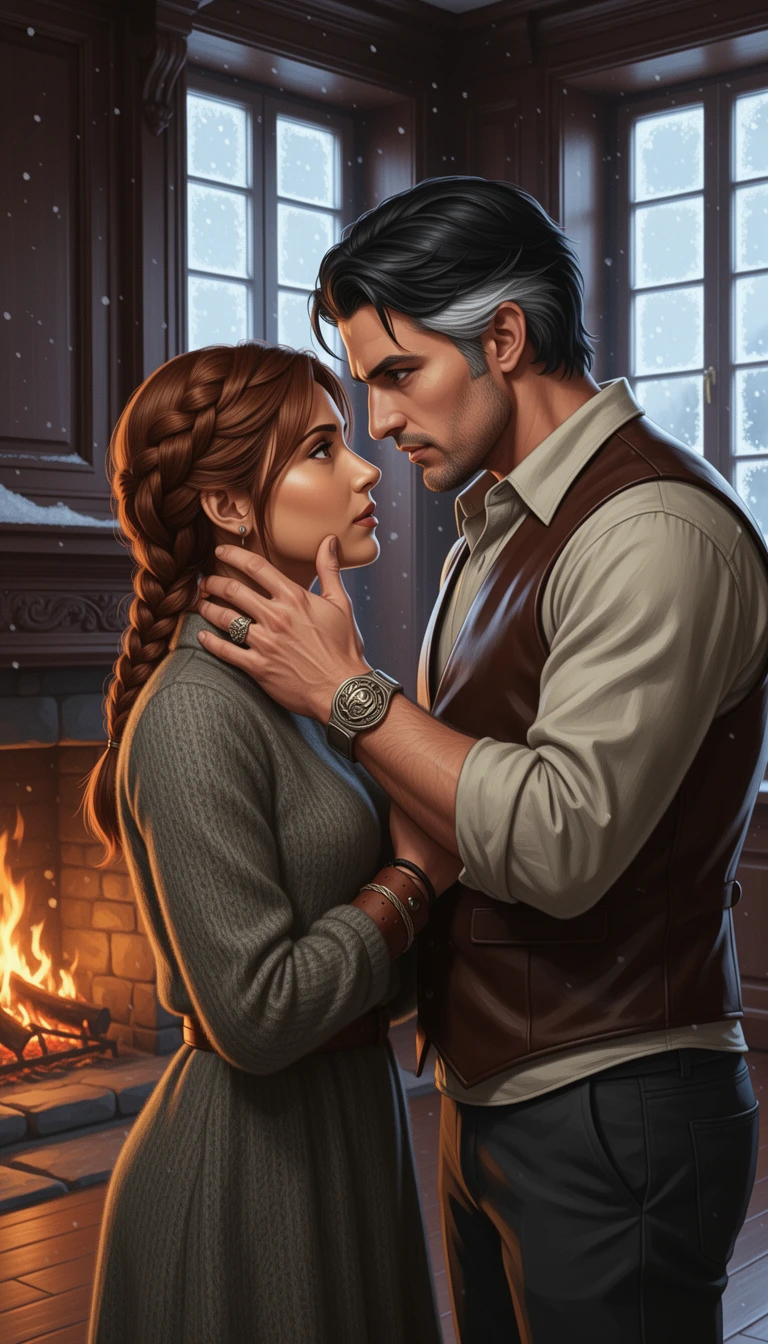
The cold had found its way through every layer. Her wool dress, once a defense against autumn chills, hung heavy and useless against her skin, water wicking down her collarbone and along her spine. Elena blinked against the snow clinging to her lashes, and in that small darkness she felt the weight of the last three days—the road, the storm, the horse that had stumbled and run, the farmhouse where no one answered, the miles of white that blurred into a single, endless shiver.
Darius Blackwood filled the doorway. Not because he was broad—though he was—but because he occupied space as if he owned it. His eyes moved over her like a merchant scanning a ledger, finding nothing worth noting. The grey of them matched the sky behind her, and they held no warmth, no curiosity. Just assessment.
He did not ask her name.
“You work until the roads clear.” His voice carried over the wind, low and flat, the tone of a man who had said the same words a hundred times. “You follow every rule. You do not enter the east wing.” A pause. The wind tore at her cloak, snapping the wool against her thighs. “If you break any of those, you leave in the storm.”
Her hand pressed into the stone doorframe. The cold of it had gone beyond feeling, into a dull ache that ran up her wrist. She should say something. Thank him. Give a name that wasn't hers. But her jaw was clenched against the chattering, and the words would have come out broken.
She nodded. Once.
Darius watched her for a beat longer than necessary. The wind lifted a strand of grey-streaked hair across his forehead, and he did not brush it away. Then he stepped back, leaving the doorway open but not inviting.
The warmth of the hall rushed past him, carrying the scent of woodsmoke and old stone. Elena's fingers cramped as she pushed off the frame. Her boots left dark prints on the threshold, and the ice in her braid began to melt, a single drop tracing the curve of her neck.
She crossed into his house. The door groaned shut behind her, cutting the storm to a muffled roar. She stood in the entry, water pooling at her feet, and did not lift her eyes from the flagstones until his footsteps receded down the corridor.
She lifted her gaze.
The corridor stretched before her, stone walls dark with age, a single iron sconce burning at the far end. The flame guttered in a draft she couldn't feel, and beyond it, nothing—just the curve where the hall turned, swallowed by shadow. No footsteps echoed now. He was gone, and she was alone in the warmth that pressed against her frozen skin like a second body.
The heat hurt. It crept into her fingers, her cheeks, the tips of her ears, and the pain of thawing spread through her like a slow, patient fire. She did not move. The flagstones beneath her boots were wet with melt, and the water had begun to soak through the leather, a cold that no fire could reach. She should take off her cloak. She should find whoever told servants where to sleep. She should do something.
Instead, she stood in the entry, her hands at her sides, and let the warmth find its way into her bones.
The hall smelled of woodsmoke and something else—old wool, iron, the faint mineral sharpness of wet stone. A door to her left stood ajar, revealing a sliver of darkness. The east wing, he had said. Do not enter. She did not turn her head toward it, but the words lodged in her chest like a splinter she couldn't ignore.
A clock ticked somewhere, deep in the house. Steady. Unhurried. The sound of a place that had never known her before and would forget her the moment she left.
She pressed her wet sleeve against her forehead, wiping the last of the melt from her skin. Her braid had begun to slip, strands of chestnut hair clinging to her jaw, and she did not tuck them back. There was no one to see.
From somewhere above, a floorboard creaked. A single, deliberate sound, like a man shifting his weight. She did not look up. She did not need to. He was watching—not to frighten her, but to see what she would do with the silence he had given her.
Elena let out a breath she hadn't realized she was holding. The air around her was still, the storm a distant, muffled roar, and she stood in the center of his house, her wet dress clinging to her thighs, and waited for the next command she would either follow or break.
She turned her head. The floorboard had groaned above her, to the right, where the staircase curved into shadow. Not the random settling of an old house—too deliberate, too weighted. She could feel the silence that followed, the way the air held its breath, waiting.
Her wet sleeve dripped onto the flagstones. The sound was loud in the stillness, a single drop breaking the surface tension of the quiet. She did not wipe her forehead again, did not adjust her collar, did not do any of the small things that would have acknowledged the weight of his attention. She simply stood, her arms at her sides, her braid dripping onto her shoulder, and let the heat of the hall press against her skin.
Another creak. Closer this time. The top of the stairs, maybe, where the landing turned. He was moving, but slowly, as if he had all the time in the world to watch her freeze.
Elena pressed her lips together. The chill in her fingers had begun to recede, replaced by a pins-and-needles heat that made her want to clench her fists. She did not. She let them hang, water on her knuckles, and counted the seconds between heartbeats to keep from looking up.
The silence stretched. The clock kept ticking, a steady heartbeat beneath the storm's muffled roar. She could smell herself now—wet wool, the faint salt of sweat from the road, the metallic tang of cold that clung to her skin. The house smelled of woodsmoke and iron, and beneath that, something older, something that had soaked into the stone over decades of winter.
She took a step. Not toward the stairs—toward the wall, where a narrow corridor branched off the entry. She did not know where it led, only that it was not the east wing, and that moving felt better than standing.
Her boots squelched against the flagstones. The sound was obscenely loud, and she felt a flush crawl up her neck. She had not been embarrassed to arrive soaked and shivering, but the sound of her own wet footprints in his quiet house made her feel like a child tracking mud across a clean floor.
She stopped. The corridor stretched ahead, dim, a single sconce burning at its midpoint. She did not know where she was going. She had not been told where to sleep, or where to dry her clothes, or even what name to use. He had given her rules and left her standing in a puddle.
From above, the floorboard did not creak again. But the silence changed—the quality of it, the weight. He was no longer watching. Or he had already seen enough.
Elena let out a slow breath. She turned back toward the entry, toward the staircase that rose into darkness, and she lifted her chin. She would find him. She would ask for a towel, or a room, or a task—something that made her presence here mean more than a wet spot on the floor. She was not a child. She would not wait to be told what to do.
Her fingers found the leather bracelet on her wrist, turning it once, a nervous habit she could not break. Then she stepped toward the stairs, her wet boots leaving dark prints on the stone, and she did not look back at the door she had entered through.
Her foot found the first step, the wood groaning beneath her weight. The sound was too loud in the quiet, and she felt the tremor of it travel up through her ankle, into her thigh. She paused, one hand going to the banister, the leather of her bracelet catching the faint light from below.
The stairs curved upward into shadow, each step a darker shade than the last. She could not see the landing, could not see him, but she felt his presence like a held breath above her. The silence was not empty—it was full, waiting, and she had stepped into it willingly.
Her fingers found the bracelet again, turning the worn leather against her wrist. It was warm from her skin, damp from the melt still soaking through her dress, and the motion was older than this house, older than the storm. A habit she had worn so long it had become part of her, like the scar beneath it.
She took another step. Then another. The wood complained under each, and she did not try to soften her tread. Let him hear her coming. Let him know she was not sneaking, not hiding, not waiting for permission to exist in his house.
The temperature changed as she climbed—cooler, the air thinner, the scent of woodsmoke fading into something older: dust, wax, the faint metallic tang of cold iron. A sconce flickered on the wall halfway up, the flame guttering in a draft she could not trace. She watched it as she passed, the way the light caught the oil on the stone, the way it seemed to reach for her shadow and miss.
At the top of the stairs, the corridor opened into a narrow hall. A single door stood at the far end, closed, a sliver of light beneath it. No footsteps. No creak of floorboards. But the silence was different here—shaped, as if by a body standing still.
She stopped at the threshold, her boots dripping onto the dark wood. The hall was dim, lit only by the light from below and the faint glow beneath the door. She could not tell if he was behind it, or if he had simply vanished into the shadows of the upper floor, leaving her to wander until she found him.
Her hand dropped from the bracelet. She pressed her palm flat against the wall, the stone cold through her fingers, and listened. A clock ticked somewhere below, steady as a pulse. The storm muttered against the windows, muffled and distant. And beneath that, a sound she had almost missed: the soft scrape of a chair being pushed back from a desk.
He was in there. And he knew she had come.