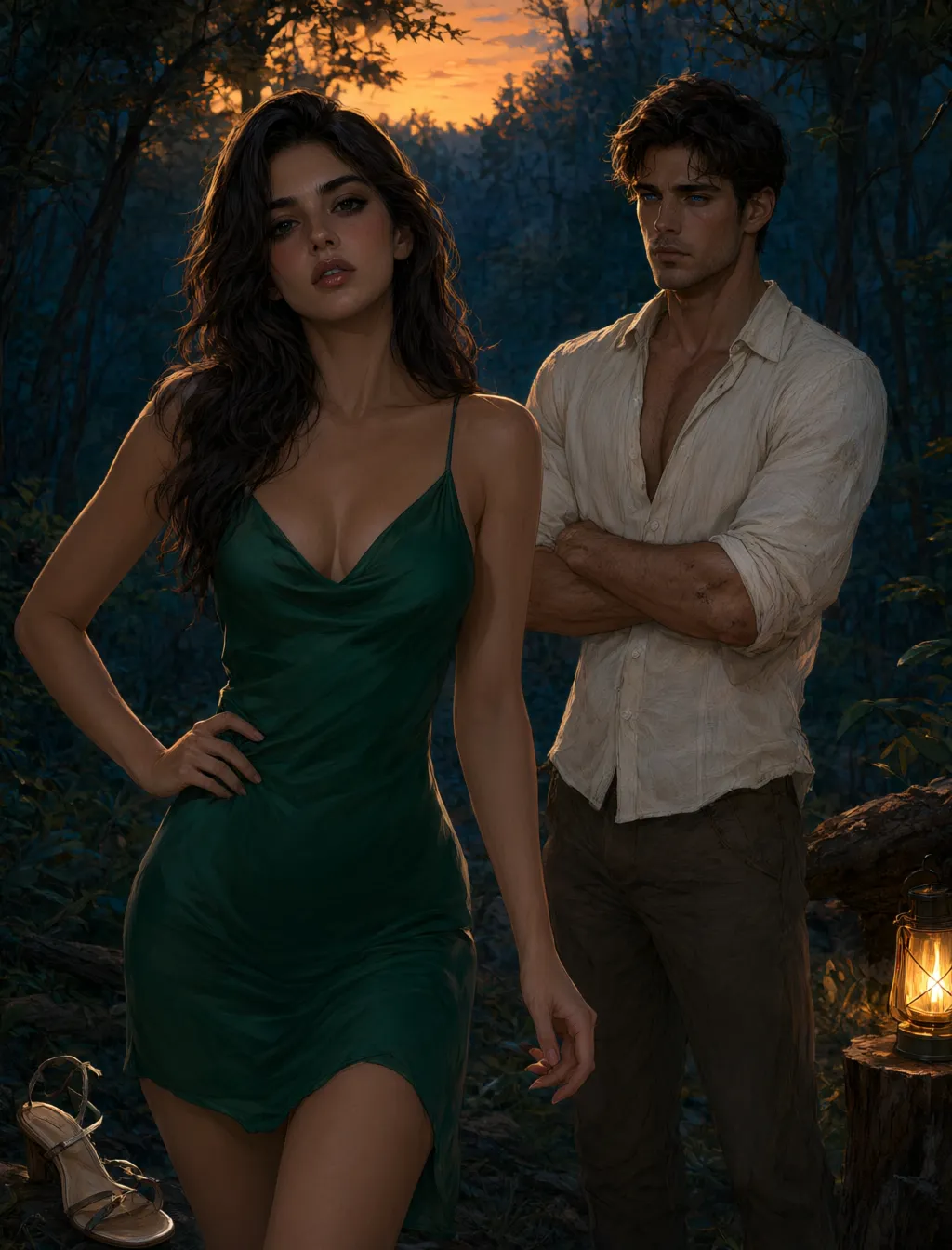
The flashbulbs were a physical heat on Sofia’s skin, her smile a fixed, brilliant mask. Then she saw him. Noah. Leaning against a jeep, watching her with those storm-gray eyes that saw everything. Her breath hitched, a tiny fracture in her perfect rhythm. His gaze dropped to her hands, where her knuckles were white around her microphone. He knew. He always knew.
She finished the soundbite for the entertainment correspondent, the laugh that followed a practiced, airy thing. The crew moved on, a flock of cameras swiveling toward the next star being unloaded from a black SUV. The sudden absence of their focus left a vacuum, filled only by the distant shouts of producers and the growl of idling engines. The air smelled of diesel and damp earth.
She lowered the microphone. The plastic was warm from her grip. She made a show of checking the time on her ridiculous, diamond-studded sports watch—a sponsor’s gift—just to have somewhere to look that wasn’t him.
When she looked up, he was still there. He hadn’t moved. He wore faded cargo pants and a simple gray t-shirt that stretched across his shoulders. He looked like he’d been born in this mud, while she felt like a cut flower slowly wilting in her two-thousand-dollar hiking boots.
“Sofia.”
A producer materialized at her elbow, clipboard pressed to his chest. “Quick briefing at the main tent. Then we’ll mic you and your partner for the introductory walk-in.”
“My partner,” she repeated, the word tasting like ash.
“Noah Blake. The journalist. The network loves the… narrative tension.” The producer smiled, a bland, professional curve of the lips. “He’s over by the jeep. We’ll pair you up there.”
He hurried off. She was left standing alone in the churned-up grass. She felt Noah’s attention like a weight, a constant, quiet pressure against the back of her neck. She had to move. To walk toward him was to surrender to the narrative, but to walk away was a confession.
She chose surrender, her boots sinking slightly into the soft ground with each step. He pushed off the jeep as she approached, standing at his full height. He was taller than she remembered. Or maybe she’d just forgotten how he seemed to take up all the available space in a different way than cameras did.
“Sofia Duran,” he said. His voice was calm, grounded. It hadn’t changed.
“Noah Blake.” She stopped a few feet away, the distance a declaration. “I didn’t read the full participant list.”
“I did.”
Of course he did. He’d have known for weeks. He’d have had time to prepare, to steel himself. She’d walked in blind, armored in nothing but branded nylon and lipstick.
A sound assistant rushed over, a small microphone pack in hand. “Miss Duran, if you could just—”
She turned, offering her back, and lifted the heavy fall of her dark hair. The assistant’s fingers fumbled at the waistband of her pants, clipping the pack, threading the wire up under her shirt. The touch was clinical, impersonal. She stared straight ahead at the grille of the jeep.
“Mr. Blake?” the assistant said.
Noah simply lifted his arms, standing still as the young man fitted him with his own pack. His eyes never left Sofia’s profile. She could feel it—the study. The reassessment. He was looking for the cracks the last three years had made.
“All set,” the assistant chirped, and vanished.
Silence bloomed between them, thick and humming. In the distance, a director yelled for quiet on set.
“Why are you here, Noah?” The question left her before she could sculpt it into something less direct, less real.
He considered her, his head tilting just a degree. “The same reason you are, probably. The paycheck buys a lot of silence.”
“You don’t need the money.”
“You don’t need the exposure.”
She had no retort. He’d already won, because he’d stated a simple truth and she was standing there wrestling with a lie. Her thumb found the inside of her opposite wrist, rubbing a slow, unconscious circle over the smooth skin there.
His eyes tracked the movement. He said nothing.
A horn blared. “Blake and Duran! You’re on the green path, markers one through three! Go now!”
It was time. The first steps into the edited wilderness. Noah nodded toward a gap in the tree line where a narrow, flagged trail began. “After you.”
It wasn’t a courtesy. It was strategy. He wanted her in front. He wanted to watch.
Sofia adjusted the strap of her designer backpack, felt the ridiculous weight of its non-essential contents, and walked past him. The scent of him hit her as she did—soap, sun, and something else, something fundamentally and infuriatingly familiar. She didn’t look back.
She stepped onto the path. The world changed. The engine rumble faded, swallowed by the dense green of the forest. The light softened, filtering through a high canopy. The air cooled, smelling of pine and decay.
She heard his footsteps behind her, steady and quiet on the earth. He was there. Just there. For the next twenty-one days, he was just there.
Her perfect smile was gone. Her face felt strange without it.
The silence between his footsteps was a language. Sofia heard every variation—the soft crush of pine needles, the slight skid on a buried stone, the steady, even rhythm of a man in no hurry. He was ten paces back. Maybe twelve. He never closed the distance, never let it stretch too far. A predator’s distance. An observer’s.
Her neck prickled. The weight of his attention was a physical point between her shoulder blades, a sun-warmed spot where her shirt had dampened with sweat. She resisted the urge to twist, to look. Looking was an admission. It gave him the confirmation he was waiting for: that she was aware, that she was counting his breaths just as he was counting hers.
The trail narrowed, forcing her to brush against a wall of ferns. Cold droplets from their fronds spattered her arm. She flinched. The sound of her movement—the quick intake of breath, the rustle of fabric—felt obscenely loud in the green hush.
His footsteps didn’t change.
She focused on the mechanics of walking. The too-stiff soles of her boots. The rub of the backpack’s strap against her collarbone. The way her hair clung to the damp skin of her neck. She was a collection of minor irritations, a symphony of discomfort, and he was the silent conductor listening to every off-key note.
“You’re favoring your left,” his voice came, calm and conversational, as if commenting on the weather.
Sofia froze mid-step. She didn’t turn. “I’m not.”
“You are. Your right foot lands heavier. You’re avoiding pressure on the ball of your left. New boots?”
She looked down at the pristine, mud-spattered leather. A blister had already formed, a hot, liquid betrayal against her heel. He’d diagnosed it from twelve paces behind, through layers of sound-deadening forest floor. Of course he had.
“They’re fine.”
“They’re not. But you’ll walk until you bleed because admitting it means stopping. And stopping means facing me.”
The truth of it, laid out so simply, stole her breath. She stared straight ahead at the dappled path. “I don’t have anything to face you with, Noah. You took all the words last time.”
“I took the published words. You kept the real ones.”
She started walking again, faster now. A stupid, transparent escape attempt. The pain in her foot spiked with each hurried step. His gait behind her lengthened effortlessly, maintaining the exact same interval. He was a shadow she couldn’t outpace.
A fallen tree lay across the path, moss-covered and massive. She stopped, assessing it. It was thigh-high. An easy vault for someone dressed for the part. She was dressed for a photoshoot.
His footsteps ceased. He’d stopped directly behind her. She could feel the heat of him, the slight disturbance in the air. She could smell him again—that clean, sunbaked scent cut with something sharp, like cold river stone.
“Need a hand?”
“No.”
She hooked her fingers under the strap of her backpack, took a short, awkward run-up, and hauled herself onto the broad trunk. Her boot slipped on the wet moss. She scrabbled, knees digging into rotten wood, her balance a frantic, undignified thing. She landed on the other side in a stumble, one hand slapping against the trunk of a sapling to steady herself.
She stood there, breathing hard, her palms stinging. She didn’t look back.
A soft thud, a rustle of foliage, and he was beside her. He’d cleared the log in a single, fluid motion, landing soundlessly on the balls of his feet. He wasn’t even breathing heavily.
He looked at her, then at the path ahead. “Marker two’s just up there. A clearing. They’ll have a crate.”
“I know the briefing.”
“Then you know we have to decide what to take from it. Together.”
He started walking, not waiting for her this time. She had no choice but to follow, falling back into her place behind him. The view was different. The worn fabric of his cargo pants across lean thighs. The shift of muscle in his shoulders under the thin gray cotton. The way his hair curled, damp, against his nape.
It was worse, somehow. Following him meant watching him move through this world as if he belonged to it. It meant admitting he was leading.
The clearing opened up ahead, a sudden bowl of harsh sunlight. In the center sat a heavy plastic crate, bright orange, lashed shut with a cable lock. A camera on a tripod watched from the tree line, its red recording light a tiny, unblinking eye.
Noah walked to the crate and knelt, examining the lock. Sofia hovered at the edge of the clearing, the sun hot on her exposed skin.
“Combination’s probably in the briefing pack,” he said, without looking up.
“I didn’t read it.” The confession was out, petty and small.
He paused, his hands stilling on the cable. He looked over his shoulder at her. The sunlight caught the storm-gray of his eyes, turning them translucent for a moment. He didn’t look surprised. He looked… resigned. “Right.”
He unzipped a side pocket on his own worn pack, pulled out a folded sheet of laminate, and scanned it. “Four-seven-two.”
He dialed the numbers on the lock. It sprang open with a clack that echoed in the clearing. He lifted the lid.
Sofia approached, her shadow falling across the open crate. Inside, neatly packed, were options: a coiled nylon rope, a compact water filter, a small hatchet, a first-aid kit, a folded tarp, a fire-starting ferro rod, and three protein bars.
“We take three items,” Noah said, his voice flat. “The briefing says to discuss. To strategize.”
She stared at the contents. The hatchet was real, its edge gleaming. The rope was thick and serious. These were tools for surviving, not for performing. “The water filter. The tarp. The fire starter.”
“No food?”
“We have the protein bars.”
“Three bars. For two people. For possibly three days until the next cache.” He leaned back on his heels, looking up at her. “You’re thinking short-term. Shelter, water, fire. Basics. That’s fear talking.”
“It’s practicality.”
“It’s a lack of faith.” He held her gaze. “In the environment. Or in me.”
Her jaw tightened. “Take the hatchet instead of the tarp, then. We can make shelter.”