
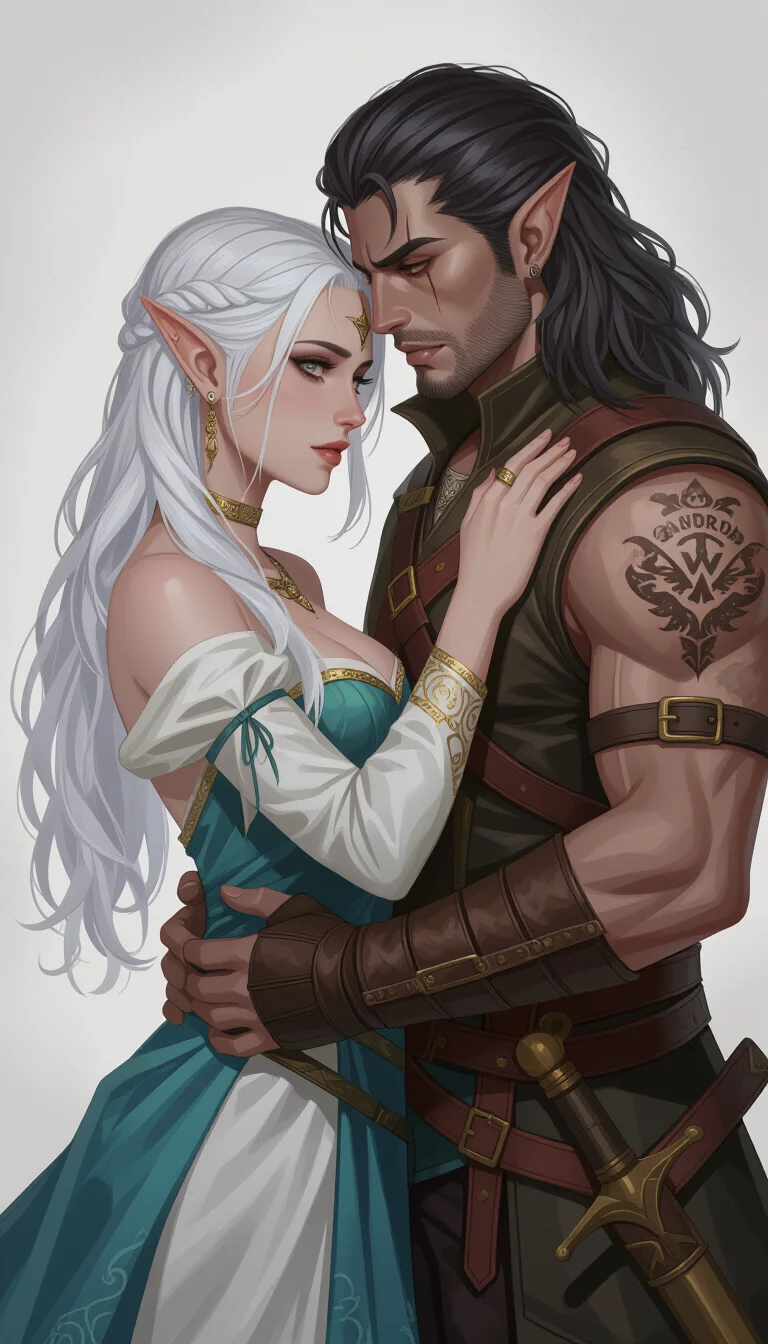
The silence broke not with a shout, but with a low, resonant hum that seemed to come from the silver-barked pines themselves. Syldra felt it in her teeth, a vibration that was less sound and more memory—an elven ward-song, twisted and sickly. John shoved her behind a trunk as the first figure stepped from the shadows, not a marauder but a man in faded imperial leathers, his eyes blank with a stolen song's compulsion.
“Don’t move,” John breathed, his voice a thread of sound. His hand was a firm pressure on her shoulder, holding her against the rough bark.
Two more figures emerged. Their movements were synchronized, unnervingly fluid, like puppets on the same string. They wore the same leathers, the same empty stares. The hum deepened, vibrating up through the soles of Syldra’s boots.
“That’s a Melindin border ward,” she whispered, horror dawning. “The Song of the Rooted Path. It guides travelers away. It doesn’t… command them.”
“It does now.” John’s eyes tracked the trio as they began to fan out. His free hand drifted to the worn hilt of his long knife. “Someone’s rewritten the melody. Imperial resonance theory. A Pruxan art for bending lesser magics.”
“Lesser?” Syldra’s voice cracked indignantly.
“Their word, Princess. Not mine.” He finally looked at her, his grey eyes flat. “Can you hear the break in the song? The fault line?”
She forced herself to listen past the dread. The hum was a wall of noise, but beneath it… a dissonant thrum, like a lute string about to snap. “There. A third note in the chord. It’s wrong.”
A grim approximation of a smile touched his mouth. “Good. That’s our door.”
John stepped out from behind the tree. He didn’t draw his blade. He took a deep, centering breath, and then he began to hum.
It was a counterpoint, low and steady, weaving through the corrupted ward-song. Not a shout to overpower it, but a precise, surgical vibration. Syldra watched the compelled men falter. Their synchronized steps stuttered. The one in the lead shook his head, a flicker of confusion breaking the blankness.
John’s hum shifted, becoming a series of sharp, staccato notes. The lead man clutched his ears, a raw, animal sound tearing from his throat. The corrupted song shattered like glass.
The silence that followed was deafening. The three men blinked, swaying on their feet, looking at each other and their surroundings with dawning, terrified awareness.
“Run,” John said, his voice hoarse from the effort. “South. Don’t stop.”
They ran, crashing through the undergrowth without a backward glance. John leaned a hand against the trunk, his head bowed. A single line of blood traced from his nostril to his lip.
“You’re bleeding,” Syldra said, stepping toward him.
He wiped it away with a rough swipe of his thumb. “Resonance backlash. The song was anchored to them. Breaking it is… messy.” He pushed off the tree. “They were scouts. Perimeter control. Which means there’s a core somewhere nearby. A source for the corruption.”
“We go around.”
“We find it,” he corrected, already moving in the direction the men had come from. “A working imperial resonator in these woods isn’t a coincidence. It’s a beacon. And it’s using your people’s magic to do it. You want to get home? We need to know who lit the signal fire.”
She followed, the moss swallowing the sound of their steps. The air grew colder. The silver bark of the pines began to show faint, pulsing lines of sickly green light, like corrupted veins. The hum was gone, replaced by a palpable pressure, a wrongness that made her skin prickle.
They found it in a small clearing. It was a cylindrical device of tarnished brass and dead crystal, covered in Pruxan engineering runes. It was sunk into the heart of a great, ancient pine, which was now bleached bone-white, its needles a brittle black. Thick, root-like tendrils of green light pulsed from the machine into the earth.
“A Type-Three field resonator,” John murmured, circling it. “Military issue. For pacifying occupied territories by subverting local geomantic lines.” He crouched, examining the runes. “This one’s modified. Tuned specifically to elven sylvan frequencies. This wasn’t found. It was built for this.”
Syldra stared at the dead tree, a knot of cold fury tightening in her chest. “This is an act of war.”
“It’s an act of research,” John said flatly. He pried a panel open with his knife. Inside, amidst the crystal shards and copper wire, sat a small, opaque data-sliver. He pocketed it. “They’re field-testing. Your escort wasn’t just attacked. They were harvested. For a song.”
The implication hung in the poisoned air between them. Syldra wrapped her arms around herself. The cut on her jaw throbbed in time with the fading green pulse in the roots.
John stood, dusting his hands on his leathers. “We can’t disable it without triggering an alert. But we know its signature now.” He finally looked at her, his expression unreadable. “The library in my head just got a new, ugly book. Let’s move. This place is a tomb.”
He turned to leave the clearing. Syldra didn’t follow immediately. She reached out, her fingers hovering just above the cold, dead bark of the white pine. A final, faint whisper of the Rooted Path song echoed in the memory of the wood, a ghost beneath the corruption.
“Princess.” John’s voice was a low warning from the tree line.
She pulled her hand back, fist clenched. She turned and followed him, leaving the humming corpse of the woods behind.
“They’re harvesting songs,” Syldra said, her voice cutting through the muffled silence of the deeper woods. She kept her eyes ahead, on John’s back. “To build more of those… things. My safety is irrelevant. I am a vector. They’ll use me to tune their next resonator.”
John didn’t turn. “Probably.”
“You knew.” This time, it wasn’t a question. The cold fury from the clearing had solidified into something sharper. “The attack. The imperial method. You knew what it meant before we ever left the city.”
He stopped, finally looking over his shoulder. The grey in his eyes was flat. “I suspected. Knowing and proving are different currencies. The sliver proves it.”
“And your silence?”
“Was professional courtesy. Clients panic. Panic gets you killed.” He resumed walking. “You’re still alive.”
She caught up in two quick strides, her silks whispering against the undergrowth. “I am not a client. I am a princess of the Rooted Throne, and that device was an act of cultural defilement. You served the empire that created it. Explain.”
John halted, turning fully. The greenish gloom painted hard planes on his face. “I served the Imperial House. The Madrix answered to the throne, not the war college. That resonator is post-collapse work. Someone’s using old blueprints without the old restraints.”
“A distinction without a difference.”
“The difference,” he said, his voice dropping, “is that the empire I served would have considered that device an abomination. The Silence of ’89. The Geomantic Accords. You ever hear of them?”
Syldra shook her head, the motion tight.
“Of course not. Imperial shame. The war college developed a prototype resonator to break the dwarven stone-songs during the Border Grind. It worked. It also liquefied the bones of every dwarf within three leagues and poisoned the bedrock for a century.” He took a step closer. The air between them grew colder. “The Emperor himself ordered the research sealed, the engineers disappeared. The Accords forbade weaponizing a people’s soul-song. That,” he jabbed a thumb back toward the clearing, “is what happens when the seals break and the principles die.”
She searched his face. The haunted certainty there was new. “You were there. The Border Grind.”
“I was a junior blade. I carried the order to scuttle the project.” His mouth was a grim line. “So don’t lecture me about defilement, Princess. I’ve seen the original sin. This is just the echo.”
The confession hung in the damp air. Syldra’s anger faltered, replaced by a dawning, terrible understanding. He wasn’t just a mercenary. He was a relic, a walking archive of imperial guilt. Her voice softened, against her will. “Then you understand what they’re doing to my people.”
“I understand the math.” He turned away again, pushing through a curtain of hanging moss. “Your song is unique. Royal bloodline, right? The Rooted Path isn’t just a melody. It’s a key.”
They emerged beside a shallow, fast-moving stream. The water was black in the low light, cutting a silver ribbon through the moss. John crouched, filling his waterskin.
Syldra stood by the bank, watching him. The professional detachment was back, a wall she’d just seen a crack in. “If they have a key, what do they open?”
“The Silverpine.” He took a long drink, water tracing a line down his stubbled jaw. “The great ward-songs that guard your borders. They’re not just barriers. They’re part of the forest’s life-pulse. Subvert that, and the woods get sick. Defenseless. Your home becomes a garden, ready for planting.” He capped the skin, his movements efficient. “Your escort’s song was a test. Yours would be the master tune.”
The horror of it settled in her stomach, cold and heavy. She wrapped her arms around herself, the travel-stained silk suddenly feeling as thin as cobweb. “We have to warn them.”
“We are.” He stood, slinging the skin over his shoulder. His eyes scanned the far tree line. “By getting you home alive. You’re the proof. The living sample. Your people’s song-weavers need to hear the corruption from your own memory. A data-sliver is just metal. You’re the testimony.”
He said it like a fact. A mission parameter. But the weight of it pressed down on her—the idea that her very blood, her breath, was now a strategic objective. She was no longer just fleeing. She was transporting a weapon, in her own skin.
“You should have told me,” she whispered.
John looked at her then, really looked. His gaze traveled from the determined set of her chin down to her hands, which were clenched so tightly her knuckles were bone-white. The professional mask didn’t slip, but something in his intensity deepened. “Would it have helped?”
“No,” she admitted after a moment. Her shoulders slumped, a fraction. “It would not have.”
A faint, almost imperceptible hum vibrated through the soles of her boots. Not the corrupted ward-song. Something older, deeper. A ley line, bleeding pain.
John felt it too. His head tilted, listening with something other than ears. “The woods feel the sickness. It’s spreading.” He offered her the waterskin. “Drink. We move until dark. I know a place.”
She took the skin, her fingers brushing his. His were callused, warm. Hers were freezing. The brief contact sent a jolt through her—a reminder of life, of heat, in this place of creeping death. She drank, the water icy and clean.
When she handed it back, his eyes lingered on the fresh scar along her jawline. “That cut. It’s clean. No infection. The palliative I used… it shouldn’t have healed that fast.”
Syldra touched the smooth line. She’d forgotten about it. “Elven constitution. Our flesh remembers wholeness.”
“Hmm.” The sound was noncommittal, but his gaze was assessing. Cataloging. Another data point for the library in his head. “Lucky.”
He led the way, following the stream upstream. Syldra followed, the implications of their argument coiling inside her like vines. He carried the empire’s sins. She carried her people’s doom. And in the silent, singing dark of the Hushed Woods, that felt like the only thing they shared.
John stopped so suddenly Syldra nearly walked into his back. He turned his head, a hunter’s tilt, listening to something she couldn’t yet hear. The damp air seemed to thicken.
Then it came—a wet, rasping exhalation, like lungs filled with moss and rot. A death rattle.
She followed his gaze into the tangled gloom. Pale points of light winked into existence between the trunks. Not reflections. Eyes. A dozen of them, drifting closer without sound.
“Tree ghosts,” John said, his voice low and flat. “Spirits of the lost. They bind you to the bark. Stand back.”
He drew his sword. The steel was unadorned, practical, but as he whispered words in a guttural, forgotten tongue and drew his palm down the flat of the blade, ancient symbols etched into the metal flared to life. A cold, silvery-blue flame rippled along the edge.
He moved.
It wasn’t the flamboyant swordsmanship of storybooks. It was efficiency distilled into violence. He met the first drifting specter—a translucent shape of tangled roots and sorrow—and his blade passed through its core. The ghost didn’t scream. It ignited, burning from the inside out with that same blue fire before crumbling into ash that smelled of ozone and old grief.
Syldra watched, her breath caught in her throat. This was no palliative hum. This was the Madrix art as it was meant for war: a focused, brutal negation. He cut down two more, his movements a grim economy, each strike leaving a brief, beautiful scorch of light in the oppressive dark.
The cold hand that closed around her wrist felt like immersion in a winter stream. She gasped, wrenching away, and found herself face-to-face with a specter that had seeped from the bark beside her. Its eyes were hollow pits. Its mouth opened in a silent cry.
Panic clamped her throat shut. She tried to summon a ward-song, a simple melody of repulsion her tutors had drilled into her, but her mind was white noise. The notes fractured before they could form.
The ghost’s other hand rose toward her face.
Blue fire severed the air between them. John’s blade cleaved through the specter’s neck from behind, and the creature dissolved into a shower of cinders that stung her skin like sleet. He stood there, breathing evenly, the dying light from his sword casting hard planes across his face.
He sheathed the blade. The silvery glow vanished, plunging them back into the deep green gloom. The woods were silent again.
“Learning to use your songs under pressure,” he said, wiping ash from his cheek, “isn’t a royal pastime. It’s how you keep your soul out of the timber. We keep moving.”
He didn’t wait for a reply, turning back to the path. Syldra stared at her wrist. The skin was mottled with a faint, frostbitten white where the ghost had touched. She rubbed it, feeling the numbness.
“You didn’t need the song for the scouts,” she said, hurrying to catch up. The accusation was softer now, edged with awe. “You used a counter-melody. But for these… you used fire.”
“Different tools for different corruptions,” he said, not slowing. “The scouts were men. Their song was stolen. That’s a knot you can untie. Tree ghosts are just echoes. Knots that have tightened into stone. You don’t untie stone. You break it.”
“The empire’s library held such things? How to break ghosts?”
“The empire’s library held everything. How to break ghosts. How to bind them. How to make them.” He glanced back at her, his grey eyes unreadable. “That’s the real horror, Princess. Not what was lost. What was kept.”
They walked in silence after that, the encounter clinging to them like the ash. Syldra found her eyes tracing the lines of his shoulders, the way he carried the sword, looking for the shadow of the fire that had lived in the steel. Her own blood felt too warm, too loud, compared to his lethal calm.
The stream they followed plunged into a ravine, the water cutting a deeper channel through black rock. The trees here grew twisted, their roots gripping stone like desperate fingers. The greenish moss-light began to fail.
“The place you know,” Syldra ventured. “Is it far?”
“No.” John pointed to a darker patch in the ravine wall ahead. A cave mouth, half-hidden by a curtain of weeping roots. “There.”
He approached with caution, placing a hand on the stone beside the entrance, his eyes closing for a moment. “No songs here. Just stone. Old and deep.” He seemed almost relieved.
Inside, the cave was a shallow overhang, dry and smelling of cold earth. A faint trickle of water seeped down the back wall, collecting in a natural stone basin. John shrugged off his pack. “We’ll have a fire. The smoke will dissipate up the ravine. Won’t be seen.”
He worked quickly, gathering dry moss and splintered wood from just inside the entrance. Soon, a small, controlled flame crackled to life, painting the cave walls in dancing orange. The warmth was an immediate, shocking comfort.
Syldra sat near the fire, holding her hands out to the heat. The numbness in her wrist began to recede, replaced by a prickling ache. She watched John check the edges of his blades, his movements ritualistic. The firelight caught the faded Madrix sigil on his neck.
“You said the empire kept knowledge of how to make ghosts,” she said quietly.
He didn’t look up. “I did.”
“Why?”
“Why does any power make weapons? To use them. Or to hold the threat of them over someone else’s head.” He set his whetstone aside. “The Pruxan Peace was a ledger, Princess. A balance of terrors. The elves had their soul-songs. The dwarves had their earth-choirs. The empire had its library. Everyone agreed to keep their worst tricks in the vault because everyone knew the vaults existed.”
“And your order was the keymaster.”
“We were the auditors.” For the first time, a trace of something bitter colored his tone. “We made sure the vaults stayed shut. Until the empire fell, and the vaults… didn’t.”
He stood and walked to the cave mouth, looking out at the deepening dark. His silhouette was a cutout against the last embers of daylight in the ravine. “The resonator we found. The ghosts. They’re not just attacks. They’re tests. Someone is methodically checking the seals on the old vaults, seeing what still works.”
Syldra felt the cold understanding settle in her stomach. “And my bloodline is a key.”
“A very specific tuning fork,” he confirmed, his back still to her. “Which means getting you home isn’t just a job anymore. It’s a strategic denial. If they can’t get a sample of your song from you, they’d have to siege the Goldenwood itself. That’s a louder war. One they might not be ready for.”
The fire popped. Syldra pulled her knees to her chest, the travel-stained silk of her dress rough against her skin. The weight of it was immense, a physical pressure. She was no longer just a survivor. She was a contested secret.
“You knew all this,” she said, not looking at him. “When you took my star-seed stone. You knew what walking with me would mean.”
He was silent for a long time. “I knew the shape of it. The weight.” He finally turned. The firelight carved deep shadows under his eyes. “Knowing the weight of a thing and feeling it on your shoulders are two different beasts.”
His gaze held hers across the fire. In it, she didn’t see pity. She saw recognition. The professional mask was still there, but the man beneath was tired. He carried his own weight, and now he carried hers. The shared burden he’d mentioned in the woods was no longer abstract. It sat here with them, in the smell of smoke and cold stone.
“Get some sleep,” he said, his voice returning to its usual gravel. “I’ll take first watch. The ravine is defensible, but the night is long.”
She didn’t argue. She wrapped herself in her cloak, the wool scratchy but warm, and lay down on the hard ground. Her body ached with exhaustion, but her mind raced, playing the day’s horrors against the blue fire of his sword. The last thing she saw before sleep took her was his profile, still and watchful at the mouth of the cave, a dark sentinel between her and the singing, sick dark.
John’s stillness changed. It wasn’t a movement, but a tightening, like a bowstring drawn an inch further. His eyes, fixed on the ravine below, lost their passive watchfulness.
“Movement,” he said, the word barely a breath.
Syldra was awake instantly, the deep exhaustion burned away by cold adrenaline. She pushed up on her elbows, her cloak falling away. “The scouts?”
“No.” He didn’t look back at her. “Lower. By the stream. Too low for a man.”
She crept forward to kneel beside him at the cave mouth, careful to stay in shadow. The ravine was a gash of deeper black, the thin silver thread of the stream at its bottom catching faint starlight. At first, she saw nothing. Then a shape detached itself from the gloom, moving with a liquid, unsettling grace along the water’s edge.
It was long, low to the ground, its coat a matted, non-reflective black that drank the light. It paused, a silhouette against the water, and lifted its head. Two points of sickly green phosphorescence glowed where its eyes should be.
“A gloomhound,” John murmured. “Imperial sentry-beast. They don’t patrol. They guard.”
“Guard what?”
“Whatever its master left behind.” He was silent for a moment, tracking the beast’s path. “It’s following a pattern. A circuit. It’s tied to a locus.”
The hound completed its slow turn and began padding back the way it came, vanishing into a thicket of shadow near the far wall of the ravine. A place the daylight would have shown as a tumble of boulders.
“There’s a vault seal near that stream,” John said, the pieces clicking together in his voice. “A minor one. Probably a supply cache. The resonator was the test. The hound is the active guard.”
Syldra watched the empty darkness where the creature had been. “Can we go around?”
“The ravine narrows for a league in either direction. Cliffs. We’d lose half a day, and we’re being tracked by more than just hounds.” He finally looked at her, his face all hard angles in the gloom. “Or we clear the guard and see what’s so precious it needs a gloomhound a century after its empire died.”
“You want to loot it.”
“I want to know what we’re denying them,” he corrected, standing. He offered a hand down. “And imperial caches sometimes held medical supplies. Something better than field dressings for that jaw.”
She ignored his hand and rose on her own, her pride a thin armor. The mention of her wound made it throb in time with her heartbeat. “How do you kill it?”
“You don’t. It’s not alive, not the way we are. It’s a construct of bound shadow and spite. You unravel the binding. Or you break the locus it’s tied to.” He was already checking the straps on his vambraces, the motion practiced, calm. “The locus will be warded. Touching it will trigger the hound’s full aggression. I’ll need you to draw its attention.”
Her blood went cold. “You want me to bait that thing?”
“I want you to stand in clear sight and sing.”
She stared at him. “My song is what they’re harvesting.”
“And to a shadow-beast tied to an imperial lock, it will sound like a key turning. It will come to investigate. It will be focused on you. That gives me time to break the ward.” His voice was utterly matter-of-fact. “It won’t attack unless the ward is threatened. Standard protocol.”
“And if the protocol has changed in a hundred years?”
His grey eyes met hers. “Then you run. And I’ll be busy dying.”
He said it like he was discussing the weather. Syldra felt the immensity of the trust he was placing in her, and the terrifying weight of the trust he was asking for. She gave a single, sharp nod.
The descent into the ravine was a silent, sliding journey of loose scree and cold rock. The sound of the stream grew louder, a cheerful babble that felt obscene in the presence of the waiting dark. John guided her to a flat, open stone by the water, directly across from the shadowed boulder pile.
“Here,” he whispered, his mouth close to her ear. His breath was warm against the chill of her skin. “Wait for my signal. Then sing something… old. A lullaby. A lineage hymn. Nothing of power, just of blood.”
He melted away into the darkness, becoming just another shadow along the ravine wall. Syldra stood alone on the stone, the water rushing past her feet. She could feel the oppressive silence pressing down, broken only by the stream. She realized the forest birds had gone quiet.
From the darkness, John made a low, chirping sound—a night insect. The signal.
Her throat was tight with fear. She closed her eyes, pushing past the image of the green, glowing eyes. She thought of her mother, not the queen, but the woman who sang in the sun-drenched gardens of her childhood. The melody was simple, a tune for weaving flower crowns. She opened her mouth and let it out, soft at first, then clearer, the elven words flowing like the water beside her.
For three heartbeats, nothing. Then the darkness within the boulder pile stirred. The gloomhound emerged, its form coalescing from the shadows. It moved toward her, utterly silent, those green pinpoints fixed on her. It stopped at the water’s edge, just ten paces away, and tilted its head. The gesture was almost canine, deeply wrong on something made of condensed night.
Syldra kept singing, her voice steady even as her hands trembled at her sides. The hound took a step into the stream, the black water swirling around its insubstantial legs. It was captivated.
A flash of blue-white light erupted from the boulder pile. Not the clean fire of John’s sword, but a crackling, violent discharge of shattered magic. The gloomhound’s head snapped around. A sound like tearing velvet ripped from it. The green eyes flared with fury.
The protocol had changed.
It launched itself at her, not through the water, but flowing across the surface of the stream like spilled ink. Syldra’s song cut off in a gasp. She stumbled back, but the rock was slick. She fell hard, the impact driving the air from her lungs.
The creature of shadow and spite flowed up onto the stone, its form rising, blotting out the stars. The cold of it hit her first—a deep, soul-numbing chill. Then the smell of ozone and old graves. It loomed over her, a maw of deeper darkness opening within its form.
A blur of motion. John crashed into the hound’s flank not with his sword, but with his body, wrapped in a nimbus of flickering blue energy. The contact wasn’t solid; it was a violent dispersion, like a stone thrown into a reflection. The hound’s form rippled, screeching.
“The locus!” John roared, his voice strained. He was on his knees, one hand buried in the shifting shadow-stuff of the beast, holding it back, the blue energy around him sputtering. “Shatter the stone!”
Syldra scrambled to her feet. Across the stream, within the boulder pile, a single smooth obelisk of black rock now glowed with faint, dying runic lines. At its base lay a small, metal-bound chest. She plunged into the icy water, slipping on the stones, her dress dragging heavy. She reached the obelisk as another unearthly screech tore the night.
She had no weapon. She looked around, desperation clawing at her throat. A rock. She seized a heavy, jagged stone from the stream bed, hefting it with both hands.
Behind her, John grunted in pain. The blue light flickered wildly.
Syldra brought the rock down on the glowing runes with all her strength. The impact jarred up her arms. The black stone didn’t chip, but the runes flared once—a violent, bloody red—and went dark.
The screeching stopped. Abruptly, utterly.
She turned. The gloomhound was gone. John was on one knee in the stream, breathing hard. The blue energy was gone. In the sudden quiet, the only sound was the water and their ragged breathing.
He looked up at her, water streaming down his face. A fresh cut, thin and dark, traced his temple. In his eyes, the professional assessment was gone. Something raw and fierce looked back at her. “You didn’t run.”
She dropped the rock. It landed with a dull thud. “You said you’d be busy dying.” Her voice shook. “It seemed… inefficient to waste the opportunity.”
A short, sharp sound escaped him. It might have been a laugh, or a gasp of pain. He pushed himself to his feet, wading toward her. He didn’t stop at the obelisk. He went to the small chest, knelt, and examined the lock. It was a simple mechanical thing, corroded but intact. He drew a thin pick from his vambrace and worked it for a moment. The latch clicked.
He lifted the lid. Inside, nestled in crumbling velvet, were three items: two sealed glass vials of amber liquid, and a slender metal cylinder, etched with the imperial eagle.
“Panacea,” he said, lifting a vial. “Imperial battlefield medicine. It’ll heal that cut without a scar.” He tossed it to her. She caught it on instinct, the glass cool in her hand.
He picked up the cylinder. It hissed as he broke the vacuum seal. He unrolled a scroll within, his eyes scanning the dense script. His expression hardened into something grim.
“What is it?” Syldra asked, clutching the vial.
“A manifest,” he said, his voice flat. “For a vault not meant for supplies.” He looked at her, the starlight reflecting in his grey eyes. “It’s a transfer order. For live specimens. Dated three days before the Fall of Pruxas.” He rerolled the scroll. “The specimen listed is an embryonic forest-warden. A sapling of the Goldenwood’s heart-tree.”
The implications crashed over Syldra. Her home. The very source of her people’s power. “They stole a seed?”
“They tried.” John stood, tucking the cylinder into his tunic. “This order was never fulfilled. The cache was sealed before the transfer happened. But someone knows it was attempted. And now they’re checking every vault, every cache, looking for what was lost.” He looked at the empty space where the gloomhound had been. “They’re not just testing weapons. They’re hunting for a key that can grow another.”
He walked back through the stream toward her. He stopped in front of her, his gaze dropping to the vial in her hand. “Use it. Now. Before the chill sets in.”
She uncorked it. The smell was of herbs and clean earth. She tipped the cool liquid onto her fingers and carefully dabbed it along the cut on her jaw. A warmth spread through the tissue, a gentle knitting sensation that made her sigh in relief.
John watched her, his professional distance seemingly eroded by the night’s work. Water dripped from his leathers. The cut on his temple still bled a little.
“You’re hurt,” she said.
“It’s nothing.”
“The other vial,” she said, nodding to the chest. “Use it.”
He hesitated, then fetched it. He broke the seal and applied it to his temple. The relief on his face was subtle, a slight easing around his eyes. He met her gaze again. The shared burden was no longer just strategic. It was here, in the exchanged medicine, in the shattered locus, in the secret they now both carried.
“We should go back to the cave,” he said, but he didn’t move. “The night’s not done with us.”
Syldra looked at the dark water, then back at him. The fear was still there, a cold stone in her gut. But beneath it, something else was growing, hard and determined. She had stood her ground. She had not run. She saw the same acknowledgment in his eyes.
“Lead the way, Madrix,” she said.
He offered his arm, a silent gesture in the dim green light. Not a command. An offer. The path back to the cave was slick with moss and wet stone.
Syldra looked at his outstretched arm, then at his face. The professional distance was gone, burned away by the shared violence in the dark. She placed her hand on his forearm. The leather was cold and wet, but the muscle beneath was solid as iron.
“The Hushed Woods have a long memory,” John said as they moved, his voice low. “It doesn’t forget a wound. That resonator… it was a violation. The trees sing of it.”
“You understand their song?” she asked, her steps careful beside his.
“I understand the silence that comes after a scream.”
They climbed a short, rocky incline. Her foot slipped on a wet root. His arm tensed, holding her steady without a word. She didn’t let go when she found her footing. The contact was a new thread in the fragile alliance.
The cave mouth was a darker blot in the gloom. Inside, the remnants of their earlier fire were dead ash. John released her arm and knelt to rebuild it.
Syldra sat against the wall, watching his hands work. Flint sparked. Tinder caught. The firelight bloomed, painting his profile in gold and shadow. The cut on his temple was sealed now, a thin dark line.
“You said my bloodline was the key,” she said into the growing light. “The scroll mentioned the heart-tree of the Goldenwood. My great-grandmother was its last guardian before the Fall.”
John fed a small branch to the flames. “The Pruxans always wanted what they couldn’t have. Magic they couldn’t breed, lands they couldn’t conquer. A seed from a living heart-tree… it’s not a weapon. It’s a template.”
“For what?”
“For growing a new kind of ward. Or for unweaving an old one.” He looked at her. “Your blood opens the door. Your family’s song is the lock.”
The implication settled between them, colder than the cave air. She wrapped her arms around herself. The silks were still damp. “They weren’t just trying to kill me. They were trying to harvest me.”
“Yes.”
The fire crackled. Outside, the woods were silent. Not peaceful. Waiting.
“You knew about this,” she said, not accusing. Stating. “Your order. The Madrix. You knew they were researching this.”
John’s gaze was fixed on the flames. “We suppressed it. Or we were ordered to believe we did. The project was called ‘Chorus Root’. It was deemed a heresy against the natural order.” A dry, hollow sound escaped him. Not a laugh. “The empire fell. Heresies have a way of surviving.”
Syldra felt the weight of it, the scale. Her personal flight was a skirmish in a secret war that had begun before she was born. The chill from her clothes seeped into her bones. A shiver racked her, violent and sudden.
John saw it. He moved from the fire, rummaging in his pack. He pulled out a grey wool blanket, coarse and practical. He held it out to her.
“Take the damp things off,” he said, his voice devoid of any suggestion beyond necessity. “You’ll catch a fever, and that’s a quieter death than any scout or hound.”
She stared at the blanket, then at him. The firelight danced in his grey eyes. He turned his back, presenting her with the broad line of his shoulders and the faint outline of the Madrix sigil beneath his tunic. A gesture of privacy in the intimate dark.
Her fingers trembled on the fastenings of her overdress. The silks, once fine, were torn and stained with mud and fear. She peeled the wet layers away, the cave air biting at her skin. She wrapped herself in the rough wool. It smelled of smoke and pine and him.
“Done,” she whispered.
He turned back. His eyes flickered over her, wrapped like a refugee in his blanket. Something shifted in his expression, a slight tightening at the corner of his mouth. He walked to the opposite wall and sat, leaning his head back. “Get some sleep. I’ll keep watch.”
“You need rest as well.”
“I’ll manage.”
She lay down, the blanket scratchy against her cheek. The fire warmed her front, but her back was cold. She watched him across the space. The firelight traced the lines of weariness on his face, the set of his jaw. He was a man built of old oaths and older regrets.
“John,” she said, his name unfamiliar on her tongue.
He opened his eyes. Looked at her.
“Thank you. For the arm. For the medicine.” She paused. “For not letting them harvest me.”
He held her gaze for a long moment. The professional distance was shattered. What remained was raw and unclassified. “Go to sleep, Princess.”
She closed her eyes. The silence stretched, filled only by the pop of the fire and the slow, even sound of his breathing. Her body ached with exhaustion, but her mind raced. The image of the resonator, the blank-eyed scouts, the scroll’s elegant script detailing theft—they swirled behind her eyelids.
Another, deeper shiver took her. The cold from the stone floor had seeped up through the blanket.
She heard him move. Soft footsteps. Then the weight of a second blanket settled over her. He had draped his own over the wool.
Before she could speak, she felt him lie down behind her, his back not touching hers, but close enough that the heat of him radiated through the layers. A human windbreak against the cave’s chill. A tactical decision. Nothing more.
Her breath caught. The proximity was a different kind of shock. She could feel the solid presence of him, a wall between her and the dark woods. The scent of leather and cold air and man surrounded her.
“Sleep,” he said again, his voice a low rumble in the dark. “The watch is kept.”
Syldra let out a slow breath. The tremors in her body stilled, soothed by the borrowed heat. The hard determination in her gut softened, warmed into something else. A fragile trust. Her hand, tucked under her cheek, slowly unclenched.
In the firelight, John stared at the cave wall, his body rigid with the effort of stillness. The warmth of her seeped into his back, a gentle, accusing heat. He closed his eyes, but he did not sleep. The watch was kept. Over the woods. Over the silence. Over the strange, quiet peace that had settled between them in the dark.