
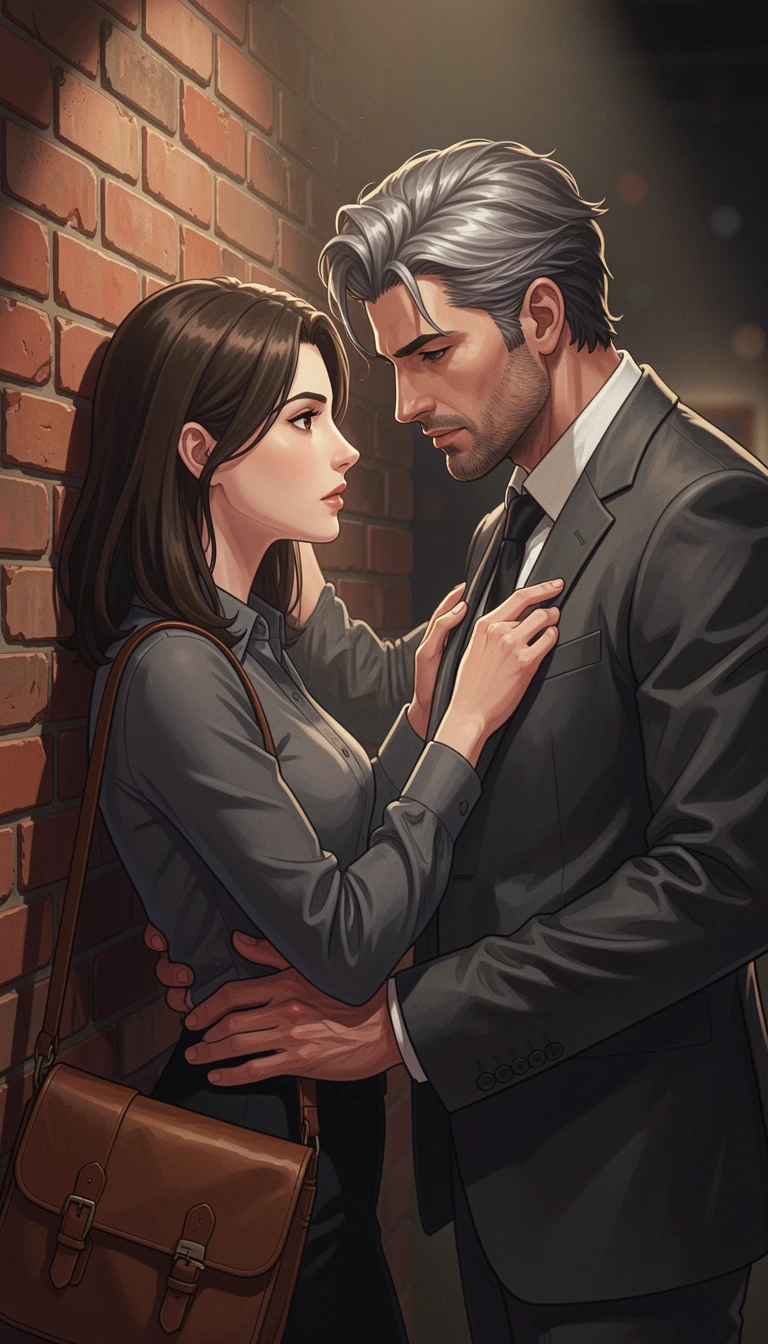
Her fingers found the marble again—cool, smooth, a fixed point in a room that kept tilting. Adrian shifted his weight. Half a step. Not enough to touch her, but enough that the air between them changed density. She felt the heat off his jacket, a trace of something clean and cedar-warm that she refused to name because naming it would mean noticing it, and noticing it would mean she had already started trusting him.
The halogen hum filled the silence. A steady electrical pulse, the building's lungs breathing for both of them. The weight of his offer sat in her chest like a stone she couldn't swallow past.
"You said you'd help me find the truth." Her voice came out lower than she'd meant, rougher at the edges. "Where do we start?"
He held her gaze. His breath moved in that steady rhythm she could almost feel—a metronome set to patience. His hands stayed at his sides. Open. Empty. Offering nothing but the space she stood in, as if that was the only starting point he believed in.
"With what you're afraid to ask."
The marble warmed under her fingertips. She pressed harder, grounding herself against the impulse to say I'm not afraid of anything—which would be the fastest way to prove him right. He watched her choose her words. Didn't rush her. Didn't fill the silence with reassurance or explanation. Just stood in it with her, letting the halogen hum and the distant clink of a glass somewhere across the gallery mark time.
"I'm not afraid of the questions," she said finally. "I've been asking hard questions for seven years. I know how they land." She paused. Let her hand drop from the marble. "I'm afraid of what happens when I stop asking."
Something shifted in his eyes. Not surprise—he'd known that before she said it—but recognition. Like he'd been holding that same silence somewhere in his chest for years and had forgotten anyone else might recognize its shape.
"You want to know if your investigation will find a story worth chasing," he said, his voice dropping to something almost raw. "Or if it will find something that burns what's left of your belief in people." He held her gaze and did not look away. "I can't promise which one you'll find. But I can promise I won't hide the evidence."
The halogen flickered. A door closed somewhere deeper in the gallery, the sound swallowed by silk and plaster. Clara counted the seconds in the gap between his words and her response. Four. Five. Enough time for the air to thicken and the choice to settle into something irreversible.
"Show me the books," she said. "The acquisition records. The correspondence with your patrons. Everything people say you're hiding." Her voice steadied as the shape of the work returned to her. "And show me the logs for your private viewing rooms."
He smiled. Barely. A flicker at the corner of his mouth that was gone before she could tell if she'd imagined it. "The private viewing rooms," he repeated, tasting the words. "You've been reading up on proper gallery protocol."
"I've been doing my job."
"Then follow me." He turned—not abruptly, but with the unhurried certainty of a man who knew exactly what he was leading her toward. His steps echoed once, twice, across the marble before he paused at the archway. "The records room is downstairs. But I should warn you." He looked back over his shoulder. "The evidence is either everything I've ever touched or nothing at all. I haven't decided which would be worse."
She held his gaze. The marble under her fingertips had cooled again, the warmth of her touch already fading from the stone. His words hung in the air between them—everything I've ever touched or nothing at all—and she felt the weight of both possibilities pressing against her ribs like a second heartbeat.
He didn't look away. Didn't fill the silence with a joke or a deflection. Just stood at the archway, one hand resting against the frame, his body angled toward the stairs like he'd already made his choice and was waiting for her to make hers.
The halogen hum pressed against her eardrums. Somewhere behind her, a woman laughed—bright and careless—and the sound felt like it belonged to a different world entirely. One where people looked at art without reading seven layers of meaning into every brushstroke.
Clara let her hand fall from the marble. The absence of its cool surface against her fingertips felt like letting go of something she hadn't realized she was holding. She took a step. Then another. Her boots clicked against the polished floor, the sound sharp and final in the gallery's hush.
She stopped two feet from him. Close enough to see the pulse in his throat—steady, unhurried—and the faint lines at the corners of his eyes that deepened when he watched her approach.
"Everything you've ever touched," she repeated. Not a question. A test of the shape of his words in her mouth. "That's a lot of paper."
"It is." His voice came low, almost warm. "But I suspect you've read worse."
She felt the corner of her mouth twitch—not quite a smile, but the beginning of one, caught before it could commit. He noticed. Of course he noticed. His eyes tracked the movement like he was cataloging it for later, filing it away in the same mental archive where he'd stored the thirty-seven minutes of her behavior in his gallery.
"Lead the way," she said. "But if I find a single forged provenance document, I'm writing about the view from your office window first. It's got good light."
His smile surfaced—brief, genuine, cracking the composure for just a second before it settled back into place. "I'd expect nothing less."
He turned and descended the stairs. She followed, one hand trailing along the cold iron railing, counting the steps. Ten. Eleven. Twelve. The air changed as they went lower—cooler, stiller, carrying the faint chemical tang of solvent and aged paper. The records room was a basement, she realized. A basement full of everything he'd ever touched.
At the bottom, he paused with his hand on a steel door. The lock glinted under the single bulb. "Once we're inside," he said, not looking back, "you'll see things that won't make sense without context. Ask me anything. I'll answer or I won't, but I won't lie." He turned the key. The lock clicked open. "Ready?"
She held his gaze for a single breath—long enough to feel the weight of the choice settle in her chest like a stone dropped into still water. Then she stepped past him. Her shoulder brushed the edge of the steel doorframe, the cold metal biting through her blouse, and she was inside.
The room exhaled around her. Cooler than the stairwell, the air thick with the ghost of old paper and the chemical tang of archival solvents. A single fluorescent strip hummed overhead, casting the space in a flat, unforgiving light that left no shadows to hide in. Filing cabinets lined the far wall—four of them, gray metal, each drawer labeled in a precise hand she couldn't read from here. A wooden desk sat at the center, bare except for a banker's lamp and a leather-bound ledger.
The door clicked shut behind her. She didn't turn. Her reflection swam in the glass of a framed photograph on the desk—a woman, younger, laughing, her arm around shoulders she didn't recognize. Clara's own face stared back, sharp and wary, a stranger in someone else's history.
Behind her, Adrian's footsteps were quiet on the concrete floor. He didn't speak. Didn't fill the space with reassurance or instruction. Just stood, letting the silence settle around them like dust in a room that hadn't been opened in years.
Clara let her hand drop to the edge of the desk. The wood was smooth, worn at the corners—a surface that had held every version of whatever he'd been building here. "Everything you've ever touched," she said, her voice low, almost to herself. "That's a lot of paper."
She heard him shift his weight. Heard the soft creak of leather as he moved closer. "The ledgers are in the second cabinet. Acquisition records, correspondence, provenance documents. The private viewing logs are in the desk drawer on your left."
She didn't reach for the drawer. Instead, she turned to face him. He stood two feet away, his hands at his sides, his face unreadable in the harsh light. But his eyes—his eyes were not calm. They were waiting. Open. As if he'd laid himself bare and was watching to see if she'd use that vulnerability as a weapon or a bridge.
"You said you wouldn't lie." Her voice came out steady, but she felt the tremor in her chest—a thin wire vibrating under the pressure of what she was about to find. "That means you've already decided what you're willing to show me. And what you're not."
He didn't blink. "I've decided what I'm willing to let you find. That's not the same thing."
She turned back to the desk. Her fingers found the drawer handle—cold brass, worn smooth by years of use. She pulled. The drawer slid open without resistance. Inside, a single manila folder, thick with paper. No label. No date. Just the weight of something deliberately left in plain sight.
Her thumb found the edge of the cover. The cardboard was warm—had been warm, she realized, sitting in the dark of the drawer while the gallery hummed above it. She pressed down. The cover resisted for a fraction of a second before lifting, the paper inside shifting with a dry rustle that filled the space between her and the sound of Adrian's breathing.
The first page was a photograph. A man she didn't recognize, mid-fifties, standing in front of a painting she did recognize—a Rothko, the deep burgundy and black one that had sold at Sotheby's for eleven million. The man's hand rested on the frame like a claim. Behind him, half-obscured by his shoulder, a woman in a pearl necklace watched the camera with the careful neutrality of someone accustomed to being photographed in rooms where things were decided.
Her breath stopped. Not at the image—at the date stamped in the corner. Eighteen months before the Rothko had been publicly acquired by a museum in Zurich. Before it had been donated. Before the tax write-off had been filed and the provenance had been rewritten to erase the private transaction that had actually moved the painting.
She didn't lift the photograph. Her finger traced the edge of it, feeling the weight of what sat beneath—a stack of paper thick enough to hold a dozen more images, a dozen more dates, a dozen more handshakes between men who didn't want their names in the same sentence. The air in the room pressed against her skin. Cool and still and heavy with the ghost of decisions she hadn't made yet.
Behind her, Adrian had not moved. She could feel his stillness the way she felt the hum of the fluorescent light—constant, present, waiting to break if she reached toward it. His breath was a near-silent rhythm she shouldn't have been able to hear but did, because silence in a room like this was not empty. It was full of everything he hadn't said.
"This is the first page," she said. Her voice came out flat. Not a question.
"Yes."
She let the cover fall. Not slammed—just released, the cardboard settling back against the stack with a soft thud that felt louder than anything she'd said since entering the room. The photograph disappeared beneath it. The date. The woman's careful neutrality. The Rothko that had traveled through hands that didn't want to hold it.
She turned. Adrian stood exactly where he'd been, his hands still at his sides, his face still unreadable. But his eyes—his eyes had changed. The openness from earlier had sharpened into something watchful. Not defensive. Waiting. As if he'd handed her a loaded gun and was giving her space to decide whether to point it at him or set it down.
"You left this in the drawer," she said. "You knew I'd find it first."
"I knew you'd open the drawer." His voice came low, almost gentle. "I didn't know what you'd do when you saw what was inside."
Her hand found the edge of the desk and held. The wood grain pressed into her palm—a ridge, a valley, the worn smooth patch where years of someone's forearm had rested. She felt the shape of it like a confession. Touch. Repetition. The body leaving its mark on surfaces that didn't forget.
"You want me to look," she said. "But you want me to choose to look."
He didn't answer. Didn't need to. The silence between them was the answer—patient, terrifying, holding space for whatever she decided next.
She pressed the folder flat. Both hands on the cardboard, palms spread, feeling the weight of what sat beneath like a pulse she could measure through the surface. The photograph was still there. The Rothko. The date. The woman with the careful neutrality. All of it waiting beneath her hands like a held breath.
"I'm asking," she said. Her voice came out steadier than she'd expected—low, deliberate, the voice she used when she was about to extract a confession from someone who thought they'd prepared for every question. "You left this here because you wanted me to find it. Fine. I found it. Now tell me what you want in return."
His silence stretched. She felt it the way she felt the hum of the fluorescent light—constant, vibrating just beneath the surface of the room, waiting to resolve into something she could hold. When he spoke, his voice was quiet. Almost careful.
"One month."
She didn't turn. Her hands stayed flat on the folder, her fingers spread, feeling the cardboard warm beneath her palms. "One month of what?"
"Access. Full access. Every record in this room, every transaction I've ever touched, every name I've ever done business with." His footsteps were slow, deliberate, crossing the concrete floor until she felt him stop a foot behind her—close enough that the air between them seemed to thicken. "But you don't publish anything until you come to me first. You don't write a single word without telling me what you've found."
She let out a breath she hadn't realized she'd been holding. "That's not how journalism works, Adrian."
"I know." His voice dropped lower, rougher at the edges. "I'm not asking you to be less of a journalist. I'm asking you to be enough of a person to look me in the eye before you decide what I am."
The words hit like a hand pressed flat against her chest—not hard, but firm, stopping the momentum she'd been carrying since she stepped through the gallery doors. She turned. He stood closer than she'd expected, close enough that she could see the pulse beating at the base of his throat, could smell the wool of his jacket and something underneath—cedar, maybe, or the ghost of coffee from earlier.
"And if I agree?" Her voice had gone quiet. She didn't know when that had happened.
"Then you open that folder. You read every page. And you decide what kind of story you want to write." His eyes held hers, steady, dark, carrying something that looked almost like hope but wasn't quite—hope was too soft for the weight pressing between them. "But not alone. Not without knowing the context behind every image."
Her hands were still on the folder. She could feel the shape of his terms pressing against her palms, waiting for her to decide whether to close her fingers around them or let go.