
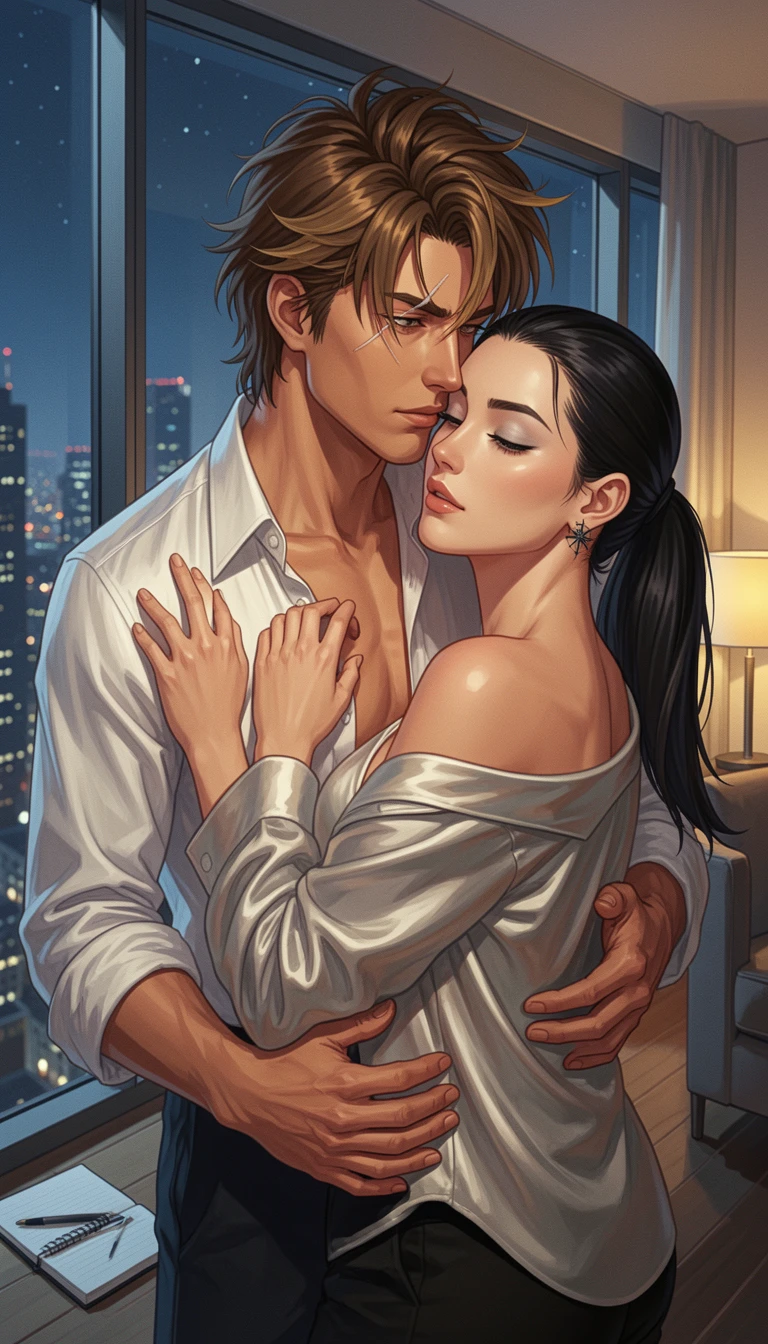
The folded photograph pressed against her collarbone, a hard rectangle she'd learned the exact shape of in the twenty minutes since she'd torn it from the folder. Her thumb found the edge through her jacket fabric—the crease she'd made herself, folding him smaller and smaller until he fit inside her pocket like a secret she hadn't decided whether to keep.
The parking lot light cut diagonally across her lap, a sharp wedge of fluorescence that caught every mote of dust floating through her stopped car. She watched them drift. Watched the dashboard clock tick from 10:47 to 10:48. Watched her own breath fog the windshield in slow, deliberate clouds.
She didn't start the engine.
Her thumb pressed down until the paper's edge bit through the lining of her jacket. A small pain. Sharp. Cleaner than the hollow in Mason Vale's eyes, which she'd been trying to unsee for—she checked the clock again—forty-two straight minutes of sitting in a dark car in an empty lot.
The hollow was the third thing she'd noticed about the photograph, after the scar through his left eyebrow and the way his hands were still even when the rest of him wasn't supposed to be. The first two were details. Easy to note, easy to file. The hollow was the kind of thing that lived under your skin once you'd seen it, and she'd folded it into her pocket anyway.
She pulled the photograph out. The parking lot light caught the glossy surface and she tilted it until the overexposed face of Mason Vale—unsmiling, unposed, caught in a moment no one had been meant to see—resolved into something she could look at without flinching.
The scar was thin and white, a clean line through the chaos of his left eyebrow. Someone had done a good job stitching it, or he'd healed well. Either way, it was the kind of mark that told a story she wasn't supposed to know yet. The rest of his face was young, famous, curated by algorithm and lighting. But the scar was real in a way nothing else in the folder had been.
She folded the photograph again, smaller this time, until the creases crossed like a grid and Mason Vale's face was a collection of white edges. Then she tucked it back into her jacket.
The dashboard was still dusty. The parking lot light was still slicing across her lap. She still hadn't started the engine, and the hollow in his eyes was still a question she couldn't answer—but she had forty-seven hours until the Riverview Gallery event, and she was starting to think she might spend every minute of them trying.
She reached for the folder before she'd decided to move, her hand finding the passenger seat's edge and dragging the manila rectangle across the console. The remaining pages slid out in a loose fan, and the folded photograph—the one she'd already memorized—dropped into the cradle of her thighs like a stone she'd been carrying all night.
She smoothed the photograph against her jeans, the creases softened by her earlier handling. The scar through his eyebrow caught the parking lot light—a thin white line that bisected the chaos of his left brow, and she found herself tracing it with her fingertip, not touching the surface, just following the path of it in the air above the glossy paper. The hollow in his eyes was still there, and she let herself sit with it a beat longer before she folded him away again, this time into the folder itself.
The pages were arranged in chronological order. Tomorrow night's Riverview Gallery reception led the stack: black tie, 7 PM, a brief statement by Vale followed by a Q&A with literacy advocates. A page of talking points—"authenticity," "impact," "next generation"—neatly bullet-pointed in a font that matched the foundation's letterhead. She skimmed them, but her attention snagged on a handwritten note in the margin: "Resist the script. Ask him about the library collapse."
She turned the page. The library collapse. She hadn't heard that story. Diane's handwriting—she recognized the sharp, impatient slant of it—scrawled beneath: "Westbrook branch, three years ago. He gave the donation anonymously. The press never found him. See if he'll tell you why." Eva's thumb rested on the sentence, and she let the weight of it settle. An anonymous donation. A scar. A hollow behind the performance. The shape of something true was starting to form, but it was still too soft to hold.
The rest of the folder held the expected: a media bio that highlighted his charity work and his rise to prominence, a list of past collaborations with children's organizations, a schedule of appearances for the next two weeks. She flipped past it all, the paper whispering against her fingers, until she reached the last page—a printout of a news article from three years ago, timestamped and clipped. The headline read "Mystery Donor Rebuilds Library After Collapse; No Name Given."
She read the first paragraph twice. A section of the Westbrook branch had collapsed during an after-school program—twelve children treated for minor injuries, no fatalities. The donor had covered the full cost of reconstruction and refused to be credited. The article ended with a quote from a library director: "Whoever they are, they didn't want a plaque. They just wanted the kids to have a place to read." Eva set the page down, her throat tight in a way she couldn't explain.
She picked up the photograph again, unfolding it with more care this time. The Mason Vale in this image wasn't the one who smiled for cameras. This was the man who rebuilt a library and walked away. The scar, the hollow—they weren't cracks in a persona. They were evidence of something else. Something she didn't yet have words for.
She started the engine before she could second-guess the motion. The dashboard lit up, the parking lot light dimming as the headlights caught the concrete ahead. The folder sat on the passenger seat, slightly splayed, the photograph tucked face-down on top. She put the car in drive, but her foot stayed on the brake, the engine idling into the silence.
Forty-seven hours until she'd be standing in a gallery full of strangers, shaking the hand of a man who kept his truths in shadows and his scars on display. She let her foot off the brake, and the car rolled forward into the empty lot.
The brake lights flared red against the chain-link fence at the lot's edge, and Eva's hand found her phone before she'd consciously decided to reach for it. The engine idled beneath her, a low vibration through the steering wheel, as she pulled up the article she'd already read twice in the folder—but that was the folder's version, clipped and printed and slightly yellowed at the edges, stripped of the comments and the share count and the metadata that told you how a story had actually landed.
She found it on the third search attempt. "Westbrook branch collapse, mystery donor, June 14." Her thumb hovered over the link, and she watched the loading spinner turn once, twice, three times before the page resolved into the same headline, the same byline, the same opening paragraph she'd already memorized. But this time the comments section loaded below it, a hundred and forty-seven voices she hadn't known existed until now.
She didn't scroll. Not yet. Her thumb stayed at the article's final paragraph, the one the folder had ended on—the library director's quote about the plaque no one wanted. She read it once, and the words settled the same way they had in the parking lot: Whoever they are, they didn't want a plaque. They just wanted the kids to have a place to read. She read it again, and this time she heard something else underneath it—a shape she couldn't quite name, a silence where a name should have been.
Her thumb moved before she'd decided to let it, scrolling down to the comments. The first few were routine: praise for the donor, anger at the building inspector, a debate about public school funding that had spiraled into something ugly by the third reply. But halfway down, a username she didn't recognize had posted: my kid was in that program. whoever paid for it, they came by the hospital. didn't give a name. just sat with the parents until everyone was accounted for. The comment was three years old, with a handful of likes and no replies.
Eva's chest tightened. She read it three times, and each time the unnamed figure in the hospital waiting room resolved a little clearer in her mind—a man with a scar through his eyebrow and a hollow in his eyes, sitting in a plastic chair at 2 AM, saying nothing, staying until the last parent had heard their child was safe. She didn't know if it was Mason Vale. She had no proof, no confirmation, no source willing to go on the record. But the shape of it fit the photograph in her pocket, and the fit was tight enough to hurt.
She locked the phone and set it in her lap, the screen darkening to black. The parking lot fence was still red in her taillights, and the car was still idling, and she was still sitting at the edge of a decision she hadn't yet named. The article was open in her browser. The comment was burned into her memory. And the hollow in Mason Vale's eyes—the one she'd been trying to unsee for an hour now—had just acquired a story she wasn't sure she was ready to hear him tell.
She didn't start the engine again. Didn't shift into drive. Her hand rested on the gearshift, fingers loose around the plastic, and she let herself sit in the quiet of the stopped car and the empty lot and the knowledge that forty-seven hours was too long and not nearly enough time to prepare for the version of Mason Vale who sat in hospital waiting rooms and rebuilt libraries in secret. She didn't know which Mason she'd find at the Riverview Gallery. But she knew, with a certainty that sat cold in her stomach, that the one in the photograph was real.
The phone buzzed in her lap. A text from Diane: You read the article yet?
Eva stared at it. The message had been sent three minutes ago—long enough for Diane to know she'd stopped, long enough for the editor to guess exactly where her reporter was. She typed a reply, deleted it, typed another, and set the phone face-down on the passenger seat without sending anything. The question Diane was really asking wasn't about the article. It was about what Eva planned to do with what she'd found. And she didn't have an answer yet—only the image of a man in a hospital waiting room, the scar through his eyebrow catching the fluorescent light, his hands still in a way that said he'd learned stillness through something harder than discipline.