
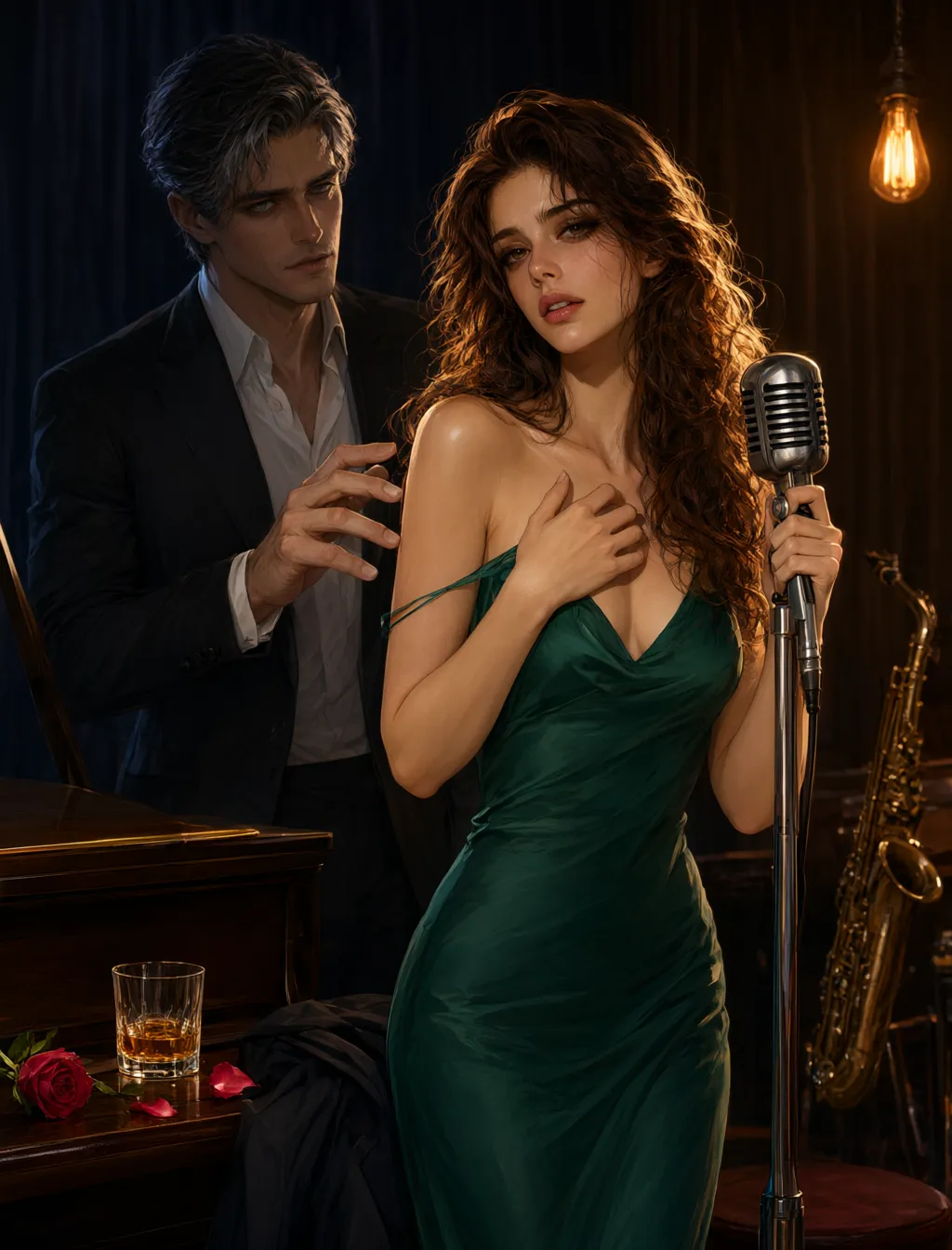
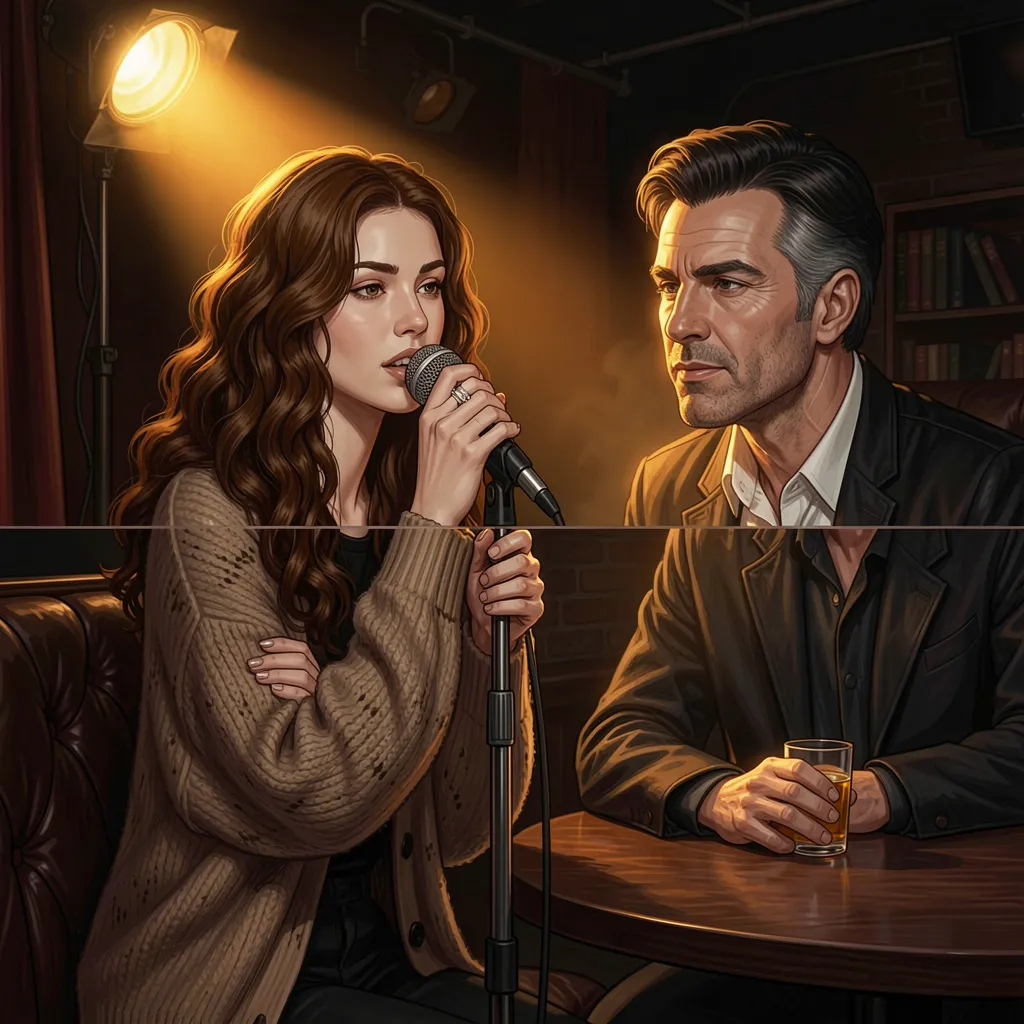
The stage lights hadn't been adjusted yet. One of them caught her directly in the face, a hot amber burn that made the empty room beyond it vanish into darkness. She could hear him, though. The soft clink of his glass against the table. The creak of leather as he shifted in the booth.
Lena wrapped her fingers around the mic stand. The metal was warm from her grip already, and she hadn't sung a note. Her other hand found the curve of her cardigan sleeve, thumb rubbing the worn wool the way she used to rub the engagement ring she no longer wore.
"Whenever you're ready." His voice came from somewhere in the dark—low, unhurried. A voice that didn't need volume to fill a room.
She closed her eyes. Not from nerves. From habit. The first note came out rough, a little too breathy, and she felt her shoulders tighten. Then the second note found its footing. And the third one opened something in her chest that had been closed for months.
The song was "Cry Me a River." She'd sung it a hundred times in a hundred empty rooms. But tonight the lyrics landed differently. Now you say you're sorry. Her voice climbed into the high, aching place where the hurt lived, and she let it stay there. Didn't pretty it up. Didn't pull back.
When she opened her eyes, the stage light had shifted just enough that she could see him. Julian Cross sat in the corner booth, one arm stretched along the back of the seat. His jacket was off. White shirt, sleeves rolled to the forearm. The whiskey glass had stopped moving.
She finished the verse. Let the last note hang in the stale air until it dissolved into nothing. Her hand was trembling on the mic stand, and she made herself let go. Pressed her palms flat against her thighs.
He didn't clap. Didn't speak. Just held her gaze across the empty room, those pale gray eyes patient and unreadable. A clock ticked somewhere behind the bar. The ice in his glass shifted.
Then he tilted his head—a small, deliberate gesture toward the bar. "Start Friday." His voice carried the same weight it had before. Measured. Certain. "Come early. I'll have a key at the door."
Lena's throat tightened. She'd expected questions. A second song. Some kind of negotiation. Not this—this quiet finality, like he'd made up his mind before she'd opened her mouth.
She nodded. Her voice came out steadier than she felt. "What time?"
He still hadn't moved. The glass sat untouched now, a thumbprint smudged on the rim. "Seven."
She stepped off the stage, and her heel caught the edge of the riser. She stumbled—barely, just a half-second loss of balance—and when she looked up, he was already standing. Not moving toward her. Just standing, like he'd been about to. Like he'd known she'd need it.
She caught herself against the back of a chair, knuckles white on the upholstery. The stumble had been nothing—a half-inch miscalculation in heels she'd worn a hundred times. But her pulse was suddenly in her throat, and the space between her shoulder blades prickled with the awareness of him standing. Not moving toward her. Just standing.
Lena straightened. Smoothed her cardigan. Turned.
Julian hadn't moved from his booth. Light from the stage caught the silver at his temples, the edge of his jaw. His hands were still at his sides—elegant, still hands that hadn't reached for her, even though his body had said I'm going to before his mind had caught up. She'd seen it. The half-second lift. The shift of weight. And then the decision to stay.
Her thumb found the inside of her wrist. The spot where his hand would have landed if he'd closed the distance. Where his fingers would have wrapped around her arm—steadying, warm, too familiar for a man she'd just met. She pressed into the skin, and the ache that bloomed there wasn't from the stumble.
"You always catch singers before they fall?" Her voice came out sharper than she intended. A deflection. She was good at those.
He didn't smile. Those gray eyes traveled from her face to her hand, still pressed against her wrist. "Only the ones who look like they'd hate it."
The truth of it landed somewhere low in her stomach. She dropped her hand. The spot on her wrist throbbed, phantom pressure where nothing had touched her.
He lifted his glass—the whiskey, the smudged thumbprint—and took a slow sip. His throat moved. When he set it down, the sound was soft and deliberate. "Friday. Seven." Not a question. Not a reminder. An opening.
Lena nodded. Her curls fell forward, and she let them hide her face for the half-second it took to collect herself. "I heard you the first time."
"Did you." It wasn't a question. His voice was low, a little rougher now, and she realized he'd been standing long enough that the leather of the booth had stopped creaking. He was waiting for something. An answer. A reaction. Her eyes on his.
She gave him the last one. Lifted her chin and met his gaze across the empty room, the amber lights catching dust motes between them. The air was cold and stale and suddenly too thin.
"Seven," she said. Her thumb found the spot on her wrist again—an unconscious gesture, a bruise that wasn't there. She made herself stop.
She pressed harder. Not the gentle rub of earlier—real pressure now, her thumbnail finding the tendon beneath the skin and digging in until the ache sharpened into something almost bright. She watched him watch her do it.
Julian's eyes dropped to her wrist. The movement was slow, deliberate, the way a man might watch a door open when he wasn't sure what would walk through. His jaw didn't tighten. His hands didn't move. But something shifted in the stillness of him—a tightening around the eyes, a fraction of attention that hadn't been there a moment before.
The air between them got heavy.
Lena held the pressure. Let the sting radiate up her forearm. Her pulse beat against her own thumb, and she knew he could see it—the flutter at the hollow of her wrist, the way her skin blanched white around the nail. She'd done this a thousand times in a thousand anxious moments, and no one had ever noticed. No one had ever looked.
"That hurt?" His voice came out lower than before. Rougher. The question wasn't kind.
"That's the point." She said it before she could think better of it, and the words hung in the cold air like smoke.
He didn't move. But his weight shifted—the smallest transfer from one foot to the other, the kind of adjustment a man made when staying still was suddenly costing him something. His hands stayed at his sides. Elegant hands. Still hands. The hands of a man who'd trained himself not to reach for things.
She should let go now. The game was played. He'd seen her—really seen her—and that was either a victory or a loss she couldn't calculate yet. But her thumb stayed where it was, and she realized she was waiting. Waiting for him to stop her.
"Lena." Her name in his mouth was a sentence. A warning. An invitation she didn't know how to read.
She dropped her hand. The blood rushed back into the spot, hot and immediate, and she had to lock her knees against the sudden vertigo of release. He'd said her name like he'd been saying it for years. Like it already belonged to him.
"Friday," she said. Her voice was steady. Her hands were not. "Seven."
Julian lifted his glass again—a slow, deliberate motion—and finished the whiskey in one swallow. His throat moved. When he set the glass down, the thumbprint was gone, smudged into nothing. "Come hungry," he said. "The kitchen makes a decent pasta."