
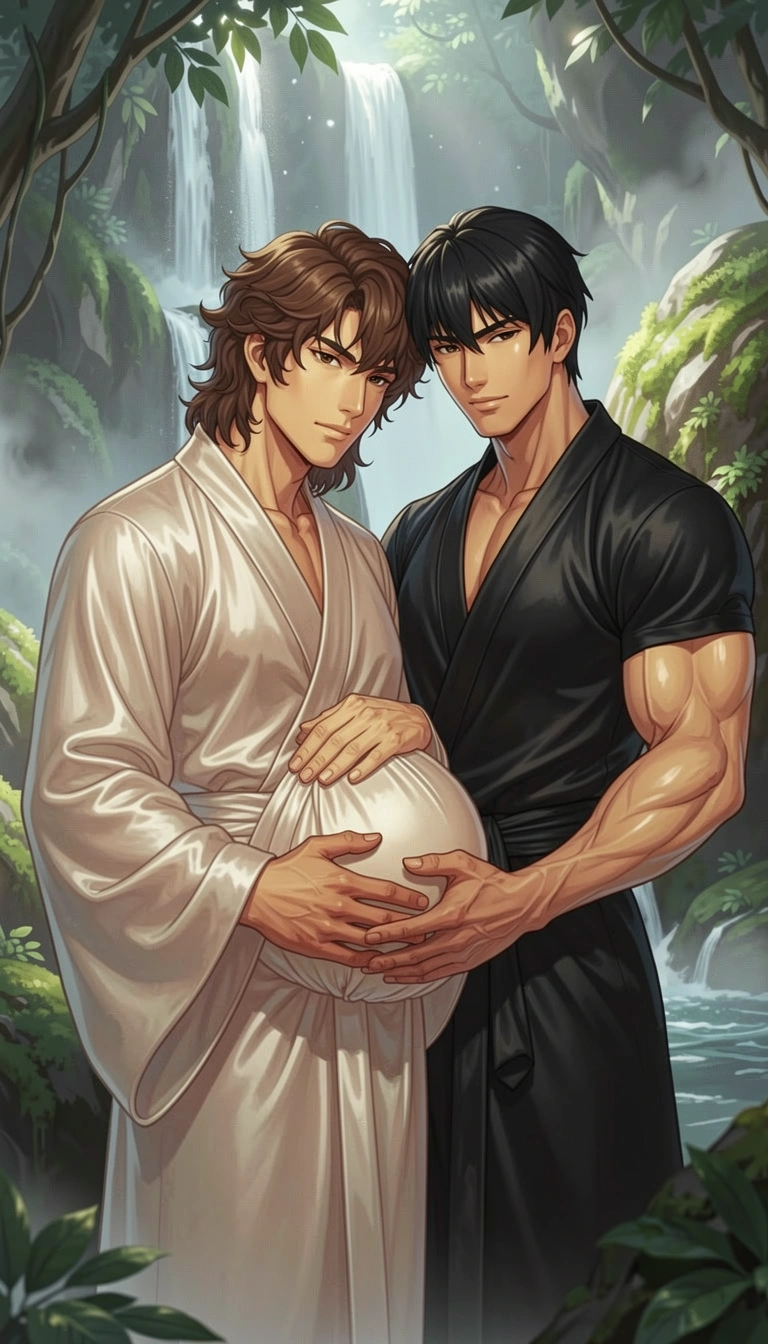
The cold had stopped being cold. That was the first thing—the way the water stopped announcing itself, stopped biting at his skin, until it was simply the temperature of the world and he was simply a part of it. Phuwin floated on his back, arms spread wide, hair fanned out around his head in dark tendrils that the current tugged at like impatient fingers, and he let the waterfall's roar fill him until there was no room left for anything else.
His belly rose above the surface, a warm island in the cold, the skin stretched tight and gleaming with spray. He kept one hand resting there, palm flat, feeling the slow roll of the child inside—not a kick yet, just a shift, a turning, a presence reminding him it was there. He had stopped counting how long he had been in the water. The sun had moved. That was all he knew. The sun had moved and his fingers had pruned and the cold had become him.
Behind his closed eyelids, the green dark of the pool's depths swam with memory.
It came without warning, the way grief always did—not a wave, but a tide that had been pulling at him all along, and he had only now stopped fighting it. The year of Terrence's birth. He could see it in the water behind his eyes: himself younger, belly lower and rounder, his hair longer then, falling in waves and curls past his shoulders the way Pond had loved it. He had worn it loose in those days, before the weight of the crown had made him pin it back, before the births had thinned it at the temples.
He remembered the bed. The birthing bed in the old chamber, the one with the carved headboard that Pond's father had commissioned, all those twisting vines and hidden faces. He had screamed into that wood. He remembered the grain of it pressing into his forehead, the slick sweat of his skin against the polish, the way his fingers had clawed at the carvings as the pain rolled through him in waves that never fully receded.
Pond's hands had gripped his. That was the clearest memory—not the pain, not the blood, but Pond's hands. The emperor's hands, the hands that had signed treaties and commanded armies, wrapped around his own and holding on like Phuwin was the only thing keeping him anchored to the earth. Pond had been young then, barely twenty, his face still carrying the softness of a boy who had not yet learned to hide his fear. He had been terrified. Phuwin remembered that, too. He remembered looking up through the sweat and the tears and seeing his husband's dark eyes wide and wet, and thinking, He's afraid. He's afraid and he's still here.
Five maids had crowded the room, their hands moving in constant motion—one pressing cool cloths to his forehead, one holding his legs, one fetching water, one whispering prayers to gods Phuwin had stopped believing in. The healer had been an old woman with hands like bird claws, and she had worked between his thighs with a calm that had infuriated him. How could anyone be calm when his body was tearing itself apart?
But Star had been there. Star had been there, younger then, her face unmarked by the scars she would later carry, her hand on his shoulder, her voice in his ear. Breathe, Phuwin. Breathe with me. In. Out. In. Out. He had breathed. He had breathed and screamed and bled and breathed again, and somewhere in the middle of it all, the healer had said, I see the head, and the room had changed, had sharpened, had become a single point of focus.
And then Terrence had been born.
Phuwin's eyes stayed closed, but his hand tightened on his belly, and the child inside him kicked—a small, sharp protest, as if it could feel the grief bleeding through his skin. He did not gasp. Not yet. He let the kick travel through him, let it anchor him to the present even as the memory pulled him under.
Terrence at five. He could see him so clearly—the boy with Pond's strong brows and his own gentle mouth, the boy who had laughed with his whole body, who had run through the palace halls with his sisters chasing behind him. Imaria had been six then, old enough to remember her brother, young enough to have loved him without reservation. Ovoale had been three, too young to understand, too young to do anything but cry when she saw her mother crying.
Terrence at five, fevered and weak. The healer had said it was a summer sickness, the kind that passed through villages and took the old and the young. Phuwin had sat by his son's bed for three days, refusing to eat, refusing to sleep, holding the small hand that had grown so hot it felt like a coal. He had watched the fever burn through his son's body, had watched the life drain out of him by inches, and he had prayed—prayed to every god he knew, prayed to gods he had never heard of, prayed to the waterfall itself, to the water that had always listened to him.
The water had not listened.
The morning he woke to find his son cold and still, the scream that tore through the palace had been his own, though he had not recognized it. He had not recognized the sound of his own voice breaking, had not recognized the animal noise that came out of his throat when he felt the stillness of that small chest, the absence of breath, the terrible finality of a body that would never move again.
Guards had come. They had carried the small body away, and Phuwin had let them. He had stood in the doorway of the nursery and watched them take his son, and he had not moved, had not spoken, had not done anything but stand there with his hands hanging empty at his sides.
Pond had found him there. He remembered that, too—the way Pond had run down the hall, the way his imperial robes had billowed behind him, the way he had stopped at the sight of Phuwin's face and known. He had not said anything. He had just crossed the distance and pulled Phuwin into his arms, and they had stood there together, holding each other, while the palace moved around them in the terrible hush of a house that had lost a child.
The baby inside him kicked again, harder this time, and Phuwin's breath caught. His eyes opened.
The waterfall roared above him, the spray misting over his face, and for a moment he did not know where he was—had to blink, had to orient himself, had to remember that he was not in that birthing bed, was not in that nursery, was not standing in that doorway watching his son be carried away. He was in the pool. The waterfall pool. The cold water was lapping at his shoulders, his hair was tangled around his head, and his belly was rising above the surface, heavy and full and alive.
He pressed his hand to the spot where the baby had kicked, feeling the small movement through his palm, and the tears that had been gathering in his eyes spilled over and ran down his cheeks. They were hot against the cold of his skin, and he let them fall, let them mix with the spray, let them become part of the water that surrounded him.
He thought of Ovoale's birth. He had not meant to. The memory rose unbidden, rising like the water around him, and he could not stop it. Twelve maids had crowded that room, not five. The birth had been harder, longer, a full day of labor that had left him screaming and cursing, his voice hoarse from the sound of it, his body wracked with pain that had come in waves and never fully receded. The healer had worked at him with her silver instruments, her face grim, her hands moving in ways that had made Phuwin's vision go white at the edges.
He had lost so much blood. That was what the healer had said afterward, her voice tight with a fear she had not been able to fully hide. He has lost so much blood. Phuwin remembered the way the sheets had looked, dark and slick, remembered the way the world had started to fade at the edges, remembered the way Star had gripped his hand so hard her nails had left crescents in his palm.
But Ovoale had been born. Ovoale had cried, a thin, reedy sound that had cut through the fog of his pain, and Phuwin had turned his head to see her—small and chubby, her face scrunched and red, her tiny fists waving in the air. He had watched as the healer cut the umbilical cord, had watched as the midwife wrapped her in cloth and brought her to him, and he had smiled. He had smiled despite the blood, despite the pain, despite the way his body was trying to give out beneath him. He had smiled because his daughter was here, because she was alive, because she was beautiful.
Her hair. Her small, chubby, cute face. Her beautiful lips. He had kissed her forehead and whispered her name, and she had opened her eyes—hazel, he would learn later, hazel like her father's had been before they had darkened—and looked at him, and he had known, in that moment, that he would die for her. That he would die for all of them.
He had almost died for her. The afterbirth fevers had come days later, had laid him low and kept him bedridden for months, had brought him so close to the edge that the healer had called for Pond in the middle of the night, had told the emperor to say his goodbyes. Phuwin remembered that, too—the look on Pond's face, the way his husband had gripped his hand and refused to let go, the way he had whispered, Don't leave me. Please don't leave me.
He had not left. He had fought, had clawed his way back from the edge, had opened his eyes to find Pond asleep in a chair beside his bed, his hand still wrapped around Phuwin's, his face gaunt with worry. He had watched his husband sleep and had thought, I cannot do this to him again.
But he was doing it again. He was lying in this cold water, pregnant with another child, while Pond lay in the healer's chamber with green rot eating through his hands and his lungs filling with poison, and Phuwin could not—he could not—
The baby kicked again, sharp and insistent, and this time Phuwin gasped. The sound was swallowed by the roar of the falls, lost in the spray, but he felt it in his chest, felt the way his breath caught and his body tensed. He pressed his hand to his belly, feeling the small foot or fist pressing back against his palm, and he thought, Not again. Please, not again.
The words were already forming on his lips, the prayer already rising in his throat, but the water was cold and the memory was heavy and he was not ready to surface. Not yet. He let his eyes close again, let the roar of the falls fill his ears, let the current tug at his hair and the spray mist over his face, and he floated there, suspended between the past and the present, between the children he had lost and the child he was carrying, between the man he loved and the death that was reaching for him.
The baby kicked once more, softer this time, and Phuwin's hand moved over his belly in a slow circle, soothing, promising. He did not know what he was promising. He did not know if he could keep it. But he kept his hand there, kept the warmth of his palm against the stretched skin, and he let the waterfall swallow the sound of his breathing.
The cold had stopped being cold again. The memory had stopped being memory. It was all just water now, all just the roar and the spray and the weight of his belly rising above the surface, and Phuwin floated in the middle of it, eyes closed, tears slipping into the current, waiting for the strength to surface.
Waiting for the strength to go back.
The baby turned inside him, a slow roll that pressed against his ribs, and Phuwin's breath hitched. His eyes snapped open. The green dark of the pool's depths swam beneath him, and above him the waterfall roared, and he was here, he was now, he was floating in the cold water with his pregnant belly rising above the surface and his wedding ring glinting on his finger.
He pressed his hand to his belly, feeling the child settle, feeling the small movements fade into stillness, and he whispered into the spray, the words barely audible beneath the roar of the falls:
"Not again. Please, not again."
The waterfall swallowed his prayer, took it into the churning green water and carried it away, and Phuwin floated there, alone in the cold, waiting for the strength to surface and go back to the man he loved.