
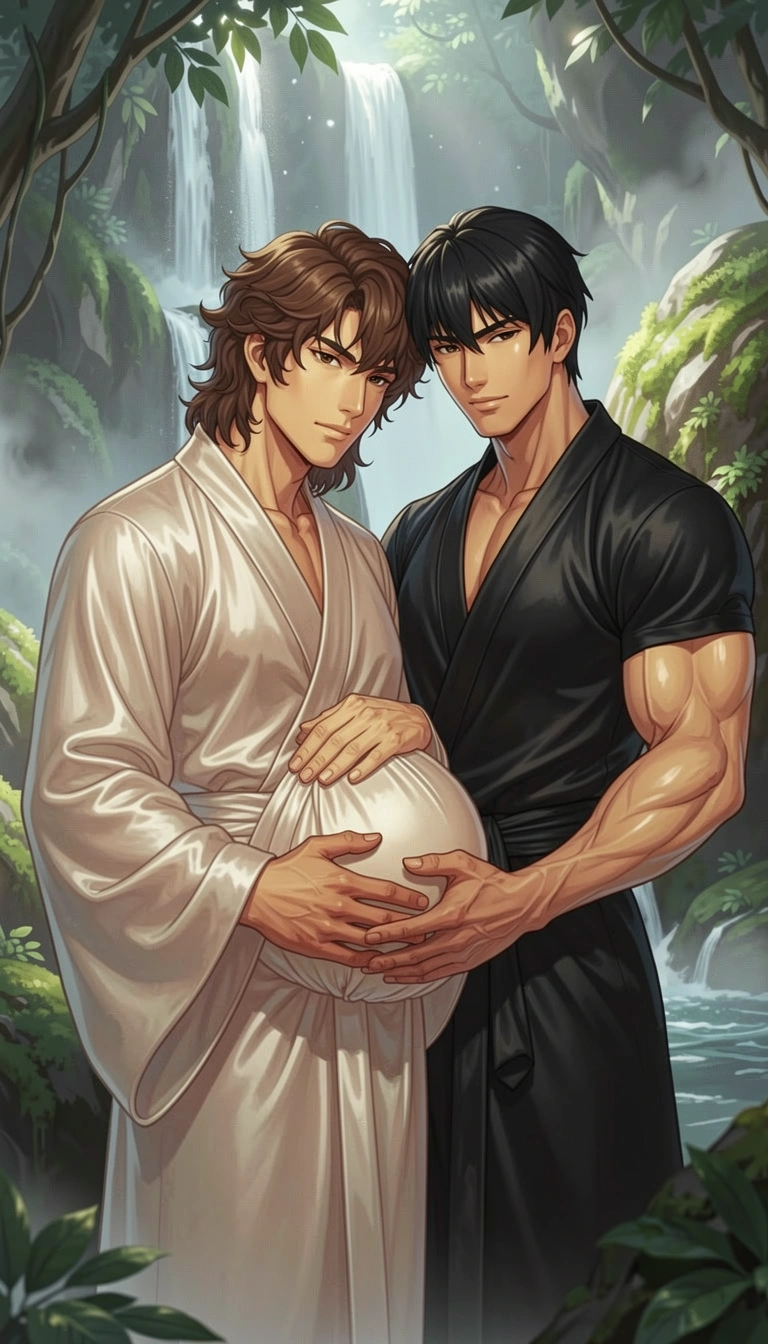
Phuwin's hands moved by memory now—the twins latched, one at each breast, their small mouths working with the urgency that six months of hunger had taught them. He sat at the long mahogany table, the candlelight catching the pale blue of his dress, the gold threads glinting like threads of hope he didn't quite feel. Lirien nursed quietly, her dark eyes fixed on Phuwin's face with that watchful stillness that made her seem older than his months. Kael, as always, made his demands known—a small fist pressing against Phuwin's chest, a sound halfway between a whimper and a command.
"He's got your temperament," Clove said from across the table, spearing a piece of roasted root vegetable with her fork. "Loud and certain."
Phuwin's mouth curved, barely. "He has his father's lungs."
The words landed in the room and hung there, and Phuwin felt the weight of them settle on the empty chair at the head of the table. Pond's chair. The wood was polished, the cushion undisturbed, the space before it set with a plate that no one would fill tonight. The servants had learned not to ask whether to clear it. They simply left it, a place setting for a ghost who was still breathing somewhere on a frozen mountain.
Imaria sat to Phuwin's right, cutting her meat into precise pieces, her scar a pale line in the lamplight. She ate with the economy of someone who had learned to make every motion count. Beside her, Xiana balanced on her crutches, one foot barely touching the floor, her braid—newly done by Phuwin's own hands that morning—swinging as she reached for bread.
"Xiana," Imaria said, not looking up. "Use your words."
"I want the honey one."
"Then ask."
"May I have the honey bread, please?"
Imaria passed the basket. Xiana took it with both hands, set it on her plate, and began to tear it into small pieces with a concentration that reminded Phuwin of Pond studying a treaty.
Aric banged his spoon against the tray of his highchair, a sound that cut through the quiet like a bell. "Mommy," he declared, pointing at Phuwin with a sticky finger. "Mommy, Mommy, Mommy."
"I'm right here, little one." Phuwin shifted the twins, adjusting his hold, feeling the familiar tug of nursing that had become the rhythm of his days. "I'm not going anywhere."
The words were for Aric. They were also for himself. He said them every morning now, to the children, to the mirror, to the empty chair at the head of the table. A promise and a prayer.
Lunara slept in her crib by the window, her tiny chest rising and falling beneath a blanket that Clove had knitted in the weeks before the birth. Phuwin's gaze drifted to her, then past her, to the chair that stood between the window and the wall. It had been Ovoale's chair—she'd always insisted on sitting there, claiming she could see the garden best, though everyone knew she simply liked to watch the servants cross the courtyard. The chair was empty now. The garden was empty too.
And beyond it, half-hidden in the shadows where the candlelight didn't reach, was the chair where Star had always perched when she joined them for meals. Not quite at the table, not quite apart from it. She'd always said she preferred the edges. Phuwin had never corrected her. He wished he had. He wished he'd pulled her into the center, made her sit at the table proper, told her she was family and not just the woman who held the edges together.
The twins finished nursing, and Phuwin shifted them to his shoulders, patting their backs with a practiced rhythm. Lirien burped quietly. Kael announced his satisfaction with a cry that made Aric laugh, a bright sound that startled the silence.
"He's loud," Xiana observed, watching Kael with the analytical stare she'd inherited from her father.
"He's Kael," Imaria said, and something in her voice was almost gentle.
Clove reached across the table and took Phuwin's hand. Her palm was warm, callused from work he'd never fully understood, and she squeezed once before letting go. "You should eat," she said. "You barely touched your plate."
"I'm not hungry."
"That's not what I asked."
Phuwin looked at her. Clove's face was open, direct, the same face she'd worn when she forced him to spit out the pill, the same face she'd worn when she caught him in her arms at the gate. She was not his sister by blood, but she had become something close. Something that held him when the world fell away.
He picked up his fork. He ate. The food tasted like ash, but he chewed and swallowed, because Clove was watching, and because the children needed to see him eat, and because somewhere on a mountain, Pond was climbing with nothing in his belly but fear and hope.
"He's going to come back," Imaria said, without being asked. Her voice was steady. "He promised."
Phuwin looked at his eldest daughter. The scar on her face had faded from angry red to pale pink, but it was still there, a reminder of the night she'd tried to reach her sisters and had been marked for it. She met his gaze and held it, and Phuwin saw something in her eyes that he recognized. It was the same thing he saw in the mirror every morning. A will to believe, held together by the thinnest thread.
"Yes," he said. "He promised."
The words were a rope thrown across a chasm. He gripped it with both hands.
Later, after the children were bathed and fed and settled, after Clove had carried Lunara to the nursery and Imaria had walked Xiana to her chamber, Phuwin stood in the doorway of his bedchamber and looked at the bed. The sheets had been changed. The pillows were fluffed. The room smelled of lavender and something faintly floral—the sachets the maids had placed in the drawers. But the scent that clung to his memory was different. It was the sharp, clean smell of Pond's skin, the way it mixed with the oil he used to keep his hair soft, the way it filled Phuwin's chest when he pressed his face against his husband's neck.
He crossed the room and sat on the edge of the bed. The mattress dipped under his weight. The silence pressed in around him, vast and patient, the way silence always was when you were waiting for something that might never come.
He changed into his nightgown—a soft, worn thing that Pond had bought him years ago, before the daughters, before the war, before the mountain. He ran his fingers over the fabric, remembering the way Pond had held it up in the market stall, a grin on his face that made him look younger than his thirty years. This one, he'd said. This one matches your eyes. The nightgown was pale green now, faded from washing, but the memory was still bright.
Phuwin lay down. He pulled the blanket to his chin. He stared at the ceiling, then at the window, where the moon hung full and silver in a sky scattered with stars. He put one hand on his stomach, feeling the small curve beneath his palm, the life that was growing there, the child that Pond didn't know about. The child that might never meet its father.
He pressed his other hand over his mouth. The tears came silently, the way they always did when he was afraid to let anyone hear. They slid down his cheeks, wetting the pillow, and he made no sound, because sound would mean admitting it, and admitting it would make it real.
Pond was on a mountain that had killed every man sent to it. He was climbing alone, with no one to catch him if he fell, no one to pull him back from a ledge, no one to tell him when to rest. And Phuwin was here, in this bed, in this palace, carrying his child, waiting for news that might never come.
The tears kept coming. He didn't try to stop them.
And then the memory rose, unbidden, the way memories do when the mind is too tired to fight them off.
He was on the road again, running after the horse. The ground was hard beneath his bare feet, the stones cutting into his soles, but he didn't feel it. He was still sore from the birth, still bleeding, still weak, but he ran anyway, holding up his skirts with one hand, screaming Pond's name until his throat was raw.
The horse was getting smaller. Pond's back was to him, broad and straight, and Phuwin saw him turn, saw the smile on his face—a smile that was supposed to be a promise, a smile that was supposed to mean I'll be back —and then the horse picked up speed, and the guards followed, and Pond disappeared down the road, and Phuwin was left standing in the dust, screaming his name into the wind.
His knees gave out. He dropped into the dirt, the skirts of his dress pooling around him, and he screamed, no, no, no, until his voice broke and the sound came out as nothing but air.
Clove was there. She was always there. She ran out of the cottage, her skirts hiked up, her face pale, and she caught him before he could fall forward, pulling him against her chest, holding him while he sobbed.
"It's okay," she said. "It's okay. He's coming back. He's coming back."
But Phuwin shook his head, because he knew, he knew, that some promises were made to be broken, and he was terrified that this was one of them.
The memory blurred, dissolved, and Phuwin was back in the bedchamber, the tears still wet on his face, the moon still silver in the sky. He was still crying. He had been crying for seven days, in pieces, in private, in the moments when no one was watching.
The door opened.
Phuwin didn't turn. He couldn't. He didn't want Clove to see his face like this, red and swollen and broken.
But Clove had seen him broken before. She had seen him at his worst, kneeling on the cold tile of her bathroom, a bottle of pills in his hand. She had seen him give birth, had caught his daughter with her own hands. There was nothing left to hide.
The bed dipped as she sat beside him. Her hand found his back, broad and warm, and she didn't say anything. She just sat there, her hand moving in slow circles, waiting.
"I have to sit here and wait," Phuwin said, his voice thick with tears. "I have to sit here and wait, knowing that he can die at any moment, and I'll get a call from the north—" his voice cracked, "—and they'll tell me he's dead. They'll tell me he fell, or he froze, or the mountain took him. And I'll have to tell the children. I'll have to tell Imaria that her father isn't coming back. I'll have to tell Aric, and he won't understand, and the twins will grow up never knowing—"
He couldn't finish. The sobs took him, shaking his shoulders, and he pressed his face into the pillow, the fabric wet beneath his cheek.
"I'm scared, Clove. I'm so scared."
Clove's hand stilled. Then she shifted, and her arms came around him, pulling him up, turning him toward her. He went, boneless with grief, and she held him against her chest, her chin resting on the top of his head.
"Stop," she said, her voice low and fierce. "Stop saying that. He's my brother. He won't leave and die. He knows that if he lets himself die, Ovoale and Star are going to die after him. He wouldn't do that to you. He wouldn't do that to them."
Phuwin shook his head against her chest. "You don't know that."
"I do." Clove's hand came up to cup the back of his head, her fingers threading through his hair. "I know my brother. I know that he spent his whole life trying to be worthy of the crown, and then you came along, and he spent his whole life trying to be worthy of you. He's not going to throw that away. He's not going to throw you away."
Phuwin sobbed. The sound was ugly, raw, torn from somewhere deep in his chest. Clove held him through it, rocking him slightly, the way she'd held Lunara when the baby wouldn't sleep.
"He's going to come back," she said. "He's going to come back with the root, and he's going to walk through that gate, and he's going to find you waiting for him. And you're going to tell him about the baby, and he's going to cry, because he's a soft fool who cries at everything, and then he's going to hold you so tight you can't breathe."
Phuwin laughed, a wet, broken sound. "He does cry at everything."
"He cried at the birth of every single one of those children," Clove said. "I was there for two of them. It was embarrassing."
The laugh turned into another sob, and Phuwin pressed his face into her shoulder, breathing in the smell of her—woodsmoke and soap, the scent of someone who had spent her life working with her hands.
"I don't know what I'd do without you," he whispered.
"You'd figure it out," Clove said. "You're stronger than you think."
She pulled back, just enough to reach for the cup of water on the bedside table. She pressed it into his hands, and he drank, the water cool and clean, washing away the salt of his tears.
"Drink it all," she said.
He did. Then she took the cup, set it aside, and lay down beside him on the bed, pulling the blanket over them both.
Phuwin turned toward her, his face finding her chest, his hand clutching at the fabric of her dress. His wedding ring pressed against his palm, the metal warm from his skin. He had been twisting it all night, turning it round and round his finger, as if the motion could somehow reach Pond across the miles, as if it could remind him of the promise they'd made to each other.
Clove's arm came around him, holding him close. Her hand found his hair again, stroking it slowly, the way she might soothe a frightened animal.
"Sleep," she said. "You need to sleep."
"I can't—"
"You can." Her voice was soft but certain. "I'm right here. I'm not going anywhere."
Phuwin closed his eyes. His heart was still racing, his mind still spinning with images of frozen cliffs and falling snow, but Clove's hand was steady on his hair, and her breath was warm against his forehead, and slowly, slowly, the tension began to drain from his body.
He didn't know when he fell asleep. He only knew that one moment he was staring at the moon through the window, and the next he was somewhere else—somewhere dark and quiet, where the only sound was Clove's breathing and the distant beat of his own heart.
Clove felt him go limp against her, felt the weight of him settle into sleep. She smiled, a small, sad thing, and pressed a kiss to the top of his head.
"He's going to come back to you, Phuwin," she whispered into the dark. "He will."
She closed her eyes, and held him, and let the silence carry them both into the night.