
The lamp had burned low, its flame a thin amber tongue licking at the darkness. Phuwin sat on the edge of the vast bed, the sheets tangled beneath his thighs, damp and cool now but still holding—if he pressed his palm flat and closed his eyes—the ghost of Pond's warmth. He had not changed them. He could not bring himself to let the maids strip the linen, to watch that last evidence of Pond's body lifted away and replaced with something crisp and clean and empty.
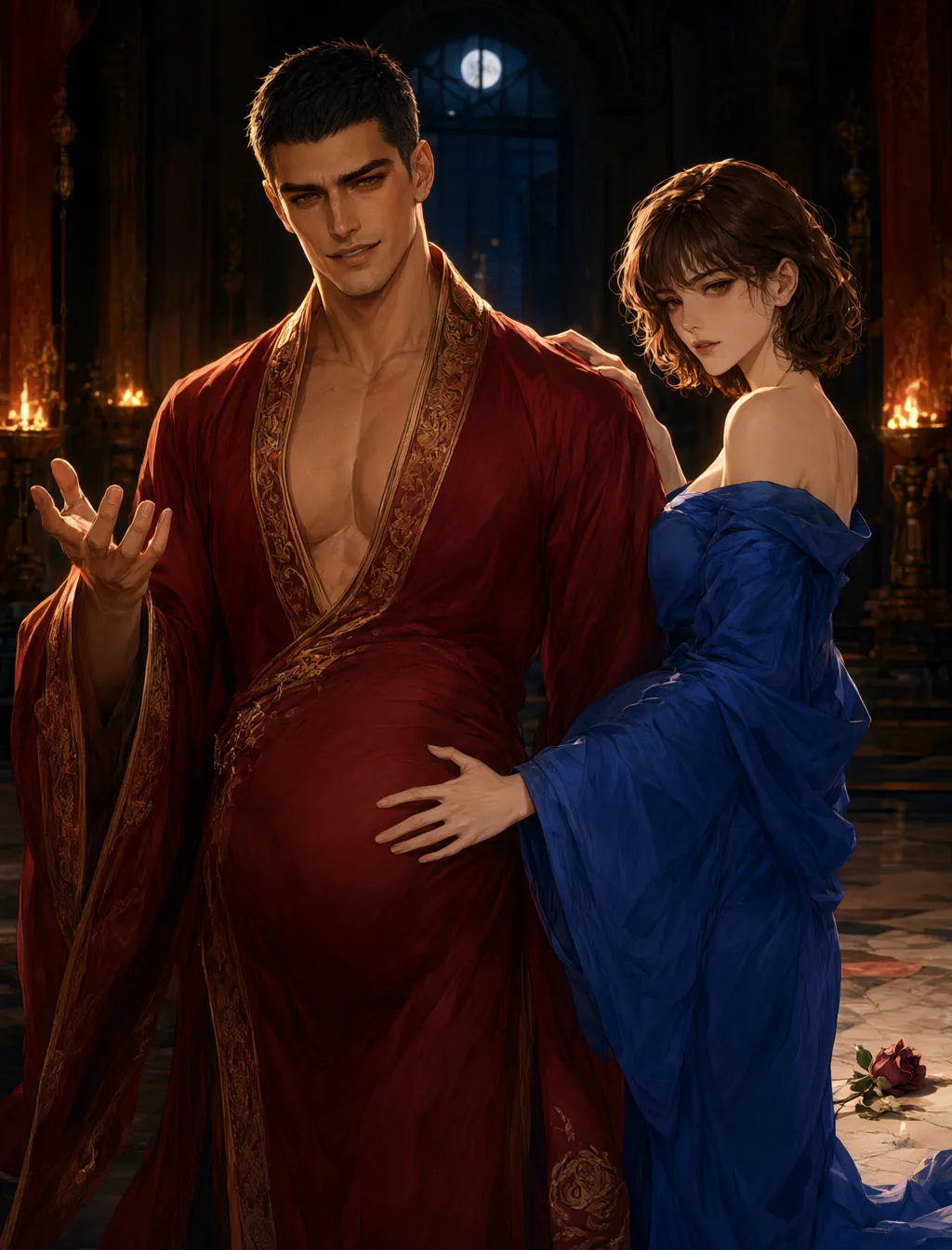
In his hands, the charcoal drawing. The glass was cool against his fingers, smudged in places where he had held it too long, too often, tracing the same lines until they blurred. Pond's arm around his waist, that strong jaw tilted toward him, the corner of his mouth lifted in a smile so rare it had made Phuwin's breath catch when the artist had unveiled it. And there he was beside him—younger, lighter, his hand resting on Pond's chest, his face open in a way it had not been in years.
He had been pregnant with Xiana in that drawing. He remembered the session—how the artist had fussed over the drape of his robes, how Pond had grown impatient with the stillness and pulled him close instead, murmuring something that made him laugh. The artist had caught that laugh. Had caught the way Phuwin leaned into Pond's side like a plant turning toward sun.
The tears came without warning. Silent, hot, unstoppable. They slipped down his cheeks and fell onto the glass, smearing the image of Pond's face until it swam and blurred. He did not wipe them away. He let them fall, let his shoulders shake with the effort of keeping quiet, because the children were asleep and he would not—could not—let them hear him break.
It had been a week. Seven days since Pond had ridden out at dawn, his hand slipping from Phuwin's grip, his horse's hooves scattering dew from the grass. Seven days of waking to the empty indentation in the mattress beside him. Seven days of moving through the palace as if it were a body with a missing heart.
He set the drawing down on the bedside table, face-up, the smeared glass catching the lamplight. His reflection stared back at him from the dark window glass beyond it—red-rimmed eyes, hollow cheeks, the nightgown slipping off one shoulder. He looked like a ghost wearing his own skin.
In the distance, muffled by stone and silk, a thin cry rose from the nursery. One of the twins—Kael, by the pitch of it, the sharper, more insistent voice. Phuwin's hands tightened on the edge of the mattress. He listened, breath held, until the cry was soothed into silence, swallowed by a wet nurse's murmured hushing or the press of a warm body against a small one.
They were six months old now. Six months since the twins' bloody arrival, since the healer's hands had been slick with red, since he had screamed until his voice gave out and then screamed in silence after. Lirien and Kael. One more daughter. Another Son. Two more faces that would grow into his own delicate bones, Pond's intense stare, the same long black hair that he would learn to braid in his sleep.
He had not held them enough. That was the thought that rose now, unbidden, as he sat on the damp sheets with Pond's scent fading around him. He had been so hollowed out by the birth, so emptied by the loss of Ovoale's bright voice and Star's steady presence, that he had let the wet nurses take them. Had let them be carried away to the nursery while he lay in bed and stared at the ceiling and tried to remember how to feel anything at all.
And then Lunara. His smallest, his desperate one, the child he had almost ended with a bottle of pills hidden in his cloak. When he looked at her face—so like Lirien's, so like his own—he saw the cliff he had stood on, the edge of the fall he had nearly taken. He had chosen her. In the end, he had chosen her, and the choosing had nearly destroyed him.
Phuwin let out a shaky breath and rose from the bed. His legs trembled beneath him, still weak from the week of lying down, of letting Clove bring him broth and bread and gentle scolding. He crossed the room slowly, one hand pressed to the small of his back, the other trailing along the silk curtains until he reached the door.
His hand found the latch. The wood was cool beneath his fingers, smooth from a decade of his touch. Beyond this door, the corridor. Beyond the corridor, the nursery, where his children slept—Imaria in her own chamber now, too old for the nursery but not too old to creep into his bed during storms; Xiana in the room beside her, healing from the stab wound that had nearly taken her from him; Aric in his crib, two-toothed and laughing; the twins in their shared cradle, Lirien and Kael, six months old and already so different—Lirien quiet and watchful, Kael loud and demanding.
And Lunara. His youngest daughter, asleep in the crib beside his bed, her tiny chest rising and falling with the rhythm of a life he had almost ended.
He should let them sleep. He should return to the bed, lie down in the hollow of Pond's absence, and wait for morning. The palace would need him tomorrow—the council would expect him to appear, to nod at their reports, to pretend he was not counting the days until his husband returned from a mountain that had killed every man sent to it.
His hand tightened on the latch.
He could not. The need rose in him like a tide, unstoppable and salt-bitter. He needed to see them. Needed to count their breaths, to press his lips to their foreheads, to hold them close enough that he could feel their hearts beating against his own. Because Pond was gone, and the mountain was cruel, and if the worst happened—if the root was not found, if Ovoale and Star never woke, if Pond did not come back—he needed to have held them. Needed to have memorized the weight of each small body in his arms.
He opened the door.
The corridor was dim, lit only by the distant glow of the nursery lamp. The stone was cold beneath his bare feet as he walked, his nightgown whispering around his ankles, his hand never leaving the curve of his belly. The baby shifted with each step, turning toward the sound of his heartbeat.
The nursery door stood ajar. A sliver of golden light spilled through the crack, and with it came the soft sound of breathing—many small breaths, rising and falling together like wind through grass. Phuwin pushed the door open slowly, careful not to let it creak, and stepped inside.
The lamp on the low table had been turned down to a warm glow. The wet nurse had gone, leaving only the children and, in the chair by the window, Clove, her head lolled against the cushion, her mouth slightly open, snoring a soft, rhythmic sound that Phuwin had come to find as familiar as his own heartbeat.
He crossed to the cradle first. The twins lay tangled together, as they always did, Lirien's dark head tucked beneath Kael's chin, Kael's small fist curled around a fistful of his sister's hair. Six months old. He had missed so much—their first smiles, their first coos, the way they reached for each other in their sleep. He had been hollow, and they had grown without him.
His thumb found Kael's hand, stroking the tiny fingers, the soft pad of each one. Kael stirred, made a small sound, and settled deeper into sleep. Beside her, Lirien's face was peaceful, her lashes dark crescents against her cheeks. So like Lunara. So like him. The same delicate bones, the same serious set to the mouth even in sleep.
"I'm sorry," he whispered, the words barely a breath. "I'm sorry I wasn't here."
He moved to Aric's crib. His son—his first son—lay on his back, arms flung wide, two teeth showing in a gummy smile even in sleep. Aric. The child the court had whispered about, the child who had been born while Phuwin lay feverish and grieving, the child who had learned to walk and talk in the weeks his mother was gone. He was growing so fast. Too fast. Soon he would be running through these halls, training with the men, asking his father questions about war and diplomacy, and Phuwin would blink and he would be a man.
Phuwin pressed a kiss to Aric's forehead, breathing in the warm, milky scent of him. "I'm here now," he whispered. "I'm not leaving again."
Lunara's crib stood beside the bed, and Phuwin lingered there longest. She was so small, so impossibly small, her chest rising and falling in quick, shallow breaths. He had almost ended her. He had stood in Clove's bathroom with a pill in his mouth, and he had almost swallowed it, almost chosen the emptiness over the hope. And now she was here, alive, breathing, and he could not imagine a world without her.
He lifted her from the crib, cradling her against his chest. She did not wake, only turned her face into the warmth of his nightgown, her tiny mouth seeking blindly. He carried her to the bed, the vast bed in the corner of the nursery where he sometimes lay with them all, and laid her in the center. Then he went back for the twins, lifting them one at a time—Kael first, who grumbled in her sleep but settled against him; then Lirien, who opened her eyes for a moment, looked at him with that ancient, knowing gaze, and closed them again.
He laid them beside Lunara, arranging them like flowers in a garden. Then he went for Aric, who was heavier than he remembered, solid and warm and real. He curled at the foot of the bed, his small body a comma against the blankets, and Phuwin pulled the coverlet over him.
He was about to leave, to return to his own empty chamber, when a sound stopped him. Footsteps in the corridor—light, quick, familiar. Imaria appeared in the doorway, her long black braid swinging, her amber eyes sharp in the lamplight. She was still in her training tunic, a sheathed dagger at her hip, and there was a smudge of dirt on her cheek.
"Mama?" she said, her voice soft with surprise. "I thought I heard someone walking."
Phuwin's throat tightened. "I couldn't sleep," he said. "I needed to see them."
Imaria crossed the room without hesitation, her boots silent on the stone. She stopped beside the bed, looking down at her siblings—the twins tangled together, Aric curled at the foot, Lunara's tiny chest rising and falling—and something in her face softened, the hard edges the past months had carved into her smoothing away.
"Can I stay?" she asked.
Phuwin opened his arms, and she stepped into them, letting him hold her the way he had when she was small, before the weight of the crown had settled on her shoulders. She was taller now, nearly his height, but she still fit against him like she had at five, at seven, at ten.
"Always," he said.
They lay down together on the bed, Imaria on one side, Phuwin in the center with Lunara against his chest. The baby stirred, seeking warmth, and Phuwin guided her to his breast, watching her nurse in the dim light. Imaria watched too, her hand resting on Kael's back, her thumb stroking the soft baby hair.
"She looks like you," Imaria said. "Lunara. She has your eyes."
Phuwin smiled, a fragile thing. "She has your father's stubbornness. She refuses to sleep anywhere but against me."
"That's not stubbornness. That's love."
The words hit him like a blow, soft and devastating. He blinked, and the tears came again, silent and hot, spilling down his cheeks onto Lunara's head. He did not try to stop them. Here, in the warm dark with his children around him, there was no one to perform for. No court, no council, no careful mask.
"Mama?" Imaria's voice was small now, the voice of the little girl she had been before the blood and the war and the weight of knowing. "Are you crying?"
"Yes," he said, because he could not lie to her. "But they're not sad tears."
"What are they?"
He looked down at Lunara, at the twins, at Aric curled at the foot of the bed. He thought of Xiana asleep in her chamber, her wound healing, her fierce heart intact. He thought of Ovoale, lying in a room down the hall, her body alive but her mind gone, waiting for a root that might never come. He thought of Pond, climbing a mountain that had killed every man sent to it, carrying Phuwin's hope in his chest like a flame against the wind.
"They're grateful tears," he said. "And afraid tears. And tired tears. All mixed together."
Imaria was quiet for a long moment. Then she reached out and took his hand, her fingers calloused from sword work, warm and strong.
"He'll come back," she said. "Father. He promised."
"I know." Phuwin squeezed her hand. "I'm just scared and waiting for him to come back so we can be a family."
Imaria's grip tightened. "We're already a family, Mama."
And that was the thing, wasn't it? The truth that broke him open even as it held him together. They were already a family. Fragmented, scarred, missing pieces—Ovoale's laughter, Star's steady presence, Pond's warmth beside him in the dark—but still a family. Still his. Still breathing, still here, still reaching for him in the night.
He looked at his children—Imaria's serious eyes, the twins' tangled limbs, Aric's two-toothed smile, Lunara's tiny hand curled against his chest—and the love rose in him so vast and so terrible that he thought he might drown in it.
"I love you all," he whispered, his voice breaking. "My babies. I'm just scared and waiting for your Father to come back so we can be a family again."
He said it again, softer, the words a prayer and a promise and a plea. And as the lamp burned low and the night deepened around them, his children slept on, their breaths rising and falling together, and Phuwin lay in the center of them, holding them all, waiting for the dawn.