
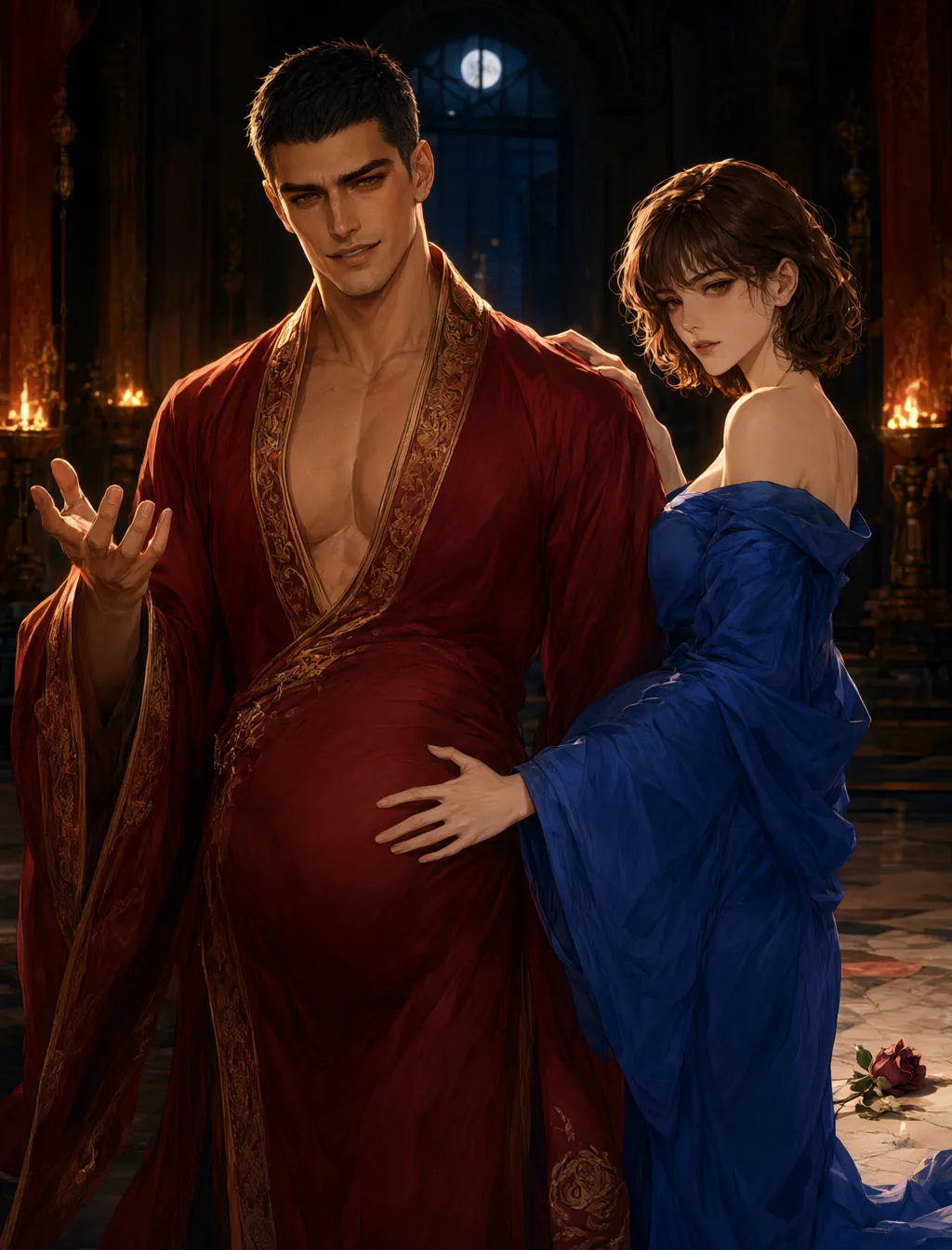
The fire had sunk to orange embers, their heat barely reaching the worn armchair where Clove sat, and the room smelled of stale smoke and the damp wool of his blanket. Ash dusted the stone hearth, and the only sound was the dry crackle of a collapsing log.
Pond's hand was still in Phuwin's when he spoke, voice rough and low, the words scraping out of him like they cost something to say. "I'll leave at dawn for the mountain."
The mountain. The northern root. The cliffs that had killed every man sent to retrieve it.
Phuwin's grip tightened around Pond's fingers, knuckles pressing hard against the bones of his hand. His other arm cradled Lunara against his chest, the newborn's weight warm and impossibly small, her head tucked into the curve of his neck. He could feel her breath against his skin, a soft puff of air, steady and alive, and he held onto that rhythm like it was the only thing keeping him upright.
The silence stretched between them, thick as the smoke that hung in the air. The fire popped, a spark landing on the hearthstone, and neither of them moved to brush it away.
Phuwin stared at the embers, at the way they glowed orange and then dimmed, and he felt the weight of the words he didn't want to say pressing against his teeth. He could feel them there, waiting. He swallowed them down once, twice, and then they came anyway, quieter than he meant them to.
"What if you don't come back?"
The question hung in the smoke between them, fragile and terrible. He watched it land on Pond's face, watched the way his jaw tightened, the way his eyes flickered with something that might have been fear, might have been resolve, might have been both. Phuwin didn't take it back. He couldn't. The question had been living in his chest since the moment the healer had spoken the words "northern root," and now it was out, and there was no putting it back.
Pond's thumb moved against Phuwin's hand, tracing the band of his wedding ring, the metal warm from his skin. He didn't answer with words. He lifted Phuwin's hand, slow and deliberate, and pressed his lips to the ring, to the place where the gold circled Phuwin's finger, and the kiss was soft, almost reverent, like a prayer he didn't know how to say.
Phuwin's breath caught. He felt the warmth of Pond's mouth against his skin, felt the slight tremor in the hand that held his, and he did not know if the tremor was from cold or fear or something else entirely. He watched Pond's dark eyes lift to meet his, and there was something in them he hadn't seen in a long time—something raw and unguarded, like a wall coming down.
"I will come back," Pond said, and his voice was steady now, firmer, like he was trying to make it true by saying it. "I will come back to you. To all of you."
Phuwin wanted to believe him. He wanted to let the words sink into his chest and settle there, to hold them against the fear that gnawed at the edges of his mind. But he had believed in promises before. He had believed in the safety of walls and the strength of guards and the loyalty of men who wore the emperor's sigil. And he had watched those walls fall, had felt the blood of his daughter on his hands, had held Star's body as she died and then didn't die, trapped somewhere between breathing and gone.
He looked down at Lunara, at the soft curve of her cheek, the flutter of her lashes as she slept. She was so small. So impossibly fragile. He had almost ended her life with a pill he'd hidden in his cloak, and now she was here, warm and breathing against his chest, and he could not imagine a world where she did not exist.
"The mountain is dangerous," he said, and his voice came out smaller than he meant it to. "They said every man sent to retrieve the root has died."
"I know."
"And you're still going."
"Yes."
Phuwin's jaw tightened. He wanted to argue. He wanted to tell Pond that he couldn't lose him, that he had already lost Ovoale, that he could not bear to lose anyone else. But the words wouldn't come. They stuck in his throat, tangled with the grief and the fear and the love he didn't know how to name, and all he could do was hold his daughter and his husband's hand and try to breathe.
Clove shifted in the armchair, the worn wood creaking beneath her. She had been quiet for a long time, watching them with the careful stillness of someone who had learned to read the spaces between words. Now she rose, her knees popping softly as she stood, and she moved to the hearth, where she bent to bank the fire.
The shovel scraped against the stone. Embers shifted, sending up a small shower of sparks that died almost immediately. Clove worked slowly, deliberately, her movements unhurried, and Phuwin understood what she was doing. She was giving them space. She was leaving them alone with the weight of the road ahead.
The wind rattled the shutters outside, a sharp, insistent sound that made Phuwin's shoulders tense. He remembered the wind the night he'd left the palace—the way it had whipped through the courtyard, the way the gate had groaned on its hinges. He remembered the cold of the night air against his bare feet, the mud caking his nightgown, the way his body had ached with the beginning of labor.
He had left Pond sleeping that night. He had walked out of the imperial bedchamber with a leather bag and a wedding ring and a heart full of shattered pieces, and he had not looked back.
And now Pond was here. Here, in this small house that smelled of herbs and smoke, kneeling on the packed-dirt floor beside him, promising to climb a mountain that had killed every man who had tried.
Phuwin's throat ached. He looked at the fire, at the way the embers glowed and dimmed, and he felt the tears prick at his eyes again. He had cried so much in the past weeks. He had cried until his eyes were raw and his chest was hollow, and he had thought, more than once, that he had no tears left. But they kept coming, unbidden, unstoppable, like the waterfall that had heard his grief and swallowed it whole.
"Pond," he said, and his voice broke on the name.
Pond's grip on his hand tightened. "I'm here."
"I know." Phuwin swallowed. "I know you are. I just—" He stopped. He didn't know how to say what he needed to say. He didn't know if there were words for it.
He looked at Pond's face, at the lines of exhaustion carved into his brow, at the shadow of stubble along his jaw, at the dark circles under his eyes that spoke of sleepless nights and long rides through the dark. Pond had come to him. Pond had ridden through the night, through the roads that were slick with rain and mud, through the fear that something might happen to him before he could reach them. And he had been there. He had been there for the birth of their daughter. He had held Phuwin's hand and watched their child come into the world, and he had not left.
And now he was going to leave. Not because he wanted to, but because he had to. Because Ovoale lay in a bed in the palace, her heart beating, her lungs drawing breath, but her mind unreachable. Because Star lay in a bed beside her, trapped in the same half-life. Because the northern root was the only thing that could wake them, and no one else could be trusted to retrieve it.
Phuwin understood. He understood why Pond had to go. But understanding did not make it easier. Understanding did not quiet the voice in his chest that whispered what if, what if, what if.
Lunara stirred against his chest, a small, wordless sound, and Phuwin looked down at her. Her eyes were still closed, her lips parted slightly, her tiny fingers curled against his skin. She was so perfect. So untouched by the grief and the fear and the blood that had marked the past weeks. He wanted to keep her safe from all of it. He wanted to wrap her in a cocoon of warmth and light and never let the world touch her.
But he knew he couldn't. He knew the world would find her, as it had found her sisters, as it had found him. All he could do was hold her close and hope that when the world came, she would be strong enough to survive it.
"She looks like you," Pond said, and his voice was soft, almost reverent.
Phuwin looked up, startled. "What?"
"Lunara. She looks like you." Pond's eyes were on the baby, on the small curve of her face, the delicate line of her brow. "She has your mouth. Your stillness."
Phuwin blinked. He looked down at Lunara again, trying to see what Pond saw. He saw a baby. A tiny, fragile, perfect baby. He didn't know if she looked like him or like Pond or like no one at all. He only knew that she was here, that she was alive, that she had survived the fear and the doubt and the moment when he had almost chosen to end her.
"She has your strength," he said, and he didn't know if it was true, but he wanted it to be. He wanted her to have Pond's strength, his resolve, his stubborn refusal to give up. He wanted her to have the thing that had driven Pond to ride through the night, to climb a mountain that had killed every man who had tried, to promise a future he had no guarantee of delivering.
Pond's thumb moved against Phuwin's hand again, tracing the ring, and Phuwin felt the gesture like a small, steady anchor. He leaned into it. He let himself be held by it, just for a moment, just for a breath.
The fire crackled. The wind rattled the shutters. Somewhere in the dark outside, an animal called out, a sharp, lonely sound that faded almost as soon as it began.
"I don't want you to go," Phuwin said, and the words came out before he could stop them, raw and honest and afraid. "I know you have to. I know Ovoale and Star need the root. I know you're the only one who can get it. But I don't want you to go."
Pond's jaw tightened. He looked at Phuwin, and there was something in his eyes that Phuwin couldn't read—something that flickered and faded and then came back, stronger. "I know," he said. "I know you don't."
"I almost lost you once." Phuwin's voice cracked. "I left, and I didn't know if I would ever see you again, and I told myself it was what I wanted, but it wasn't. It was never what I wanted. I just—I didn't know how to stay."
Pond was quiet for a long moment. The fire popped. The shadows on the wall shifted. And then he lifted his other hand, slow and careful, and reached toward Phuwin's face. His fingers brushed Phuwin's cheek, feather-light, and Phuwin felt the touch like a wound, like a healing, like something he didn't have words for.
"You don't have to know how to stay," Pond said, and his voice was thick, unsteady. "You just have to stay."
Phuwin's breath caught. He leaned into the touch, into the warmth of Pond's palm against his cheek, and he felt the tears slide down his face, hot and steady, and he did not try to stop them.
"I'm scared," he whispered. "I'm so scared, Pond."
"I know." Pond's thumb traced his cheekbone, wiping away a tear. "I'm scared too."
Phuwin's eyes widened. He had never heard Pond say that. He had never heard the emperor admit to fear, to uncertainty, to the kind of doubt that lived in the quiet hours of the night. He stared at Pond, at the man who had conquered kingdoms and built an empire, at the man who had ridden through the dark to be with him, and he saw something he had never seen before.
He saw a man who was afraid. A man who was carrying the weight of a kingdom and a family and a promise he had no guarantee of keeping. A man who was trying, so hard, to hold everything together, even as the pieces slipped through his fingers.
"But I will come back," Pond said, and his voice was firmer now, steadier. "I will find the root, and I will come back, and we will wake our daughter. We will wake Star. And we will be a family."
Phuwin wanted to believe him. He wanted to let the words sink into his chest and settle there, to hold them against the fear that gnawed at the edges of his mind. He wanted to believe that the mountain would not take Pond, that the cliffs would not claim him, that the root would be found and the world would be made right.
But he had believed in promises before. And he had learned that promises were not always enough.
Still, he nodded. Still, he let himself lean into Pond's touch, let himself be held by the warmth of his hand and the steady rhythm of his breath. He looked down at Lunara, at the small, sleeping bundle in his arms, and he felt the weight of her, the warmth of her, the impossible, fragile miracle of her.
"Come back to me," he said, and his voice was quiet, almost a whisper. "Come back to us."
Pond's hand tightened around his. "I will."
The fire crackled. The wind rattled the shutters. And somewhere in the dark outside, the road stretched on, long and uncertain, leading toward a mountain that had killed every man who had tried to climb it.
Phuwin held his daughter and his husband's hand, and he did not know what the morning would bring. He did not know if Pond would survive the climb, if the root would be found, if Ovoale and Star would wake from their long, silent sleep.
He only knew that he was here. That they were here. And that for now, in this small, warm room, with the fire glowing and the baby breathing and the man he loved holding his hand, that was enough.
Clove's silhouette moved in the corner of his eye, banking the last of the embers, and the room dimmed. The shadows lengthened. The air grew cooler, and Phuwin pulled Lunara closer, tucking her against the warmth of his chest.
The room settled into a deeper quiet as Clove's footsteps receded toward the back of the house. A door opened and closed, soft and final, and then there were only the two of them, and the baby, and the low breath of the dying fire.
Phuwin listened to the silence the way he had learned to listen to his own body in the weeks of labor—for the small shifts, the warnings, the things that moved beneath the surface. He heard the wind press against the shutters. He heard a log settle in the hearth, sending up a thin spiral of smoke. He heard his own heartbeat, and Lunara's, and the slow, steady rhythm of Pond's breathing beside him.
"How will you know where to find it?" he asked, and the question surprised him. He hadn't meant to ask it. He had meant to hold the silence, to let it stretch between them like a thread he could grip onto. But the words came anyway, and once they were out, he couldn't take them back.
Pond's hand tightened around his, a small, reflexive squeeze. "The healer gave me a map. It's old, worn at the edges, but it marks the path up the eastern face. She said the root grows in a crevice near the summit, where the snow never fully melts."
"And the men who went before you? They had the same map."
"They did."
Phuwin waited for more, but Pond didn't offer it. He didn't offer excuses or assurances or the kind of confident dismissal that emperors were supposed to wear like armor. He just sat there, his thumb moving against the ring, his eyes on the embers, and let the truth sit between them.
"Why you?" Phuwin's voice was barely a breath. "Why does it have to be you?"
Pond was quiet for a long moment. The fire popped. A shadow shifted on the wall. And then he turned to look at Phuwin, and there was something in his eyes that Phuwin had seen only a handful of times in all their years together—something that stripped away the crown and the title and the weight of the empire, leaving only the man beneath.
"Because I'm the only one who can," he said. "Because I'm the emperor, and my daughter lies in a bed waiting for me to save her, and I will not send another man to die in my place. Not again. Not when the blood already stains my hands."
Phuwin's breath caught. He thought of Ovoale, of the way her body had felt in his arms when the soldiers had brought her in—too still, too pale, her wild curls matted with blood that wasn't his. He thought of the way her heart had beaten beneath his palm, stubborn and alive, even as her mind had slipped somewhere he couldn't follow.
"It's not your fault," he said, and the words came out thinner than he meant them to. "What happened to Ovoale. What happened to Star. It wasn't your fault."
Pond's jaw tightened. He didn't answer, but Phuwin felt the tremor in his hand, the slight unsteadiness of his grip, and he understood that Pond didn't believe him. He understood that the guilt had burrowed into him the same way it had burrowed into Phuwin, and that words alone could not dig it out.
Phuwin shifted Lunara in his arms, adjusting the weight of her against his chest. She stirred, a small, wordless murmur, and then settled again, her tiny fingers curling against the fabric of his robe. He looked down at her, at the delicate arch of her brow, the impossibly small curve of her ear, and he felt something in his chest crack open, raw and tender and aching.
"When I was carrying her," he said, and his voice was quiet, almost reluctant, "I thought about ending it. I bought the pills. I hid them in my cloak. And I stood in Clove's bathroom with one of them in my hand, and I almost swallowed it."
He felt Pond go still beside him. Felt the air change, the weight of the confession settling between them like ash.
"I didn't," Phuwin said quickly, the words tumbling out. "I didn't do it. Clove stopped me. But I thought about it. I wanted to, for a moment. I wanted to end her because I was so afraid of what the world would do to her, of what it had already done to her sisters."
He looked up, meeting Pond's eyes, and he saw the grief there, the shock, the something else that flickered and faded and came back stronger. He didn't know what it was. He didn't know if it was anger or understanding or something in between. But he kept going, because now that the words had started, he couldn't stop them.
"I was so afraid," he said. "I was afraid of losing her like I lost the other ones. I was afraid of holding her and watching her slip away. I was afraid of loving her and then having to let her go. And I thought, if I never let her in, if I never let myself love her, then it wouldn't hurt so much when she was gone."
His voice cracked on the last word, and he felt the tears come again, hot and unwelcome. He blinked them back, but they fell anyway, landing on Lunara's blanket, leaving small, dark spots on the fabric.
Pond's hand moved from Phuwin's cheek and reached for the edge of Lunara's blanket, his fingers brushing the damp spots where the tears had fallen. He didn't wipe them away. He just touched them, one finger tracing the small, dark circles, and then he looked up at Phuwin with eyes that held no judgment, only a grief that matched his own.
"I know," Pond said. "I know that fear. I've felt it every time you carried one of our children. Every time I watched your belly grow and thought about what could go wrong. Every time the healer came to me with that look on her face, the one that meant bad news."
Phuwin's breath hitched. He had never heard Pond speak of it like that—of the fear, the waiting, the helplessness of watching someone you loved carry a life you couldn't protect. He had always thought Pond's worry was for the heir, for the son, for the continuation of the bloodline. He had never considered that Pond might have been afraid for him.
"I didn't know," Phuwin said, and his voice was thin, uncertain. "I didn't know you felt that way."
"I didn't know how to tell you." Pond's thumb traced the ring again, a slow, circular motion. "I didn't know how to say that I was terrified every time you went into labor, that I held my breath until I heard the baby cry, that I counted your breaths afterward to make sure you were still there."
Phuwin's chest ached. He thought of all the times he had felt alone in his fear, all the nights he had lain awake in the palace, staring at the ceiling, convinced that Pond cared more about the son he wasn't carrying than the person who was carrying it. He had been so sure of that. So certain. And now, sitting here in this small, smoke-filled room, he wondered how many things he had been wrong about.
"I thought you only cared about the heir," Phuwin said, and the words came out raw, scraped from somewhere deep. "I thought that was all I was to you. A vessel. A way to get a son."
Pond's grip on his hand tightened, almost painfully. "No," he said, and his voice was rough, urgent. "Never. Phuwin, never."
"But you argued with me. Every time I told you it was a girl. Every time I said I couldn't give you a son."
"Because I was afraid." Pond's eyes were bright, wet. "Because I knew what the court would do to you. What they would say about you. What they would do to our daughters if I didn't have a male heir to protect them. I argued because I was terrified of losing you to their cruelty, not because I wanted a son more than I wanted you."
Phuwin stared at him. The words didn't fit with the memories he had carried for years—the arguments, the silences, the way Pond had looked at him with something that had seemed like disappointment. But as he looked at Pond now, at the raw vulnerability in his face, at the way his hand trembled around Phuwin's, he wondered if he had been reading the wrong story all along.
"You should have told me," Phuwin said, and his voice was quiet, not accusing. "You should have told me what you were afraid of."
"I didn't know how." Pond's laugh was hollow, bitter. "I'm the emperor. I'm supposed to be strong. I'm supposed to have all the answers. How do I tell my wife that I'm terrified of the court, of the council, of the men who wear my sigil and whisper behind my back? How do I say that I'm afraid I can't protect the people I love?"
Phuwin's throat tightened. He thought of Pond's father, of the cruelty that had marked so much of their early years together. He thought of the way Pond had learned to wear his emotions like armor, to hide his fear behind a mask of certainty and command. He had always known that Pond carried wounds from his past, but he had never fully understood how deep they ran.
"You don't have to be strong with me," Phuwin said. "You never had to be strong with me."
Pond's jaw worked. He looked down at their hands, at the way their fingers were intertwined, at the ring that circled Phuwin's finger. "I know," he said, and his voice was thick. "I know that now."
Lunara stirred against Phuwin's chest, a small, mewling sound, and Phuwin looked down at her. Her face was scrunched, her tiny fists waving, and she rooted against his chest, searching for warmth. He shifted her, guiding her to his breast, and she latched on with the instinctive urgency of the newborn, her small hands pressing against him as she suckled.
Pond watched them, his eyes soft, and Phuwin felt the weight of his gaze like a physical thing. He had never nursed a baby in front of Pond before. With their other children, he had always retreated to a private room, had covered himself with a cloth, had kept the act hidden. But here, in this small house with the dying fire and the wind rattling the shutters, there was nowhere to go. There was no privacy to hide behind.
"She's hungry," Phuwin said, and his voice was quiet, almost apologetic.
"She's perfect," Pond said, and his voice held no awkwardness, no discomfort. Just wonder. Just awe.
Phuwin's cheeks warmed. He looked down at Lunara, at the way her small hand pressed against his chest, at the way her eyes fluttered as she suckled. She was perfect. She was so impossibly perfect, and he had almost ended her life before it had begun.
"I'm sorry," he said, and the words came out before he could stop them. "I'm sorry I almost took her from you. I'm sorry I almost took her from all of us."
Pond's hand moved to Phuwin's, covering it where it cradled Lunara's head. "You don't have to apologize," he said. "You were afraid. You were hurting. You were carrying more than anyone should have to carry."
"But I—"
"No." Pond's voice was firm, gentle. "You don't have to apologize. You're here. She's here. That's what matters."
Phuwin's eyes burned. He blinked, and the tears spilled over, landing on Lunara's blanket, joining the spots that were already there. He didn't try to stop them this time. He let them fall, let them soak into the fabric, let them carry some of the grief and the guilt and the fear that had been living in his chest for so long.
Pond's hand moved from his, reaching up to brush the tears from his cheek. The touch was gentle, almost reverent, and Phuwin leaned into it, letting himself be held by it.
"I'm going to come back," Pond said, and his voice was steady, sure. "I'm going to find that root, and I'm going to come back to you. To Lunara. To all of our children. And we are going to wake Ovoale. We are going to wake Star. And we are going to be a family."
Phuwin wanted to believe him. He wanted to let the words settle into his chest and take root there, to hold them against the fear that gnawed at the edges of his mind. He wanted to believe that the mountain would not take Pond, that the cliffs would not claim him, that the root would be found and the world would be made right.
But he had believed in promises before. He had believed in the safety of walls and the strength of guards and the loyalty of men who wore the emperor's sigil. And he had watched those walls fall, had felt the blood of his daughter on his hands, had held Star's body as she died and then didn't die, trapped somewhere between breathing and gone.